Chemotherapy
Infect Chemother 2017;49(1):38-43
ISSN 2093-2340 (Print) · ISSN 2092-6448 (Online)
Received: October 20, 2015 Accepted: October 20, 2016 Publised online: February 28, 2017 Corresponding Author : Mi Young Han, MD, PhD
Department of Pediatrics, Kyung Hee University School of Medicine, 23 Kyungheedae-ro, Dongdae- mun-gu, Seoul 02447, Korea
Tel +82-2-958-8283, Fax +82-2-958-8299 E-mail: [email protected]
This is an Open Access article distributed under the terms of the Creative Commons Attribution Non-Commercial License (http://creativecommons.org/licenses/by-nc/3.0) which permits unrestricted non-commercial use, distribution, and repro- duction in any medium, provided the original work is properly cited.
Copyrights © 2017 by The Korean Society of Infectious Diseases | Korean Society for Chemotherapy
www.icjournal.org
Mycoplasma Infection as a Cause of Persistent Fever after Intravenous Immunoglobulin Treatment of Patients with Kawasaki Disease: Frequency and Clinical Impact
Hye Rim Park
1, Mi Young Han
2, Kyung Lim Yoon
2, Sung-Ho Cha
1, Sung Kyoung Moon
3, and Hae Woon Jung
11Department of Pediatrics, Kyung Hee University Hospital; 2Department of Pediatrics, 3Department of Diagnostic Radiology, Kyung Hee University School of Medicine, Seoul, Korea
Background: Mycoplasma is a common cause of respiratory infections and may require differential diagnosis from Kawasaki disease (KD). In this study, we investigated the frequency and clinical manifestations of mycoplasma infection in patients with KD.
Materials and Methods: Medical records of 375 in-patients admitted for treatment during the acute stage of KD, were collected, and reviewed retrospectively. Of these patients, 152 (40.5%) were also tested for recent mycoplasma infection. Patients with positive results (anti-mycoplasma IgM Ab >1:640 or cold agglutinin >1:64) were designated as the case group (n = 37, 24.3%) whereas those with negative results were designated as the control group (n = 115, 75.7%). Clinical findings of the two groups were compared.
Results: Patients in the case group were older than those in the control group (mean age, 48.2 ± 32.1 months, vs. 31.7 ± 21.7 months; P = 0.001). There were significant differences between the case and control groups in the changes in the extremities (78.3% vs. 57.4%, respectively; P = 0.031), and in fever duration (6.5 ± 2.5 days vs. 5.4 ± 1.5 days; P = 0.047). Of the 37 pa- tients with positive mycoplasma testing, 7 (18.9%) had persistent fever even after the symptoms and signs of systemic inflamma- tion (acute phase of KD) had been resolved. These patients were positive for mycoplasma infection during further evaluation of persistent fever, and all of them responded to macrolide antibiotics.
Conclusions: We found that mycoplasma infection is somewhat related to KD. When fever persists after resolution of the acute stage of KD, mycoplasma infection may be considered as a possible cause of fever in preschool-aged children.
Key Words: Mycoplasma; Mycoplasma infections; Kawasaki disease
Introduction
Kawasaki disease (KD) is a main cause of acquired heart dis- ease in children. At present, the exact etiology of the disease is unknown. The most plausible hypothesis of KD is systemic vasculitis in a genetically susceptible individual, due to an overwhelming immune response triggered by ubiquitous in- fectious agents. Several studies have attempted to examine the correlation between some respiratory viruses and KD [1, 2].
In KD patients, respiratory symptoms such as cough (69%), and rhinorrhea (58%) [3] are often observed.
Mycoplasma infection, contributes to the high incidence of pneumonia or bronchitis, mainly in school-aged children.
However, younger children are now affected by mycoplasma infection in Korea due to earlier exposures with daycare atten- dance at a younger age. The symptoms of extrapulmonary my- coplasma infection in children are nonspecific and it can hard- ly be diagnosed on the basis of clinical symptoms and signs [4].
These symptoms are similar or identical to those of KD; there- fore, Mycoplasma pneumoniae may be one of the infectious agents that trigger the immune response in KD. In this study, we evaluated the incidence of recent mycoplasma infection and its impact on the clinical course and manifestations of KD.
Materials and Methods
Medical records of 375 inpatients admitted in a single center (Kyung Hee University Hospital, Seoul, Korea) who were treat- ed for acute stage of KD from January 2000 to December 2013 were retrospectively reviewed.
The Diagnostic Guidelines for KD (American Heart Associa- tion [AHA], 2004) were used as a reference for the diagnostic criteria of KD [5].
Each patient was treated initially with 2 g/kg intravenous im- munoglobulin (IVIG) [5]. Symptoms and signs were observed for 36 to 48 h after termination of IVIG infusion. Additional IVIG, steroid (especially intravenous methylprednisolone), or infliximab was administered when patients were not respon- sive to the initial IVIG infusion.
After treatment, all KD patients were followed-up with regu- lar two-dimensional (2D) cardiac echocardiography for one year. Abnormalities of coronary arteries were diagnosed by 2D echocardiography, according to the 2004 AHA guidelines [5].
Among 375 patients, 152 (40.5%) patients were also tested for mycoplasma infections by enzyme immunoassay (Sero- dia-Myco II, Fujirebio, Japan, from 2011). The patients were
classified into two groups: 37 (24.3%) with positive results (case group) and 115 (75.7%) with negative results (control group). A positive result was defined as the presence of anti-mycoplas- ma IgM ≥1:640 or an increase in anti-mycoplasma IgG by more than 4-fold in consecutive tests between 10 to 21 days [6]. As anti-mycoplasma IgM can remain positive for up to 6 to 12 months after infection, the positive group includes acute and recent infections.
Clinical profiles of the two groups were compared. All labo- ratory data were collected before IVIG was started. Clinical manifestations, respiratory symptoms, and chest X-rays of the patients with persistent fever after treatment were analyzed.
Positive respiratory symptoms were defined as one or more of the following on admission: cough, sputum, or rhinorrhea.
All statistical analyses were performed using SPSS version 22.0 for Windows (IBM, Chicago, IL, USA). P values of <0.05 were considered as statistically significant. Data were present- ed as mean ± standard deviation. Continuous numeric vari- ables were analyzed by Student t-test, and categorical variables were analyzed by Pearson Chi-square test or Fisher’s exact test.
Results
1. Mycoplasma testing of Kawasaki disease patients The numbers of KD patients admitted each year from 2000 to 2013, patients chosen from mycoplasma testing and those positive for mycoplasma infection are shown in Figure 1. From 2000 to 2005, KD patients were rarely tested for anti-mycoplas- ma antibody or cold agglutinin. In 2006 to 2007 and 2011, there
Figure 1. Distribution of Kawasaki disease patients who underwent test- ing for mycoplasma and those who tested positive for mycoplasma (January 1, 2000 – December 31, 2013).
Myco, Mycoplasma pneumonia; KD, Kawasaki disease.
were nationwide mycoplasma epidemics. Thus, in 2012 and 2013, almost all KD patients had anti-mycoplasma antibody testing as part of the initial laboratory tests.
2. Clinical manifestations
Clinical manifestations of the patients are compared in Table 1.
There were statistically significant differences between the case and control groups in the changes in the extremities, including erythematous changes and/or edema of the hands and feet (78.3% vs. 57.4%, respectively; P = 0.031), the duration of fever (6.5 ± 2.5 days vs. 5.4 ± 1.5 days; P = 0.047), and in the mean age of KD onset (48.2 ± 32.1 months vs. 31.7 ± 21.7 months; P = 0.001).
The case and control groups did not differ significantly in gender (P = 0.314), and in other clinical criteria of KD, such as presence or absence of bilateral conjunctival injection (94.6%
vs. 90.4%; P = 0.431), mucosal changes (91.9% vs. 85.2%; P = 0.406), polymorphous rash (89.2% vs. 86.0%; P = 0.783), and cervical lymphadenopathy (70.2% vs. 61.7%, P = 0.348). No dif-
ferences between the two groups were found in the presence of incomplete KD (P =0.437), respiratory symptoms (P = 0.476), response to IVIG (P = 0.951), and development of coronary ar- tery lesions (P = 0.937).
3. Laboratory data
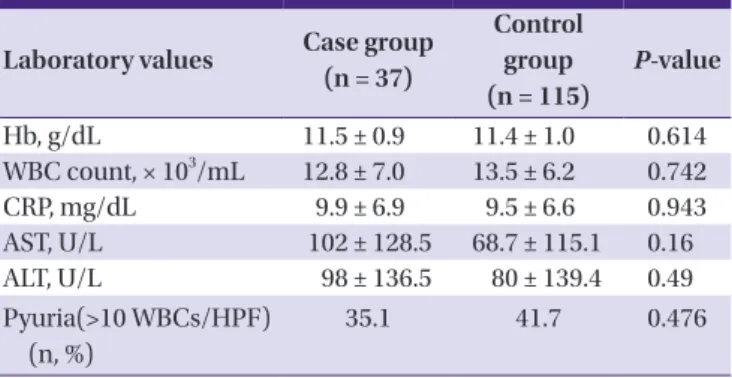
No significant differences between the case and control groups were found in laboratory values (hemoglobin [Hb], white blood cell [WBC] count, C-reactive protein [CRP], aspar- tate transaminase [AST], alanine transaminase [ALT], and pyuria; Table 2), and pro-brain natriuretic peptide (proBNP) concentration (Table 3).
4. Patients with persistent fever after resolution of acute- stage KD
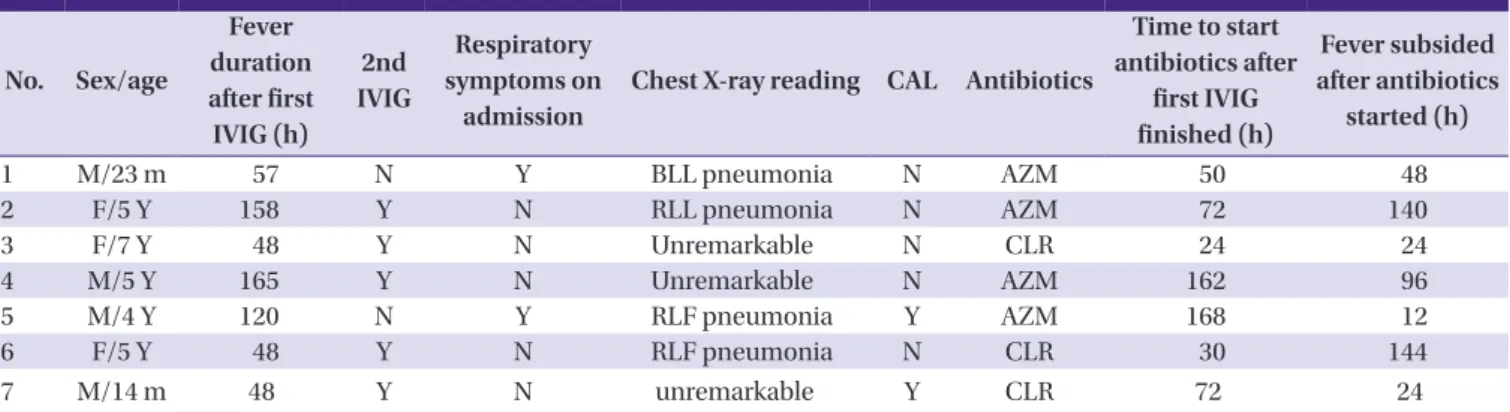
In 7 (18.9%) patients from the case group, despite an im- provement in symptoms of acute-stage KD and desquamation of the extremities after the first or second IVIG treatment, fever persisted for an additional 48 to 165 hours after the completion of IVIG infusion. Their clinical characteristics are listed in Ta- ble 4. Among these 7 patients, 2 had respiratory symptoms on the first day of admission, 4 patients had chest X-rays consis- tent with pneumonia and 2 had coronary artery lesions on echocardiography. Five patients had a secondary IVIG infu- sion of 2 g/kg; and neither corticosteroid nor infliximab were used for secondary treatment of acute-stage KD.
Table 1. Clinical characteristics of the mycoplasma positive group (case group) and negative group (control group)
Variables
Case group (n = 37)
Control group (n = 115)
P-value
Age (months) (range) 48.2 ± 32.1 31.7 ± 21.7 0.001a Fever duration (day)
(range) 6.5 ± 2.5 5.4 ± 1.5 0.047a
Sex (M) (n, %) 25 (67.6) 67 (58.3) 0.314 Clinical criteria (n, %)
Bilateral conjunctival
injection 35 (94.6) 104 (90.4) 0.431 Mucosal changes 34 (91.9) 98 (85.2) 0.406 Polymorphous rash 33 (89.2) 99 (86.0) 0.783 Change in the extremi-
ties 29 (78.3) 66 (57.4) 0.031a
Cervical lymphadenopa-
thy 26 (70.2) 71 (61.7) 0.348
Incomplete KD presenta-
tion (n, %) 5 (13.5) 22 (19.1) 0.437
Respiratory symptoms
(n, %) 13 (35.1) 48 (41.7) 0.476
Initial IVIG resistance
(n, %) 5 (13.5) 16 (14.0) 0.951
Coronary artery lesions
(n, %) 5 (14.0) 16 (14.0) 0.937
Values shown marked with aP <0.05.
KD, Kawasaki disease; IVIG, intravenous immunoglobulin.
Table 2. Laboratory values in the case and control groups
Laboratory values Case group (n = 37)
Control group (n = 115)
P-value
Hb, g/dL 11.5 ± 0.9 11.4 ± 1.0 0.614
WBC count, × 103/mL 12.8 ± 7.0 13.5 ± 6.2 0.742
CRP, mg/dL 9.9 ± 6.9 9.5 ± 6.6 0.943
AST, U/L 102 ± 128.5 68.7 ± 115.1 0.16
ALT, U/L 98 ± 136.5 80 ± 139.4 0.49
Pyuria(>10 WBCs/HPF) (n, %)
35.1 41.7 0.476
Mean values, percentages, and standard deviations are shown.
WBC, white blood cells; CRP, C-reactive protein; AST, aspartate aminotransferase;
ALT, alanine aminotransferase; HPF, high power field.
Table 3. Concentration of pro-brain natriuretic peptide (proBNP) on ad- mission in patients from the case and control groups
Laboratory values
Case group (n = 27)
Control group
(n = 70) P-value ProBNP, pg/mL 1187.2 ± 1,397.0 1,168.0 ± 2,511.7 0.459
Discussion
Of the 375 KD patients assessed during the study, 152 pa- tients were tested for mycoplasma, and 37 patients had posi- tive results. Before 2007, the patients were tested for mycoplas- ma infection in the presence of cough, rhinorrhea or persistent fever. From 2007, when there was a mycoplasma epidemic most patients admitted for KD were initially tested for myco- plasma infections. The group with positive tests had longer fe- ver duration, older age, and more changes in the extremities.
Seven (18.9%) patients in the case group had persistent fever even after resolution of the acute stage of KD.
The mean age of KD patients is generally considered to be 3 years; all patients are younger than 5 years [7]. However, in one study, the age distribution was 9 to 11 months [3]. Because my- coplasma infection was common in preschool-aged children in our study, the onset age of KD may be slightly higher than in other studies. On the other hand, the youngest mycoplas- ma-positive child with KD in our study was 2 months of age.
Mycoplasma infection in Korea is not limited to school-aged children because many infants and younger children are cared for in daycare centers. Therefore, differential diagnosis between KD and mycoplasma infection is becoming more important in Korea. According to our study, recent mycoplasma infection and KD co-occur more often in older children. Immune modu- lation of M. pneumoniae infection may results in cross-reac- tion between bacterial and human cell components, and auto- immunity may contribute to the pathogenesis of KD [8].
In our study, the mean fever duration was 6.5 days in the my- coplasma-positive group and 5.4 days, in the negative group. In general, fever duration in patients with KD is more than 5 days;
it can persist to 14 days when mycoplasma infection present [9]. Mycoplasma infection alone has a longer fever duration
than KD has. In a study by Lee et al. [8], the mean fever dura- tion was 9.2 days in the mycoplasma-positive group and 6.9 days in the negative group, which was longer than both groups in our study.
In our study, changes in the extremities differed significantly between the mycoplasma-positive and negative groups. The detailed mechanism of the changes of the extremities in the acute stage of KD and the following subacute stage is not well understood. Hand and foot changes in patients with myco- plasma infection have been described in a case report by Gre- co et al., 2007 [10]. Although the pathogenesis of the changes has not been fully elucidated, they may be explained by hyper- sensitivity vasculitis. The patient reported by Greco et al. had extrapulmonary symptoms of M. pneumoniae infection, namely cutaneous vasculitis, as well as inflammation and ne- crosis of small blood vessel walls.
Of the 37 case group patients, 7 patients had persistent fever Table 4. Clinical profiles of children with persistent fever after IVIG who were proved to be mycoplasma-positive (n = 7)
No. Sex/age
Fever duration after first IVIG (h)
2nd IVIG
Respiratory symptoms on
admission
Chest X-ray reading CAL Antibiotics
Time to start antibiotics after
first IVIG finished (h)
Fever subsided after antibiotics
started (h)
1 M/23 m 57 N Y BLL pneumonia N AZM 50 48
2 F/5 Y 158 Y N RLL pneumonia N AZM 72 140
3 F/7 Y 48 Y N Unremarkable N CLR 24 24
4 M/5 Y 165 Y N Unremarkable N AZM 162 96
5 M/4 Y 120 N Y RLF pneumonia Y AZM 168 12
6 F/5 Y 48 Y N RLF pneumonia N CLR 30 144
7 M/14 m 48 Y N unremarkable Y CLR 72 24
IVIG, intravenous immunoglobulin; CAL, coronary artery lesions; BLL, both lung field; AZM, azithromycin; RLL, right lower lung field; RLF, right lung field; CLR, clarithromy- cin.
Figure 2. Clinical course of case No. 4 (see Table 3).
IVIG, intravenous immunoglobulin; HD, hospital day; BT, body temperature; CRP, c-reactive protein.
after the resolution of acute symptoms and laboratory abnor- malities. They were reevaluated to identify the cause of sus- tained fever after use of IVIG. Laboratory studies including WBC, Hb, Hct, CRP, AST, ALT and immunology assay were within normal level. Respiratory viral polymerase chain reac- tion (PCR) was not available for the group. Clarithromycin (CLR), or azithromycin (AZM) was given to the patients with subsequent subsiding of fever.
One of these 7 cases (case 4) is described in Figure 2. A 5-year-old male presented with all symptoms of acute-stage KD and we started treatment with IVIG on the first hospital day. Almost 48 hours after the end of the first IVIG treatment, fever and erythema of the hands and feet remained. The pa- tient was regarded as having refractory acute stage of KD and the second IVIG treatment was infused on day 4. On day 8, desquamation of hands and feet was observed yet fever per- sisted. During evaluation for the sustained fever, CRP was de- creased and other laboratory findings were normalized, how- ever anti-mycoplasma IgM titer remained high (>1:1,280) until day 10. Azithromycin was administered and fever subsided on day 14. Initially, the child had no respiratory symptoms and showed unremarkable chest X-ray findings. A follow-up chest X-ray was also unremarkable. Therefore, mycoplasma infec- tion may be a cause of persistent fever after the resolution of acute-stage KD.
In our study, 11 (29.7%) of the 37 case group patients were treated with macrolide antibiotics. Antibiotics were not used in the other patients.
Mycoplasma is known as a main cause of pneumonia in school-aged children. Our results seem to indicate high inci- dence of recent mycoplasma infection in preschool-aged chil- dren. Mycoplasma infection has many extrapulmonary symp- toms such as arthritis, hemolytic anemia and other systemic symptoms [11]. Symptoms of mycoplasma infection may be similar to those of KD and concomitant infection with myco- plasma in KD patients is also possible. Therefore, it is import- ant to distinguish recent mycoplasma infection from KD in pa- tients with fever that persists despite appropriate management of KD.
A study revealed some factors which predict refractory KD:
male gender, cervical lymphadenopathy, decreased platelet count, changes of extremities, increased total bilirubin, in- creased alkaline phosphatase (ALP), elevated lactate dehydro- genase(LDH), and elevated CRP [12]. In another study by Kim et al. [13], CRP, AST, ALT, and the neutrophil differential were higher while the lymphocyte differential, protein, albumin, platelet count, and total cholesterol were decreased in the re-
fractory group.
IVIG with conventional antibiotics in early treatment of mac- rolide-resistant mycoplasma pneumonia can prevent disease progression. In 4 patients with macrolide-resistant mycoplas- ma pneumonia in the study by Youn et al. [14], corticosteroid was previously used for immune modulation. In those patients with remaining pneumonia, IVIG treatment improved the le- sions within 2 days.
There are a few limitations in our study. Some laboratory findings, for example, urine WBC, had either positive or nega- tive categorical values. Early diagnosis of mycoplasma infec- tion was challenging, especially in its acute stage, because of a low antibody level. In addition, respiratory virus RT-PCR test- ing was not performed for all patients in this study.
In this study, most patients admitted for treatment of KD from 2007 were initially tested for possible mycoplasma infec- tion. Cross-reactivities of IVIG and anti-mycoplasma antibody may be considered in patients who were admitted before 2007.
The false-positive IgM ratio of enzyme immunoassay methods vary from 2.8 - 14.9% [15]. When PCR is combined with the im- munoassay method, the sensitivity of rapid diagnosis is 95%
[16].
In conclusion, recent mycoplasma infection was somewhat related to KD. The mean age of the mycoplasma-positive group was 48.2 months, which was significantly older than the nega- tive group.
When fever persists after the resolution of acute symptoms and laboratory abnormalities of KD, further evaluation and treatment for mycoplasma infection may be considered, espe- cially in preschool-aged children.
Conflicts of Interest
No conflicts of interest.
ORCID
Hye Rim Park http://orcid.org/0000-0002-0736-3045 Mi Young Han http://orcid.org/0000-0001-8733-0982
References
1. Takahashi K, Oharaseki T, Yokouchi Y. Pathogenesis of Ka- wasaki disease. Clin Exp Immunol 2011; 164 (Suppl 1):S20-2.
2. Jordan-Villegas A, Chang ML, Ramilo O, Mejias A. Con- comitant respiratory viral infections in children with Ka-
wasaki disease. Pediatr Infect Dis J 2010;29:770-2.
3. Chang LY, Lu CY, Shao PL, Lee PI, Lin MT, Fan TY, Cheng AL, Lee WL, Hu JJ, Yeh SJ, Chang CC, Chiang BL, Wu MH, Huang LM. Viral infections associated with Kawasaki dis- ease. J Formos Med Assoc 2014;113:148-54.
4. Wang K, Gill P, Perera R, Thomson A, Mant D, Harnden A.
Clinical symptoms and signs for the diagnosis of Myco- plasma pneumoniae in children and adolescents with community-acquired pneumonia. Cochrane Database Syst Rev 2012;10:CD009175.
5. Newburger JW, Takahashi M, Gerber MA, Gewitz MH, Tani LY, Burns JC, Shulman ST, Bolger AF, Ferrieri P, Baltimore RS, Wilson WR, Baddour LM, Levison ME, Pallasch TJ, Fal- ace DA, Taubert KA; Committee on Rheumatic Fever, En- docarditis and Kawasaki Disease; Council on Cardiovascu- lar Disease in the Young; American Heart Association;
American Academy of Pediatrics. Diagnosis, treatment, and long-term management of Kawasaki disease: a state- ment for health professionals from the Committee on Rheumatic Fever, Endocarditis and Kawasaki Disease, Council on Cardiovascular Disease in the Young, Ameri- can Heart Association. Circulation 2004;110:2747-71.
6. Chung EH. Serologic diagnosis of Mycoplasma pneumoni- ae infection. Korean J Pediatr Infect Dis 2006;13:21-30.
7. Son MB, Newburger JW. Kawasaki Disease, In: Kliegman R, Stanton B, Geme J St., Schor N, eds. Nelson Textbook of Pe- diatrics. 20th ed. Philadelphia: WB Saunders Co,;
2015;1209.
8. Lee MN, Cha JH, Ahn HM, Yoo JH, Kim HS, Sohn S, Hong YM. Mycoplasma pneumonia infection in patients with Kawasaki disease. Korean J Pediatr 2011;54:123-7.
9. Chung SW, Kim SH. Analysis of genotype distribution and detection rate of Mycoplasma pneumoniae according to respiratory disease type. Public Health Weekly Report 2014;7:177-81.
10. Greco F, Sorge A, Salvo V, Sorge G. Cutaneous vasculitis as- sociated with Mycoplasma pneumoniae infection: case re- port and literature review. Clin Pediatr (Phila) 2007;46:451-3.
11. Atkinson TP, Balish MF, Waites KB Epidemiology, clinical manifestations, pathogenesis and laboratory detection of Mycoplasma pneumonia infections. FEMS Microbiol Rev 2008;32:956-73.
12. Choi MH, Park CS, Kim DS, Kim KH. Prediction of intrave- nous immunoglobulin nonresponse Kawasaki disease in Korea. Korean J Pediatr Infect Dis 2014;21: 29-36.
13. Kim SK, Han JY, Rhim JW, Oh JH, Han JW, Lee KY, Kang JH, Lee JS. Limitation of prediction on intravenous immu- noglobulin responsiveness in Kawasaki Disease. Korean J Pediatr Infect Dis 2010;17:169-76.
14. Youn YS, Lee SC, Rhim JW, Shin MS, Kang JH, Lee KY. Ear- ly additional immune-modulators for Mycoplasma pneu- moniase pneumonia in children: an observation study. In- fect Chemother 2014;46:239-47.
15. Csángó PA, Pedersen JE, Hess RD. Comparison of four My- coplasma pneumonia IgM-, IgG- and IgA specific enzyme immunoassays in blood donors and patients. Clin Micro- biol Infect 2004;10:1094-8.
16. Waris ME, Toikka P, Saarinen T, Nikkari S, Meurman O, Vainionpää R, Mertsola J, Ruuskanen O. Diagnosis of My- coplasma pneumoniae pneumonia in children. J Clin Mi- crobiol 1998;36:3155-9.