- 68 -
First Principles Study of spin polarization in Fe-doped monolayer C2N- h 2D
Sang Yoon Lee1, and Geumbi Jeong2
1School of Computing, KAIST, 291 Daehak-ro, Yuseong-gu, Daejeon, Korea.
2Graduate School of EEWS, KAIST, 291 Daehak-ro, Yuseong-gu, Daejeon, Korea E-mail: [email protected], [email protected]
Recent multifunctional two-dimensional material research has triggered huge interests in various modifications for substitution of atoms. Instead of novel metals used as the most popular catalysts, nonprecious transition metals are promising candidates for efficient oxidation-reduction transfers. The recent discovery of Co@C
2N has an alternate possiblity as catalysts for the ORR(Oxygen Reduction Reaction) in DSSc(Dye Sensitized Solar Cell) and OER(Oxygen evolution cobalt oxides). Here we report spin-polarized DFT calculations of the structure doped Iron that is one of ferromagnetism atoms like Co to provide a basic desciption of the ferromagnetism of the elemental metals. The spin-density-funtional results present the most stable state energetically is when having pairwise up/down spin.
INTRODUCTION
The recent research on the design of a two-dimensional crystal with uniform holes and nitrogen atoms as multifunctional two-dimensional material has garnered interests in many areas. The nitrogenated holey two-dimensional crystal structure has potentional for multifunctional 2D crystals as practical applications.
1What is more, cobalt oxide nanoparticles encapsulated in C
2N- h 2D network polymer (Co@C
2N) has experimently evaluated as a promising candidate for a novel catalyst as to the hydrogen evolution and hetergeneous reduction.
2Instead of
novel metals, inexpensive materials can have great potential to be used as catalysts with ferromagnetism atoms like Co, Fe, and Ni. Here, we carried out spin-polarized density-functional theory(DFT) calculations to understand the magnetism of itinerant electrons in Fe-doped monolayer C
2N- h 2D.
COMPUTATIONAL METHODS
In this study, all the geometry optimization and calculation we carried out are based on the spin-polarized density functional theory(DFT) using the EDISON DFT software in LCAODFTLab of the EDISON Nano-physics. The local density approximations and Caperley-Alder(LDA-CA) are used. In all calculations, these were performed with 200 Ry cutoffs. For the geometry optimization, 5 × 5 × 1 Monkhorst−Pack grid k -meshe is adopted for a single-layer C
2N- h 2D doping Iron.
These structures are fully relaxed until converged to 1.0
-4eV and 0.02 eV/Å, energy and forces respectively.
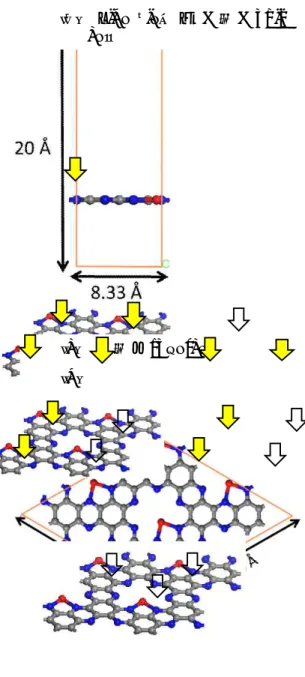
Fig. 1. Theoretical modeling of the atomic structure of monolayer Fe@C
2N : (a)Top view, (b)side view and (c) 2 X 2 supercell.
Red ball and blue ball mean Fe and Ni,respectively. And the other is C
.
336
제 5 회 첨단 사이언스 교육 허브 개발(EDISON) 나노물리 경진대회
- 69 -
69 RESULTS AND DISCUSSION
First of all, we explored the geometric properties and electronic structure of monolayer Fe@C
2N. The atomistic ball-stick models of monolayer Fe@C
2N are optimized as illustrated in Fig. 1. The lattice parameters of monolayer Fe@C
2N is equivalently 8.33 Å, generating the covalent bond lengths as C-C of 1.385/1.485 Å, C-N of 1.345/1.381 Å, and N-Fe of 2.003 Å.
We have performed the total energy calculations to find the most stable state among spin-polarization differences. In the
case of 1 X 1 unit cell, the initial spin polarization of Fe is 4 μ B /atom, while total spin polarization is 3.710082 μ B /atom and total energy is - 4.021685941 eV. What is more, we also conducted all of the possible case to change spin directions in 2 X 2 supercell. As illustrated in Fig 2 , there are 4 cases for a pair of coupled spins. Moreover there is only one case for unpairwise spin direction like up, down, down, and down.
Fig. 2. The number of occasion depended on spin directions
(a) Pairwise spin direction
(b) Unpairwise spin direction
Table 1. Total energies of Spin plarized calcultions : (+) means up and (–) means down.
(a) Pairwise spin direction
(b) Unpairwise spin diection
Resultingly, the more stable state is when spin directions are pairwise than unpairwise as shown in Table 2. However, it is hard to
(a) Top view of 1 X 1 unit cell
(b) Side view of 1 X 1 unit cell
(c) 2 X 2 supercell (d)
337
- 70 -
predict what state the most stable is in a pair of coupled directions. This is because these energies differences have possibility by some conditions like temperature etc.
Comparatively, the stable state would be when all the spin is up or the second condition of Fig. 2(a) than others.
CONCLUSION
We investigated Total energies of Fe-containing C
2N- h 2D structure spin-polarized DFT calculations to find out the most stable state with differences of spin directions.
.ACKNOWLEDGEMENT
Thank you for the opptunity to close simulation nano physics.
This research was supported by the EDISON Program through the National Research Foundation of Korea(NRF) funded by the Ministry of Science, ICT & Future Planning (No. NRF-2012-M3C1A6035302)
REFERENCES [1] Nat Commun. 2015 Mar 6;6:6486
[2] Chem. Mater., 2015, 27 (13), pp 4860–4864 l
338