This review of national and international randomized controlled trials of Salviae miltiorrhizae radix pharmacopuncture for lumbar herniated intervertebral discs was performed to assess its clinical efficacy.
There were 5 online databases (PubMed, EMBASE, CNKI, NDSL, OASIS, and RISS) searched on June 1st, 2020. Studies were selected according to the inclusion and exclusion criteria and were reviewed by risk of bias assessment. This review included 14 Chinese studies. The sample sizes ranged from 50 to 100. The numbers of treatments ranged from 20 to 30, with most patients receiving 20 treatments. The longest treatment periods were 10-15 and 15-20 days, of which each accounted for 29% of the studies. The most frequently used evaluation indices were the Japanese Orthopedic Association and the Visual Analog Scale scoring method.
The most frequently used acupoints were EX18 and BL25, which accounted for 31% of the total number of acupoints. In 50% of the studies, the pharmacopuncture injection volume was 2 mL. Acupuncture treatment was the most common control group. Eleven studies reported that the intervention group had significantly improved symptoms. However, most of the included studies were of low quality.
©2021 Korean Acupuncture & Moxibustion Medicine Society. This is an open access article under the CC BY- NC-ND license (http://creativecommons.org/licenses/by-nc-nd/4.0/).
Article history:
Submitted: October 17, 2020 Revised: November 26, 2020 Accepted: December 10, 2020 Keywords:
herniated disc,
pharmacopuncture, randomized controlled trial
https://doi.org/10.13045/jar.2020.00374 pISSN 2586-288X eISSN 2586-2898
J Acupunct Res 2021;38(1):1-7
Review Article
Clinical Research Using Salviae Miltiorrhizae Radix-Pharmacopuncture for Lumbar Herniated Intervertebral Disc: Analysis of Trends
Seon Woo Kim 1, *, Cheol Woo Park 1 , Myeong Jae Jo 2 , Min Wook Kim 3 , Jae Hee Yu 4 , Jeon Seok Hee 4 , Seung Won Jang 5 , Do Young Kang 6 , Hyun Jin Jeong 7
1 Department of Acupuncture and Moxibustion Medicine, Gwang-ju Jaseng Hospital of Korean Medicine, Gwangju, Korea 2 Department of Korean Medicine Rehabilitation, Gwang-ju Jaseng Hospital of Korean Medicine, Gwangju, Korea 3 Department of Acupuncture and Moxibustion Medicine, DongShin Korean Medicine Hospital, Gwangju, Korea 4 Department of Acupuncture and Moxibustion Medicine, DongShin Korean Medicine Hospital, Mokpo, Korea 5 Department of Acupuncture and Moxibustion Medicine, DongShin Korean Medicine Hospital, Seoul, Korea 6 Department of Korean Medicine Rehabilitation, DongShin Korean Medicine Hospital, Seoul, Korea 7 Department of Internal Korean Medicine, DongShin Korean Medicine Hospital, Gwangju, Korea
ABSTRACT
Journal of Acupuncture Research
Journal homepage: http://www.e-jar.org
Introduction
Low back pain is one of the most common musculoskeletal disorders, with approximately 80% of individuals experiencing low back pain at least once in their lifetime [1]. The most common cause of low back pain with radiating pain is disc herniation, which upon physical examination is a neurological abnormality such as neuromuscular compression identified on computed tomography scans or magnetic resonance imaging scans of the lumbar spine, and neuromuscular lesions during electromyography examination [2]. Symptoms of herniated intervertebral discs (HIVD) present as low back pain and lower extremity radiated pain. This is caused
by nerve root compression by part or all of the nuclei protruding outward along the fibrous ring. This is due to degenerative changes in the intervertebral disc or external force. A suspected HIVD is based on physical examination and range of motion assessments, and is confirmed by radiological examination [3]. The treatments of HIVD both include surgical and conservative approaches. It was reported in 2004 that conservative treatment for various diseases, including low back pain, have increased in type and number, and Oriental medicine treatments were a major proportion of conservative treatments [4].
In Oriental medicine, since its first symptoms were recorded in (Huang Di Nei Jing), lumbar herniated intervertebral discs (L-HIVD) has been suggested to belong to the categories of wind
* Corresponding author. Seon Woo Kim
Department of Acupuncture and Moxibustion Medicine, Gwang-ju Jaseng Hospital of Oriental Medicine, 207, Uncheon-ro, Seo-gu, Gwangju, 61964 Korea E-mail: [email protected]
ORCID: Seon Woo Kim https://orcid.org/0000-0003-0785-6242, Park Cheol Woo https://orcid.org/0000-0002-1536-9121, Myeong Jae Jo https://orcid.org/0000-0003-4642-
9753, Min Wook Kim https://orcid.org/0000-0003-1047-9572, Jae Hee Yu https://orcid.org/0000-0002-3290-4595, Jeon Seok Hee https://orcid.org/0000-0003-0207-476X, Seung Won Jang https://orcid.org/0000-0002-2164-1822, Do Young Kang https://orcid.org/0000-0002-0911-3023, Hyun Jin Jeong https://orcid.org/0000-0002-5998-8661
©2021 Korean Acupuncture & Moxibustion Medicine Society. This is an open access article under the CC BY-NC-ND license (http://creativecommons.org/licenses/by-nc-
nd/4.0/).
J Acupunct Res 2021;38(1):1-7
2
pattern lumbago, kidney deficiency pattern lumbago, wind and cold pattern lumbago, cold and dampness pattern lumbago, and arthralgia [5]. Unlike Western medicine methods, which mainly include surgical interventions, in Oriental medicine, conservative treatments such as herbal medicine treatment, acupuncture treatment, and cupping therapy are mainly performed, with excellent therapeutic effect [6].
Among the conservative therapies in Oriental medicine for the treatment of low back pain, acupuncture, bee venom, heating, herbal medicine, and Chuna therapies have shown therapeutic effects [7]. Among these methods, research related to pharmacopuncture has been actively conducted in recent years. Pharmacopuncture therapy is an acupuncture therapy that combines acupuncture theory to treat disease (by controlling the meridian function with blood transfusion needles), and herbal theory to treat diseases (using herbal medicines) [8].
Among the various pharmacopuncture treatments used for low back pain, Jungsongouhyul pharmacopuncture is widely used.
It is a combination of drugs such as Salviae miltiorrhizae radix, Paeoniae Radix, Persicae Semen, Corydalis Tuber, and Gardeniae Fructus which have the effect of activating blood, and relieving pain and inflammation. However, research on pharmacopuncture using these drugs is not active.
Salviae miltiorrhizae radix (SMR) has essentially a bitter, slightly cold taste. It promotes blood circulation, regulates menstruation, removes blood stagnation, and relieves pain. SMR may have therapeutic effects on heart, gastrointestinal diseases, back and spine strength, joint pain, limb dysfunction, and blood stagnation [9]. Chinese studies applying SMR pharmacopuncture in patients with L-HIVD reported pain reduction and improvement of clinical symptoms [10,11]. This review analyzed Korean and international randomized controlled trials (RCTs) to determine consensus and the effect of SMR-pharmacopuncture treatment of L-HIVD.
Materials and Methods
Data sources and eligibility criteria
To investigate the efficacy of SMR pharmacopuncture for L-HIVD, searches were performed in the following databases to analyze studies published up to July 31
st, 2020: PubMed/
MEDLINE, the China National Knowledge Infrastructure (CNKI), the National Digital Science Library (NDSL), the Research Information Sharing Service (RISS), and the Oriental Medicine Advanced Searching Integrated System (OASIS).
The following keywords were used for the database searches with minor adjustments for each database: (“Salviae miltiorrhizae radix” OR “Pharmacopuncture” OR “Herbal acupuncture”) AND (“Lumbar herniated intervertebral disc” OR “Intervertebral disc displacements” OR “Lumbar disc prolapse” OR “Slipped disc” OR
“Lumbar disc herniation” OR “Herniated disc”).
Eligibility criteria Inclusion criteria
RCTs of p at ients w it h L-HIVD t re ate d w it h SMR pharmacopuncture with simple, and complex content were included in this review. There were no restrictions on the control group or the year of publication.
Exclusion criteria
Non-RCTs, case studies, reviews, articles, and protocols were excluded. Furthermore, studies that combined SMR
pharmacopuncture with Western medicine treatment in the experimental group were also excluded.
Data collection and risk of bias
Studies that satisfied the inclusion criteria were selected.
Two reviewers then independently performed data extraction and assessment. In the case of a disagreement a third reviewer reassessed the article. The risk of bias in RCTs was assessed using the Cochrane Risk of Bias tool [12].
Results
A total of 575 studies were retrieved from 5 online databases up until July 31
st, 2020 (PubMed = 12, CNKI = 497, NDSL = 9, RISS
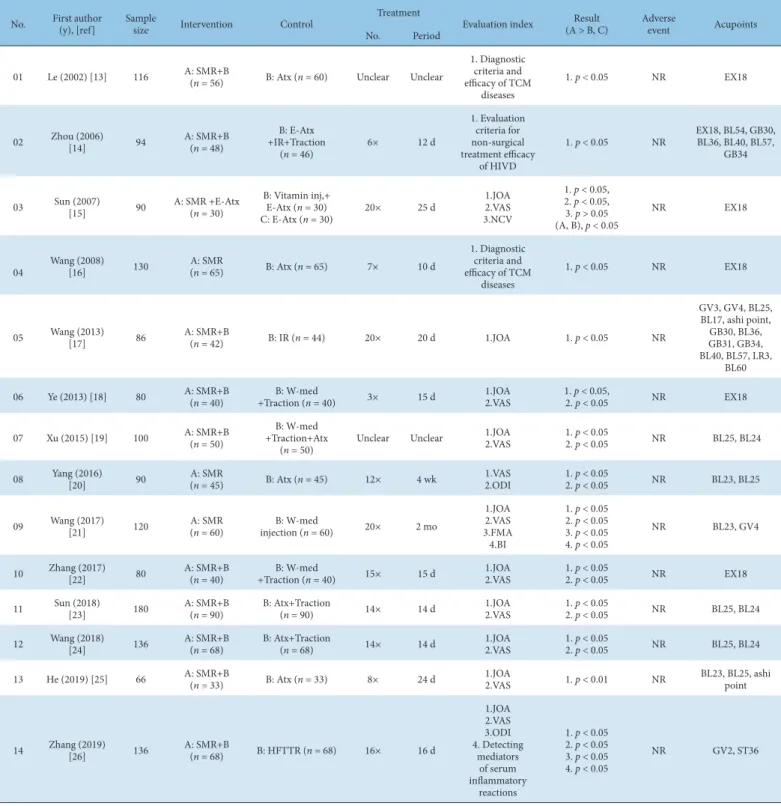
= 14, and OASIS = 43). From the 535 studies, 38 duplicates, 50 non-related studies, and 1 non-clinical study were removed. Of the 486 remaining studies assessed for eligibility, 261 were excluded (31 studies without original text, and 230 studies were excluded because 38 studies were not RCTs, 179 were case studies, 8 were review articles, and 1 was a protocol. Of the 225 remaining studies, 211 were excluded because 172 combined pharmacopuncture with Western medicine, 1 did not mention the pharmacopuncture ingredients, and 38 were not related to SMR. This provided a final selection of 14 studies for analysis (Table 1; Fig. 1). All 14 studies were published in China, and all were in Chinese.
Year of publication
All 14 selected studies were published in China. Analysis by year showed that the 14 studies were conducted from 2002 to 2019 (Fig. 2).
Fig. 1. Flow diagram according to the diagram of PRISMA.
RCT, randomized controlled trial.
Fig. 1. Flow diagram according to the diagram of PRISMA
Identifi-cation
Records identified through database searching (N = 575 total recieved)
1) CNKI (n = 497) 2) Pubmed (n = 12)
3) NDSL (n = 9) 4) Oasis (n = 43) 5) RISS (n = 14)
Additional records identified through other
sources(n = 0)
Screening
Records after duplicates (n = 38) removed (n = 537)
Records screened (n = 537)
Records excluded (n = 51) 1. Not relevant to pharmacopuncture
(n = 50) 2. Not clinical studies (n = 1)
Eligibility Full-text articles assessed for eligibility
(n = 486)
Full-text articles excluded, with reasons (n = 261) 1. Not RCT (n = 38) 2. Absence of full-text (n = 31)
3. Case study (n = 179) 4. Review (n = 8)
6. Article (n = 4) 7. Protocol (n = 1)
Included
Studies included in qualitative synthesis (n = 225 selected)
RCTs excluded, with reasons (n = 211) 1. Pharmacopuncture combined
with W-med (n = 172) 2. No name of pharmacopuncture
(n = 1) 3. Articles not related to Salvia
4. (n = 38) Qualitative synthesis
(n = 14 selected)
Fig. 1. Flow diagram according to the diagram of PRISMA
Identifi-cation
Records identified through database searching (N = 575 total recieved)
1) CNKI (n = 497) 2) Pubmed (n = 12) 3) NDSL (n = 9) 4) Oasis (n = 43) 5) RISS (n = 14)
Additional records identified through other
sources(n = 0)
Screening
Records after duplicates (n = 38) removed (n = 537)
Records screened (n = 537)
Records excluded (n = 51) 1. Not relevant to pharmacopuncture
(n = 50) 2. Not clinical studies (n = 1)
Eligibility Full-text articles assessed for eligibility
(n = 486)
Full-text articles excluded, with reasons (n = 261) 1. Not RCT (n = 38) 2. Absence of full-text (n = 31)
3. Case study (n = 179) 4. Review (n = 8)
6. Article (n = 4) 7. Protocol (n = 1)
Included
Studies included in qualitative synthesis
(n = 225 selected)
RCTs excluded, with reasons (n = 211) 1. Pharmacopuncture combined
with W-med (n = 172) 2. No name of pharmacopuncture
(n = 1) 3. Articles not related to Salvia
4. (n = 38) Qualitative synthesis
(n = 14 selected)
Fig. 1. Flow diagram according to the diagram of PRISMA
Identifi-cation
Records identified through database searching (N = 575 total recieved)
1) CNKI (n = 497) 2) Pubmed (n = 12) 3) NDSL (n = 9) 4) Oasis (n = 43) 5) RISS (n = 14)
Additional records identified through other
sources(n = 0)
Screening
Records after duplicates (n = 38) removed (n = 537)
Records screened (n = 537)
Records excluded (n = 51) 1. Not relevant to pharmacopuncture
(n = 50) 2. Not clinical studies (n = 1)
Eligibility Full-text articles assessed for eligibility
(n = 486)
Full-text articles excluded, with reasons (n = 261) 1. Not RCT (n = 38) 2. Absence of full-text (n = 31)
3. Case study (n = 179) 4. Review (n = 8)
6. Article (n = 4) 7. Protocol (n = 1)
Included
Studies included in qualitative synthesis
(n = 225 selected)
RCTs excluded, with reasons (n = 211) 1. Pharmacopuncture combined
with W-med (n = 172) 2. No name of pharmacopuncture
(n = 1) 3. Articles not related to Salvia
4. (n = 38) Qualitative synthesis
(n = 14 selected)
Fig. 1. Flow diagram according to the diagram of PRISMA
Identifi-cation
Records identified through database searching (N = 575 total recieved)
1) CNKI (n = 497) 2) Pubmed (n = 12) 3) NDSL (n = 9) 4) Oasis (n = 43) 5) RISS (n = 14)
Additional records identified through other
sources(n = 0)
Screening
Records after duplicates (n = 38) removed (n = 537)
Records screened (n = 537)
Records excluded (n = 51) 1. Not relevant to pharmacopuncture
(n = 50) 2. Not clinical studies (n = 1)
Eligibility Full-text articles assessed for eligibility
(n = 486)
Full-text articles excluded, with reasons (n = 261) 1. Not RCT (n = 38) 2. Absence of full-text (n = 31)
3. Case study (n = 179) 4. Review (n = 8)
6. Article (n = 4) 7. Protocol (n = 1)
Included
Studies included in qualitative synthesis
(n = 225 selected)
RCTs excluded, with reasons (n = 211)
1. Pharmacopuncture combined with W-med (n = 172) 2. No name of pharmacopuncture
(n = 1) 3. Articles not related to Salvia
4. (n = 38) Qualitative synthesis
(n = 14 selected)
Fig. 1. Flow diagram according to the diagram of PRISMA
Identifi-cation
Records identified through database searching (N = 575 total recieved)
1) CNKI (n = 497) 2) Pubmed (n = 12)
3) NDSL (n = 9) 4) Oasis (n = 43) 5) RISS (n = 14)
Additional records identified through other
sources(n = 0)
Screening
Records after duplicates (n = 38) removed (n = 537)
Records screened (n = 537)
Records excluded (n = 51) 1. Not relevant to pharmacopuncture
(n = 50) 2. Not clinical studies (n = 1)
Eligibility Full-text articles assessed for eligibility
(n = 486)
Full-text articles excluded, with reasons (n = 261) 1. Not RCT (n = 38) 2. Absence of full-text (n = 31)
3. Case study (n = 179) 4. Review (n = 8)
6. Article (n = 4) 7. Protocol (n = 1)
Included
Studies included in qualitative synthesis (n = 225 selected)
RCTs excluded, with reasons (n = 211) 1. Pharmacopuncture combined
with W-med (n = 172) 2. No name of pharmacopuncture
(n = 1) 3. Articles not related to Salvia
4. (n = 38) Qualitative synthesis
(n = 14 selected)
Fig. 1. Flow diagram according to the diagram of PRISMA
Identifi-cation
Records identified through database searching (N = 575 total recieved)
1) CNKI (n = 497) 2) Pubmed (n = 12)
3) NDSL (n = 9) 4) Oasis (n = 43) 5) RISS (n = 14)
Additional records identified through other
sources(n = 0)
Screening
Records after duplicates (n = 38) removed (n = 537)
Records screened (n = 537)
Records excluded (n = 51) 1. Not relevant to pharmacopuncture
(n = 50) 2. Not clinical studies (n = 1)
Eligibility Full-text articles assessed for eligibility
(n = 486)
Full-text articles excluded, with reasons (n = 261) 1. Not RCT (n = 38) 2. Absence of full-text (n = 31)
3. Case study (n = 179) 4. Review (n = 8)
6. Article (n = 4) 7. Protocol (n = 1)
Included
Studies included in qualitative synthesis (n = 225 selected)
RCTs excluded, with reasons (n = 211) 1. Pharmacopuncture combined
with W-med (n = 172) 2. No name of pharmacopuncture
(n = 1) 3. Articles not related to Salvia
4. (n = 38) Qualitative synthesis
(n = 14 selected)
Seon Woo Kim et al / Trends in CR with SMR-pharmacopuncture for L-HIVD
3
No. First author
(y), [ref] Sample
size Intervention Control Treatment
Evaluation index Result
(A > B, C) Adverse
event Acupoints
No. Period
01 Le (2002) [13] 116 A: SMR+B
(n = 56) B: Atx (n = 60) Unclear Unclear
1. Diagnostic criteria and efficacy of TCM
diseases
1. p < 0.05 NR EX18
02 Zhou (2006)
[14] 94 A: SMR+B
(n = 48)
B: E-Atx +IR+Traction
(n = 46) 6× 12 d
1. Evaluation criteria for non-surgical treatment efficacy
of HIVD
1. p < 0.05 NR EX18, BL54, GB30, BL36, BL40, BL57,
GB34
03 Sun (2007)
[15] 90 A: SMR +E-Atx
(n = 30)
B: Vitamin inj,+
E-Atx (n = 30)
C: E-Atx (n = 30) 20× 25 d 1.JOA
2.VAS 3.NCV
1. p < 0.05, 2. p < 0.05, 3. p > 0.05 (A, B), p < 0.05
NR EX18
04 Wang (2008)
[16] 130 A: SMR
(n = 65) B: Atx (n = 65) 7× 10 d
1. Diagnostic criteria and efficacy of TCM
diseases
1. p < 0.05 NR EX18
05 Wang (2013)
[17] 86 A: SMR+B
(n = 42) B: IR (n = 44) 20× 20 d 1.JOA 1. p < 0.05 NR
GV3, GV4, BL25, BL17, ashi point, GB30, BL36, GB31, GB34, BL40, BL57, LR3,
BL60
06 Ye (2013) [18] 80 A: SMR+B
(n = 40) B: W-med
+Traction (n = 40) 3× 15 d 1.JOA
2.VAS 1. p < 0.05,
2. p < 0.05 NR EX18
07 Xu (2015) [19] 100 A: SMR+B
(n = 50)
B: W-med +Traction+Atx
(n = 50) Unclear Unclear 1.JOA
2.VAS 1. p < 0.05
2. p < 0.05 NR BL25, BL24 08 Yang (2016)
[20] 90 A: SMR
(n = 45) B: Atx (n = 45) 12× 4 wk 1.VAS
2.ODI 1. p < 0.05
2. p < 0.05 NR BL23, BL25
09 Wang (2017)
[21] 120 A: SMR
(n = 60) B: W-med
injection (n = 60) 20× 2 mo
1.JOA 2.VAS 3.FMA 4.BI
1. p < 0.05 2. p < 0.05 3. p < 0.05 4. p < 0.05
NR BL23, GV4
10 Zhang (2017)
[22] 80 A: SMR+B
(n = 40) B: W-med
+Traction (n = 40) 15× 15 d 1.JOA
2.VAS 1. p < 0.05
2. p < 0.05 NR EX18
11 Sun (2018)
[23] 180 A: SMR+B
(n = 90) B: Atx+Traction
(n = 90) 14× 14 d 1.JOA
2.VAS 1. p < 0.05
2. p < 0.05 NR BL25, BL24
12 Wang (2018)
[24] 136 A: SMR+B
(n = 68) B: Atx+Traction
(n = 68) 14× 14 d 1.JOA
2.VAS 1. p < 0.05
2. p < 0.05 NR BL25, BL24
13 He (2019) [25] 66 A: SMR+B
(n = 33) B: Atx (n = 33) 8× 24 d 1.JOA
2.VAS 1. p < 0.01 NR BL23, BL25, ashi
point
14 Zhang (2019)
[26] 136 A: SMR+B
(n = 68) B: HFTTR (n = 68) 16× 16 d
1.JOA 2.VAS 3.ODI 4. Detecting
mediators of serum inflammatory
reactions
1. p < 0.05 2. p < 0.05 3. p < 0.05 4. p < 0.05
NR GV2, ST36
Atx, acupuncture treatment; BI, Barthel Index; E-Atx, electric acupuncture treatment; HIVD, herniated inter vertebral disc; FMA, Fugl-Meyer assessment; HFTTR, high-frequency thermocoagulation targeted resection; IR, infrared therapy; inj., injection; JOA, Japanese Orthopedic Association; n, sample size; NR, not reported; ODI, overseas development institute;
RF-TCTR, radiofrequency thermal coagulation target resection; SMR, Salviae Miltiorrhizae radix; TCM, traditional chinese medicine; VAS, visual analogue scale; W-med, western medicine.
Table 1. Studies Included in This Review.
Treatment numbers and periods
The number of pharmacopuncture treatments (in a course of a patient’s treatment) ranged from 3 to 20, with 20 treatments being the most common. When expressed as a range, 2 studies (14%)
did not clearly indicate the number of treatments, 1 study (7%) administered 1-5 treatments, 3 studies (21%) administered 5-10 treatments, 4 studies (29%) administered 10-15 treatments, and 4 studies (29%) administered 15-20 treatments (Fig. 3).
The treatment period varied from a minimum of 10 days to a
J Acupunct Res 2021;38(1):1-7
4
maximum of 60 days (excluding unclear studies). Two studies (17%) were unclear about the treatment duration, 5 studies (42%) had more than 10 days and less than 20 days, 4 studies (33%) had more than 20 days and less than 30 days, and 1 study (8%) had more than 30 days (Fig. 4).
Pharmacopuncture treatments
Among the 14 studies, the most commonly used acupoints were Jiaji (EX18) and Dachangyu (BL25; 6 times each), followed by Qihiayu (BL24, 3 studies), Huantiao (GB30), Sungfu (BL36), Weizhong (BL40), Chengshan (BL57), Yanglingquan (GB34), Shenyu (BL23), Shenting. (GV24), and ashi points (2 studies each).
There were 10 acupoints used once (Fig. 5).
Except for 1 study (not mentioning this information) in the remaining 13 studies, the pharmacopuncture injection volumes included 2 mL (7 studies), 4 mL (3 studies), 5 mL (2 studies), and 2.5 mL (1 study; Fig. 6).
There were 3 monotherapy groups among the treatment groups, and 11 combination therapy groups per study. Among the combination therapy groups, 6 studies combined traction therapy, 5 acupuncture therapy, 3 Western medicine, 2 electric acupuncture therapy, 2 infrared irradiator, and 1 high-frequency thermocoagulation targeted resection.
Fig. 2. The number of articles published on Salviae miltiorrhizae radix- pharmacopuncture treatment for lumbar herniated intervertebral disc.
0 0.5 1 1.5 2 2.5
2002 2006 2007 2008 2013 2015 2016 2017 2018 2019
Publication year
Fig. 2. Analysis of the n umber of articles publis hed
Fig. 3. Analysis of the number of pharmacopuncture treatments used (in a course of treatment) per patient in each RCT.
RCT, randomized controlled trial.
Fig. 4. Analysis of the number of days of treatment each patient received.
Fig. 5. Analysis of the frequency of use of acupoints used to treat L-HIVD.
HIVD, herniated inter vertebral disc.
Fig. 5. Analysis of the fr equency of acupoints u sed to treat L-HIVD
0 2 4 6 8 10 12
Etc Ashi point BL23 GB34 BL57 BL40 BL36 GB30 BL24 BL25 EX18
Fig. 6. Analysis of pharmacopuncture injection volume used in the RCTs.
RCT, randomized controlled trial.
Fig. 6. Analysis of phar macopuncture injection volume across the RC T’s
0 1 2 3 4 5 6 7 8
unclear 2.5ml 5ml 4ml 2ml
Seon Woo Kim et al / Trends in CR with SMR-pharmacopuncture for L-HIVD
5
Of the 14 studies, 7 used a single Salvia miltiorrhiza component, and the remaining 7 studies used a complex composition of Salvia miltiorrhiza. In the complex composition group, 5 studies used Xiangdan (Salvia miltiorrhiza, Dalbergia odorifera), and 1 study used Guan Xinning (Salvia miltiorrhiza, Ligusticum striatum) and 1 study used Dan Hong (Salvia miltiorrhiza, Carthamus tinctorius).
Control group treatments
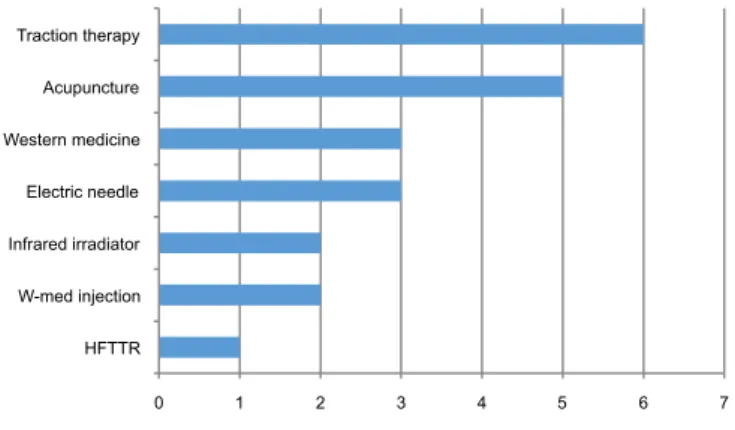
Of the 14 selected studies, 13 used 1 control group, and 1 used 2 control groups. Among the 15 control groups, 7 used combination therapies and 8 used monotherapies. The most common control group treatment was acupuncture (7 studies), followed by traction therapy (5 studies), Western medicine and electric acupuncture therapy (3 studies), infrared irradiation and Western medicine injections (2 studies), and high-frequency thermocoagulation targeted resection (1 study; Fig. 7).
Therapeutic effect
The efficacy of pharmacopuncture treatment was measured in all 14 selected studies included in this review. The effects of experimental and control treatments in the 29 groups were analyzed. The evaluation indices in the pharmacopuncture-treated groups showed improvement after treatment in 11 studies. The comparison of treatment results between the experimental and control groups was made as a baseline before treatment and after
treatment to assess the therapeutic effects.
In 11 studies, the experimental group showed a statistically significant improvement for each evaluation index compared with the control group.
Among the remaining 3 studies, Sun et al [15] showed that in using JOA and visual analog scale (VAS) evaluation indices, both the experimental and control groups improved with treatment, with a significantly better outcome in the experimental group than the control group after treatment. Using the NCV evaluation index, only the experimental group showed improvement after treatment, with a significant difference compared to the control group. Yang et al [20] reported that both the experimental and control groups improved after treatment using the JOA and ODI evaluation indexes, with a significant difference between the 2 groups after treatment. There was no significant difference at 2 weeks post treatment, but there was a significant difference 1 month post treatment. He et al [25] reported that the JOA evaluation index showed improvement after the 1
sttreatment in both the experimental and control groups and at the last treatment, with significant differences between the 2 groups after both time points.
However, in the VAS evaluation index, the experimental and control groups showed improvement and a significant difference between the 2 groups after 1 treatment, but not after all treatments.
Adverse reactions
None of the 14 studies reported adverse reactions.
Risk of bias assessment
The risk of bias was assessed in 14 studies using the Cochrane Risk of Bias tool (Figs. 8 and 9).
Fig. 7. Analysis of the conditions used for the control group in each RCT.
RCT, randomized controlled trial; HFTTR, high-frequency thermocoagulation targeted resection.
Fig. 7. Analysis of the c onditions used for the c ontrol group in each R CT
0 1 2 3 4 5 6 7
HFTTR W-med injection Infrared irradiator Electric needle Western medicine Acupuncture Traction therapy
HFTTR: High-Frequency Thermocoagulation Targ eted Resection
Fig. 8. Risk of RCT bias.
RCT, randomized controlled trial.
Fig. 8. Risk of RCT bia s graph
Fig. 9. Risk of RCT bias summary. (+), low risk of bias; (-), high risk of bias; (?), unclear of bias.
RCT, randomized controlled trial.
Fig. 9. Risk of RCT bia s summary
(+) : Low risk of bias. (- ) : High risk of bias.
(?) : Unclear of bias
J Acupunct Res 2021;38(1):1-7
6
Random sequence generation
Low risk was observed in 5 studies (36%) that used random number tables. In the remaining 9 studies (64%), the level of risk was unclear because the group randomization method was not described.
Allocation concealment
Low risk was observed in 1 study (7%), which used sealed envelopes with serial numbers. The remaining 13 studies (93%) were classified as having an unclear risk of bias because they did not describe concealment or lack of judgment.
Blinding of participants and personnel
All 14 studies (100%) were categorized as having high risk of bias because the studies were not blinded due to the characteristics of acupuncture treatment.
Blinding of outcome assessment
All 14 studies (100%) were categorized as having an unclear risk of bias because there was no mention of concealment or lack of judgment.
Incomplete outcome data
Thirteen studies (93%) had a low risk of bias, all of which had a complete data set. A high risk of bias was observed in 1 study (7%), for which incomplete data could have affected the results and because there was no mention that it did not significantly affect the outcome.
Selective reporting
All 14 studies (100%) were categorized as an unclear risk because they did not describe their protocols or predefined plans.
Other bias
High risks of bias were observed in 3 studies (21%). Among them, 2 studies were judged to be at a risk of potential bias due to missing information on the number and duration of treatments. One study that did not describe the exact volume of pharmacopuncture was also classified as high risk due to the potential risk of bias. The remaining 11 studies (79%) did not show a possibility of additional bias and were classified as low risk.
Discussion
To evaluate the effectiveness of SMR pharmacopuncture treatment for L-HIVD, 5 online databases were searched and 14 RCTs were selected for a systematic review. All 14 studies were published in China from 2002 to 2019. The largest sample sizes ranged from 50 to 100, accounting for 57% of all RCT studies. The largest number of treatments was 20 (3 studies), and 4 studies (29%) had treatment numbers in the ranges of 10-15 and 15-20. The most frequent treatment period was 10 to 20 sessions (5 studies, 42%). The results of these RCTs suggested that pharmacopuncture treatment performed 1 or 2 times per week may have a beneficial therapeutic effect against L-HIVD.
A total of 1,504 patients were evaluated using 10 indices across 14 studies. The most frequently used evaluations were the JOA and VAS indices, of which each was applied 10 times. This implied that the JOA and VAS indices were the most common measures to evaluate the pharmacopuncture treatment of L-HIVD.
In the 14 studies that used acupoints, the most commonly used acupoints were Jiaji (EX18) and Dachangyu (BL25), which were each used 6 times. These 2 acupoints accounted for 12 of the 39 (31%) acupoints, implying that these commonly used acupoints
may have a more beneficial therapeutic effect compared with other acupoints. Except for 1 study, 7 of the remaining 13 studies used a pharmacopuncture injection volume of 2 mL, suggesting that this volume is the most common for pharmacopuncture treatment for L-HIVD. There were 3 monotherapy and 11 combination therapy groups among the treatment groups. There were 6 studies which combined pharmacopuncture with traction therapy, 5 included acupuncture therapy, 3 included Western medicine, 2 included electric acupuncture therapy and infrared irradiation, respectively, and 1 included high-frequency thermocoagulation targeted resection. Of the 14 studies, 7 administered a Salvia miltiorrhiza component; the remaining 7 studies administered complex compositions based on Salvia miltiorrhiza. Among these, 5 studies administered Xiangdan (Salvia miltiorrhiza, Dalbergia odorifera), while the remaining studies administered Guan Xinning (Salvia miltiorrhiza, Ligusticum striatum) or Dan Hong (Salvia miltiorrhiza, Carthamus tinctorius).
The most common treatment in the control group was acupuncture (7 studies), followed by traction therapy (5 studies).
The findings indicated that pharmacopuncture treatment was more effective for L-HIVD compared with acupuncture at the same acupoint and traction treatments. Comparisons of the experimental and control groups among the 14 studies showed statistically significant differences in 11 studies, indicating that SMR pharmacopuncture was a beneficial treatment for L-HIVD, while 3 studies observed no significant difference between the control and treatment groups for each evaluation index tested.
There were no reports of adverse reactions in any of the 14 studies suggesting that SMR pharmacopuncture was a safe treatment for L-HIVD.
Bias is a systematic error in which the findings deviate from the true value of the outcome or estimation. Understanding bias may reveal an underestimation or overestimation of the intervention effect. In this study, the risk of bias was evaluated in 7 areas (random sequence generation, allocation concealment, blinding of participants and personnel, blinding of outcome assessment, incomplete outcome data, selective reporting, and other bias) using the Cochrane Risk of Bias tool. The overall risk assessment of bias was unclear for most of the 14 studies. Only 5 of the 14 studies described random sequence generation, and only 1 study described allocation concealment. Blinding of both patients and staff was difficult due to the nature of the pharmacopuncture treatment. No studies described selective reporting. Analysis of the bias risk showed that in most studies, explanations of research methods were overly concise or did not describe the random sequence generation, allocation concealment, or selective reporting area; therefore, bias could not be avoided. These results suggest that researchers should be more awareness of bias when conducting RCTs. Thus, to demonstrate the efficacy of SMR pharmacopuncture treatment for L-HIVD, clinical studies with an improved design, with low risk of bias are needed and RCT guidelines such as CONSORT 2010 should be referred to [27].
However, there is a limit to effectively designing a blinded trial due to the interventional nature of pharmacopuncture treatment.
Therefore, future research is also needed to improve study designs and controls for acupuncture research studies.
In conclusion, these results suggest that SMR pharmacopuncture
treatment for lumbar disc herniation is effective and shows
positive significant differences from the control group comprising
acupuncture and traction therapies. However, the quality of most
of the studies was low.
Seon Woo Kim et al / Trends in CR with SMR-pharmacopuncture for L-HIVD