Biomedical Science Letters 2015, 21(2): 69~76 http://dx.doi.org/10.15616/BSL.2015.21.2.69 eISSN : 2288-7415
Human Papillomavirus Distribution among Women in Western Shandong Province, East China using Reverse Blot Hybridization Assay
Dongsup Lee 1,§ , Geehyuk Kim 2,§ , Sunghyun Kim 3 , Sunyoung Park 2 , Hye-young Wang 4 , Sangjung Park 5 , Lin Han 6 , Ren Yubo 6 , Yingxue Li 6 , Kwang Hwa Park 7,† and Hyeyoung Lee 2,†
1
Department of Clinical Laboratory Science, Hyejeon College, Hongseong, Chungnam 350-702, Korea;
2
Department of Biomedical Laboratory Science, College of Health Sciences, Yonsei University, Wonju, Gangwon 220-710, Korea;
3Department of Clinical Laboratory Science, College of Health Sciences, Catholic University of Pusan, Busan 609-757, Korea;
4Optipham M&D, Inc., Wonju Eco Environmental
Technology Center, Wonju, Gangwon 220-710, Korea;
5Department of Clinical Laboratory Science, College of Medical Science, Daegu Haany University, Daegu 712-715, Korea;
6Department of Pathology, Liaocheng School of Clinical Medicine, Taishan Medical University, Liaocheng, Shandong 11206, China;
7
Department of Pathology, Yonsei University Wonju College of Medicine, Wonju, Gangwon 220-701, Korea
Cervical cancer is the third most common cancer in women worldwide and there is a significant association between human papillomavirus (HPV) infection and cervical cancer. Certain HPV groups, labeled high-risk (HR) HPV groups, are strongly associated with malignancies of the human cervix. HPV prevalence and genotype distribution were analyzed using the REBA HPV-ID
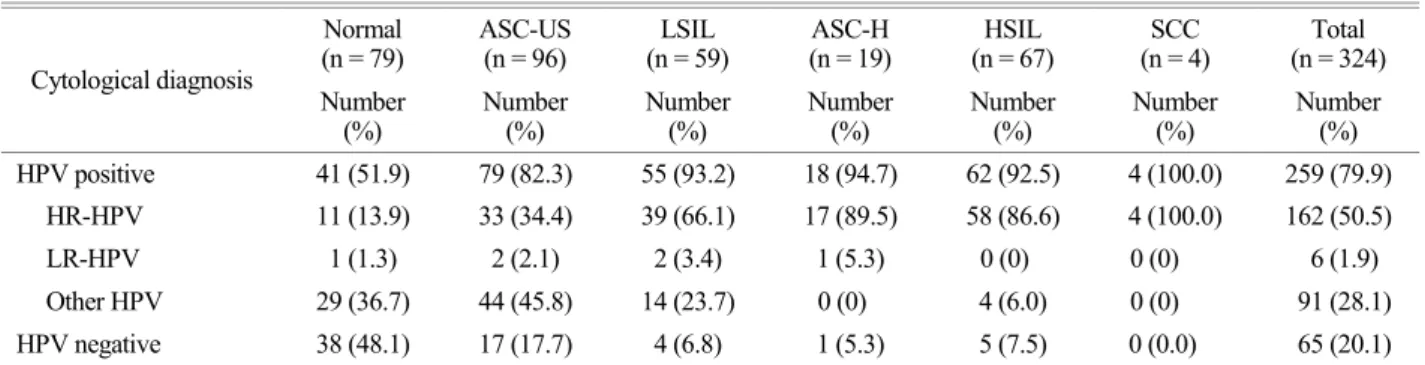
®(YD Diagnostics, Yongin, Korea) assay based on the reverse blot hybridization assay (REBA) with a total of 324 liquid-based cytology samples from women in Western Shandong Province, East China and results were compared with cytological diagnosis. Most of the HPV genotypes that were detected in high-grade cervical lesions were HR-HPV genotypes such as HPV 16, 18, 33, 53, and 58. The prevalence of these HR-HPV genotypes increased in high-grade cervical lesions. However, from low- to high-grade cervical lesions, the ability to detect LR-HPV genotypes decreased. Additionally, in general, the single HPV genotype infection rate increases in proportion to the severity of the lesion. The study findings suggest that a currently available preventive vaccine against HPV 16 and 18 may have limited effectiveness for prevention of all HPV infection in this province. Finally, based on these findings, these data could guide national or regional vaccination programs in the Western Shandong Province of East China to substantially reduce the burden of cervical lesions.
Key Words: Human papillomavirus, Prevalence, Genotype-distribution, REBA HPV-ID
®, Western Shandong Province
INTRODUCTION
Cervical cancer is the third most common cancer in women worldwide (Ferlay et al., 2010). There are 75,500 new cases and 34,000 deaths annually in developing coun- tries such as China (Zhao et al., 2012) (Dunne et al., 2007).
Recent studies estimated that there is a significant association between human papillomavirus (HPV) infection and cervical cancer and precancerous lesions of the cervix (Bosch et al.,
Original Article
*
Received: May 19, 2015 / Revised: June 5, 2015 Accepted: June 22, 2015
§
Equal contributors.
†
Corresponding author: Hyeyoung Lee. Department of Biomedical Laboratory Science, College of Health Sciences, Yonsei University, 1 yonseidae-gil, Wonju, Gangwon 220-710, Korea.
Tel: +82-33-760-2740, Fax: +82-33-760-2561 e-mail: [email protected]
†