https://doi.org/10.4094/chnr.2020.26.1.72
CHNR
Pediatric Nurses' Perspectives on Family-Centered Care in Sri Lanka:
A Mixed-Methods Study
Rishani Deepika Gangodage Done
1, Jina Oh
2, Mihae Im
3, Jiyoung Park
41Nursing Officier, Teaching Hospital-Colombo South, Colombo, Sri Lanka; 2Professor, Department of Nursing, Institute of Health Science, Inje University, Busan;
3Assistant Professor, Department of Nursing, Choonhae College of Health Science, Ulsan; 4Assistant Professor, Department of Nursing, Institute of Health Science, Inje University, Busan, Korea
Purpose: This study was conducted to investigate nurses’ perceptions and performance of family-centered care (FCC) at a children’s hospital in Sri Lanka and to explore the feasibility of implementing FCC in the context of the Sri Lankan healthcare system. Methods: A convergent, parallel, mixed-methods design was applied to understand Sri Lankan nurses’ perspectives on FCC. In total, 157 nurses working at a large teritagy children’s hospital responded to a self-report survey and 18 nurses participated in focus group interviews. Results: Of the factors of FCC, family participation in caring for children received the highest score (4.09±0.51) for perceptions, and information-sharing received the highest score (3.54±0.55) for performance. The qualitative data revealed the following five themes: (a) importance of the family in caring for children; (b) helping families during children’s hospitalization; (c) taking steps to implement FCC, even with imperfect knowledge; (d) barriers in the current situation; and (e) suggested strategies to promote FCC. Conclusion: Participants endorsed the concept of FCC and demonstrated some aspects of it in their day-to-day practice. The results indicate a clear knowledge deficit and several challenges, which need to be addressed to effectively implement FCC.
Key words: Hospitalized children; Family nursing; Parents; Pediatric nursing
INTRODUCTION
Family-centered care (FCC), as a professional support sys- tem for children and their families [1], is a widely accepted philosophy of caring for children in hospital and community settings. FCC is characterized by a relationship between health- care professionals and the family, in which both parties share the responsibility for the child’s healthcare [2,3]. Because the family is a unique social unit with an ongoing influence on a child’s life [4], FCC is concerned with the prevailing ideals of empowerment, respecting personal autonomy, and recogni- tion of human rights.
In order to implement FCC, nurses need to shift from the position of care prescribers to a collaborative role in which they partner with families [5]. That is, nurses must share health information with children and families, and each care plan should include families’ preferences and needs. Many studies have confirmed that FCC has favorable impacts on pa- tients’ outcomes, families’ satisfaction, and the effective use of health care resources [6].
In Sri Lanka, hospitalization of children is gradually be- coming more common, although pediatric care has yet to re- ceive the attention it requires [7]. In most hospital environ- Corresponding author Jina Oh
https://orcid.org/0000-0002-5883-7538
Department of Nursing, Institute of Health Science, Inje University, 75 Bokji-ro, Gaeguem-dong, Jin-gu, Busan 47392, Korea
TEL +82-51-890-6833 FAX +82-51-896-9840 E-MAIL [email protected]
*This article was adapted from a thesis by Rishani Deepika Gangodage Done in partial fulfillment of the requirements for the masters’ degree at Inje University.
*The study was supported by an Official Development Assistance project through the National Research Foundation of Korea (NRF) funded by the Ministry of Education (#2017 H1A7A2A03048933).
Received Nov 25, 2019 Revised Dec 19, 2019 Accepted Dec 29, 2019
This is an Open Access article distributed under the terms of the Creative Commons Attribution Non- Commercial License (http://creativecommons.org/licenses/by-nc/4.0/) which permits unrestricted non- commercial use, distribution, and reproduction in any medium, provided the original work is properly cited.
Figure 1. Graphical presentation of the research design.
ments in Sri Lanka, the healthcare system is solely concent- rated on medical doctors [8]. Consequently, decision-making about patients is determined by doctors, rather than the opin- ions of families or nurses. Most patients are therefore treated as passive recipients of care, and nurses have long adhered to the biomedical model [9].
Furthermore, FCC is not appropriately recognized in nurs- ing education in Sri Lanka. The diploma-level nursing schools where more than 90% of nurses receive their basic nursing training do not include FCC in their curricula [10]. De Silva and Rolls [11] emphasized that Sri Lankan nurses are stagnat- ing in the absence of proper guidance and with minimal op- portunities for professional development. In addition, few studies have explored FCC in Sri Lanka. Although a single cross-sectional descriptive study was conducted to investigate the perceptions and practices of FCC among undergraduate nursing students [12], no study has yet explored registered nurses’ perceptions of FCC and its feasibility in practice in Sri Lanka. Therefore, nurses may face difficulties when seeking to practice FCC.
The purpose of the current study was to assess the levels of perceptions and performance of FCC among Sri Lankan pe- diatric nurses, to explore their perspectives on the feasibility of practicing FCC, and finally to obtain insights into the status of FCC in Sri Lankan pediatric nursing. A mixed-methods re- search design, involving simultaneous quantitative and qual- itative research, can be used to increase the breadth and depth of understanding of a phenomenon of interest [13]. The find- ings of this study are expected to act as a cornerstone for the successful establishment of FCC in Sri Lanka. This study is al- so expected to contribute to improvements in family sat- isfaction and the quality of child care.
METHODS
1. Research DesignA convergent, parallel, mixed-methods study design was employed. Quantitative data were collected via questionnaires, and focus group interviews (FGIs) were conducted to obtain qualitative data. Both datasets were analyzed separately and merged for the overall interpretation [13] (Figure 1).
2. Ethical Considerations
The study was approved by the institutional review board of Inje University in the Republic of Korea (No. 2017-10-056- 001) and the ethical review board of Lady Ridgway Hospital in Sri Lanka (LRH/DA/09/2018). The subjects received an ex- planation of the necessity, purpose, and methods of the study, and the data were processed anonymously. They also re- ceived an explanation that it was possible for them to with- draw their participation in the study at any time without any penalties. In order to maintain the anonymity of the data, con- sent forms, questionnaires, and interview records were kept separately after data collection. The subjects of the recording files were sorted alphabetically, and the respondents to the questionnaires were referred to using numbers so that they could not be personally identified.
3. Study Setting
The study was conducted in a large tertiary children’s hos- pital, the Lady Ridgway Hospital in Colombo, the capital of Sri Lanka. With over 900 beds, it serves as the national referral
center for pediatric care.
4. Quantitative Study 1) Participants
In total, 200 questionnaires were distributed among pedia- tric nurses who agreed to participate in the study. In this quantitative study, it was not possible to use the G*power pro- gram to calculate the sample size, because only the mean and standard deviation were used as descriptive statistics, without special statistical methods. Thus, the number of samples was calculated based on a prior study [6] that investigated nurses’
perceptions of FCC at Saudi Arabian Children’s Hospital, in a similar developing country, using a mixed-methods analysis.
In total, 173 surveys were received (response rate: 86.5%), of which 16 were discarded due to incomplete responses, yield- ing a final sample of 157 (78.5%).
2) Instruments
The questions on nurses’ perceptions and performance of FCC were developed according to the core concepts of FCC defined by the Institute of Patient and Family-Centered Care [14]. Initially, 77 items were drafted and sent to seven experts in the field from Sri Lanka and South Korea. After analyzing the experts’ feedback, 31 questions were deleted because of in- appropriateness for the Sri Lankan context or an insufficient content validity index (CVI) score, with a CVI of .80 or higher considered to be evidence of good content validity. The result- ing 46 items was sent to 15 nurses working in a pediatric unit to evaluate face validity and reliability. Three items were de- leted based on the CVI, while two items were modified.
The scale used to assess nurses’ perceptions of FCC had 16 items, and each subscale (core concepts) had 4 questions. The Cronbach’s ⍺ values for the subscales- (a) respect and dig- nity, (b) information sharing, (c) collaboration, and (d) family participation-were .72, .77, .85, and .82, respectively, while the total perception scale had a Cronbach’s ⍺ of .92. The final ver- sion of the scale used to assess nurses’ performance of FCC comprised 27 items. In the present study, the overall Cron- bach’s ⍺ was .88, but the Cronbach’s ⍺ values showed con- siderable variation across the subscales, with the values for (a) respect and dignity (9 items), (b) information-sharing (6 items), (c) collaboration (7 items), and (d) family participation (5 items) being .77, .41, .72, and .71 respectively. Despite the low Cronbach’s ⍺ value for information-sharing, the subscale was used for comparing perceptions of FCC with performance.
Confirmatory factor analysis (CFA) was used to test wheth- er measures of a construct were consistent with the research- er’s understanding of the nature of that factor. CFA showed that four factors including standardized factor loading, con-
struct reliability, and average variance extracted among all items exceeded the cut-off values of .50, .70, and .50 respec- tively, used to assess model fit.
A strengths, weaknesses, opportunities, and threats (SWOT) analysis was employed to assess the feasibility of FCC and identify its advantages and disadvantages. Thirty-one struc- tured multiple response questions were developed by re- searchers and nurse experts in Sri Lanka to analyze SWOT.
Each item of the questionnaire was constructed in English and translated into Sinhala (the most widely-spoken official lan- guage of Sri Lanka) based on World Health Organization guidelines for the process of translation and adaptation of in- struments [15].
3) Data collection and analysis
Data collection was conducted during January 2018. After the president of the hospital approved data collection, a box was put in the matron’s office, and completed questionnaires were picked up after 1 week. A gift voucher raffle (1,000 Sri Lanka rupees, roughly equivalent to 5.50 USD or 4.95 EUR) was conducted for participants. Descriptive statistics for gen- eral characteristics and each subscale were calculated using SPSS version 24.0 (IBM Corp., Armonk, NY, USA).
5. Qualitative Study 1) Participants
The qualitative study included three FGIs with six nurse managers who had more than 10 years of clinical experience (mean: 14.3±4.6 years) and 12 nurses with more than 5 years of clinical experience (mean: 10.8±6.8 years).
2) Data collection
Data collection was conducted during February 2018. Each FGI took approximately 1.5~2.0 hours. The interviews were conducted using the following questions: “What do you know about FCC?”, “How do you practice FCC?”, “Do nurses need to learn FCC?”, “What are the difficulties in implementing FCC?”, and “How can we practice FCC in your setting?” All interviews were recorded and each participant received 750 Sri Lanka rupees as compensation.
3) Data analysis
Inductive content analysis was performed according to the method described by Elo and Kyngäs [16]. This approach pro- vides researchers a better understanding of the context. This method also has the advantage of obtaining information di- rectly from participants without bias or theoretical opinions.
This process involves iterative steps of line-by-line reading, coding, categorizing, and abstraction. Opposite and inter-
Table 1. General Characteristics of Participants (N=157)
Characteristics Categories n (%) or
M±SD
Age (year) ≤29
30~34 35~39
>40
64 (40.8) 48 (30.6) 23 (14.6) 22 (14.0) 32.4±6.6 Working unit Medical unit
Surgical unit Operating theater ICU
Other
41 (26.1) 20 (12.7) 28 (17.8) 51 (32.5) 17 (10.9) Religion Buddhism
Christianity Islam
146 (93.0) 10 (6.4) 1 (0.6) Marital status Married
Unmarried
91 (58.0) 66 (42.0) Experience as a
nurse (year)
<1 1~5 5~10
>10
29 (18.5) 50 (31.8) 34 (21.7) 44 (28.0)
7.2±6.5 Experience as a
pediatric nurse (year)
<1 1~5 5~10
>10
31 (19.7) 59 (37.6) 29 (18.5) 38 (24.2) 6.4±6.0 Formal education Nursing school
University
152 (96.8) 5 (3.2) Post-basic pediatric
training
Yes No
25 (15.9) 132 (84.1) I have heard of FCC Yes
No
61 (38.9) 96 (61.1) I have learned about
FCC
Yes No
23 (14.6) 134 (85.4) I learned about FCC
at (n=23)
Pre licensure In-service program Post-basic pediatric training
11 (47.8) 8 (34.8) 4 (17.4) If you learned about
FCC, how do you perform FCC? (n=23)
Practice it day-to-day Practice it in sometimes No, not practice at all
9 (39.1) 6 (26.1) 8 (34.8) ICU=Intensive care unit; FCC=Family-centered care.
active codes were placed together within higher-level head- ings to build a meaningful picture of the phenomenon under study. To begin with, the audio-recorded data were tran- scribed verbatim and translated into English from Sinhala. In order to ensure the trustworthiness of the data, the translated data were verified by three participants from each FGI.
RESULTS
1. Quantitative Results1) Demographic data of the participants
The mean age of participants was 32.4±6.6 years, the ma- jority of participants (93.0%) were Buddhists, and 91 partic- ipants (58.0%) were married. The nurses’ mean experience was 7.2±6.5 years, whereas their mean experience as pediatric nurses was 6.4±6.0 years, and only five had a bachelor’s degree. Sixty-one respondents (38.9%) had previous know- ledge of FCC. Twenty-three nurses (14.6%) had learned about FCC, among whom 11 nurses (47.8%) had learned about FCC in a pre-licensure course (Table 1).
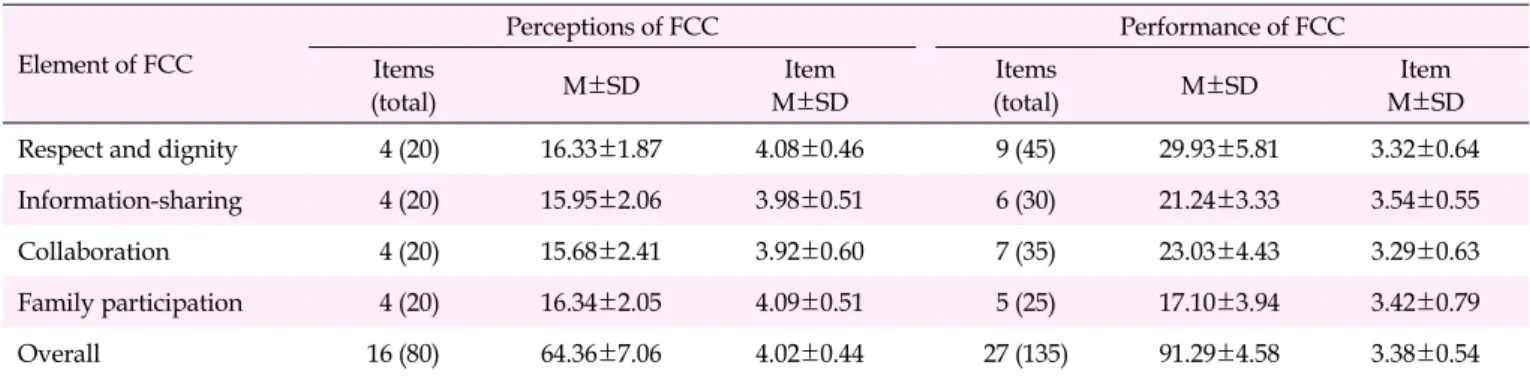
2) Nurses' perception and performance of family-centered care The mean score for overall perceptions of FCC was 4.02±
0.44 and the mean score for performance of FCC was 3.38±
0.54 (Table 2). Family participation was the element that re- ceived the highest score (4.09±0.51), followed by respect and dignity (4.08±0.46), information-sharing (3.98±0.51), and collaboration (3.92±0.60). In contrast, for the performance of FCC, information-sharing (3.54±0.55) received the highest score, and collaboration (3.29±0.63) received the lowest (Table 2).
3) Nurses' perceived feasibility of practicing family-centered care
Most of the participants (87.3%) perceived that increased family satisfaction was a strength of implementing FCC.
However, lack of knowledge of FCC among Sri Lankan nurses (84.1%) was identified as a weakness. The participants an- swered that an opportunity of implementing FCC was that their public image as nurses’ status would improve (85.4%).
However, the high nurse-to-patient ratio was (81.5%) identi- fied as a threat to FCC (Table 3).
2. Qualitative Results
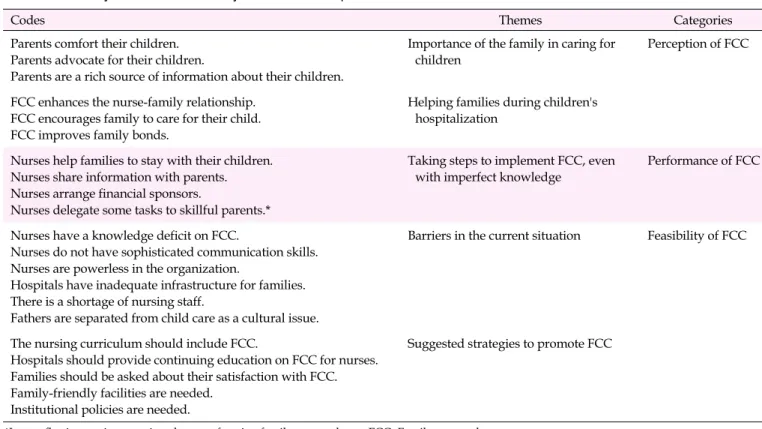
The qualitative results were classified into three categories (perceptions, performance, and feasibility of FCC). Five themes were derived by merging 21 codes (Table 4).
1) Perceptions of family-centered care
(1) Importance of the family in caring for children Children are not comfortable in the hospital, and their dis- comfort can be reduced by having parents stay with their children. The participants stated that FCC is a crucial compo- nent of providing care to children and that nurses cannot pro-
Table 2. Perceptions and Performance of Family-Centered Care (N=157) Element of FCC
Perceptions of FCC Performance of FCC
Items
(total) M±SD Item
M±SD
Items
(total) M±SD Item
M±SD
Respect and dignity 4 (20) 16.33±1.87 4.08±0.46 9 (45) 29.93±5.81 3.32±0.64
Information-sharing 4 (20) 15.95±2.06 3.98±0.51 6 (30) 21.24±3.33 3.54±0.55
Collaboration 4 (20) 15.68±2.41 3.92±0.60 7 (35) 23.03±4.43 3.29±0.63
Family participation 4 (20) 16.34±2.05 4.09±0.51 5 (25) 17.10±3.94 3.42±0.79
Overall 16 (80) 64.36±7.06 4.02±0.44 27 (135) 91.29±4.58 3.38±0.54
FCC=Family-centered care.
Table 3. Nurses' Perceptions of the Feasibility of Practicing
Family-Centered Care (N=157)
n (%) Strengths FCC will increase families'
satisfaction.
Nurses have a good understanding of FCC.
Nurses are willing to change.
137
105
97 (87.3)
(66.9)
(61.8) Weaknesses Nurses lack knowledge about
FCC.
The hospital has insufficient infrastructure.
Families have low literacy levels.
Other healthcare team members do not cooperate.
132
113
101 80
(84.1)
(72.0)
(64.3) (51.0)
Opportunities Nurses' image will improve among the public.
The quality of care will improve.
Children's hospital stays will be reduced.
134
124 113
(85.4)
(79.0) (72.0)
Threats The nurse-to-patient ratio is still high.
Family members will interfere with the nurse's work.
Nurses' workload will be doubled.
It will disturb the ward routines.
128
95
90
71 (81.5)
(58.6)
(57.3)
(45.2) FCC=Family-centered care.
vide proper care without children’s families. Moreover, the participants acknowledged that parents are a rich source of relevant information and serve as advocates for their children.
Others cannot make important decisions regarding someone else’s child. The rule is that important decisions can be made by the mother or father of the child.(#4;
group 1)
I think parents provide reliable information, because parents know the child’s disease history, developmental
history, and the child’s usual behavior, and it is easy to communicate with the parents. (#2; group 1)
(2) Helping families during children’s hospitalization Participants felt that mutual trust between parents and healthcare staff would be enhanced by concentrating on the family. Furthermore, they thought that input from parents and family members improved their knowledge and skills in caring for children. It was helpful to reinforce family bonds through providing the family with knowledge and skills about caring for their children.
For example; when performing tracheostomy care, we can invite parents to take part in procedures. However, whether they take part depends on their knowledge and abilities. It helps to improve their abilities to care for the child at home. (#1; group 3)
One day, a congenitally abnormal baby was born, and the mother said it was her fault, while others thought it was the father’s fault. They were very anxious and depressed. So, I explained that it wasn’t anyone’s fault and that they should get rid of myths. I think it will strengthen family bonds. (#2; group 3)
2) Performance of family-centered care
(1) Taking steps to implement family-centered care, even with imperfect knowledge
Even though the participants had not learned about FCC in depth, they did practice some aspects of FCC. The participants acknowledged the importance of parents being present with their children during procedures. Therefore, the participants made efforts to give parents information about the treatment plan, follow-up care at home, and so on. The participants who worked in the pediatric intensive care unit introduced parents who could not afford the costs of healthcare to financial sponsors. However, some participants delegated some ele- ments of their work to the parents.
Table 4. Summary of the Thematic Analysis of Focus Group Interview Data
Codes Themes Categories
Parents comfort their children.
Parents advocate for their children.
Parents are a rich source of information about their children.
Importance of the family in caring for children
Perception of FCC
FCC enhances the nurse-family relationship.
FCC encourages family to care for their child.
FCC improves family bonds.
Helping families during children's hospitalization
Nurses help families to stay with their children.
Nurses share information with parents.
Nurses arrange financial sponsors.
Nurses delegate some tasks to skillful parents.*
Taking steps to implement FCC, even with imperfect knowledge
Performance of FCC
Nurses have a knowledge deficit on FCC.
Nurses do not have sophisticated communication skills.
Nurses are powerless in the organization.
Hospitals have inadequate infrastructure for families.
There is a shortage of nursing staff.
Fathers are separated from child care as a cultural issue.
Barriers in the current situation Feasibility of FCC
The nursing curriculum should include FCC.
Hospitals should provide continuing education on FCC for nurses.
Families should be asked about their satisfaction with FCC.
Family-friendly facilities are needed.
Institutional policies are needed.
Suggested strategies to promote FCC
*Item reflecting a misperception about performing family-centered care; FCC=Family-centered care.
In relation to the ICU, if the child is conscious and ask- ing for his or her mother, we allow mothers to come in- side the ICU and be with the child after giving advice about how to behave in the ICU. (#4; group 2)
We have some affluent parents. Children have been treated at the ICU . . . When needy children appear, we contact donors and arrange for individualized help for the child... (#4; group 2)
Sometimes, I delegate minor nursing tasks such as ad- ministering oral medications, bed-making, and changing dressings. (#5; group 1)
3) Feasibility of family-centered care (1) Barriers in the current situation
There were many barriers to the successful practice of FCC.
The majority of the participants had not learned about FCC, and they experienced difficulties in informing families about various aspects of their children’s care due to their lack of so- phisticated communication skills. Moreover, participants felt that they did not have power in the medical-dominant health care system, especially given the shortage of nursing staff.
Additionally, in Sri Lankan culture, fathers are separated from caring for their children in hospitals.
I did not learn FCC specially, but I have some idea about FCC by reading journals…. Sometimes, I can’t de-
cide whether certain information should be revealed to the family or not. (#1; group 2)
…. And this overcrowded situation interferes with nursing care too. On the other hand, as the ratio of nurse to patients goes up, this can be an extra burden to nurses.
(#1; group 1)
(2) Suggested strategies to promote family-centered care Participants suggested that the concept of FCC should be introduced into the basic nursing curriculum and continuing education at the hospital. They also expressed the need to evaluate their practice of FCC by gathering information on pa- rents’ satisfaction. They expressed the need to create a fam- ily-friendly environment and to change hospital policies accordingly.
This concept of FCC should be taught in basic nursing programs during nursing school or university under- graduate programs. (#6; group 1)
In-service workshops would be a better option to edu- cate nurses who are currently working. One or two work- shops are not enough. They should be done continuously till all nurses grasp the meaning of FCC. (#1; group 1)
There are not enough accommodations, nurses even put two sick children in a single bed. (#3; group 2)
I think our supervisors and the chief of the hospital
should learn about FCC, and then help us to initiate this.
(# 1, group 3).
DISCUSSION
1. Perceptions of Family-Centered Care among Sri Lankan Pediatric Nurses
The Sri Lankan pediatric nurses included in this study ac- knowledged parents’ crucial role in caring for children, and recognized that parents should be with their children to com- fort and advocate for them within the framework of FCC.
Consistent results reported in previous studies have shown that parents are the best caregivers for their children [6,17].
According to Dokken and Ahmann [18], the first role of a pa- rent is to be an advocate who speaks for his or her child’s opinions. The second role is a supporter who helps other fami- lies in similar situations, the third is an advisor who helps build a family-friendly hospital environment, and the final role is that of an educator in the process of sharing his or her child’s information with health professionals. Given the rec- ognition that families’ roles are gradually expanding as FCC continues to develop [1], it is necessary to explore various ways through which family members and health professio- nals can cooperate. This will help families continue to play an independent role in the future.
In the qualitative results of this study, participants ex- pected FCC to establish mutual trust between healthcare staff and parents, thereby ultimately contributing to better health outcomes for children. FCC brings nurses and parents closer to each other, thereby enhancing the nurse-parent relation- ship [19]. Therefore, FCC enables nurses to carry out care plans more easily by collaborating with parents [4]. Patients and families are also expected to be more satisfied with the care received, reducing the risk of conflict. Finally, FCC cre- ates an environment in which nurses and parents act like a team with dynamic interactions.
In this study, we found FCC to be helpful for encouraging families to provide care for their children. Nurses can assess and teach certain procedures to the parents when the child is discharged. The Sri Lankan pediatric nurses thought that they would be able to empower families. A trusting nurse-parent relationship gives patients the chance to receive information, increases their understanding of their children’s condition and treatment plan, and supports them in understanding the parental role and being involved in clinical decision-making [5]. The Family-Centered Care Coordination (FCCC) program of Massachusetts General Hospital for Children was designed to train caregivers in tracheostomy care and to provide earlier, timely follow-up after a child is discharged [20]. The re-
searchers found that the FCCC program significantly reduced post-discharge complications and re-admissions. Establishing and disseminating FCC in Sri Lanka will strengthen parents’
capacity to care for their children and will positively affect children’s health outcomes. Therefore, FCC is the most effec- tive strategy for providing care to children in the hospital set- ting, especially in underdeveloped countries such as Sri Lanka.
2. Performance of Family-Centered Care by Sri Lankan Pediatric Nurses
In the qualitative results, Sri Lankan pediatric nurses dem- onstrated that they performed FCC to some extent despite still having some misconceptions. After the FGIs, the misunder- standings of FCC became clear. For instance, some nurses taught skills such as tube feeding and stoma care for patients experiencing long-term hospitalization. This kind of nurse- parent relationship has sometimes been criticized, because implementing FCC in this way comes close to shifting the re- sponsibility of providing care to parents, rather than promot- ing collaboration [17].
Further, participants thought that FCC would be a partial solution for the nursing shortage in Sri Lanka. Similarly, Shield [1] argued that this is a misbelief that arises because the family is always to be found at the child’s bedside and nurses delegate some aspects of care. She emphasized that this is a fallacy. In developing countries, it is usual for parents to take care of their children, not from any philosophical choice on the part of the hospital, but because of insufficient nursing staff [21]. Even still, fathers are not allowed to stay with their children due to the lack of appropriate facilities, institutional rules, and cultural beliefs. However, nurses try to involve fa- thers and siblings in the care of hospitalized children. In ac- cordance with the definition of FCC [2], healthcare professio- nals should encourage parents to be with the child at any time.
Information-sharing is necessary to promote hospitalized children’s well-being. In this study, participants acknowl- edged that providing accurate information has a positive ef- fect on carrying out the treatment plan. However, they re- frained from giving all the relevant information, because they felt that parents may misunderstand the information or feel depressed [22]. In Turkey, pediatric nurses thought that giv- ing parents too much information about their children could lead to stress and confusion [23]. However, transparent in- formation-sharing is an important component of FCC, so nurses need to improve their communication skills, including the use of accurate and easy-to-understand wording in combi- nation with emotional support.
In this study, the lowest score for perceptions of FCC among Sri Lankan pediatric nurses was found for collabo-
ration, reflecting the fact that actual collaboration in the field has also been also rare. According to Rosen et al. [24], collabo- ration between various disciplines will foster teamwork and strengthen the capabilities of healthcare providers. Collabora- tion and interactions with all stakeholders, including doctors and parents, play an important role in ensuring the best deci- sion-making in the hospital setting [3]. Collaboration allows nurses to confirm the treatment plan and intention and to identify parents’ preferences for their children’s medical care.
In the qualitative results, participants reported working to create a network of affluent parents to help families that need financial support. However, such parents are usually not in- vited to ward meetings as team members.
3. Feasibility of Practicing Family-Centered Care in Sri Lankan Pediatric Settings
First of all, our qualitative and quantitative data revealed that Sri Lankan pediatric nurses have a knowledge deficit of FCC that needs to be improved. The participants reiterated the need for education on FCC. Without prior knowledge, nurses cannot implement the principles of FCC properly [25].
Almost all participants in both groups agreed with the notion of including FCC in the basic nursing curriculum. According to the SWOT analysis, they believed that nurses’ willingness to change was a major strength.
The participants reported in the qualitative research that Sri Lankan nurses lacked communication skills or were reluctant to communicate with parents. In the SWOT analysis, threats included the lack of time to communicate effectively given their heavy workload and the shortage of nurses. Effective communication and regular information-sharing are helpful for reducing parents’ anxiety and giving timely and attentive care [26]. A study done in Ireland reported that nurses needed communication skills training [17], and this need extends to all staff members, in addition to healthcare professionals [1].
This is supported by the finding of a systematic review [24] of the use of understandable language during medical rounds, which reported that the amount and type of communication and satisfaction with communication need to be considered to ensure effective communication.
Environmental factors such as facilities, human resources, and institutional rules and protocols play a major role in nurs- ing care [25]. Unlike private hospitals, hospitals in Sri Lanka run by the government are characterized by poor facilities for families, overcrowding, staff shortages, and unlimited hospi- tal admissions. Our analysis identified this underdeveloped infrastructure as a weakness that hinders the successful im- plementation of FCC. In Ireland, nurses supported the model
of FCC, but they were unable to implement all elements of FCC in practice because of barriers such as a lack of resources and aspects of hospital design related to healthcare organ- izations [17].
Furthermore, in the quantitative results of the current study, Sri Lankan pediatric nurses expressed uncertainty about their ability to practice FCC fruitfully because of their lack of in- stitutional power, as their ideas are seldom recognized by the hospital authorities. However, in the qualitative findings, nurses hoped that the hospital authorities would help them if they want to practice FCC. A similar idea was found in a study conducted in Ireland [17], where nurses seldom participated in designing the healthcare system.
Apart from that, cultural issues have a significant influence on practicing FCC [23]. In Sri Lanka, fathers are restricted from entering hospital rooms, and mothers usually take care of their children. As such, the hospital does not provide ac- commodations for families. In Ireland, pediatric nurses high- lighted the need for specific facilities such as parent and fam- ily rooms, teenage recreation areas, and breastfeeding rooms [17]. To involve families in FCC, hospitals need to create a family-friendly environment, as well as showing sincere hos- pitality and respect for families’ opinions.
There are some misconceptions of FCC, such as the idea that it provides a solution for the shortage of nurses, rather than being a way of making decisions related to the health- care provided to children. Although nurses were enthusiastic about the need to practice FCC, in order to successfully imple- ment FCC, the barriers should be addressed beforehand.
There should be adequate staff and physical facilities. Educa- tional programs should be developed in order to bridge the knowledge gap. FCC should be included in the undergra- duate curriculum in universities and in conventional nursing training schools in Sri Lanka. In addition, comprehensive in-service programs should be arranged within the hospital for registered nurses, and post-basic pediatric courses should be strengthened to create a venue for nurses to update their knowledge on not only FCC, but also communication skills in general.
CONCLUSION
The Sri Lankan pediatric nurses approved of FCC, as demon- strated by their favorable perceptions, although they did have certain misconceptions. This finding can be explained by their lack of knowledge about FCC. They appeared to be practicing some elements of FCC, despite lacking proper knowledge. The most important aspect of these findings is they are keen to learn FCC, for which they need to cultivate their competencies through further professional development. However, many
barriers to implementing FCC were identified; working to- ward the adoption of FCC will not be an easy task, and coop- eration with other healthcare parties and institutional support through policy changes may be required to implement the FCC philosophy in the pediatric clinical setting. To integrate FCC, Sri Lanka will need changes in its health policy, and in particular, efforts should be made to accelerate nurse recruit- ment. Further studies should focus on other healthcare staff and healthcare institutional authorities to understand the bar- riers to FCC and to improve the feasibility of practicing FCC in the children’s hospital setting in Sri Lanka. Education pro- grams also need to be arranged for parents and families, in or- der to increase their awareness of FCC and their participation.
Parents’ satisfaction with care should be another indicator used to assessing pediatric nurses’ FCC competencies.
This study was conducted at a single institution, and the re- sults therefore cannot be generalized to the whole country.
Our population is limited to nurses, but healthcare is a team enterprise, and other related professionals’ points of view are also important for making decisions. Furthermore, healthcare consumers’ points of view should also be investigated.
Conflict of interest
No existing or potential conflict of interest relevant to this article was reported.
REFERENCES
1. Shields L. What is "family-centered care"? European Journal for Person Centered Healthcare. 2015;3(2):139-144.
https://doi.org/10.5750/ejpch.v3i2.993
2. Committee on Hospital Care; Institute for Patient-and Family- Centered Care. Patient-and family-centered care and the pediatri- cian's role. Pediatrics. 2012;129(2):394-404.
https://doi.org/10.1542/peds.2011-3084
3. Rostami F, Hassan ST, Yaghmai F, Ismaeil SB, Suandi TB. Effects of family-centered care on the satisfaction of parents of children hos- pitalized in pediatric wards in a pediatric ward in Chaloos in 2012.
Electronic Physician. 2015;7(2):1078-1084.
https://doi.org/10.14661/2015.1078-1084
4. Im M, Oh J. An integrative review on family-centered rounds for hospitalized children caring. Child Health Nursing Research. 2016;
22(2):107-116. https://doi.org/10.4094/chnr.2016.22.2.107 5. Choi MY, Bang KS. Development and testing of a pediatric nurse
parent partnership scale. Journal of Korean Academy of Nursing.
2013;43(2):194-202. https://doi.org/10.4040/jkan.2013.43.2.194 6. Alabdulaziz H, Moss C, Copnell B. Paediatric nurses' perceptions
and practices of family-centred care in Saudi hospitals: A mixed methods study. International Journal of Nursing Studies. 2017;69:
66-77. https://doi.org/10.1016/j.ijnurstu.2017.01.011
7. Karunarathna ANW, Wickramanayaka IL, Goonasekera CDA.
Paediatric workload in a multidisciplinary tertiary care intensive care unit in Sri Lanka. Sri Lanka Journal of Child Health. 2009;
38(3):92. https://doi.org/10.4038/sljch.v38i3.1008
8. Mudiyanse RM, Pallegama RW, Jayalath T, Dharmaratne S, Kru- pat E. Translation and validation of patient-practitioner orienta- tion scale in Sri Lanka. Education for Health. 2015;28(1):35-40.
https://doi.org/10.4103/1357-6283.161847
9. van Mol MM, Boeter TG, Verharen L, Kompanje EJ, Bakker J, Nijkamp MD. Patient- and family-centred care in the intensive care unit: A challenge in the daily practice of healthcare professionals.
Journal of Clinical Nursing. 2017;26(19-20):3212-3223.
https://doi.org/10.1111/jocn.13669
10. Rathnayake S, Senevirathna A. Self-reported eHealth literacy skills among nursing studnets in Sri Lanka: A cross-sectional study.
Nurse Education Today. 2019;78:50-56.
https://doi.org/10.1016/j.nedt.2019.04.006
11. De Silva BSS, Rolls C. Health-care system and nursing in Sri Lanka:
An ethnography study. Nursing and Health Sciences. 2010;12(1):
33-38. https://doi.org/10.1111/j.1442-2018.2009.00482.x
12. Damayanthi HDWT. Perceived stressors among undergraduate nursing students, University of Peradeniya, Sri Lanka. Internation- al Journal of Scientific and Research Publications. 2014;4(6):1-4.
13. Creswell JW, Clark VLP. Designing and conducting mixed meth- ods research. 2nd ed. USA: Sage Publication; 2012. p. 4-5.
14. Institute for Patient -And Family-Centered Care. Patient-and fam- ily-centered care defined [Internet]. Bethesda: Institute for Patient -And Family-Centered Care; [cited 2019 December 17]. Available from: https://www.ipfcc.org/bestpractices/sustainable-partner- ships/background/pfcc-defined.html
15. World Health Organization. Process of translation and adaptation of instruments [Internet]. Geneva: World Health Organization;
2017 [cited 2017 October 12]. Available from:
http://www.who.int/substance_abuse/research_tools/translati on/en/
16. Elo S, Kyngäs H. The qualitative content analysis process. Journal of Advance Nursing. 2008;62(1):107-115.
https://doi.org/10.1111/j.1365-2648.2007.04569.x
17. Coyne I, Murphy M, Costello T, O'Neill C, Donnellan C. A survey of nurses' practices and perceptions of family-centered care in Ireland. Journal of Family Nursing. 2013;19(4):469-488.
https://doi.org/10.1177/1074840713508224
18. Dokken D, Ahmann E. The many roles of family members in "family- centered care"- Part I. Pediatric Nursing. 2006;32(6):562-565.
19. Vasil P, Salsali M. Parents' participation in taking care of hospi- talized children: A concept analysis with hybrid model. Iranian Journal of Nursing and Midwifery Research. 2014;19(2):139-144.
20. Hartnick C, Diercks G, De Guzman V, Hartnick E, Van Cleave J, Callans K. A quality study of family-centered care coordination to
improve care for children undergoing tracheostomy and the qual- ity of life for their caregivers. International Journal of Pediatric Otorhinolaryngology. 2017;99:107-110.
https://doi.org/10.1016/j.ijporl.2017.05.025
21. Shields L, Nixon J. Hospital care of children in four countries. Jour- nal of Advanced Nursing. 2004;45(5):475-486.
https://doi.org/10.1046/j.1365-2648.2003.02930.x
22. Hill C, Knafl KA, Santacroce SJ. Family-centered care from the per- spective of parents of children cared for in a pediatric intensive care unit: An integrative review. Journal of Pediatric Nursing.
2018;41:22-33. https://doi.org/10.1016/j.pedn.2017.11.007 23. Boztepe H, Kerimoğlu Yıldız G. Nurses perceptions of barriers to
implementing family-centered care in a pediatric setting: A qual- itative study. Journal for Specialists in Pediatric Nursing. 2017;22
(2):e12175. https://doi.org/10.1111/jspn.12175
24. Rosen P, Stenger E, Bochkoris M, Hannon MJ, Kwoh CK. Family- centered multidisciplinary rounds enhance the team approach in pediatrics. Pediatrics. 2009;123(4):e603-e608.
https://doi.org/10.1542/peds.2008-2238
25. Alemdar DK, Ozdemir FK, Polat S. Opinions of nurses working in NICU about family centered care. Medicine Science International Medical Journal. 2018;7(1):93-96.
https://doi.org/10.5455/medscience.2017.06.8697
26. Byczkowski TL, Gillespie GL, Kennebeck SS, Fitzgerald MR, Down- ing KA, Alessandrini EA. Family-centered pediatric emergency care: A framework for measuring what parents want and value.
Academic Pediatrics. 2016;16(4):327-335.
https://doi.org/10.1016/j.acap.2015.08.011