© 2013 Korean Breast Cancer Society. All rights reserved. http://ejbc.kr | pISSN 1738-6756
INTRODUCTION
Breast cancer was one of the most common cancers in 2008 and overtook stomach cancer as the cancer with the highest incidence in Korean women in 2001 [1]. The incidence rate of breast cancer has been increasing globally [2], and that of Korean women has been rising gradually in the 2000s [1].
Diet and nutrition have been emphasized as a modifiable risk factor for breast cancer, while most of the other factors, i.e., reproductive history, lactation, menstrual history, adult- attained height and obesity, are generally difficult to modify [3]. The 2007 World Cancer Research Fund report concluded that fruits in general likely protect against cancers of the mouth, pharynx, and larynx, and those of the esophagus, lungs, and stomach. Vegetable and fruits are low in energy and contain various micronutrients which act as markers for consumption [3]. The theory that vegetables and fruits protect against some cancers is supported by evidence from studies on foods con- taining carotenoids [4], β-carotene [5], lycopene [6], folate [7], vitamin C [8], vitamin E [9], B-vitamin pyridoxine (vitamin
B6) [10], selenium [11], and quercetin [12].
Recently, a systematic review reported on the protective effects of high citrus fruit intake on stomach cancer risks [13]. Another systematic review on citrus fruits has followed, reporting on an inverse association with citrus fruit ingestion and pancreatic cancer risk, although the effect was limited due to weak study design [14]. Citrus fruits are complex sources of β-cryptoxanthin (carotenoid), β-carotene, folate, vitamin C, and Quercetin (flavonoid) [4]. They are fruits commonly eaten including oranges, tangerines, grapefruits, lemons, and limes [4]. Taking the above into consideration, we have conducted a systematic review and meta-analysis to explore the hypothesis that dietary intake of citrus fruits may be associated with a reduced risk of breast cancer.
METHODS
Search strategy
An electronic literature search was conducted in PubMed (U.S. National Library of Medicine, Bethesda, USA) and EMBASE (Reed Elsevier PLS, Amsterdam, The Netherlands) to identify human adult studies written in the English language and published up to January 2012 that included the following keywords or phrases: breast, breast neoplasms, fruit, citrus, diet, dietary, prevention and control, etiology, epidemiology, humans, and adult. The search terms used were: (“Breast Neo-
Citrus Fruit Intake and Breast Cancer Risk: A Quantitative Systematic Review
Jung-Kook Song, Jong-Myon Bae
Department of Preventive Medicine, Jeju National University School of Medicine, Jeju, Korea ORIGINAL ARTICLE
Purpose: We investigated the association between dietary intake of citrus fruits and breast cancer risk. Methods: The PubMed and EMBASE were searched for relevant articles on diet and breast cancer up to January 2012. All of the epidemiological studies that assessed dietary intake of citrus fruits and presented risk estimates of the association between citrus fruits intake and risk of breast cancer were reviewed. Multivariable-adjusted odds ratios (OR) and associated 95% confidence intervals (CI) for highest versus lowest intake of dietary citrus fruits level were extracted. Overall summary OR was calculated by using a fixed- effect meta-analysis. Results: Six case-control studies out of five
articles were eligible. Overall summary OR showed a 10%
reduction in risk of breast cancer associated with high intake of citrus fruits (summary OR, 0.90; 95% CI, 0.85-0.96; p<0.001);
results were consistent across the studies (I 2=0). Visual inspec- tion of the results did not suggest a publication bias. Conclusion:
Pooled results from observational studies showed an inverse association between citrus fruits intake and the risk of breast cancer.
Key Words: Breast neoplasms, Citrus, Meta-analysis, Prevention
Correspondence to: Jong-Myon Bae
Department of Preventive Medicine, Jeju National University School of Medicine, 102 Jejudaehang-ro, Jeju 690-756, Korea
Tel: +82-64-755-5567, Fax: +82-64-702-2687 E-mail: [email protected]
Received: April 2, 2012 Accepted: February 13, 2013
Cancer
plasms/diet therapy”[Majr] OR “Breast Neoplasms/epidemi- ology”[Majr] OR “Breast Neoplasms/etiology”[Majr] OR
“Breast Neoplasms/prevention and control”[Majr]) AND (“Fruit” [Mesh] OR “Citrus”[Mesh]) AND (“humans”[MeSH Terms] AND Comparative Study[ptyp] AND “adult”[MeSH Terms]) for PubMed; and breast AND [(neoplasm) OR (can- cer)] AND [(FRUIT) OR (CITRUS)] AND [(PREVENTION) OR (RISK) OR (ETIOLOGY)] for EMBASE. In addition, we reviewed the references cited in the full-text articles and in the relevant review articles or meta-analyses identified in the search.
Study selection
We applied the following inclusion criteria [13]: 1) epide- miological studies including case-control or cohort studies;
2) human adult participants; and 3) studies addressing the association between fruit intake and breast cancer. The full- text articles of all references selected by the inclusion criteria were collected. The following exclusion criteria were applied to the full-text articles including potential references listed by hand-search: 1) no original data, that is, reviews, meta-analysis;
2) studies not measuring the intake of citrus fruit or citrus juice at the individual level; and 3) studies not reporting the standard error (SE) of the associated measure of association.
Two independent reviewers read the abstracts or full-text articles to assess the eligibility in a standardized manner.
Disagreements between reviewers were resolved by consensus.
Data abstraction
The following information was extracted from all of the eligible studies: study design, country of origin, years of enroll- ment, sampling frame, number of participants, range of age, kinds of citrus fruits, level of comparison, and potential con- founding variables that had been adjusted for. From the eligible studies that met the inclusion criteria, estimates of the odds ratio (OR)/relative risk (RR), and their associated 95% confi- dence intervals (CIs), were calculated for the data relating to the intake of citrus fruits. If separate articles from the same study were published, the article containing the more detailed information on the case and control was selected for inclusion.
Statistical analysis
Using general variance-based methods, study-specific OR/
RR and 95% CIs for the highest versus the lowest intake of citrus fruits level were extracted from each article. For all studies, the reported OR/RR estimate was adjusted for age.
SE=[ln (OR/RR upper limit)–ln (OR/RR lower limit)]/2×
1.96. Where OR were given by menopause status (e.g., pre- menopausal or postmenopausal) [15]; separate estimates were
obtained by fixed-effects meta-analysis.
Heterogeneity was tested with a chi-square test and measured by using the I 2 statistic. The I 2 describes the percentage of total variation across studies because of study differences rather than chance. A fixed-effect model was used to calculate the summary OR and its 95% CI when substantial heterogeneity was not observed. Each study’s estimate and SE was used to produce a forest plot that gave a pooled estimate. In an attempt to detect publication bias, we visually examined asymmetry in the Begg’s funnel plot. We used Cochrane Collaboration soft- ware RevMan 5.0 (Oxford, UK) to analyze the extracted data using fixed effects model analysis.
RESULTS
Search results
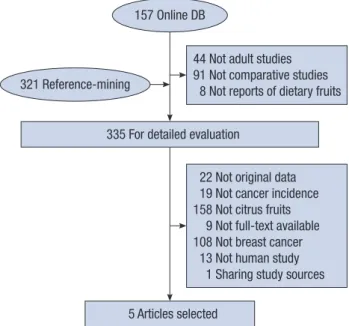
The computerized search yielded 157 articles, and 321 articles that had been identified from the citations were added. Of the 335 articles that were obtained for full-text review, we excluded 330 articles based on the exclusion criteria (Figure 1). In particu- lar, the results of Li et al. [16] were replaced by those of Shan- non et al. [17], as it shared the same database. Finally, 5 articles were included in the meta-analysis [15,17-20], including one article that reported on two ORs from two study groups clas- sified by menopausal status [15].
Study characteristics
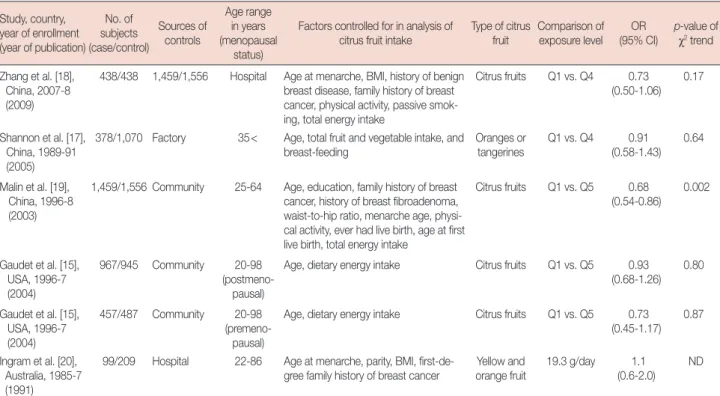
The six studies included in the final analysis had 8,393 participants: 3,789 cases and 4,705 controls. Some details of
Figure 1. Literature flow.
DB=database.
44 Not adult studies 91 Not comparative studies 8 Not reports of dietary fruits 335 For detailed evaluation
5 Articles selected
22 Not original data 19 Not cancer incidence 158 Not citrus fruits 9 Not full-text available 108 Not breast cancer 13 Not human study 1 Sharing study sources 157 Online DB
321 Reference-mining
the selected studies are shown in Table 1. All articles were published in English. Three studies were conducted among the residents of China [17-19], two studies were from the U.S. [15], and one study was from Australia [20]. Five of the studies recruited participants in the 2000s and one in the 1990s.
Four studies adjusted for age [15,17,19], and another four adjusted for total energy intake [15,18,19]. Common adjustment factors of three studies included age at menarche and family history of breast cancer [18-20]. Studies differed in factors considered as potential confounders (Table 1). The potential confounders were education, breast-feeding, parity, age at first
live birth, history of benign breast disease, body mass index (BMI), waist-to-hip ratio, physical activity, and total fruit and vegetable intake.
In all of the studies, intake of citrus fruits was part of a broader dietary assessment, and the relationship between citrus fruit intake and breast cancer was not a primary hypothesis. The adjusted OR for the highest category for citrus fruit intake varied considerably, with the ORs ranging from 0.68 to 1.1.
One study reached the usual threshold p-value of 0.05 [19].
Table 1. Summary of case-control studies selected in meta-analysis Study, country,
year of enrollment (year of publication)
No. of subjects (case/control)
Sources of controls
Age range in years (menopausal
status)
Factors controlled for in analysis of
citrus fruit intake Type of citrus
fruit Comparison of exposure level OR
(95% CI) p-value of χ2 trend Z hang et al. [18],
China, 2007-8 (2009)
438/438 1,459/1,556 Hospital Age at menarche, BMI, history of benign breast disease, family history of breast cancer, physical activity, passive smok- ing, total energy intake
Citrus fruits Q1 vs. Q4 0.73 (0.50-1.06)
0.17
S hannon et al. [17], China, 1989-91 (2005)
378/1,070 Factory 35< Age, total fruit and vegetable intake, and
breast-feeding Oranges or
tangerines Q1 vs. Q4 0.91
(0.58-1.43) 0.64
M alin et al. [19], China, 1996-8 (2003)
1,459/1,556 Community 25-64 Age, education, family history of breast cancer, history of breast fibroadenoma, waist-to-hip ratio, menarche age, physi- cal activity, ever had live birth, age at first live birth, total energy intake
Citrus fruits Q1 vs. Q5 0.68 (0.54-0.86)
0.002
G audet et al. [15], USA, 1996-7 (2004)
967/945 Community 20-98
(postmeno- pausal)
Age, dietary energy intake Citrus fruits Q1 vs. Q5 0.93 (0.68-1.26)
0.80
G audet et al. [15], USA, 1996-7 (2004)
457/487 Community 20-98
(premeno- pausal)
Age, dietary energy intake Citrus fruits Q1 vs. Q5 0.73
(0.45-1.17) 0.87 Ingram et al. [20],
Australia, 1985-7 (1991)
99/209 Hospital 22-86 Age at menarche, parity, BMI, first-de-
gree family history of breast cancer Yellow and
orange fruit 19.3 g/day 1.1
(0.6-2.0) ND OR=odds ratio; CI=confidence interval; BMI=body mass index; Q1=baseline level by rank distribution; Q4=quartile level; Q5=quintile level; ND=not described.
Favours Intakes Study
or sub-category Zhang 2009 [18]
Shannon 2005 [17]
Malin 2003 [19]
Ingram 1991 [20]
Gaudet (premenopause) 2004 [15]
Gaudet (postmenopause) 2004[15]
Total (95%CI)
Test for heterogeneity. Chi2=4.47, df=5 (p=0.48), I 2=0%
Test for overall effect: Z=3.30 (p=0.001)
14.7 10.2 38.4 5.7 9.1 21.9 100.0
0.87 0.96 0.85 1.04 0.87 0.97 0.90
[0.74, 1.03]
[0.79, 1.17]
[0.76, 0.94]
[0.80, 1.35]
[0.71, 1.07]
[0.85, 1.11]
[0.85, 0.96]
OR (fixed)
95% CI OR (fixed)
95% CI Weight
(%)
0.5 0.7 1 1.5 2 Favours Control
Figure 2. Summary estimates of the association between citrus fruits intake and breast cancer risks sorted by effect estimate.
CI=confidence interval; df=degree of freedom; chi2=chi-square statis- tic; I 2=the percentage of total variation across studies that is due to heterogeneity rather than change; fixed=using fixed-effect model.
Figure 3. Funnel plot of studies evaluating the association between citrus fruit intake and breast cancer risks. Dot lines are 95% pseudo- confidence intervals.
SE=standard error; OR=odds ratio.
0.5 0.7 1 1.5 2 0
0.05 0.1 0.15 0.2
SE (log[OR])
OR
Heterogeneity and pooled results
There was no significant heterogeneity among the study results (I 2=0, p=0.48). The overall summary OR using the fixed effect model showed a 10%, statistically significant reduc- tion in the risk of breast cancer for the highest intake group when compared to the lowest (summary OR, 0.90; 95% CI, 0.85-0.96) (Figure 2).
Publication bias
No publication bias was observed in the selected studies.
Visualization of Begg’s funnel plot was symmetrical (Figure 3).
DISCUSSION
The results indicate that a higher intake of citrus fruits may decrease breast cancer risks. To the best of our knowledge, this is the first systemic review and meta-analysis of breast cancer and citrus fruit intake. When the latest World Cancer Research Fund report was published in 2007, there was no convincing evidence for individual foods and nutrients modify- ing the risk of breast cancer except for alcohol consumption.
It was judged that the evidence was too limited to reach a conclusion on the effect of fruits on breast cancer risk [3]. Up to now, only one [18] of the six studies included in our analy- ses [15,17-20] was published subsequent to the 2007 World Cancer Research Fund report. It showed a nonsignificant decreased risk for the highest intake group when compared to the lowest intake group, with an effect estimate of 0.73 (95%
CI, 0.50-1.06) and a p-value for trend of 0.17 [18].
The results of this quantitative meta-analysis could be suppor- ted by the finding of the lowest age-standardized incidence rate of breast cancer in Korea occurring in the population of Jeju who simultaneously consumed the highest amount of tangerines in Korea [21-23]. The previous two quantitative meta-analyses reporting a protective effect of high citrus fruit intake in stomach and pancreas cancer risk, respectively [13,14], also seem to exist in the same context [24].
The following study limitations are considered. Firstly, although the selected studies for this meta-analysis were homogeneous with zero I 2 (p=0.48), the data were supple- mentary, as from observational studies originally designed to test other hypotheses. Because of a diversity of study design among the studies we analyzed as well as the existence of potential biases, it may be problematic to interpret the pooled results as a simple summary. In addition, although all the selected studies had collected information on factors considered as potential confounders, such as demographic characteristics, gynecologic and reproductive history, medication history, family history of breast cancer, smoking, BMI, physical activity,
and energy intake, the factors adjusted for in the individual analyses of citrus fruit intake were not identical.
Secondly, the apparent association of this pooled result is restricted to the case-control studies. As retrospective studies are considered as more prone to overestimating the exposure effect due to recall and selection bias, it is possible that any true ORs are likely smaller than as shown in this analysis.
Thirdly, measurement error in a food frequency question- naire (FFQ), such as inability to accurately capture the intake of all citrus fruits, should be considered. It has been shown that frequency of intake explains most of the variations in intake. While the FFQ may be an adequate, albeit imperfect, instrument for measuring relative fruit and vegetable intake, the nondifferential misclassification errors observed in the FFQ likely attenuate the estimates toward the null [25]. Con- sequently, there is another possibility that any true ORs are likely greater than as shown in this analysis. Lastly, as the cutoff points for citrus fruit intake vary across studies, there is uncertainty on the optimal amount of citrus fruit intake for the prevention of breast cancer.
Environmental factors are important in the progression of the disease, although between 4% and 9% of breast cancer cases are hereditary with mutations in either the BRCA1 or BRCA2 gene [26]. The risk of breast cancer of migrants from areas of low risk to areas of high risk increased by as much as six-fold within one to two generations, likely due to changes in lifestyle [27]. Early life events, including food and nutrition, as well as other life events which affect the number of menstrual cycles have an effect on lifetime exposure to estrogen. Food and nutrition influence the age of breast development and menopause, with high-energy diets promoting earlier puberty and late menopause, and low-energy diets delaying puberty and advancing menopause [3].
Citrus fruits contain a complex mixture of constituents, all of which may also contribute to any effect [3]. While it is not possible to ascertain which constituents in citrus fruits play a significant role in breast cancer, relevant mechanisms have been available. Vitamin C traps free radicals and reactive oxygen molecules, and regenerates other antioxidant vitamins [28]. Vitamin C also inhibits the formation of carcinogens which attack DNA to mutagenic changes [29]. Two citrus flavonoids, hesperetin and naringenin, are found in orange and grapefruit, respectively. An experimental study has shown that citrus flavonoids are effective inhibitors of human breast cancer cell proliferation in vitro, especially when paired with quercetin, widely distributed in other foods [30]. Beta-carotene and other carotenoid antioxidants are also found in citrus fruits.
In summary, pooled results from observational studies show an inverse association between citrus fruit intake and
the risk of breast cancer. This statistical evidence helps to gen- erate a new hypothesis of citrus fruits modifying the risks of breast cancer. However, the limitations as outlined above may present questions on showing a true association. As such, the need for well-designed prospective observational and inter- vention studies is highlighted by this study to clarify the role of citrus fruit intake and breast cancer.
CONFLICT OF INTEREST
The authors declare that they have no competing interests.
REFERENCES
1. National Cancer Center; Ministry of Health and Welfare. Cancer Facts
& Figures 2011 in the Republic of Korea. Goyang: National Cancer Center, Ministry of Health and Welfare; 2011. p.7.
2. Parkin DM, Fernández LM. Use of statistics to assess the global burden of breast cancer. Breast J 2006;12 Suppl 1:S70-80.
3. World Cancer Research Fund; American Institute for Cancer Research.
Food, Nutrition, Physical Activity, and the Prevention of Cancer: A Global Perspective. Washington, DC: WCRF/AICR; 2007. p.289-95.
4. Shekelle RB, Lepper M, Liu S, Maliza C, Raynor WJ Jr, Rossof AH, et al.
Dietary vitamin A and risk of cancer in the Western Electric study. Lan- cet 1981;2:1185-90.
5. Franceschi S, Bidoli E, Negri E, Zambon P, Talamini R, Ruol A, et al.
Role of macronutrients, vitamins and minerals in the aetiology of squa- mous-cell carcinoma of the oesophagus. Int J Cancer 2000;86:626-31.
6. Giovannucci E, Rimm EB, Liu Y, Stampfer MJ, Willett WC. A prospec- tive study of tomato products, lycopene, and prostate cancer risk. J Natl Cancer Inst 2002;94:391-8.
7. Larsson SC, Håkansson N, Giovannucci E, Wolk A. Folate intake and pancreatic cancer incidence: a prospective study of Swedish women and men. J Natl Cancer Inst 2006;98:407-13.
8. Eichholzer M, Stähelin HB, Lüdin E, Bernasconi F. Smoking, plasma vi- tamins C, E, retinol, and carotene, and fatal prostate cancer: seventeen- year follow-up of the prospective basel study. Prostate 1999;38:189-98.
9. Knekt P, Aromaa A, Maatela J, Aaran RK, Nikkari T, Hakama M, et al.
Serum vitamin E and risk of cancer among Finnish men during a 10- year follow-up. Am J Epidemiol 1988;127:28-41.
10. Zhang SM, Moore SC, Lin J, Cook NR, Manson JE, Lee IM, et al. Folate, vitamin B6, multivitamin supplements, and colorectal cancer risk in women. Am J Epidemiol 2006;163:108-15.
11. Willett WC, Polk BF, Morris JS, Stampfer MJ, Pressel S, Rosner B, et al.
Prediagnostic serum selenium and risk of cancer. Lancet 1983;2:130-4.
12. Garcia-Closas R, Agudo A, Gonzalez CA, Riboli E. Intake of specific carotenoids and flavonoids and the risk of lung cancer in women in Barcelona, Spain. Nutr Cancer 1998;32:154-8.
13. Bae JM, Lee EJ, Guyatt G. Citrus fruit intake and stomach cancer risk: a quantitative systematic review. Gastric Cancer 2008;11:23-32.
14. Bae JM, Lee EJ, Guyatt G. Citrus fruit intake and pancreatic cancer risk:
a quantitative systematic review. Pancreas 2009;38:168-74.
15. Gaudet MM, Britton JA, Kabat GC, Steck-Scott S, Eng SM, Teitelbaum SL, et al. Fruits, vegetables, and micronutrients in relation to breast can- cer modified by menopause and hormone receptor status. Cancer Epi- demiol Biomarkers Prev 2004;13:1485-94.
16. Li W, Ray RM, Lampe JW, Lin MG, Gao DL, Wu C, et al. Dietary and other risk factors in women having fibrocystic breast conditions with and without concurrent breast cancer: a nested case-control study in Shanghai, China. Int J Cancer 2005;115:981-93.
17. Shannon J, Ray R, Wu C, Nelson Z, Gao DL, Li W, et al. Food and bo- tanical groupings and risk of breast cancer: a case-control study in Shanghai, China. Cancer Epidemiol Biomarkers Prev 2005;14:81-90.
18. Zhang CX, Ho SC, Chen YM, Fu JH, Cheng SZ, Lin FY. Greater vegeta- ble and fruit intake is associated with a lower risk of breast cancer among Chinese women. Int J Cancer 2009;125:181-8.
19. Malin AS, Qi D, Shu XO, Gao YT, Friedmann JM, Jin F, et al. Intake of fruits, vegetables and selected micronutrients in relation to the risk of breast cancer. Int J Cancer 2003;105:413-8.
20. Ingram DM, Nottage E, Roberts T. The role of diet in the development of breast cancer: a case-control study of patients with breast cancer, be- nign epithelial hyperplasia and fibrocystic disease of the breast. Br J Cancer 1991;64:187-91.
21. Curado MP, Edwards B, Shin HR, Storm H, Ferlay J, Heanue M, et al.
Cancer Incidence in Five Continents. Vol. IX. Lyon: IARC; 2007.
22. Community of Population-based Regional Cancer Registries in Korea.
An estimation of the national cancer incidence in Korea for 2000-2002 using the databases of 8 population-based regional cancer registries. J Prev Med Public Health 2008;41:380-6.
23. 2001 Report of Korea National Health and Nutrition Survey. Korea Centers for Disease Control & Prevention. http://knhanes.cdc.go.kr.
Accessed February 15th, 2012.
24. Bae JM. Explaining cancer incidence in the Jejudo population. J Prev Med Public Health 2009;42:67-72.
25. Kipnis V, Midthune D, Freedman LS, Bingham S, Schatzkin A, Subar A, et al. Empirical evidence of correlated biases in dietary assessment in- struments and its implications. Am J Epidemiol 2001;153:394-403.
26. Blackwood MA, Weber BL. BRCA1 and BRCA2: from molecular ge- netics to clinical medicine. J Clin Oncol 1998;16:1969-77.
27. Ziegler RG, Hoover RN, Pike MC, Hildesheim A, Nomura AM, West DW, et al. Migration patterns and breast cancer risk in Asian-American women. J Natl Cancer Inst 1993;85:1819-27.
28. Padayatty SJ, Katz A, Wang Y, Eck P, Kwon O, Lee JH, et al. Vitamin C as an antioxidant: evaluation of its role in disease prevention. J Am Coll Nutr 2003;22:18-35.
29. Fountoulakis A, Martin IG, White KL, Dixon MF, Cade JE, Sue-Ling HM, et al. Plasma and esophageal mucosal levels of vitamin C: role in the pathogenesis and neoplastic progression of Barrett’s esophagus. Dig Dis Sci 2004;49:914-9.
30. So FV, Guthrie N, Chambers AF, Moussa M, Carroll KK. Inhibition of human breast cancer cell proliferation and delay of mammary tumori- genesis by flavonoids and citrus juices. Nutr Cancer 1996;26:167-81.