ISSN 2234-3806 • eISSN 2234-3814
162 www.annlabmed.org http://dx.doi.org/10.3343/alm.2016.36.2.162 Ann Lab Med 2016;36:162-165
http://dx.doi.org/10.3343/alm.2016.36.2.162
Brief Communication
Clinical Microbiology
Xpert CARBA-R Assay for the Detection of
Carbapenemase-Producing Organisms in Intensive Care Unit Patients of a Korean Tertiary Care Hospital
Do-Kyun Kim, M.D.1, Hyoung Sun Kim, M.S.1, Naina Pinto, M.S.1, Jongsoo Jeon, M.S.1, Roshan D’Souza, Ph.D.1, Myung Sook Kim, M.T.1, Jun Yong Choi, M.D.2, Dongeun Yong, M.D.1, Seok Hoon Jeong, M.D.1, and Kyungwon Lee, M.D.1
Department of Laboratory Medicine and Research Institute of Bacterial Resistance1; Department of Internal Medicine and AIDS Research Institute2, Yonsei University College of Medicine, Seoul, Korea
Carbapenemase-producing organisms (CPO) are rapidly disseminating worldwide, and their presence in tertiary care hospitals poses a significant threat to the management of nosocomial infections. There is a need to control CPO, especially in intensive care unit (ICU) patients, because these organisms are resistant to most β-lactam antibiotics and are easily transmitted. At present, the identification of CPO is time-consuming; hence, this study focused on the use of the Xpert CARBA-R assay (Cepheid, USA) to determine intes- tinal colonization rates of CPO in patients admitted to the ICU of a tertiary care hospital in Korea. Forty clinical stool samples were collected and inoculated both in a CARBA-R car- tridge and in conventional culture plates. The CARBA-R assay required only ~one hour to screen CPO, while the time required for conventional culture was over three days. We also found that the prevalences of intestinal colonization by carbapenem-resistant organisms and Enterobacteriaceae were 17.5% (7 out of 40) and 7.5% (3 out of 40), respectively.
Among the colonizing strains, three that contained carbapenemase, including Klebsiella pneumonia carbapenemase (KPC), and imipenem (IMP) and Verona integron-mediated metallo-β-lactamase (VIM) were found. With its convenience, the Xpert CARBA-R assay can be included in CPO surveillance strategies.
Key Words: Carbapenemase-producing organisms, Carbapenem-resistant organisms, In- tensive care unit, Colonization, Xpert CARBA-R
Received: April 21, 2015
Revision received: September 9, 2015 Accepted: December 1, 2015 Corresponding author: Dongeun Yong Department of Laboratory Medicine and Research Institute of Bacterial Resistance, Yonsei University College of Medicine, 50-1 Yonsei-ro, Seodaemun-gu, Seoul 03722, Korea
Tel: +82-2-2228-2442 Fax: +82-2-364-1583 E-mail: [email protected]
© The Korean Society for Laboratory Medicine This is an Open Access article distributed under the terms of the Creative Commons Attribution Non-Commercial License (http://creativecom- mons.org/licenses/by-nc/3.0) which permits unrestricted non-commercial use, distribution, and reproduction in any medium, provided the original work is properly cited.
A rapid increase in the prevalence of carbapenem-resistant or- ganisms (CRO) has been reported in Korea, particularly in ter- tiary care hospitals [1, 2]. Among the different resistance mech- anisms in CRO, the most important is the production of the car- bapenemase enzyme. The reason for concern about these car- bapenemase-producing organisms (CPO), which are a subset of CRO, is that these enzymes can induce high levels of resis- tance to most β-lactam antibiotics, including carbapenems, which are the last line of defense in the treatment of gram-neg- ative Enterobacteriaceae infections. In addition, CPO can spread and have been related to outbreaks of carbapenem-resistant bacteria in both developed and developing countries [3-8]. In
Korea, six multidrug-resistant organisms, including CPO, have been implicated as the main agents of nosocomial infections according to the Korean government. It has been mandated for hospitals to report infections by these organisms to the Korean Center for Disease Control and Prevention since 2012 (http://
www.cdc.go.kr/CDC/).
The risk factors for infection with multidrug-resistant organ- isms include a previous invasive procedure, diabetes mellitus, solid tumors, tracheostomy, urinary catheter insertions, and re- ceipt of antipseudomonal penicillin [9]. Because the above fac- tors are common in intensive care unit (ICU) patients, the detec- tion of CRO or CPO colonization, which easily leads to true infec-
Kim D-K, et al.
Xpert CARBA-R assay to detect CPO
http://dx.doi.org/10.3343/alm.2016.36.2.162 www.annlabmed.org 163
tions or to the horizontal transfer of carbapenem resistance de- terminants to other species [10], is very important for infection prevention. According to the study reported in 2012, the preva- lence of fecal carriage of carbapenem-resistant Enterobacteria- ceae (CRE) was 0.3%; however, to date, there have been no car- bapenemase-producing Enterobacteriaceae (CPE) reported in the ICUs of Korean tertiary care hospitals [11]. Furthermore, a Chinese study in 2012 reported the prevalences of CRE and CPE, including Klebsiella pneumonia carbapenemase (KPC)-2, imipenem (IMP)-4, and New Delhi metallo-β-lactamase (NDM)-1 producers, to be 6.6% and 2.6%, respectively [12]. However, these previous studies utilized conventional methods, which were time-consuming and laborious. Recently, the Xpert CARBA- R assay (Cepheid, Sunnyvale, CA, USA) has been introduced for the detection of CPO from clinical samples. This assay is based on a multiplex real-time PCR technique and can detect blaVIM, blaIMP, blaNDM, blaKPC, and blaOXA-48-like alleles. However, reports on its clinical application have been scarce [13]. Hence, we ap- plied the CARBA-R assay to determine the colonization rate of CPO in ICU patients in a tertiary care hospital in Korea and com- pared its results with those of conventional culture methods.
From July to August 2013, a total of 102 clinical samples were collected from ICU patients. Of these, the samples from patients in neonatal ICUs or patients with less than five-day stay in ICU were excluded. Additionally, duplicate samples from the same patients were excluded. In total, 40 clinical samples, including 23 stool samples and 17 rectal swabs, from 40 patients were evaluated. One of the rectal swabs was inoculated into the sam- ple reagent and loaded into the cartridge of the CARBA-R assay
according to the manufacturer’s instructions, while another swab was inoculated in MacConkey broth containing 1 μg/mL merope- nem (MEM) and incubated for 24 hr. The organisms from the broth containing MEM were then sub-cultured on MacConkey agar plates, each containing an MEM disk. Colonies growing near the MEM disks were sub-cultured on MacConkey agar con- taining 2 μg/mL MEM to ascertain resistance to carbapenem.
Species were identified by using Matrix-Assisted Laser Desorp- tion Ionization–Time-of-Flight Mass Spectrometry (Bruker Dalton- ics, Bremen, Germany). For carbapenemase screening, a modi- fied Hodge test using an IMP disk and a double disk synergy (DDS) test using aminophenyl boronic acid (APBA) and dipico- linic acid (DPA) vs. MEM were performed [14].
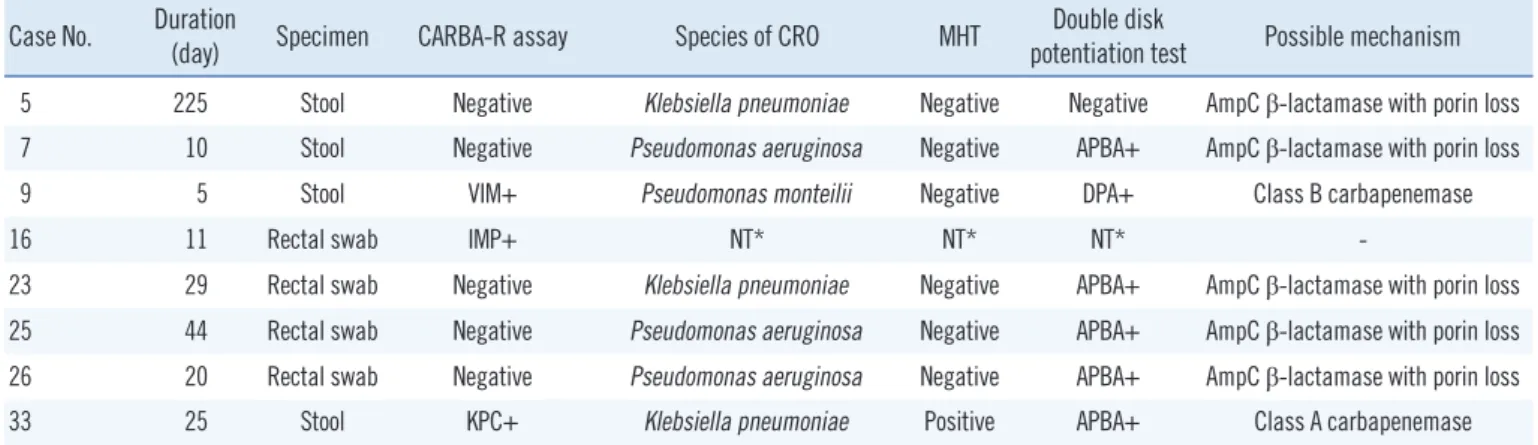
Three out of 40 samples (7.5%) tested positive by the CARBA- R assay, i.e., they showed one blaVIM-, one blaIMP-, and one blaKPC-positive signal, indicating that the prevalence of CPO was substantial in these ICU patients (Table 1). By conventional cul- ture, 16 out of 40 samples showed bacterial growth close to the MEM disk on MacConkey agar. Of these, seven isolates (three Klebsiella pneumoniae, three Pseudomonas aeruginosa, and one Pseudomonas monteilii) were resistant to MEM with a mini- mum inhibitory concentration (MIC) over 2 μg/mL. Among the seven MEM-resistant strains, two K. pneumoniae and three P.
aeruginosa were isolated from samples that tested negative by Xpert CARBA-R assay. For these five strains, the modified Hodge test was negative. In addition, enhanced inhibition zones were observed around APBA disks but not around DPA disks for four strains, and one strain showed no inhibition zone around either the APBA and DPA disks. This indicated that over-expression of
Table 1. Summary of the results showing positivity in CARBA-R assay or conventional culture assay Case No. Duration
(day) Specimen CARBA-R assay Species of CRO MHT Double disk
potentiation test Possible mechanism 5 225 Stool Negative Klebsiella pneumoniae Negative Negative AmpC β-lactamase with porin loss
7 10 Stool Negative Pseudomonas aeruginosa Negative APBA+ AmpC β-lactamase with porin loss
9 5 Stool VIM+ Pseudomonas monteilii Negative DPA+ Class B carbapenemase
16 11 Rectal swab IMP+ NT* NT* NT* -
23 29 Rectal swab Negative Klebsiella pneumoniae Negative APBA+ AmpC β-lactamase with porin loss 25 44 Rectal swab Negative Pseudomonas aeruginosa Negative APBA+ AmpC β-lactamase with porin loss 26 20 Rectal swab Negative Pseudomonas aeruginosa Negative APBA+ AmpC β-lactamase with porin loss
33 25 Stool KPC+ Klebsiella pneumoniae Positive APBA+ Class A carbapenemase
*Not tested owing to the lack of bacterial growth after overnight incubation in an enrichment (MacConkey) broth with 1 μg/mL MEM or no MEM-resistant colony around the MEM disk on MacConkey agar.
Abbreviations: APBA, aminophenylboronic acid; CCU, coronary care unit; CRO, carbapenem-resistant organism; DPA, dipicolinic acid; ERP, ertapenem;
ICU, intensive care unit, IMP, imipenem; MEM, meropenem; MHT, modified Hodge test; NCU, neurosurgical care unit; NT, not tested; PCCU, pediatric criti- cal care unit; VIM, Verona integron-mediated metallo-β-lactamase; KPC, Klebsiella pneumonia carbapenemase.
Kim D-K, et al.
Xpert CARBA-R assay to detect CPO
164 www.annlabmed.org http://dx.doi.org/10.3343/alm.2016.36.2.162 Amp-C β-lactamase along with porin loss might be the causes of
carbapenem resistance in these strains.
One P. monteilii isolate from a blaVIM-positive sample was neg- ative for the modified Hodge test using an IPM disk but positive for the DDS test, indicating the limitations of the modified Hodge test in carbapenemase screening owing to its relatively low sen- sitivity [15-17]. Additionally, no bacterial growth was observed from the sample showing a positive signal for blaIMP-, indicating that the CARBA-R assay is sensitive enough to detect CPO even in a rectal swab sample with a very low bacterial concentration.
Alternatively, this might indicate a limitation of this study: we fol- lowed the MEM resistance cut-off value for Enterobacteriaceae in the CLSI guidelines [18]; however, this cut-off can cause low levels of CPO resistance to be missed. In addition, a recent re- port showed that the CARBA-R assay does not perform well in the detection of OXA-48-producing Escherichia coli [19]. There- fore, further studies are required to determine the prevalence of CPO in specific settings and to determine the accuracy of the CARBA-R assay with organisms that exhibit a low level of resis- tance to carbapenems.
Regarding the turn-around time, while over three days were required for the conventional culture, the CARBA-R assay re- quired only about one hour, including 48 min running time.
The prevalences of intestinal colonization by CRO and CRE were 17.5% and 7.5%, respectively, in the ICUs of a tertiary care hospital in Korea, which is higher than those previously re- ported in similar settings [11, 12]. However, owing to the limited number of samples, further study will be needed to determine the true prevalence of CPO and CPE in the guts of ICU patients.
The Xpert CARBA-R assay was found to be an easy-to-use as- say, considering the labor and processing time required for con- ventional culture. The Xpert CARBA-R assay t should be ad- opted for surveillance and the determination of CPO colonization rates in clinical settings.
Authors’ Disclosures of Potential Conflicts of Interest
No potential conflicts of interest relevant to this article were re- ported.
Acknowledgments
Cartridges for this study were provided by Cepheid. This work was supported by BioNano Health-Guard Research Center, funded by the Ministry of Science, ICT & Future Planning
(MSIP) of Korea, as a Global Frontier Project (Grant Number H- GUARD_2014M3A6B2060509).
REFERENCES
1. Yong D, Shin HB, Kim YK, Cho J, Lee WG, Ha GY, et al. Increase in the prevalence of carbapenem-resistant Acinetobacter isolates and ampicil- lin-resistant non-typhoidal Salmonella species in Korea: a KONSAR Study Conducted in 2011. Infect Chemother 2014;46:84-93.
2. Chung HS, Lee Y, Park ES, Lee DS, Ha EJ, Kim M, et al. Characteriza- tion of the multidrug-resistant Acinetobacter species causing a nosoco- mial outbreak at intensive care units in a Korean Teaching Hospital:
suggesting the correlations with the clinical and environmental samples, including respiratory tract-related instruments. Ann Clin Microbiol 2014;
17:29-34.
3. Cornaglia G, Mazzariol A, Lauretti L, Rossolini GM, Fontana R. Hospital outbreak of carbapenem-resistant Pseudomonas aeruginosa producing VIM-1, a novel transferable metallo-beta-lactamase. Clin Infect Dis 2000;31:1119-25.
4. Gregory CJ, Llata E, Stine N, Gould C, Santiago LM, Vazquez GJ, et al.
Outbreak of carbapenem-resistant Klebsiella pneumoniae in Puerto Rico associated with a novel carbapenemase variant. Infect Control Hosp Epidemiol 2010;31:476-84.
5. Woodford N, Tierno PM Jr, Young K, Tysall L, Palepou MF, Ward E, et al.
Outbreak of Klebsiella pneumoniae producing a new carbapenem-hy- drolyzing class A beta-lactamase, KPC-3, in a New York Medical Center.
Antimicrob Agents Chemother 2004;48:4793-9.
6. Gibb AP, Tribuddharat C, Moore RA, Louie TJ, Krulicki W, Livermore DM, et al. Nosocomial outbreak of carbapenem-resistant Pseudomonas aeruginosa with a new bla(IMP) allele, bla(IMP-7). Antimicrob Agents Chemother 2002;46:255-8.
7. Tokatlidou D, Tsivitanidou M, Pournaras S, Ikonomidis A, Tsakris A, So- fianou D. Outbreak caused by a multidrug-resistant Klebsiella pneu- moniae clone carrying blaVIM-12 in a university hospital. J Clin Microbiol 2008;46:1005-8.
8. Wrenn C, O’Brien D, Keating D, Roche C, Rose L, Ronayne A, et al. In- vestigation of the first outbreak of OXA-48-producing Klebsiella pneu- moniae in Ireland. J Hosp Infect 2014;87:41-6.
9. Borer A, Saidel-Odes L, Eskira S, Nativ R, Riesenberg K, Livshiz-Riven I, et al. Risk factors for developing clinical infection with carbapenem-re- sistant Klebsiella pneumoniae in hospital patients initially only colonized with carbapenem-resistant K pneumoniae. Am J Infect Control 2012;
40:421-5.
10. Tacconelli E, Cataldo MA, Dancer SJ, De Angelis G, Falcone M, Frank U, et al. ESCMID guidelines for the management of the infection control measures to reduce transmission of multidrug-resistant Gram-negative bacteria in hospitalized patients. Clin Microbiol Infect 2014; 20:S1-55.
11. Kim J, Lee JY, Kim SI, Song W, Kim JS, Jung S, et al. Rates of fecal trans- mission of extended-spectrum β-lactamase-producing and carbapen- em-resistant Enterobacteriaceae among patients in intensive care units in Korea. Ann Lab Med 2014;34:20-5.
12. Zhao ZC, Xu XH, Liu MB, Wu J, Lin J, Li B. Fecal carriage of carbapen- em-resistant Enterobacteriaceae in a Chinese university hospital. Am J Infect Control 2014;42:e61-4.
13. Tenover FC, Canton R, Kop J, Chan R, Ryan J, Weir F, et al. Detection of colonization by carbapenemase-producing Gram-negative Bacilli in patients by use of the Xpert MDRO assay. J Clin Microbiol 2013;51:
3780-7.
14. Song W, Hong SG, Yong D, Jeong SH, Kim HS, Kim HS, et al. Com-
Kim D-K, et al.
Xpert CARBA-R assay to detect CPO
http://dx.doi.org/10.3343/alm.2016.36.2.162 www.annlabmed.org 165
bined use of the modified Hodge test and carbapenemase inhibition test for detection of carbapenemase-producing Enterobacteriaceae and metallo-β-lactamase-producing Pseudomonas spp. Ann Lab Med 2015;
35:212-9.
15. Lee W, Chung HS, Lee Y, Yong D, Jeong SH, Lee K, et al. Comparison of matrix-assisted laser desorption ionization-time-of-flight mass spec- trometry assay with conventional methods for detection of IMP-6, VIM- 2, NDM-1, SIM-1, KPC-1, OXA-23, and OXA-51 carbapenemase-pro- ducing Acinetobacter spp., Pseudomonas aeruginosa, and Klebsiella pneumoniae. Diagn Microbiol Infect Dis 2013;77:227-30.
16. Park YJ and Song W. Strategies for interpretive standards of β-lactams susceptibility testing and identification of extended-spectrum β-lactamases and carbapenemases in Enterobacteriaceae. Ann Clin Microbiol 2013;16:
111-9.
17. Seah C, Low DE, Patel SN, Melano RG. Comparative evaluation of a chromogenic agar medium, the modified Hodge test, and a battery of meropenem-inhibitor discs for detection of carbapenemase activity in Enterobacteriaceae. J Clin Microbiol 2011;49:1965-9.
18. Clinical and Laboratory Standards Institute. Performance standards for antimicrobial susceptibility tsting. M100-S24. Wayne, PA: Clinical and Laboratory Standards Institues, 2014.
19. Decousser JW, Poirel L, Desroches M, Jayol A, Denamur E, Nordmann P.
Failure to detect carbapenem-resistant Escherichia coli producing OXA- 48-like using the Xpert Carba-R assay. Clin Microbiol Infect 2015;21:e9- 10.