A Monteggia equivalent fracture is an uncommon child- hood injury comprising approximately 2% of all childhood elbow fractures. In very rare situations, it has been reported to be associated with ipsilateral limb injuries1-10). The author experienced an uncommon injury of the upper limb, name- ly, a Monteggia Type III equivalent fracture with a fracture of the ipsilateral distal radial epiphyseal (Salter-Harris type II) and an ulnar metaphyseal fracture in a child. No previ- ous reports has shown an injury identical to the one currently described. This paper describes the clinical and radiograph- ic findings and discusses the various treatment methods.
CASE REPORT
An eight-year-old boy was examined after fall from a height and was immediately referred to us for treatment. He had remarkable deformities and swelling of his forearm and wrist.
There was no external wound, and the sensory and finger
motions were not disturbed. The radiographs showed a meta- physeal fracture of the proximal radius with a lateral displace- ment as well as a diaphyseal fracture of the ulna. There was also a Salter-Harris Type II fracture separation of the distal radial epiphysis with a dorsal displacement as well as a meta- physeal fracture of the distal ulna with an ulnar angulation.
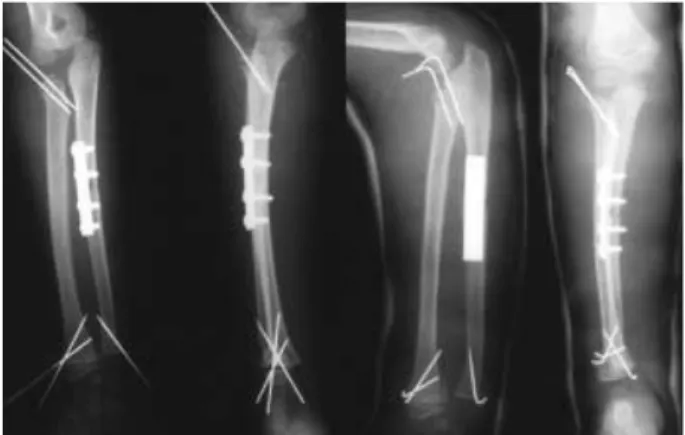
A dislocation was not noted in the proximal and distal ra- dioulnar joint (Fig. 1). Even though the closed reduction had been attempted under general anesthesia, the reduction was not acceptable due to the floating of the radial shaft and instability of the ulna. First, the diaphyseal fracture of the ulna was stabilized with an open reduction and internal fixa- tion with plate and screws. Second, a closed reduction and percutaneous pinning with K-wires were performed for the distal radial epiphyseal and ulnar metaphyseal fracture. Plate fixation for a diaphyseal fracture of the ulna provided suffi- cient stability to attempt a closed reduction of the fracture separation of the distal radial epiphysis and the distal ulnar metaphysis. Finally, a closed reduction of the proximal radi- al metapyseal fracture was attempted using a percutaneous pinning technique and was fixed with two K-wires. The open reduction was not required for the fractures of the proxi- mal and distal radius. A long arm cast was applied with the elbow in 90°flexion and neutral rotation. The postoperative
563 J. of Korean Orthop. Assoc.
2004; 39: 563-5
563
Type III Monteggia Equivalent Fracture with Ipsilateral Distal Radial Epiphyseal and Ulnar Metaphyseal Fracture in a Child
-Case Report-
Kwang Soon Song, M.D., and Ki Cheol Bae, M.D.
Department of Orthopedic Surgery, Keimyung University, Daegu, Korea
563 563 Address reprint requests to
Kwang Soon Song, M.D.
Department of Orthopedic Surgery, School of Medicine, Keimyung University 194 Dongsan-dong, Jung-gu, Daegu 700-712, Korea
Tel: +82.53-250-7250, Fax: +82.53-250-7205 E-mail: [email protected]
*No financial support was provided for this research, and the author has received nothing of value.
*This manuscript does not contain information about medical devices.
This paper present a rare case of a Type III Monteggia equivalent fracture with an ipsilateral distal radial epiphyseal (Salter-Harris type II) and an ulnar metaphyseal fracture in a child. An 8-year-old boy sustained a closed bipolar fracture of his forearm after a fall from a height. The closed reduction was unsuccess- ful. Therefore, an open reduction and plate fixation was performed for a diaphyseal fracture of the ulna, and the unstable radial fractures and the distal ulnar metaphyseal fracture were treated with a closed reduction and internal fixation using Kirschner wires (K-wires). Two years after surgery, the joint motion including the forearm, wrist and elbow were completely normal. Radiologically, the bone was well united without any residual deformity.
Key Words: Monteggia equivalent fracture, Forearm, Bipolar fracture, Plate fixation
radiographs showed an acceptable alignment (Fig. 2). The plaster cast was removed after four weeks and the patient began active exercise. The K-wires were removed at the 7- weeks follow up. The full range of motions and bony union were achieved at the 4-month follow up. The plate was re- moved at two years after surgery (Fig. 3).
DISCUSSION
A Monteggia equivalent fracture is uncommon in chil- dren. In addition, ipsilateral proximal and distal forearm injuries are quite rare. Such combinations previously report- ed include a Type II Monteggia lesion and a fracture sepa- ration of the lower radial epiphysis4), a Type IV Monteggia injury with a distal diaphyseal fracture of the radius9), and a Monteggia Type I lesion combined with a fracture sepa- ration of the distal radial epiphysis2,6). A simultaneous prox-
imal as well as a distal “bipolar” fracture of both bones of the forearm has also been described5). Bipolar fractures simi- lar to our case include a Monteggia Type III equivalent injury and a distal radial and ulnar fracture1), and a Monteggia Type II equivalent injury involving a fracture separation of the proximal radial epiphysis (Salter-Harris type II) combined with fracture separations of the distal radius (Salter-Harris type II) and ulna7). Our patient differed from the previous- ly described cases in terms of the level of the fracture in the ulna, the direction of the displacement, and the treatment methods. The fracture in our patient can be designated as a Monteggia Type III equivalent fracture involving a fracture of the proximal radial metaphysis with a lateral displace- ment and fracture of the diaphysis of the ulna combined with a fracture of the distal radial epiphysis (Salter-Harris type II) and a fracture of the distal ulnar metaphysis. The mechanism of an injury of the ipsilateral two level forearm fractures is not very well understood. In our case, a fall on the outstretched hand, a dorsiflexed wrist and a pronated forearm leads to a fracture of the distal radius and ulna. This is because as the force travels upwards, a varus force also comes into play. The Monteggia fracture dislocation in chil- dren usually does not require surgery3,10,11). However, a Mon- teggia equivalent with a fracture separation of the proximal radial epiphysis or of the distal ends is known to require an open reduction and internal fixation4,6,7,9). It has been previ- ously reported that the treatment of a Monteggia Type III equivalent fracture with a distal radial fracture using closed reduction achieved good results1). In a previously reported case, the level of the ulnar fracture was proximal and the degree of the displacement was minimal. In our patient, the
564 Kwang Soon Song∙Ki Cheol Bae
Fig. 1.Initial radiographs show displaced fractures of the distal radial epiphysis and a fracture of the distal ulnar metaphysis with a type III Monteggia equivalent fracture.
Fig. 2.Open reduction and plate fixation was performed for a diaphyseal fracture of the ulna and the radial fractures and the metaphyseal fracture of the ulna were treated with a closed re- duction and internal fixation using K-wires.
Fig. 3.Two years after surgery, radiographically, bone was well united without any residual deformity.
closed reduction under general anesthesia was not success- ful due to instability. In general, an isolated distal and prox- imal radial fracture can be managed with a closed reduction with or without internal fixation. Initially, firm stabiliza- tion of the ulna is essential for a closed reduction of the frac- tures of the radial side. Osada, et al.7)reported that K-wires reinforced with a circumferential wire might unsuitable for restoring the stability of this unstable fracture, and suggest- ed a secure fixation of the ulna with a plate. In this case, plate fixation of the ulnar diaphyseal fracture provided a sufficient stability during the closed reduction as well as the percuta- neus pinning of the unstable radial fractures and the distal ulnar metaphyseal fracture.
REFERENCES
1. Biyani A: Ipsilateral Monteggia equivalent injury and distal radi- al and ulnar fracture in a child. J Orthop Trauma, 8: 431-433, 1994.
2. Deshpande and O’Doherty: Type I Monteggia fracture dislo- cation associated with ipsilateral distal radial epiphyseal injury. J Orthop Trauma, 5: 373-375, 2001.
3. Givon U, Pritsch M, Levy O, Yosepovich A, Amit Y and Horoszowski H:Monteggia and equivalent lesions: a study of
41 cases. Clin Orthop, 337: 208-215, 1997.
4. Kristansen B and Eriksen AF: Simultaneous type II Monteggia lesion and fracture-separation of the lower radial epiphysis. Injury, 17: 51-52, 1986.
5. Odena IC: Bipolar fracture -dislocation of the forearm. J Bone Joint Surg, 34-A: 968-976, 1952.
6. Olney BW and Menelaus MB: Monteggia and equivalent lesion in childhood. J Pediatr Orthop, 9: 219-223, 1989.
7. Osada D, Tamai K, Kuramochi T and Saotome K: Three epiphyseal fracture (Distal radius and ulna and proximal radius) and a diaphyseal ulnar fracture in a seven-year-old child’s forearm.
J Orthop Trauma, 5: 375-377, 2001.
8. Reckling FW: Unstable fracture-dislocations of the forearm: Mon- teggia and Galeazzi lesions. J Bone Joint Surg, 64-A: 857-863, 1982.
9. Rodgers WB and Smith BG: Type IV Monteggia injury with a distal diaphyseal radius fracture in a child. J Orthop Trauma, 7:
84-86, 1993.
10. Shonnard PY and DeCoster TA: Combined Monteggia and Galeazzi fractures in a child’s forearm. A case report. Orthop Rev, 13: 60-63, 1999.
11. Wiely JJ and Galey JP: Monteggia injuries in children. J Bone Joint Surg, 67-B: 728-731, 1985.
Monteggia Equivalent Fracture with Ipsilateral Forearm Both Bones in a Child 565
소아에서 드문, 동측 원위 요골 골단(Salter-Harris II형) 및 척골 골간단부 골절이 동반된 제 3형 Monteggia 유사 골절의 치료 증례를 보고하고자 한다. 8세 남아로 낙상에 의한 전완부의 폐쇄성 양극성 골절로 내원을 하였다. 척골 골간부 골절 은 도수적 정복이 불가능하여 관혈적 정복술 및 금속판 내고정술을 시행하였고, 요골의 근위부, 원위부 골절 및 척골의 원 위 골간단부 골절은 도수적 정복술 및 K-강선 내고정을 시행하였다. 수술 후 2년에 주관절, 전완부 및 수근 관절 운동범위 는 정상이었으며 골절은 변형 없이 잘 유합되었다.
색인 단어: Monteggia 유사 골절, 전완부, 양극성 골절, 금속판 내고정술
소아에서 동측 원위 요골 골단 및 척골 골간단부 골절이 동반된 제 3형 Monteggia 유사 골절의 치료
- 증례 보고 -
송광순ㆍ배기철
계명대학교 의과대학 정형외과학교실