Endocrinol Metab 2019;34:390-397 https://doi.org/10.3803/EnM.2019.34.4.390 pISSN 2093-596X · eISSN 2093-5978
Original Article
Association between Serum Gamma-Glutamyltransferase and Prevalence of Metabolic Syndrome Using Data from the Korean Genome and Epidemiology Study
Mi Young Lee1, Dae Sung Hyon2, Ji Hye Huh1, Hae Kyung Kim1, Sul Ki Han1, Jang Young Kim1,3, Sang Baek Koh2,3,4
1Department of Internal Medicine, 2Department of Preventive Medicine and Institute of Occupational Medicine, 3Institute of Genomic Cohort, Yonsei University Wonju College of Medicine, Wonju; 4Center for Global Health and Social Medicine, Institute of Poverty Alleviation and International Development, Yonsei University, Seoul, Korea
Background: The aim of this study was to determine whether there is a positive correlation between gamma-glutamyltransferase (GGT) levels and the prevalence of metabolic syndrome and whether GGT can be used as an easily checkable metabolic index using data from the large-scale Korean Genome and Epidemiology Study (KoGES).
Methods: We obtained data of 211,725 participants of the KoGES. The collected data included age, sex, height, weight, waist cir- cumference, and various biochemical characteristics, including serum GGT levels. The data of study participants who ingested more than 40 g/day of alcohol and who were diagnosed with metabolic syndrome at baseline was excluded. We analyzed the prevalence of metabolic syndrome according to GGT quartiles in both genders.
Results: The GGT level was significantly higher in subjects with metabolic syndrome compared to normal subjects (37.92±48.20 mg/dL vs. 25.62±33.56 mg/dL). The prevalence of metabolic syndrome showed a stepwise increase with GGT quartiles in both male and female subjects. Compared to the lowest GGT quartile, the odds ratio was 1.534 (95% confidence interval [CI], 1.432 to 1.643), 1.939 (95% CI, 1.811 to 2.076), and 2.754 (95% CI, 2.572 to 2.948) in men and 1.155 (95% CI, 1.094 to 1.218), 1.528 (95%
CI, 1.451 to 1.609), and 2.022 (95% CI, 1.921 to 2.218) in women with increasing GGT quartile. The cutoff value of GGT predicting risk of metabolic syndrome was 27 IU/L in men and 17 IU/L in women.
Conclusion: We suggested that GGT could be an easily checkable marker for the prediction of metabolic syndrome.
Keywords: Gamma-glutamyltransferase; Metabolic syndrome; Korean Genome and Epidemiology Study
INTRODUCTION
Gamma-glutamyltransferase (GGT) is synthesized in the epi- thelial cells of the intrahepatic bile ducts and is considered an indicator of the degree of liver disease and alcohol consumption [1,2]. Recently, a number of reports revealed that GGT levels
are also associated with diabetes, hypertension, and cardiovas- cular mortality regardless of liver damage or alcohol consump- tion [3-6]. In addition, the prevalence and incidence of metabol- ic syndrome were also reported to increase with increasing se- rum GGT concentration or with longitudinal increasing of GGT levels [7-9]. The elevated GGT levels in these metabolic disease
Received: 23 April 2019, Revised: 18 September 2019, Accepted: 19 November 2019
Corresponding author: Sang Baek Koh
Department of Preventive Medicine, Yonsei University Wonju College of Medicine, 20 Ilsan-ro, Wonju 26426, Korea
Tel: +82-33-741-0341, Fax: +82-33-747-0409, E-mail: [email protected]
Copyright © 2019 Korean Endocrine Society
This is an Open Access article distributed under the terms of the Creative Com- mons Attribution Non-Commercial License (http://creativecommons.org/
licenses/by-nc/4.0/) which permits unrestricted non-commercial use, distribu- tion, and reproduction in any medium, provided the original work is properly cited.
had been explained that GGT is indirectly reflected the in- creased oxidative stress and chronic inflammation which is closely related with metabolic disease [10].
Despite the availability of metabolic markers, such as adipo- nectin, leptin, and tumor necrosis factor α, clinical professionals and patients require an easily measured and cheaper test [11].
Among the potential markers, we considered GGT a favorable laboratory marker to reflect metabolic syndrome. We previously reported the association between GGT and diabetes mellitus or metabolic syndrome using data from single center study sub- jects or Korean Rural Genomic Cohort (KRGC) study [7,9,12].
In this study, we investigated the association between GGT and the prevalence of metabolic syndrome using data from the large-scale Korean Genome and Epidemiology Study (KoGES).
METHODS
This study was conducted using data from the KoGES. The Ko- GES is an integrated study of Korean cohort-based surveys con- ducted in South Korea. The KoGES study is managed by the Korea Centers for Disease Control and Prevension (KCDC) and the design of the KoGES study has been published previously [13]. The KoGES study included a population-based prospec- tive cohort studies such as the KoGES-Ansan and Ansung, Ko- GES-health examinee (HEXA), and the KoGES-cardiovascular disease association (CAVAS) studies and also gene-environment model studies such as the KoGES-twin and family, KoGES-im- migrant, and KoGES-emigrant (Japan and China) studies. We used only data from the population-based KoGES studies and excluded data from the KoGES gene-environment model stud- ies.
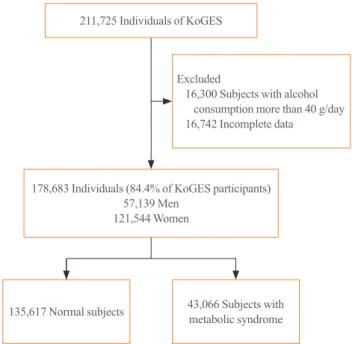
The baseline data were collected from 10,030 adults included in the KoGES-Ansan and Ansung study, 173,357 adults in the KoGES-HEXA study, and 28,338 adults in the KoGES-CA- VAS. We excluded data of study population who consumed more than 40 g of alcohol per day and who were diagnosed with metabolic syndrome at baseline. Thus, 178,683 from a total 211,725 subjects were included in this study (Fig. 1). The study protocol was approved by the Institutional Review Board (IRB;
CR317023) of Wonju Severance Christian Hospital. All partici- pants provided written informed consent before the commence- ment of the study.
The collected data from the KoGES study included social sta- tus (i.e., economic status, educational level, and residence), past medical history (i.e., diabetes mellitus, hypertension, dyslipid- emia, chronic kidney disease, cardiovascular disease), family
history of medical disease, and lifestyle pattern (i.e., smoking, alcohol consumption, exercise) [13]. Dietary assessment was achieved by a semi-quantitative food frequency questionnaire consisting of 103 items [14,15].
The measured anthropometric data was included height, weight, body mass index (BMI), blood pressure, and waist cir- cumference (WC). The collected biochemical parameters were fasting serum glucose level, total cholesterol, triglyceride (TG), high-density lipoprotein cholesterol (HDL-C), low-density lipo- protein cholesterol, aspartate aminotransferase (AST), alanine aminotransferase (ALT), and GGT levels.
The definition of metabolic syndrome was conducted by the modified criteria from the National Cholesterol Education Pro- gram Adult Treatment Panel III report [16-18]. We defined the metabolic syndrome as subjects who had three or more compo- nents among abdominal obesity, hypertriglyceridemia, low HDL- C, high blood pressure, and high fasting serum glucose level. WC cutoff points was ≥90 cm for men and ≥85 cm for women ac- cording to the abdominal obesity criteria from Korean Society for the Study of Obesity (KSSO) [19]. The definition of hyper- triglyceridemia was serum TG concentration of ≥150 mg/dL (1.69 mmol/L). The definition of low HDL-C was serum HDL- C concentration of <40 mg/dL (1.04 mmol/L) for men and
<50 mg/dL (1.3 mmol/L) for women. The definition of high blood pressure was ≥130/80 mm Hg or use of antihypertensive medication. The definition of high fasting serum glucose was
211,725 Individuals of KoGES
178,683 Individuals (84.4% of KoGES participants) 57,139 Men
121,544 Women
135,617 Normal subjects 43,066 Subjects with metabolic syndrome Excluded
16,300 Subjects with alcohol consumption more than 40 g/day 16,742 Incomplete data
Fig. 1. Study population. KoGES, Korean Genome and Epidemiol- ogy Study.
serum glucose concentration of ≥100 mg/dL (5.6 mmol/L) or use of antidiabetic medication.
To compare anthropometric and biochemical measurements and metabolic syndrome, we conducted two-sample t and chi- square tests. The prevalence of metabolic syndrome was calcu- lated by categorizing GGT values by quartiles. Because the GGT level was different between men and women, we analyzed the data divided by gender [20]. After stratification by sex, mul- tivariate logistic regression analysis was performed to evaluate the association between GGT and the prevalence of metabolic syndrome. Less than 25% of the GGT values were used as the reference category. The study adjusted for several variables, in- cluding age, alcohol, smoking, weight, blood pressure, and fast- ing plasma glucose level, to determine the independent associa- tion between GGT and incident metabolic syndrome. Multivari- ate logistic regression analysis was conducted to investigate the association of metabolic syndrome prevalence among the sub-
jects who had abnormal findings of each components including WC, blood pressure, TG, glucose, and HDL-C according to GGT quartiles. We analyzed the area under the receiver operat- ing characteristic curve (AUC) for measuring cutoff point of GGT predicting metabolic syndrome in men and women. We considered the data statistically significant as P values of <0.05.
The statistical analyses were performed using IBM SPSS Statis- tics for Windows version 23.0 (IBM Co., Armonk, NY, USA).
RESULTS
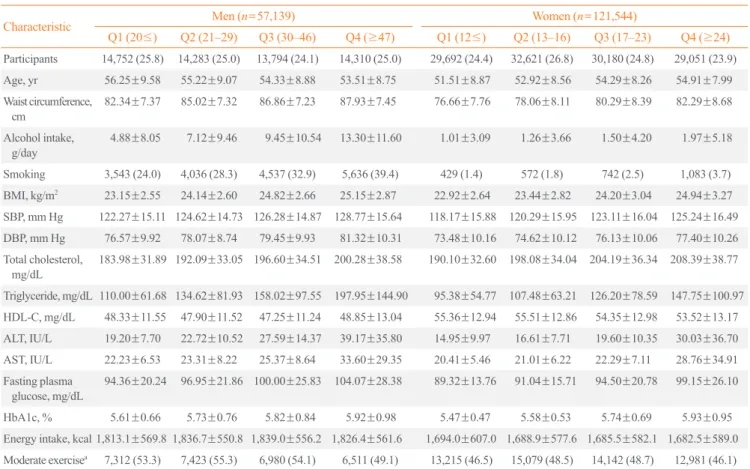
This study enrolled a total of 178,683 subjects with a mean age of 53.86±8.76 years (men 57,139, women 121,544). The gen- eral characteristics of tudy participants stratified with GGT quartiles and gender are shown in Table 1. Age, WC, BMI, blood pressure, total cholesterol, TG, ALT, AST, fasting glu- cose, and glycated hemoglobin were increased from 1st GGT
Table 1. Anthropometric and Biochemical Characteristics of Subjects at Baseline and Follow-up
Characteristic Men (n=57,139) Women (n=121,544)
Q1 (20≤) Q2 (21–29) Q3 (30–46) Q4 (≥47) Q1 (12≤) Q2 (13–16) Q3 (17–23) Q4 (≥24) Participants 14,752 (25.8) 14,283 (25.0) 13,794 (24.1) 14,310 (25.0) 29,692 (24.4) 32,621 (26.8) 30,180 (24.8) 29,051 (23.9) Age, yr 56.25±9.58 55.22±9.07 54.33±8.88 53.51±8.75 51.51±8.87 52.92±8.56 54.29±8.26 54.91±7.99 Waist circumference,
cm 82.34±7.37 85.02±7.32 86.86±7.23 87.93±7.45 76.66±7.76 78.06±8.11 80.29±8.39 82.29±8.68 Alcohol intake,
g/day 4.88±8.05 7.12±9.46 9.45±10.54 13.30±11.60 1.01±3.09 1.26±3.66 1.50±4.20 1.97±5.18
Smoking 3,543 (24.0) 4,036 (28.3) 4,537 (32.9) 5,636 (39.4) 429 (1.4) 572 (1.8) 742 (2.5) 1,083 (3.7) BMI, kg/m2 23.15±2.55 24.14±2.60 24.82±2.66 25.15±2.87 22.92±2.64 23.44±2.82 24.20±3.04 24.94±3.27 SBP, mm Hg 122.27±15.11 124.62±14.73 126.28±14.87 128.77±15.64 118.17±15.88 120.29±15.95 123.11±16.04 125.24±16.49 DBP, mm Hg 76.57±9.92 78.07±8.74 79.45±9.93 81.32±10.31 73.48±10.16 74.62±10.12 76.13±10.06 77.40±10.26 Total cholesterol,
mg/dL 183.98±31.89 192.09±33.05 196.60±34.51 200.28±38.58 190.10±32.60 198.08±34.04 204.19±36.34 208.39±38.77 Triglyceride, mg/dL 110.00±61.68 134.62±81.93 158.02±97.55 197.95±144.90 95.38±54.77 107.48±63.21 126.20±78.59 147.75±100.97 HDL-C, mg/dL 48.33±11.55 47.90±11.52 47.25±11.24 48.85±13.04 55.36±12.94 55.51±12.86 54.35±12.98 53.52±13.17 ALT, IU/L 19.20±7.70 22.72±10.52 27.59±14.37 39.17±35.80 14.95±9.97 16.61±7.71 19.60±10.35 30.03±36.70 AST, IU/L 22.23±6.53 23.31±8.22 25.37±8.64 33.60±29.35 20.41±5.46 21.01±6.22 22.29±7.11 28.76±34.91 Fasting plasma
glucose, mg/dL 94.36±20.24 96.95±21.86 100.00±25.83 104.07±28.38 89.32±13.76 91.04±15.71 94.50±20.78 99.15±26.10
HbA1c, % 5.61±0.66 5.73±0.76 5.82±0.84 5.92±0.98 5.47±0.47 5.58±0.53 5.74±0.69 5.93±0.95
Energy intake, kcal 1,813.1±569.8 1,836.7±550.8 1,839.0±556.2 1,826.4±561.6 1,694.0±607.0 1,688.9±577.6 1,685.5±582.1 1,682.5±589.0 Moderate exercisea 7,312 (53.3) 7,423 (55.3) 6,980 (54.1) 6,511 (49.1) 13,215 (46.5) 15,079 (48.5) 14,142 (48.7) 12,981 (46.1) Values are expressed as number (%) or mean±standard deviation.
BMI, body mass index; SBP, systolic blood pressure; DBP, diastolic blood pressure; HDL-C, high-density lipoprotein cholesterol; ALT, alanine amino- transferase; AST, aspartate aminotransferase; HbA1c, glycated hemoglobin.
aModerate physical exercise is defined regular physical exercise performed enough to sweat body.
quartile to 4th GGT quartiles in both men and women. The prevalence of metabolic syndrome showed a stepwise increase with higher GGT quartiles in both men and women (Table 2).
The prevalence of metabolic syndrome in the 1st, 2nd, 3rd, and 4th quartiles were 14.0%, 24.0%, 33.0%, and 43.8%, respec- tively, in men and 11.4%, 16.0%, 25.3%, and 36.1%, respec- tively, in women.
Compared to the lowest GGT quartile, the odds ratios (ORs) of subjects with 2nd, 3rd, and 4th quartiles were 1.534 (95%
confidence interval [CI], 1.432 to 1.643), 1.939 (95% CI, 1.811 to 2.076), and 2.754 (95% CI, 2.572 to 2.948) in men and 1.155 (95% CI, 1.094 to 1.218), 1.528 (95% CI, 1.451 to 1.609), and 2.022 (95% CI, 1.921 to 2.218) in women, respectively, after adjusting for age, alcohol intake, smoking, weight, blood pres- sure, and fasting plasma glucose concentration (Table 2).
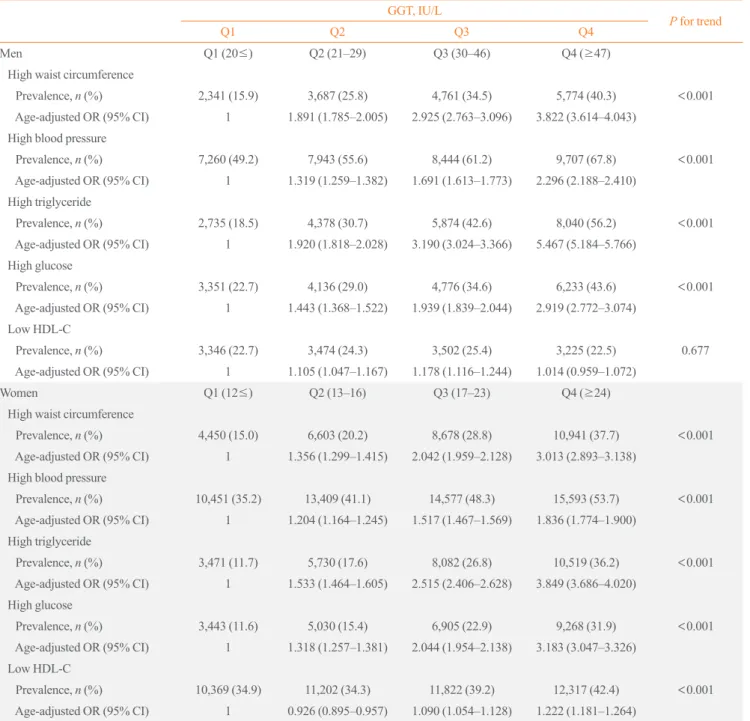
The prevalence of each component of metabolic syndrome by GGT quartile is shown in Table 3. With increasing GGT quar- tile, the proportions of subjects with high WC, blood pressure, TG level, and glucose level and low HDL-C level increased.
The OR for the prevalence of abnormal metabolic syndrome components also significantly increased according to GGT quar- tile in both men and women subjects (Table 3). The cutoff value of GGT predicting risk of metabolic syndrome was 27 IU/L in men and 17 IU/L in women (Fig. 2).
DISCUSSION
These results suggest that the prevalence of metabolic syndrome
increases with increasing GGT levels. These results were signif- icant even after adjusting for alcohol intake. Patients with meta- bolic syndrome have increased risks for diabetes, cardiovascular disease, and mortality. Therefore, various markers for metabolic syndrome have been proposed to predict and prevent cardiovas- cular disease [21]. Adiponectin is one of the most commonly used indicators of metabolic syndrome. Adiponectin, which is adipocytes derived from fat, binds to the nuclear receptor and improves the decreased insulin resistance in patients with diabe- tes mellitus, obesity, and metabolic syndrome [11,22,23]. Adi- ponectin and other adipocytokines can also be used as indicators of metabolic syndrome. However, they are complex and rela- tively expensive measurement. But, GGT is one of the easiest markers to measure and generally included in basic blood tests.
So, physicians can easily prescribe and interpret the GGT level.
Since the early 2000s, many studies have assessed the associ- ation between GGT and diabetes, metabolic syndrome, and car- diovascular disease [5,9,24-27]. In most cases, these were the results of cohort studies. In addition to basal GGT, changes in GGT are also associated with the development of metabolic syndrome [12]. Meta-analyses have also reported the associa- tion between GGT and metabolic syndrome [28,29].
The results of the present study were not significantly differ- ent from those of previous studies. However, this study has a power because we used data from the KoGES cohort, part of the largest cohort study in Korea, from nearly 210,000 subjects were analyzed. These analyses showed that the prevalence of metabolic syndrome linearly increased with increasing GGT Table 2. Prevalence of Metabolic Syndrome in Men and Women According to GGT Quartile
GGT, IU/L
P for trend
Q1 Q2 Q3 Q4
Men Q1 (20≤) Q2 (21–29) Q3 (30–46) Q4 (≥47)
Prevalence 2,061 (14.0) 3,435 (24.0) 4,546 (33.0) 6,264 (43.8) <0.001
Model 1 Reference 1.988 (1.871–2.112) 3.136 (2.957–3.327) 5.043 (4.760–5.342) Model 2 Reference 2.027 (1.907–2.154) 3.251 (3.063–3.451) 5.320 (5.014–5.645) Model 3 Reference 1.534 (1.432–1.643) 1.939 (1.811–2.076) 2.754 (2.572–2.948)
Women Q1 (12≤) Q2 (13–16) Q3 (17–23) Q4 (≥24)
Prevalence 3,392 (11.4) 5,233 (16.0) 7,640 (25.3) 10,495 (36.1) <0.001
Model 1 Reference 1.387 (1.322–1.455) 2.329 (2.226–2.438) 3.867 (3.700–4.042) Model 2 Reference 1.395 (1.330–1.463) 2.354 (2.250–2.464) 3.934 (3.763–4.112) Model 3 Reference 1.155 (1.094–1.218) 1.528 (1.451–1.609) 2.022 (1.921–2.128)
Values are expressed as number (%) or adjusted odds ratio (95% confidence interval). Model 1: age-adjusted; Model 2: Model 1 plus adjustment for al- cohol and smoking; Model 3: Model 2 plus adjustment for weight, blood pressure, and fasting plasma glucose.
GGT, gamma-glutamyltransferase.
Table 3. Prevalence of Abnormal Metabolic Syndrome Components in Men and Women According to GGT Quartile GGT, IU/L
P for trend
Q1 Q2 Q3 Q4
Men Q1 (20≤) Q2 (21–29) Q3 (30–46) Q4 (≥47)
High waist circumference
Prevalence, n (%) 2,341 (15.9) 3,687 (25.8) 4,761 (34.5) 5,774 (40.3) <0.001
Age-adjusted OR (95% CI) 1 1.891 (1.785–2.005) 2.925 (2.763–3.096) 3.822 (3.614–4.043) High blood pressure
Prevalence, n (%) 7,260 (49.2) 7,943 (55.6) 8,444 (61.2) 9,707 (67.8) <0.001
Age-adjusted OR (95% CI) 1 1.319 (1.259–1.382) 1.691 (1.613–1.773) 2.296 (2.188–2.410) High triglyceride
Prevalence, n (%) 2,735 (18.5) 4,378 (30.7) 5,874 (42.6) 8,040 (56.2) <0.001
Age-adjusted OR (95% CI) 1 1.920 (1.818–2.028) 3.190 (3.024–3.366) 5.467 (5.184–5.766) High glucose
Prevalence, n (%) 3,351 (22.7) 4,136 (29.0) 4,776 (34.6) 6,233 (43.6) <0.001
Age-adjusted OR (95% CI) 1 1.443 (1.368–1.522) 1.939 (1.839–2.044) 2.919 (2.772–3.074) Low HDL-C
Prevalence, n (%) 3,346 (22.7) 3,474 (24.3) 3,502 (25.4) 3,225 (22.5) 0.677
Age-adjusted OR (95% CI) 1 1.105 (1.047–1.167) 1.178 (1.116–1.244) 1.014 (0.959–1.072)
Women Q1 (12≤) Q2 (13–16) Q3 (17–23) Q4 (≥24)
High waist circumference
Prevalence, n (%) 4,450 (15.0) 6,603 (20.2) 8,678 (28.8) 10,941 (37.7) <0.001
Age-adjusted OR (95% CI) 1 1.356 (1.299–1.415) 2.042 (1.959–2.128) 3.013 (2.893–3.138) High blood pressure
Prevalence, n (%) 10,451 (35.2) 13,409 (41.1) 14,577 (48.3) 15,593 (53.7) <0.001 Age-adjusted OR (95% CI) 1 1.204 (1.164–1.245) 1.517 (1.467–1.569) 1.836 (1.774–1.900)
High triglyceride
Prevalence, n (%) 3,471 (11.7) 5,730 (17.6) 8,082 (26.8) 10,519 (36.2) <0.001 Age-adjusted OR (95% CI) 1 1.533 (1.464–1.605) 2.515 (2.406–2.628) 3.849 (3.686–4.020)
High glucose
Prevalence, n (%) 3,443 (11.6) 5,030 (15.4) 6,905 (22.9) 9,268 (31.9) <0.001
Age-adjusted OR (95% CI) 1 1.318 (1.257–1.381) 2.044 (1.954–2.138) 3.183 (3.047–3.326) Low HDL-C
Prevalence, n (%) 10,369 (34.9) 11,202 (34.3) 11,822 (39.2) 12,317 (42.4) <0.001 Age-adjusted OR (95% CI) 1 0.926 (0.895–0.957) 1.090 (1.054–1.128) 1.222 (1.181–1.264)
GGT, gamma-glutamyltransferase; OR, odds ratio; CI, confidence interval; HDL-C, high-density lipoprotein cholesterol.
quartile.
It is reported that higher GGT concentration predicts an in- creased risk of metabolic syndrome because GGT is a marker for oxidative stress [30-32]. Studies have revealed that oxidative stress is an important marker of pathogenesis in metabolic syn- drome [33-36]. Recently, several studies reported that GGT lev- el was related to the iron status. The increased toxic free iron
load could cause the GGT elevation [37]. The increased iron and GGT level was associated with metabolic syndrome [37].
In addition, the risk of nonalcoholic fatty liver disease (NAFLD) is increased in patients with metabolic syndrome [38,39]. Be- cause GGT level is frequently elevated in patients with NAFLD, patients with metabolic syndrome have higher GGT levels [38,40,41]. Increased GGT level in subjects with metabolic syn-
drome could be thought due to relationship with oxidative stress, results from NAFLD state, or other pathways, but exact mechanisms were not elucidated.
Although this study used large-scale data, it was difficult to determine the hazard ratio because only a part of the partici- pants in the KoGES underwent follow-up, so we could perform cross-sectional analysis. This is one limitation of the present study. Second limitation is that we could not clearly defined whether the increase in GGT level was related with liver disease or not. We just excluded the heavy alcohol drinking subjects.
The another limitation is that our results showed similar out- comes to other cohort studies. However, this result is first report that showed relationship between GGT levels and metabolic syndrome from data of all subjects included on KoGES study.
So the results of the present study emphasize the usefulness of GGT level as a marker for metabolic syndrome, again.
In conclusion, the analysis using large-scale population cohort data showed that the prevalence of metabolic syndrome in- creased with increasing GGT. Based on this, it can be concluded that GGT may reflect the risk of metabolic syndrome. We sug- gest that the easily measured GGT level could be a marker for metabolic syndrome.
CONFLICTS OF INTEREST
No potential conflict of interest relevant to this article was re- ported.
ACKNOWLEDGMENT
Data in this study were from the Korean Genome and Epidemi- ology Study (KoGES; 4851-302), National Research Institute of Health, Centers for Disease Control and Prevention, Ministry for Health and Welfare, Republic of Korea.
This study was supported by the Medical Research Center Program, Ministry of Science, ICT and Future Planning (2017 R1A5A2015369).
AUTHOR CONTRIBUTIONS
Conception or design: M.Y.L., J.H.H., H.K.K., S.K.H. Acquisi- tion, analysis, or interpretation of data: D.S.H., J.Y.K., S.B.K.
Drafting the work or revising: M.Y.L. Final approval of the man- uscript: S.B.K.
ORCID
Mi Young Lee https://orcid.org/0000-0002-0967-9350 Sang Baek Koh https://orcid.org/0000-0001-5609-6521
REFERENCES
1. Teschke R, Brand A, Strohmeyer G. Induction of hepatic microsomal gamma-glutamyltransferase activity following chronic alcohol consumption. Biochem Biophys Res Com- mun 1977;75:718-24.
1.0 0.8 0.6 0.4 0.2 0
1.0 0.8 0.6 0.4 0.2 0
1-Specificity 1-Specificity
Sensitivity Sensitivity
0 0.2 0.4 0.6 0.8 1.0 0 0.2 0.4 0.6 0.8 1.0
Fig. 2. The cutoff value of gamma-glutamyltransferase predicting the risk of metabolic syndrome. (A) Men. (B) Women. AUC, area under the receiver operating characteristic curve.
A B
Cut off : 27 AUC : 0.661
Cut off : 17 AUC : 0.658
2. Sharpe PC, McBride R, Archbold GP. Biochemical markers of alcohol abuse. QJM 1996;89:137-44.
3. Lee DH, Silventoinen K, Jacobs DR Jr, Jousilahti P, Tuomi- leto J. Gamma-glutamyltransferase, obesity, and the risk of type 2 diabetes: observational cohort study among 20,158 middle-aged men and women. J Clin Endocrinol Metab 2004;89:5410-4.
4. Kim DJ, Noh JH, Cho NH, Lee BW, Choi YH, Jung JH, et al. Serum gamma-glutamyltransferase within its normal concentration range is related to the presence of diabetes and cardiovascular risk factors. Diabet Med 2005;22:1134-40.
5. Ndrepepa G, Braun S, Cassese S, Fusaro M, Laugwitz KL, Schunkert H, et al. Relation of gamma-glutamyl transferase to cardiovascular events in patients with acute coronary syn- dromes. Am J Cardiol 2016;117:1427-32.
6. Williams KH, Sullivan DR, Nicholson GC, George J, Jen- kins AJ, Januszewski AS, et al. Opposite associations be- tween alanine aminotransferase and γ-glutamyl transferase levels and all-cause mortality in type 2 diabetes: analysis of the Fenofibrate Intervention and Event Lowering in Diabe- tes (FIELD) study. Metabolism 2016;65:783-93.
7. Lee MY, Koh SB, Koh JH, Nam SM, Shin JY, Shin YG, et al. Relationship between gamma-glutamyltransferase and metabolic syndrome in a Korean population. Diabet Med 2008;25:469-75.
8. Andre P, Balkau B, Vol S, Charles MA, Eschwege E; DESIR Study Group. Gamma-glutamyltransferase activity and de- velopment of the metabolic syndrome (International Diabe- tes Federation Definition) in middle-aged men and women:
data from the Epidemiological Study on the Insulin Resis- tance Syndrome (DESIR) cohort. Diabetes Care 2007;30:
2355-61.
9. Yadav D, Lee MY, Kim JY, Ryu H, Huh JH, Bae KS, et al.
Combined effect of initial and longitudinal increases in γ-glutamyltransferase on incident metabolic syndrome:
ARIRANG Study. Yonsei Med J 2017;58:763-9.
10. Bo S, Gambino R, Durazzo M, Guidi S, Tiozzo E, Ghione F, et al. Associations between gamma-glutamyl transferase, metabolic abnormalities and inflammation in healthy sub- jects from a population-based cohort: a possible implication for oxidative stress. World J Gastroenterol 2005;11:7109-17.
11. Lafontan M, Viguerie N. Role of adipokines in the control of energy metabolism: focus on adiponectin. Curr Opin Phar- macol 2006;6:580-5.
12. Lee MY, Weon CS, Ko CH, Lee BJ, Lee Y, Kim MJ, et al.
Relations between serum gamma-glutamyltransferase and
prevalence of diabetes mellitus. Korean J Med 2004;67:498- 505.
13. Kim Y, Han BG; KoGES group. Cohort profile: the Korean Genome and Epidemiology Study (KoGES) consortium. Int J Epidemiol 2017;46:e20.
14. Kim J, Kim Y, Ahn YO, Paik HY, Ahn Y, Tokudome Y, et al.
Development of a food frequency questionnaire in Koreans.
Asia Pac J Clin Nutr 2003;12:243-50.
15. Ahn Y, Kwon E, Shim JE, Park MK, Joo Y, Kimm K, et al.
Validation and reproducibility of food frequency question- naire for Korean genome epidemiologic study. Eur J Clin Nutr 2007;61:1435-41.
16. Alberti KG, Zimmet P, Shaw J. Metabolic syndrome: a new world-wide definition. A Consensus Statement from the In- ternational Diabetes Federation. Diabet Med 2006;23:469- 80.
17. American Heart Association; National Heart, Lung, and Blood Institue, Grundy SM, Cleeman JI, Daniels SR, Dona- to KA, et al. Diagnosis and management of the metabolic syndrome. An American Heart Association/National Heart, Lung, and Blood Institute Scientific Statement. Executive summary. Cardiol Rev 2005;13:322-7.
18. Expert Panel on Detection, Evaluation, and Treatment of High Blood Cholesterol in Adults. Executive summary of the third report of the National Cholesterol Education Pro- gram (NCEP) expert panel on detection, evaluation, and treatment of high blood cholesterol in adults (Adult Treat- ment Panel III). JAMA 2001;285:2486-97.
19. Yoon YS, Oh SW. Optimal waist circumference cutoff val- ues for the diagnosis of abdominal obesity in Korean adults.
Endocrinol Metab (Seoul) 2014;29:418-26.
20. Breitling LP, Raum E, Muller H, Rothenbacher D, Brenner H.
Synergism between smoking and alcohol consumption with respect to serum gamma-glutamyltransferase. Hepatology 2009;49:802-8.
21. Ferrannini E, Balkau B, Coppack SW, Dekker JM, Mari A, Nolan J, et al. Insulin resistance, insulin response, and obesi- ty as indicators of metabolic risk. J Clin Endocrinol Metab 2007;92:2885-92.
22. Arita Y, Kihara S, Ouchi N, Takahashi M, Maeda K, Miya- gawa J, et al. Paradoxical decrease of an adipose-specific protein, adiponectin, in obesity. Biochem Biophys Res Com- mun 1999;257:79-83.
23. Ouchi N, Kihara S, Arita Y, Okamoto Y, Maeda K, Kuriya- ma H, et al. Adiponectin, an adipocyte-derived plasma pro- tein, inhibits endothelial NF-kappaB signaling through a
cAMP-dependent pathway. Circulation 2000;102:1296-301.
24. Nakanishi N, Suzuki K, Tatara K. Serum gamma-glutamyl- transferase and risk of metabolic syndrome and type 2 dia- betes in middle-aged Japanese men. Diabetes Care 2004;27:
1427-32.
25. Nannipieri M, Gonzales C, Baldi S, Posadas R, Williams K, Haffner SM, et al. Liver enzymes, the metabolic syndrome, and incident diabetes: the Mexico City diabetes study. Dia- betes Care 2005;28:1757-62.
26. Lee JH, Um MH, Park YK. The association of metabolic syn- drome and serum γ-glutamyl transpeptidase: a 4-year cohort study of 3,698 Korean male workers. Clin Nutr Res 2013;
2:67-75.
27. Ndrepepa G, Kastrati A. Gamma-glutamyl transferase and cardiovascular disease. Ann Transl Med 2016;4:481.
28. Kunutsor SK, Apekey TA, Seddoh D. Gamma glutamyl-
transferase and metabolic syndrome risk: a systematic review and dose-response meta-analysis. Int J Clin Pract 2015;69:
136-44.
29. Liu CF, Zhou WN, Fang NY. Gamma-glutamyltransferase levels and risk of metabolic syndrome: a meta-analysis of prospective cohort studies. Int J Clin Pract 2012;66:692-8.
30. Lim JS, Yang JH, Chun BY, Kam S, Jacobs DR Jr, Lee DH.
Is serum gamma-glutamyltransferase inversely associated with serum antioxidants as a marker of oxidative stress?
Free Radic Biol Med 2004;37:1018-23.
31. Roberts CK, Barnard RJ, Sindhu RK, Jurczak M, Ehdaie A, Vaziri ND. Oxidative stress and dysregulation of NAD(P)H oxidase and antioxidant enzymes in diet-induced metabolic syndrome. Metabolism 2006;55:928-34.
32. Stocker R, Keaney JF Jr. Role of oxidative modifications in atherosclerosis. Physiol Rev 2004;84:1381-478.
33. Otani H. Oxidative stress as pathogenesis of cardiovascular risk associated with metabolic syndrome. Antioxid Redox
Signal 2011;15:1911-26.
34. Cannizzo B, Lujan A, Estrella N, Lembo C, Cruzado M, Castro C. Insulin resistance promotes early atherosclerosis via increased proinflammatory proteins and oxidative stress in fructose-fed ApoE-KO mice. Exp Diabetes Res 2012;
2012:941304.
35. Venturini D, Simao AN, Scripes NA, Bahls LD, Melo PA, Belinetti FM, et al. Evaluation of oxidative stress in over- weight subjects with or without metabolic syndrome. Obesi- ty (Silver Spring) 2012;20:2361-6.
36. Bonomini F, Rodella LF, Rezzani R. Metabolic syndrome, aging and involvement of oxidative stress. Aging Dis 2015;6:
109-20.
37. Koenig G, Seneff S. Gamma-glutamyltransferase: a predic- tive biomarker of cellular antioxidant inadequacy and dis- ease risk. Dis Markers 2015;2015:818570.
38. Ballestri S, Zona S, Targher G, Romagnoli D, Baldelli E, Nascimbeni F, et al. Nonalcoholic fatty liver disease is asso- ciated with an almost twofold increased risk of incident type 2 diabetes and metabolic syndrome. Evidence from a sys- tematic review and meta-analysis. J Gastroenterol Hepatol 2016;31:936-44.
39. Sookoian S, Pirola CJ. NAFLD. Metabolic make-up of NASH: from fat and sugar to amino acids. Nat Rev Gastro- enterol Hepatol 2014;11:205-7.
40. Banderas DZ, Escobedo J, Gonzalez E, Liceaga MG,
Ramirez JC, Castro MG. γ-Glutamyl transferase: a marker of nonalcoholic fatty liver disease in patients with the metabolic syndrome. Eur J Gastroenterol Hepatol 2012;24:805-10.
41. Thamer C, Tschritter O, Haap M, Shirkavand F, Machann J, Fritsche A, et al. Elevated serum GGT concentrations pre- dict reduced insulin sensitivity and increased intrahepatic lipids. Horm Metab Res 2005;37:246-51.