D I A B E T E S & M E T A B O L I S M J O U R N A L
This is an Open Access article distributed under the terms of the Creative Commons At- tribution Non-Commercial License (http://creativecommons.org/licenses/by-nc/3.0/) which permits unrestricted non-commercial use, distribution, and reproduction in any medium, provided the original work is properly cited.
Hexane Extract of Orthosiphon stamineus Induces Insulin Expression and Prevents Glucotoxicity in INS-1 Cells
Hae-Jung Lee1,*, Yoon-Jung Choi2,*, So-Young Park2, Jong-Yeon Kim2, Kyu-Chang Won3, Jong-Keun Son4, Yong-Woon Kim2
1Department of Pediatrics, Samsung Changwon Hospital, Sungkyunkwan University School of Medicine, Changwon, Departments of 2Physiology and 3Internal Medicine, Yeungnam University College of Medicine, Daegu,
4Yeungnam University College of Pharmacy, Gyeongsan, Korea
Background: Hyperglycemia, a characteristic feature of diabetes, induces glucotoxicity in pancreatic β-cells, resulting in further impairment of insulin secretion and worsening glycemic control. Thus, preservation of insulin secretory capacity is essential for the management of type 2 diabetes. In this study, we evaluated the ability of an Orthosiphon stamineus (OS) extract to prevent glucotoxicity in insulin-producing cells.
Methods: We measured insulin mRNA expression and glucose-stimulated insulin secretion (GSIS) in OS-treated INS-1 cells af- ter exposure to a high glucose (HG; 30 mM) concentration.
Results: The hexane extract of OS elevated mRNA expression of insulin as well as pancreatic and duodenal homeobox-1 of INS- 1 cells in a dose-dependent manner. The hexane OS extract also increased the levels of phosphorylated phosphatidylinositol 3-kinase (PI3K) in a concentration-dependent manner. Additionally, Akt phosphorylation was elevated by treatment with 100 and 200 μmol of the hexane OS extract. Three days of HG exposure suppressed insulin mRNA expression and GSIS; these ex- pressions were restored by treatment with the hexane OS extract. HG elevated peroxide levels in the INS-1 cells. These levels were unaffected by OS treatment under both normal and hyperglycemic conditions.
Conclusion: Our results suggested that the hexane extract of OS elevates insulin mRNA expression and prevents glucotoxicity induced by a 3-day treatment with HG. This was associated with the activation of PI-3K and Akt.
Keywords: Glucose-stimulated insulin secretion, Insulin mRNA; Glucotoxicity; Orthosiphon stamineus
Corresponding author: Yong-Woon Kim
Department of Physiology, Yeungnam University College of Medicine, 170 Hyeonchung-ro, Nam-gu, Daegu 705-717, Korea
E-mail: [email protected]
*Hae-Jung Lee and Yoon-Jung Choi contributed equally to this study as first
INTRODUCTION
Hyperglycemia is a key pathologic feature of type 2 diabetes that mainly results from insulin resistance and pancreatic β-cell dys- function. However, insulin resistance alone does not induce hy- perglycemia if compensatory insulin secretion is maintained.
When insulin secretion is not sufficient to overcome insulin re- sistance, hyperglycemia develops. Moreover, elevated glucose concentrations worsen defective insulin secretion. This condition is known as “glucotoxicity” [1-4]. Thus, β-cell preservation is es- sential for the prevention and management of type 2 diabetes.
Insulin is secreted through an exocytotic process that releases insulin granules following the influx of calcium ions through
voltage-dependent calcium channels. This results from the clo- sure of ATP-sensitive potassium channels [5] or the activation of the phospholipase C/phosphatidyl 4,5-biphosphate/diacylg- lycerol/protein kinase C pathway in response to glucose or other insulin secretagogues [6-8]. Additionally, insulin gene expres- sion is stimulated by glucose or signaling molecules through the activation of transcriptional factors, such as pancreatic duode- nal homeobox-1 (PDX-1) and musculoaponeurotic fibrosarco- ma oncogene homolog A (MafA) [9]. The expressions of PDX- 1 and MafA may be associated with the phosphatidylinositol 3-kinase (PI3K)/Akt pathway in insulin-producing cells [10,11].
In general, chronic hyperglycemia suppresses both insulin mRNA expression and glucose-induced insulin secretion [4]. Thus, pro- http://dx.doi.org/10.4093/dmj.2015.39.1.51
pISSN 2233-6079 · eISSN 2233-6087
tecting β-cells from glucotoxicity can preserve both insulin pro- duction and secretion.
Orthosiphon stamineus (OS) has been used as a traditional medicinal herb in Southeast Asian countries. Tea made from the leaves and roots of this plant is believed to ameliorate vari- ous pathologic conditions, such as rheumatic arthritis, diabetes, hypertension, tonsillitis, epilepsy, menstrual disorders, gonor- rhea, syphilis, renal calculus, and urinary lithiasis [12,13]. Re- cently, other beneficial effects were reported, including antidia- betic, anti-inflammatory, antiproliferative, and antiangiogenic activities [14-18]. Moreover, several previous reports have pro- vided evidence for the metabolic effects of OS. Sriplang et al.
[14] found that OS increases insulin secretion in perfused rat pancreas. Furthermore, Son et al. [19] reported that crude OS extract elevates plasma levels of insulin in rats, while Choi et al.
[20] demonstrated the leptin stimulating effect of OS both in vi- tro and in vivo. Mohamed et al. [18] also showed that OS exerts antidiabetic effects in streptozotocin (STZ)-diabetic rats. How- ever, we still do not know whether OS stimulates insulin pro- duction or protects β-cell from glucotoxicity. The purpose of the current investigation was to determine (1) whether OS elevates insulin secretion and/or production; (2) whether OS prevents glucotoxicity in vitro; and (3) which mechanisms influence these effects in insulin secreting INS-1 cells.
METHODS
INS-1 cell culture
Roswell Park Memorial Institute medium (RPMI)-1640 medi- um, antibiotics, and trypsin-ethylenediaminetetraacetic acid (EDTA) were purchased from Gibco (Grand Island, NY, USA).
Other reagents for cell culturing were purchased from Sigma- Aldrich Co. (St. Louis, MO, USA). INS-1 cells from rat insulin- oma were grown in RPMI-1640 medium containing 11.1 mM pyruvate, 10 mM 4-(2-hydroxyethyl)piperazine-1-ethanesul- fonic acid (HEPES), 50 μM 2-mercaptoethanol, 100 U/mL penicillin, and 100 g/mL streptomycin in 5% CO2-95% air at 37°C. The RPMI-1640 medium used for all of the experiments contained the supplements noted above. All studies were per- formed using the INS-1 cells between passages 21 and 29. For the screening of the stimulating effect of OS in insulin mRNA expression, we treated various OS extracts for 12 hours. We found that the hexane extract of OS stimulated insulin mRNA expression. Glucotoxicity was induced by treatment with high glucose (HG; 30 mM) levels for 3 days and was confirmed by
observing impaired glucose-stimulated insulin secretion (GSIS) in the INS-1 cells. The INS-1 cells cultured at HG or at the nor- moglycemic condition were treated with the hexane OS extract (200 μM) for 12 hours and then harvested to measure insulin mRNA expression, insulin secretory capacity, and reactive oxy- gen species (ROS) levels. The signaling proteins (PI3K and Akt) were analyzed after 1 hour of treatment with the hexane OS ex- tract at 0, 50, 100, or 200 μM concentrations in the INS-1 cells cultured at a normal glucose condition.
Production of OS extract
Dried OS leaves imported from Indonesia were kindly donated by Dongbang FTL Co. (Seoul, Korea). A voucher specimen (OS201103) has been deposited at the Yeungnam University College of Pharmacy (Gyeongsan, Korea). Dried OS powder (78.6 g) was subjected to extraction with 70% ethanol by reflux for 12 hours as previously described by Choi et al. [20] The eth- anol solution was then completely evaporated. The ethanol ex- tract residue (8.8 g) was suspended in H2O (1.5 L), and the H2O layer was partitioned with n-hexane, ethylacetate, and n-buta- nol (each 1.5 L×3). The resulting four extracts were completely evaporated to recover the n-hexane (445 mg), H2O (2,409 mg), n-butanol (934.3 mg), and ethylacetate (1,175 mg) fractions.
Glucose stimulated insulin secretion test
The INS-1 cells were incubated in Krebs-Ringer buffer (KRB; 118 mmol/L NaCl, 4.7 mmol/L KCl, 2.5 mmol/L CaCl2, 1.18 mmol/L KH2PO4, 1.18 mmol/L MgSO4, 25 mmol/L NaHCO3, 10 mmol/L HEPES; and 0.1% bovine serum albumin (BSA, pH 7.4) that contained either normal (5.6 mM) or stimulatory (16.7 mM) concentrations of glucose for 2 hours. The incubation period was terminated by adding 1 mL of an ethanol:hydrochloric acid (95:5, v:v) solution, and the KRB was collected. Insulin levels in the buf- fer samples were measured with an enzyme-linked immunosor- bent assay (rat insulin-specific ELISA kit; Mercodia, Uppsala, Sweden) according to the manufacturer’s protocol.
Real time-polymerase chain reaction
Total RNA was obtained from the INS-1 cells using Trizol re- agent (Bio Science Technology, Daejeon, Korea). cDNA was synthesized using 1 μg of total RNA with oligo-(dT) primers (Bioneer, Daejeon, Korea) and Prime RT Premix (GeNet Bio, Seoul, Korea). Real time-polymerase chain reaction was per- formed with a LightCycler (Roche, Mannheim, Germany) as previously described [20]. The following primers were used:
5'-ACC CAA GTC CCG TCG TGA AGT-3' (forward) and 5'- CCA GTT GGT AGA GGG AGC AGA TG-3' (reverse) for insulin, 5'-GGC TTA ACC TAA ACG CCA CA-3' (forward) and 5'-GGG ACC GTC CAA GTT TGT AA-3' (reverse) for PDX-1, and 5'-TAC TGC CCT GGC TCC TAG CA-3' (for- ward) and 5'-TGG ACA GTG AGG CCA GGA TAG-3' (re- verse) for β-actin.
Evaluation of ROS production with flow cytometry The intracellular peroxide levels were measured by flow cytom- etry using an oxidation-sensitive fluorescein-labeled dye, car- boxylated dichlorodi-hydrofluorescein diacetate (carboxy- H2DCFDA; Molecular Probes, Carlsbad, CA, USA). The non- fluorescent dye is converted into a fluorescent form through an oxidative process by intracellular ROS. The INS-1 cells were la- beled with 100 M carboxy-H2DCFDA for 1 hour at 37°C. After loading with the dye, the cells were washed twice with phos- phate buffered saline (PBS) and further incubated for 2 hours.
The INS-1 cells were then harvested, washed twice with PBS, and re-suspended in trypsin-EDTA (0.25% trypsin and 2 mM Na4-EDTA) for 5 minutes at 37°C. To disperse the cells in a sin- gle suspension, the INS-1 cells were gently passed 20 times in and out of a 1-mL pipette tip. The cells were then washed twice with ice-cold PBS and analyzed with a 488-nm argon laser EP- ICS XL-MCL flow cytometer with EXPO 32-ADC software (Beckman Coulter, Fullerton, CA, USA). The ROS concentra- tions were measured based on fluorescence intensity.
Western blotting
Proteins (30 μg) in an INS-1 cell lysate were separated in 10%
polyacylamide gels and were transferred onto nitrocellulose membranes. The levels of phosphorylated PI3K, p-Akt, and glyceraldehyde 3-phosphate dehydrogenase (GAPDH) were measured by incubating the blots with primary antibodies spe- cific for these factors (1:1,000 dilution). Antibodies for p-PI3K and GAPDH were purchased from Santa Cruz Biotechnology (Santa Cruz, CA, USA) and the anti-p-Akt antibody was ob- tained from Cell Signaling Technology (Danvers, MA, USA).
The secondary horseradish peroxidase-conjugated anti-rabbit antibody (1:2,000 dilution) was used to detect primary anti- body binding. The blots were developed with an enhanced che- miluminescence reagent (Amersham Biosciences, Little Chalfont, UK), and band intensities were quantified using Multi Gauge soft- ware (Fujifilm, Tokyo, Japan).
Data analysis
All of the results are expressed as the mean±standard error. One- way analysis of variance was used for comparisons of dose-de- pendent changes. Post hoc comparisons were performed using Duncan’s test. Statistical comparisons of insulin mRNA expres- sion and peroxide level between the control and OS-treated groups were evaluated by Student t-test. Values of P<0.05 were considered statistically significant.
RESULTS
Insulin mRNA expression and OS extracts
Crude OS extract elevated insulin mRNA expression in the INS-1 cells under both normal and HG conditions. Further- more, the hexane and ethylacetate fractions elevated insulin mRNA expression in the INS-1 cells under normal and HG conditions. In contrast, the water and butanol OS fractions failed to affect insulin mRNA expression (Fig. 1). The hexane OS extract elevated insulin and PDX-1 mRNA levels in a dose- dependent manner in the INS-1 cells (Fig. 2).
Glucotoxicity protecting effect of the OS extract
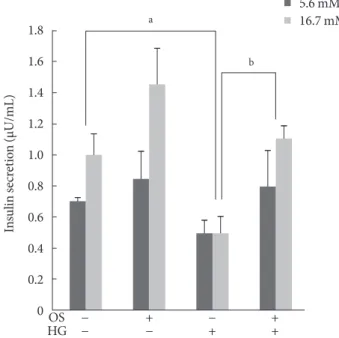
Three days of HG completely suppressed GSIS, indicating that glucotoxicity had been induced in the INS-1 cells. The hexane OS extract (200 μM) protected the INS-1 cells from glucotox- icity. Moreover, treatment with the hexane extract slightly ele- vated insulin secretion in both the basal and glucose-stimulat- ed states (Fig. 3).
OS extract and phosphorylation of PI3K and Akt
To investigate possible mechanisms underlying the induction of insulin expression by the hexane OS extract, we evaluated signaling molecules that influence insulin expression. The hex- ane OS extract increased p-PI3K levels in a dose-dependent manner. Akt phosphorylation was also increased by treatment with 100 and 200 μmoL of the OS extract (Fig. 4).
OS extract and oxidative stress
To determine whether the ability of the OS extract to protect β-cells is mediated by changes in oxidative stress, we measured the cellular peroxide levels. HG elevated the peroxide concen- trations in the INS-1 cells. Treatment with the OS extract did not affect the levels in the cells under either normal or hyper- glycemic conditions (Fig. 5).
DISCUSSION
In the present study, we demonstrated that treatment with the hexane OS extract elevated insulin mRNA expression in INS- 1 cells. Additionally, the extract prevented glucotoxicity in-
duced by HG exposure. These beneficial effects may be medi- ated by the activation of PI3K, Akt, and PDX-1.
Previous studies demonstrated that chronic HG impairs the insulin secretory capacity as well as insulin gene expression [4,21,22]. These findings are consistent with the results of our
250
200
150
100
50
Insulin mRNA expression (% of control) 0
− + − + − + − + − + − + − + − + − + − +
− − + + − − + + − − + + − − + + − − + +
a
c d
b
a a a
c
c c
b b
b,f b,e
Crude Hexne H2O BuOH EtOAc
Fig. 1. The effects of various fractions of Orthosiphon stamineus (OS) extract on insulin mRNA expression in INS-1 cells under normal and hyperglycemic (exposure to high glucose [HG] for 3 days) conditions. The cells were treated with each OS extract (200 μM) for 12 hours. Bars represent the mean±standard error of three separate experiments. BuOH, n-butanol; EtOAc, ethyl- acetate. aP<0.05, bP<0.01, and cP<0.001 versus the untreated cells under normal conditions, dP<0.05, eP<0.01, and fP<0.001 versus the untreated HG control.
HGOS
250
200
150
100
50
Insulin mRNA expression (% of control) 0
b
c
0 50 100 200
OS (μM)
200
150
100
50
PDX-1 mRNA expression (% of control) 0
0 50 100 200
OS (μM)
a a
b
b
A B
Fig. 2. The effects of various concentrations of Orthosiphon stamineus (OS) extract on the mRNA expression of (A) insulin and (B) pancreatic and duodenal homeobox-1 (PDX-1) in INS-1 cells. Cells were treated with the hexane OS extract at concentra- tions of 0, 50, 100, and 200 μM for 12 hours. Bars represent the mean±standard error of three separate experiments.
a,b,cValues that do not share a common superscript are significantly different at P<0.05.
a a
Fig. 4. The effects of various doses of Orthosiphon stamineus (OS) extract on (A) phosphatidylinositol 3-kinase (PI3K) and (B) Akt phosphorylation in INS-1 cells. Cells were treated with the hexane OS extract at concentrations of 0, 50, 100, and 200 μM for 12 hours. Bars represent the mean±standard error of three separate experiments. GAPDH, glyceraldehyde 3-phosphate dehy- drogenase.
a,b,cValues that do not share a common superscript are significantly different at P<0.05.
3
2
1
0 p-PI3K/GAPDH (fold increase)
0 50 100 200
a
c
OS (μM) p-PI3K
GAPDH
0 50 100 200
OS (μM)
2.5 2.0 1.5 1.0 0.5 0 p-Akt/GAPDH (fold increase)
0 50 100 200
b
b
OS (μM) p-Akt
GAPDH
0 50 100 200
OS (μM)
A B
a a a
b
1.8 1.6 1.4 1.2 1.0 0.8 0.6 0.4 0.2 0
Insulin secretion (μU/mL)
a
b
− + − + − − + + 5.6 mM 16.7 mM
Fig. 3. Effect of the hexane Orthosiphon stamineus (OS) ex- tract on glucose-stimulated insulin secretion (GSIS) in INS-1 cells. OS extract treatment (200 μM for 12 hours) restored GSIS that was completely suppressed by exposure to high glu- cose (HG) for 3 days. Bars represent the mean±standard error of three separate experiments. aP<0.05, bP<0.01.
HGOS
200
150
100
50
0
Peroxide level
− + − +
− − + +
a b
Fig. 5. Effects of the hexane Orthosiphon stamineus (OS) ex- tract on intracellular peroxide levels in INS-1 cells under nor- mal and high glucose (HG) conditions. Cells were treated with 200 μM of the hexane extract for 12 hours. Bars represent the mean±standard error of three separate experiments. aP<0.01,
bP<0.001 versus the untreated cells cultured under normal conditions.
OSHG
function by maintaining insulin gene expression is essential for treating type 2 diabetes. In the present investigation, we wanted to evaluate the ability of OS to protect β-cells from glucotoxici- ty induced by HG exposure in vitro.
Previous studies have demonstrated that OS extract stimu- lates insulin secretion in vivo and ex vivo [14,19]. In the present study, indicating that HG treatment suppressed both insulin
gene expression and GSIS. Therefore, preservation of β-cell
investigation, we demonstrated that the crude OS extract in- duces insulin mRNA expression in INS-1 cells. To determine which components of the crude OS extract are responsible for the stimulation of insulin production, we performed a fraction- ation. Our data indicated that the ethylacetate and hexane frac- tions elevated insulin mRNA expression under normal and HG conditions for 12 hours. The ethylacetate extract induced cell death when the INS-1 cells were cultured with HG levels for 3 days (data not shown). We subsequently evaluated the ability of the hexane OS extract to preserve β-cell function. The hex- ane OS extract stimulated insulin mRNA expression as well as insulin secretion. Moreover, the extract protected β-cells from glucotoxicity induced by HG exposure. In contrast, Mohamed et al. [18] demonstrated that the antidiabetic effect of OS is as- sociated with the inhibition of intestinal glucose absorption and the elevation of diaphragm glucose uptake rather than the stimulation of insulin secretion. This difference may have re- sulted from different experimental settings. They conducted their experiment with STZ-diabetic rats that develop defective insulin secretion because their pancreatic islets are destroyed by STZ injection.
To evaluate the mechanism underlying the effect of OS on insulin mRNA expression, we next analyzed the expression and activation of several signaling molecules. There are several tran- scriptional factors that control insulin mRNA expression, such as PDX-1, neurogenic differentiation 1 (NeuroD1), and MafA.
Among these, PDX-1 is a key factor that controls insulin gene expression [23,24]. It is also well known that Akt activates PDX- 1 in insulin-producing cells [11,25,26]. Moreover, Akt deletion results in defective insulin secretion from pancreatic islet β-cells [27]. PI3K also affects PDX-1 expression in insulin-producing cells [11,28] According to Glauser and Schlegel [10], signals from the insulin receptor, insulin-like growth factor receptor, or epidermal growth factor receptor activate PI3K, which in turn activates Akt, forkhead box protein O, and PDX-1 in insulin- producing cells. We therefore evaluated the involvement of PI3K and Akt in the ability of OS to enhance insulin mRNA expression. We demonstrated that PDX-1, PI3K, and Akt are activated following treatment with the OS extracts.
Another possible mechanism underlying β-cell preserva- tion by OS is the antioxidant activity of the extracts [29]. It is well known that oxidative stress is an important cause of glu- cotoxicity [1-4] and the treatment with antioxidants amelio- rates glucotoxicity [2,30]. It was also reported that OS has an antioxidant effect on human mononuclear cells [31] and in an
in vitro model system [32]. Furthermore, polyphenol (a major component of OS) extracted from natural products protects against cytokine-induced β-cell damage by maintaining redox homeostasis [33]. However, OS did not affect the intracellular peroxide levels of the INS1 cells in the present study under ei- ther normal or HG conditions. Although we could not explain why the hexane OS extract did not produce any antioxidant effects in our study, the results of the current investigation sug- gest that the hexane extract contains an insulin secretagogue.
Several groups discovered that OS contains physiologically active compounds, such as terpenoids, polyphenols, sterols, orthosiphols, saponins, flavonoids, caffeic acid, oleanolic acid, and rosmarinic acid [12,34,35]. However, it is not yet known which compound is responsible for stimulating insulin secre- tion. Further study is needed to identify the biologically active compounds in OS.
In summary, the results of our study demonstrated that hex- ane OS extract elevates insulin mRNA expression. Additionally, the extract conferred protection against glucotoxicity induced by a 3-day exposure to HG concentrations. These effects may be associated with the activation of PI-3K and Akt. Further studies are required to identify the active compounds responsible for the beneficial activities of OS.
CONFLICTS OF INTEREST
No potential conflict of interest relevant to this article was re- ported.
REFERENCES
1. Poitout V, Robertson RP. Glucolipotoxicity: fuel excess and be- ta-cell dysfunction. Endocr Rev 2008;29:351-66.
2. Won KC, Moon JS, Eun MJ, Yoon JS, Chun KA, Cho IH, Kim YW, Lee HW. A protective role for heme oxygenase-1 in INS-1 cells and rat islets that are exposed to high glucose conditions.
J Korean Med Sci 2006;21:418-24.
3. Poitout V, Robertson RP. Minireview: secondary beta-cell fail- ure in type 2 diabetes: a convergence of glucotoxicity and lipo- toxicity. Endocrinology 2002;143:339-42.
4. Kim YW, Moon JS, Seo YJ, Park SY, Kim JY, Yoon JS, Lee IK, Lee HW, Won KC. Inhibition of fatty acid translocase cluster determinant 36 (CD36), stimulated by hyperglycemia, prevents glucotoxicity in INS-1 cells. Biochem Biophys Res Commun 2012;420:462-6.
5. Ashcroft FM, Gribble FM. ATP-sensitive K+ channels and in- sulin secretion: their role in health and disease. Diabetologia 1999;42:903-19.
6. Zawalich WS, Zawalich KC, Kelley GG. Regulation of insulin release by phospholipase C activation in mouse islets: differen- tial effects of glucose and neurohumoral stimulation. Endocri- nology 1995;136:4903-9.
7. Persaud SJ, Jones PM, Howell SL. Activation of protein kinase C is essential for sustained insulin secretion in response to cholinergic stimulation. Biochim Biophys Acta 1991;1091:
120-2.
8. Uchida T, Iwashita N, Ohara-Imaizumi M, Ogihara T, Nagai S, Choi JB, Tamura Y, Tada N, Kawamori R, Nakayama KI, Naga- matsu S, Watada H. Protein kinase Cdelta plays a non-redun- dant role in insulin secretion in pancreatic beta cells. J Biol Chem 2007;282:2707-16.
9. Hagman DK, Latour MG, Chakrabarti SK, Fontes G, Amyot J, Tremblay C, Semache M, Lausier JA, Roskens V, Mirmira RG, Jetton TL, Poitout V. Cyclical and alternating infusions of glu- cose and intralipid in rats inhibit insulin gene expression and Pdx-1 binding in islets. Diabetes 2008;57:424-31.
10. Glauser DA, Schlegel W. The emerging role of FOXO transcrip- tion factors in pancreatic beta cells. J Endocrinol 2007;193:
195-207.
11. Furuya F, Shimura H, Asami K, Ichijo S, Takahashi K, Kaneshige M, Oikawa Y, Aida K, Endo T, Kobayashi T. Ligand-bound thy- roid hormone receptor contributes to reprogramming of pan- creatic acinar cells into insulin-producing cells. J Biol Chem 2013;288:16155-66.
12. Awale S, Tezuka Y, Banskota AH, Adnyana IK, Kadota S. Nitric oxide inhibitory isopimarane-type diterpenes from Orthosi- phon stamineus of Indonesia. J Nat Prod 2003;66:255-8.
13. Awale S, Tezuka Y, Banskota AH, Adnyana IK, Kadota S. High- ly-oxygenated isopimarane-type diterpenes from Orthosiphon stamineus of Indonesia and their nitric oxide inhibitory activi- ty. Chem Pharm Bull (Tokyo) 2003;51:268-75.
14. Sriplang K, Adisakwattana S, Rungsipipat A, Yibchok-Anun S.
Effects of Orthosiphon stamineus aqueous extract on plasma glucose concentration and lipid profile in normal and strepto- zotocin-induced diabetic rats. J Ethnopharmacol 2007;109:
510-4.
15. Yam MF, Asmawi MZ, Basir R. An investigation of the anti-in- flammatory and analgesic effects of Orthosiphon stamineus leaf extract. J Med Food 2008;11:362-8.
16. Yam MF, Lim V, Salman IM, Ameer OZ, Ang LF, Rosidah N,
Abdulkarim MF, Abdullah GZ, Basir R, Sadikun A, Asmawi MZ. HPLC and anti-inflammatory studies of the flavonoid rich chloroform extract fraction of Orthosiphon stamineus leaves.
Molecules 2010;15:4452-66.
17. Doleckova I, Rarova L, Gruz J, Vondrusova M, Strnad M, Krystof V. Antiproliferative and antiangiogenic effects of flavone eupato- rin, an active constituent of chloroform extract of Orthosiphon stamineus leaves. Fitoterapia 2012;83:1000-7.
18. Mohamed EA, Yam MF, Ang LF, Mohamed AJ, Asmawi MZ.
Antidiabetic properties and mechanism of action of Orthosi- phon stamineus Benth bioactive sub-fraction in streptozoto- cin-induced diabetic rats. J Acupunct Meridian Stud 2013;6:
31-40.
19. Son JY, Park SY, Kim JY, Won KC, Kim YD, Choi YJ, Zheng MS, Son JK, Kim YW. Orthosiphon stamineus reduces appetite and visceral fat in rats. J Korean Soc Appl Biol Chem 2011;54:200-5.
20. Choi YJ, Park SY, Kim JY, Won KC, Kim BR, Son JK, Lee SH, Kim YW. Combined treatment of betulinic acid, a PTP1B in- hibitor, with Orthosiphon stamineus extract decreases body weight in high-fat-fed mice. J Med Food 2013;16:2-8.
21. Tajiri Y, Grill V. Aminoguanidine exerts a beta-cell function- preserving effect in high glucose-cultured beta-cells (INS-1).
Int J Exp Diabetes Res 2000;1:111-9.
22. Roger B, Papin J, Vacher P, Raoux M, Mulot A, Dubois M, Kerr- Conte J, Voy BH, Pattou F, Charpentier G, Jonas JC, Moustaid- Moussa N, Lang J. Adenylyl cyclase 8 is central to glucagon-like peptide 1 signalling and effects of chronically elevated glucose in rat and human pancreatic beta cells. Diabetologia 2011;54:
390-402.
23. McKinnon CM, Docherty K. Pancreatic duodenal homeobox-1, PDX-1, a major regulator of beta cell identity and function. Dia- betologia 2001;44:1203-14.
24. Andrali SS, Sampley ML, Vanderford NL, Ozcan S. Glucose regulation of insulin gene expression in pancreatic beta-cells.
Biochem J 2008;415:1-10.
25. Zhang SS, Hao E, Yu J, Liu W, Wang J, Levine F, Feng GS. Co- ordinated regulation by Shp2 tyrosine phosphatase of signal- ing events controlling insulin biosynthesis in pancreatic beta- cells. Proc Natl Acad Sci U S A 2009;106:7531-6.
26. Yang Y, Wang W, Liu Y, Guo T, Chen P, Ma K, Zhou C. alpha-li- poic acid inhibits high glucose-induced apoptosis in HIT-T15 cells. Dev Growth Differ 2012;54:557-65.
27. Bernal-Mizrachi E, Fatrai S, Johnson JD, Ohsugi M, Otani K, Han Z, Polonsky KS, Permutt MA. Defective insulin secretion and increased susceptibility to experimental diabetes are in-
duced by reduced Akt activity in pancreatic islet beta cells. J Clin Invest 2004;114:928-36.
28. Wu H, MacFarlane WM, Tadayyon M, Arch JR, James RF, Do- cherty K. Insulin stimulates pancreatic-duodenal homoeobox factor-1 (PDX1) DNA-binding activity and insulin promoter activity in pancreatic beta cells. Biochem J 1999;344 Pt 3:813-8.
29. Yam MF, Basir R, Asmawi MZ, Ismail Z. Antioxidant and hep- atoprotective effects of Orthosiphon stamineus Benth: stan- dardized extract. Am J Chin Med 2007;35:115-26.
30. Koren-Gluzer M, Aviram M, Meilin E, Hayek T. The antioxidant HDL-associated paraoxonase-1 (PON1) attenuates diabetes de- velopment and stimulates beta-cell insulin release. Atheroscle- rosis 2011;219:510-8.
31. Alshawsh MA, Abdulla MA, Ismail S, Amin ZA, Qader SW, Hadi HA, Harmal NS. Free radical scavenging, antimicrobial and immunomodulatory activities of Orthosiphon stamineus.
Molecules 2012;17:5385-95.
32. Akowuah GA, Ismail Z, Norhayati I, Sadikun A. The effects of different extraction solvents of varying polarities on polyphe- nols of Orthosiphon stamineus and evaluation of the free radi- cal-scavenging activity. Food Chem 2005;93:311-7.
33. Cumaoglu A, Ari N, Kartal M, Karasu C. Polyphenolic extracts from Olea europea L. protect against cytokine-induced beta- cell damage through maintenance of redox homeostasis. Reju- venation Res 2011;14:325-34.
34. Sumaryono W, Proksch P, Wray V, Witte L, Hartmann T. Quali- tative and quantitative analysis of the phenolic constituents from Orthosiphon aristatus. Planta Med 1991;57:176-80.
35. Tezuka Y, Stampoulis P, Banskota AH, Awale S, Tran KQ, Saiki I, Kadota S. Constituents of the Vietnamese medicinal plant Orthosiphon stamineus. Chem Pharm Bull (Tokyo) 2000;48:
1711-9.
![Fig. 1. The effects of various fractions of Orthosiphon stamineus (OS) extract on insulin mRNA expression in INS-1 cells under normal and hyperglycemic (exposure to high glucose [HG] for 3 days) conditions](https://thumb-ap.123doks.com/thumbv2/123dokinfo/5222046.123744/4.892.89.779.285.569/fractions-orthosiphon-stamineus-expression-hyperglycemic-exposure-glucose-conditions.webp)