조혈모세포이식 환자에서 침습성 진균 감염에 대한 Micafungin의 예방 효과 및 안전성
김시현·이동건·최수미·권재철·박선희·최정현·유진홍·이성은·조병식 김유진·이 석·김희제·민창기·조석구·김동욱·이종욱·민우성·박종원
가톨릭대학교 의과대학 내과학교실
Submitted: December 4, 2009 Revised: February 16, 2010 Accepted: March 11, 2010
Corresponding author: Dong-Gun Lee, M.D.
Department of Internal Medicine, Seoul St. Mary's Hospital, The Catholic University of Korea, #505, Banpo-dong, Seocho-gu, Seoul 137-701, Korea
Tel: +82-2-2258-6003, Fax: +82-2-535-2494 E-mail: [email protected]
Copyright © 2010 by The Korean Society of Infectious Diseases | Korean Society for Chemotherapy
www.icjournal.org
Si-Hyun Kim, Dong-Gun Lee, Su-Mi Choi, Jae-Cheol Kwon, Sun Hee Park, Jung-Hyun Choi, Jin-Hong Yoo, Sung-Eun Lee, Byung-Sik Cho, Yoo-Jin Kim, Seok Lee, Hee-Je Kim, Chang-Ki Min, Seok-Goo Cho, Dong-Wook Kim, Jong-Wook Lee, Woo-Sung Min and Jong-Won Park
Department of Internal Medicine, College of Medicine, The Catholic University of Korea, Seoul, Korea
Efficacy and Safety of Micafungin for Prophylaxis of Inva- sive Fungal Infection in Hematopoietic Stem Cell Trans- plantation Recipients
Background: Micafungin, a potent inhibitor of 1,3-β-D-glucan synthase, is a novel antifungal agent of the echinocandin class. In vitro study showed that micafungin was effective against Aspergillus species as well as Candida species, but clinical data on the prophylactic efficacy against invasive fungal infections (IFIs) other than candidiasis are still lacking.
Materials and Methods: We identified 60 consecutive adult hematopoietic stem cell transplantation (HSCT) recipients who received at least 3 doses of micafungin during neutropenic period. Micafungin was started as an alternative in patients who were intolerant or had adverse events (AEs) to primary prophylactic antifungal agents. We retrospectively reviewed the medical records and analyzed the efficacy and safety of micafungin for prophylaxis against IFIs.
Results: The patients either had autologous (n=9) or allogeneic (n=51: 1 syngeneic, 24 sibling, 26 unrelated donor) HSCT. Itraconazole oral solution (n=58) was the most frequently used first line antifungal agent for prophylaxis and was administered for median 11 days. The most frequent cause of switch to micafungin was vomiting (n=42).
The duration of neutropenia and micafungin administration was median 13 and 12 days, respectively. A successful outcome was achieved in 45 (75%) patients. Empirical antifungal therapy was initiated in 13 (22%) patients. There were 2 cases (3.3%) of breakthrough fungal infections which comprised a probable invasive pulmonary aspergillosis and a possible invasive fungal sinusitis. There was no case of invasive candidiasis. A total of 53 (88%) patients experienced at least one AE regardless of causality during micafungin administration. The most frequent AEs were hypokalemia, vomiting, diarrhea, and elevated serum aspartate aminotransferase or alanine aminotransferase.
Among the aforementioned AEs, only 1 case of diarrhea could be classified as a probable relation with micafungin when causality was assessed. There was no AEs that caused discontinuation of micafungin.
Conclusions: Micafungin seems to be a safe and effective agent for prophylaxis of IFIs including aspergillosis as well as candidiasis in HSCT recipients. However, further large, prospective, and randomized comparative studies are warranted for aspergillosis.
Key Words: Hematopoietic stem cell transplantation, Micafungin, Mycoses, Prophylaxis
서론
칸디다와 아스페르길루스 종에 의한 침습성 진균 감염증은 항암요 법이나 조혈모세포이식을 받는 혈액종양 환자에서의 중요한 사망원인 중 하나이다(1-3). 이는 비특이적 증상과 징후를 보여 진단이 지연될 뿐 아니라, 침습적 시술의 제한과 낮은 배양 양성률로 인해 원인균 규명이 어려워 표적치료를 시행하기 어렵기 때문이다(4, 5). 따라서 이러한 진 균 감염 예방을 위해 예방화학요법이 광범위하게 시행되고 있고, 흔히 사용되는 예방적 항진균제로는 fluconazole, itraconazole액, 저용량 amphotericin B 등이 있다(6, 7). 그러나 최근 조혈모세포이식 환자에서 아스페르길루스 종을 포함한 사상진균 감염의 빈도가 증가하면서 칸디 다 종뿐 아니라 이에 대한 항균력을 가진 항진균제들이 예방화학요법에 사용되기 시작하였는데, micafungin이 그 중 하나이다. Micafungin은 2008년부터 국내에서 조혈모세포이식 환자의 칸디다 속에 의한 진균 감 염 예방으로 보험급여가 인정된 echinocandin 계열 항진균제로, 칸디 다 종에 대한 항균작용은 이미 여러 임상 시험에서 입증되었다(8-10). 하 지만 시험관내 아스페르길루스 종에 대한 효과는 뛰어난 것으로 알려져 있는 반면 임상적 자료는 충분하지 못한 상태이다. 이에 본 연구에서는 국내 조혈모세포이식 환자에서 생착 전 칸디다증 예방목적으로 투여된 micafungin이 아스페르길루스 종을 포함한 기타 침습성 진균 감염에 대 해서도 예방 효과가 있는지 여부를 알아보고자 하였다.
재료 및 방법
1. 대상 환자
2008년 8월부터 2009년 3월까지 가톨릭 조혈모세포이식센터에 입원 하여 조혈모세포이식을 시행 받은 18세 이상의 성인 환자 중 예방적 항진 균제로 micafungin을 3회 이상 투여한 모든 환자의 의무기록을 후향적 으로 조사하였다. 임신 중이거나 임신 가능한 여성으로 적절한 방법을 통해 임신 가능성이 배제되지 않은 여성과 수유부는 연구 대상에서 제외 하였다. 본 연구는 성모병원 임상연구심의위원회의 승인 후 진행되었다 (SCMC08MP100).
2. 예방적 항균요법
모든 환자에게 전처치 약제 투여 시기부터 예방적으로 ciprofloxacin (500 mg/일)을 경구 투여 하였고, 생착되거나 발열 또는 감염으로 정 맥 내 항균제가 필요하다고 판단되면 예방적 항균제 사용을 중단하였 다. 예방적 항진균제는 일차적으로 itraconazole액(5 mg/kg/일) 또 는 fluconazole (100 mg/일)을 이식 환자의 전처치와 함께 투여하되, itraconazole액이나 fluconazole에 부적응(intolerance)을 보이거나 이 상반응으로 투여를 지속할 수 없는 경우 micafungin으로 전환하여 50 mg 하루 일회 1시간에 걸쳐 정맥 내 투여하였다. 예방적 항진균제는 1) 생 착(3일 연속 절대 호중구수 500/mm3 이상 회복) 후 5일 이상 경과시, 2) 전신적 항진균제의 투여를 필요로 하는 경우, 3) 약물 투여를 지속할 수 없을 정도의 이상반응이 발생한 경우 중 하나의 조건을 만족하면 투여중
단하였다.
3. 감염의 분류 및 정의
호중구 감소는 말초혈액의 절대 호중구 수가 500/mm3 미만인 경우, 또는1,000/mm3 미만이면서 2일 이내 500/mm3 미만으로 감소할 것으 로 예측되는 경우로 정의하였고, 발열은 한 번 측정한 체온이 38.3℃ 이 상이거나 38℃ 이상의 체온이 1시간 이상 지속되는 경우로 정의하였다.
진균 감염은 2008년 개정한 Mycology Study Group of the European Organization for Research and Treatment of Cancer (EORTC/MSG) 의 진단기준에 따라 ‘확진(proven)’, ‘거의 틀림없는(probable)’, ‘가능한 (possible)’ 침습성 진균 감염으로 분류하였다(11). 또한 micafungin 투 여 중 호중구 감소성 발열로 경험적 광범위 항균제를 투여함에도 불구하 고 5일 이상 발열이 지속되는 경우를 ‘의심되는(suspected)’ 전신성 진 균 감염증으로 정의하였고, ‘확진’, ‘거의 틀림없는’, 또는 ‘가능한’ 침습성 진균 감염증이 발생한 경우를 ‘돌발 진균 감염증(breakthrough fungal infection)’으로 정의하였다. 본 센터에서는 연구 기간 동안 대부분의 환 자에서 호중구 감소 기간 동안 정기적으로 주 2회의 갈락토만난 항원 검 사(Platelia Aspergillus EIA, Bio-Rad, Korea)를 시행하였다.
4. 임상 반응 및 안전성 평가
임상 반응은 micafungin 투여 종료 시와 종료 4주 후까지의 임상 증 상, 방사선학적 소견, 조직검사나 배양검사 결과, 생존 여부를 종합하여 평가하였고, micafungin 투여 중 ‘의심되는’ 전신성 진균 감염증이나 ‘돌 발 진균 감염증’이 발생하지 않은 경우를 예방요법 성공으로 정의하였다.
또한 micafungin을 투여 받은 환자에 대해 약물 투여 직후부터 투 여 종료 72시간까지의 의무기록과 각종 검사 결과를 종합하여 모든 이 상반응을 기록하였다. 이상반응의 분류와 중증도는 National Cancer Institute Common Termiology Criteria of Adverse Events version 3.0 에 따라 구분하였고, 이상반응 발생 시 약제와의 인과관계 평가지표로는 Naranjo 지표를 이용하여 ‘명백히 관련이 있음(definite)’, ‘상당히 관련이 있음(probable)’, ‘관련이 있을 가능성이 있음(possible)’, ‘관련여부가 의 심스러움(doubtful)’으로 분류하였다(12, 13).
결과
1. 환자군의 특성
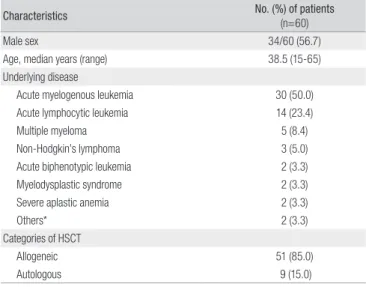
총 환자 60명중 성별은 남자 34명(57%), 여자 26명(43%)이었고, 나이 는 38.5세(중앙값, 15-65세)였다. 기저 질환은 급성 골수성 백혈병 30명 (50%), 급성 림프구성 백혈병 14명(23%), 다발골수종 5명(8%)의 순이었 다(Table 1). 조혈모세포이식은 51명(85%)이 동종, 9명(15%)이 자가 이식 을 시행 받았고, 동종 이식을 시행 받은 환자의 구체적인 이식 방법과 관 련 사항은 Table 2에 제시하였다. 동종 조혈모세포 이식 후 생착이 이루 어지기까지는 12일(중앙값, 6-32일)이 소요되었다. 동종 조혈모세포 이 식을 받은 환자 51명 중 31명(61%)에서 이식 후 18일(중앙값, 5-57일)에 급성 이식대숙주병이 발생하였고, 이 중 23명(45%)의 환자가 하루 1 mg/
kg 이상 용량의 스테로이드를 투여받았다.
일차 예방적 항진균제로 itraconazole액과 fluconazole을 각각 58 명(97%)과 2명(3%)의 환자에게 투여하였다. 투여 기간은 11일(중앙값, 1-19일)이었고, 흔한 중단 이유는 구역(70%), 부적응(31%), 설사(27%) 순이었다. 부적응의 구체적 사유는 3등급 이상의 구강 또는 장 점막염으 로 경구 약제 복용이 어렵거나 흡수 장애가 우려되는 경우였다.
침습성 진균 감염증의 과거력이 있었던 환자는 ‘거의 틀림없는’ 침습 성 폐 아스페르길루스증 2명(3%)과 기관기관지 아스페르길루스증 1명 (2%)이 있었다. 이들 3명의 환자는 항진균요법 후 침습성 진균 감염증에 의한 증상, 징후 및 방사선학적 소견이 소실되어 이식 당시에는 완전반응 상태였다.
2. 침습성 진균 감염에 대한 micafungin의 예방 효과
Micafungin의 전체 예방요법 성공률은 75% (45/60)였고, 투여 기간 은 12일(중앙값, 3-29일)이었다. 총 60명의 환자 중 15명(25%)의 환자에 게 예방요법 실패로 경험적 항진균제를 투여하였는데, ‘의심되는’ 전신 진 균 감염증으로 투여 받은 환자가 13명(22%), ‘돌발 침습성 진균 감염증’으 로 투여 받은 환자가 2명(3%)이었다. 경험적 항진균제로는 amphotericin B deoxycholate (1 mg/kg/일)가 73% (11/15), itraconazole 주사제(200 mg 하루 2번씩 2일간 투여 후 200 mg 하루 1번)가 27% (4/15)를 차지하 였다. 경험적 항진균제 투여기간은 8일(중앙값, 5-18일)이었다.
Micafungin 투여 중 ‘돌발 침습성 진균 감염증’이 발생한 두 환자 모두 침습성 진균 감염증의 과거력은 없었다. 첫번째 환자는 비호지킨 림프 종으로 비혈연간 동종 조혈모세포 이식 후 micafungin 투여 10일째 호 중구 감소성 발열과 함께 기침, 흉통, 객혈을 동반한 폐침윤이 발생하여 amphotericin B deoxycholate를 투여하기 시작하였다. 당시 혈청 갈락 토만난 항원 검사 결과 양성이었고, 호중구 감소 회복 직후 시행한 폐전 산화단층촬영에서 공기-초승달 징후(air-crescent sign)가 관찰되어 ‘거 의 틀림없는’ 침습성 폐아스페르길루스증으로 진단할 수 있었다. 환자는 7일간 amphotericin B deoxycholate를 투여하였음에도 임상적으로 호 전되지 않아 voriconazole 주사제로 변경하였고 경구제를 포함하여 약 12주 동안 voriconazole 유지 후 완전반응을 보였다. 두번째 환자는 급성 림프구성 백혈병으로 비혈연간 동종 조혈모세포 이식을 시행 받고 호중 구 감소성 발열 없이 생착이 이루어져 micafungin 투여를 종료하였으나, 종료 4일 후 발열과 상악동 압통을 동반한 부비동염이 발생하여 ‘가능한’
침습성 진균 부비동염으로 amphotericin B deoxycholate를 6주 간 투 여 후 완전반응을 보였다.
3. 이상반응
연구 기간 중 이상반응으로 인해 micafungin을 중단한 환자는 없었 다. Micafungin과의 인과관계와 무관하게 한 가지 이상의 이상반응이 관찰된 환자는 53명(88%)이었다(Table 3). 가장 흔한 이상반응은 저칼 륨혈증(28예, 47%)이었고, 다음으로 구토(27예, 45%), 설사(26예, 43%) 및 aspartate aminotransferase (AST) 또는 alanine aminotransferase (ALT) 상승(26예, 43%)의 순이었다. 이들 중 중증도가 3등급 이상인 중 대한 이상반응은 9명(15%)에서 발생하였는데, 두 가지 이상의 이상반응 이 중복 발생한 환자나 4, 5 등급의 이상반응을 보인 경우는 없었다. 중대 한 이상반응의 구체적인 예는 저칼륨혈증 4예, 설사 3예, 고칼륨혈증 1예, 구토 1예였다. 이들 중대한 이상반응을 micafungin 투여와의 인과관계 에 따라 분류하였을 때 구토 1예, 설사 1예, 저칼륨혈증 3예, 고칼륨혈증 1 예를 포함하여 총 6예(10%)가 ‘관련이 있을 가능성이 있음’에 해당하였 고, ‘상당히 관련이 있음’에 해당하는 이상반응은 설사 1예(2%)에 불과하 였으며 Clostridium difficile 관련 설사는 아니었다.
고찰
1990년대 이후 혈액종양 환자, 특히 고용량 항암화학요법을 받는 급 Table 1. Demographic and Clinical Characteristics of Study Subjects
Characteristics No. (%) of patients
(n=60)
Male sex 34/60 (56.7)
Age, median years (range) 38.5 (15-65)
Underlying disease
Acute myelogenous leukemia 30 (50.0)
Acute lymphocytic leukemia 14 (23.4)
Multiple myeloma 5 (8.4)
Non-Hodgkin’s lymphoma 3 (5.0)
Acute biphenotypic leukemia 2 (3.3)
Myelodysplastic syndrome 2 (3.3)
Severe aplastic anemia 2 (3.3)
Others* 2 (3.3)
Categories of HSCT
Allogeneic 51 (85.0)
Autologous 9 (15.0)
*Others include chronic myelogenous leukemia (n=1) and chronic lymphocytic leukemia (n=1).
HSCT, hematopoietic stem cell transplantation.
Table 2. Transplantation Procedures of the 51 Allogeneic HSCT Recipients
Characteristics No. (%) of patients
(n=51) Donor type
Sibling 25 (49.0)
Unrelated 26 (51.0)
HLA incompatibility
Matched 37 (72.5)
Mismatched 13 (25.5)
Haploidentical 1 (2.0)
Graft type
Bone marrow 29 (56.9)
Peripheral blood 22 (43.1)
Conditioning regimen
Myeloablative 35 (68.6)
Reduced-intensity 16 (31.4)
Acute graft-versus-host disease* 31 (60.8)
Grade I-II 27 (53.0)
Grade III-IV 4 (7.8)
* Defined and graded according to the standard criteria (14).
HLA, human leukocyte antigen.
성 백혈병 환자와 조혈모세포이식 환자에서 침습성 진균 감염증의 역 학적 양상에 변화를 보이기 시작하였다. 침습성 칸디다증 중 C. krusei, C. glabrata, C. tropicalis, C. parapsilosis 등 non-albicans 칸디다 종 이 차지하는 비율과 아스페르길루스 종을 포함한 사상진균에 의한 감염의 빈도가 증가하고 있다(15-18). 이러한 역학적 변화의 원인은 혈액종양 환자에서 fluconazole 예방적 투여 확대와 치료 전략의 변 화 등일 것으로 추정된다. 이에 따라 최근 발표된 조혈모세포이식 환 자에서의 감염성 합병증 예방을 위한 지침에서는 예방적 항진균제로 fluconazole, itraconazole액, amphotericin B 제재와 함께 micafungin, voriconazole, posaconazole 등을 추천하고 있다(6, 7, 19).
Micafungin은 azole-내성 칸디다와 아스페르길루스 종에도 우 수한 시험관내 항균력을 보인다. 그리고 azole 계열 항진균제와 달리 cytochrome P450 isoenzyme을 통해 대사되지 않으므로 조혈모세포 이식 환자에게 투여되는 cyclosporine A나 tacrolimus 등의 약물과의 상호작용이 적다. 뿐만 아니라 작용 기전이 진균 세포벽 성분인 1,3-β -D-glucan의 합성을 억제함으로써 항진균 작용을 나타내므로 인체에 대한 독성이 적다(20-24). 또한 중증 신장애나 경도-중등도 간장애가 있 는 환자에서도 용량을 조절할 필요가 없고, 정맥 내 투여 약제이므로 전 처치 후 점막염으로 인한 흡수율 저하를 우려하지 않아도 된다(24). 이러 한 여러 가지 장점으로 인해 조혈모세포이식 환자의 예방적 항진균제로 micafungin의 역할이 기대되고 있으나, 아직 국내 환자에서의 경험은 보 고된 바가 없었다. 따라서 본 연구는 국내 조혈모세포이식 환자에서 칸 디다증 예방목적으로 micafungin을 투여하였을 때 이에 대한 효과와 안 전성, 더 나아가 아스페르길루스증과 같은 사상진균 감염의 위험이 증가 하는지를 분석하고자 하였다.
본 센터에서는 1995년부터 fluconazole을 예방적으로 투여하면서 침 습성 칸디다증 빈도는 꾸준히 감소하면서 non-albicans 칸디다 종이 주
를 이루고 있고, 아스페르길루스 감염이 오히려 칸디다 감염보다 많은 양 상을 보이고 있다(25-30). 2001년 9월부터 1년간 조혈모세포이식 환자 에서 호중구 감소 기간 동안 itraconazole액과 fluconazole액의 침습성 진균 감염 예방 효과를 비교한 연구에서 경험적 항진균제가 투여된 빈도 는 각각 40명 중 5명(12.5%), 38명 중 8명(21.1%)이었고, 2002년 EORTC/
MSG 진단기준에 따라 분류하였을 때 ‘가능한’ 침습성 진균 감염의 빈도 는 각각 1명(2.5%), 5명(13.2%)이었다(31). 이번 연구에서 micafungin을 투여 받은 환자 60명 중 15명(25%)에서 경험적 항진균제가 투여되었으 나, 침습성 칸디다증의 발생은 없었고 2명(3.3%)의 환자에서 각각 ‘거의 틀림없는’과 ‘가능한’ 침습성 진균 감염이 발생하였다. 이는 Choi 등(31) 의 기존 연구 결과와 비교하였을 때 비록 진균 감염을 분류한 기준에서 다소 차이가 있긴 하나 itraconazole 투여군과 유사한 예방 효과를 보이 는 것으로 생각되며, 또한 국외 이식센터들의 자료(10, 32)에서 보여 준 micafungin의 침습적 진균 감염 예방 효과와도 크게 차이를 보이지 않 았다(Table 4).
조혈모세포이식 환자에서 예방적 항진균제로 itraconazole액을 투 여하는 경우 fluconazole보다 항균력이 광범위하다는 이점에도 불구 하고 경구 섭취 시의 부적응과 구역, 구토, 설사 등의 소화기 부작용이 가장 큰 문제점으로 지적되어 왔다(31, 34, 35). 본 연구에서도 60%의 환자에서 소화기 부작용이 발생하여 본 센터의 2001년 기존 연구에서 itraconazole액 투여 시 70%의 환자에서 약제 관련 소화기 부작용이 발 생한 것과 비교하여 큰 차이를 보이지 않았다. 그러나 이는 micafungin 투여 전 itraconazole액을 투여 받으면서 이미 소화기 부작용이 있었던 환자들이 대부분이었던 점과 약제와의 인과관계와 무관하게 증상이 발 생한 환자까지 모두 포함된 점을 감안할 때, 실제 micafungin 관련 소화 기 부작용이 과잉 추정되었을 것으로 생각된다. 또한 전체 환자 중 88%
의 환자에서 micafungin과의 인과관계 유무와 관계없이 하나 이상의 이 Table 3. Summary of Drug Adverse Events
Adverse event No. (%) of patients (n=60)
Grade* Probability†
1 2 3 4 5 Definite Probable Possible Doubtful
Abnormal LFTs 31 (51.7)
AST/ALT 26 (43.3) 21 5 - - - 24 2
TB 20 (33.3) 14 6 - - - 19 1
ALP 1 (1.7) 1 - - - 1 -
GGP 7 (11.7) 4 3 - - - 7 -
Electrolyte imbalance 29 (48.3)
Hypokalemia 28 (46.7) 24 - 4 - - - - 23 5
Hyperkalemia 3 (5.0) 2 - 1 - - - - 3 -
Gastrointestinal 36 (60.0)
Nausea/Vomiting 27 (45.0) 21 5 1 - - - 1 12 14
Diarrhea 26 (43.3) 20 3 3 - - - 1 15 10
Constipation 2 (3.3) 1 1 - - - 1 1
Renal 2 (3.3)
Serum Cr 2 (3.3) 2 - - - 2 -
Rash 7 (11.7) 5 2 - - - - 1 6 -
* Adverse events were graded according to the National Cancer Institute Common Terminology Criteria of Adverse Events version 3.0.
†The probability of adverse drug reactions were defined by Naranjo probability scale.
ALT, alanine aminotransferase; ALP, alkaline phosphatase; AST, aspartate aminotransferase; Cr, creatinine; GGP, γ-glutamyl transpeptidase; LFTs, liver function tests; TB, total bilirubin.
상반응을 보였는데, 이들 이상반응에 해당하는 대부분의 증상이나 징 후가 이식 전처치 후 발생하는 점막염이나 다른 이식 관련 약제들로 인한 이상반응과 명확히 구분하기 어려웠다. 그러므로 상이한 연구기간에 따 른 대상 환자군의 역학적 특성과 이식처치에 있어서의 변화 역시 소화기 부작용 발생의 변수로 고려되어야겠다. 국외 연구 결과에서도 볼 수 있듯 이(10, 32), 이상반응을 micafungin과의 인과관계와 중증도에 따라 분류 하였을 때 ‘가능성이 있는’ 중증 이상반응이 총 6예, ‘상당히 관련이 있는’
경우가 설사 1예였던 점으로 미루어 대부분의 이상반응은 micafungin 과의 직접적인 연관성 없이 발생한 경도-중등도의 이상반응이었을 가능 성이 높아 보인다.
이미 언급하였던 여러 가지 장점에도 불구하고 국내에서 조혈모세 포이식 환자의 예방적 항진균제로 micafungin을 선뜻 선택하지 못 하는 원인으로는 itraconazole액 또는 fluconazole과의 비용-효과 (cost-effectiveness)적 측면이 한 부분을 차지하고 있다. 그러나 최근 국외와 국내 조혈모세포이식 환자에서의 예방적 항진균제로 투여한 fluconazole 주사제와의 비용-효과 분석에서 micafungin이 동등한 예 방 효과와 부작용을 보였다(36, 37). 또한 전신적 항진균제의 경험적 투 여의 빈도를 낮춤으로써 의료비 지출을 낮출 수 있음을 보고하여, 향후 국내에서 예방적 항진균제로서 micafungin의 역할이 기대된다.
이번 연구에서 국내 조혈모세포이식 환자에서의 micafungin 50 mg 하루 1회 정맥 내 투여는 호중구 감소증 시기에 침습성 칸디다증 뿐만 아 니라 아스페르길루스증을 포함한 침습성 진균 감염 예방에 효과적인 반 면, 약제 관련 중대한 이상반응은 흔하지 않았다. 본 연구는 국내 조혈모 세포이식 환자를 대상으로 micafungin의 침습성 진균 감염 예방 효과 와 안전성을 분석한 첫 시도라는 점에서 그 의의가 있다. 그러나 대상 환 자 수가 작아 연구 결과를 성급히 일반화하기에는 무리가 있고, 후향적 분석을 통한 비비교연구라는 제한점이 있다. 또한 2차 예방적 항진균제 로 micafungin이 투여되었기 때문에 1차 약제에 의한 영향이 혼합되어 해석되었을 수 있다. 따라서 사상진균에 의한 침습성 진균 감염에 대한 micafungin의 예방 효과를 확인하기 위해서는 대규모 환자를 대상으로 한 전향적, 무작위 비교 연구가 국내에서도 필요할 것으로 생각된다.
References
1. Mandell GL, Bennett JE, Dolin R. Principles and Practice of Infectious Diseases. 6th ed. Philadelphia: Elsevier Inc.;
2005;3495.
2. Viscoli C, Girmenia C, Marinus A, Collette L, Martino P, Vandercam B, Doyen C, Lebeau B, Spence D, Krcmery V, De Pauw B, Meunier F. Candidemia in cancer patients: a prospective multicenter surveillance study by the Invasive Fungal Infection Group (IFIG) of the European Organization for Research and Treatment of cancer (EORTC). Clin Infect Dis 1999;28:1071-9.
3. Lin SJ, Schranz J, Teutsch SM. Aspergillosis case-fatality rate:
systematic review of the literature. Clin Infect Dis 2001;32:358- 66.
4. von Eiff M, Roos N, Schulten R, Hesse M, Zühlsdorf M, van de Loo J. Pulmonary aspergillosis: early diagnosis improves survival. Respiration 1995;62:341-7.
5. Hope WW, Walsh TJ, Denning DW. Laboratory diagnosis of invasive aspergillosis. Lancet Infect Dis 2005;5:609-22.
6. Maertens JA, Frère P, Lass-Flörl C, Heinz W, Cornely OA.
Primary antifungal prophylaxis in leukaemia patients. Eur J Cancer 2007;Suppl 5:43-8.
7. Michallet M, Ito JI. Approaches to the management of invasive fungal infections in hematologic malignancy and hematopoietic cell transplantation. J Clin Oncol 2009;27:3398- 409.
8. Kuse ER, Chetchotisakd P, da Cunha CA, Ruhnke M, Barrios C, Raghunadharao D, Sekhon JS, Freire A, Ramasubramanian V, Demeyer I, Nucci M, Leelarasamee A, Jacobs F, Decruyenaere J, Pittet D, Ullmann AJ, Ostrosky-Zeichner L, Lortholary O, Koblinger S, Diekmann-Berndt H, Cornely OA; Micafungin Invasive Candidiasis Working Group. Micafungin versus liposomal amphotericin B for candidaemia and invasive Table 4. Clinical Data from Reports of Patients Undergoing Hematopoietic Stem Cell Transplantation with Micafungin Prophylaxis during Neutropenia
Author, year
(Reference No.) Study design Antifungal prophylaxis, daily dose No. Acute leukemia (%)
Allo-HSCT (%)
Empirical therapy*
(%)
Breakthrough IFI† (%) van Burik et al., 2004
(10) Prospective, randomized,
double-blind, comparative Fluconazole IV, 400 mg
Micafungin IV, 50 mg 457
425 19
16 56
52 21.4*
15.1‡ 1.6
2.4 Choi et al., 2005
(31) Prospective, randomized,
open-labeled, comparative Fluconazole syrup, 200 mg
Itraconazole oral solution, 200 mg 38
40 47
58 100
100 21.1
12.5 13.2
2.5 Hiramatsu et al., 2008
(32)
Prospective, randomized, open-labeled, comparative
Fluconazole IV, 400 mg Micafungin IV, 150 mg
50 50
18 20
52 52
12.0 4.0
2.0 2.0
*‘Empirical therapy’ means the use of systemic antifungal agents for treatment of suspected fungal infections in patients with fever persisted for >96 h during the neutropenic phase despite broad-spectrum antibacterial therapy.
†‘Breakthrough IFI’ means the development of proven or probable invasive fungal infections defined by the EORTC/MSG in 2002 (33) during the administration of micafungin, except for in the study by Choi et al that counted possible cases in.
‡P=0.024
Allo-HSCT, allogeneic hematopoietic stem cell transplantation; IFI, invasive fungal infection; IV, intravenous; No., numbers of patients.
candidosis: a phase III randomised double-blind trial. Lancet 2007;369:1519-27.
9. Pappas PG, Rotstein CM, Betts RF, Nucci M, Talwar D, De Waele JJ, Vazquez JA, Dupont BF, Horn DL, Ostrosky-Zeichner L, Reboli AC, Suh B, Digumarti R, Wu C, Kovanda LL, Arnold LJ, Buell DN. Micafungin versus caspofungin for treatment of candidemia and other forms of invasive candidiasis. Clin Infect Dis 2007;45:883-93.
10. van Burik JA, Ratanatharathorn V, Stepan DE, Miller CB, Lipton JH, Vesole DH, Bunin N, Wall DA, Hiemenz JW, Satoi Y, Lee JM, Walsh TJ; National Institute of Allergy and Infectious Diseases Mycoses Study Group. Micafungin versus fluconazole for prophylaxis against invasive fungal infections during neutropenia in patients undergoing hematopoietic stem cell transplantation. Clin Infect Dis 2004;39:1407-16.
11. De Pauw B, Walsh TJ, Donnelly JP, Stevens DA, Edwards JE, Calandra T, Pappas PG, Maertens J, Lortholary O, Kauffman CA, Denning DW, Patterson TF, Maschmeyer G, Bille J, Dismukes WE, Herbrecht R, Hope WW, Kibbler CC, Kullberg BJ, Marr KA, Muñoz P, Odds FC, Perfect JR, Restrepo A, Ruhnke M, Segal BH, Sobel JD, Sorrell TC, Viscoli C, Wingard JR, Zaoutis T, Bennett JE; European Organization for Research and Treatment of Cancer/Invasive Fungal Infections Cooperative Group; National Institute of Allergy and Infectious Diseases Mycoses Study Group (EORTC/MSG) Consensus Group. Revised definitions of invasive fungal disease from the European Organization for Research and Treatment of Cancer/Invasive Fungal Infections Cooperative Group and the National Institute of Allergy and Infectious Diseases Mycoses Study Group (EORTC/MSG) Consensus Group. Clin Infect Dis 2008;43:1813-21.
12. Cancer Therapy Evaluation Program. Common Terminology Criteria for Adverse Events v3.0 (CTCAE). Available at:http://
ctep.cancer.gov/protocolDevelopment/electronic_applica- tions/ctc.htm. [Accessed 6 May 2009].
13. Naranjo CA, Busto U, Sellers EM, Sandor P, Ruiz I, Roberts EA, Janecek E, Domecq C, Greenblatt DJ. A method for estimating the probability of adverse drug reactions. Clin Pharmacol Ther 1981;30:239-45.
14. Glucksberg H, Storb R, Fefer A, Buckner CD, Neiman PE, Clift RA, Lerner KG, Thomas ED. Clinical manifestations of graft- versus-host disease in human recipients of marrow from HL- A-matched sibling donors. Transplantation 1974;18: 295-304.
15. Lass-Flörl C. The changing face of epidemiology of invasive fungal diseases in Europe. Mycoses 2009;52:197-205.
16. Pfaller MA, Diekema DJ. Epidemiology of invasive candidiasis:
a persistent public health problem. Clin Microbiol Rev 2007;20:
133-63.
17. Tortorano AM, Kibbler C, Peman J, Bernhardt H, Klingspor L, Grillot R. Candidaemia in Europe: epidemiology and resistance. Int J Antimicrob Agents 2006;27:359-66.
18. Sanz MA, Jarque I, Salavert M, Pemán J. Epidemiology of invasive fungal infections due to Aspergillus spp. and zygomycetes. Clin Microbiol Infect 2006;12:2-6.
19. Tomblyn M, Chiller T, Einsele H, Gress R, Sepkowitz K, Storek J, Wingard JR, Young JA, Boeckh MA. Guidelines for preventing infectious complications among hematopoietic cell transplantation recipients: a global perspective. Biol Blood Marrow Transplant 2009;15:1143-238.
20. Lee JS, Shin JH, Jung SI, Park KH, Choi HW, Cho D, Kee SJ, Kim SH, Shin MG, Suh SP, Ryang DW. In vitro susceptibilities of clinical isolates of Aspergillus species against echinocandins.
Infect Chemother 2007;39:151-8.
21. Denning DW. Echinocandin antifungal drugs. Lancet 2003;
362:1142-51.
22. Arikan S, Yurdakul P, Hascelik G. Comparison of two methods and three end points in determination of in vitro activity of micafungin against Aspergillus spp.. Antimicrob Agents Chemother 2003;47:2640-3.
23. Chandrasekar PH, Sobel JD. Micafungin: a new echinocandin.
Clin Infect Dis 2006;42:1171-8.
24. Cross SA, Scott LJ. Micafungin: a review of its use in adults for the treatment of invasive and oesophageal candidiasis, and as prophylaxis against Candida infections. Drugs 2008;68:2225- 55.
25. Yoon MJ, Yoo DG, Hong YS, Park SY, Shin WS, Kang MW, Kim CC, Kim DJ. The spectrum of infection in patients with acute leukemia. Korean J Infect Dis 1985;17:45-52.
26. Choi H, Yoo JH, Shin WS, Kim YR, Kang MW, Kim DW, Lee JW, Park JW, Kim CC, Kim DJ. The spectrum of infection in patients with acute leukemia. Korean J Intern Med 1994;46:496-504.
27. Choi JH, Kim YJ, Lee DG, Shin WS, Kim SW, Bae SS, Kimg SH, Yoo JH, Kim KM, Han KJ, Lee JW, Min WS, Kim CC. Infectious features in patients with acute leukemia. Korean J Infect Dis 1999;31:217-24.
28. Choi SM, Lee DG, Park YH, Kim YJ, Kim HJ, Lee S, Choi JH, Yoo JH, Kim DW, Lee JW, Min WS, Shin WS, Kim CC. Infections in patients with acute leukemia: comparison of induction chemotherapy group and reinduction chemotherapy group.
Infect Chemother 2003;35:78-85.
29. Woo HY, Park SH, Lee DG, Jo HS, Min CK, Kim M, Han K, Shin WS. Two cases of Candida inconspicua infection in neutropenic patients with acute leukemia. Infect Chemother 2006;38:164-8.
30. Yoo JH, Choi JH, Lee DG, Choi S, Shin WS, Kim CC. Analysis of invasive fungal infection after hematopoietic stem cell
transplantation or chemotherapy in patients with hematologic diseases. Infect Chemother 2004;36:40-5.
31. Choi SM, Lee DG, Choi JH, Park SH, Eom KS, Kim YJ, Kim HJ, Min CK, Yoo JH, Kim DW, Lee JW, Min WS, Shin WS, Kim CC. Itraconazole oral solution versus fluconazole syrup for prevention of invasive fungal infections in patients receiving hematopoietic stem cell transplantation: prospective, randomized, comparative clinical trial. Infect Chemother 2006;37:71-8.
32. Hiramatsu Y, Maeda Y, Fujii N, Saito T, Nawa Y, Hara M, Yano T, Asakura S, Sunami K, Tabayashi T, Miyata A, Matsuoka K, Shinagawa K, Ikeda K, Matsuo K, Tanimoto M; West-Japan Hematology and Oncology Group. Use of micafungin versus fluconazole for antifungal prophylaxis in neutropenic patients receiving hematopoietic stem cell transplantation. Int J Hematol 2008;88:588-95.
33. Ascioglu S, Rex JH, de Pauw B, Bennett JE, Bille J, Crokaert F, Denning DW, Donnelly JP, Edwards JE, Erjavec Z, Fiere D, Lortholary O, Maertens J, Meis JF, Patterson TF, Ritter J, Selleslag D, Shah PM, Stevens DA, Walsh TJ; Invasive Fungal Infections Cooperative Group of the European Organi za- tion for Research and Treatment of Cancer; Mycoses Study Group of the National Institute of Allergy and Infectious Diseases. Defining opportunistic invasive fungal infections in immunocompromised patients with cancer and hema- topoietic stem cell transplants: an international consensus.
Clin Infect Dis 2002;34:7-14.
34. Glasmacher A, Cornely O, U llmann AJ, Wedding U, Bodenstein H, Wandt H, Boewer C, Pasold R, Wolf HH, Hänel M, Dölken G, Junghanss C, Andreesen R, Bertz H; Itraconazole Research Group of Germany. An open-label randomized trial comparing itraconazole oral solution with fluconazole oral solution for primary prophylaxis of fungal infections in patients with haematological malignancy and profound neutropenia. J Antimicrob Chemother 2006;57:317-25.
35. Harousseau JL, Dekker AW, Stamatoullas-Bastard A, Fassas A, Linkesch W, Gouveia J, De Bock R, Rovira M, Seifert WF, Joosen H, Peeters M, De Beule K. Itraconazole oral solution for primary prophylaxis of fungal infections in patients with hematological malignancy and profound neutropenia: a randomized, double-blind, double-placebo, multicenter trial comparing itraconazole and amphotericin B. Antimicrob Agents Chemother 2000;44:1887-93.
36. Sohn HS, Lee TJ, Kim J, Kim D. Cost-effectiveness analysis of micafungin versus fluconazole for prophylaxis of invasive fungal infections in patients undergoing hematopoietic stem cell transplantation in Korea. Clin Ther 2009;31:1105-15.
37. Schonfeld W, Wang Cheng J, Tong KB, Seifeldin R. Cost- effec tiveness analysis of antifungal prophylaxis in patients undergoing hematopoietic stem cell transplantation. Clin Ther 2008;30:964-73.