http://dx.doi.org/10.5090/kjtcs.2013.46.3.185
Departments of
1Thoracic and Cardiovascular Surgery and
2Anaesthesiology and Pain Medicine, Konkuk University School of Medicine Received: October 15, 2012, Revised: October 25, 2012, Accepted: October 26, 2012
Corresponding author: Hyun Keun Chee, Department of Thoracic and Cardiovascular Surgery, Konkuk University Medical Center, Konkuk University School of Medicine, 120 Neungdong-ro, Gwangjin-gu, Seoul 143-729, Korea
(Tel) 82-2-2030-7591 (Fax) 82-2-2030-5039 (E-mail) [email protected]
C
The Korean Society for Thoracic and Cardiovascular Surgery. 2013. All right reserved.
CC
This is an open access article distributed under the terms of the Creative Commons Attribution Non-Commercial License (http://creative- commons.org/licenses/by-nc/3.0) which permits unrestricted non-commercial use, distribution, and reproduction in any medium, provided the
Effects of Ulinastatin on Postoperative Blood Loss and Hemostasis in Atrioventricular Valve Surgery with Cardiopulmonary Bypass
Jae Bum Park, M.D.
1, Seong Hyop Kim, M.D.
2, Song Am Lee, M.D.
1, Jin Woo Chung, M.D.
1, Jun Seok Kim, M.D.
1, Hyun Keun Chee, M.D.
1Background: Cardiopulmonary bypass (CPB) induces variable systemic inflammatory reactions associated with major organ dysfunction via polymorphonuclear neutrophils (PMNs). Ulinastatin, a urinary trypsin inhibitor, inhibits PMN ac- tivity and reduces systemic inflammatory responses. The aim of this study is to evaluate the effect of ulinastatin on postoperative blood loss and laboratory changes in patients undergoing open heart surgery. Materials and Methods: Between January 2008 and February 2009, 110 patients who underwent atrioventricular valve surgery through right thoracotomy were divided into two groups. Patients received either 5,000 U/kg ulinastatin (ulinastatin group, n=41) or the equivalent volume of normal saline (control group, n=69) before aortic cross clamping. The pri- mary end points were early coagulation profile changes, postoperative blood loss, transfusion requirements, and du- ration of intubation and intensive care unit stay. Results: There were no statistically significant differences between the two groups in early coagulation profile, other perioperative laboratory data, and postoperative blood loss with transfusion requirements. Conclusion: Administration of ulinastatin during operation did not improve the early coagu- lation profile, postoperative blood loss, or transfusion requirements of patients undergoing open heart surgery. In addition, no significant effect of ulinastatin was observed in major organs dysfunction, systemic inflammatory re- actions, or other postoperative profiles.
Key words: 1. Cardiopulmonary bypass 2. Polymorphonuclear neutrophils 3. Postoperative outcomes
INTRODUCTION
Open heart surgery using cardiopulmonary bypass (CPB) with aortic cross-clamping (ACC) provokes various systemic inflammatory responses that may eventually lead to multi- ple-organ injury or dysfunction. Such systemic reactions are characterized by an activation of pro-inflammatory cytokines, protease enzymes, and oxygen free radicals from activated neutrophils resulting in endothelial injury, platelet activation,
and a sequential inflammatory cascade [1-3]. Notably, poly-
morphonuclear neutrophils (PMNs) disrupt and inhibit the ac-
tivity of fibrin, fibrinogen, platelets, and other coagulation
factors, which leads to increased blood loss and transfusion
requirements [4]. Ulinastatin (Ulistin; HanLim Pharmaceutical
Co., Seoul, Korea) is a nonspecific protease inhibitor, also a
urinary trypsin inhibitor, and a type of glycoprotein that is
extracted and purified from fresh human urine [5]. It re-
presses inflammatory activity, permeation of neutrophils, and
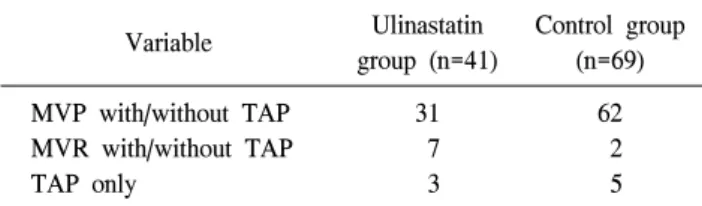
Table 1. Types of surgery
Variable Ulinastatin
group (n=41)
Control group (n=69) MVP with/without TAP
MVR with/without TAP TAP only
31 7 3
62 2 5 MVP, mitral valvuloplasty; TAP, tricuspid annuloplasty; MVR, mitral valve replacement.
release of elastase and chemical mediators [6]. One study re- ported that ulinastatin normalizes the coagulation function and prevents changes in thromboelastography (TEG) during liver resection surgery [7]. Furthermore, ulinastatin may shorten prothrombin time (PT), activated partial thromboplastin time (aPTT), and activated coagulation time in patients undergoing CPB [8]. The present study aimed to evaluate whether the in- traoperative administration of ulinastatin could improve the early coagulation profile, postoperative blood loss, or trans- fusion requirements of patients undergoing atrioventricular valve surgery using CPB and assess the effect of ulinastatin on major organ dysfunction, systemic inflammatory activities, and other postoperative profiles.
MATERIALS AND METHODS 1) Patients
All patients undergoing cardiac surgery are prospectively registered at Konkuk University Medical Center. These regis- tries prospectively contain baseline characteristics of patients, perioperative evaluation data, and the results and any compli- cations of surgery. This study was approved by Konkuk University Medical Center independent institutional review board. A total of 425 patients underwent cardiac surgery from January 2008 through February 2009. We excluded patients who had re-do cardiac surgery, severe hepatic or pulmonary disease, left ventricular ejection fraction <40%, pre-existing renal dysfunction (serum creatinine level >2.0 mg/dL), those older than 80 years of age, and those who had been treated with antithrombotic agents within 2 weeks of surgery. Among them, 110 patients who had atrioventricular valve surgery through right thoracotomy were enrolled in the present study.
These patients were assigned to either the ulinastatin group (n=41) or the control group (n=69), and this review was done retrospectively (Table 1).
2) Cardiopulmonary bypass
All of the patients received standardized CPB management in the same manner. Systemic heparinization (300 U/kg intra- venously) and arterial and venous cannulations were per- formed at an activated clotting time (ACT) >450 seconds,
which was measured by the Hemochron (International Technidyne Co., Edison, NJ, USA). CPB was initiated with a membrane oxygenator primed with normal saline with 20%
mannitol, 6 mEq sodium bicarbonate, 20% albumin, 5,000 U heparin, 1.5 g cefuroxime, and 2 g calcium gluconate (total priming volume, 20 mL/kg). Steroids were not applied during operation and the ACT was maintained at >450 seconds during the CPB procedure. The CPB flow was initiated at a rate of 60 mL/kg/min and was adjusted according to the state of hemodilution and core temperature. Myocardial protection was achieved by means of antegrade cold blood cardioplegic solution (20 mL/kg). The blood cardioplegic solution included sodium chloride (6.43 g/L), potassium chloride (1.193 g/L), calcium chloride (0.176 g/L), and magnesium chloride (3.253 g/L) at conditions of pH 7.4 and 4
oC to 8
oC. Moderate sys- temic hypothermia (range, 28
oC to 30
oC) was used. Patients were weaned from CPB when the rectal temperature reached 35
oC. Protamine (3 mg/kg) was applied intravenously with re- versal of heparinization after CPB.
3) Surgical procedure
Right thoracotomy was performed on patients of atrioven-
tricular valve diseases. In thoracotomy, we mostly used the
femoral artery and vein or right internal jugular vein as vas-
cular access for CPB. More details about the thoracotomy ap-
proach procedure have been described in a previous paper
[9]. The amounts of chest tube drainage were recorded every
hour for 6 hours after admittance to the intensive care unit
(ICU). If the accumulated amounts were over 400 mL within
the first hour postoperatively, at a rate of over 5 mL/kg/hr
for 3 consecutive hours, or >10 mL/kg/hr at any time, it
warranted surgical re-exploration for bleeding control.
4) Ulinastatin administration
Randomly selected patients of the ulinastatin group were treated with 5,000 U/kg ulinastatin (Ulistin) just prior to ACC. In contrast, patients in the control group received an equivalent volume of normal saline as a placebo.
5) Transfusion
The threshold for transfusion of packed red blood cells was a hematocrit <20% during CPB and <30% after CPB. The collected blood derived from the CPB circuit was salvaged by a cell salvage device after reversal of heparinization. Fresh frozen plasma (FFP) was transfused when the postoperative international normalized ratio (INR) was 1.5 to 2.0 (1 unit FFP) or >2.0 (2 units FFP). Platelets (8 units) were trans- fused when the postoperative platelet count was <50,000/μL.
Meanwhile, cryoprecipitate (10 units) was transfused when the postoperative fibrinogen count was <100 mg/dL. The to- tal transfusion quantities were recorded for 24 hours after ar- rival at the ICU after the operation. TEG (Hemonetic Co., Niles, IL, USA) was routinely used in cardiac surgery as vis- coelastic hemostatic assays (VHA). Many studies have dem- onstrated the superiority of using VHA as compared to rou- tine coagulation tests both in predicting bleeding and the need for re-do surgery and in reducing the total amount of blood transfusions [10]. In this trial, the TEG study was per- formed just before the initiation of anesthesia and on arrival at the ICU after operation.
6) Intensive care unit management
All of the patients were transferred to the ICU after sur- gery, where they received appropriate management. Fluid ther- apy was administered to maintain the pulmonary capillary wedge pressure at 9 to 15 mmHg, the cardiac index >2.0 L/min/m
2, and the urine output >0.5 mL/kg/hr. The duration of ventilator support, length of ICU stay, entire hospitalization period, and other hemodynamic variables were recorded. The patients were weaned off the ventilator when they met the fol- lowing criteria: hemodynamic stability; urine output ≥0.5 mL/kg/hr; chest tube drainage <100 mL/hr; oxygen saturation (SpO
2) at pulse oximetry of ≥95% at a fraction of inspired
≤55 mmHg from arterial blood gas analysis; no neurologic abnormal signs; and appropriate response to commands.
7) Statistical analyses
Statistical analyses were performed with SPSS ver. 18.0 (SPSS Inc., Chicago, IL, USA). Categorical variables are ex- pressed as percentages or numbers, and continuous variables are expressed as means with standard deviations. After testing for normality of distribution, continuous variables were com- pared using the Student t-test. Categorical variables were compared using Fisher’s exact test. The Wilcoxon signed-rank test was used to compare values before and after surgery within the same group. All p-values less than 0.05 were con- sidered statistically significant.
RESULTS
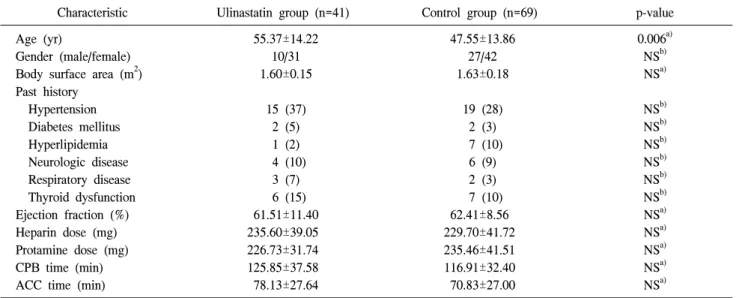
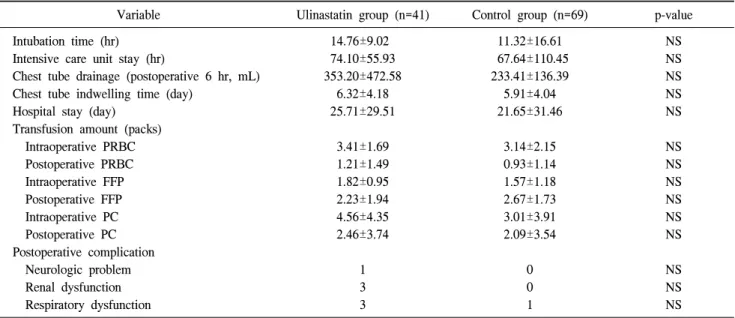
Patients in both groups had similar preoperative characteristics. CPB time, ACC time, total dosage of heparin, and protamine administration were not significantly different between the two groups (Table 2). The postoperative platelet count was statistically lower in the ulinastatin group com- pared with the control group; however, there were no sig- nificant differences in PT, INR, aPTT, or TEG. Cardiac markers (isoenzyme creatine kinase with muscle and brain subunits [CK-MB] or troponin-I) and the brain natriuretic peptide level were significantly higher in both groups than the respective preoperative values (p<0.05), but there were no significant differences between the two groups. There were no statistical differences between fibrinogen, creatinine, lactate, and aspartate aminotransferase (AST) in the two groups (Table 3). Among the postoperative outcomes, no stat- istical significant differences were observed between the two groups in the duration of mechanical ventilator support, ICU stay, chest tube drainage for postoperative 6 hours, chest tube indwelling time, hospital stay, transfusion amounts, or post- operative complications (p>0.05) (Table 4).
DISCUSSION
Urinary trypsin inhibitor, which is also called ulinastatin, is
Table 3. Comparison of laboratory parameters
Variable Ulinastatin group (n=41) Control group (n=69) p-value
Preoperative Postoperative Preoperative Postoperative Preoperative Postoperative Platelets (×10
3/uL)
PT (sec) PT INR aPTT (sec) Fibrinogen (mg/dL) CK-MB (ng/mL) Troponin-I (ng/mL) Creatinine (mg/dL) Lactate (mmol/L) BNP (pg/mL) AST (IU/L) TEG profile R K MA
187±73 15.71±3.18 1.29±0.34 42.20±10.47 327.03±79.89 2.53±5.51 0.15±0.66 1.11±0.22 0.89±0.38 1,098.90±989.39 38.17±27.51
99±40.62 18.31±1.62 1.56±0.17 49.78±11.51 189.37±49.74 57.68±43.55 8.99±6.28 0.98±0.20 2.40±1.18 708.78±544.23 74.32±27.85
26.95±13.23 14.19±9.48 39.43±12.22
210±62 14.35±2.47 1.159±0.26 40.13±8.25 290.56±85.47 1.48±1.27 0.02±0.01 1.06±0.19 1.00±0.66 543.83±875.61 28.90±9.83
116±33 17.77±1.86 1.50±0.20 48.86±12.39 184.13±73.95 53.42±42.36 8.44±6.32 0.97±0.16 2.16±1.11 633.94±1,165.43 83.87±76.67
22.64±12.85 9.20±7.58 38.66±11.61
NS 0.023 0.023 NS 0.036
NS NS NS NS 0.003 0.03
0.018 NS NS NS NS NS NS NS NS NS NS
NS NS NS Values are presented as mean±standard deviation. Statistical significance tests were performed by the Student t-test for continuous variables and Fisher exact test for categorical variables. The Wilcoxon signed-rank test was used to compare preoperative and post- operative in the same group (p<0.05 intra-group comparison with preoperative and postoperative).
NS, not statistically significant (p-value>0.05); PT, prothrombin time; INR, international normalized ratio; aPTT, activated partial thromboplastin time; CK-MB, isoenzyme creatine kinase with muscle and brain subunits; BNP, brain natriuretic peptide; AST, as- partate aminotransferase; TEG, thromboelastograph; R, clotting time; K, clot formation time; MA, maximum clot firmness.
Table 2. Preoperative characteristics and intraoperative details
Characteristic Ulinastatin group (n=41) Control group (n=69) p-value
Age (yr)
Gender (male/female) Body surface area (m
2) Past history
Hypertension Diabetes mellitus Hyperlipidemia Neurologic disease Respiratory disease Thyroid dysfunction Ejection fraction (%) Heparin dose (mg) Protamine dose (mg) CPB time (min) ACC time (min)
55.37±14.22 10/31 1.60±0.15
15 (37) 2 (5) 1 (2) 4 (10)
3 (7) 6 (15) 61.51±11.40 235.60±39.05 226.73±31.74 125.85±37.58 78.13±27.64
47.55±13.86 27/42 1.63±0.18
19 (28) 2 (3) 7 (10)
6 (9) 2 (3) 7 (10) 62.41±8.56 229.70±41.72 235.46±41.51 116.91±32.40 70.83±27.00
0.006
a)NS
b)NS
a)NS
b)NS
b)NS
b)NS
b)NS
b)NS
b)NS
a)NS
a)NS
a)NS
a)NS
a)Values are presented as mean±standard deviation or number (%).
CPB time, cardiopulmonary bypass time; ACC time, aortic cross clamp time; NS, not statistically significant (p-value>0.05).
a)
By Student t-test.
b)