• 검색 결과가 없습니다.

한국간호과학회

N/A
N/A
Protected

Academic year: 2021

Share "한국간호과학회"

Copied!
7
0
0

로드 중.... (전체 텍스트 보기)

전체 글

(1)

PURPOSE AND BACKGROUND

Today, while the demands of health care consumers are increasing, the cost of health care is rising rapidly.

This situation is forcing health care professionals and managers to emphasize the effectiveness of health care and to monitor the quality and cost of the health care that they provide (Bond & Thomas, 1991). The effective- ness of health care can be evaluated by measuring health

care outcomes. Patient outcomes are the most important health care outcomes. Thus, health care organizations and professionals in Korea are attempting to measure patient outcomes in order to evaluate the effectiveness of the health care they provide (Lee & Kwon, 1996).

Nursing plays an important role in improving patient outcomes, and certain patient outcomes are more sensi- tive to nursing interventions than others (Bloch, 1975;

Gallant & McLane, 1979; Lang & Marek, 1991; Higgins, McCaughan, Griffiths & Carr-Hill, 1992; Griffith, 1995).

Perception of Nurse Experts on the Contribution of Nursing Interventions to

NOC Nursing Outcomes in General Hospitals in Korea

Byoungsook Lee, RN, PhD

1

The purpose of this study was to identify the perception of nurse experts on the contribution of nursing inter- ventions to Nursing Outcomes Classification NOC nursing outcomes. A nursing outcome is a nursing-sensitive patient outcome primarily affected by nursing interventions. As one of the standardized language systems of nursing outcomes, the NOC must be examined for applicability before it is used in Korea. Data were collected in February and March 2003 using a 5-point Likert scale. For data collection, 230 quality improvement (QI) or qual- ity assurance (QA) nurses from general hospitals in Korea were asked to rate the extent that nursing interventions contribute to each of the NOC nursing outcomes (2000) in their hospitals. Ninety-six nurses from 63 hospitals responded and the response rate was 41.7%.

Mean scores for perception of contribution of nursing interventions to each of the NOC nursing outcomes ranged from 2.18 to 4.54. Vital Signs Status had the highest score (M = 4.54), and Abuse Recovery: Financial, the lowest score (M = 2.18). Of the seven NOC domains, the mean score was highest for Physiologic Health (M = 3.91) and lowest for Community Health (M = 2.92). Of the 29 NOC classes, the mean score for perceived contri- bution was highest for Metabolic Regulation (M = 4.32) and lowest for Community Well-Being (M = 2.92).

Participants perceived that nursing interventions in general hospitals in Korea contributed, at least to a certain extent, to most of the NOC nursing outcomes. Based on these results, NOC should have relatively good applica- bility in Korea.

Key Words : Nursing outcome, Nursing intervention, NOC

1. Professor, College of Nursing, Keimyung University

This research was supported by the Bisa Research Grant of Keimyung University in 2002.

Corresponding author: Byoungsook Lee, RN, PhD, College of Nursing, Keimyung University, 194, Dongsandong, Junggu, Daegu 700-712, Korea.

Tel: 82-53-250-7880 Fax: 82-53-252-6614

Received October 21, 2003 ; Accepted August 10, 2004

(2)

Patient outcomes that are sensitive to nursing interven- tions are called nursing outcomes and nursing outcomes reflect the practice and standards of the nursing profes- sion (Johnson, Maas & Moorhead, 1997).

Measurement of nursing outcomes is essential for eval- uation of the performance, quality, and cost of nursing practice (Maas, 1998). This evaluation can provide em- pirical data about the effectiveness of nursing interven- tions, which in turn provides evidence of the usefulness of nursing care (Hill, 1999). Moreover, the evaluation of nursing outcomes can help to clarify the purpose and fo- cus of nursing practice and provide further opportunities for empirical studies that are indispensable for the devel- opment of the nursing profession (Retting, 1991). By presenting evidence on the usefulness of nursing inter- ventions, the measurement of nursing outcomes can also be used to improve the reimbursement rates for nursing practice (Johnson, Maas & Moorhead, 2000).

Since the 1970s, one of the most important issues in nursing has been the development of standardized nurs- ing language systems and several systems have been de- veloped. Nursing Outcomes Classification (NOC), a standardized language system of patient outcomes that are sensitive to nursing interventions was developed in the U.S. NOC has a three-level taxonomy and the 260 nursing outcomes in NOC have been classified into sev- en domains and 29 classes (Johnson, Maas & Moorhead, 2000). Because they can be used as nursing goals, NOC makes it possible to evaluate individual nursing care.

NOC has been approved world wide in its usefulness for the development of nursing research, practice, and ad- ministration (Johnson & Maas, 1998; Moorhead, Head, Johnson, & Maas, 1998; Prophet & Delaney, 1998).

Nursing is a health profession that plays an important role in improving patient outcomes, and research to identify the contribution of nursing interventions to nursing outcomes is very important. Particularly, it is meaningful to examine these relationships using a stan- dardized language. Although NOC’s general adaptability to nursing in Korea has been explored in several recent studies, few studies have been done to investigate the re- lationship between nursing interventions and NOC nurs- ing outcomes. Such studies are vitally important because of the marked differences between American and Korean nursing practice. As nursing outcome research becomes more prevalent in Korea, study of how nursing interventions contribute to each NOC nursing outcomes becomes significant. For the nursing outcome studies,

nursing interventions provided to patients to help solve their nursing problems must be considered because a nursing outcome is generally achieved by implementing several nursing interventions, not just one. So, this study was done to identify the contribution of nursing inter- ventions to each NOC nursing outcome in general hospi- tals in Korea by having nurse experts assess this contri- bution.

DEFINITION OF TERMS

A nursing outcome is defined as a change in the pa- tient’s health status caused by nursing interventions (Johnson, Maas & Moorhead, 1997). For this study, 260 nursing outcomes from NOC (2000) were used. Nursing interventions are defined as nursing activities that are provided to solve a nursing problem. In this study, nurs- ing interventions are the nursing activities generally pro- vided to solve nursing problems of patients in general hospitals in Korea.

METHODS

Participants and setting

230 Quality Improvement (QI) or Quality Assurance (QA) nurses working in 130 general hospitals in Korea participated in this study. They were selected because they are the nurses mainly in charge of doing research on patient outcomes in Korea. They were considered to have sufficient expertise and experience with nursing outcomes to make a definitive assessment. A list of the participants was made from the membership list of the Korean Quality Improvement Nurse Society. Of the 230 participants who were sent questionnaires by mail, 96 from 63 hospitals responded. The response rate was 41.7%.

Instrument

The 260 nursing outcomes in NOC (2000) were used.

The nursing outcomes were translated into Korean using

as a base previous publications including one book and

one study (Park, Kim, & Cho, 2000; You, 2001). For eas-

ier and a more correct understanding, the translation

was validated by ten nurses who had master’s degrees

and three or more years of nursing experience in tertiary

hospitals. Appropriate changes were made. On the ques-

tionnaires, participants were asked to estimate the ex-

tent to which they thought nursing interventions con-

(3)

tributed to each of the NOC nursing outcomes.

Participants were asked to rate each outcome on a five- point Likert scale, from five points meaning ‘definitely contributes’ to one point meaning ‘no contribution’.

Data collection and analysis

Distribution and collection of the questionnaires was done by mail between February and March 2003. The SPSS Win 10.0 program was used for data analysis.

Mean scores and standard deviations were derived for the 260 nursing outcomes, 29 classes, and 7 dimensions.

ANOVA was used to analyze differences in the mean scores for classes and dimensions according to the demo- graphic characteristics of the participants.

RESULTS

Characteristics of the participants

The mean age of the participants was 41.06 (6.66) years and 55.2% of the participants were over 41 years old. The mean hospital experience of the participants was 17.97 (6.98) years; the majority of the participants (43.8%) had been employed in hospitals for between 11 and 20 years. About 59% of the participants had master or doctoral degrees. About 44% of the participants were head nurses, and 33.3% were middle nurse managers.

Most of the participants (71.9%) worked in large general

hospitals with 500 or more beds (Table 1).

Participants’ perception of the contribution of nurs- ing interventions to NOC nursing outcomes

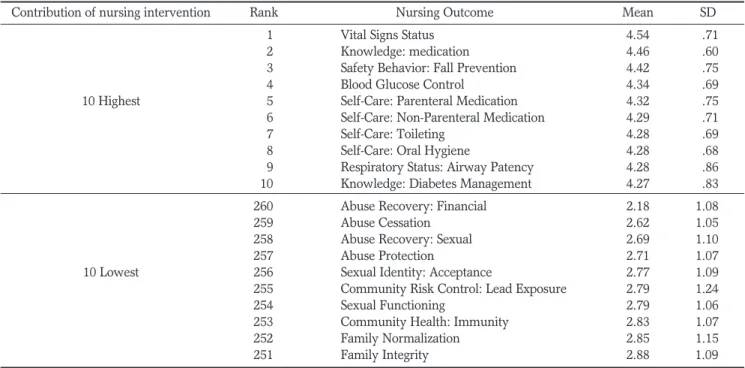
Mean scores for contribution ranged from 4.54 to 2.18. The NOC nursing outcome perceived to have had the highest contribution from nursing interventions was

Table 1. Characteristics of the Participants (N=96)

Characteristics N %

Age ¡´ 30 yrs 10 10.4

31- 40 yrs 32 33.3

¡ˆ 41 yrs 53 55.2

missing 01 1.

Job Experience ¡´ 10 yrs 14 14.6

11- 20 yrs 42 43.8

¡ˆ 21yrs 39 40.6

missing 01 1.

Education Diploma 12 12.5

Baccalaureate 23 24.0

Master/Doctoral 57 59.4

missing 04 04.2

Position Staff Nurse 20 20.8

Head Nurse 42 43.8

Middle manager 32 33.3

missing 02 02.1

Hospital <500 beds 26 27.1

¡ˆ 500 beds 69 71.9

missing 01 01.0

Table 2. Perception of Participants on the Contribution of Nursing Interventions to Each of NOC Nursing Outcomes in Korean

Hospitals: Ten Highest and Ten Lowest Nursing Outcomes (N=96)

Contribution of nursing intervention Rank Nursing Outcome Mean SD

1 Vital Signs Status 4.54 .71

2 Knowledge: medication 4.46 .60

3 Safety Behavior: Fall Prevention 4.42 .75

4 Blood Glucose Control 4.34 .69

10 Highest 5 Self-Care: Parenteral Medication 4.32 .75

6 Self-Care: Non-Parenteral Medication 4.29 .71

7 Self-Care: Toileting 4.28 .69

8 Self-Care: Oral Hygiene 4.28 .68

9 Respiratory Status: Airway Patency 4.28 .86

10 Knowledge: Diabetes Management 4.27 .83

260 Abuse Recovery: Financial 2.18 1.08

259 Abuse Cessation 2.62 1.05

258 Abuse Recovery: Sexual 2.69 1.10

257 Abuse Protection 2.71 1.07

10 Lowest 256 Sexual Identity: Acceptance 2.77 1.09

255 Community Risk Control: Lead Exposure 2.79 1.24

254 Sexual Functioning 2.79 1.06

253 Community Health: Immunity 2.83 1.07

252 Family Normalization 2.85 1.15

251 Family Integrity 2.88 1.09

(4)

Vital Signs Status (M = 4.54), followed by Knowledge:

Medication (M = 4.46), Safety Behavior: Fall Prevention (M = 4.42), Blood Glucose Control (M = 4.34), and Self- Care: Parenteral Medication (M = 4.32). The nursing outcome perceived to have had the lowest contribution from nursing interventions was Abuse Recovery:

Financial (M = 2.18). The ten highest rated and the ten lowest rated nursing outcomes are shown in (Table 2).

Of the ten highest-rated nursing outcomes, four were in the Self-Care class in NOC’s Functional Health do- main, three were in the Health Knowledge and Behavior domain, and the other three were in Physiologic Health.

Of the ten lowest-rated outcomes, six were in the Family Health domain (including four in the Family Member Health Status class). Two outcomes related to sexuality were also included in the ten lowest-rated nursing out- comes: Sexual Identity: Acceptance and Sexual Functioning.

Mean scores at the domain and class level can be found in (Table 3). In the seven NOC domains, the high- est mean score was found in Physiologic Health (M = 3.91), followed by Health Knowledge and Behavior (M

= 3.61), While the lowest mean score was found in Community Health (M = 2.92). In the 29 NOC classes, the highest mean score was found in Metabolic Regulation (M = 4.32), followed by Therapeutic Response (M = 4.24), And the lowest class mean score was found in Community Well-Being (M = 2.92).

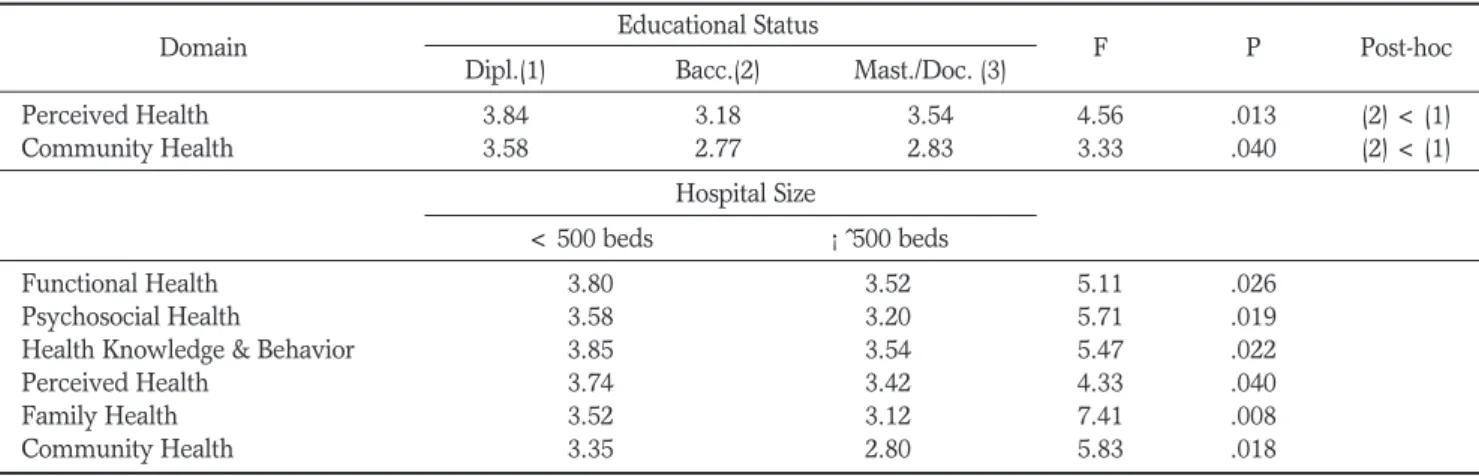
Significant differences were found in the mean scores at the domain and class level, according to educational status of the participants and size of hospitals in which the participant was working. At the domain level, for ex- ample, there were significant differences in mean scores for Perceived Health (F=4.56, p=0.013) and Community

Table 3. Perception of Participants on the Contribution of Interventions for Each NOC Domain and Class (N=96)

Domain Class Score

Mean SD

Functional Health 3.60 0.54

A-Energy Maintenance 3.41 0.69 B-Growth & Development 3.20 0.66

C-Mobility 3.75 0.59

D-Self-Care 4.00 0.62

Physiological Health 3.91 0.50

E-Cardiopulmonary 3.79 0.77

F-Elimination 4.01 0.62

G-Fluid & Electrolytes 4.16 0.68

H-Immune Response 3.93 0.60

I-Metabolic Regulation 4.32 0.68

J-Neurocognitive 3.55 0.67

K-Nutrition 3.76 0.57

a-Therapeutic Response 4.24 0.61 L-Tissue Integrity 3.92 0.58 Y-Sensory Function 3.39 0.96

Psychosocial Health 3.29 0.64

M-Psychological Well-Being 3.36 0.68 N-Psychosocial Adaptation 3.48 0.57

O-Self-Control 3.23 0.70

P-Social Interaction 3.16 0.85

Health Knowledge 3.61 0.54

& Behavior Q-Health Behavior 3.51 0.55

R-Health Beliefs 3.45 0.80

S-Health Knowledge 3.90 0.59 T-Risk Control & Safety 3.61 0.68

Perceived Health 3.50 0.66

U-Health & Life Quality 3.42 0.75

V-Symptom Status 3.57 0.65

Family Health 3.22 0.64

W-Family Care-giver Status 3.39 0.68 Z-Family Member Health Status 3.21 0.63 X-Family Well-Being 3.04 0.92

Community Health 2.92 0.99

b-Community Well-Being 2.92 1.09 c-Community Health Protection 2.98 1.05

Table 4. Perception on the Contribution to NOC Domains According to Educational Level of Participants and Size of Hospitals (N=96)

Domain Educational Status

F P Post-hoc

Dipl.(1) Bacc.(2) Mast./Doc. (3)

Perceived Health 3.84 3.18 3.54 4.56 .013 (2) < (1)

Community Health 3.58 2.77 2.83 3.33 .040 (2) < (1)

Hospital Size

< 500 beds ¡ˆ 500 beds

Functional Health 3.80 3.52 5.11 .026

Psychosocial Health 3.58 3.20 5.71 .019

Health Knowledge & Behavior 3.85 3.54 5.47 .022

Perceived Health 3.74 3.42 4.33 .040

Family Health 3.52 3.12 7.41 .008

Community Health 3.35 2.80 5.83 .018

Dipl.: Diploma, Bacc.: Baccalaureate, Mast./Doc.: Master or Doctoral

(5)

Health (F=3.33, p=0.040), according to the educational status of the participants. There was also a difference ac- cording to hospital size, as shown in Functional Health (F=5.11, p=0.026), Psychological Health (F=5.71, p=0.019), Health Knowledge and Behavior (F=5.47, p=0.022), Perceived Health (F=4.33, p=0.040), Family Health (F=7.41, p=0.008), and Community Health (F=5.84, p=0.018) (Table 4).

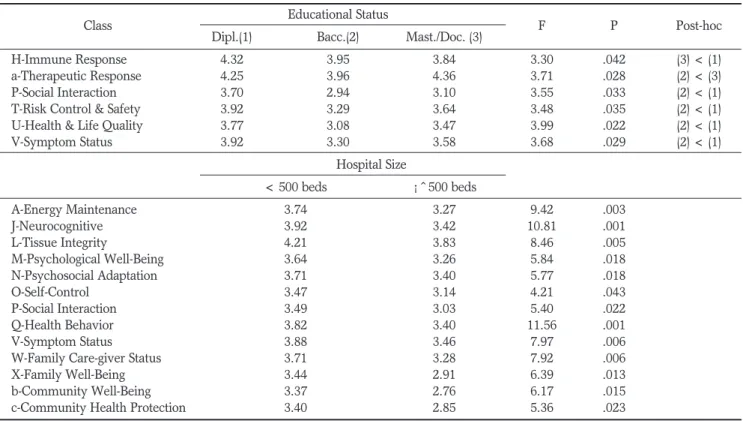
At the class level, significant differences were found in the mean scores of six classes according to educational status, and 13 classes according to hospital size (Table 5).

Participants with master’s or doctoral degrees gave high- er ratings than participants with baccalaureate degrees.

Participants employed at larger hospitals (500 or more beds) rated the contribution of nursing interventions higher than participants from smaller hospitals.

DISCUSSION

Vital Signs Status, which is included in the Metabolism Regulation class of the domain Physiologic Health, re- ceived the highest score, followed by Knowledge:

Medication, Safety Behavior: Fall Prevention, Blood Glucose Control, and Self-Care: Parenteral Medication.

In previous researches, checking and monitoring vital

signs for hospitalized patients has been reported as one of the most frequently performed nursing activities in Korea (Lee, 1992; Kim & Baek, 1996; Park et al., 2001).

According to Lee’s research (1999), Vital Signs Status was also one of the most frequently studied patient out- comes in Korea. The results of this study support these earlier findings.

Providing and Monitoring medications have been im- portant nursing activities in Korean hospitals (Kim &

Park, 1987; Kim & Baek, 1996; Yim, 1998). So, provid- ing information about medication for patients has been also regarded as an important nursing activity. The re- sults of this study, in which Knowledge: Medication had the second highest score, support these earlier findings.

Of the four self-care nursing outcomes included in the highest-rated outcomes, two involved medication, both parenteral and non-parenteral, and these results could have the same interpretation as the nursing outcome of Knowledge: Medication.

In this study, four of the ten highest rated outcomes are found in the Self-Care class of the Functional Health domain, and three in the Health Knowledge class of Health Knowledge & Behavior. The remaining three out- comes are found in Physiologic Health. It was interesting that four nursing outcomes related to self-care were in-

Table 5. Perception on the Contribution to NOC Classes According to Educational Level of Participants and Size of Hospitals (N=96)

Class Educational Status

F P Post-hoc

Dipl.(1) Bacc.(2) Mast./Doc. (3)

H-Immune Response 4.32 3.95 3.84 3.30 .042 (3) < (1)

a-Therapeutic Response 4.25 3.96 4.36 3.71 .028 (2) < (3)

P-Social Interaction 3.70 2.94 3.10 3.55 .033 (2) < (1)

T-Risk Control & Safety 3.92 3.29 3.64 3.48 .035 (2) < (1)

U-Health & Life Quality 3.77 3.08 3.47 3.99 .022 (2) < (1)

V-Symptom Status 3.92 3.30 3.58 3.68 .029 (2) < (1)

Hospital Size

< 500 beds ¡ˆ 500 beds

A-Energy Maintenance 3.74 3.27 9.42 .003

J-Neurocognitive 3.92 3.42 10.81 .001

L-Tissue Integrity 4.21 3.83 8.46 .005

M-Psychological Well-Being 3.64 3.26 5.84 .018

N-Psychosocial Adaptation 3.71 3.40 5.77 .018

O-Self-Control 3.47 3.14 4.21 .043

P-Social Interaction 3.49 3.03 5.40 .022

Q-Health Behavior 3.82 3.40 11.56 .001

V-Symptom Status 3.88 3.46 7.97 .006

W-Family Care-giver Status 3.71 3.28 7.92 .006

X-Family Well-Being 3.44 2.91 6.39 .013

b-Community Well-Being 3.37 2.76 6.17 .015

c-Community Health Protection 3.40 2.85 5.36 .023

Dipl.: Diploma, Bacc.: Baccalaureate, Mast./Doc.: Master or Doctoral

(6)

cluded in the top ten because, in Korea, self-care has not traditionally been considered as valuable as in western countries, especially for hospitalized patients. It has been considered important in Korean culture to assist patients physically for their full hospitalization even though they are sufficiently capable of providing self- care for themselves. As the nuclear family becomes in- creasingly prevalent, however, and western life style is increasingly adopted, self-care and independence are be- coming more valuable. These lifestyle changes are induc- ing changes in the nursing environment, which can be observed in the results of this study. In nursing studies in Korea, Self-Care was reported as one of the most fre- quently studied patient outcomes (Lee, 1999).

The ten lowest-rated nursing outcomes included four that involve abuse (Abuse Recovery: Financial, Abuse Cessation, Abuse Recovery: Sexual, and Abuse Protection), three related to sexuality (Abuse Recovery:

Sexual, Sexual Identity: Acceptance, and Sexual Functioning), and four related to community and family.

These results are not surprising because this study fo- cused on nursing interventions in acute care hospitals.

However, the results also seemed to reflect our socio- cultural background that has been closed, as far as com- munication about family violence and sexual life are concerned. These results could also imply that nursing practice in Korean hospitals is limited to the hospital set- tings and not connected to families and communities.

The scores were analyzed at both the domain level and the class level. The domain with the highest score was Physiological Health (M = 3.91), and the class with the highest scoring was Metabolic Regulation (M = 4.32).

Because scores for management of diabetes and physical treatment were extremely high, scores of the classes and domains that include related nursing outcomes were also high. Previous studies have found that the measurable patient outcomes primarily affected by nursing care were mostly related to the physiological health of the patients and to physical treatment (Lang & Marek, 1991;

Higgins, McCaughan, Griffiths & Carr-Hill, 1992).

The domain with the lowest score was Community Health, and class with the lowest score, Community Well-Being. These results are not surprising as partici- pants were nurse experts in general hospitals and they were asked to rate the contribution of nursing interven- tions to nursing outcomes in hospital settings. These re- sults may also suggest, however, that nursing interven- tions involving physical care of patients make a greater

contribution to patient outcomes in hospitals than they do in community settings. Further research is necessary to explore the situation related to these results, in partic- ular, when physical care is provided in community set- tings.

Education levels of the participants and the size of the hospitals where they were employed generated results that were statistically significant. In all of the domains and classes, for which there were significant differences according to educational levels, participants with mas- ter’s or doctoral degrees generally gave higher scores than participants with baccalaureate or master degrees.

Because it is not easy to identify the reasons for these findings, further research is required. Participants from hospitals with fewer than 500 beds generally gave higher scores than participants from hospitals with 500 or more beds. These results could be attributed to two main fac- tors: the differences in the severity of the patients and the availability of resources. In Korea, most general hos- pitals with fewer than 500 beds are secondary hospitals, while those with 500 or more beds are more likely to be tertiary hospitals. Patients treated in tertiary hospitals tend to have more acute and complicated health prob- lems than those in secondary hospitals. Consequently, the effect of nursing interventions may be more limited in tertiary hospitals because of the acuteness of the pa- tients’ condition. Also, as tertiary hospitals tend to have more resources available for patient care with the excep- tion of nursing resources-more qualified health profes- sionals, better equipment and supplies- outcomes related to nursing interventions might not be as apparent.

O’Connell (2001) has pointed out that the nature of the health care organization and the condition of the pa- tients were the two main factors affecting the relation- ship between nursing interventions and outcomes. She also cited the condition of the patients as the most im- portant factor affecting patient outcomes.

This study had some limitations. Because the response rate was relatively low, it is difficult to generalize the findings. Furthermore, because various interpretations of the question posed to the participants were possible, careful interpretation of the findings is essential.

CONCLUSION & RECOMMENDATIONS

The purpose of this study was to identify the extent to

which nurse experts perceive nursing interventions as

contributing to NOC nursing outcomes in general hospi-

(7)

tals in Korea. The mean scores of the perceived contribu- tion ranged from 4.54 to 2.18. The nursing outcome that participants perceived to have received the highest con- tribution from nursing interventions was Vital Signs Status; the outcome perceived to have received the least was Abuse Recovery: Financial. Of the seven NOC do- mains, the mean score was highest in the Physiologic Health Domain and lowest in Community Health. Of the 29 NOC classes, the mean score was highest for Metabolic Regulation and lowest for Community Well- Being. Mean scores differed significantly, both at the do- main level and the class level, depending on the educa- tional status of the participants and the size of hospitals in which they worked.

This study revealed that most NOC nursing outcomes could be affected by nursing interventions in Korean hospitals. Based on these results, NOC could be said to have relatively good applicability in Korea. On those nursing outcomes that had the highest scores, research to identify the relationships between specific nursing inter- ventions and specific outcomes is required. These out- comes could also be used as outcome indicators to eval- uate the nursing practice in Korean hospitals.

References

Bloch, D. (1975). Evaluation of nursing care in terms of process and outcome: Issues in research and quality assurance, Nurs Res, 24(4), 256-263.

Bond, S., & Thomas, L. H. (1991). Issues in measuring outcomes of nursing. J Adv Nurs, 16, 1492-1502.

Denehy, J. (1998). Integrating nursing outcomes classification in nursing education. J Nurs Care Qual, 12(5), 73-84.

Gallant, B. W., & McLane, A. M. (1979). Outcome criteria: A process for validation of the unit level. J Nurs Adm, 9(1), 14- 21.

Griffith, P. (1995). Progress in measuring nursing outcomes. J Adv Nurs, 21, 1092-1100.

Higgins, M., McCaughan, D., Griffiths, M., & Carr-Hill, R. (1992).

Assessing the outcomes of nursing care. J Adv Nurs, 17, 561- 568.

Hill, M. (1999). Outcomes measurement requires nursing to shift to outcome-based practice. Nurs Adm Quatery, 24(1), 1-16.

Johnson, M., & Maas, M. (1997). Iowa Outcomes Projects: Nursing Outcomes Classification (NOC). 1st ed. St. Louis: C.V. Mosby.

Johnson, M. & Maas, M.(1998). The nursing outcomes classification.

J Nurs Care Qual, 12(5), 9-20.

Johnson, M., Maas, M., & Moorhead, S. (2000). Iowa Outcomes Projects: Nursing Outcomes Classification (NOC). 2nd ed. St.

Louis: C.V. Mosby.

Keenan, G., & Aquilino, M. L. (1998). Standardized nomenclatures:

Keys to continuity of care, nursing accountability and nursing effectiveness. Outcomes Man Nurs Prac, 2(2), 81-86.

Kerr, P. (1999). Comparing two nursing outcomes reporting initia- tives. Outcome Management Nurs Prac, 4(3), 144-149.

Kim, C. J., & Park, J. W. (1987). A study for formulating criteria of patient classification system based on the analysis of direct nursing activity. J Korean Acad Nurs, 17(1), 9-23.

Kim, S. I., & Baek, H. M. (1996). A Study on the Job Analysis of the Staff Nurses. Korean Nurs, 35(5), 110-117.

Lang, N. M., & Marek, K. D. (1990). The classification of patient outcomes. J Prof Nurs, 6(3), 158-163.

Lang, N. M., & Marek, K. D. (1991). The policy and politics of pa- tient outcomes. J Nurs Qual Assurance, 5(2), 7-12.

Lee, B. S., & Kwon, Y. S. (1996). Evaluation of outcome in nursing practice. J Korean Nurs Adm Acad Soc, 2(2), 59-71.

Lee, B. S. (1999). Patient Outcomes at Nursing Research in Korea.

Keimyung J Nurs Sci, 3(1), 141-151.

Lee, Y. S. (1992). Measurement of the nursing workload in a spe- cial nursing unit-Tertiary hospital. Master’s Thesis, Seoul National University.

Marek, K. D. (1989). Outcome measurement in nursing. J Nurs Qual Assur, 4(1), 1-9.

Mark, B. A. (1995). The black box of patient outcomes research.

Image, 27(1), 42

Mass, M. L. (1998). Nursing’s role in interdisciplinary accountability for patient outcomes. Outcomes Man Nurs Prac, 2(3), 92-94.

Moorhead, S., Head, B., Johnson, M. & Maas, M. (1998). The nurs- ing outcomes taxonomy: Development and coding. J Nurs Care Qual, 12(6), 56-63.

Retting, R. (1991). History, development, and importance to nurs- ing of outcomes research. J Nurs Qual Assur, 5(2), 13-17.

O’Connell, B. (2001). Challenges of measuring and linking patient outcomes to nursing interventions in acute care settings. Nurs Health Sci, 3, 113-117.

Park, J. S., Koh, H. J., Kwon, Y. S., Kim, C. N., Park, Y. S., Park, C.

J., Shin, Y. H., Lee, K. H., & Lee, B. S. (2001). Activities of day and evening shifts nurses in a university hospital.

Keimyung J Nurs Sci, 5(1), 169-183.

Park, H. A., Kim, J. E., & Choi, I. S. (2000). Nursing Diagnosis, Intervention, Outcome Classification. Seoul, Seoul National University Press.

Prophet, C. M., & Delaney, C. W. (1998). Nursing outcomes classi- fication: Implications for nursing information systems and the computer-based patient record. J Nurs Care Qual, 12(5), 21- 29.

Yim, Y. Y. (1998). An analysis on nursing activity in a hospital. J Korean Nurs Adm Acad Soc, 4(1), 73-88.

You, C. S. (2001). Construction of linkage database on nursing di-

agnoses, interventions, outcomes in abdominal surgery pa-

tients. Doctoral Dissertation, Chung Ang University.

수치

Table 2. Perception of Participants on the Contribution of Nursing Interventions to Each of NOC Nursing Outcomes in Korean
Table 4. Perception on the Contribution to NOC Domains According to Educational Level of Participants and Size of Hospitals   (N=96)
Table 5. Perception on the Contribution to NOC Classes According to Educational Level of Participants and Size of Hospitals (N=96)

참조

관련 문서

And based on these results, in order to utilize the witty stories appeared in the novels of Korean Pansori as actual educational texts, the brief analysis

The participants were asked to describe the practices of special classes at middle schools in terms of the relationships with a variety of

Conclusion: Based on research results, lowering parent's anxiety of hospitalized children, I think I need a study for nursing intervention program for

The main effect according to the results of the repeated measures ANOVA on physical fitness based on test time showed a significant difference in grip

These results confirm that the 12-week swimming exercise based on the swimming program applied in this study has a positive effect on improvement of

Based on the analysis results, the study model is verified by analyzing the features of the tourism resources interpretation that affects the extent of

Based on our observation that a diffuse pixel is likely to have very low intensity in at least one color channel for most of natural images, we consider the dark channel as

In 2020, the utilization of emergency medical services at general hospitals or higher-tier medical institutions decreased by 22.8% compared to the average before