Vol. 66, No. 8, August 2016, pp. 978∼983 http://dx.doi.org/10.3938/NPSM.66.978
Nontrivial Dark Matter Scenarios at the Energy Frontier
Doyoun Kim · Myeonghun Park
∗Center for Theoretical Physics of the Universe, Institute for Basic Science (IBS), Daejeon 34051, Korea (Received 5 July 2016 : revised 17 July 2016 : accepted 18 July 2016)
With the only guideline being the existence of dark-matter (DM), searches for dark-matter at the Large Hadron Collider (LHC) have taken a model-independent approach. In this regard, the LHC search strategy is based on the very minimal assumption of a missing transverse energy (MET) from undetected dark-matter with a Jet from Initial State Radiation (ISR). Together with this minimal search strategy, the effective operators or “simplified” models have been used to interpret the LHC results, but those general approaches cannot cover interesting DM scenarios, for example, the very light dark-matter or co-annihilation region of DM parameter space. In this letter, we review the limits of those conventional methods and present a method that can capture very light DM scenarios and probe the DM co-annihilation region.
PACS numbers: 12.60.Jv Keywords: Particle physics
I. INTRODUCTION
After the discovery of the Higgs particle, there would be two big avenues in the energy frontier in which re- lated experiments utilize the high energy particle beams to probe the physics beyond the Standard Model (BSM).
The first direction is to understand the electroweak sym- metry breaking more precisely by focusing on the energy scale near the Higgs mass to check what kind of BSM part could be involved in the Higgs mechanism. The related experiments would be the International linear collider (ILC) and Circular Electron Positron Collider (CEPC). The other avenue in the energy frontier is to probe the BSM more directly by producing a new par- ticles. In this direction, as we don’t have any proper estimation on the mass of new particles, related experi- ments including the current LHC rely on the proton (or anti-proton) beam at the very high energy so that we can get the effective scanning of all energy range from the Parton Distribution Function (PDF).
The searches for a dark matter (DM) in collider exper- iments are very special as we try to detect invisible par- ticles in a detector. In fact, if all of produced particles do
∗E-mail: [email protected]
not leave any signals inside a detector, it would be impos- sible to trigger events for further analyses. Only possible way to observe DM in the collider detectors is to take an indirect method, to trace a missing energy signatures.
For example, if we have some reconstructed particles at the detector and the total final energy is different from the initial one, we can indirectly observe invisible parti- cles by the energy-momentum conservation law, though we can not count how many invisible particles pass the detector or getting any clues for properties of invisible particles to understand a dark sector. As the most of collider experiments including the LHC use a proton as a colliding beam, we don’t have detailed information about the partonic center-center-mass energy √
ˆ
s and a longi- tudinal momentum pz of the initial parton. Thus in ap- plying the energy-momentum conservation law, we are only limited to utilize momentums transverse to a beam direction, as that total sum of transverse momentum of all particles should be 0 or at least less thanO(1) GeV.
As we don’t know the interaction between a dark mat- ter and Standard Model (SM) particles, it becomes am- biguous which SM particle can be involved in the produc- tion process of DM. In this regard, a general method is to take an initial state radiation (ISR) from initial parton
This is an Open Access article distributed under the terms of the Creative Commons Attribution Non-Commercial License (http://creativecommons.org/licenses/by-nc/3.0) which permits unrestricted non-commercial use, distribution, and reproduction in any medium, provided the original work is properly cited.
[9,10] as a reconstructed particle to tag an event of DM production. In other case where DM interacts with SM gauge bosons, one can use reconstructed gauge bosons or leptons from a gauge boson as a trigger. This type of search strategy is named as “mono-X” and it has been a popular channel for DM searches at the LHC [11–14].
The issue in mono-X search is to suppress backgrounds from SM Quantum Chromodynamics (QCD) as compli- cated hadronization evolution of QCD can mimic various mono-X signatures with huge amount of cross-sections.
To reduce QCD backgrounds, the collider analyses usu- ally have two requirements;
1. Hard ISR: The size of a transverse momentum pT of ISR in DM search would be more than O(200) GeV.
2. Large missing transverse energy (MET, ̸ET) to avoid any effective MET signatures from QCD.
The hardness of ISR is dependent on the scale of a hard scattering. Thus a search with a hard ISR is optimized to a case of heavy DM. The size of̸ET is also proportional to the mass of DM. In this aspect, current analyses re- lying on ISR mono-jet and a missing transverse energy
̸ET would be less sensitive to the light DM case, which is also difficult parameter space for dark matter direct searches [15,16]. In addition to the parameter space of light DM, current LHC analyses based on mono-X type analysis is incapable to search for degenerated spectrum case where a dark matter DM co-annihilation region lo- cates in. In this parameter space where the mass differ- ence between a dark matter and the next lightest new particle is small compared to DM mass, tagging ̸ET is not enough to understand the dark matter annihilation mechanism. In above regards we propose to cluster low pT particles with one jet-like object to enhance a sensitiv- ity for light DM and to understand DM co-annihilation region at the LHC.
II. LIGHT DARK MATTER
When the mass of a dark matter is less than O(10) GeV, the current dark matter direct searches be- come less sensitive due to its very soft recoil energy com- pared to noise in electronic readouts. In this section, we present a method for the low mass DM detection
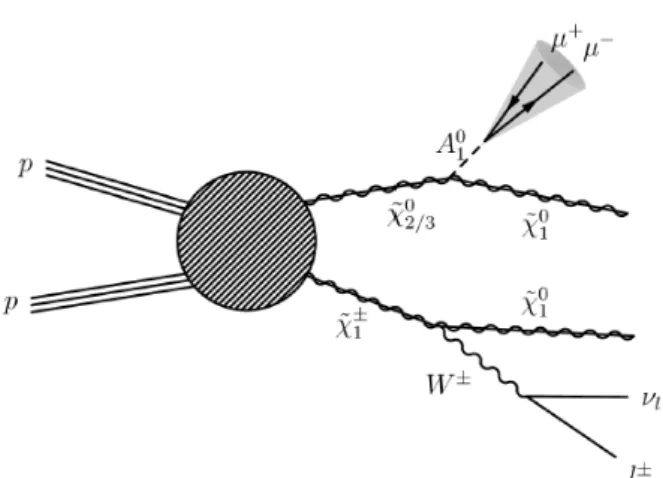
Fig. 1. Production process for the eχ02,3eχ±1 pair, with the eχ02,3 decaying via A1eχ01. Muons (µ+, µ−) become collimated due to the low mass of A01.
at the LHC. For the case of a light dark matter with mass O(1) GeV, we take an example of the Next-to- Minimal Supersymmetric Standared Model (NMSSM) with singlino ˜s as a dark matter. In this case, relevant minimal processes for the DM pair production would be from the pair production of electro-weakinos, ( ˜χ02/3, ˜χ±1), the super-partners of W , B and Higgs bosons. The cor- responding feynman diagram of a DM production in the NMSSM we consider is described in Fig.1.
NMSSM is described with soft SUSY-breaking terms in the scalar-Higgs sector with a singlet superfield S which generates the effective µ term as µeff= λs through its vacuum expectation value, s≡ ⟨ bS⟩:
Vsoft = m2Hu|Hu|2+ m2H
d|Hd|2+ m2S|S|2 +
(
λAλSHuHd+1
3κAκS3+ h.c.
)
, (1)
where λ and κ are the Higgs-singlet coupling and a sin- glet self coupling, respectively. mHu,Hd,S and Aλ,κ are soft SUSY-breaking parameters.
Corresponding phenomenology of Higgs sector and neutralino sector becomes more colorful compared to usual Minimal Supersymmetric Standard Model (MSSM) scenarios. In our consideration for DM, the most relevant parameters are the mass of a pseudo-scalar component A01 of the singlet S, and the mixing compo- nent of the next to lightest SUSY particle (NLSP) and the LSP out of various neutralino components. The mix- ing between the singlet and doublet Higgs is negligible
since our singlet mass is typically O(1) GeV while the Higgs is 125 GeV, so that the mass of A01 would be
m2A
1 ≃ λ(Aλ+ 4κs)v2sin 2β
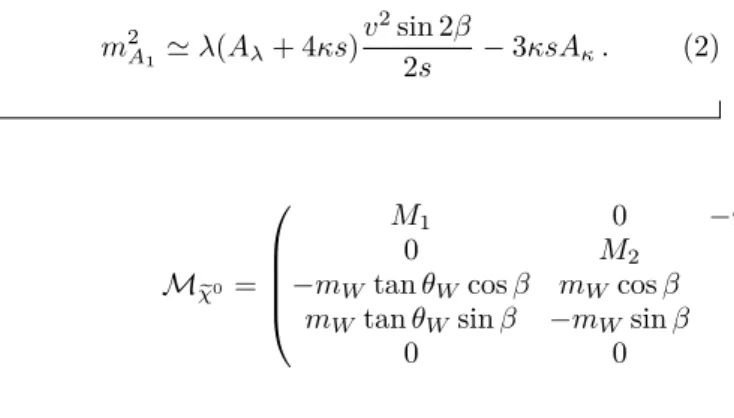
2s − 3κsAκ. (2)
The neutralino mass matrix which provides the mixing
angles among various neutralinos are
Mχe0 =
M1 0 −mWtan θWcos β mWtan θWsin β 0
0 M2 mWcos β −mWsin β 0
−mWtan θW cos β mWcos β 0 −µeff −λvu
mWtan θW sin β −mWsin β −µeff 0 −λvd
0 0 −λvu −λvd 2κs
.
(3)
In our study, we scan over the whole SUSY parameters mostly focusing on the case of higgsino dominant NLSP (Table. 1). All scalar soft masses and trilinear A terms are unified at the grand unified scale, and unified gaugino mass relations at the SUSY breakning scale are assumed:
M0≡ MQ1,2,3 = MU1,2,3 = MD1,2,3 = ML1,2,3 = ME1,2,3, M1/2≡ 2M1= M2= 1
3M3, (4)
A0≡ At= Ab = Aτ.
In the selection process of our bench mark point, we consider constraints from B physics, relic abundant and Higgs mass. In this review we show one bench mark point where the current analyses at the LHC do not have any sensitivity.
1. Collimated Muons from A1 at the LHC
In the phenomenological study based on the results from collider experiments, the branching ratio of a new particle is the most relevant feature to decide the search strategy. In our case of higgino NLSP pair production, there would be three competing decay processes of ˜χ02 to the dark matter eχ01 in association with Z/hSM/A01, depending on λ.
In Fig.2, we show the branching fractions of NSLP with Z or A01. In a process where NSLP decays into Z and DM, the relevant search channel would be a tri- lepton channel [18–20] where two leptons are from Z bo- son and one is from W±from a chargino decay similarly
Table 1. Ranges of the NMSSM input parameters scanned to obtain eχ01 (LSP) with a mass below 2 GeV and eχ02(NSLP) dominated by the higgino component.
Parameter Scanned range
M0(GeV) 500 – 2000
M1/2(GeV) 300 – 1000
A0(GeV) 0 – 4000
µeff(GeV) 100 – 300
tan β 6 – 25
λ 0.01 – 0.4
κ 10−5 – 10−1
Aλ(GeV) 0 – 5000
Aκ(GeV) −100 – 0
to Fig.1. On the other hand, if NSLP decays into Higgs and a dark matter, due to the standard Higgs branch ra- tion, we need to consider two b-jets from the Higgs. This channel suffers severely from the QCD backgrounds. Fi- nally in a case where NSLP decays into A01 and a dark matter, because its mass is around 2mχ˜0
1 greatly satisfy- ing the current relic density, A01 decays to highly colli- mated particles due to the large boost of A01.
There have been several studies regarding to the O(1) GeV dark matter in the context of NMSSM, where A01 decays into tau leptons [21]. If A01 mass is below the τ+τ− threshold, A01 → ¯cc would be the most dominant decay mode. In this channel, much deliberate analy- ses are required to take care of the QCD background even we utilize the heavy flavor tagging as ¯cc being re- garded as a jet due to the boost. In the LHC detec- tors where we can use all sub-detectors to tag muons,
Fig. 2. (Color online) The BR(eχ02 → Z eχ01) and the BR (eχ02→ A1eχ01) as functions of the parameter λ.
A01 → µ+µ− decay channel can provide kinematical in- formation very precisely. But if we use a conventional muon tagging method where analyses require an isola- tion around a muon, we can have only one reconstructed muon which has the best χ2 fitting from trajectories in various sub dectectors. It motivates us to adapt a con- cept of “lepton-jet” [22] to cluster a collimated muon sys- tem as a single jet-like object. For a detailed discussion on the LHC analysis we refer [17] and here we illustrate how to define it conceptually.
1. Cluster a collimated muons with a jet-like object µcolof the cone size R = 0.4. We impose the isola- tion criteria, Isum< 3 GeV, where Isumis the scalar sum of the transverse momenta of all additional charged tracks with a requirement of pT > 0.5 GeV.
2. Require the minimum transverse momentum of µcol: pT (µcol)> 50 GeV.
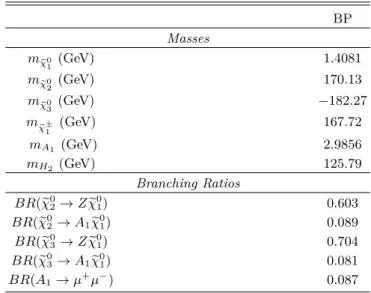
A benchmark point is illustrated in Table2and the result for the luminosity 300 fb−1 of the LHC 14 TeV is sum- marised in Table 3. As seen in our result from a Monte Carlo simulation, without a new concept, “lepton-jet”, it would be difficult to probe a light dark matter scenario at the LHC. Our study, therefore, sheds a light on the DM search in this regard; as the LHC can produce NL- SPs more than the DM, if we design a proper analysis method, we can capture the characteristic of a light dark matter physics, while it is not an easy work for conven- tional search methods which do not pay attention to an interaction type between DM and SM particles.
Table 2. Our benchmark points used for the LHC anal- ysis
BP Masses
mχe0
1 (GeV) 1.4081
mχe0
2 (GeV) 170.13
mχe0
3 (GeV) −182.27
mχe± 1
(GeV) 167.72
mA1 (GeV) 2.9856
mH2 (GeV) 125.79
Branching Ratios
BR(eχ02→ Z eχ01) 0.603
BR(χe02→ A1χe01) 0.089
BR(χe03→ Z eχ01) 0.704
BR(χe03→ A1χe01) 0.081
BR(A1→ µ+µ−) 0.087
Table 3. 14 TeV LHC with a luminosity of 300 fb−1 luminosity. here SRZc represents a three lepton channel in [18].
Point S/B in analysis sensitivity as (σ) in analysis 3ℓ (SRZc region) µcol 3ℓ (SRZc region) µcol
BP 0.436 15 2.0 27
III. LHC FOR DM CO-ANNIHILATION REGION
In this section, we take an example of DM bino-gluino co-annihilation process in Supersymmetric models where a dark matter ˜χ01 has mostly with bino component and NLSP is a gluino (˜g), the susy partner of SM gluon. In this case, ˜g decays into ˜χ01 with two soft jets. As a mass difference between a gluino and a dark matter becomes negligible compared to the mass of a gluino, jets from ˜g decay become too soft to be tagged, leaving only mono- jet+̸ET analysis for the LHC study. The analyses relying on ISR jet are not sensitive to details of this process as the hardness of ISR only depends on the energy scale of the hard scattering, in our case the mass of a gluino.
Thus it would be necessary to develop a method to tag soft jets from gluino decaying to understand details from which we can infer the nature of a process. In this sec- tion, we review our study in [23] where we propose a method to cluster soft jets by utilizing a large size of a jet.
Fig. 3. (Color online) Exclusions from utilizing fat-jet tagging on search sensitivity of 2σ (Red with grid lines) compared to results from conventional ATLAS search in in multi-jet signal region (grey).
1. Jet Substructure Methods to Tag Soft Parti- cles
When a gluino decays into two quarks and dark mat- ter, ˜g → q¯q˜χ01 through a offshell squark, the invariant mass of two quarks mq ¯qlocate near the peak Pq ¯q of three body invariant mass distribution in most events;
Pq ¯q =
m2˜g+ m2χ˜0 1
3
2 − vu
ut1 + 12m2˜gm2χ˜0 1
(m2˜g+ m2χ˜0 1
)2
1 2
∆m−→≪m˜g
∆m√ 2 ,
where ∆m is a mass gap between gluino and a dark mat- ter ∆m = mg˜− mχ˜01. Thus if we require a pT of (q, ¯q) system as pT (q,¯q)≥ ∆m, we can capture two quarks with a single jet (“fat-jet”) of a large cone size R as
R = 2M(q,¯q) pT (q,¯q) ≥ 2
(∆m
√2 ) 1
∆m =√
2 . (5)
The major concern to utilize a large size jet to tag a signal is to reduce SM QCD backgrounds which would be the big issue in the hadron colliders.
In our case the major background would be Z(→ ν ¯ν) + js. The mass of a normal QCD jet (NLO) is ap- proximately to
√
< MJ2>NLO ≈ 0.2pJR . (6) When we probe the co-annihilation region of ∆m ≃ 100 GeV, the mass of background QCD jet becomes
√< MJ2> ∼ 30 GeV with a large cone size R ≃ √ 2 while the mass of signal jet M(q,¯q) ≃ 70 GeV. Thus in principle we can sort out background jets only with jet mass. But a normal QCD jet get additional masses from various contaminations including soft QCD and underly- ing events. This becomes more serious if one use a large size jet. To reduce soft QCD activities in the mass of a jet, various grooming methods have been introduced [24–27]. In our analysis we use a Mass Drop Tagger (MDT) [24] which was invented to enhance Higgs dis- covery in H → b¯b as our study point of a mass difference is similar to the mass of Higgs as ∆m ≃ O(100) GeV.
We also require a cut from jet substructures to reduce QCD backgrounds further. In various jet substructure variables, we use ρ variable
ρ = m2j/( p2T jR2)
(7) since for a signal jet which has two quarks with shar- ing equal energy, ρ ≃ 0.2 while jets in SM backgrounds which are initiated by a single quark have ρ≤ 0.1. By utilizing jet mass after MDT and tagging signal jets with a jet substructure variable ρ, we can suppress back- grounds efficiently. To see the overall performance we compare our method of using a fat-jet with conventional analysis in ATLAS multi-jet signal region [28] in Fig.3.
As we see in this plot, using a fat-jet in search for DM can enhance a search sensitivity. We also can get hints for the properties of DM and related BSM particles as we can use information from various kinematical distri- butions by tagging particles involved in DM production.
In this regard, colliders including the current LHC have a very unique position among various experiments for dark matter searches.
IV. CONCLSION
In this review, we demonstrate non-conventional search strategies at the LHC to search for DM in var- ious interesting parameter space, the one is for the light dark matter and the other is for the co-annihilation re- gion. The current LHC with 13 TeV collision energy can probe not only dark matter(s) but also the mechanism of dark matter production. This can enlighten the dark sector of our universe.
ACKNOWLEDGEMENTS
D. K. and M. P. is supported by IBS under the project code, IBS-R018-D1. D. K. is also supported by the Ba- sic Science Research Program through the National Re- search Foundation of Korea (NRF) funded by the Min- istry of Science, Grant No. 2015R1C1A1A02037830.
REFERENCES
[1] S. Chang, R. Edezhath, J. Hutchinson and M. Luty, Phys. Rev. D 89, 015011 (2014).
[2] H. An, L. T. Wang and H. Zhang, Phys. Rev. D 89, 115014 (2014).
[3] Y. Bai and J. Berger, J. High Energy Phys. 1311, 171 (2013).
[4] A. DiFranzo, K. I. Nagao, A. Rajaraman and T. M.
P. Tait, J. High Energy Phys. 1311, 014 (2013).
[5] O. Buchmueller, M. J. Dolan and C. McCabe, J.
High Energy Phys. 1401, 025 (2014).
[6] G. Busoni, A. De Simone, J. Gramling, E. Morgante and A. Riotto, J. Cosmol. Astropart. Phys. 1406, 060 (2014).
[7] M. Papucci, A. Vichi and K. M. Zurek, J. High Energy Phys. 1411, 024 (2014).
[8] M. R. Buckley, D. Feld and D. Goncalves, Phys.
Rev. D 91, 015017 (2015).
[9] G. Aad et al. [ATLAS Collaboration], Eur. Phys.
J. C 75, 299 (2015). Erratum: Eur. Phys. J. C 75, 408 (2015).
[10] V. Khachatryan et al. [CMS Collaboration], Eur.
Phys. J. C 75, 235 (2015).
[11] J. Goodman, M. Ibe, A. Rajaraman, W. Shepherd, T. M. P. Tait and H. B. Yu, Phys. Rev. D 82, 116010 (2010).
[12] P. J. Fox, R. Harnik, J. Kopp and Y. Tsai, Phys.
Rev. D 85, 056011 (2012).
[13] Y. Bai and T. M. P. Tait, Phys. Lett. B 723, 384 (2013).
[14] L. M. Carpenter, A. Nelson, C. Shimmin, T. M. P.
Tait and D. Whiteson, Phys. Rev. D 87, 074005 (2013).
[15] P. Draper, T. Liu, C. E. M. Wagner, L. T. Wang and H. Zhang, Phys. Rev. Lett. 106, 121805 (2011).
[16] J. Tiffenberg et al. [DAMIC Collaboration], arXiv:1310.6688 [astro-ph.IM].
[17] C. Han, D. Kim, S. Munir and M. Park, JHEP 1507, 002 (2015).
[18] [ATLAS Collaboration], ATLAS-CONF-2013-035.
[19] G. Aad et al. [ATLAS Collaboration], J. High En- ergy Phys. 1404, 169 (2014).
[20] V. Khachatryan et al. [CMS Collaboration], Eur.
Phys. J. C 74, 3036 (2014).
[21] D. G. Cerdeno, P. Ghosh, C. B. Park and M. Peiro, J. High Energy Phys. 1402, 048 (2014).
[22] N. Arkani-Hamed and N. Weiner, J. High Energy Phys. 0812, 104 (2008).
[23] C. Han and M. Park, Phys. Rev. D 94, 011502 (2016).
[24] J. M. Butterworth, A. R. Davison, M. Rubin and G.
P. Salam, Phys. Rev. Lett. 100, 242001 (2008).
[25] D. Krohn, J. Thaler and L. T. Wang, J. High En- ergy Phys. 1002, 084 (2010).
[26] S. D. Ellis, C. K. Vermilion and J. R. Walsh, Phys.
Rev. D 80, 051501 (2009).
[27] S. D. Ellis, C. K. Vermilion and J. R. Walsh, Phys.
Rev. D 81, 094023 (2010).
[28] G. Aad et al. [ATLAS Collaboration], J. High En- ergy Phys. 1409, 176 (2014).