
J. Appl. Biol. Chem.51(4), 172-175 (2008)
Short Communication
Evaluation of Isoflavones from the Leaves of Soybean ( Glycine max L.) Cultivars
Jin Hwan Lee
1,2,†, Tae Joung Ha
1,†, In-Youl Baek
1, Won-Young Han
1,
Kye Man Cho
4, Keum-Yong Park
1, and Myoung-Gun Choung
3,*
1Yeongnam Agricultural Research Institute, National Institute of Crop Science, Rural Development Administration, 1085 Neidong, Miryang, 627-803, Korea
2Department of Monitoring and Analysis, NAKDONG River Basin Environmental Office, Ministry of Environment, Changwon, 641-722, Korea
3Department of Herbal Medicine Resource, Kangwon National University, Samcheok, 245-711, Korea
4Division of Applied Life Science (BK21 Program), Research Institute of Life Science,
Gyeongsang National University, Jinju 660-701, Korea
Received May 27, 2008; Accepted August 18, 2008 Key words: cultivar, HPLC (high-performance liquid
chromatography), isoflavone, ESI/MS, (electro spray ionization/mass spectrometry), leaves, soybean
Recently, soybean [Glycine max (L.) Merr.] and soy foods have been receiving a great deal of attention due to their potential health benefits. Among various phytochemicals of soybean, it is well established that isoflavones are responsible for preventing cardiovascular diseases [Anthony et al., 1996; Anthony et al., 1998] and cancers [Wu et al., 1998; Lamartiniere, 2000], as well as lowering of blood pressure [Jenkins et al., 2002]. In numerous
studies on isoflavone contents and compositions of soybean, focus have been placed on the seeds of the soybean cultivars [Wu et al., 2004; Kim et al., 2007].
Among the different parts of soybean, leaves have been used in Korean folk medicine as a detoxifying agent for snake poisoning and as food and dietary supplement sources in the southern province of Korea. However, the evaluation of the isoflavone contents in the leaves has not yet been attempted. Thus, characterization of the isoflavones in soybean leaves is of great importance to enhance the values of leaves as functional materials and soybean as pharmaceutical.
The leaves of soybean (cv. Heugcheongkong) (1.0 kg) were extracted at room temperature with MeOH (2 L×2) and filtered to remove the precipitate. After evaporation, the combined methanol extracts were suspended in water, and then successively partitioned with EtOAc and BuOH to afford EtOAc-soluble (62.1 g) and BuOH-soluble (38.9 g) fractions. The EtOAc phase was chromatographed on silica gel (6.0×50 cm, 230-400 mesh) using hexane/
acetone gradient to yield five fractions (A-E). Fraction C (6.4g) was subjected to the silica gel column chromatography, eluted with a hexane/acetone gradient (20:1→4:1) to give 25 subfractions. Subfractions 20-24 were rechromato- graphed to give isoflavone 3 (16.2 mg) (CHCl3/acetone 5:1). Fraction E (12.5 g) was chromatographed using a gradient of CHCl3/acetone (15:1→1:2), resulting in 45 subfractions. Subfractions 33-41 were combined and purified using the second flash silica gel column (1.5×50 cm, 230-400 mesh) at the gradient of CHCl3/acetone (8:1→2:1) to yield isoflavone 1 (25.0 mg) (CHCl3/ acetone 3:1).Subfractions 43-45 were combined on the basis of their comparative TLC profiles and subjected to preparative TLC (CHCl3/acetone 3:1) to give isoflavone
2 (19.4 mg). The structures of three isoflavones 1-3 were confirmed by 1H NMR in comparison with the values previously reported (Fig. 1) [Lee et al., 2006a; Lee et al., 2006b; Lee et al., 2007; Lee et al., 2008].
On the basis of the isolated isoflavones 1-3, HPLC
*Corresponding author
Phone: +82-33-570-6491; Fax: +82-33-570-6499 E-mail: [email protected]
†Both authors contributed equally to the work.
Abbreviations: ESI/MS, electro spray ionization/mass spec- trometry; HPLC, high-performance liquid chromatography;
DAD, diode-array detector
doi:10.3839/jabc.2008.027 Fig. 1. Chemical structures of the isolated isoflavones 1- 3 from the leaves of soybean.
Characterization of Isoflavone from Soybean Leaves 173
separation was performed on an Agilent 1100 series instrument equipped with a diode array detector (DAD) operating at 254 nm and a C18 column [LichroCART 125- 4, 5µm, 125 mm×4 mm (Lichrophore 100 RP-18e)].
The column temperature was set at 30oC, and methanol:
water mixture [40:60 (v/v)] was isocratically eluted at 1.0 mL/min. The sample injection volume was 20µL. A typical HPLC chromatogram of isoflavones 1-3 is presented in Fig. 2. Retention times were as follows:
isoflavone 1 (daidzein, 8.8 min), isoflavone 2 (glycitein, 12.4 min), and isoflavone 3 (genistein, 15.8 min).
To quantitatively analyze isoflavones 1-3, calibration curves were constructed in the range 0.38-100µg/mL.
The concentrations of the isoflavones were determined on the basis of the peak areas in the chromatogram as follows:daidzein, y= 146.50x–19.78, R2=0.999; glycitein, y= 98.91x– 3.75, R2=0.999; and genistein, y= 200.20x – 151.20, R2=0.999.
The isoflavones present in the leaves of soybean were characterized by HPLC-DAD-ESI/MS analysis. Mass spectrometer was performed on an ion trap mass analyzer (Bruker Daltonick GmbH, Bremen, Germany) equipped with an ESI source. Conditions of HPLC-DAD-ESI/MS detection were as follows: negative ion mode; drying gas, N2 from a generator; flow rate, 0.2 mL/min; column, LichroCART 125-4, 5µm, 125mm×4mm; gas temperature, 350oC; nebulizer pressure, 30 psi; He (collision gas) pressure, 6×10⁻⁶ mbar. Other conditions were the same as those used for HPLC/DAD analysis. Data was acquired in the ESI mode at 1.10 kV with a scan range of m/z 100- 350. Retention times of the sample peaks were compared to those of the pure standards. Peak identity was confirmed when peak retention time and HPLC-DAD-
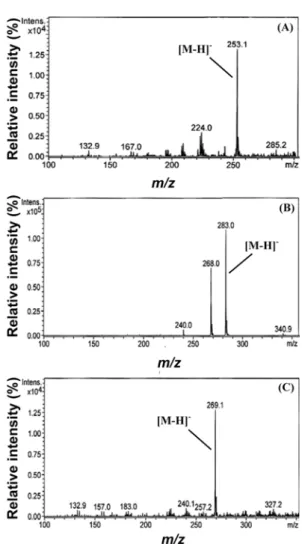
ESI/MS value were identical to those of the pure standard in the mobile phase. The mass spectra of isoflavones 1-3 in soybean leaf extracts (cv. Cheongja 1) are presented in Fig. 3. Analysis revealed compounds 1-3 were daidzein, glycitein, and genistein with [M-H]− at m/z 253.1 (Fig.
3A), 283.0 (Fig. 3B), and 269.1 (Fig. 3C), respectively.
On the basis of the above results, the leaves of 14 Korean soybean cultivars were evaluated. The soybean leaves were collected on September 10, 2006 at the experimental field of Yeongnam Agricultural Research Institute, Miryang, Korea and air-dried in the shade for 5 days. The dried leaves were ground using a coffee grinder (Brabender, Germany). One gram each of the leaves from different cultivars was hydrolyzed in the presence of 10 mL of 1 N HCl at 105oC for 3 h. After the hydrolysis was completed, the mixture was cooled to room temperature, Fig. 2. HPLC chromatogram of isoflavones 1-3 isolated
from the leaves of soybean.
Fig. 3. HPLC-DAD-ESI/MS fragmentations of isolated isoflavones 1-3 from soybean leaf extracts (cv. Cheongja 1). HPLC operating conditions: column, LichroCART 125-4, 5µm, 125 mm×4 mm; solvent, methanol:water [40:60 (v/v)]; flow rate: 0.2 mL/min; detection at 254 nm; HPLC system, Agilent 1100; mass system, Bruker Daltonick DE/ESQUIRE 4000 (negative ion mode).
174 Jin Hwan Lee et al.
followed by the addition of 15 mL methanol. The hydrolysate obtained from the acid hydrolysis was filtered using a Millipore (Millipore, MSI, Westboro, MA) with 0.45-µm membrane filter. The isoflavone contents in leaves of 14 soybean cultivars harvested from Miryang are shown in Table 1.
Differences between isoflavones and cultivars were found. The isoflavone concentrations of soybean leaves
ranged from 29.94±0.13 to 163.61±7.35µg/g (daidzein), 95.11±2.06 to 292.94±2.43µg/g (glycitein), and 67.72±
0.11 to 173.14±7.35µg/g (genistein) (Table 1). Among the 14 Korean cultivars, the highest total isoflavone content was 628.22µg/g in Cheongja 1 leaves. Glycitein (2) (292.94±2.43µg/g) was the predominant isoflavone, followed by daidzein (1) (162.14±6.69µg/g) and genistein (3) (173.14±7.35µg/g). The lowest was found Table 1. Contents of isofalvones 1-3 from the leaves of soybean cultivars
Cultivar Compound (µg/g)a
1 2 3
Geomjeongkong 2 124.23±3.550 134.46±3.40 79.36±0.90
Seonheukkong 44.20±1.40 126.11±3.99 66.57±1.28
Milyang 168 97.25±1.64 174.29±3.97 79.65±2.29
Milyang 181 65.59±3.69 129.47±2.13 82.39±1.89
Suwon 235 131.10±2.570 122.11±0.95 111.56±1.200
Hobankong 122.63±15.50 137.85±5.78 122.74±3.400
Jinpum 2 101.27±3.580 150.66±9.82 157.68±6.410
Galmikong 106.87±8.890 116.88±2.35 102.74±1.150
Heugcheongkong 163.61±4.150 143.27±2.51 82.46±0.41
Jinyulkong 145.66±1.030 147.63±3.76 96.76±1.91
Cheongja 1 162.14±6.690 292.94±2.43 173.14±7.350
Cheongja 2 36.17±0.74 095.11±2.06 73.09±0.11
Cheongja 3 82.66±0.22 188.90±2.38 67.72±0.11
Geomjeongkong 1 29.94±0.13 133.11±1.40 81.66±0.96
aValues indicate the means of three replications.
Fig. 4. HPLC chromatogram of 40% methanol extracts from the leaves of Korean soybean cultivars. (A) Cheongja 3, (B) Cheongja 2, (C) Cheongja 1, (D) Milyang 168, (E) Seonheukkong, and (F) Milyang 181 cultivars.
Characterization of Isoflavone from Soybean Leaves 175 in Cheongja 2 leaves (204.37µg/g) (1, 36.17±0.74; 2,
95.11±2.06; and 3, 73.09±0.11µg/g). Between the two cultivars, Cheongja 1 (628.22µg/g) showed three times higher isoflavone content than Cheongja 2 (204.37µg/g) (Table 1, Fig. 4B, and 4C). A typical HPLC chromatogram of three isoflavones 1-3 is presented in Fig. 4. The isoflavone contents slightly differed among cultivars.
Although the isoflavone contents of soybean leaves were lower than those of the soybean (Lee et al., 2003; Lee et
al., 2004), the contents of the three representative isoflavones, daidzein, glycitein, and genistein, have not yet been analyzed.
Among the 14 cultivars, the leaves of Jinpum 2 (409.61
µg/g) and Cheongja 1 (628.22µg/g) exhibited higher levels of the total isoflavone concentrations in comparison with other cultivars (Table 1). These results indicated that Jinpum 2 and Cheongja 1 cultivars are important sources for development of soybean leaves with high quality breeding and nutritional values.
In conclusion, we isolated and identified three representative isoflavones from soybean leaves. On the basis of the isolated isoflavones, the leaves of 14 Korean soybean cultivars were subjected to HPLC analysis.
Jinpum 2 and Cheongja 1 cultivars showed high amounts of isoflavone, with the content of glycitein (2) being predominantly higher than those of daidzein (1) and genistein (3). Our results show these cultivars are important sources for development of better soybean leaves contains high quality breeding and nutritional value.
Acknowledgments. This study was supported by a Post Doctoral Course Program of Yeongnam Agricultural Research Institute (YARI), National Institute of Crop Science, Rural Development Administration (RDA), Republic of Korea. We thank Prof. Ki Hun Park, Division of Applied Life Science (BK21 Program), EB-NCRC, Institute of Agriculture & Life Science, Graduate School of Gyeongsang National University, Jinju, Korea for many discussions and suggestions.
References
Anthony MS, Clarkson TB, Hughes CL, Morgan TM, and Burke GL (1996) Soybean isoflavones improve cardio- vascular risk factors without affecting the reproductive system of peripubertal Rhesus monkeys. J Nutr126, 43- 50.
Anthony MS, Clarkson TB, and Williams JK (1998) Effects of soy isoflavones on atherosclerosis: potential mecha- nisms. Am J Clin Nutr68, 1390S-1393S.
Jenkins DJA, Kendall CWC, Jackson CJC, Connelly PW, Parker T, Faulkner D, Vidgen E, Cunnane SC, Leiter LA, and Josse RG. (2002) Effects of high- and low- isoflavone soyfoods on blood lipids, oxidized LDL, homocysteine, and blood pressure in hyperlipidemic men and women. Am J Clin Nutr76, 365-372.
Kim JA, Hong SB, Jung WS, Yu CY, Ma KH, Gwag JG, and Chung IM (2007) Comparison of isoflavones com- position in seed, embryo, cotyledon, and seed coat of cooked-with-rice and vegetable soybean (Glycine max L.) varieties. Food Chem102, 738-744.
Lamartiniere CA (2000) Protection against breast cancer with genistein, a component of soy. Am J Clin Nutr 71, 1705S-1707S.
Lee JH, Baek IY, Choung MG, Ha TJ, Han WY, Cho KM, Ko JM, Jeong SH, Oh KW, Park KY, and Park KH (2008) Phytochemical constituents from the leaves of soybean (Glycine max (L.) Merr.). Food Sci Biotechnol
17, 578-586.
Lee JH, Baek IY, Kang NS, Ko JM, Han WY, Kim HT, Oh KW, Suh DY, Ha TJ, and Park KH (2006a) Isolation and characterization of phytochemical constituents from soybean (Glycine max (L.) Merr.). Food Sci Biotechnol
15, 392-398.
Lee JH, Baek IY, Ko JM, Kang NS, Kim HT, Han WY, Shin SO, Park KY, Oh KW, Ha TJ, and Park KH (2007) Profiles of compositional components in vegetable soy- beans (Glycine max (L.) Merr.). J Appl Biol Chem 50, 63-69.
Lee JH, Lee BW, Kim JH, Jeong TS, Kim MJ, Lee WS, and Park KH (2006b) LDL-antioxidant pterocarpans from roots of Glycine max (L.) Merr. J Agric Food Chem54, 2057-2063.
Lee JH, Renita M, Fioritto RJ, Martin SK, Schwartz SJ, and Vodovotz Y (2004) Isolation characterization and antiox- idant activity of Ohio soybeans. J Agric Food Chem 52, 2647-2651.
Lee SJ, Ahn JK, Kim SH, Kim JT, Han SJ, Jung MY, and Chung IM (2003) Variation in isoflavone of soybean cul- tivars with location and storage duration. J Agric Food Chem51, 3382-3389.
Wu AH, Ziegler RG, Nomura AMY, West DW, Kolonel LN, Ross PLH, and Pike MC (1998) Soy intake and risk of breast cancer in Asians and Asian Americans. Am J Clin Nutr68, 1437S-1443S.
Wu Q, Wang M, Sciarappa WJ, and Simon JE (2004) LC/
UV/ESIMS analysis of isoflavones in edamame and tofu soybeans. JAgric Food Chem52, 2763-2769.

![Effects of Weed Interference and Starter Fertilizer on Subsequent Seed Germination and Vigour of Soybean (Glycine max [L.] Merr.)](data:image/gif;base64,R0lGODlhAQABAIAAAP///wAAACH5BAEAAAAALAAAAAABAAEAAAICRAEAOw==)