
www.kwss.or.kr
- 17 -
1Departmentof Crop Production and Breeding, Faculty of Agriculture, Razi University, Kermanshah, Iran. Postal code:6715685438
* Corresponding author:Fax) +98-831-8321083, E-mail) [email protected]
(Received July 18, 2011; Examined March 19, 2012; Accepted March 22, 2012)
Ⓒ 2012 Korean Society of Weed Science
Effects of Weed Interference and Starter Fertilizer on Subsequent Seed Germination and Vigour of Soybean
( Glycine max [L.] Merr.)
G. R. Mohammadi
1* and F. Amiri
1ABSTRACT The study was conducted to investigate the effect of weed interference and starter fertilizer on subsequent soybean seed quality at the Agricultural Research Farm and Laboratory of Razi University, Kermanshah, Iran. Two factorial experiment was laid-outon a randomized complete block design with four replications. First factor was starter fertilizer levels (0 and 25 kg ha
-1) applied in the forms of monoammonium phosphate, the second factor was different weed interference periods consisted of five initial weed-free periods (in which, plots were kept free of weeds for 0, 15, 30, 45 and 60 days after crop emergence (DAE) and then weeds were allowed to grow until harvest) and five initial weed-infested periods (in which, weeds were allowed to grow for 0, 15, 30, 45 and 60DAE, after which the plots were kept free of weeds until harvest). Full season weedy condition reduced 100-seed weight, seed germination percentage and seedling dry weight by 25.9, 13.3 and 22.5%, respectively and increased mean germination time and seed electrical conductivity by 55.8 and 24.3%, respectively as compared with full season weed-free control. However, the traits under study were not significantly influenced when field was kept free of weeds for at least 45 DAE (R1) or weedy condition was continued for less than 30 DAE (V8).
There was a significant and negative correlation between weed biomass and seed weight (r = -0.93), so that when weed free condition was less than 45 DAE or weed infested period was continued for at least 30 DAE, soybean plants produced wrinkled and underdeveloped seeds with lower weights and qualities.
Moreover, soybean seed quality reduction due to weed interference was more evident when starter fertilizer was applied and weeds interfered with soybean from the beginning of the growing season. Information from the present study is beneficial in soybean seed production systems and where farmers use the harvested seeds for the following planting.
Key words: seed quality soybean starter fertilizerweed interference.
INTRODUCTION
Soybean (Glycine max [L.] Merr.) is one of the most important oil seed crops, which is planted in many regions of Iran. It is a valuable source of edible oil and protein for human nutrition. The success of a soybean production system is highly dependent on the seed quality used for planting. High quality seed lots may improve crop yield in two ways: first because seedling emergence from the seedbed is rapid and uniform, leading to the production of vigorous plants, and second the percentage seedling emergence is high were optimum plant population density could be achieved under a wide rang of environmental conditions (Ghassemi- Golezani and Mazloomi-Oskooyi 2008). Seed quality is affected by various factors experienced during develop- ment and maturation (Vieira et al. 1992; Westgate et al. 1989). Environmental stresses during the growth and development of the mother plant may influence the quality of the produced seeds. For example, Smiciklas et al. (1989) observed that water stress during the seed filling period induced a reduction in seed quality of soy- bean as assessed by germination and conductivity results.
However, different opinions with regard to the influence of stress conditions during plant development on seed germination and vigour exist. According to Vieira et al. (1992) drought and lack of fertilization decreased the germination of soybean seed but a decrease in seed vigour was evident only when stress was intense enough to cause wrinkled and / or underdeveloped seeds. Other research workers found a decrease in both germination and seed vigour of soybean (Westgate et al. 1989; Keigley and Mullen 1976) and corn (Hunter et al. 1977; Cloninger et al.
1975) seed developing in stress conditions as drought.
In soybean, weed infestation is considered a persistent and complex constraint in many regions of production world-wide, as it influences soybean growth and development through competition for nutrients, water and light (Vollmann et al. 2010) as well as the production of allelopathic compounds (Rice 1984;
Bhowmik and Doll 1982). According to the literature review, there is a little information related to the effect of weed interference on the quality of crop seeds. For example, Saayman and Van De Venter (1996) reported that both germination and vigour of corn seeds decreased with an increase in weed density. They also observed an increase in the mean time to corn seedling emergence with an increase in weed density indicating reduced seed vigour. However, we did not find any report on the effect of weed interference on subsequent seed germination and vigour of soybean.
Therefore, the present study was conducted to evaluate the effect of different weed interference periods under two levels fertilizer levels (0 and 25 kg.ha
-1) on subsequent seed quality of soybean.
MATERIALS and METHODS
The study was carried out in 2009 at the Agricultural Research Farm and Laboratory of Razi University, Kermanshah, western Iran. (Latitude 34˚18' N, Longitude 47˚4' E, Altitude 1350 m above sea level).
The climate is characterized by mean annual preci- pitation of 478 mm and mean annual temperature of 13.8˚C. The soil type was a silty clay with a pH of 7.9-8.3 and about 0.8% organic matter. The land was plowed and disked before planting. The soybean cultivar used was Williams (a soybean cultivar that is commonly planted in the region). Soybean seeds were inoculated with Bradyrhizobium japonicum bacterium prior to sowing. The crop was planted on 22 May 2009. Soybean is an irrigated crop in western Iran;
therefore, it is not dependent on seasonal rainfall.
Irrigations were carried out as needed throughout the growing season.
The experiment was conducted as a two factors
factorial arrangement based on a randomized complete
block design with four replications. First factor was
starter fertilizer levels (0 and 25 kg ha
-1) applied in the
form of monoammonium phosphate (starter fertilizer
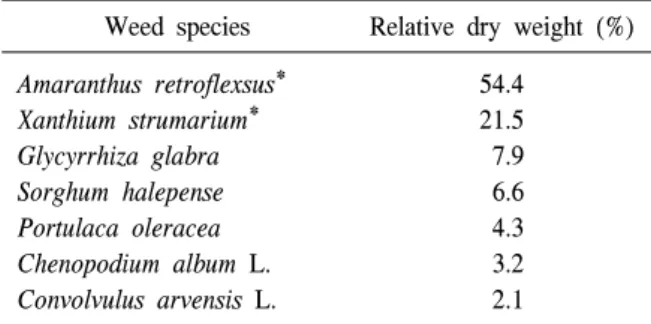
Table 1. Weed species of the experimental field and their
relative dry weights.Weed species Relative dry weight (%)
Amaranthus retroflexsus*
Xanthium strumarium*
Glycyrrhiza glabra Sorghum halepense Portulaca oleracea Chenopodium album L.
Convolvulus arvensis L.
54.4 21.5 7.9 6.6 4.3 3.2 2.1
* Dominant weed species.
level (25 kg ha
-1) was applied according to the soil test recommendation), the second factor was different weed interference periods consisted of five initial weed-free (WF) periods (in which, plots were kept free of weeds for 0, 15, 30, 45 and 60 days after crop emergence (DAE) and then weeds were allowed to grow until harvest) and five initial weed-infested (WI) periods (in which, weeds were allowed to grow for 0, 15, 30, 45 and 60 DAE, after which the plots were kept free of weeds until harvest). Weed removal within and between the plant rows was carried out manually.
Each plot consisted of six soybean rows of 5 m long with a row spacing of 50 cm and with 5 cm between plants in the same row. Crop development stages were recorded on 10 randomly selected plants in each plot at 7 day intervals, beginning soybean emergence. High natural weed populations were observed in the experimental field. Weed species of the field and their relative dry weights are shown in Table 1. These are nearly common weeds in soybean fields of the region.
At maturity, soybean plants at a 4 m length from the two center rows of each plot were harvested by hand and allowed to dry to a constant weight then threshed and cleaned. 100-seed weight was measured according to the recommendation of the International Seed Testing Association (ISTA) (Draper 1985). To evaluate seed germination and vigour, four replicates of twenty five seeds of each plot were placed in sterilized petri dishes containing two layers of filter papers (Whatman
# 41). The petri dishes were moistened with distilled water and then were placed in a germinator at 20±1˚C.
Seed germination was recorded daily up to day 7 after the start of the experiment. A seed was considered germinated when radicle emerged by about 2 mm in length. Mean germination time (MGT), seedling dry weight (SDW) and seed electrical conductivity (SEC) were evaluated as seed vigour indices. In general, the underdeveloped and less vigorous seeds show higher EC and MGT and lower SDW than the well-developed and more vigorous seeds. The mean germination time was calculated according to the following equation (Ellis and Roberts 1980):
MGT = ∑Dn / ∑n
Where MGT is the mean germination time, n is the number of seeds germinated on day and D is the number of days from the start of test.
Moreover, seed germination percentage (SGP) was recorded in the end of test. To determine SDW, after the 7
thday, radicles and plumules produced in each petri dish were separated from the seeds, dried at 70°C to a constant weight and weighed. Another important index of the legumes seed vigour is the electrical conductivity of seed-steep water. The electrical conduc- tivity (EC) test is known as one of the best evaluation of vigour in soybean seed (Loeffler et al. 1988;
Yaklich et al. 1979) and it is recommended in the manual of vigour tests (ISTA 1995). SEC was deter- mined by two replicates of 50 seeds (EC
1and EC
2) from each plot. Each seed sample was weighed (SW
1and SW
2) and then immersed in 250 ml distilled water for 24 h at 20˚C. Then the seed-steep water was gently decanted and EC was measured using an EC meter.
Following equation was used to calculate SEC (Powell et al. 1984):
SEC (μs.cm
-1.g
-1) = [(EC
1/SW
1) + (EC
2/SW
2)] / 2
Weed biomass (WB) was also measured by harves-
Table 2. Analysis of variance of the traits under study.
Source of Variance Mean Square
SGP MGT SDW SEC 100-SW WB
Replication Starter fertilizer (S) Weed treatment (W)
S×W Error C.V
227.78**
252.05**
553.00**
70.32*
33.57 6.40
0.03ns 0.02ns 0.45**
0.05*
0.02 9.71
843.65ns 1911.01ns 15980.22**
3026.29*
1275.73 12.17
1.86ns 69.25**
105.96**
7.82ns 3.97 4.97
0.21ns 0.08ns 5.76**
2.12**
0.13 3.53
128368.16**
139612.05*
2486821.03**
43722.05ns 26995.25 23.93 Abbreviations:SGP, seed germination percentage; MGT, mean germination time; SDW, seedling dry weight; SEC, seed electrical conductivity; 100-SW, 100- seed weight; WB, weed biomass.
ns, * and **: Non significant and significant at the 0.05 and 0.01 level of probability, respectively.
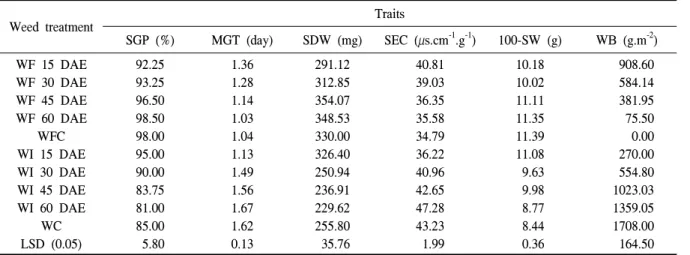
Table 3. Means comparison of the studied traits under different weed treatments.
Weed treatment Traits
SGP (%) MGT (day) SDW (mg) SEC (µs.cm-1.g-1) 100-SW (g) WB (g.m-2) WF 15 DAE
WF 30 DAE WF 45 DAE WF 60 DAE
WFC WI 15 DAE WI 30 DAE WI 45 DAE WI 60 DAE
WC LSD (0.05)
92.25 93.25 96.50 98.50 98.00 95.00 90.00 83.75 81.00 85.00 5.80
1.36 1.28 1.14 1.03 1.04 1.13 1.49 1.56 1.67 1.62 0.13
291.12 312.85 354.07 348.53 330.00 326.40 250.94 236.91 229.62 255.80 35.76
40.81 39.03 36.35 35.58 34.79 36.22 40.96 42.65 47.28 43.23 1.99
10.18 10.02 11.11 11.35 11.39 11.08 9.63 9.98 8.77 8.44 0.36
908.60 584.14 381.95 75.50 0.00 270.00 554.80 1023.03 1359.05 1708.00 164.50 Abbreviations:DAE, days after crop emergence; WFC, weed-free control WC, weedy control (un-weeded for all of the growing season); SGP, seed germination percentage; MGT, mean germination time; SDW, seedling dry weight; SEC, seed electrical conductivity; 100-SW, 100- seed weight; WB, weed biomass LSD, least significant difference.
ting weeds at ground level in three random 0.5×0.5 m quadrats in each plot, at soybean harvest and before every weed removal activity for weed-free and weedy treatments, respectively. Weeds were initially dis- tinguished, then dried at 80˚C to constant weight and weighed. Data analyses were carried out using SAS software (SAS Institute 2003).
RESULTS and DISCUSSION
Analysis of variance (Table 2) revealed that different
weed treatments had significant effect on all of the traits under study including 100-seed weight, SGP, MGT, SDW, SEC and WB (at 0.01 level of proba- bility). Moreover SGP, SEC and WB were significantly influenced by starter fertilizer. However, starter fertilizer by weed treatment interaction was significant for all of the evaluated traits except SEC and WB (Table 2).
In general, all of the traits under study improved
when duration of weed-free period increased or length
of weed infested period decreased (Table 3). Full
season weedy condition produced 1,708 g.m
-2of weed
biomass (Table 3). This condition reduced 100-seed weight, SGP and SDW by 25.9, 13.3 and 22.5%, respectively, as compared with control (weed free condition for all of the growing season). Whereas, this treatment increased MGT and SEC by 55.8 and 24.3%, respectively, compared to control (Table 3).
However, the traits under study were not signi- ficantly influenced when field was kept free of weeds for at least 45 DAE (R1 development stage) (Fehr and Caviness 1977) or weedy condition was continued for less than 30 DAE (V8 development stage). Weed control for at least 45 DAE and weedy condition for less than 30 DAE decreased WB produced by 95.6 and 84.2% respectively, as compared with full season weedy condition (Table 3). In general, weed presence less than 30 days after soybean emergence had no notable effect on quality of the produced seeds (Table 3). This can be attributed to the lack of severe competition between soybean plants and weeds in order to acquire the environmental resources during this period. According to Gibson and Liebman (2003) water and nutrients are often in sufficient supply early in the season to support both the crop and weed seedlings and light competition does not occur until the weed canopy shades the crop. Or it may be that soybean growth and development is sufficient plastic at V8 to recover after weeds are removed. Moreover, when weed free condition was continued until 45 DAE, the few weeds emerging after this time accumulated little biomass and did not significantly affect soybean seed quality (Table 3). This was probably due to the higher competitive ability of soybean against weeds at R1 development stage resulting from its canopy closure. Other researchers have also suggested that the establishment and competition of weeds were reduced following crop canopy closure, because weeds that emerge later are suppressed by shading from the crop (Mohammadi et al. 2005; Martin et al., 2001; Malik et al. 1993;
Swanton and Weise 1991).
However, weed free condition less than 45 DAE significantly influenced the traits under study (Table 3).
Among the evaluated traits, SGP was less affected by weed presence, so that when field kept free of weeds for only 15 DAE, this traits was not significantly influenced (Table 3). Moreover, weedy condition from 15 to 30 DAE reduced SGP by only 5%, which was not statistically significant (Table 3). It seems that soybean seed germination is less sensitive to environ- mental stresses compared to its vigour. As determined visually, when weed-free condition was less than 45 DAE or weed infested period was continued for at least 30 DAE, soybean plants produced wrinkled and underdeveloped seeds with lower weights (Table 3).
Seed development is characterized by numerous cell divisions and differentiation of organs, acquisition of assimilates from the mother plant and consequently a substantial increase in seed weight (Ellis and Pieta Filho 1992). Since, the subsequent crop seed weight and quality can be influenced by the environmental condition of the mother plants, therefore, it is concluded that weeds by competing for light, water and nutrients (Massinga et al. 2003; Holt 1995; Di Tomaso 1995; Tollenaar et al. 1994; Jones and Walker 1993) as well as through the production of allelopathic compounds (Rice 1984; Bhowmik and Doll 1982) can suppress crop growth and development and conse- quently reduce weight and vigour of the produced seeds.
Saayman and Van de Venter (1996) found that germination and seedling emergence of corn seed harvested in the case of competition of the mother plants with Xanthium strumarium decrease with an increase in weed density. Generally, in our study, the variation in weed biomass produced was inverse to variation in seed weight. This was supported by significant and negative correlation between WB and seed weight (r = -0.93). Moreover there were negative and significant correlations between seed weight and MGT and SEC (r = -0.95 and -0.92, respectively).
Whereas, the correlations between seed weight and
SGP and SDW were positive and significant (r = 0.89
and 0.86, respectively). In other words, seed germina-
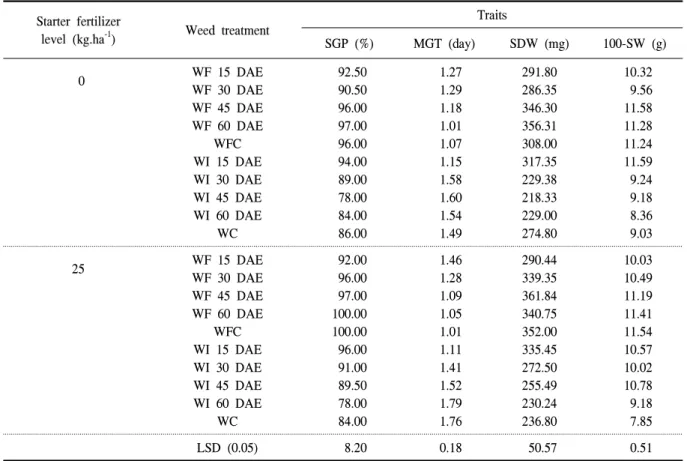
Table 4. Means comparison of the starter fertilizer level × weed treatment interaction for some of the traits under study.
Starter fertilizer
level (kg.ha-1) Weed treatment
Traits
SGP (%) MGT (day) SDW (mg) 100-SW (g)
0 WF 15 DAE
WF 30 DAE WF 45 DAE WF 60 DAE
WFC WI 15 DAE WI 30 DAE WI 45 DAE WI 60 DAE
WC
92.50 90.50 96.00 97.00 96.00 94.00 89.00 78.00 84.00 86.00
1.27 1.29 1.18 1.01 1.07 1.15 1.58 1.60 1.54 1.49
291.80 286.35 346.30 356.31 308.00 317.35 229.38 218.33 229.00 274.80
10.32 9.56 11.58 11.28 11.24 11.59 9.24 9.18 8.36 9.03
25 WF 15 DAE
WF 30 DAE WF 45 DAE WF 60 DAE
WFC WI 15 DAE WI 30 DAE WI 45 DAE WI 60 DAE
WC
92.00 96.00 97.00 100.00 100.00 96.00 91.00 89.50 78.00 84.00
1.46 1.28 1.09 1.05 1.01 1.11 1.41 1.52 1.79 1.76
290.44 339.35 361.84 340.75 352.00 335.45 272.50 255.49 230.24 236.80
10.03 10.49 11.19 11.41 11.54 10.57 10.02 10.78 9.18 7.85
LSD (0.05) 8.20 0.18 50.57 0.51
Abbreviations:DAE, days after crop emergence; WFC, weed-free control; WC, weedy control (un-weeded for all of the growing season); SGP, seed germination percentage; MGT, mean germination time; SDW, seedling dry weight; 100-SW, 100- seed weight LSD, least significant difference.
![The Effects of Increased Temperature on Soybean[Glycine max(L.) Merrill] Yield and Seed Quality in Temperature Gradient Chamber](data:image/gif;base64,R0lGODlhAQABAIAAAP///wAAACH5BAEAAAAALAAAAAABAAEAAAICRAEAOw==)