서 론
한국 사회는 일본에 이어 노인 인구가 가장 많은 나라이며 출산 율은 감소하는 반면 노령화 속도는 세계에서 가장 빠른 속도로 증가 하는 양상으로 나타나고 있다. 2015년 인구 총 조사에 따르면 한국 전체 인구 중 65세 이상은 약 650만 명이고, 전체 인구의 약 13%를 차 지하는 것으로 조사되었다. 또한, 장래 인구 동향 조사에 의하면
2050년에는 약 35.9%까지 급등할 것으로 예상되고 있다.1) 그리고 이 미 노령화 사회에 접어든 한국에서 65세 이상 노인 중 1인 가구의 비 율은 약 18%에 달한다.2) 노인에게 있어 1인 가구의 생활 양식은 일상 생활은 물론 식사의 형태에 있어서도 혼자 하는 경우가 많을 것으로 보여진다.
노인의 건강은 거주 형태나 식생활의 양식 등 다양한 생활 방식에 의해 영향을 받는다. 노인 인구의 주요 건강 문제 중 하나는 우울증 Received March 13, 2017 Revised August 3, 2017
Accepted August 11, 2017 Corresponding author Eun Jin Bae Tel: +82-51-550-9300, Fax: +82-51-553-7575 E-mail: [email protected]
Copyright © 2017 The Korean Academy of Family Medicine
This is an open-access article distributed under the terms of the Creative Commons At- tribution Non-Commercial License (http://creativecommons.org/licenses/by-nc/4.0) which permits unrestricted noncommercial use, distribution, and reproduction in any medium, provided the original work is properly cited.
Original Article
https://doi.org/10.21215/kjfp.2017.7.6.904 eISSN 2233-9116
Korean J Fam Pract. 2017;7(6):904-908
Korean Journal of Family Practice
KJFP
한국 노인에서 동반 식사 여부와 우울 증상과의 관계:
2013년 국민건강영양조사
양정숙, 배은진*, 홍지은, 강준일, 전원진
대동병원 가정의학과
Eating Alone among Korean Elderly Association with Depressive Symptoms:
The Korean National Health and Nutrition Examination, 2013
Jeong Sook Yang, Eun Jin Bae*, Ji Eun Hong, Joonil Kang, Won Jin Jeon Department of Family Medicine, Daedong Hospital, Busan, Korea
Background: Eating alone is becoming an important social issue, and simultaneously, Korea is rapidly turning into an aged society. However, little research has focused on eating alone and its effect on depressive symptoms, quality of life (QOL), and activities of daily living (ADL) in Korean elderly.
Methods: We conducted a cross-sectional study to examine the relationship of eating alone with depressive symptoms, QOL, and ADL in Korean elderly. The study population consisted of 1,111 Korean elderly aged 65 to 80 years (men, 472; women, 639). A chi-square test and Student’s t-test were conducted to compare geriatric functions and QOL between who ate alone and those who ate with others. The association between eating alone and depressive symptoms was analyzed by a multivariate logistic regression analysis, with eating alone/eating with others as the dependent variable. P-value<0.05 was considered to indicate statistical significance.
Results: In the study, proportion of those usually eating alone, 76.5% ate with others but lived alone, and 9.6% ate alone but lived with others. In terms of depressive symptoms, QOL, and activities of daily living, higher rates of suicidal thoughts, plans, and attempts were found among those eating alone. Also, the higher rate of depressive and anxiety symptoms with statistical significance and the lower rate of mobility was found in the population of eating alone.
Conclusion: Findings revealed that the elderly who ate alone had a higher rate of depressive and anxiety symptoms as compared to those who ate with others.
Keywords: Eating Alone; Korean Elderly; Depression; Anxiety
양정숙 외. 한국 노인에서 혼자하는 식사와 우울 증상과의 관계 Korean Journal of Family Practice
KJFP
으로 이는 허혈성 심질환 및 사망과 같은 많은 부정적인 결과를 초 래할 수 있으며 노인의 삶의 질에 크게 영향을 미치고 의료비용을 증 가시킨다.3) 일본 Tosa 마을의 노인들에 대한 한 연구에 따르면 15항 목으로 조사된, 노인성 우울증 척도를 검사했을 때, 혼자 먹는 노인 들은 다른 사람들과 함께 먹는 노인들보다 우울증이 통계적으로 더 높게 나왔다. 그리고 이 데이터에 대한 다변량 분석 결과에 따르면 혼자 식사하는 노인이 정서적인 우울증과 관련이 있음이 밝혀졌 다.4) 또한, 최근 중국의 한 연구에서도 혼자 식사하는 노인들이 다른 사람들과 동반 식사를 하는 노인들과 비교했을 때 우울 증상이 증 가했다는 결과가 보여졌다.5) 그러나 아직 한국에서 노인에게 있어 식 사 시간 동안의 사회적인 동반자의 부족, 즉, 혼자 식사하는 생활 형 태가 정서적인 문제와 관련하여 어떤 영향을 미치는지는 광범위하 게 연구되지 않았다.
이 연구는 한국 노인의 식사를 통한 사회적 참여와 우울 증상 사 이의 연관성을 조사하는 것을 목표로 하고 있으며, 특별히 혼자서 식사하는 것에 중점을 두고 우울 증상과의 관계를 보고자 한다.
방 법
1. 연구 설계: 단면 연구 2. 연구 대상
본 연구는 국민건강영양조사 2013년도 자료를 이용하여 분석하 였다. 연령은 남녀 모두 65세에서 80세 사이의 인구를 대상으로 하였 으며 이 중 결측값과 모름 및 무응답, 비해당에 해당하는 사람들을 제외하고 1,111명(남자 472명, 여자 639명)이 최종 분석 대상자로 선정 되었다.
3. 변수 설명 1) 식사 방식과 거주 양식
국민건강영양조사의 가구 조사 항목에서 “세대 유형은 다음 중 무엇에 해당합니까?”라는 질문에 “1인 가구”로 대답한 65세 이상에 서 80세 이하의 인구를 선정하였고, 식생활조사 항목에서 “최근 1년 동안 아침식사 혹은 점심식사, 저녁식사 시 다른 사람과 함께 식사 를 하셨습니까”의 질문에 각각 “예” 또는 “아니오”로 응답하였으며 세 끼 중 “전부 혼자 먹는다”와 “한 끼 이상은 동반 식사를 한다”로 구분 하였다.
2) 정신건강
국민건강영양조사의 건강설문 이환 항목에서 우울증 의사 진단 여부 질문에는 “있음”과 “없음”으로 답변하였고, 일상생활에서 스트
레스 인지 정도는 “대단히 많이 느낀다”, “많이 느낀다”, “조금 느끼는 편이다”, “거의 느끼지 않는다” 의 1에서 4까지의 범위로 답변하였다.
1년간 자살 생각 여부는 “최근 1년 동안 진지하게 자살을 생각한 적 이 있습니까?”, 자살 계획 여부는 “최근 1년 동안 자살하기 위해 구체 적인 계획을 세운 적이 있습니까?”, 자살 시도 여부는 “최근 1년 동안 실제로 자살 시도를 해 본 적이 있습니까?”로 설문하였고 “예”와 “아 니오”로 답변하였다.
3) 삶의 질
국민건강영양조사의 EuroQol-5D조사표를 이용한 삶의 질 항목 에서 운동 능력, 자기관리, 일상활동, 통증 및 불편, 불안 및 우울 문 항에 대해 3개의 답변이 있고 “지장이 없다” 그리고 “다소 지장 및 어 려움 있다”와 “심하게 지장 및 어려움 있다” 두 범주로 나누어 분석하 였다.
4) 노인 기능 및 체질량지수
국민건강영양조사의 구강 설문조사 항목에서 “현재 치아나 틀니, 잇몸 등 입안의 문제로, 음식을 씹는 데에 불편감을 느끼십니까?” 질 문에 “매우 불편함”, “불편함”, “그저 그러함”, “불편하지 않음”’ “전혀 불편하지 않음”으로 답변하였고 1부터 5까지의 범위로 분석하였다.
체질량지수는 체중(kg)을 신장(m)의 제곱으로 나누어 계산하였고, 범위는 14–37 kg/m2 내로 설정하였다.
4. 통계 분석
수집된 자료는 IBM SPSS Statistics 19.0 (IBM Co., Armonk, NY, USA) 통계 패키지 프로그램을 사용하여 분석하였다. 주거 형태에 따른 동반 식사 여부를 비교하기 위해 chi-square test를 시행하였다.
인구학적인 특성에 따른 동반 식사 여부의 차이 비교를 위해 연령, 스트레스 인지 정도, 씹기 문제, 체질량지수 항목은 student t-test로 분석하였고, 성별, 우울증 의사 진단 여부, 1년간 자살 생각 여부 및 계획과 시도, 운동 능력, 자기 관리, 통증 및 불편, 불안 및 우울 항목 은 logistic regression analysis를 사용하였다. 모델 1은 성별과 연령을 통제였고, 모델 2는 성별, 연령, 자살 생각, 계획, 시도 여부를 통제하 였으며, 모델 3은 성별, 연령, 운동 능력, 통증/불편, 체질량지수를 통 제하여 분석하였다. Multivariate logistic regression analysis를 실시하 였고 통계적 유의 수준은 P<0.05로 정하였다.
Original Article
Korean Journal of Family Practice
Jeong Sook Yang, et al. Eating Alone among Korean Elderly Association with Dpressive Symptoms
Korean Journal of Family Practice
KJFP
결 과
1. 주거 형태에 따른 동반 식사 여부
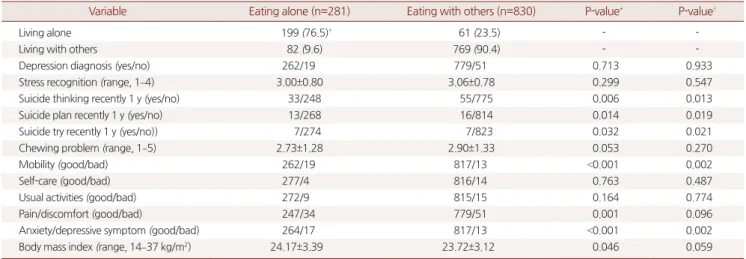
이 연구의 참가자는 모두 65세에서 80세 사이의 노인이며 총 1,111 명(남자 472명, 여자 639명)으로 이 중 199명의 참가자는 혼자 거주하 면서 혼자 식사를 하였고, 82명의 참가자는 다른 사람들과 함께 거 주하였으나 혼자 식사하였다. 61명의 참가자는 혼자 거주하였으나 다른 사람들과 식사를 하였고, 769명의 참가자는 다른 사람과 함께 거주하면서 다른 사람과 함께 식사를 하였다. 혼자 거주하면서 다른 사람과 함께 식사하는 비율은 약 76.5%, 다른 사람과 함께 거주하면 서 혼자 식사하는 비율은 약 9.6%로 나타났다(Table 1).
2. 동반 식사 여부에 따른 우울 증상 및 삶의 질, 노인 기능 연구 분석 결과 혼자 식사하는 경우는 남자(72명)보다 여자(209
명)가 더 많았고(P<0.001), 평균 연령도 혼자 식사하는 경우는 73.5세 로 71.8세보다 높은 것으로 나타났다(P<0.001). 또한, 혼자 식사하는 노인에게 있어 자살에 대한 생각, 계획, 시도가 많고, 운동 능력, 불 안/우울이 적은 것으로 나타났다(P<0.001).
3. 혼자 하는 식사와 우울 증상과의 관계
혼자 하는 식사와 우울 증상과의 관계를 살펴보기 위해 multivari- ate logistic regression analysis를 시행한 결과는 Table 2와 같다. 분석 결과 모델 1의 경우 성별과 연령을 통제한 상태에서 함께 식사하는 참가자보다 혼자 식사하는 참가자에서 불안 및 우울이 3.35배 더 높 은 것으로 나타났고(odds ratio [OR], 3.35), 모델 2에서 성별, 연령, 자 살 생각, 자살 계획, 자살 시도 여부를 통제한 분석에서 혼자 식사하 는 참가자에서 불안 및 우울이 2.77배로 높게 보였다(OR, 2.77). 모델 3은 성별, 연령, 운동 능력, 통증/불편, 체질량지수를 통제한 분석에
Table 1. Comparison of geriatric functions and quality of life between elderly who eat alone and eat with others
Variable Eating alone (n=281) Eating with others (n=830) P-value* P-value†
Living alone 199 (76.5)‡ 61 (23.5) - -
Living with others 82 (9.6) 769 (90.4) - -
Depression diagnosis (yes/no) 262/19 779/51 0.713 0.933
Stress recognition (range, 1–4) 3.00±0.80 3.06±0.78 0.299 0.547
Suicide thinking recently 1 y (yes/no) 33/248 55/775 0.006 0.013
Suicide plan recently 1 y (yes/no) 13/268 16/814 0.014 0.019
Suicide try recently 1 y (yes/no)) 7/274 7/823 0.032 0.021
Chewing problem (range, 1–5) 2.73±1.28 2.90±1.33 0.053 0.270
Mobility (good/bad) 262/19 817/13 <0.001 0.002
Self-care (good/bad) 277/4 816/14 0.763 0.487
Usual activities (good/bad) 272/9 815/15 0.164 0.774
Pain/discomfort (good/bad) 247/34 779/51 0.001 0.096
Anxiety/depressive symptom (good/bad) 264/17 817/13 <0.001 0.002
Body mass index (range, 14–37 kg/m2) 24.17±3.39 23.72±3.12 0.046 0.059
Values are presented as number (%), number only, or mean±standard deviation.
*Differences were analyzed by the chi-square test for categorical variables and the student’s t-test for continuous variables. †Analyzed by logistic regressing analysis and adjusted for gender and age. ‡Percentage shows proportion of eating alone/eating with others among the total participatiants of livingalone/with others.
Table 2. Association between eating alone and depressive symptom
Variable Model 1 Model 2 Model 3
OR (95% CI) P-value OR (95% CI) P-value OR (95% CI) P-value
Sex (male/female) 2.64 (1.95–3.59) <0.001 2.65 (1.95–3.59) <0.001 2.49 (1.83–3.41) <0.001
Age (y) (range, 65–80 y) 1.07 (1.04–1.10) <0.001 1.07 (1.04–1.11) <0.001 1.08 (1.04–1.11) <0.001
Anxiety/depression (good/bad) 3.35 (1.57–7.14) 0.002 2.77 (1.28–6.01) 0.010 2.37 (1.03–5.45) 0.042
Suicide thinking recently 1 y (yes/no) – – 1.39 (0.80–2.40) 0.239 1.27 (0.72–2.24) 0.404
Suicide plan recently 1 y (yes/no) – – 1.43 (0.54–3.83) 0.475 1.34 (0.49–3.63) 0.566
Suicide try recently 1 y (yes/no) – – 1.77 (0.49–6.39) 0.380 1.79 (0.49–6.56) 0.377
Mobility (good/bad) – – – – 2.25 (1.00–5.06) 0.050
Pain/discomfort (good/bad) – – – – 0.96 (0.56–1.64) 0.891
BMI (range, 14–37 kg/m2) – – – – 1.04 (0.99–1.09) 0.112
Model 1: adjusted sex and age. Model 2: adjusted for sex and age and suicide thinking, plan, try. Model 3: adjusted for sex and age and mobility and pain/discomfort and BMI. By multivariate logistic regression analysis.
OR, odds ratio; CI, confidence interval; BMI, body mass index; –, not used in the model.
양정숙 외. 한국 노인에서 혼자하는 식사와 우울 증상과의 관계 Korean Journal of Family Practice
KJFP
서 혼자 식사하는 참가자의 불안 및 우울이 2.37배로 통계적으로 유 의한 것으로 나타났다(OR, 2.37) (Table 2).
고 찰
본 연구에 의하면 1,111명의 참가자 중 281명(25.2%)이 평소 혼자 식 사를 하였고, 혼자 거주하는 참가자의 199명(76.5%)이 혼자 식사하였 으며, 다른 사람과 함께 거주하면서 혼자 식사하는 참가자는 82명 (9.6%)으로 나타났다. 이 연구의 목적은 65세 이상의 참가자 중 혼자 식사하는 사람이 우울 증상과 어떤 관계를 보이는지를 밝히는 데 있 었다. 분석 결과 혼자 식사하는 경우 불안 및 우울 증상이 관련이 있 는 것으로 보였다. 혼자 식사한다는 것은 우울한 기분에 영향을 줄 수 있다. 식사로 인한 사회적인 유대감의 부족은 정서적인 결핍과 연 관이 있다.
일부 연구에서는 식사 형태가 정서적인 안녕과 우울감과 관련하 여 식욕의 저하와 같은 실제적인 문제와 연관이 되어있다고 밝혔 다.6) 가족이나 친구와의 동반 식사를 통한 의사소통은 좋은 식욕이 나 우울증과 관련이 있다.7) 특별히 가족 간의 유대관계, 즉, 함께 식 사하는 행위를 통한 정서적인 지지는 삶의 질과도 관련이 있다. 식사 는 노인들에게 사회적으로 중요한 일 중 하나이다. 타인과 함께 하는 식사를 통해 교류를 할 수 있다.8) 한 연구에서는 혼자 식사하는 것은 먹는 음식의 다양성 및 노인의 건강 상태에도 영향을 주는 것으로
나타났다.9,10) 혼자 식사하는 노인에게 있어 체질량지수와의 관련성
을 보여주는 일본의 한 연구에서는 혼자 식사하는 노인의 체질량지 수가 음식의 다양성과 관련하여 더 낮은 것으로 보고되었다. 이는 어 린이가 혼자 식사하는 경우 체질량지수가 높은 것과는 대조적인 결 과를 보인다. 어린이는 혼자 식사하는 경우 패스트푸드에 많이 노출 되는 반면 노인의 경우는 영양 부족과 연관성을 보였다.11) 노인이 혼 자 식사하는 경우 건강한 음식을 선택하는 것에 대한 어려움이 있고 스스로 알맞은 식사에 대한 동기 부여가 안 된다.12) 우울 증상은 적 당한 식이의 부족과도 관련이 있다.13) 어떤 연구에서는 독거하는 노 인의 경우 식사 준비의 사회적 지지의 부족함으로 인해 다양한 영양 섭취가 부족하였고, 우울감이 높은 것으로 나타났다. 이후 영양 중 재 프로그램을 실시한 후 우울감이 낮아진 결과를 보였다.14) 본 연구 에서는 음식의 다양성과의 상관관계는 분석되지 않았으나 혼자 식 사하는 노인과 동반 식사하는 노인 간의 차이는 체질량지수의 차이 는 보이지 않았으나 우울감의 차이는 나타났다.
이 연구는 단면 연구로 분석되었고 참여 대상자의 숫자도 적었다.
따라서 혼자 식사하는 것과 우울증과의 상관관계를 더 명확히 밝힐 수는 없었다. 또한, 노인에게 초점이 맞추어진 우울증 척도가 적용되
어 있지 않아 우울증의 정도를 측정하는 데 있어 부족함이 있었다.
그러나 한국 내 고령 인구 비율이 늘어나고 있고, 개인화된 사회에 서 혼자 하는 식사로 인한 사회적인 유대감의 부족이 노인 우울 증 상과 관련이 있다는 연구의 기초를 제공하는 데에 의의가 있다고 하 겠다. 또한, 앞으로 노인에게 초점이 맞춰진 연구 방법이 마련되고, 이에 따라 다양한 사회 참여와 노인의 우울 및 삶의 질과의 연관성 에 관한 연구가 진행되어야 하겠다.
한국의 65세 이상 80세 이하의 노인을 대상으로 한 본 연구에서 혼자 식사하는 것은 우울 증상과 밀접한 관계가 있는 것으로 나타 났다. 이 연구를 통해 노인들에게 “함께 식사하는 것”을 통한 사회 참 여도 증가와 유대감 강화 대책이 필요할 것으로 보인다.
요 약
연구배경:
본 연구는 노인 인구의 비율이 늘어나고 빨라지는 노령 화 속도로 인해 산업화 및 개인화된 사회 속에서 특별히 노인에게 있 어 함께 식사하는 것을 통한 사회적 활동의 참여도 증가와 우울 증 상 완화의 관련성에 대해 연구하고자 한다.방법:
국민건강영양조사 2013년도의 설문 및 계측 결과를 바탕으로 65세 이상 80세 이하의 참여자를 대상으로 주거형태에 따른 동반 식 사 여부를 비교하기 위해 chi-square test를 실시하였고, 동반 식사 여 부에 따른 우울 증상 및 삶의 질, 노인 기능의 평가를 비교하기 위해 비교하기 위해 chi-square test 및 student’s t-test를 사용하였다. 혼자 식 사하는 것과 우울 증상과의 연관성을 분석하기 위해 multivariate lo- gistic regression analysis를 실시하였다.결과:
주거 형태에 따라서 동반 식사 여부를 비교하였을 때, 평소 혼 자 식사하는 비율은 약 25.2%였고, 혼자 거주하면서 다른 사람과 함 께 식사하는 비율은 약 76.5%, 다른 사람과 함께 거주하면서 혼자 식 사하는 비율은 약 9.6%로 나타났다. 동반 식사 여부에 따른 우울 증 상 및 삶의 질, 노인 기능 비교 시 혼자 식사하는 노인에게 있어 자살 에 대한 생각, 계획, 시도가 높고, 운동 능력, 불안 및 우울이 낮은 것 으로 나타났다. 혼자 하는 식사와 우울 증상과의 관계를 보았을 때 혼자 식사하는 경우 불안 및 우울 증상이 유의하게 높은 결과를 보 였다.결론:
65세 이상 80세 이하의 노인 중 혼자 식사하는 경우 다른 사람 과 함께 식사하는 노인에 비해 불안 및 우울 증상이 높은 것으로 나 타났다.중심단어:
혼자 하는 식사; 노인; 우울; 불안Jeong Sook Yang, et al. Eating Alone among Korean Elderly Association with Dpressive Symptoms
Korean Journal of Family Practice
KJFP
REFERENCES
1. Population sensus [Internet]. Daejeon: Korean Statistical Information Ser- vice; 2015. [cited 2017 Feb 17]. Available from: http://kosis.kr/statisticsList/
statisticsListIndex.do?menuId=M_01_01&vwcd=MT_ZTITLE&parmTab Id=M_01_01#SelectStatsBoxDiv.
2. Household by sensus [Internet]. Daejeon: Korean Statistical Information Service; 2015. [cited 2017 Feb 17]. Available from: http://kosis.kr/statistic- sList/statisticsListIndex.do?menuId=M_01_01&vwcd=MT_ZTITLE&par mTabId=M_01_01#SelectStatsBoxDiv.
3. Luppa M, Heinrich S, Angermeyer MC, König HH, Riedel-Heller SG. Cost- of-illness studies of depression: a systematic review. J Affect Disord 2007; 98:
29-43.
4. Kimura Y, Wada T, Okumiya K, Ishimoto Y, Fukutomi E, Kasahara Y, et al.
Eating alone among community-dwelling Japanese elderly: association with depression and food diversity. J Nutr Health Aging 2012; 16: 728-31.
5. Wang X, Shen W, Wang C, Zhang X, Xiao Y, He F, et al. Association between eating alone and depressive symptom in elders: a cross-sectional study.
BMC Geriatr 2016; 16: 19.
6. Engel JH, Siewerdt F, Jackson R, Akobundu U, Wait C, Sahyoun N. Hardi- ness, depression, and emotional well-being and their association with appe- tite in older adults. J Am Geriatr Soc 2011; 59: 482-7.
7. Okamoto K, Harasawa Y, Shiraishi T, Sakuma K, Momose Y. Much commu- nication with family and appetite among elderly persons in Japan. Arch
Gerontol Geriatr 2007; 45: 319-26.
8. Vesnaver E, Keller HH. Social influences and eating behavior in later life: a review. J Nutr Gerontol Geriatr 2011; 30: 2-23.
9. Kimura Y, Wada T, Ishine M, Ishimoto Y, Kasahara Y, Konno A, et al. Food diversity is closely associated with activities of daily living, depression, and quality of life in community-dwelling elderly people. J Am Geriatr Soc 2009;
57: 922-4.
10. Kimura Y, Okumiya K, Sakamoto R, Ishine M, Wada T, Kosaka Y, et al. Com- prehensive geriatric assessment of elderly highlanders in Qinghai, China IV:
comparison of food diversity and its relation to health of Han and Tibetan elderly. Geriatr Gerontol Int 2009; 9: 359-65.
11. Torres CC, Mclntosh WA, Kubena KS. Social network and social back- ground characteristics of elderly who live and eat alone. J Aging Health 1992; 4: 564-78.
12. Locher JL, Ritchie CS, Roth DL, Sen B, Vickers KS, Vailas LI. Food choice among homebound older adults: motivations and perceived barriers. J Nutr Health Aging 2009; 13: 659-64.
13. German L, Kahana C, Rosenfeld V, Zabrowsky I, Wiezer Z, Fraser D, et al.
Depressive symptoms are associated with food insufficiency and nutritional deficiencies in poor community-dwelling elderly people. J Nutr Health Ag- ing 2011; 15: 3-8.
14. Shin SK, Kim HJ, Choi BY, Lee SS. A comparison of food frequency for the elderly regarding different family types: based on community health survey for 2008. Korean J Nutr 2012; 45: 264-73.