Printed in the Republic of Korea DOI 10.5012/jkcs.2010.54.5.506
요약. benzoylisothiocyanate 와 아스파르트산 [BATA] (1), 글루탐산 [BATG] (2) , 메티오닌 [BATM] (3), 루신 [BATL] (4), 및 트립토판 [BATT] (5) 등의 다양한 아미노산을 반응시켜 일련의 새로운 리간드인 N-[(benzoylamino)-thioxomethyl]-amino acid (HL)를 합성하였다. 이들 리간드의 특성을 원소분석, IR 및 NMR로 규명하였다. 이러한 리간드 (6-8)의 몇가지 전이금속 착물을 제조하여[M = Cu(II), Co(II), 또는 Ni(II)] 원소분석, IR 및 1H NMR을 통하여 특성을 규명하였다. 항균성에 대한 연구 결과 모든 리간드가 항균 활성을 보이지 않는 반면, (ML2) 착물; [M=Cu(II),Co(II), 또는 Ni(II)]은 (Gram -ive) Escherichia (NCTC5933) 및 (Gram +ive) Staphylococcus (NCTC6571)에 대해 항균 활성을 보였으며 또한 (BALB/C) 알비노 쥐에 대해 독 성을 보이지 않았다.
주제어: 리간드, 아미노산, Benzoylisothiocyanate, 전이금속, 항균 활성
ABSTRACT. A new series of ligands N-[(benzoylamino)-thioxomethyl]-amino acid (HL) were synthesized by reaction of benzoyl- isothiocyanate with various amino acids namely aspartic acid [BATA] (1), glutamic acid [BATG] (2), methionine [BATM] (3), leucine [BATL] (4), and tryptophan [BATT] (5). The ligands were characterized by elemental analysis, IR and NMR spectra. Some transition metal complexes (ML2) for these ligands (6-8) were prepared; [M=Cu(II), Co(II), or Ni(II)], and characterized by elemental analysis, IR and 1H NMR spectra. Antibacterial study showed that all the ligands have no antibacterial activity, whereas (ML2) com- plexes; [M = Cu(II), Co(II), or Ni(II)] have antibacterial activity towards (Gram -ive) Escherichia (NCTC5933) and (Gram +ive) Stap- hylococcus (NCTC6571) and have no toxicity on (BALB/C) Albino mice.
Keywords: Ligands, Amino acid, Benzoylisothiocyanate, Transition metals, Antibacterial activity
새로운 아미노산 유도체인 N-[(Benzoyl amino)-Thioxomethyl]-Amino Acid(HL)의 착물 합성 , 특성규명 및 생물학적 활성
Dhafir M. H. Al-Mudhaffar*, Dawood S. Al-Edani, and Suma M. Dawood Chemistry Department, Science College, Basra University, Basra, Iraq
(접수 2009. 12. 4; 수정 2010. 3. 17; 게재확정 2010. 6. 1)
Synthesis, Characterization and Biological Activity of Some Complexes
of Some New Amino Acid Derivatives N-[(Benzoyl amino)-Thioxomethyl]-Amino Acid(HL)
Dhafir M. H. Al-Mudhaffar*, Dawood S. Al-Edani, and Suma M. Dawood Chemistry Department, Science College, Basra University, Basra, Iraq
*E-mail: [email protected]
(Received December 4, 2009; Revised March 17, 2010; Accepted June 1, 2010)
INTRODUCTION
It is well verified that many transition metals-1,2 and rare earth metals-amino acids complexes3 have considerable bio- logical activity, such as antitumor properties. Ga(NO3)3 has exhibited clinical activity against lymphomas4 and bladder carcinomas.5,6 Ruthenium complexes, such as ammine, ami- ne, and heterocyclic complexes of ruthenium (III) exhibit in- hibition of DNA replication.7 Many Rh (II)- and other transi- tion metal-complexes have shown good antitumor activities.8 Transition metal complexes of thiourea derivatives of gly- cine,9,10 hisitidine, phenylalanine, serine, alanine and cysteine have been prepared and characterized.11
A new series of amino acid esters bearing coumarin were synthesized and evaluated, in vitro, against HIV-1 and bo- vine viral diarrhea virus (BVDV).12
J. David invented method producing hydroxyamino-acids, esters, or derivative, thereof , is provided13 through regio- selective or enzymatic hydrolysis followed by rearrangement for substituted β-ketodiester giving the final product. A con- venient microwave assisted synthesis of N-glycosyl amino- acids, in which complying reaction of glycosylamines with Fmoc-protected aspartic acid, by microwave approach was described.14
Recently a novel synthetic method for isomeric peptides through an appropriate linkage of L-selenomethionine or Se-
Methyl-L-selenocysteine with L-glutamic acid producing peptides of L-Selenomethionine or Se-Methyl-L-selenocy- steine which have among other properties ,capabilities to prevent, reduce hair fall and promote hair growth.15
A series of antibacterial and antifungal amino acid-derived compounds and their Co(II)-, Cu(II)-, Ni(II)-, and Zn(II)- complexes; [M(L)(H2O)4]Cl have been synthesized and cha- racterized by elemental analysis, molar conductance, magne- tic moments, IR and electronic spectral measurements. The ligand (L) were derived by condensation of β-diketones with glycine, phenylalanine, valine and histidine.16
Recently, a series of amino acid ester derivatives contain- ing 5-fluorouracil were synthesized using 1-ethyl-3-(3-di- methylaminopropyl)carbodiimide hydrochloride (EDC·HCl) and N-hydroxybenzotriazole (HOBt) as a coupling agent.17 The in vitro antitumor activity tests against leukaemia HL-60 and liver cancer BEL-7402 indicated that (R)-ethyl 2-(2-(5- fluoro-2,4-dioxo-3,4-dihydropyrimidin-1-(2H-yl-acetamido)- 3-(4-hydroxyphenyl) propanoate showed more inhibitory effect against BEL-7402 than 5-FU.17 A new non-natural arginine-like amino acid derivative with a sulfamoyl group in the side-chain were synthesized by Sulfamoylation of the L-ornithine methyl ester side-chain generates a non-natural arginine isostere.18 Vivek Kumar et al synthesized a new series of functionalized amino acid derivatives N-substituted- 1-N-(tert-butoxycarbonyl)-2,2-dimethyl-4-phenyl-5-oxazo lidine carboxamide and 1-N-substituted-3-amino-2-hydro- xyl-3-phenylpropane-1-carboxamide.19
The synthesis, and characterization of some new series of transition metal complexes of ligands; N-[(Benzoylamino) thioxomethyl] amino acid (HL) where (amino acid = apartic acid, glutamic acid, metheonine, leucine, or tryptophan) are reported here.
EXPERIMENTAL Chemicals
All solvents are from G.C.C. D,L-Amino acids are from Merck or BDH. Transition metal chlorides are from Merck.
Sodium Hydroxide and Benzoyl Chloride are from Fluka.
Bilogical study was accomplished by using LTF-Uni Jemp Autoclave for sterilizing and Escherichia (NCTC 5933) coli and Staphylococcus aureus (NCTC 6571) for biological acti- vity study of the prepared compounds (1-8).
Physical Measurements
The IR -spectra were recorded on Shimadzu FTIR -8400 spectrometer using KBr pellets in the range 4000 - 400 cm-1. Elemental analysis were performed on EA 3000 A-Euro-
vector. 1H NMR-spectra were recorded on Bruker Ultra shield 300 MHz using tetraflouroacetic acid and MeOD as solvents and TMS as internal standard.
Synthesis of the ligands (HL)
(i) Preparation of the benzoylisothiocyante was done as described in the literature.11 Equivalent molal ratios of ben- zoyl chloride and ammonium thiocyanate in acetone was re- fluxed for 1hr.,and worked up as the literature method to give pure filtrate.11
(ii) preparation of N-[(benzoyl amino)thioxomethyl]-as- partic acid (BATA) (1) was carried out by applying the general procedure as in the literature,11 by adding rapidly (0.01 mmol) of aspartic acid to the above solution in (i) to maintain vigo- rous reflux for 6 h. The resultant solid product was collected, washed with acetone and recrystallized using column chro- matography with eluent (ethanol : chloroform = 4 : 1) giving a white solid. Yield (65%). m.p. = 273 - 275 oC.
Similarly, the glutamic acid-, leucine-, and tryptophan- derivatives; i.e compounds 2-5 were obtained applying simi- lar procedure as in (ii) above. Physical properties for com- pounds 1-5 are given in Table 1.
Synthesis of the metal complex compounds (6-8) 11 1.24 mmol of the ligand (HL) was dissolved in 25 mL of pure methanol containing 1.24 mmol of NaOH. A solution of metal chloride; (0.62 mmol); MCl2{M:Co(II),Cu(II) or Ni(II)}, in methanol was added dropwise over the ligand (HL) basic solution, and the precipitate appeared immediately.
After stirring the mixture at room temperature for 2 h, the precipitate was collected by filtration, washed with methanol and dried under vacuum. Further purification applying co- lumn chromatography (methanol / chloroform = 4.5 : 0.5) gave the purest solid products with melting points shown in Table 1.
RESULTS AND DISCUSSION
Synthesis of the ligands
The synthesis of the ligands 1-5 requires firstly the pre- paration of benzoylisothiocyante,9 and subsequent reactions with respective amino acid (HL) under reflux in acetone, as shown in Scheme 1.
Infrared spectra
The IR spectra for the ligands 1-5 shows similarity in some absorption frequencies: aromatic C-H stretching in the range 3000 - 3100 cm-1, aliphatic C-H frequencies in the range 2750 - 2990 cm-1. Broad and medium bands in the range
NH4SCN PhCOCI acetone
benzoyl is othiocyanate
amino acid
acetone heat
Where R = CH2COOH; Asp (1), (CH2) 2COOH, Glu (2), CH2CH2SCH3; Met (3), CH2CH(CH3)2; Leu (4), or C9H8N; Trp (5)
N-[(benzoyl amino)thioxomethyl]aminoacid
Scheme 1. Preparation of N-[(benzoyl amino-thioxomethyl)-amino acid (HL)
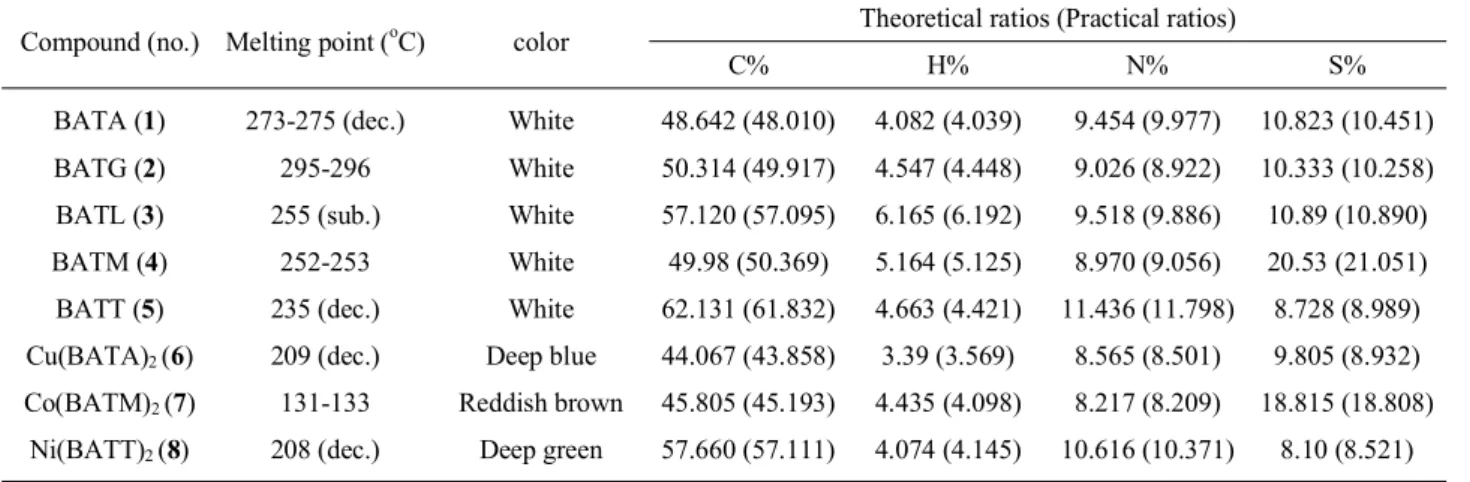
Table 1. Elemental analysis and physical properties of the ligands and complexes (1-8)
Compound (no.) Melting point (oC) color Theoretical ratios (Practical ratios)
C% H% N% S%
BATA (1) 273-275 (dec.) White 48.642 (48.010) 4.082 (4.039) 9.454 (9.977) 10.823 (10.451) BATG (2) 295-296 White 50.314 (49.917) 4.547 (4.448) 9.026 (8.922) 10.333 (10.258) BATL (3) 255 (sub.) White 57.120 (57.095) 6.165 (6.192) 9.518 (9.886) 10.89 (10.890) BATM (4) 252-253 White 49.98 (50.369) 5.164 (5.125) 8.970 (9.056) 20.53 (21.051) BATT (5) 235 (dec.) White 62.131 (61.832) 4.663 (4.421) 11.436 (11.798) 8.728 (8.989) Cu(BATA)2 (6) 209 (dec.) Deep blue 44.067 (43.858) 3.39 (3.569) 8.565 (8.501) 9.805 (8.932) Co(BATM)2 (7) 131-133 Reddish brown 45.805 (45.193) 4.435 (4.098) 8.217 (8.209) 18.815 (18.808)
Ni(BATT)2 (8) 208 (dec.) Deep green 57.660 (57.111) 4.074 (4.145) 10.616 (10.371) 8.10 (8.521)
Table 2. Fundamental stretching frequencies (cm-1) of the compounds (1-8)
Compound (no.) Vs NH VC-H arm. VC-H alp. VC=O
(carboxylic)
VC=O (amide)
asym. sym.
BATA (1) 3425 (w) 3010 (m) 2945 (m) 2912 (m) 1691 (m) 1616 (s)
BATG (2) 3407 (m) 3014 (s) 2900 (s) 2819 (s) 1724 (s) 1681 (s)
BATL (3) 3421 (m) 3035 (s) 2958 (s) 2880 (w) 1724 (w) 1625 (w)
BATM (4) 3413 (m) 3033 (s) 2921 (s) 2800 (w) 1718 (m) -
BATT (5) 3404 (s) 3035 (m) 2990 2858 (w) 1664 (s) 1593 (s)
Cu(BATA) (6) 3520-3320 (br) 3000-3100 (br) 2923 (m) 2900 (w) 1584 (s) -
Co(BATM) (7) 3448 (m) 3050 (w) 2920 (m) 2800 (m) 1587 (s) 1635 (s)
Ni(BATT) (8) 3409 (s) 3064 (m) 2921 (w) 2860 (w) 1589 (s) -
3250 - 3520 cm-1 are attributed to superimposed O-H and NH stretching bands. Band, due to strong Vas (C=O) stretch- ing occurred in the range 1691 - 1724 cm-1 and weaker Vs
(C=O) bands in the range 1490 - 1593 cm-1. The characteristic band at ~ 1700 cm-1; for Vas (C=O) shifts to lower frequencies upon complexation. The complexes 6-8 display both sym- metric and asymmetric stretching vibrations of COO- 1390 - 1458 cm-1 and 1583 - 1635 cm-1 respectively associated with charged form of carboxylic group20 which indicates the coor- dination of ligand carboxyl group with the metal ions; (Cu(II), Ni(II), Co(II), as bidentate chelate fashion in accordance with the work of Kabbani et al.11 Other n (C=S), and n (C=O) (carbonyl group) either show no change or vary little in their frequencies, therefore indicating do not coordinate to the metal ions (Cu(II), Ni(II) or Co(II). (Metal-O) frequencies are out of scale of measurement. Fundamental infrared fre- quencies for ligands 1-5, and complexes 6-8 are given in Table 2. The elemental analysis and physical properties of ligands 1-5 and complexes 6-8 are shown in Table 1.
3.9 3.8 3.7 3.6 3.5 3.4 3.3 3.2 3.1 3.0 2.9 2.8 2.7 2.6 2.5 2.4 2.3 2.2 2.1 ppm
11.0 10.5 10.0 9.5 9.0 8.5 8.0 ppm
7.0 6.5 6.0 5.5 5.0 4.5 4.0 ppm
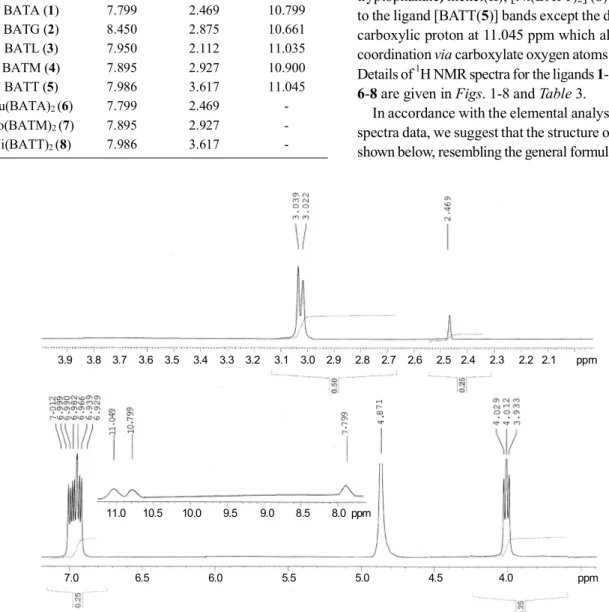
Fig. 1. 1HNMR spectrum of the ligand (BATA) (1)
Table 3. 1HNMR chemical shifts (ppm) of the ligands (1-5) and complexes (6-8)
Compound (no.) Hx (-CO-NH) HY (-CS-NH) HZ (-COOH)
BATA (1) 7.799 2.469 10.799
BATG (2) 8.450 2.875 10.661
BATL (3) 7.950 2.112 11.035
BATM (4) 7.895 2.927 10.900
BATT (5) 7.986 3.617 11.045
Cu(BATA)2 (6) 7.799 2.469 -
Co(BATM)2 (7) 7.895 2.927 -
Ni(BATT)2 (8) 7.986 3.617 -
1H NMR spectra
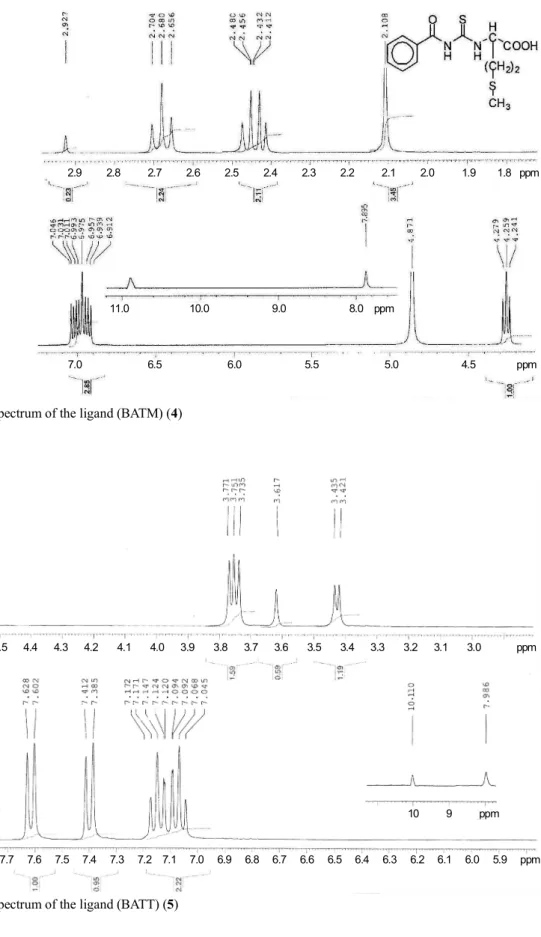
1H NMR spectra of the ligands (HL): The 1H NMR spec- trum of N-[(benzoyl amino)thioxomethyl] aspartic acid [BATA](1) shows two single bands at 11.042 ppm and 10.799 ppm which are attributed to carboxylic protons of R-group and that attached to (α-CH), respectively.11,17 A triplet band at 3.99, 4.01, 4.03 ppm attributed to α-CH-proton, which oc- curred as a triplet signal in N-[(benzoyl amino)thioxomel- thyl] serine.11 The ligand [BATT(5)] shows a characteristic indole- protons band, at 10.11 ppm (NH), which for free in- dole occured at 10.1 ppm, and in coumarine derivative occur- ed at 9.03 ppm.12 Other two doublet occur at 7.628, 7.602
ppm and 7.412,7.385 ppm due to two aromatic protons of tryptophan. Details of proton NMR data for the ligands 1-5 are shown in Table 3.
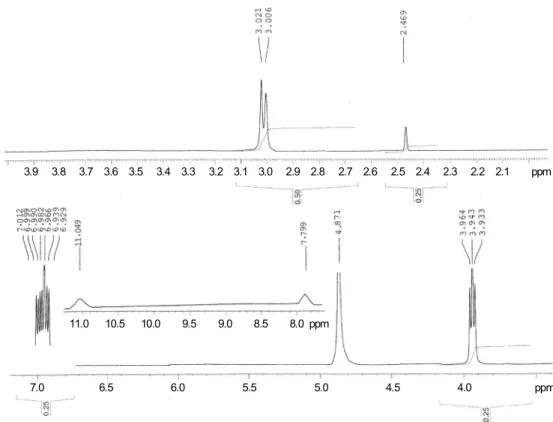
1H NMR spectra of complex compounds: (a) Bis-(benzoyl- aminothioxomethylaspartate) copper(II); [Cu(BATA)2] (6) shows similar bands to that for free ligand [BATA(1)] except the disappearance of the carboxylic protons attached to (α- CH) at 10.799 ppm which indicates the coordination of the ligand to copper(II) ion via oxygens of carboxylate group which attached to α-carbon atom.
(b) 1H NMR spectra of bis-(benzoylaminothioxomethyl- metheoninate) cobalt(II); [Co(BATM)2] (7) showed similar band as that of free ligand [BATM(3)] except the disappea- rance of carboxylic proton band at ~ 10.9 ppm. Which indi- cates the coordination of Co(II) ion with carboxylate oxygens.
(c) 1H NMR spectra of bis-(benzoylaminothioxomethyl- tryptophanate) nickel(II); [Ni(BATT)2] (8) shows similarly to the ligand [BATT(5)] bands except the disappearance of carboxylic proton at 11.045 ppm which also indicates the coordination via carboxylate oxygen atoms to the metal ion.
Details of 1H NMR spectra for the ligands 1-5 and complexes 6-8 are given in Figs. 1-8 and Table 3.
In accordance with the elemental analysis, IR and NMR spectra data, we suggest that the structure of the ligands 1-5 shown below, resembling the general formula which was also
3.0 2.9 2.8 2.7 2.6 2.5 2.4 2.3 2.2 2.1 2.0 1.9 1.8 1.7 ppm
11.0 10.5 10.0 9.5 9.0 8.5 ppm
7.0 6.5 6.0 5.5 5.0 4.5 ppm
Fig. 2. Proton NMR spectra of BATG (2)
2.1 2.0 1.9 1.8 1.7 1.6 1.5 1.4 1.3 1.2 1.1 1.0 0.9 0.8 0.7 ppm
11.0 10.0 9.0 8.0 ppm
7.0 6.5 6.0 5.5 5.0 4.5 4.0 ppm
Fig. 3. 1HNMR spectrum of the ligand (BATL) (3)
2.9 2.8 2.7 2.6 2.5 2.4 2.3 2.2 2.1 2.0 1.9 1.8 ppm
11.0 10.0 9.0 8.0 ppm
7.0 6.5 6.0 5.5 5.0 4.5 ppm
Fig. 4. 1HNMR spectrum of the ligand (BATM) (4)
4.5 4.4 4.3 4.2 4.1 4.0 3.9 3.8 3.7 3.6 3.5 3.4 3.3 3.2 3.1 3.0 ppm
10 9 ppm
7.7 7.6 7.5 7.4 7.3 7.2 7.1 7.0 6.9 6.8 6.7 6.6 6.5 6.4 6.3 6.2 6.1 6.0 5.9 ppm
Fig. 5. 1HNMR spectrum of the ligand (BATT) (5)
3.9 3.8 3.7 3.6 3.5 3.4 3.3 3.2 3.1 3.0 2.9 2.8 2.7 2.6 2.5 2.4 2.3 2.2 2.1 ppm
11.0 10.5 10.0 9.5 9.0 8.5 8.0 ppm
7.0 6.5 6.0 5.5 5.0 4.5 4.0 ppm
Fig. 6. 1HNMR spectrum of the Cu(BATA)2 (6)
2.9 2.8 2.7 2.6 2.5 2.4 2.3 2.2 2.1 2.0 1.9 1.8 ppm
7.0 6.5 6.0 5.5 5.0 4.5 ppm 11.0 10.0 9.0 8.0 ppm
Fig. 7. 1HNMR spectrum of the complex compound Co(BATM)2(7)
Table 4. Growth inhibition by complexes (6‐8) against bacteria in (mm)
Compound(no.) IZ(mm) (Gram +ive Staphylococcus aureus) IZ(mm) (Gram ‒ ive Esherichia coli)
Cu(BATA)2 (6) 13 25
Co(BATM)2 (7) 20 14
Ni(BATT)2 (8) 15 15
(mm): millimeter
Table 5. Minimal Inhibition Concentration (MIC) in (µg/mL) for complex compounds (6‐8)
Compound(no.) (Gram + ive (µg/mL) St.aureus ) (Gram ‒ ive (µg/mL) E.Coli )
Cu(BATA)2 (6) 10 25
Co(BATM)2 (7) 2 10
Ni(BATT) (8) 10 2.5
4.5 4.4 4.3 4.2 4.1 4.0 3.9 3.8 3.7 3.6 3.5 3.4 3.3 3.2 3.1 3.0 ppm
10 9 ppm
7.7 7.6 7.5 7.4 7.3 7.2 7.1 7.0 6.9 6.8 6.7 6.6 6.5 6.4 6.3 6.2 6.1 6.0 5.9 ppm
Fig. 8. 1HNMR spectrum of the complex compound Ni(BATT)2
suggested by Kabbani et al,11 and the metal ions; {Cu(II), Ni(II) or Co(II)} complex with the ligands 1-5 via α-carboxyl- ic oxygen atoms, as (ML2 complexes).
HL
Biological activity
Antibacterial activity: By using agar diffusion techni- que,21,22 the ligands antibacterial activities have been studied in vitro against Escherichia coli (NCTC 5933) and Staphyl- ococcus aureus (NCTC 6571). All five ligands 1-5 have no effect upon these two types of bacteria ,whereas all the com- plexes 6-8 show antibacterial activities for both types. The results of bacterial growth inhibition data are given in Table 4.
Minimal Inhibitory Concentration (MIC):23 The minimal
inhibitory concentrations for the complex compounds 6-8 show variation in concentrations depending upon complex type. The lowest (MIC) is for [Co(BATA)2] (7), as indicated in Table 5.
Medium Lethal Dose [LD50]: Twenty one white female Albino mice had been used for this study. They were divid- ed into seven groups. One group (6 mice) was the control group which were given orally distilled water , whereas the other groups had been given orally (200, 400, 600, 800 and 1000) mg/kg doses of the complexes;[Cu(BATA)2] (6), [Co (BATM)2] (7), and [Ni(BATM)2] (8). No toxicity effect for these complexes 6-8 has been observed after 72 h for all groups of mice; i.e. no lethal cases.
All the ligands 1-5 show no antibacterial activity, whereas the metal complexes of these ligands 6-8 have antibacterial activities. Besides, all these complex compounds 6-8 have no toxicity toward mice, hence they may replace cisplatin compounds as anticancer drugs which have toxic side effect for human being. To confirm such idea it needs further future study to be regarded as an invention if possible as anticancer drug.
Acknowledgments. We are grateful to Science College, Basra University (Iraq) for supporting the work. Our thanks to AL-Albeit University (Jordan) for doing elemental analysis and proton NMR measurements.
REFERENCES
1. Canty, A. J.; Steven, E. A. Inorg. Chim. Acta 1981, 55, L 57.
2. Rasenberg, B. Nature 1969, 222, 385.
3. Shukla, S. K. Inorg. Chim. 1983, 94, 144.
4. Foster, J. M.; ClageH-Carr, K.; Hoth, D.; Leyland-Jones, B.
Cancer Treat. Rep. 1986, 70, 1311.
5. Seligman, P. A.; Crawford, E. D. J. Natl .Cancer Inst. 1991, 83, 1582.
6. Crawford, E. D.; Saiers, J. H.; Baker, L. H.; Costanzi, J. H.; Bu- Kowski, R. M. Urology 1991, 38, 355.
7. Kelman, A. D.; Clarke, M. J.; .Emonds, S. D; Peresie , H. J.; He- matol, J. C. Oncol. 1977, 7, 274.
8. Clarke, M. J.; Zhu, F.; Frasca, D. R. Chem. Reu. 1999, 99, 2511.
9. Yanping, R.; Junfeng, B.; Liufang, W.; Jigui, W.; Changu, X.
Syn. React. Inorg. Met-Org. Chem. 1999, 29, 1171.
10. Junfeng, B.; Jigui, W.; Liufang, W.; Yingnian, R. Syn. React.
Inorg. Met-Org. Chem. 1998, 28, 917.
11. Kabbani, A. T.; Ramadan, H.; Hammud, H. H.; Ghannoum, A.
M.; Mouneimne, Y. J. Univ. Chem. Tech. and Met. 2005, 40, 339.
12. AL-Masoudi, N. A.; AL-Masoudi, I. A.; Ali, I. A. I.; AL-Soud, Y. A.; Saeed, B.; LAColla, P. Acta Pharm. 2006, 56, 175.
13. Rozzell, J. D. United State Patent 2007, No. US 7, 301 B2, Nov.
27.
14. Paolini, I.; Nuti, F.; Chelli, M.; Papini, A. M. Tetrahedron Lett.
2007, 48, 2901.
15. Majeed, M.; Nagabhushanam, K.; Ramanujam, R.; Chandra- mouli, R. H. United State Patent Application Publication 2008, No. US 2008l0026017A1, Jan. 31.
16. Chohan, Z. H.; Arif, M.; Akhtar, M.; Supuran, C. T. Bioinor- ganic Chemistry and Applications 2006,Vol. 2006, Article ID 83131, 1.
17. Xiong, J.; H-Feng Zhu; Y-Juan Zhao; Y-Jun Lan; J-Wang Jiang;
J-Jing Yang; S-Feng Zhang Molecules 2009, 14, 3142.
18. De Marco, R.; DI Gioia , M. L.; Leggio, A.; Liguori, A.; Perri, F.;
Siciliano, C.; Viscome, M. C. Amino Acids 2009, DOI 10.1007/
s00726-009-0267-2.
19. Kumar, V.; Mudugal, M. M.; Rani, N.; Jha, A.; Jaggi, M.; Singh, A. T.; Sanna, V. K.; Singh, P.; Sharma, P. K.; Rchhaiya, R. I.; Bur- man, A. C. J. Enzy. Inhib. Med. Chem. 2009, 24, 763.
20. Silverstein, R. M.; Webster, F. X.; Kiemle, D. G. Spectrometric Identification of Organic Compounds , 7th edn., John Wiley &
Sons,Inc., NJ, USA, 2005, pp 109-103.
21. Shank, R. C.; Marmion, D. G. Microbiology, 12th ed., Churchil, Living Stone Edinbrg, London, 1979.
22. Larry, G. R.; Chatles, W. S.; Barth, R. Antimicrob. Agent & Che- mother 1981, 19, 1050.
23. Gerald, C. J.; Barrie, P. M.; Andrew, G. F.; Anthong, S. Practical Medical Microbiology, 14th Ed., London, 1996.