
Printed in the Republic of Korea
http://dx.doi.org/10.5012/jkcs.2013.57.5.560
Synthesis, Characterization and Spectrophotometric Studies of Seven Novel Antibacterial Hydrophilic Iron(II) Schiff Base Amino Acid Complexes
Ali M. Shaker, Lobna A. E. Nassr, Mohamed S. S. Adam, and Ibrahim M. A. Mohamed*
Chemistry Department, Faculty of Science, 82524, Sohag University, Sohag, Egypt.
*E-mail: [email protected] (Received May 7, 2013; Accepted June 11, 2013)
ABSTRACT. A series of new Iron(II) Schiff base amino acid complexes derived from the condensation of amino acid and sodium 2-hydroxybenzaldehyde-5-sulfonate have been synthesized. The complexes were characterized by elemental, elec- tronic, IR spectral analyses and conductance measurements. The stability and solubility of the prepared complexes were deter- mined. Two spectral methods used to determine the stoichiometry of the prepared complexes which exhibited divalent tridentate coordination and formed chelates of octahedral structures. The antibacterial activity of the prepared complexes has been tested against Bacillus cereus, Pseudomonas aeruginosa and Micrococcus bacteria. The effect of HCl on investigated complexes studied spectrophotometrically.
Key words: Schiff base complex, Amino acid, Bio-inorganic chemistry, Spectrophotomtric study
INTRODUCTION
Salicylaldehyde–amino acid Schiff base complexes are used as non-enzymatic models for the metal - pyridoxal (vitamin B6) amino acid Schiff base systems which are the key intermediates in many metabolic reactions of amino acids catalyzed by enzymes which require pyridoxal as a cofactor (transamination, decarboxylation, elimination, racemization, etc.).1 Over the past few years, there have been many reports on Schiff base applications in homo- geneous and heterogeneous catalysis,2 e.g., epoxidation of alkenes,3 cyclopropanation reaction,4 asymmetric hydros- ilylation of ketones,5 selective oxidation of alcohols to corre- sponding carbonyl compounds,6 controlled ring-opening polymerization,7 hydrogenation of benzene under mild con- ditions,8 hydrogenation of ketones,9 Suzuki cross-coupling reaction under ambient condition10 and enantioselective oxidation of methyl aryl sulfides.11 In the area of bio-inor- ganic chemistry, transition metal complexes of Schiff bases have attracted a lot of interest due to their potent bio- logical activities such as antifungal, antibacterial, anti- cancer and herbicidal applications.12–14 These studies have shown that complexation of metals to Schiff base ligands improves the antimicrobial and anticancer activities of the ligands.13 Some research groups found that the Schiff base metal complexes derived from salicylaldehyde can specially cleave the DNA.15−17 Water soluble complexes of sulpho- nato - substituted Schiff base ligands used as catalytic anti- oxidants.18 Comparatively very little effort has been expended
to prepare Iron(II) Schiff base amino acid complexes19−21 despite their importance as complexes containing a metal in unstable, low oxidation state, as well as involving unstable ligands, the Schiff base amino acid, that forms through coor- dination to Fe(II) metal ion. Therefore, in this work we pre- pared seven novel Fe(II) Schiff base amino acid complexes and characterized their structures by various possible physical methods to obtain more information about their structures.
EXPERIMENTAL
Reagents and Instrumentation
All the used amino acids and (NH4)2Fe(SO4)2·6H2O in the present study are of analytical grade purchased from Sigma Aldrich, sodium 2-hydroxybenzaldehyde-5-sulfonate was prepared according to literature.22 Conductivity mea- surements were made at 25oC on Jenway Conductivity meter 4320 using bidistilled water as solvent. The electronic spectra of the complexes were monitored using matched 1 cm silica cells on Perkin Elmer Lambda 35 spectropho- tometer and IR spectra of the metal chelates recorded over the 400−4000 cm−1 range on a Shimadzu FTIR-8101 Fourier transform infrared spectrophotometer using KBr discs.
Elemental analyses were carried out at the Micro analyti- cal Center, Assiut University, Egypt.
Synthesis of Schiff Base Metal Complexes
2 mmol (0.448 g) of sodium 2-hydroxybenzaldehyde-5- sulfonate in de-ionized water (20 ml) was added dropwise
to an equimolar aqueous solution of amino acid; 1, 0.15 g Glycine in de-ionized water (10 ml); 2, 0.178 g L-alanine in de-ionized water (10 ml); 3, 0.262 g L-leucine in de- ionized water (15 ml); 4, 0.262 g L-Isoleucine in de-ionized water (15 ml); 5, 0.298 g DL-methionine in de-ionized water (15 ml); 6, 0.21 g DL-serine in de-ionized water (10 ml);
7, 0.33 g L-phenylalanine in de-ionized water (10 ml) then the mixture was stirred at 100oC for 3 h to give yellow color. Then the obtained ligand solution was mixed with an equimolar aqueous solution of ferrous ammonium sul- phate. In order to avoid the oxidation of ferrous to ferric, a few drops of Glacial acetic acid were added.19−21 The resulting solution was stirred at 40oC for 10 h (Its color becomes deep violet), then the obtained solution was evaporated under room temperature. The solid obtained was filtered-off, washed several times with ether, and then recrystallized from eth- anol - water mixture (2:1). All the complexes were prepared by similar procedure.
Antibacterial Activity
The Inhibitory effect of the prepared Schiff base com- plexes on the in vitro growth of bacteria representing one gram negative bacterium, Pseudomonus aeruginosa and two gram positive bacteria, Bacillus Cereus and Micrococcus was evaluated using agar diffusion method23,24 by mea- suring the zone of inhibition on agar plates at two different concentrations 3 mg/ml and 6 mg/ml. De-ionized water was used as solvent control. All plates were incubated at 37 ± 0.5oC for 24 h.
RESULTS AND DISCUSSION
All the complexes are soluble in bidistilled water and in
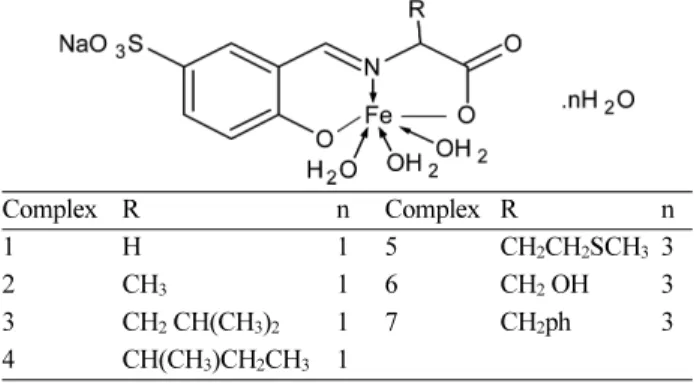
two organic solvents (ethanol and methanol), but partially soluble in acetone. The suggested structures of the pre- pared complexes are listed in Scheme 1 and general prop- erties listed in Table 1.
Infrared Spectra
The IR spectral data containing the relevant vibrational bands of Fe(II) complexes are listed in Table 2. The absorption bands around 1625 cm−1 is corresponding to azomethine group (N=C)25,26 and around 1100 cm−1 is related to S=O bond,27 the disappearance of the peak around 1650 cm−1 shows that the product does not contain 5-sulfo- salicylaldehyde.28 The IR results showed that the metal coordinated to nitrogen (azomethine) and oxygen (car- boxylato) atoms of the amino acid groups besides water molecules.
Electronic Spectra
The electronic spectra of the aqueous solutions of the prepared Fe(II) complexes display maximum absorption bands around 325 nm ( = 3596–4685 dmC- 3 mol−1 cm−1).
Complex R n Complex R n
1 H 1 5 CH2CH2SCH3 3
2 CH3 1 6 CH2 OH 3
3 CH2 CH(CH3)2 1 7 CH2ph 3
4 CH(CH3)CH2CH3 1 Scheme 1.
Table 1. General properties of the prepared complexes
No. Empirical formula Molar conductance
(ohm−1 cm2 mol−1) M.P. (oC) Electronic spectra
λmax, nm max, M−1cm−1
1 FeC9H14NO10SNa 106 >350oC 505
320
644.71 3596.34
2 FeC10H16NO10SNa 108 >350oC 504
321
668.73 3809.51
3 FeC13H22NO10SNa 112 >350oC 502
324
694.46 3969.14
4 FeC13H22NO10SNa 114 >350oC 500
321
711.57 4010.23
5 FeC12H24N O12S2Na 120 >350oC 499
320
727.03 4286.97
6 FeC10H20NO13SNa 125 >350oC 508
322
637.87 3709.21
7 FeC16H24NO12SNa 98 >350oC 509
322
768.19 4685 C
This band can be ascribed to an intramolecular charge transfer transition taking place in the complexed ligand. In addition, a band shown around 500 nm ( = 637–769 M−1cm−1) may be attributable to a d-d transition in an octahedral
structure for such complexes. Fig. 1 shows the compar- ison between complex 1, its ligand and the corresponding amino acid (Glycine).
Elemental Analysis and Electrical Conductivity The obtained elemental analyses of the metal com- plexes are listed in Table 3. The obtained data are in agree- ment with the calculated values showing that the complexes have (1:1) metal/ligand ratio as in Scheme 1.
The observed molar conductance values of the 1:1 com- plexes of 1×10⁻³ M aqueous solutions of the prepared complexes at 25oC are consistent with the electrolytic nature of the (1:1) complexes due to the presence of
−SO3Na group in the proposed structures of the Schiff base metal complexes.
The electrical conductivity of the prepared complexes is determined at different temperatures (Table 4), the acti- C-
Figure 1. The electronic spectra of complex 1 and its components.
Table 2. The infrared absorption frequencies (cm−1) of the investigated Fe (II) Schiff base amino acid complexes
Complex H2O C=N C=C S=O M−O M−N
1 3114.5 1625.2 1435.2 1135.2 741.7 620.2
2 3205.1 1626.2 1416.9 1118.8 819.8 614.4
3 3217.7 1635.8 1409.2 1112.1 731.1 612.5
4 3209.9 1636.8 1439.1 1097.6 817.9 616.3
5 3192.6 1632.0 1413.0 1116.0 823.7 615.4
6 3442.4 1637.8 1399.5 1128.5 815.4 687.7
7 3199.3 1616.5 1437.1 1138.1 746.5 612.5
Table 3. The elemental analyses and magnetic moment of the investigated complexes
Complex Found (calculated) (%)
µeff (BM)
C H N S
1 27.11 (26.55) 2.97 (3.47) 3.39 (3.44) 7.16 (7.88) 3.96
2 27.91 (28.52) 3.23 (3.83) 2.97 (3.33) 7.11 (7.61) 3.99
3 33.98 (33.71) 4.32 (4.79) 2.59 (3.02) 6.40 (6.92) 4.01
4 33.91 (33.71) 4.42 (4.79) 2.64 (3.02) 6.39 (6.92) 4.03
5 27.37 (27.86) 4.38 (4.68) 2.51 (2.71) 11.95 (12.40) 4.06
6 24.91 (25.38) 3.91 (4.26) 2.99 (2.96) 6.38 (6.78) 4.1
7 35.54 (36.04) 4.94 (4.54) 2.34 (2.63) 5.95 (6.01) 4.18
Table 4. The observed conductivity (σ, µS) and activation energy of the prepared complexes
Complex T, K σ, µS
1 2 3 4 5 6 7
283 99 100 101 102 103 104 91
288 102 102 104 106 108 110 93
293 104 106 107 110 114 117 95
298 106 109 113 114 120 124 98
303 109 112 116 118 126 130 101
308 112 114 119 123 131 134 103
313 116 117 121 127 135 138 106
E, kJ/mol 7.45 7.88 9.40 10.78 13.68 14.24 7.60
vation energies of charged ions in the complexes solu- tions were calculated from the following equation:
σ = σ0 e(−E/2KT)
where σ, σ0, E, and k are the observed conductance, con- ductivity constant, activation energy, and Boltzman con- stant, respectively29,30 Fig. 2 shows the relation between ln σ against 1/T for all the investigated complexes, From the slopes of the linear plots, the values of E were calculated.
The conductivity of the investigated complexes increases with increasing temperature, hence all complexes exhibit semiconducting properties.
Determination of the Stoichiometry of the Complexes The stoichiometry of the tested complexes were deter- mined by applying the spectrophotometric molar ratio19,21
and continuous variation methods19,21 (cf. Figs. 3 and 4).
The results suggested the possible formation of 1:1 com- plexes (Iron(II): Schiff base amino acid ligand).
Magnetic Moment Measurements
Magnetic susceptibility measurements showed that the prepared complexes have paramagnetic character and sug- gested high spin values i.e., the studied Schiff base amino acid ligands are so weak that they exhibited low t2g and eg
d-splitting of the octahedral structures of the complexes.31,32
Apparent Formation Constant
The apparent formation constants (Kf) of the synthe- sized complexes formed in solution were determined from spectrophotometric measurements using the continuous variation method21 (cf. Table 5). The obtained Kf values indicate the stability of these complexes.
Stability pH Range of the Investigated Complexes The stability range of the studied complexes was found Figure 2. The relation between ln σ against 1/T for all the inves-
tigated complexes.
Figure 3. Continuous variation plot of Fe(II) Schiff base amino acid complexes in aqueous medium at [Fe2+]+[L] = 5×10⁻³ mol dm−3 and 298 K against [Fe2+-ald.], as a blank, with the same concentra- tion as in the test solution.
Figure 4. Molar ratio plots of Fe(II) Schiff base amino acid com- plexes in aqueous medium at [Fe2+] = 7.5×10⁻³ mol dm−3 and 298 K against [Fe2+-ald.], as a blank, of the same concentration as in the test solution.
Table 5. The formation constants (Kf), stability constants (pK) and Gibbs free energy (∆G) values of the prepared complexes in aque- ous medium at 298 K
Complex 10−5 Kf pK ∆G, kJ/mol
1 1.01 5.01 −28.55
2 1.86 5.27 −30.06
3 2.07 5.32 −30.33
4 1.43 5.16 −29.41
5 2.86 5.46 −31.13
6 5.51 5.74 −32.75
7 1.58 5.20 −29.66
to be from pH = 5 to pH = 8 according to the obtained pH- absorbance curves (cf. Figs. 5 and 6). This means that Fe(II) ion greatly stabilizes the tested Schiff base amino acid ligands in this range. Accordingly, these ligands can be used as masking reagents of Fe2 + ions in that range of pH.
Determination of the Solubility of the Investigated Complexes
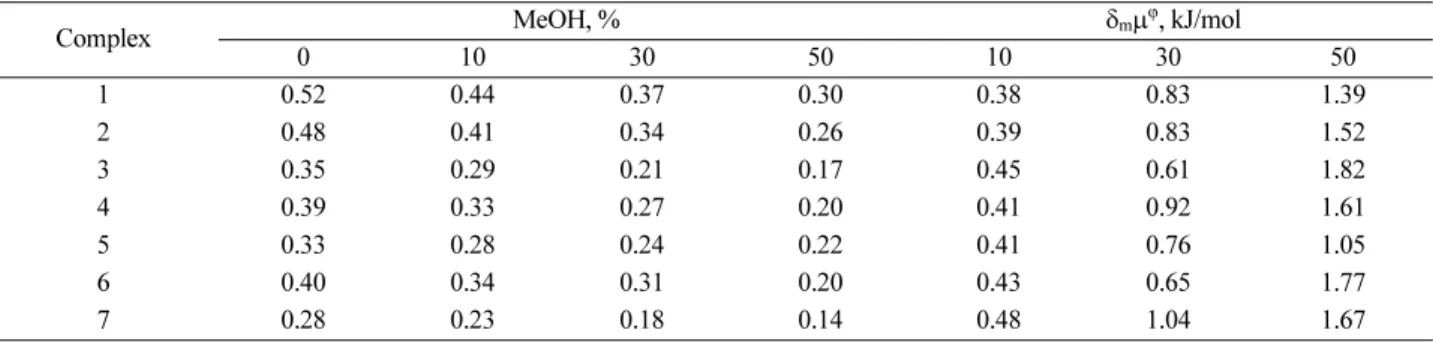
The solubility of the prepared complexes was measured in aqueous solution, 10%, 30% and 50% aqueous meth- anol as a solvent. A saturated solution of the solid was agi- tated with the appropriate solvent at 298 K. The mixture was centrifuged then an aliquot of the saturated solution removed. The obtained complexes solutions were diluted and their absorbance values measured at λmax for each one.19,33 The solubility values and transfer chemical potentials are cited in Table 6, on the assumption that the ratio of mean activity co-efficients in the aqueous and aqueous metha- nol mixtures are in all cases unity. The values of the trans- fer chemical potentials δmµϕ, of the investigated complexes from water to water-methanol binary mixtures, were esti- mated by applying the following equation: δmµϕ = −RT ln (Ss/Sw) where Ss is the solubility in 10%, 30% and 50%
aqueous-methanol binary mixtures and Sw the solubility in the aqueous medium. According to the solubility data, Table 3, the following ascending order of the hydropho- bicity of the examined complexes was deduced: 1 <2 <6
<3 <4 <5 <7.
Antibacterial Activity
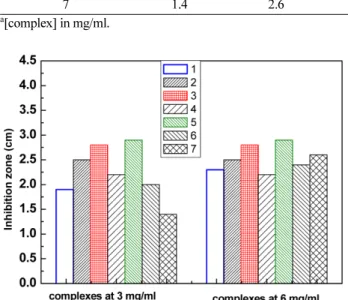
The results of antibacterial activity are shown in Table 7.
Investigated Schiff base complexes exhibited good activity against three types of bacteria: Bacillus cereus, Pseudomonus aeruginosa, Micrococcus (cf. Figs. 7−9).
Complex derived from methionine showed the highest inhibitory effect against examined bacteria. In general the inhibition zones of the complexes were increased with increasing their concentrations. The highest inhi- bition zone was obtained by complex 7 against Pseudomo- nus aeruginosa where the minimum inhibition zone obtained by complex 7 against Bacillus cereus. Figs. 9−11 show the inhibition zone of complex 1 against the tested bacteria.
Figure 5. pH-absorbance plots of Fe (II) Schiff base amino acid complexes at 1×10⁻³M in aqueous medium at 298 K.
Figure 6. pH-absorbance plots of Fe (II) complexes in aqueous medium at 298 K in stability range (pH=5−8).
Table 6. Solubility(mol dm−3) and transfer chemical potential (δmµϕ) values of the prepared complexes in water, 10%, 30% and 50% aque- ous-methanol mixtures at 25oC
Complex MeOH, % δmµϕ, kJ/mol
0 10 30 50 10 30 50
1 0.52 0.44 0.37 0.30 0.38 0.83 1.39
2 0.48 0.41 0.34 0.26 0.39 0.83 1.52
3 0.35 0.29 0.21 0.17 0.45 0.61 1.82
4 0.39 0.33 0.27 0.20 0.41 0.92 1.61
5 0.33 0.28 0.24 0.22 0.41 0.76 1.05
6 0.40 0.34 0.31 0.20 0.43 0.65 1.77
7 0.28 0.23 0.18 0.14 0.48 1.04 1.67
Effect of HCl on Investigated Complexes Spectro- photometric Study
Completed repeated spectral scans of prepared com- plexes at [complex] = 1.67×10⁻³ mol dm−3 were carried
out before and just after addition of hydrochloric acid (0.1 M) for a period of time with time interval 1 min at 298 K, cf.
Figs. 13 and 14. These results were supported by the naked eye observation that the color of the complex rapidly changed from violet to pink then decayed slowly until the solution turned colorless and optically clear at the end of Table 7. Results of anti-bacterial evaluation of Schiff base amino acid complexes. Inhibition zone diameter in cm
Bacteria Bacillus cereus Pseudomonas aeruginosa Micrococcus
[complex]a 3 6 3 6 3 6
1 1.9 2.3 1.5 2.8 2 2.7
2 2.5 2.5 2.7 3.1 3.2 3.2
3 2.8 2.8 3.1 3.1 3.2 3.2
4 2.2 2.2 3.3 3.3 2.8 3.2
5 2.9 2.9 3 3.5 3.7 4
6 2 2.4 1.4 1.8 2.9 3.6
7 1.4 2.6 3.3 4.3 2.9 3.3
a[complex] in mg/ml.
Figure 7. Plots of Inhibition zones of prepared complexes in the presence of Bacillus cereus bacteria.
Figure 8. Plots of Inhibition zones of prepared complexes in the presence of Pseudomonus aeruginosa bacteria.
Figure 9. Plots of Inhibition zones of prepared complexes in the presence of Micrococcus bacteria.
Figure 10. The inhibition zone of complex 1 against Bacillus cereus.
each run. The rst-order rate constants (kobs) obtained by a least-squares procedure from the spectral scans, as shown
in Figs. 13 and 14. Linear plots of kobs vs [H+] displayed (cf. Fig. 15) are in a good correlation with the following equation: Rate = kobs [complex]: kobs= k1+ k2 [H+].
CONCLUSION
Novel hydrophilic ferrous Schiff base amino acid com- plexes were prepared and characterized by elemental, electronic, IR spectral analyses and conductance measure- ments. The stability pH range of complexes was found to be from pH = 5 to pH = 8. The solubility and transfer chem- ical potentials of the complexes were determined to show Figure 11. The inhibition zone of complex 1 against Pseudomonus
aeruginosa.
Figure 12. The inhibition zone of complex 1 against Micrococcus.
Figure 13. Repeated spectral scans of complex 4 before and after addition of HCl in aqueous media at [complex] = 1.67×10⁻³ mol dm−3, [HCl] = 0.1 mol dm−3, I = 0.5 mol dm−3, T = 298 K and interval time 1 min.
Figure 14. Repeated spectral scans of complex 7 before and after addition of HCl in aqueous media at [complex] = 1.67×10⁻³ mol dm−3, [HCl] = 0.1 mol dm−3, I = 0.5 mol dm−3, T = 298 K and interval time 1 min.
Figure 15. The relationship between [H+] and 105 kobs. Values for hydrolysis of investigated complexes in aqueous medium with [complex] = 1.67×10⁻³ mol dm−3, I = 0.5 mol dm−3 and 298 K.
the hydrophilicity of these complexes. The complexes showed good antibacterial activity against Bacillus cereus, Pseudomo- nas aeruginosa and Micrococcus bacteria. The complexes studied spectrophotometrically in the presence of HCl.
Acknowledgments. The authors are grateful to Mr. Bah- gat Ramadan Mahmoud and Ms. Dalia Ahmed Abd El- Raheem for their help in antibacterial activity test. And the publication cost of this paper was supported by the Korean Chemical Society.
REFERENCES
1. Casella, L.; M. Gullotti Inorg. Chem. 1986, 25, 1293.
2. Gupta, K. C.; Sutar, A. K. Coord. Chem. Rev. 2008, 252, 1420.
3. Grivani, G.; Khalaji, A. D.; Tahmasebi, V.; Gotoh, K.;
Ishida, H. Polyhedron 2012, 31, 265.
4. Youssef, N. S.; El-Zahany, E.; El-Seidy, A. M. A.; Caselli, A.; Fantauzzi, S.; Cenini, S. Inorg. Chim. Acta 2009, 362, 2006.
5. Liu, S.; Peng, J.; Yang, H.; Bai, Y.; Li, J.; Lai, G. Tetra- hedron 2012, 68, 1371.
6. Rong, M.; Wang, J.; Shen, Y.; Han, J. Catal. Commun. 2012, 20, 51.
7. Xufeng, N.; Weiwei, Z.; Zhiquan, S. Chin. J. Catal. 2010, 31, 965.
8. Chen, P.; Fan, B.; Song, M.; Jin, C.; Ma, J.; Li, R. Catal.
Commun. 2006, 7, 969.
9. Venkatachalam, G.; Ramesh, R.; Inorg. Chem. Commun.
2005, 8, 1009.
10. He, Y.; Cai, C. Cat. Comm. 2011, 12, 678.
11. Tan, R.; Li, C.; Peng, Z.; Yin, D. Catal. Commun. 2011, 12, 1488.
12. Nair, M. S.; Arish, D.; Joseyphus, R. S. J. Saudi. Chem.
Soc. 2012, 16, 83.
13. Holla, B. S.; Veerendra, B.; Shivananda, M. K.; Poojary,
B. Eur. J. Med. Chem. 2003, 38, 759.
14. Silva, C. M.; Silva, D. L.; Modolo, L. V.; Alves, R. B.;
Resende, M. A.; Martins, C. V. B.; Fatima, A. J. adv. Res.
2011, 2, 1.
15. Sylvain, R.; Bernier, J. L.; Waring, M. J. J. Org. Chem.
1996, 61, 23.
16. Santanu, B.; Subbrangsu, S. M. J. Chem. Soc. Chem. Com- mun. 1995, 24, 2489.
17. Gravert, D. J.; Griffin, J. H. J. Org. Chem. 1993, 58, 820.
18. Moreno, D.; Daier, V.; Palopoli, C.; Tuchagues, J. P.;
Signorella, S. Inorg. Biochem. 2010, 104, 496.
19. Shaker, A. M.; Awad, A. M.; Nassr, L. A. E. Synth. React.
Inorg. Met. Org. Chem. 2003, 33, 103.
20. Sharma, P. K.; Dubey, S. N. Ind. J. Chem. 1994, 33A, 1113.
21. Abdel-Rahman, L. H.; El-Khatib, R. M.; Nassr, L. A. E.;
Abu-Dief, Aorg. M. J. Mol. Struct. 2013, 1040, 9.
22. Kirker, G. W. Org. Prep. Proced. Int. 1980, 12, 246.
23. Barry, A. L. The Antimicrobial Susceptibility Test, Prin- ciples and Practices; Illus Lea, Febiger, Eds.; Philadeliphia, PA, USA. 1976, p 180.
24. Baver, A.; Kirby, W. M. M.; Sherris, J. E.; Turck, M. Am.
J. Clin. Pathol. 1986, 45, 493.
25. Biradar, N. S.; Karajagi, G. V.; Aminabhavi, T. M. Inorg.
Chim. Acta 1984, 82, 211.
26. Biradar, N. S.; Kulkarni, V. H. J. Inorg. Nucl. Chem. 1971, 33, 2451.
27. Chen, D.; Martell, A. E.; Sun, Y. Inorg. Chem. 1989, 28, 2647.
28. Boghaei, D. M.; Gharag, M. Spectrochim. Acta 2006, 63A, 139.
29. Abd El-wahed, M. G.; Hassan, A. M.; Hammad, H. A.;
El-Desouky, M. M. Bull. Korean Chem. Soc. 1992, 13, 113.
30. Zaki, Z. M. Spectrochem. Acta 2000, 56A, 1917.
31. Canpolat, E.; Kaya, M. J. Coord. Chem. 2000, 55, 961.
32. El-Tabl, A. S.; EL-Saied, F. A.; Al-Hakimi, A. N. J. Coord.
Chem. 2008, 61(15), 2380.
33. Abu-Gharib, E. A. J. Ind. Chem. Soc. 1994, 71, 537.

![Figure 3. Continuous variation plot of Fe(II) Schiff base amino acid complexes in aqueous medium at [Fe 2+ ]+[L] = 5×10 −3 mol dm −3 and 298 K against [Fe 2+ -ald.], as a blank, with the same concentra-tion as in the test soluconcentra-tion.](https://thumb-ap.123doks.com/thumbv2/123dokinfo/5298965.154286/4.892.465.807.154.417/figure-continuous-variation-schiff-complexes-aqueous-concentra-soluconcentra.webp)
![Figure 14. Repeated spectral scans of complex 7 before and after addition of HCl in aqueous media at [complex] = 1.67×10 −3 mol dm −3 , [HCl] = 0.1 mol dm −3 , I = 0.5 mol dm −3 , T = 298 K and interval time 1 min.](https://thumb-ap.123doks.com/thumbv2/123dokinfo/5298965.154286/7.892.118.396.429.680/figure-repeated-spectral-complex-addition-aqueous-complex-interval.webp)
