Printed in the Republic of Korea DOI 10.5012/jkcs.2010.54.5.515
요약. o-phenylene diamines, dehydroacetic acid (DHA) 및 p-chloro benzaldehyde에서 유도된 세자리 Schiff 염기 리간드인 4- hydroxy-3(1-{2-(benzylideneamino)-phenylimino}-ethyl)-6-methyl-2H-pyran-2-one (HL)의 Cu(II), Ni(II), Co(II), Mn(II) 및 Fe(III) 착물의 형성상수와 항미생물 활성과의 관계를 연구하였다. 리간드와 착물은 원소분석, 전도도, 자기수자율, 열분석, X-선 회 절, IR, 1H-NMR, UV-vis 및 질량 스펙트럼으로 특성조사를 하였다. 분석데이터로부터 착물들의 화학량론비가 1:2 (금속:리간 드)임을 알았다. 금속 착물들의 몰 전도도 값은 이들의 비전해질 성질을 의미한다. X-선 회절 데이터에서 Ni(II) 착물은 단사정 계 그리고 Cu(II) 및 Co(II) 착물은 삼사정계 결정계임을 규명하였다. IR 스펙트럼 데이터로부터 리간드는 중심금속에 대해 ONN 주개원자 배열의 세자리 리간드로 행동함을 알았다. 열적 행동 (TG/DTA)과 Coats-Redfern 법에 의해 계산한 반응속도 파라메터는 착물형성 과정에서 좀 더 질서 있는 활성화 상태를 제안하고 있다. 착물의 양성자화 상수를 THF:물 (60:40) 용액, 25 oC 및 이온세기 µ = 0.1 M (NaClO4)에서 전위차법으로 측정하였다. Staphylococcus aureu 및 Escherichia coli.에 대한 항박 테리아 활성을 시험관에서 조사하였다. 또한 Aspergillus Niger 및 Trichoderma에 대한 항세균 활성도 조사하였다. 금속 이온 및 착물의 안정도가 항미생물학적 활성에 미치는 영향을 고찰하였다.
주제어: 세자리 리간드, Schiff 염기, 금속 착물, 항미생물학적 활성, 전위차법
ABSTRACT. A relation between antimicrobial activities and the formation constants of solid complexes of Cu(II), Ni(II), Co(II), Mn(II) and Fe(III) with tridentate Schiff base ligand, 4-hydroxy-3(1-{2-(benzylideneamino)-phenylimino}-ethyl)-6-methyl-2H- pyran-2-one (HL) derived from o-phenylene diamines, dehydroacetic acid (DHA) and p-chloro benzaldehyde have been studied.
The ligand and metal complexes were characterized by elemental analysis, conductivity, magnetic susceptibility, thermal analysis, X-ray diffraction, IR, 1H-NMR, UV-vis and mass spectra. From the analytical data, the stiochiometry of the complexes was found to be 1:2 (metal:ligand) with octahedral geometry. The molar conductance values suggest the nonelectrolytic nature of metal com- plexes. The X-ray diffraction data suggests monoclinic crystal system for Ni(II) and orthorhombic crystal system for Cu(II) and Co(II) complexes. The IR spectral data suggest that the ligand behaves as tridentate ligand with ONN donor atoms sequence towards central metal ion. Thermal behavior (TG/DTA) and kinetic parameters calculated by Coats-Redfern method suggests more ordered activated state in complex formation. The protonation constants of the complexes were determined potentiometri- cally in THF:water (60:40) medium at 25 oC and ionic strength µ = 0.1 M (NaClO4). Antibacterial activities in vitro were perform- ed against Staphylococcus aureu and Escherichia coli. Antifungal activities were studied against Aspergillus Niger and Trichoderma.
The effect of the metal ions and stabilities of complexes on antimicrobial activities are discussed.
Keywords: Tridentate ligand, Schiff bases, Metal complexes, Antimicrobial activity, Potentiometry
세자리 리간드의 전이금속 착물에 대한 합성과 전위차 및 분광학적 확인 그리고 미생물학적 연구
S. M. Jadhav, A. S. Munde†, S. G. Shankarwar, V. R. Patharkar, V. A. Shelke, and T. K. Chondhekar*
Department of Chemistry, Dr. Babasaheb Ambedkar Marathwada University, Aurangabad-431 004, Maharashtra, India
†Department of Chemistry, Milind College of Science, Aurangabad-431 004, (MS), India (접수 2010. 1. 5; 수정 2010. 7. 5; 게재확정 2010. 7. 5)
Synthesis, Potentiometric, Spectral Characterization and Microbial Studies of Transition Metal Complexes with Tridentate Ligand
S. M. Jadhav, A. S. Munde†, S. G. Shankarwar, V. R. Patharkar, V. A. Shelke, and T. K. Chondhekar*
Department of Chemistry, Dr. Babasaheb Ambedkar Marathwada University, Aurangabad-431 004, Maharashtra, India
†Department of Chemistry, Milind College of Science, Aurangabad-431 004, (MS), India. *E-mail: [email protected] (Received January 5, 2010; Revised July 5, 2010; Accepted July 5, 2010)
INTRODUCTION
3-acetyl-4-hydroxy-6methyl-2H-pyran-2-one (dehydro-
acetic acid or DHA) is widely used as fungicide,1 herbicide and preservative which shows promising antimicrobial acti- vities against bacteria, yeast and particularly molds.2 The
6 hrs reflux in cthanol
4-hydroxy-3(1-{2-(benzylideneamino)-phenylimino}-ethyl)-6-methyl-2H- pyran-2-one Ortho phenylene diamine Dehydroacetic acid
refiux in ethanol 3 hrs
Intermidiate
Synthesis Scheme of Ligand
copper complexes of dehydroacetic acid are more active than dehydroacetic acid or copper salts.3 The structural and interesting biological activities of DHA appeals to inorga- nic chemists working in the field of coordination chemistry.
Schiff bases and their metal complexes exhibit a wide range of biological activities and various structural features. The metal complexes of Schiff bases derived from diamines and heterocyclic compounds have been the centre of attraction for many workers in recent years.4-7 Dehydroacetic acid is one of such heterocyclic compound. Literature survey re- veals that little attention has been given to tridentate Schiff bases of DHA containing ONN donor systems. Considering the enormous importance of DHA, its metal complexes and in continuation of our earlier work,8-11 we are reporting in this communication, synthesis and characterization of tri- dentate Schiff base ligand derived from o-phenylene dia- mines, dehydroacetic acid (DHA) and p-chloro benzalde- hyde. The solid complexes of Cu(II), Ni(II), Co(II), Mn(II) and Fe(III) with this ligand have been prepared and cha- racterized by different physicochemical methods. Stability constants of these complexes have also been determined potentiometrically. The structure- microbial activity correla- tion of Schiff base and its metal complexes is discussed on the basis of their stability constants.
EXPERIMENTAL
DHA (purity ≥ 99%) was purchased from Merck and used as supplied. o-Phenylenediamine and p-chloro benzaldehyde
of AR grade were used for synthesis of ligand. AR grade metal chlorides were used for complex preparation. AR grade solvents were used for spectral measurements. The carbon, hydrogen, nitrogen contents were determined on Perkin Elmer (2400) CHNS analyzer. IR spectra in the range of 4000 - 400 cm-1 were recorded on Jasco FT IR 4100 spec- trometer using KBr pellets. 1H-NMR spectra of the ligand was recorded in CDCl3 using TMS as an internal standard.
The TG/DTA and XRD were recorded on Perkin Elmer TA/
SDT-2960 and Philips 3701 respectively. The UV-vis spectra of the complexes were recorded on Jasco UV-530 Spectro- photometer. Magnetic susceptibility measurements of the metal complexes were done on Guoy balance at room tem- perature using Hg[CO(SCN)4] as calibrant. Molar conduc- tance of complexes was measured on Elico CM-180 con- ductometer using 1 mM solution in dimethyl sulphoxide.
Elico digital pH meter (model LI-127) equipped with a CL- 51B combined electrode was used for pHmeasurements.
The pH meter was calibrated against standard buffers (pH 4.02 and 9.18) before measurements. pHmeter readings were corrected for organic-aqueous media. Titrations were perfor- med in a double walled glass cell in an inert atmosphere (nitrogen) at ionic strength of 0.1 M (NaClO4) and the solu- tions were titrated pH-metrically against (0.2 N) NaOH.
The system used for potentiometric measurements and cal- culations has been described in our earlier publication.12
Synthesis of Ligand
The ligand was prepared by modification of reported
method.13-15 50 mL solution of 0.001 mol (0.168 g) of DHA, 0.001 mol (0.168 g) of o-phenylenediamine in ethanol was refluxed for 3 h and mono Schiff base thus obtained was refluxed for 6 h with 0.001 mol (0.112 mL) of p-chloro benzaldehyde in super dry ethanol. The precipitate formed was filtered, dried in vaccum over CaCl2 and recrystallised in ethanol (yield: 72%).
Synthesis of Metal Complexes
To a hot methanolic solution (0.02 mol) of ligand in (25 mL) methanolic solution (25 mL) of metal chloride (0.01 mol) was added with constant stirring. The pH of reaction mix- ture was adjusted to 7.5 ~ 8.5 by adding 10% alcoholic ammo- nia solution and refluxed for about 3 h. The precipitated solid metal complex was filtered off in hot condition and washed with hot methanol, petroleum ether (40 ~ 60 oC) and dried over calcium chloride in vaccum dessicator (yield 65%).
Potentiometric Study
THF-water (60:40) solution was used as a solvent for po- tentiometric studies. THF has advantage of low dielectric constant (7.52 as compared to 78.30 for water at 25 oC) thus preventing decomposition of the metal chelates. THF used in the present investigation was obtained from Merck was further distilled by known literature method.16 All metal ion solutions were prepared from their AR grade metal chlo- rides and standardized by known literature methods. The initial ionic strength of solutions was maintained at 0.1 M by adding sodium perchlorate solution. Initially, the pH meter was standardised at 25 oC using appropriate buffer solutions of pH 4.01 and 9.12, equilibrated for 30 minutes before mea- surements. NaOH solution of (0.2 M) was prepared in doubly distilled water and standardised against oxalic acid solution.
HClO4 solution (0.2 N) was prepared and standardised aga- inst NaOH solution. The ionic strength was maintained at (0.1 M) by adding appropriate amount of NaClO4. Stock solu- tion of ligand (0.1 M) and metal ion (0.01 M) were prepared in THF and water respectively.
RESULT AND DISCUSSION
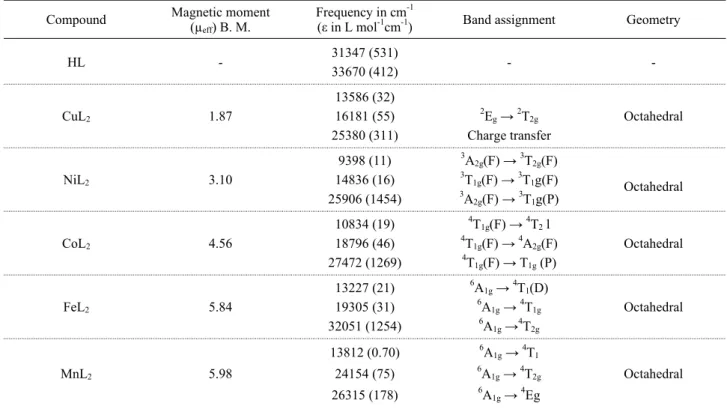
The analytical data of ligand and metal complexes is given in Table1. The elemental analysis show 1:2 (metal:ligand) stoicheometry for the complexes. It corresponds well with the general formula [ML2] where M = Cu(II), Ni(II), Co(II), Mn(II)and Fe(III). The magnetic susceptibilities of all com- plexes at room temperature are found to be consistent with octahedral geometry. The metal complex solutions in DMSO
show low conductance which support their non electrolyte nature.
1H-NMR Spectrum of Ligand
The 1H NMR spectrrm of the ligand was recorded in CDCl3. It shows following signals at 2.12 δ, (s, C6-CH3), 2.55 δ (s,3H,N=C-CH3),5.84 δ (s,1H,C5-H),7.4 to 8.0 (m, 8H, phenyl), 8.8 δ (s, 1H, N=C-H) and 15.88 δ (s, 1H, enolic OH of DHA moiety).
FT IR Spectra
The IR spectrum of free ligand shows characteristic bands at 3059 ~ 3300, 1697, 1663, 1356 and 1213cm-1 assignable to intramolecular hydrogen bonded (υ OH), lactone car- bonyl (υ C=O), azomethine (υ C=N), arylazomethine (υ C-N) and phenolic (υ C-O) stretching modes respectively.17,18 In the IR spectra of metal complexes, the absence of weak broad band in the range of 3059 - 3300 cm-1 region indicates deprotonation of the intramolecular hydrogen bonded OH group on complexation. This is supported by upward shift in phenolic (υ C-O).19 On complexation the (υ C=N) band is shifted to lower wave number with respect to free ligand denoting that the nitrogen of azomethine group is coordi- nated to the metal ion. This is supported by upward shift in (υ C-N) values. The IR spectra of metal complexes showed new bands in 457 - 540 cm-1 region which can be assigned to υ (M-O) and (M-N) stretching vibrations respectively.20 From the above facts it is evident that the coordination takes place via azomethine nitrogen and phenolic OH of the li- gand molecule.
Electronic Absorption Spectra and Magnetic Measure- ments
The magnetic and electronic spectral data is given in Table 2. The electronic spectra of Cu(II) complexes in DMSO show bands at 13586, 16181 and 25380cm-1 assignable to a
2Eg → 2T2g and charge transfer transition respectively. The electronic spectral data coupled with observed magnetic moment 1.87 B. M. suggest octahedral geometry for Cu(II) complex.21 Ni (II) complex display three bands at 9398, 14836 and 25906 cm-1 assignable to 3A2g → 3T2g(F) ,3A2g →
3T1g(F) and, 3A2g → 3T1g(P) transitions respectively. These electronic transitions along with magnetic moment 3.1 B.
M. suggest octahedral geometry for Ni (II) complex.22,23 The Co(II) complex shows three transitions at 10834, 18796 and 27472 cm-1assignable to 4T1g(F) → 4T1g(P), 4T1g(F) →
4A2g and 4T1g(F) → 4T1g(P) transitions respectively. These transitions and observed magnetic moment 4.56 B. M. in- dicate high spin octahedral geometry of the complex.24,25
Table 1. Analytical and physical data of the compounds
Compound Empirical formula Colour Contents (found/calcd) %
M Λ Ω-1cm- 1 cm2
C H N Cl
HL C21H17N2O3Cl Cream white 66.20/66.23 4.40/4.49 7.30/7.35 9.40/9.30 - - CuL2 C42H32N4O6Cl2Cu Green 66.90/66.87 3.70/3.91 6.50/6.80 8.70/8.61 7.60/7.71 13.02 NiL2 C42H32N4O6Cl2Ni Yellow 62.50/61.64 3.70/3.94 6.90/6.84 8.70/8.66 7.20/7.17 26.05 CoL2 C42H32N4O6Cl2CO Brown 61.70/61.62 3.90/3.94 6.75/6.84 8.60/8.66 7.20/7.19 21.04 FeL2 C42H32N4O6Cl2Fe Brown 61.80/61.85 3.90/3.95 6.90/6.87 8.75/8.69 6.50/6.84 12.02 MnL2 C42H32N4O6Cl2Mn Brown 61.80/61.95 3.70/3.95 6.90/6.87 8.50/8.70 6.50/6.74 10.02
Table 2. Electronic absorption and magnetic susceptibility data of metal complexes
Compound Magnetic moment
(µeff) B. M. Frequency in cm-1
(ε in L mol-1cm-1) Band assignment Geometry
HL - 31347 (531)
- -
33670 (412)
CuL2 1.87
13586 (32)
Octahedral 16181 (55) 2Eg → 2T2g
25380 (311) Charge transfer
NiL2 3.10
9398 (11) 3A2g(F) → 3T2g(F)
Octahedral 14836 (16) 3T1g(F) → 3T1g(F)
25906 (1454) 3A2g(F) → 3T1g(P)
CoL2 4.56
10834 (19) 4T1g(F) → 4T2 l
Octahedral 18796 (46) 4T1g(F) → 4A2g(F)
27472 (1269) 4T1g(F) → T1g (P)
FeL2 5.84
13227 (21) 6A1g → 4T1(D)
Octahedral 19305 (31) 6A1g → 4T1g
32051 (1254) 6A1g →4T2g
MnL2 5.98
13812 (0.70) 6A1g → 4T1
Octahedral 24154 (75) 6A1g → 4T2g
26315 (178) 6A1g → 4Eg
Fe(III) complex exhibits bands at 13227, 19305 and 32051 cm-1 assignable to 6A1g → 4T1(D), 6A1g → 4T1 and 6A1 → 4T2g, respectively. The observed magnetic moment 5.84 B. M along with electronic transitions corresponds to octahedral geo- metry.26-29 In case of Mn(II) complex the observed magnetic moment 5.98 B. M and the spectral bands at 13812, 24154 and 26315 cm-1 assignable to 6A1g → 4T1(G), 6A1g → 4T2g
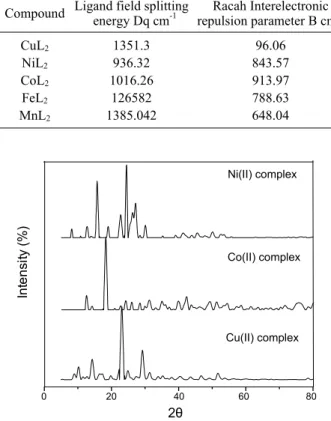
(G)and 6A1g → 4Eg transitions respectively, indicate octahed- ral geometry of the complex.30,31 The calculated values of ligand field splitting energy (10 Dq), Racah interelectronic repulsion parameter (B), covalent factor (β), ratio υ2/υ1 and ligand field stabilization energy (LFSE) data of metal com- plexes given in Table 3 supports the proposed geometry for
all the complexes.
Powder X-ray Diffraction
The X-ray diffractograms of Cu(II), Ni(II) and Co(II) complexes were scanned in the range 5 ~ 100o at wavelength 1.543 Å and are given in Fig. 1. The diffractogram and associ- ated data depict 2θ values for each peak, relative intensity and interplanar spacing (d-values). The diffractogram of Cu(II) complex shows seven reflections with maxima at 2θ = 23.07 corresponding to d value 3.851 Å. The diffractogram of Co(II) complex had eleven reflections with maxima at 2θ = 18.11o corresponding to d value 4.89 Å ,where as the diffractogram of Ni(II) complex had thirteen reflections
C u ( I I ) c o m p le x
C o ( I I ) c o m p le x
N i( I I ) c o m p le x
0 20 40 60 80
2θ
Intensity (%)
Ni(II) complex
Co(II) complex
Cu(II) complex
Fig. 1. X-ray diffractograms of Cu(II), Co(II) and Ni(II) complexes.
Table 3. Ligand field parameter of metal complexes
Compound Ligand field splitting energy Dq cm-1 Racah Interelectronic
repulsion parameter B cm-1 Covalent factor (β) % β ν2/ν1 Ligand field stabilization energy LFSE kcal mol-1
CuL2 1351.3 96.06 - - - 38.512
NiL2 936.32 843.57 0.8103 23.40 1.584 26.685
CoL2 1016.26 913.97 0.9412 6.23 1.832 28.963
FeL2 126582 788.63 0.7769 22.30 1.496 36.075
MnL2 1385.042 648.04 0.6743 32.56 1.760 39.473
with maxima at 2θ = 24.35o corresponding to d value 3.651 Å.
The X-ray diffraction pattern of these complexes with re- spect to major peaks having relative intensity grater than 10% have been indexed by using computer programme.32 The above indexing method also yields Miller indices (hkl), unit cell parameters and unit cell volumes. The unit cell of Cu(II) complex yielded values of lattice constants a = 15.40 Å, b = 10.46 Å, c = 5.70 Åand unit cell volume V = 920.49 (Å).3 Co (II) complex yielded values of lattice con- stants a = 11.34 Å, b = 7.12 Å, c = 4.88 Å and unit cell vol- ume V = 394.25 (Å).3 The unit cell of Ni(II) complex yield- ed values of lattice constants, a = 12.18 Å, b = 6.32 Å, c = 7.75 Å and unit cell volume V = 539.17 (Å).3 In concurrence with these cell parameters of these complexes, the condition such as a ≠ b ≠ c and α = β = γ = 90o required for the com- pound to be orthorhombic were tested and found to be sati- sfactory for Cu(II) and Co(II) complexes. The condition a ≠ b ≠ c and α = γ = 0o ≠ β required for the compound to be mono- clinic was tested and found to be satisfactory for Ni(II) com- plex. Hence it can be concluded that Cu(II), Co(II) shows orthorhombic crystal system whereas Ni(II) complex show monoclinic crystal system. Experimental density values of the complexes were determined by using specific gravity
method33 and found to be 2.6637, 2.965 and 2.5374 gcm-3 for Cu(II), Co(II), and Ni(II) complexes respectively. By experimental density values, molecular weight of complexes, Avogadro’s number, volume of the unit cell, the number of molecules per unit cell were calculated by using equation ρ = nM/NV and was found to be two, one, two for Cu(II), Co(II), and Ni(II) complexes respectively. With these values, theo- retical density were computed and found to be 2.673, 2.956, 2.517 gcm-3 for respective complexes. Comparison of experi- mental and theoretical density value shows good agree- ment within the limits of experimental error.11
Thermal Analysis
The Cu(II), Ni(II) and Co(II) complexes were chosen for thermal study. The TG/DT analysis of metal complexes was carried from ambient temperature to 1000 oC in nitrogen atmosphere using α-Al2O3 as reference. The TG/DTA curves of these complexes show no weight loss up to 270 oC indicat- ing the absence of coordinated water molecules.34 In TG curve of copper complex, the first step decomposition in the range 280to 375 oC with a mass loss of 51.20% (calcd.
51.60%) and an exothermic peak ∆Tmax = 350 oC in DTA may be attributed to decomposition of non coordinated part of ligand. The second step decomposition in the range 460 to 700 oC with mass loss 37.20% (calcd. 37.70%) corresponds to decomposition of coordinated part of ligand. finally stable metal oxide CuO corresponding to mass 9.62% (calcd.
9.80%) was obtained. In TG curve of cobalt complex first step decomposition in the range 280 to 350 oC with mass loss 60.95% (calcd. 61.07%) corresponds to decomposi- tion of non coordinated part of ligand. In DTA, correspond- ing endothermic peak at 290 oC was obtained. Second step decomposition in the range 360 ~ 890 oC with mass loss of 38.80 (calcd. 38.92%) corresponds to the decomposition of non coordinated part of ligand .A broad exothermic peak in DTA was obtained at 398 oC. Finaly stable nickel oxide was formed which corresponds to 9.10% (calcd. 9.16%). In case of nickel complex, first step decomposition in the range 275 to 375 oC with mass loss of 51.60% (calcd. 51.90%)
Table 4. Kinetic parameters of metal complexes Complex Steps Decomposition. Temperature (oC) Activation
energy(Ea) kJmol-1 Free energy
change(∆G), (kJmol-1) Entropy
change(∆S) JK-1mol-1 Frequency
factor (Z), S-1 Correlation coefficient
CuL2 I 325 27.66 42.40 -213.84 81.07 0.9807
II 575 9.64 37.67 -274.89 7 × 10⁻² 0.9942
NiL2 I 350 9.66 9.66 -262.417 2.563 × 10⁻¹ 0.9996
II 625 18.33 18.53 -260.120 4.812 × 10⁻¹ 0.9945
CoL2 I 310 25.48 41.81 -223.34 27.47 0.9963
II 650 18.14 47.43 -262.47 3.79 × 10⁻¹ 0.9959
Table 5. Sability constants of the complexes at 25 ± 0.1 oC, µ = 0.1 NaClO4 and protonation constants of Schiff base pk1 = 3.01, pk2 =9.97
Compound CuL2 NiL2 CoL2 FeL2 MnL2
log k1 9.97 9.94 9.93 9.75 9.90
log k2 7.47 6.34 3.24 2.99 3.08
log β 17.44 16.28 13.17 12.74 12.98
Fig. 2. Resonance structure of the ligand.
corresponds to decomposition of non coordinated part of ligand. A sharp exotherm at 370 oC was obtained in the DTA curve. Second step decomposition from 390 to 820 oC with mass loss 38.02% (calcd. 38.93%) may be attributed to de- composition of coordinated part of ligand. The residue at the end of the decomposition of complex corresponds to stable metal oxides with mass 9.12% (calcd. 9.15%).
Kinetic Calculations
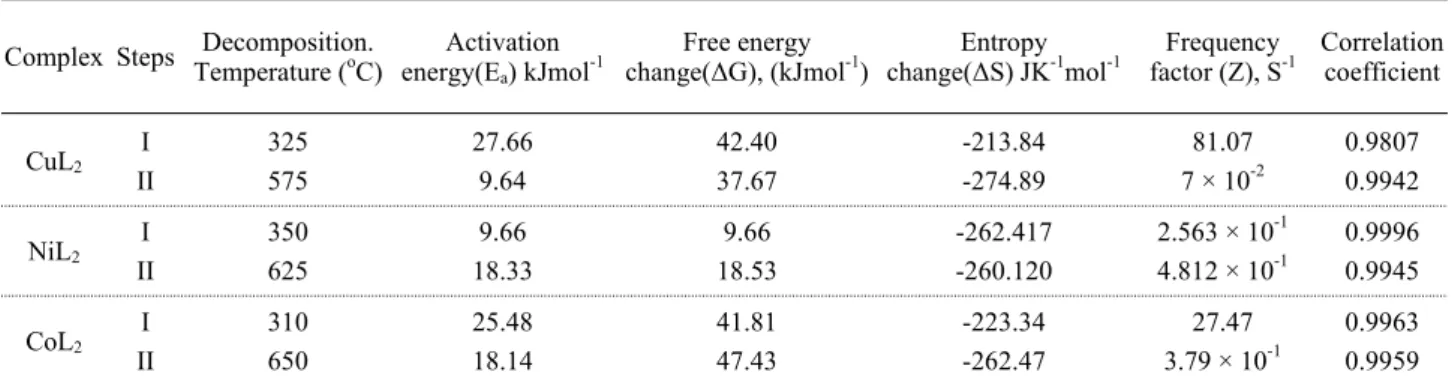
The kinetic and thermodynamic parameters for decom- position of metal complexes have been determined by Coats- Redfern method35 and given in Table 4. The calculated free energy of activation is relatively low indicating the autoca- talytic effect of metal ion on thermal decomposition of metal complexes.36,37 Negative ∆Svalues indicate more ordered activated states that may be possible through chemisorp- tions of oxygen and other decomposition products. The more ordered nature may be due to the polarization of bonds in activated state which might happen through charge transfer electronic transitions.
Potentiometry
Calvin-Bjerrum pH titration technique as modified by Irving and Rossotti was used to determine proton- ligand and metal-ligand stability constants in THF-water mixture (60% v/v) at a constant temperature 25 oC. Irving and Rossotti method was used to calculate thenA,n, pK and pL values from the pH titration curves. The constants of ligand and metal complexes are given in the Table 5.
In the present ligand, protonation takes place in the initial stages of titrations because of the presence of azomethine
nitrogen. The pK1 and pK2 were determined atnA = 1.5 and 0.5 respectively. The first stability constant pK1 therefore refers to the imine nitrogen. However there are two imine nitrogens present in the ligand and only one pK value is displayed by it, suggesting that out of two nitrogens, one is not involved in protonation. This may be attributed to the intramolecular hydrogen bonding of nitrogen Nb (Fig. 2) which undergo chelation with enolic OH of dehydroacetic acid moiety and hence does not take part in protonation and deprotonation. Therefore the pK value shown by the ligand is due to the protonation of nitrogen Na. The second pK ob- served as 9.97 in the ligand is due to the dissociation of enolic proton which is sufficiently acidic due to the resonance effect.
All the metals form 1:1 and 1:2 chelates with this ligand.
The 1:1 and 1:2 chelates are formed in a simultaneous pro- cess in all the systems. Hence, the method of least squares has been invariably used for getting accurate values of log k1 and log k2.These values are reported in Table 5.
Table 6. Antibacterial activity of compounds (diameter of inhibition zone in mm) and antifungal activity weight in mg (% inhibition) of the ligand and complexes
Compound
Antibacterial activity Antifungal activity
E.Coli Staphylococcus Aspergillus Niger Trichoderma
500ppm 1000ppm 500ppm 1000ppm 500ppm 1000ppm 500ppm 1000ppm
Ciprofloxin/Control 30 35 32 34 75 72 65 60
HL 15 17 09 11 65 (13) 60 (17) 45 (31) 27 (55)
CuL2 30 32 20 24 40 (47) 10 (86) 30 (54) 20 (67)
NiL2 10 16 15 17 42 (44) 13 (82) 32 (51) 22 (63)
CoL2 22 24 16 22 45 (40) 18 (75) 36 (45) 24 (60)
FeL2 25 27 17 23 53 (29) 20 (72) 40 (38) 25 (58)
MnL2 27 28 18 23 54 (28) 22 (69) 45 (31) 27 (55)
Coordination of metal ion with ligand takes place via protonated nitrogen and oxygen of the enolic group. The order of stability constants is Cu > Ni > Co > Fe > Mn which is in agreement with Irving -Williams order.38
Antimicrobial Activity
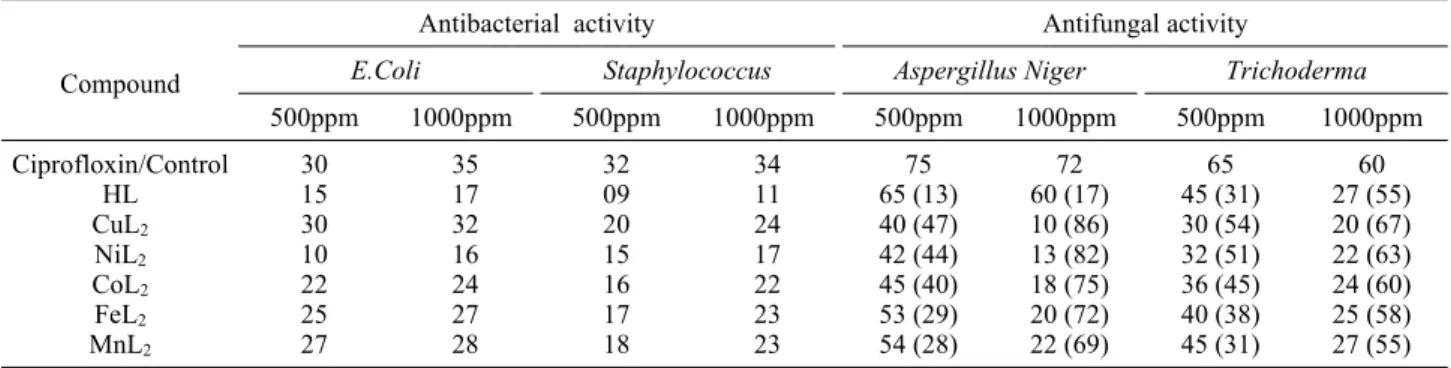
The antibacterial activity of ligand and metal complexes were tested in vitro against bacteria staphylococcus aureus and Escheria coli by paper disc method.19 The compounds were tested at 500 and 1000 ppm concentrations in DMSO.
The 10mm diameter Whatmann No.1 paper discs were soak- ed in different solutions of compounds, dried and then plac- ed on the lawn cultures on nutrient agar plates. The plates were incubated for 24 h at 37 oC and the inhibition zone around each disc was measured. The results obtained were compared with known antibiotics, ciprofloxin. For antifungal activity, compounds were screened against Aspergillus Niger and Trichoderma by mycelia dry weight method39 with glu- cose nitrate media. The compounds were tested at the con- centration 500 to 1000 ppm in DMSO and compared with control. Three replicates were taken and the average values are given in Table 6. The results of antibacterial studies show that the metal complexes exhibit enhanced inhibitory effect than the free ligand against the same organisms under iden- tical conditions. Increased activity of metal chelates can be explained on the basis of chelation theory.40 The biological activity of free ligand is enhanced in presence of the metal.41 This is a consequence of the increased lipid solubility of the metal complex as compared to the parent ligand. Trans- port of both metal and ligand across lipophilic membranes to vital intramolecular sites is favored by chelation. Once intracellular, the fully coordinated complex or one of its derivatives, including the dissociated metal or ligand may be the active entity.
For each class of microorganism, higher antibacterial acti- vity shown by Cu(II) complex may be because of the higher
stability of Cu(II) chelate than the other complexes. Other metal complexes, except Ni(II) complex, also show that activity is enhanced to approximately same extent irrespec- tive of their stability constants. Activity was found to be increased with the increasing concentration of complexes which may be due to the effect of metal ions on normal process of cell. The toxicity of metal chelates follow the order Cu > Mn > Fe > Co > Ni. This indicates that the anti- bacterial activity is not in accordance with stability order of metal ions.
Investigation of antifungal activity of the ligand and its metal complexes revealed that all metal chelates are more fungi toxic than their parent ligand Table 6. The antifungal activity of the ligand is found to enhance several times on being coordinated with metal ions. Antifungal activity of these complexes is found to be increased as the stability of the complex increased. The activity of these complexes follow the order Cu > Ni > Co > Fe > Mn which is exactly same as the order of stability constants of these complexes.
Comparison of the activities of ligand, its metal chelates shows that the copper complex is approximately four-five times active as ligand against Aspergillus niger. Activity of ligand against Trichoderma also increases after chelation with Cu(II), Ni(II), Co(II), Mn(II) and Fe(III). This high antifungal activity of ligand and its metal complexes may be attributed to the chloro substituent present in the ligand.42,43
CONCLUSION
On the basis of physicochemical and spectral data dis- cussed above, octahedral geometry for Cu(II), Ni(II), Co(II), Mn(II) and Fe(III) complexes is proposed. From IR spectra it is assumed that the ligand behaves as ONN tridentate, coor- dinating via phenolic oxygen and imino nitrogen as illustrat- ed in Fig. 2. Thermal study reveals that the complexes are thermally stable. The XRD study suggests monoclinic crystal
system for Ni(II)and orthorhombic crystal system for Cu(II) and Co(II) complexes. The antimicrobial activity of the com- plexes is more as compared to ligand. Antibacterial activity shows that the copper complex is more biologically active in all complexes. Antifungal activity of these complexes is found to be increased in the similar order of increase in the stability constants of metal complexes .
REFERENCES
1. Rao, D. S.; Ganorkar, M. C.; Rao, D. L. S.; John, V. T. Natl.
Acad. Sci. Lett. 1978, 1, 402.
2. Chalaca, M. Z.; Figueroa-Villar, J. D.; Ellena, J. A.; Castella- no, E. E. Inorg. Chim. Acta 2002, 45, 328.
3. Puerta, D. T.; Cohen, S. M. Inorg. Chem. 2003, 42, 3423.
4. Munde, A. S.; Jagdale, A. N.; Jadhav, S. M.; Chondhekar, T.
K. J. Serb. Chem. Soc. 2010, 75, 349.
5. Gold, Progress in Chemistry, Biochemistry and Technology, Schmidbaur, H., Ed.,Chichester John, Wiley, 1999.
6. Dryden, N. H.; Shapter, J. G.; Coatsworth, L. L.; Norton, P. R.;
Puddephatt, R. O. J. Chem. Mater. 1992, 4, 979.
7. Deb, A. K.; Goawami, S. Polyhedron 1991, 10, 1799.
8. Naikwade, S. D.; Mane, P. S.; Chondhekar, T. K. J. Indian Chem.
Soc. 2001, 78, 41.
9. Mane P. S.; Shorodkar, S. G.; Arbad, B. R.; Chondhekar, T. K.
Indian J. Chem. 2001, 40A, 648.
10. Shirodkar, S. G.; Mane, P. S.; Chondhekar, T. K. Indian J. Chem.
2001, 40A, 1114.
11. Munde, A. S.; Jagdale, A. N.; Jadhav, S. M.; Chondhekar, T. K.
J. Korean Chem. Soc. 2009, 53, 407.
12. Chondhekar, T. K.; Arbad, B. R. Indian J. Chem. 1986, 25A, 787.
13. Marzilli, L. G.; Marzilli, P. A.; Halpern, J. J. Am. Chem. Soc.
1971, 14, 1374.
14. Jha, N. K.; Joshi, D. M. Synth. React. Inorg. Met-Org. Chem.
1984, 14, 455.
15. Qayyoom, M. A.; Hanumanthu, P.; Ratnam, C. V. Indian. J.
Chem. 1982, 21B, 883.
16. Vogel, A. I. A Text Book of practical Organic Chemistry, 3rd edn, (Longmans, London). 1959, p 177.
17. Ramarao, N.; Rao. V. P.; Tyaga, R. V. J.; Ganorkar, M. C. Indi- an, J. Chem. 1985, 24A, 877.
18. Tan, S. F.; Ang, K. P. Transition Met. Chem. 1988, 13, 64.
19. Venketeswar, R. P.; Venkata, N. A. Indian J. Chem. 2003, 42A, 896.
20. Sari, N.; Gurkan, P.; Cete, S.; Sakiyan, I. Russian J. Coord.
Chem. 2006, 32, 511.
21. Eichhorn, G. L.; Bailar, J. C. J. Am. Chem. Soc. 1953, 75, 2905.
22. Sacconi, L. Transition. Met. Chem. 1968, 61, 943.
23. Lever, A. B. P. Inorganic Electronic spectroscopy, Elsevier, Amsterdam. 1968, p 275.
24. Varma, A. N.; Bhosale, S. B.; Sangel, S. P. J. Indian Chem. Soc.
1995, 72, 685.
25. Satpathy, K. C.; Panda, A. K.; Mishra, R.; Pande, I. Transition Met. Chem. 1991, 16, 410.
26. Mane, P. S.; Shirodkar, S. G.; Chondhekar, T. K. J. Indian Chem.
Soc. 2001, 40, 648.
27. Yaul, S. R.; Yaul, A. R.; Pethe, G. B.; Aswar, A. S. Am-Eura.
J. Sci. Research. 2009, 4, 229.
28. David, P. G. J. Chem. Soc. 1977, 2037.
29. Sen Gupta, S. K.; Sahani, S. K.; Kapoor, R. N. Indian J. Chem.
1980, 19A(7), 703.
30. Choubey, P.; Singh, P. J. Indian Chem. Soc. 2003, 80, 40.
31. Badwaik, V. B.; Deshmsukh, R. D.; Aswar, A. S. Russian J.
Coord. Chem. 2009, 35, 247.
32. Carvajal, J. R.; Roisnel, T.; Winplotr, A. Graphic Tool for Pow- der Diffraction Laborataire leon brillouin (ceal/enrs) 91191 gif suryvette cedex. 2004, France.
33. Shoemaker, D. P.; Garland, C. W. Experiments in Physical Che- mistry, 5th edn, Mc Graw-Hill International Edition, New York, 1989, pp 17-27.
34. Dash, D. C.; Panda, A. K.; Jena, P.; Patjoshi, S. B.; Mahapatra, A. J. J. Indian Chem. Soc. 2002, 79, 48.
35. Coats, A .W.; Redfern, I. P. Nature 1964, 20, 68.
36. El-Award, A.M. J. Therm. Anal. Cal. 2000, 61, 197.
37. Impura, A.; Inoue, Y.; Yasumori, I. Bull. Chem. Soc. Jpn. 1983, 56, 2203.
38. Irving, H. M.; Rossotti, H. S. J. Chem. Soc. 1954, 2904.
39. Raman, N.; Kulandaisamy, A.; Shanmugasundaram, A.; Jeya- subramania, K. Transition Met. Chem. 2001, 26, 131.
40. Badwaik, V. B.; Aswar, A. S. Russian J. Coord. Chem. 2008, 34, 179.
41. Thangadurai, D.; Natarajan, K. Synth. React. Inorg. Met-Org.
Chem. 2001, 30, 569.
42. Dash, B.; Mahapatra, P. K.; Panda, D.; Patnaik, J. M. J. Indian Chem. Soc. 1984, 61, 1061.
43. Rao, N. R.; Rao, P. V.; Reddy, G. V.; Ganorkar, M. C. Indian J. Chem. 1987, 26A, 887.