19
책임저자 : 윤현조, 전북 전주시 덕진구 금암동
561-712, 전북대학교 의학전문대학원 외과학교실 Tel: 063-250-1570, Fax: 063-271-6197
E-mail: [email protected] 게재승인일:2009년 3월 15일
순수 유두 갑상선암과 소포 변이 유두 갑상선암: 임상병리학적 특성 비교 연구
전북대학교 의학전문대학원 외과학교실 유방ㆍ갑상선외과 이병길ㆍ윤현조ㆍ정성후
The Pure and Follicular Variants of Papillary Thy- roid Carcinoma: A Comparative Study of the Clinicopathologic Features
Byoung Kil Lee, M.D., Hyun Jo Youn, M.D. and Sung Hoo Jung, M.D.
Purpose: Pure papillary thyroid carcinoma (PPTC) and the
follicular variant of papillary thyroid carcinoma (FVPTC) are the most common subtypes of papillary thyroid carcinoma (PTC). The aim of this study was to investigate if there are any differences in clinicopathological features of these two subgroups.Methods: We performed a retrospective chart review of pa-
tients who were treated for PPTC and FVPTC between September 2003 and April 2008. Four hundred fifty patients were shown to have PPTC (91.8%) and forty (8.2%) had FVPTC after a histologic review. The two groups were com- pared in terms of the clinicopathologic features and the re- sults of preoperative ultrasonography (USG), the fine nee- dle aspiration cytology (FNAC), the frozen section biopsy and the surgical treatmentResults: The tumor size was significantly larger in the
FVPTC group than in the PPTC group (1.47 cm versus 1.08 cm, respectively P=0.024). However, both groups had similar clinicopathologic features in terms of age, gender, capsular invasion, multifocality, lymph node metastasis, the MACIS score and the TNM stage. Further, the operative method did not differ between the two groups. The sensitiv- ities of USG and frozen section biopsy for diagnosing FVPTC were significantly lower than those for PPTC (53.85% versus 72.95%, respectively, P=0.045, 81.58% ver- sus 97.25%, respectively, P=0.049).Conclusion: The FVPTC group presented with a larger tu-
mor size, and the clinicopathologic features of the FVPTCgroup did not significantly differ from those of the PPTC group. Although further studies with longer follow-up are re- quired, these results suggest that the patients in both groups should be treated identically. (Korean J Endocrine
Surg 2009;9:19-23)
Key Words: Papillary thyroid carcinoma, Follicular variant,
Clinicopathologic feature중심 단어:유두 갑상선암, 소포 변이, 임상 병리학 적 특징
Division of BreastㆍThyroid Surgery, Department of Surgery, Chonbuk National University Medical School, Jeonju, Korea
서 론
유두 갑상선암은 갑상선암의 약 80%를 차지하는 가장 흔 한 암으로, 순수 유두 갑상선암외에 소포상 변이, 키 큰 세 포 변이, 원주상 변이, 미만성 경화 변이, 피막성 변이, 호산 성 세포 변이등 여러 가지 형태가 존재한다.(1-4) 이중 소포 변이 유두 갑상선암은 Crile과 Hazard(5)이 1953년 폐포상 변이 유두 갑상선암으로 처음 보고 한 후 Lindsay(6)에 의해 소포 변이 유두 갑상선암으로 불리워졌다.
전체 유두 갑상선암 중 약 9∼41%를 차지한다고(7,8) 알 려진 소포 변이 유두 갑상선암의 조직학적 진단 기준은 종 양의 80% 이상이 소포 구조물로 이루어지며 유두 갑상선암 의 특징적 소견인 사종체, 핵 내 포함물, 풍부한 핵열 , 불투 명한 핵, 핵중첩, 불규칙한 핵 모양 중 두 가지 이상의 소견 을 보일 때 진단 할 수 있다.(8)
소포 변이 유두 갑상선암에 대한 이전 보고는 순수 유두 갑상선암보다 피막 침범은 많으나 경부 림프절 전이는 적 고 다발성의 빈도가 더 높다는 보고(3,4)와 종양의 크기가 더 크며 병기는 높지만 국소 침범과 재발률은 낮아 양호한 임상병리학적 특징을 보이고 장기 추적 관찰 결과 순수 유 두 갑상선암과 비슷한 생존률과 재발률을 보인다는 보고가 있다.(7,9)
Table 1. Clinicopathologic characteristics of pure papillary thyroid carcinoma and follicular variant papillary thyroid carcinoma
Variables PPTC (%) FVPTC (%) P value Number of patients 440 (91.8) 39 (8.2)
Age (years, mean±SD) 46.67±11.95 47.10±10.62 0.825
Male:Female ratio 40:400 6:33 0.202
Tumor size (cm, mean±SD) 1.08±0.70 1.47±1.02 0.024 Capsular invasion 106 (24.1) 5 (12.8) 0.167 Multifocality 126 (28.6) 8 (20.5) 0.197 Lymph node metastasis* 126/400 (27.8) 6/36 (16.6) 0.355 MACIS score14 (mean±SD) 4.43±1.01 4.45±0.82 0.856
TNM stage* 0.462
I 308 (77.0) 29 (80.56)
II 7 (1.75) 1 (2.78) III 83 (20.75) 5 (13.89) IVa 2 (0.5) 1 (2.78)
*Exclude the patient without lymph node dissection.
Table 2. Pre & intraoperational diagnosis Variables PPTC (%) FVPTC (%) P value
Ultrasonography 0.045
Malignancy 321 (73.0) 21 (53.85) Indeterminate 43 (9.8) 5 (12.82) Benign 76 (17.3) 13 (33.33)
FNAC* 0.986
Malignancy† 343 (91.22) 27 (75.0) Benign‡ 33 (8.78) 9 (25.0)
Frozen biopsy 0.049
Malignancy 425 (97.25) 31 (81.58) Benign§ 12 (2.75) 7 (18.42)
*Exclude the patient without FNAC & nondiagnostic nodule; † Diagnosis with confident, suspicious, suggestive malignant nod- ule; ‡Diagnosis with indeterminate and benign nodule; §Include follicular neoplasm.
술 전 검사나 술 중 검사에 관한 보고로 소포 변이 유두 갑상선암은 순수 유두 갑상선암과 달리 수술 전 미세침흡 인세포검사 및 수술 중 동결절편검사의 민감도가 낮아 수 술 범위가 축소되는 위험성이 있고 그로 인해 완결 갑상선 절제술을 시행하는 경우가 많다는 보고도 있다.(10-12) 이에 저자들은 갑상선 수술 후 순수 유두 갑상선암과 소 포 변이 유두 갑상선암으로 진단된 490예의 임상 병리학적 특징을 비교하여 두 군 간의 차이점을 알아보고 초음파, 미 세침흡인세포검사, 동결절편검사의 민감도를 분석하고자 하였다.
방 법 1) 연구대상
2003년 9월부터 2008년 4월까지 본원에서 유두 갑상선암 으로 수술 받은 490명의 환자 중 조직병리학적으로 순수 유 두 갑상선암으로 진단받은 450명과 소포 변이 유두 갑상선 암으로 진단 받은 40명의 환자를 대상으로 하였으며 동결 절편검사에서 정확한 진단을 내리지 못한 후 확정 조직 검 사에서 유두 갑상선암으로 진단된어 완결 갑상선 절제술을 시행받은 11예는 중복되는 경우로 제외하였다.
2) 연구방법
환자의 의무기록을 후향적으로 조사하여 순수 유두 갑상 선암과 소포 변이 유두 갑상선암 두 군 간의 나이, 성별, 다 발성, 갑상선외 침범, American Joint Committee on Cancer (AJCC 6th edtion) TNM 병기 분류,(13) MACIS (distant Metastasis, Age, Completeness of primary surgical resection,
extrathyroidal Invasion, and tumor Size) 점수 산정,(14) 수술 전 초음파, 미세침흡인세포검사 및 수술 중 동결절편 검사 결과, 수술방법 등을 비교 분석하였다.
통계처리 및 분석은 SPSS 13.0 for windows를 이용하여 분석하였으며 TNM 병기 분류, MACIS점수는 Mann Whit- ney U-test를 이용하였고 임상병리학적 특성 중 나이, 성별, 종양의 크기, 다발성, 피막 침범의 비교 분석은 indepen- dent-sample t-test를 이용하여 0.05 미만의 P값을 유의 수준 으로 하였다.
결 과 1) 임상병리학적 특징
대상 환자 479명의 평균 연령은 46.58세(16∼87)였고 남 녀 비는 46:433였으며 평균 추적 관찰 기간은 29.8개월(11
∼59)이었다.
순수 유두 갑상선암과 소포 변이 유두 갑상선암 환자 두 군의 임상 병리학적 특성 비교는 Table 1에 요약하였으며 두 군간의 성별, 나이, 갑상선 주위 조직 침범, 다발성, 림프 절 전이, MACIS점수, 병기는 통계학적 차이를 보이지 않았 다.
종양의 평균 크기는 순수 유두 갑상선암이 1.08±0.70 cm, 소포 변이 유두 갑상선암이 1.47±1.02 cm (P=0.024)로 소포 변이 유두 갑상선암의 크기가 컸으며 통계학적으로 의미 있는 차이를 보였다(Table 1).
수술 전 시행한 초음파검사의 민감도는 순수 유두 갑상선 암이 72.9%, 소포 변이 유두 갑상선암이 53.85% (P=0.045)였 고 미세침흡인세포검사는 순수 유두암이 91.22%, 소포변이 유두 갑상선암이 75.0% (P=0.986)였으며 수술 중 동결절편 검사의 민감도는 순수 유두암이 97.25%, 소포 변이 유두상
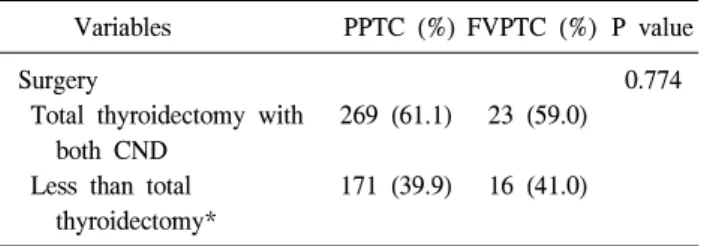
Table 3. Surgical treatment and local recurrence of papillary thyroid carcinoma
Variables PPTC (%) FVPTC (%) P value
Surgery 0.774
Total thyroidectomy with 269 (61.1) 23 (59.0) both CND
Less than total 171 (39.9) 16 (41.0) thyroidectomy*
*Lobectomy with isthmectomy & unilateral CND.
암이 81.58% (P=0.049)로 순수 유두 갑상선암에서 초음파 검사와 수술 중 동결 절편 검사 결과의 정확도가 감소함을 알 수 있었다(Table 2).
2) 수술 방법과 재발 빈도
두 군 간에 수술 방법의 차이는 보이지 않았으며 통계학 적으로 의미를 보이지 않았다(Table 3).
고 찰
유두 갑상선암은 갑상선암중에서 가장 많은 암으로 여러 변이들이 있으며(1-4) 순수 유두 갑상선 암이 전체 유두 갑 상선암의 55∼66%를 차지하고 다음으로 소포상 변이가 약 9∼41%의 비율을 차지하고 있다.(7,8) 본 연구에서는 소포 상 변이가 8.9%의 비율을 보였다.
소포 변이 유두 갑상선암에 관한 초기 보고에서는 순수 유두 갑상선암에 비하여 전이가 잘되는 공격적인 성향을 보인다는 보고가 있으며(1,15) Tielens 등(22)은 크기가 유의 하게 작다고 보고하였으나 최근 Burningham 등(7)은 소포 변이 유두 갑상선암이 진단 시 종양의 크기가 크지만 국소 침윤과 재발률은 유의하게 낮다고 보고하였으나 서로 다른 결과를 보이고 있다.
소포 변이 유두 갑상선암 최근의 다른 보고로는 Zidan 등(3)은 소포 변이 유두 갑상선암이 순수 유두 갑상선암보 다 피막 침범은 많았으나 경부 림프절 전이는 적다고 보고 하였고 Passler 등(4)은 다발성의 빈도가 더 높다고 보고하 였다. Lang 등(9)은 양호한 임상병리학적 특징을 가지며 장 기 추적 관찰 결과 순수 유두 갑상선암과 비슷한 생존률과 재발률을 보고하였다.
본 연구에서는 소포 변이 유두 갑상선암의 크기가 순수 유두 갑상선암에 비해 크지만 병기나 재발률에서 순순 유 두 갑상선암과 의미 있는 차이를 보이지 않았으며 두 군간 의 임상 병리학적 특성은 큰 차이를 보이지 않아, 최근의 연구 보고와 유사한 결과를 보이고 있어 치료 또한 순수 유두상 갑상선암에 준하여 시행되어야 한다는 최근 연구와 같은 결과를 보인다고 생각된다.
수술 전, 혹은 수술 중 검사에 대한 보고로는 순수 유두 갑상선암에서 미세침흡인세포검사의 민감도는 최고 94%
로 높게 보고되는 반면(12,16-18) 소포 변이 유두 갑상선암 은 술전 초음파 검사에서 양성으로 진단되는 비율이 높고 (21) 미세침흡인검사와 동결절편검사의 민감도가 9∼37%, 20∼42%로 낮다고 보고 되었으며(11,19,20) 이로 인해 검사 의 정확도가 낮아지는 경향이 있고 보고하였다. 본 연구의 소포 변이 유두 갑상선암의 경우 초음파, 미세침흡인세포 검사, 동결절편검사의 민감도는 53.85%, 75.0%, 81.58%로 이전의 보고들에 비해 다소 높은 결과를 보였지만 초음파 검사에서 양성으로 진단되는 비율이 33%로 높고 동결 절편 검사의 민감도도 낮게 진단되었으며 통계적으로 의미있는 차이를 보였다(Table 2).
위와 같이 소포 변이 유두 갑상선암의 술 전, 술 중 진단 이 쉽지 않은 원인으로는 초음파상에서 잘 구분되는 경계 와 석회질 소견을 잘 동반하지 않는 특징으로 인해 양성 병변으로 진단되는 경향이 있으며(21) 미세침흡인세포검사 상 양성과 악성 소포상의 병변이 혼합되어 있어 유두 갑상 선암의 특징적인 소견을 쉽게 찾을 수 없고(23-25) 세포학 적으로 결절성 갑상선종 및 하시모토씨 갑상선염과 감별이 쉽지 않은 특징을 보이며(24,26) 동결절편검사에서도 냉동 과정에서 발생하는 특징적인 핵소견의 소실과 피막을 잘 형성하는 종양의 특징을 들 수 있다.(20,23)
그러나 최근의 연구 결과는 소포 변이 유두 갑상선암의 진단이 순수 유두 갑상선암에 비하여 쉽지 않음에도 임상 병리학적 소견과 국소 재발, 전이 치료, 예후 인자가 순수 유두 갑상선암과 유의한 차이를 보이고 있지 않다고 보고 되고 있다.(22,27,28)
본 연구에서 조사된 임상 병리학적 결과는 발생연령, 남 녀의 비율, 피막침범, 임파절전이, 다발성의 경우 두 군간에 큰 차이를 보이지 않았고 소포 변이 유두갑상선암에서 종 양의 크기만 유의하게 크게 관찰 되었다. 그러나 소포 변이 유두 갑상선암 그룹의 수가 많지 않음으로 보다 많은 환자 군으로 비교 분석이 필요하리라 생각된다. 미세침흡인세포 검사에서 악성을 의심하는 소견이 보일 경우 수술을 시행 하였고 크기가 1 cm 미만, 갑상선 주위조직의 침범이 없고 한엽에만 종양이 존재한 경우는 갑상선 일엽절제술 및 협 부절제술 그리고 동측 중암경부림프절곽청술을 시행하였 고 1 cm 이상 이거나 주위조직에 침범이 있는경우, 양측에 종양이 존재하는 경우는 갑상선 전절제술 및 양측 중앙경 부림프절 곽청술을 시행하였다. 두 그룹간의 수술 방법은 차이가 없었다(Table 3).
이러한 연구를 근거로 하여 소포 변이 유두 갑상선암의 치료는 수술 전, 수술 중 진단이 가능한 경우 순수 유두 갑 상선암의 치료에 준하여 시행되는 것이 바람직하리라 생각 되며 소포 변이 유두 갑상선암의 술 전, 술 중 진단의 정확 도가 순수 유두 갑상선암에 비하여 낮은점을 고려하여 확
정 조직 검사결과에 따라 완결 갑상선 절제술이 필요함을 염두해 두어야겠다.
결 론
소포 변이 유두 갑상선암은 종양의 크기를 제외하고 임 상병리학적 특징에서 순수 유두 갑상선암과 유사한 소견을 보였다. 임상병리학적 특징과 재발의 형태가 순수 유두 갑 상선암과 의미있는 차이가 없다는 본 연구 결과를 토대로 소포 변이 유두 갑상선암의 치료는 수술 전, 수술 중 진단이 가능한 경우 순수 유두 갑상선암의 치료에 준하여 시행되 는 것이 바람직하리라 생각된다.
그러나 초음파, 동결절편검사를 통한 수술 전, 수술 중 진 단의 정확도가 낮아 초음파나 동결절편검사상에서 진단이 불명확 할 경우 양성 종양이 의심될지라도 여포상 변이 갑 상선 유두암의 가능성을 항상 염두 해 두어야 하겠으며 영 구 조직검사를 확인한 후 환자의 예후 예측 인자들을 고려 하여 추가적인 치료의 필요성을 고려해야 할 것이다.
REFERENCES
1) Carcangiu ML, Zampi G, Pupi A, Castagnoli A, Rosai J.
Papillary carcinoma of the thyroid: a clinicopathologic study of 241 cases treated at the University of Florence, Italy.
Cancer 1985;55:805-28.
2) Sebastian SO, Gonzalez JM, Paricio PP, Perez JS, Flores DP, Madrona AP, et al. Papillary thyroid carinoma: prognostic index for survival including the histological variety. Arch Surg 2000;135:272-7.
3) Zidan J, Karen D, Stein M, Rosenblatt E, Basher W, Kuten A. Pure versus follicular variant of papillary thyroid car- cinoma: clinical features, prognostic factors, treatment, and survival. Cancer 2003;97:1181-5.
4) Passler C, Prager G, Scheuba C, Niederle BE, Kaserer K, Zettinig G, et al. Follicular variant of papillary thyroid carcinoma: a long-term follow-up. Arch Surg 2003;138:
1362-6.
5) Crile G Jr, Hazard JB. Relationship of the age of the patient to the natural history and prognosis of carcinoma of the thyroid. Ann Surg 1953;138:33-8.
6) Lindsay S. Carcinoma of the Thyroid Gland: A Clinical and Pathologic Study of 293 Patients at the University of California Hospital. 3rd ed. Springfield: Charles C Thomas Publisher; 1960.
7) Burningham AR, Krishnan J, Davidson BJ, Ringel MD, Burman KD. Papillary and follicular variant of papillary carcinoma of the thyroid: initial presentation and response to therapy. Otolaryngol Head Neck Surg 2005;132:840-4.
8) Liu J, Singh B, Tallini G, Carlson DL, Katabi N, Shaha A,
et al. Follicular variant of papillary thyroid carcinoma: a clinicopathologic study of a problematic entity. Cancer 2006;
107:1255-64.
9) Lang BH, Lo CY, Chan WF, Lam AK, Wan KY. Classical and follicular variant of papillary thyroid carcinoma: a comparative study on clinicopathologic features and long- term outcome. World J Surg 2006;30:752-8.
10) Logani S, Gupta PK, LiVolsi VA, Mandel S, Baloch ZW.
Thyroid nodules with FNA cytology suspicious for follicular variant of papillary thyroid carcinoma: follow-up and mana- gement. Diagn Cytopathol 2000;23:380-5.
11) Kesmodel SB, Terhune KP, Canter RJ, Mandel SJ, LiVolsi VA, Baloch ZW, et al. The diagnostic dilemma of follicular variant of papillary thyroid carcinoma. Surgery 2003;134:
1005-12.
12) Lin HS, Komisar A, Opher E, Blaugrund SM. Follicular variant of papillary carcinoma: the diagnostic limitations of preoperative fine-needle aspiration and intraoperative frozen section evaluation. Laryngoscope 2000;110:1431-6.
13) Stigletary SE, Allred C, Ashley P, Bassett LW, Berry D, Bland KI, et al. Staging system for breast cancer: revisions for the 6th edition of the AJCC Cancer Staging Manual. Surg Clin North Am 2003;83:803-19.
14) Hay ID, Bergstralh EJ, Goellner JR, Ebersold JR, Grant CS, Hay ID. Predicting outcome in papillary thyroid carcinoma:
development of a reliable prognostic scoring system in a cohort of 1779 patients surgically treated at one institution during 1940 through 1989. Surgery 1993;114:1050-5.
15) LiVolsi VA, Asa SL. The demise of follicular carcinoma of the thyroid gland. Thyroid 1994;4:233-6.
16) Baloch ZW, Gupta PK, Yu GH, Sack MJ, LiVolsi VA.
Follicular variant of papillary carcinoma. Cytologic and histologic correlation. Am J Clin Pathol 1999;111:216-22.
17) Chen H, Zeiger MA, Clark DP, Westra WH, Udelsman R.
Papillary carcinoma of the hyroid: can operative management be based solely on fine-needle aspiration? J Am Coll Surg 1997;184:605-10.
18) Akerman M, Tennvall J, Biorklund A, Martensson H, Moller T. Sensitivity and specificity of fine needle aspiration cytology in the diagnosis of tumors of the thyroid gland. Acta Cytol 1985;29:850-5.
19) Goodell WM, Saboorian MH, Ashfaq R. Fine-needle aspi- ration diagnosis of the follicular variant of papillary carci- noma. Cancer 1998;84:349-54.
20) Shen PU, Kuhel WI, Yang GC, Hoda SA. Intraoperative touch-imprint cytological diagnosis of follicular variant of papillary thyroid carcinoma. Diagn Cytopathol 1997;17:80-3.
21) Yoon JH, Kim EK, Hong SW, Kwak JY, Kim MJ.
Sonographic features of the follicular variant of papillary thyroid carcinoma. J Ultrasound Med 2008;27:1431-7.
22) Tielens ET, Sherman SI, Hruban RH, Ladenson PW. Follicular variant of papillary thyroid carcinoma. A clinicopathologic
study. Cancer 1994;73:424-31.
23) Mesonero CE, Jugle JE, Wilbur DC, Nayar R. Fine-needle aspiration of the macrofollicular and microfollicular subtypes of the follicular variant of papillary carcinoma of the thyroid.
Cancer 1998;84:235-44.
24) Wu HH, Jones JN, Grzybicki DM, Elsheikh TM. Sensitive cytologic criteria for the identification of follicular variant of papillary thyroid carcinoma in fine-needle aspiration biopsy.
Diagn Cytopathol 2003;29:262-6.
25) Zacks JF, de las Morenas A, Beazley RM, O'Brien MJ.
Fine-needle aspiration cytology diagnosis of colloid nodule versus follicular variant of papillary carcinoma of the thyroid.
Diagn Cytopathol 1998;18:87-90.
26) Lugli A, Terracciano LM, Oberholzer M, Bubendorf L, Tornillo L. Macrofollicular variant of papillary carcinoma of the thyroid: a histologic, cytologic, and immunohistochemical study of 3 cases and review of the literature. Arch Pathol Lab Med 2004;128:54-8.
27) Mazzaferri EL, Jhiang SM. Long-term impact of initial surgical and medical therapy on apillary and follicular thyroid cancer. Am J Med 1994;97:418-28.
28) Albores-Saavedra J, Gould E, Vardaman C, Vuitch F. The macrofollicular variant of papillary thyroid carcinoma: a study of 17 cases. Hum Pathol 1991;22:1195-205.