© 2014 Korean Breast Cancer Society. All rights reserved. http://ejbc.kr | pISSN 1738-6756
INTRODUCTION
Breast carcinoma is a major cause of cancer-specific mortal- ity worldwide, and efforts are being made for its prevention and early detection, which is important. Breast cancer remains the most common cancer among the female population in China, with an age-standardized rate by world population of 21.6 per 100,000 [1]. In addition to the well-established risk factors for breast cancer, including age at first birth, menarche, and menopause; family history; ethnicity; and geographic
variation [2], the significance of exposure to circulating estro- gen has been widely accepted as an important factor in the development of breast cancer. Recent studies have shown that estrogen is capable of inducing the proliferation of breast epi- thelial cells, making them more susceptible to genetic errors during DNA replication; malignant phenotypes are frequently generated by uncorrected replication errors [3]. Therefore, genes that regulate the transcription and translation necessary for the biosynthesis and metabolism of estrogen may contrib- ute to the function of estrogen and, consequently, influence the susceptibility to breast cancer [2].
Catechol-O-methyltransferase (COMT) is a phase II enzyme that inactivates catechol estrogen by methylation and may play a vital role in estrogen-induced carcinogenesis [4]. Aberrant expression of COMT has been observed in several malignan- cies, including breast carcinoma, in parallel with estrogen me- tabolism disorders. Recently, Catechol-O-methyltransferase gene (COMT) was found to be polymorphic in its participation
The Catechol-O-Methyltransferase Val158Met Polymorphism Contributes to the Risk of Breast Cancer in the Chinese Population: An Updated Meta-
Analysis
Guo-Xing Wan*, Yu-Wen Cao*, Wen-Qin Li, Yu-Cong Li, Feng Li
Department of Pathology and the Key Laboratories for Xinjiang Endemic and Ethnic Diseases, Shihezi University School of Medicine, Shihezi, China ORIGINAL ARTICLE
Purpose: Catechol-O-methyltransferase (COMT) enzyme plays a central role in estrogen-induced carcinogenesis. Emerging evi- dence from association studies has revealed that the functional Val158Met polymorphism (rs4680 G>A) of the Catechol-O- methyltransferase gene (COMT) has been implicated in suscep- tibility to breast cancer in the Chinese population, while results of individual published studies remain inconclusive and inconsis- tent. To assess this association in the Chinese population, a me- ta-analysis was performed. Methods: Eligible studies were searched on MEDLINE, Embase, Cochrane Library, China Na- tional Knowledge Infrastructure, and the Chinese Biomedicine Database. Odds ratios (ORs) with their corresponding 95% con- fidence intervals (CIs) were pooled to assess the association be- tween COMT polymorphisms and the risk of breast cancer using RevMan 5.2 and Stata 12.0 software. Results: The meta-analysis included 14 eligible studies, with a total of 4,626 breast cancer
cases and 5,637 controls. Overall, the COMT Val158Met poly- morphism (rs4680 G>A) was significantly associated with an in- creased risk of breast cancer in several genetic models (A/A vs.
G/G: OR, 1.59, 95% CI, 1.12–2.27; A/A vs. G/A+G/G: OR, 1.62, 95% CI, 1.14–2.29; A vs. G: OR, 1.15, 95% CI, 1.00–1.32), and a subgroup analysis according to menopausal status showed that this association was especially evident among premenopausal Chinese women (A/A vs. G/G: OR, 1.87, 95% CI, 0.99–3.54; A/A vs. G/A+G/G: OR, 1.94, 95% CI, 1.03–3.63). Conclusion: The re- sults of this meta-analysis indicated that COMT Val158Met vari- ants contribute to breast cancer susceptibility in the Chinese population, particularly among premenopausal women.
Key Words: Breast neoplasms, Catechol-O-methyltransferase, Genetic, Meta- analysis, Polymorphism
Correspondence to: Feng Li
Department of Pathology, Shihezi University School of Medicine, 59 North 2nd Road, Shihezi 832000, China
Tel: +86-0993-2057125, Fax: +86-0993-2057125 E-mail: [email protected]
*These authors contributed equally to this work.
Received: October 10, 2013 Accepted: April 11, 2014
Cancer
in the development of breast cancer [3]. The polymorphism of COMT gene at codon 158 resulting in the amino acid substitu- tion of Val with Met is designated as Val158Met, with COMT- H and COMT-L alleles. Individuals carrying the COMT-Met (COMT-A) allele are hypothesized to harbor a higher risk for breast cancer owing to the formation and accumulation of car- cinogenic catechol estrogens [5]; this hypothesis is supported by several lines of evidence indicating that this amino acid sub- stitution is responsible for a decrease in COMT activity and dysregulation of estrogen metabolism [6].
An increasing number of epidemiological studies conduct- ed in the Chinese population have addressed the association between the COMT Val158Met polymorphism (rs4680 G>A) and the risk of breast cancer. However, the results remain con- flicting or even contradictory [3,7-19]. Moreover, previous studies with pooled analyses of the overall population regard- ing this issue have yielded different conclusions, possibly ow- ing to the different sample sizes and different ethnicities of the populations investigated [2,20-22]. The discrepancies between previous overall meta-analyses and the inconclusive results of studies conducted in the Chinese population prompted us to perform a meta-analysis for a more precise estimation of the association between the COMT Val158Met polymorphism (rs4680 G>A) and the risk of breast cancer in the Chinese population.
METHODS
Literature search strategy
Relevant papers included in the meta-analysis were system- atically and electronically searched on MEDLINE, Embase, Cochrane Library, China National Knowledge Infrastructure, and the Chinese Biomedicine Database to identify association studies updated to July 2013 using the following limits: Hu- mans, Chinese population, and article in English or Chinese.
We developed a search strategy using the following query:
[“COMT” or “Catechol-O-methyltransferase” or “Val158Met”
or “rs4680”] and [“breast cancer” or “breast carcinoma”] and [“SNP” or “polymorphisms” or “polymorphism” or “variant”].
The reference lists of major textbooks, review articles, and all of the included articles identified by the search were then in- dividually and manually reviewed to identify other potentially eligible studies for the meta-analysis. In cases of duplicate studies, only the one with the largest sample size was included.
Inclusion criteria
To be eligible for inclusion in the current meta-analysis, studies had to satisfy the following criteria: 1) case–control studies including nested case-control studies to evaluate the
association between the COMT Val158Met polymorphism and the risk of breast cancer; 2) sufficient information provid- ed for estimating odds ratios (ORs) with their 95% confidence intervals (CIs); 3) diagnoses of all patients with malignant tu- mors were confirmed by pathological or histological examina- tion; 4) the frequencies of alleles or genotypes in case and control groups were able to be extracted.
Exclusion criteria
The following criteria were used to exclude studies from the analysis: 1) no control population was present; 2) they were not conducted in the Chinese population; 3) the outcomes of the study were not reported or were difficult to determine; 4) they were based on incomplete raw data or duplicated the re- sults of previous publications; 5) they were abstracts, com- ments, letters, reviews, or editorial articles; 6) other necessary information for this meta-analysis were lacking, including studies based on families and those that did not specify the genotyping methods or provide appropriate references.
Data extraction
Using a standardized form, data from published studies were extracted independently by two reviewers to evaluate their eligibility for inclusion by first screening the title and ab- stract of each identified reference, and then establishing the eligibility of the included papers based on the full text when necessary. For each included study, the following information was collected: first author, year of publication, region, study design, sample size, source of control, genotyping method, al- lele or genotype frequencies, and evidence of Hardy-Weinberg equilibrium. Any discrepancy between the two reviewers was resolved by discussion and consultation with a third reviewer.
Statistical analysis
Individual or pooled OR and 95% CIs were calculated for the strength of the association between the COMT Val158Met polymorphism (rs4680 G>A) and the risk of breast cancer using Review Manager version 5.2 software (provided by The Cochrane Collaboration, Oxford, UK; http://www.cochrane.
org/software/revman.htm). The between-study heterogeneity was evaluated using both the Q test and the I2 test; p<0.1 and I2>50% indicated heterogeneity [23]. The Q test was used to calculate the pooled OR if the between-study heterogeneity was significant across the included studies [24], and the ran- dom-effects model was selected; otherwise, the fixed-effects model (the Mantel-Haenszel method) was used [25]. The sources of heterogeneity were appraised using stratification analysis, based on study characteristics such as menopausal status and source of control. Sensitivity analysis was per-
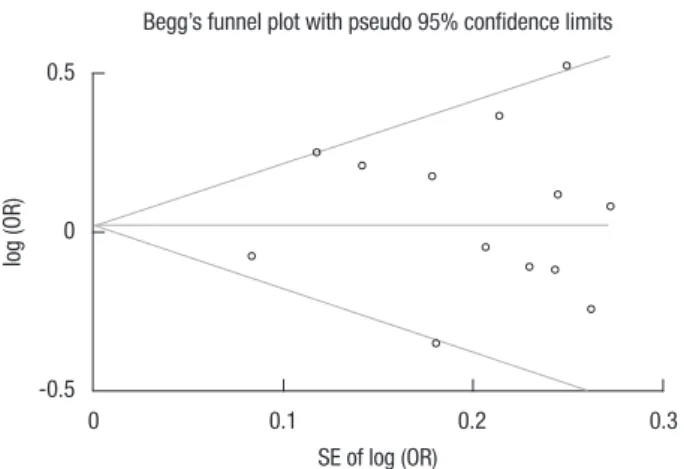
formed by sequential omission of individual studies under various contrasts. The significance of the pooled OR was not influenced excessively, indicating the reliability of the results of the meta-analysis. Begger’s funnel plots, in which the stan- dard error (SE) of the log (OR) of each study was plotted against its log (OR), were drawn to estimate potential publica- tion bias. An asymmetric plot suggested a possible publication bias; funnel plot asymmetry was assessed using Egger’s linear regression test, and p<0.05 was considered to be statistically significant [22]. The Begger’s funnel plot and Egger’s linear re- gression test were performed using Stata 12.0 software (Stata Corp., College Station, USA). All p-values generated were two-tailed.
RESULTS
Study characteristics
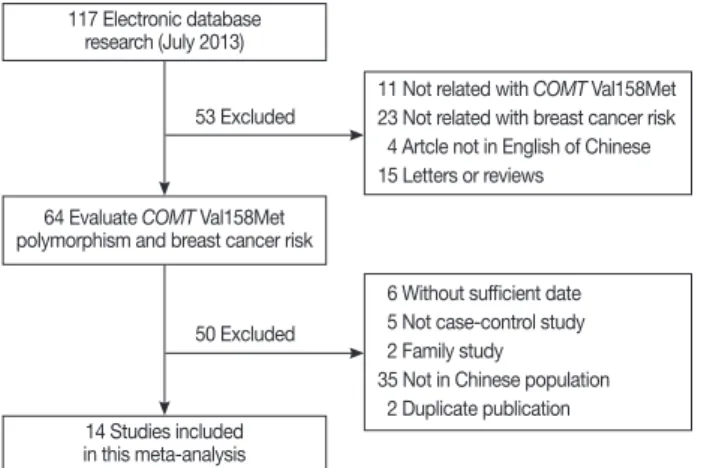
A total of 117 potentially relevant publications focusing on the COMT Val158Met polymorphism and breast cancer were retrieved using our search strategy. However, only 14 studies were ultimately included, in accordance with the established inclusion criteria. After reading the titles and/or abstracts, 101 studies lacked indispensable information or were not conduct- ed in Chinese population and were excluded. Of these, 53 arti- cles were excluded because they were irrelevant (34 articles), the language was not Chinese or English (4 articles), or they were letters or reviews (15 articles). Forty-eight articles were excluded because they were not case-control studies (5 arti- cles), not conducted in the Chinese population (35 articles), had insufficient data (6 articles) or were family-based studies (2 articles). Sixteen studies were subjected to a full text review, two of which were excluded due to duplication (1 study) and a lack of essential information (1 study). A flow chart summariz- ing study selection is shown in Figure 1. In total, 14 case-con- trol studies involving 4,626 breast cancer cases and 5,637 con- trols were included in the final meta-analysis [3,7-19]. Eleven studies were reported in English and three were reported in Chinese. Nine of the included studies were population-based studies, and five had a hospital-based design. Five publications were concerned with the COMT Val158Met polymorphism and premenopausal breast cancer cases, and six were con- cerned with the COMT Val158Met polymorphism and post- menopausal breast cancer cases. Detailed characteristics of the included studies are summarized in Table 1.
Table 1. Characteristics and genotype distribution of included studies in the meta-analysis
First author, year Region SC Genotyping method Menopausal status Genotypes distribution (case/control)
HWE test
A/A G/A G/G
Hu, 2007 [12] Shanghai PB Sequencing Pre-, post- 11/3 36/41 65/66 0.25
Cheng, 2005 [10] Taiwan HB SEQUENOM Mixed 35/58 197/262 237/420 0.06
Huang, 1999 [13] Taiwan HB PCR-RFLP Pre-, post- 12/4 35/55 66/65 0.06
Wang, 2010 [17] Sichuan PB AS-PCR Post- 34/14 62/66 80/96 0.58
Fan, 2007 [11] Tianjin HB PCR-RFLP Mixed 29/5 75/44 96/51 0.25
Wen, 2005 [18] Shanghai PB PCR-RFLP Pre-, post- 83/93 425/470 612/628 0.70
Shrubsole, 2009 [15] Shanghai PB PCR-RFLP Mixed 497/554* 596/615 NA
Lin SC, 2005 [14] Taiwan PB PCR-RFLP Mixed 6/23 35/138 58/205 0.97
Chang, 2006 [9] Taiwan HB PCR-RFLP Mixed 9/30 77/159 103/160 0.28
Lin WY, 2005 [3] Taiwan PB PCR-RFLP Mixed 5/18 31/133 51/190 0.39
Wang, 2011 [16] Sichuan PB Sequencing Pre-, post- 68/36 145/156 187/208 0.39
Wu, 2003 [19] Unknown PB TaqMan Mixed 14/15 67/78 97/106 0.90
Tan, 2003 [8] Beijing HB PCR-RFLP Pre-, post- 26/13 103/105 121/132 0.17
Xu, 2010 [7] Shandong PB AS-PCR Mixed 38/10 42/44 60/68 0.45
SC=source of control; HWE=Hardy-Weinberg equilibrium; PB=population-based; Pre-=premenopausal; Post-=postmenopausal; HB=hospital-based; PCR- RFLP=polymerase chain reaction-restriction fragment length polymorphism; AS-PCR=allele-specific-polymerase chain reaction; NA=not available.
*Number of A/A+G/A genotype in case and control, respectively.
117 Electronic database research (July 2013)
64 Evaluate COMT Val158Met polymorphism and breast cancer risk
11 Not related with COMT Val158Met 23 Not related with breast cancer risk 4 Artcle not in English of Chinese 15 Letters or reviews
6 Without sufficient date 5 Not case-control study 2 Family study
35 Not in Chinese population 2 Duplicate publication 14 Studies included
in this meta-analysis 53 Excluded
50 Excluded
Figure 1. Flow chart of study selection procedure.
COMT=catechol-O-methyltransferase.
Overall results of meta-analysis
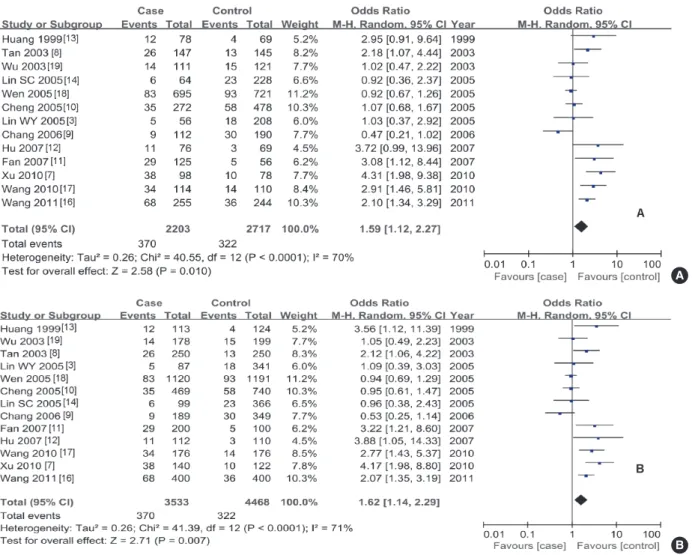
As shown in Table 2, significant evidence of heterogeneity was detected in four genetic models (ph<0.1), all except the additive model (ph=0.4), and the random-effects model was used to calculate the pooled OR, in all except the additive model. Overall, the results of the meta-analysis showed that the COMT Val158Met polymorphism (rs4680 G>A) was sig- nificantly associated with an increased risk of breast cancer in the Chinese population in three genetic models (A/A vs. G/G:
OR, 1.59, 95% CI, 1.12–2.27; A/A vs. G/A+G/G: OR, 1.62, 95% CI, 1.14–2.29; A vs. G: OR, 1.15, 95% CI, 1.00–1.32) (Ta- ble 2, Figure 2A, B). However, no significant association be- tween the COMT Val158Met polymorphism and the risk of breast cancer was observed in the dominant model or the ad- ditive model (A/A+G/A vs. G/G: OR, 1.04, 95% CI, 0.93–1.17;
G/A vs. G/G: OR, 0.98, 95% CI, 0.89–1.08, respectively). The results are shown in Table 2.
Results of subgroup analysis
According to the different menopausal status and sources of control, we also performed further subgroup analyses. In the
subgroup analysis based on menopausal status, the polymor- phism presented a significantly increased risk of breast cancer in a premenopausal group (A/A vs. G/G: OR, 1.87, 95% CI, 0.99–3.54; A/A vs. G/A+G/G: OR, 1.94, 95% CI, 1.03–3.63), but not in other genetic models. However, the postmenopaus- al group did not show a significantly increased risk of breast cancer in any model. The data were further stratified by the source of control, and the polymorphism only showed a sig- nificantly increased risk of breast cancer in population-based studies in the codominant model and the recessive model (A/
A vs. G/G: OR, 1.69, 95% CI, 1.06–2.69; A/A vs. G/A+G/G:
OR, 1.71, 95% CI, 1.10–2.66). Similarly, no significantly ele- vated risk of breast cancer was associated with this polymor- phism in hospital-based studies in any of the genetic models.
All the results are presented in Table 2.
Sensitivity analysis and publication bias
Since significant between-study heterogeneity was observed in the overall meta-analyses in some genetic models, we per- formed a sensitivity analysis by sequential omission of indi- vidual studies in an attempt to investigate the influence of Table 2. Meta-analysis of the COMT Val158Met polymorphism on breast cancer susceptibility in Chinese population
Contrast Study groups No. of studies OR (95% CI) p-value Heterogeneity
Effect model
Ph I2 (%)
A/A vs. G/G Overall 13 1.59 (1.12–2.27)* 0.01* <0.01 70 R
Pre- 5 1.87 (0.99–3.54)* 0.05* 0.04 60 R
Post- 6 1.71 (0.90–3.28) 0.10 0.01 65 R
PB 8 1.69 (1.06–2.69)* 0.03* <0.01 73 R
HB 5 1.47 (0.77–2.80) 0.24 <0.01 71 R
G/A vs. G/G Overall 13 0.98 (0.89–1.08) 0.70 0.40 5 F
Pre- 5 0.91 (0.77–1.08) 0.29 1.00 0 F
Post- 6 0.96 (0.80–1.16) 0.70 0.57 0 F
PB 8 0.95 (0.85–1.08) 0.45 0.98 0 F
HB 5 0.95 (0.72–1.25) 0.70 0.03 62 R
A vs. G Overall 13 1.15 (1.00–1.32)* 0.05* <0.01 69 R
Pre- 5 1.07 (0.95–1.22) 0.27 0.15 41 F
Post- 6 1.23 (0.09–1.51) 0.06 0.08 50 R
PB 8 1.20 (0.98–1.47) 0.08 <0.01 75 R
HB 5 1.08 (0.88–1.33) 0.46 0.03 61 R
A/A+G/A vs. G/G Overall 14 1.04 (0.93–1.17) 0.48 0.06 40 R
Pre- 5 1.00 (0.85–1.17) 0.98 0.71 0 F
Post- 6 1.10 (0.93–1.31) 0.27 0.23 28 F
PB 9 1.00 (0.91–1.10) 0.97 0.17 32 F
HB 5 1.02 (0.79–1.31) 0.89 0.05 58 R
A/A vs. G/A+G/G Overall 13 1.62 (1.14–2.29)* <0.01* <0.01 71 R
Pre- 5 1.94 (1.03–3.63)* 0.04* 0.03 62 R
A/A vs. G/A+G/G Post- 6 1.75 (0.90–3.38) 0.10 <0.01 69 R
PB 8 1.71 (1.10–2.66)* 0.02* <0.01 72 R
HB 5 1.51 (0.79–2.92) 0.22 <0.01 74 R
COMT=catechol-O-methyltransferase; OR=odds ratio; CI=confidence interval; Ph= p-value for heterogeneity; I2=quantitative estimate for heteroge- neity; Pre-=premenopausal; Post-=postmenopausal; PB=population-based; HB=hospital-based; R=random effects model; F=fixed effects model.
*The values indicates a significant difference.
each study on the overall OR. As a result, the significance of the pooled OR in all genetic models was not affected exces- sively, with the exception of the allele contrast model. We found a slight fluctuation of the p-value around 0.05 indicat- ing a significant association of A versus G with the risk of breast cancer in the sensitivity analysis, the result of which is shown in Table 3. Nevertheless, a significant association of this polymorphism with the risk of breast cancer was suggest- ed by most results of sequential omission in the sensitivity analysis. Publication bias of the literature on the association between the COMT Val158Met polymorphism (rs4680 G>
A) and the risk of breast cancer was assessed by Begger’s fun- nel plot and Egger’s linear regression test. The graphical funnel plot shown in Figure 3 seemed symmetrical, suggesting no evident publication bias; this was also supported by the results of Egger’s test (A/A+G/A vs. G/G, p=0.44; A vs. G, p=0.284;
G/A vs. G/G, p=0.362; A/A vs. G/A+G/G, p=0.129; A/A vs.
A
B Figure 2. Forest plots for the association of catechol-O-methyltransferase Val158Met polymorphism with breast cancer risk in Chinese population. (A) A significant association was observed under A/A versus G/G contrast. (B) A significant association was observed under A/A versus G/A+G/G contrast.
CI=confidence interval.
Table 3. Sensitivity analysis by sequential omission Study omitted A vs. G model
Effect model p-value OR (95% CI)
Huang, 1999 [13] 0.05 1.16 (1.00–1.34) R
Tan, 2003 [8] 0.09 1.14 (0.98–1.33) R
Wu, 2003 [19] 0.04 1.17 (1.00–1.35) R
Lin WY, 2005 [3] 0.04 1.17 (1.01–1.35) R Cheng, 2005 [10] 0.08 1.15 (0.98–1.35) R Wen, 2005 [18] 0.03 1.18 (1.02–1.37) R Lin SC, 2005 [14] 0.04 1.17 (1.01–1.35) R Chang, 2006 [9] <0.01 1.19 (1.04–1.37) R
Hu, 2007 [12] 0.07 1.14 (0.99–1.32) R
Fan, 2007 [11] 0.08 1.14 (0.98–1.32) R
Xu, 2010 [7] 0.13 1.10 (0.97–1.25) R
Wang, 2010 [17] 0.12 1.12 (0.97–1.29) R Wang, 2011 [16] 0.10 1.13 (0.97–1.31) R OR=odds ratio; CI=confidence interval; R=random effects model.
G/G, p=0.165, all p>0.05).
DISCUSSION
The present meta-analysis assessing the association between the COMT Val158Met polymorphism (rs4680 G>A) and the risk of breast cancer in the Chinese population was based on data from all available studies published to date, representing the largest study so far. Our results suggest that the COMT Val158Met polymorphism (rs4680 G>A) is significantly as- sociated with an increased risk of breast cancer in the Chinese population, particularly in premenopausal women.
The preponderance of data from epidemiological and ani- mal studies indicates that estrogen signaling is central in breast carcinogenesis. The levels of estrogen are partially regu- lated by its catabolism. However, the participation of the genes involved in estrogen catabolism in carcinogenesis and the ex- tent to which estrogen exposure modifies the associations of these genes with the risk of breast cancer require further in- vestigation. Several molecular epidemiologic studies conduct- ed worldwide have reported the potential role of the function- al polymorphism, COMT Val158Met (rs4680 G>A), in deter- mining the risk of breast cancer. An amino acid substitution yielded by a single G to A base pair change in the COMT gene is believed to result in a 2- to 3-fold decrease in the enzymatic activity of COMT, which was suggested to contribute to the susceptibility of breast cancer through its role in estrogen sig- naling [20,26,27]. To date, although many epidemiological studies conducted in the overall population have evaluated the association of the COMT Val158Met polymorphism with breast cancer, the results remain inconsistent; some original
studies conducted in the Chinese population demonstrated an association between the COMT Val158Met polymorphism and the risk of breast cancer [8,10,13], whereas others report- ed contrasting results [3,17,18]. We undertook the present meta-analysis to achieve a more precise estimation of the as- sociation between the COMT Val158Met polymorphism and the risk of breast cancer in the Chinese population. To our knowledge, this is the most comprehensive meta-analysis with the largest sample size focusing on the COMT Val158Met polymorphism (rs4680 G>A) and the risk of breast cancer in the Chinese population.
Previous epidemiological studies conducted in the Chinese population obtained discrepant results. Huang et al. [13] and Cheng et al. [10] found a trend toward an increasing risk for developing breast cancer in women who harbored low-activ- ity COMT (COMT L/L or A/A) genotypes. Similarly, a study by Tan et al. [8] showed that the elevated risk of breast cancer associated with the COMT A/A genotype was only evident among premenopausal women, but not among postmeno- pausal women. In contrast, Wang et al. [17] suggested that postmenopausal women carrying the COMT A/A genotype may possess a higher risk of breast cancer. However, Lin et al.
[3] and Wen et al. [18] found no overall association between the COMT genotype and individual susceptibility to breast cancer.
In the current meta-analysis, we found evidence of a signifi- cant association between the COMT Val158Met polymor- phism and the risk of breast cancer in the Chinese population on the overall analysis of 14 case-control studies involving 4,626 cases and 5,637 controls. In line with most individual studies conducted in the Chinese population, a significant as- sociation between the COMT Val158Met polymorphism (rs4680 G>A) and the risk of breast cancer was found in sev- eral genetic models (A/A vs. G/G: OR, 1.59, 95% CI, 1.12–
2.27; A/A vs. G/A+G/G: OR, 1.62, 95% CI, 1.14–2.29; A vs. G:
OR, 1.15, 95% CI, 1.00–1.32), suggesting a contribution of the COMT Val158Met variant genotype to an increased risk of breast cancer in the Chinese population. Furthermore, sub- group analysis based on menopausal status and the source of control showed that the variant genotype was also significant- ly associated with an elevated risk of breast cancer in pre- menopausal cases (A/A vs. G/G: OR, 1.87, 95% CI, 0.99–3.54;
A/A vs. G/A+G/G: OR, 1.94, 95% CI, 1.03–3.63) and in pop- ulation-based studies (A/A vs. G/G: OR, 1.69, 95% CI, 1.06–
2.69; A/A vs. G/A+G/G: OR, 1.71, 95% CI, 1.10–2.66). How- ever, the results of present meta-analysis were not in accord- ance with previous analyses. He et al. [20] and Ding et al. [21]
reported a decreased risk of breast cancer among European populations in the recessive model, with borderline signifi-
log (OR)
0 0.1 0.2 0.3 SE of log (OR)
Begg’s funnel plot with pseudo 95% confidence limits 0.5
0
-0.5
Figure 3. Begger’s funnel plot of the overall analysis of breast cancer risk and catechol-O-methyltransferase Val158Met polymorphism in Chi- nese population revealed no evident publication bias under A/A+G/A versus G/G contrast.
SE=standard error; OR=odds ratio.
cance (OR, 0.96, 95% CI, 0.92–1.00; OR, 0.90, 95% CI, 0.90–
1.00, respectively), but not in Asians. In contrast, the studies conducted by Qin et al. [2] and Mao et al. [22] both demon- strated no association between the COMT Val158Met poly- morphism and the risk of breast cancer in an overall analysis and in subgroup analysis according to ethnicity, menopausal status, or control source. Moreover, although He et al. [20]
performed a more comprehensive analysis compared to pre- vious reports, several more recent studies conducted in the Chinese population with larger sample sizes involving 2,006 cases and 2,018 controls have been reported since that study;
these studies also failed to show any association in Asians (only 2,674 cases and 3,619 controls in the Chinese popula- tion, as well as 1,609 cases and 1,580 controls in other Asian populations), indicating that sample size or geographical vari- ation were possible influences on the assessment of this asso- ciation. Additionally, in premenopausal women, we found that the COMT Val158Met polymorphism was significantly associated with an increased risk of breast cancer in the Chi- nese population; this may be due to the interaction between the COMT polymorphism and menopausal status, which may play a critical role in catechol estrogen metabolism in breast cancer etiology, depending on the levels of circulating estro- gens. Therefore, in a higher estrogen environment, such as that typically observed in premenopausal women, the pres- ence of higher circulating levels of the catechol compounds of estradiol generated in an environment with low COMT activ- ity may result in higher circulating levels of potentially muta- genic compounds, such as estrogens, leading to a relatively high risk of breast cancer in premenopausal women. These results were, at least in part, different from those of previously published studies, and this mechanism may account for these disparities. First, the discrepancies indicated that sample size was likely significant for the assessment regarding the associa- tion between the COMT Val158Met polymorphism and the risk of breast cancer. Second, the same polymorphism played different roles in breast cancer susceptibility among different regions or ethnic populations; since cancer is a complicated, multigenetic disease, diverse genetic backgrounds and envi- ronmental exposures may result in different influences on the risk of breast cancer through gene-gene and gene-environ- ment interactions [28]. In the stratification analysis based on control source, we found a borderline significant increase in the risk of breast cancer among studies using population- based controls but not in those using hospital-based controls.
The reason behind this difference may be that the controls were retrieved from an ill-defined reference population asso- ciated with the genotype investigated under the disease condi- tion. Therefore, using a suitable and representative control
population may contribute to a more reliable and robust re- sult. Furthermore, heterogeneity is a potential problem that may affect the interpretation of the results. Obvious between- study heterogeneity was found in the overall comparison of this meta-analysis. However, the observed heterogeneity was not significantly reduced by subgroup analysis, suggesting a possibility that other limitations may partially contribute to the observed heterogeneity.
Despite the considerable efforts to explore the possible asso- ciation between the COMT Val158Met polymorphism (rs4680 G>A) and the risk of breast cancer, some limitations need to be addressed when interpreting the results of this meta-analy- sis. First, the association of the COMT Val158Met polymor- phism with the risk of breast cancer has been reported to be modified by related factors such as the consumption of soy isoflavones, consumption of green tea, duration from men- arche to the first full-term pregnancy, and body mass index.
Because of a lack of necessary data, the use of unadjusted esti- mates was unavoidable in this meta-analysis. Second, poten- tial interactions of other important genes with COMT in simi- lar biological pathways involved in the risk of breast cancer were not assessed because of the lack of original data. Third, the controls were not defined uniformly, and therefore, non- differential misclassification was possible.
In summary, our meta-analysis demonstrated that the COMT Val158Met polymorphism (rs4680 G>A) was signifi- cantly associated with an increased risk of breast cancer, par- ticularly among premenopausal women, in the Chinese popu- lation. In order to verify our findings, the interaction of estro- gen metabolism-related factors and genes in similar biological pathways in the development of breast cancer with COMT should be evaluated for their influence on the susceptibility to breast cancer in additional well-designed studies with a larger sample size and an adequate methodological quality to prop- erly control for possible confounding factors.
CONFLICT OF INTEREST
The authors declare that they have no competing interests.
REFERENCES
1. Wang YC, Wei LJ, Liu JT, Li SX, Wang QS. Comparison of cancer inci- dence between China and the USA. Cancer Biol Med 2012;9:128-32.
2. Qin X, Peng Q, Qin A, Chen Z, Lin L, Deng Y, et al. Association of COMT Val158Met polymorphism and breast cancer risk: an updated meta-analysis. Diagn Pathol 2012;7:136.
3. Lin WY, Chou YC, Wu MH, Jeng YL, Huang HB, You SL, et al. Poly- morphic catechol-O-methyltransferase gene, duration of estrogen ex- posure, and breast cancer risk: a nested case-control study in Taiwan.
Cancer Detect Prev 2005;29:427-32.
4. Lajin B, Hamzeh AR, Ghabreau L, Mohamed A, Al Moustafa AE, Alachkar A. Catechol-O-methyltransferase Val 108/158 Met polymor- phism and breast cancer risk: a case control study in Syria. Breast Cancer 2013;20:62-6.
5. Wen W, Ren Z, Shu XO, Cai Q, Ye C, Gao YT, et al. Expression of cyto- chrome P450 1B1 and catechol-O-methyltransferase in breast tissue and their associations with breast cancer risk. Cancer Epidemiol Bio- markers Prev 2007;16:917-20.
6. Yager JD. Catechol-O-methyltransferase: characteristics, polymor- phisms and role in breast cancer. Drug Discov Today Dis Mech 2012;
9:e41-46.
7. Xu YJ, Ge YL, Zhang JY, Li FN, Zheng Z. Polymorphism of COMT, p21 and NuMA in sporadic breast cancer. Chin J Clin 2010;4:591-6.
8. Tan W, Qi J, Xing DY, Miao XP, Pan KF, Zhang L, et al. Relation between single nucleotide polymorphism in estrogen-metabolizing genes COMT, CYP17 and breast cancer risk among Chinese women. Zhong- hua Zhong Liu Za Zhi 2003;25:453-6.
9. Chang TW, Wang SM, Guo YL, Tsai PC, Huang CJ, Huang W. Glutathi- one S-transferase polymorphisms associated with risk of breast cancer in southern Taiwan. Breast 2006;15:754-61.
10. Cheng TC, Chen ST, Huang CS, Fu YP, Yu JC, Cheng CW, et al. Breast cancer risk associated with genotype polymorphism of the catechol es- trogen-metabolizing genes: a multigenic study on cancer susceptibility.
Int J Cancer 2005;113:345-53.
11. Fan Y, Feng Y, Wang L, Wang Y, Fu L. The relationship between cate- chol-O-methyltransferase (COMT) polymorphisms and the develop- ment of breast cancer. Chin J Clin Oncol 2007;34:430-3.
12. Hu Z, Song CG, Lu JS, Luo JM, Shen ZZ, Huang W, et al. A multigenic study on breast cancer risk associated with genetic polymorphisms of ER Alpha, COMT and CYP19 gene in BRCA1/BRCA2 negative Shanghai women with early onset breast cancer or affected relatives. J Cancer Res Clin Oncol 2007;133:969-78.
13. Huang CS, Chern HD, Chang KJ, Cheng CW, Hsu SM, Shen CY. Breast cancer risk associated with genotype polymorphism of the estrogen- metabolizing genes CYP17, CYP1A1, and COMT: a multigenic study on cancer susceptibility. Cancer Res 1999;59:4870-5.
14. Lin SC, Chou YC, Wu MH, Wu CC, Lin WY, Yu CP, et al. Genetic vari- ants of myeloperoxidase and catechol-O-methyltransferase and breast cancer risk. Eur J Cancer Prev 2005;14:257-61.
15. Shrubsole MJ, Lu W, Chen Z, Shu XO, Zheng Y, Dai Q, et al. Drinking green tea modestly reduces breast cancer risk. J Nutr 2009;139:310-6.
16. Wang Q, Li H, Tao P, Wang YP, Yuan P, Yang CX, et al. Soy isoflavones, CYP1A1, CYP1B1, and COMT polymorphisms, and breast cancer: a case-control study in southwestern China. DNA Cell Biol 2011;30:585- 95.
17. Wang Q, Wang YP, Li JY, Yuan P, Yang F, Li H. Polymorphic catechol-O- methyltransferase gene, soy isoflavone intake and breast cancer in post- menopausal women: a case-control study. Chin J Cancer 2010;29:683-8.
18. Wen W, Cai Q, Shu XO, Cheng JR, Parl F, Pierce L, et al. Cytochrome P450 1B1 and catechol-O-methyltransferase genetic polymorphisms and breast cancer risk in Chinese women: results from the shanghai breast cancer study and a meta-analysis. Cancer Epidemiol Biomarkers Prev 2005;14:329-35.
19. Wu AH, Tseng CC, Van Den Berg D, Yu MC. Tea intake, COMT geno- type, and breast cancer in Asian-American women. Cancer Res 2003;
63:7526-9.
20. He XF, Wei W, Li SX, Su J, Zhang Y, Ye XH, et al. Association between the COMT Val158Met polymorphism and breast cancer risk: a meta- analysis of 30,199 cases and 38,922 controls. Mol Biol Rep 2012;39:
6811-23.
21. Ding H, Fu Y, Chen W, Wang Z. COMT Val158Met polymorphism and breast cancer risk: evidence from 26 case-control studies. Breast Cancer Res Treat 2010;123:265-70.
22. Mao C, Wang XW, Qiu LX, Liao RY, Ding H, Chen Q. Lack of associa- tion between catechol-O-methyltransferase Val108/158Met polymor- phism and breast cancer risk: a meta-analysis of 25,627 cases and 34,222 controls. Breast Cancer Res Treat 2010;121:719-25.
23. Higgins JP, Thompson SG, Deeks JJ, Altman DG. Measuring inconsis- tency in meta-analyses. BMJ 2003;327:557-60.
24. DerSimonian R, Laird N. Meta-analysis in clinical trials. Control Clin Trials 1986;7:177-88.
25. Mantel N, Haenszel W. Statistical aspects of the analysis of data from retrospective studies of disease. J Natl Cancer Inst 1959;22:719-48.
26. Goodman JE, Jensen LT, He P, Yager JD. Characterization of human soluble high and low activity catechol-O-methyltransferase catalyzed catechol estrogen methylation. Pharmacogenetics 2002;12:517-28.
27. Dawling S, Roodi N, Mernaugh RL, Wang X, Parl FF. Catechol-O- methyltransferase (COMT)-mediated metabolism of catechol estro- gens: comparison of wild-type and variant COMT isoforms. Cancer Res 2001;61:6716-22.
28. Srivastava K, Srivastava A. Comprehensive review of genetic associa- tion studies and meta-analyses on miRNA polymorphisms and cancer risk. PLoS One 2012;7:e50966.