237
책임저자 : 박정수, 서울시 서대문구 성산로 250번지
120-752, 연세대학교 의과대학 외과학교실 Tel: 02-2228-2100, Fax: 02-313-8289
E-mail: [email protected] 게재승인일:2007년 12월 20일
갑상선 수술의 해부학적 지표로서의 Zuckerkandl 결절의 중요성
성균관대학교 의과대학 강북삼성병원 외과학교실, 1연세대학교 의과대학 외과학교실 및 내분비연구소
윤지섭ㆍ정종주1ㆍ이용상1ㆍ남기현1ㆍ정웅윤1ㆍ장항석1ㆍ박정수1
The Zuckerkandl’s Tubercle is a Useful Anatomi- cal Landmark for the Detection of Both the Recurrent Laryngeal Nerve and the Superior Parathyroid during Thyroid Surgery
Ji-Sup Yun, M.D., Jong Ju Jeong, M.D.
1, Yong SangLee, M.D.
1, Kee Hyun Nam, M.D.1, Woong Youn Chung, M.D.1, Hang Seok Chang, M.D.1 and Cheong Soo Park, M.D.1Purpose: Zuckerkandl’s tubercle (ZT) of the thyroid gland
is a well-documented anatomical structure. This study eval- uated the anatomical relationship of the ZT in terms of the recurrent laryngeal nerve (RLN) and the superior para- thyroid gland (SP).Methods: The study included 325 patients (ten patients with
benign tumors and 315 patients with malignancies) who un- derwent thyroid surgery between February and June 2007.Tubercles were classified according to size: Grade 0 (unrecognizable), Grade I (≤ 5 mm), Grade II (6∼10 mm) and Grade III (>10 mm). The incidence and size of the ZT and its positional relationship to the RLN and SP were investigated during thyroid surgery.
Results: ZTs were identified in most patients (right thyroid
89.3%, left thyroid 85.6%). The percentageof tubercles ac- cording to grade and location was as follows: Grade 0, right thyroid 10.7% and left thyroid 14.4%; Grade I, right thyroid 7.9% and left thyroid 11.1%; Grade II, right thyroid 43.5%and left thyroid 38.5%; Grade III, right thyroid 37.9% and left thyroid 35.9%. The most common RLN course was in a groove between the ZT and the main body of the thyroid.
Most of the SPs are situated cranial to the ZTs and were located at the 1 or 2 o’clock position (96.1%) in the left thyroid and at the 10 or 11 o’clock position (95.2%) in the right thyroid. A greater distance between the ZT and the SP was seen with a decreasing size of the ZT.
Conclusion: The ZT was identified during most thyroidec-
tomies, and there was a constant relationship between the ZT and either the RLN or SP. Therefore, identification of the ZT and an understanding of the relationship between the ZT and either the RLN or SP are essential for the per- formance of safe thyroid surgery. (Korean J Endocrine Surg
2007;7:237-241)
Key Words: Zuckerkandl’s tubercle, Recurrent laryngeal
nerve, Superior parathyroid, Anatomical land- mark중심 단어:Zuckerkandl 결절, 되돌이후두신경, 상부 갑상선, 해부학적 지표
Department of Surgery, Kangbuk Samsung Hospital, Sungkyunkwan University School of Medicine, 1Yonsei University College of Medicine, Seoul, Korea
서 론
Zuckerkandl 결절(Zuckerkandl’s tubercle, ZT)은 1902년 Zuckerkandl(1)에 의해 명명된 해부학적 구조로, 갑상선의 측면 경계에서 외측 후방으로 가장 돌출된 부위이다. 이보 다 앞서 1867년 Madelung(2)은 “posterior horn of the thy- roid”라는 표현으로 ZT에 대해 최초로 기술하였다. 1938년 Gilmour(3)는 ZT와 되돌이후두신경(recurrent laryngeal nerve, RLN), 상부갑상선(superior parathyroid, SP) 간의 해부 학적 연관성에 대해 보고했으나, 최근까지 갑상선 절제술 시 되돌이후두신경을 보존하기 위한 해부학적 지표로서 ZT를 이용할 수 있다는 발표는 소수에서만 있어 왔다.(4-9) 일부에서는 되돌이후두신경의 고식적 확인이 반드시 필요 하다고 주장하기도 한다.(10) 이렇게 ZT와 되돌이후두신경 의 관계에 대한 보고는 계속 있어왔지만, 현재까지 ZT와 상 부갑상선의 해부학적 관계를 세부적으로 분류한 보고는 전 무한 실정이다. 이에 저자들은 ZT의 해부학적 특징을 살펴 보고, 특히 되돌이후두신경과 상부갑상선과의 관계를 저자 들이 제시하는 분류방법으로 나누어 조사하여 갑상선 수술 시 해부학적 지표로서 의의가 있는지 알아보고자 하였다.
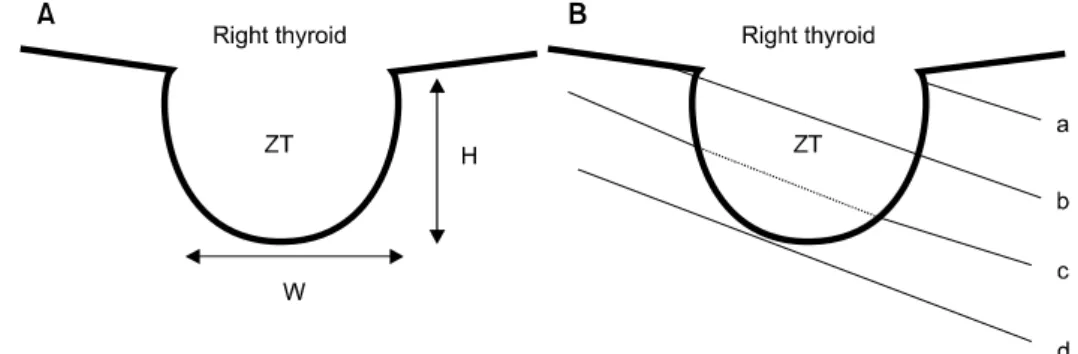
Fig. 1. The measurement of ZT size (A) and classification of relationship between the ZT and the RLN (B). H = height; W = width;
a = Type A (posterior surface of the ZT); b = Type B (anterior surface of the ZT); c = Type C (passes through parenchyma of the ZT); D = Type D (lateral to the ZT).
Fig. 2. Clock-face location of the SP (4 cases behind the ZT (Right, 2; Left, 2) and 1 case on the anterior surface of the ZT (Right) were excluded from this figure).
Table 1. Grade of ZT Grade (%)
P value
0 I II III
Right 30 22 122 106
(n=280) (10.7) (7.9) (43.5) (37.9)
0.127
Left 39 30 104 97
(n=270) (14.4) (11.1) (38.5) (35.9)
방 법 1) 연구대상
2007년 2월부터 2007년 7월까지 6개월간 연세대학교 의 과대학 세브란스 병원 갑상선암 전문 클리닉에서 외과적 갑상선 질환으로 단일 외과의에게 수술 받은 325명의 환자 들을 대상으로 연구를 진행하였다.
2) 연구 방법
수술 중 ZT의 유무, 크기 및 되돌이후두신경과 상부갑상 선과의 관계를 조사하였다. ZT가 확인된 경우는 양극성 전 기소작기(bipolar electrocautery)를 이용해 섬세하게 피막을 박리하여 ZT를 노출시켰다. 노출된 ZT의 크기는 넓이, 높 이를 측정하였고, Grade는 Pelizzo 등(4)이 분류한 방법과 같 이 0∼III (0: unrecognizable, I: ≤5 mm, II: 6∼10 mm, III:
>10 mm)으로 분류하였다. 되돌이후두신경은 ZT 부위에서 의 주행 경로를 구분했다(Type A: posterior surface of ZT,
Type B: anterior surface of ZT, Type C: pass through paren- chyma of ZT, Type D: lateral of ZT) (Fig. 1). 특히 Type D의 경우는 ZT의 꼭지점과 근접한 경우를 D1으로, 꼭지점과 떨 어진 경우를 D2로 구분하였다.
상부갑상선은 ZT에서 시계방향 상의 위치 및 간격을 측 정하였다(Fig. 2). ZT 자체 또는 근처에 종괴가 있거나 갑상 선 종괴의 크기가 커서 ZT 측정이 힘든 경우, 만성 갑상선 염이 심한 경우, 그리고 갑상선의 소결절형성(nodularity)이 있는 경우는 측정 대상에서 제외하였다.
통계학적 분석은 SPSS 12.0 (2003 SPSS Inc. Chicago, Illinois, U.S.A.)을 이용하여 처리하였으며, 비교 군 간의 분 석은 Chi-square test 및 independent sample’s t-test를 사용하 였다. P값 0.05 미만을 유의 수준으로 하였다.
결 과
1) 임상적 특성 및 ZT의 해부학적 특징
대상 환자 325예의 남녀 비는 1:6.9 (41:284), 평균 연령 은 47.0세(범위, 17∼71세)였다. 질환 별로는 갑상선 양성 종 양 10예, 갑상선암 315예였으며, 갑상선 절제 범위는 전절 제술 251예, 일엽절제술 74예(좌측 33예, 우측 41예)였다.
ZT는 측정 배제 조건에 부합하는 경우를 제외하면 좌측 95.1% (270/284), 우측 96.0% (280/292)에서 관찰되었고, 이 중 좌우 전부 관찰된 경우는 91.2% (229/251)였다. 평균 크
Table 2. Type of RLN Type (%)
P value
A B C D1 D2
Right 232 1 0 12 5
(n=250) (92.8) (0.4) (4.8) (2.0)
0.787
Left 210 1 0 12 8
(n=231) (90.9) (0.4) (5.2) (3.5)
Table 3. Relationship between the ZT and RLN ZT height
≤5 mm 6∼10 mm >10 mm
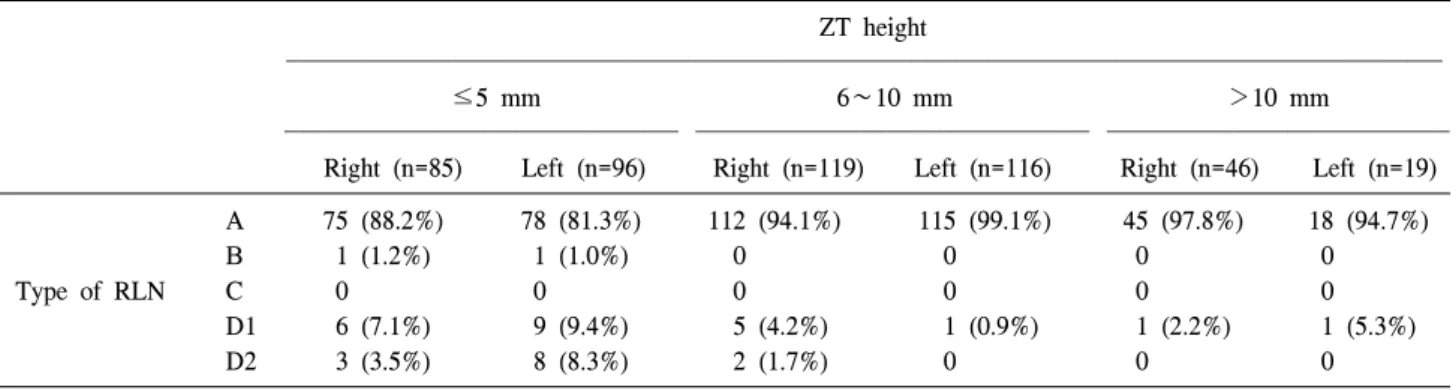
Right (n=85) Left (n=96) Right (n=119) Left (n=116) Right (n=46) Left (n=19) A 75 (88.2%) 78 (81.3%) 112 (94.1%) 115 (99.1%) 45 (97.8%) 18 (94.7%)
B 1 (1.2%) 1 (1.0%) 0 0 0 0
Type of RLN C 0 0 0 0 0 0
D1 6 (7.1%) 9 (9.4%) 5 (4.2%) 1 (0.9%) 1 (2.2%) 1 (5.3%)
D2 3 (3.5%) 8 (8.3%) 2 (1.7%) 0 0 0
Table 4. Distance between the ZT and the SP Distance (%)
P value
0 mm <5 mm ≥5 mm
Rt. (n=250) 219 (87.6) 26 (10.4) 5 (2.0) 0.483 Lt. (n=231) 206 (89.2) 19 (8.2) 6 (2.6)
Table 5. Relationship between the ZT and the SP ZT width
≤5 mm 6∼10 mm >10 mm
Right (n=21) Left (n=30) Right (n=123) Left (n=104) Right (n=106) Left (n=97)
0 11 (52.4%) 14 (46.7%) 109 (88.6%) 99 (95.2%) 100 (94.4%) 92 (94.8%)
Distance <5 mm 9 (42.8%) 10 (33.3%) 11 (9.0%) 4 (3.9%) 5 (4.7%) 5 (5.2%)
≥5 mm 1 (4.8%) 6 (20.0%) 3 (2.4%) 1 (0.9%) 1 (0.9%) 0 기는 좌측 8.5×5.7 mm, 우측 9.5×6.8 mm였다. ZT Grade는
좌측이 Grade 0 14.4% (39/270), Grade I 11.1% (30/270), Grade II 38.5% (104/270), Grade III 35.9% (97/270)였고, 우측 은 Grade 0 10.7% (30/280), Grade I 7.9% (22/280), Grade II 43.5% (122/280), Grade III 37.9% (106/280)였다. Grade 별로 좌, 우측을 비교했을 때 통계학적인 차이는 없었다(Table 1).
2) ZT와 되돌이후두신경의 관계
RLN의 주행 경로는 ZT Grade 0을 제외하고 좌측 Type A, 90.9% (210/231); Type B, 0.4% (1/231); Type C, 0% (0/
231); Type D1, 5.2% (12/231); Type D2, 3.5% (8/231)였고, 우측은 Type A, 92.8% (232/250); Type B, 0.4% (1/250); Type C, 0% (0/250); Type D1, 4.8% (12/250); Type D2, 2.0%
(5/250)로 좌, 우측의 차이는 없었다(Table 2). ZT의 높이에 따른 되돌이후두신경의 주행 경로를 비교해 보면 ZT의 높
이가 낮을수록 Type D가 많았음을 알 수 있었다(P<0.001) (Table 3).
3) ZT와 상부갑상선의 관계
Grade I 이상의 ZT를 기준으로 좌측 상부갑상선의 위치는 기관식도고랑(tracheoesophageal groove)을 축으로 했을 때 1 시 방향이 13.4% (31/231), 2시 방향 82.7% (191/231), 3시 방 향 3.0% (7/231)였고, 2예(0.9%)는 ZT 후면으로 숨어 있었 다. 우측은 8시 방향이 0.8% (2/250), 9시 방향 2.8% (7/250), 10시 방향 81.6% (204/250), 11시 방향 13.6% (34/250)예였 고, 2예(0.8%)는 ZT 후면에서, 1예(0.4%)는 ZT 전면에서 관 찰되었다(Fig. 2). 상부갑상선과 ZT의 간격은 좌우 각각 89.2% (206/231), 87.6% (219/250)에서 ZT와 붙어있었고, 5 mm 미만 떨어진 경우는 8.2% (19/231), 10.4% (26/250), 5 mm 이상 떨어진 경우는 2.6% (6/231), 2.0% (5/250)로 좌, 우측의 차이는 없었다(Table 4). ZT의 너비에 따른 상부갑상 선과의 간격을 비교해 보면 ZT의 너비가 좁을수록 많이 떨
Table 6. Incidences of Zuckerkandl’s tubercle (n: sides)
Pelizzo et al.4 Hisham and Aina22 Yacin et al.9 Present study
Grade 0 24/104 (23%) 19/96 (19.8%) 11/80 (13.8%) 69/550 (12.5%)
Grade I 9/104 (8.6%) . 17/80 (21.2%) 52/550 (9.5%)
Grade II 56/104 (53.8%) 24/96 (25.0%) 42/80 (52.5%) 226/550 (41.1%)
Grade III 15/104 (14.4%) 53/96 (55.2%) 10/80 (12.5%) 203/550 (36.9%)
어져 있었음을 알 수 있었다(P<0.001) (Table 5).
고 찰
갑상선 수술 시 되돌이후두신경과 부갑상선의 보존은 내 분비외과의사의 주된 관심사이다. 수술 중 이 구조물의 손 상이 초래된다면 추가적인 치료나 영구적 장애 때문에 환 자의 삶의 질이 낮아지게 된다.(11) 그러므로, 안전한 갑상 선 수술을 위해서는 갑상선 주변의 정상 해부학 및 해부학 적 변이에 대한 충분한 이해가 필요하다.
갑상선은 발생학적으로 중앙원기(median anlage)와 측면 원기(lateral anlage)에서 기원한다. 중앙원기는 여포세포(fol- licular cell)로 구성되며 후두 부위의 설근(base of tongue)에 위치한 맹공(foramen cecum)의 상피세포에서 기원하여 경 부 중앙을 따라 하강하여 성인 갑상선의 양측엽의 대부분 을 차지하는 중앙 갑상선(median thyroid)을 형성하게 된 다.(12) 측면원기는 4번 또는 5번 새열(branchial cleft)에서 양측성으로 기원하여 종새체(ultimobranchial body)를 형성 하며 태생 5주 경 중앙 갑상선과 경부에서 융합된다.(13) 이 때 종새체는 갑상선의 측후방에 위치해서 측부 갑상선 (lateral thyroid)을 형성하게 되는데, 갑상선 전체 무게의 1∼
30%를 차지하며 신경 능선(neural crest)에서 기원한 여포곁 C 세포(parafollicular C cell)로 구성된다.(14) 이렇게 형성된 측부 갑상선이 ZT이다.
경부의 되돌이후두신경은 기도앞 근막 밑에 위치하고 두 측(cephalad)을 향해 주행한다. 가슴문(thoracic inlet) 근처 경 동맥 내측에서 출현하여 ZT와 갑상선 사이의 고랑(groove) 을 지나 베리인대(ligament of Berry) 외측을 통과하여 윤상 인두근(cricopharyngeal muscle) 아래에서 후두로 이행한 다.(6) 갑상선 수술 시 되돌이후두신경 손상을 최소화하기 위해 전통적으로 경부의 되돌이 후두 신경 전체를 박리하 여 노출시키는 방법이 적용되고 있다.(15,16) 그러나, 신경 주변의 과도한 박리는 신경 주변 혈관(vasa nervorum)을 차 단하여 일시적 신경기능 이상(neuropraxia)을 초래하기도 한 다.(7) 많은 연구자들은 수술 중 되돌이후두신경을 보존하 기 위한 해부학적 지표로 Simon’s triangle을 이용하기 위해 하갑상선동맥, 베리인대, 갑상연골, ZT 등과의 관계를 보고 해 왔다.(4,5,11,17-20) 그러나, ZT에 관한 보고는 소수에서 만 있어 왔고 되돌이후두신경과의 관계에 대한 자세한 분
류는 없었기에 본 저자들은 ZT 부위에서의 되돌이후두신 경의 주행 경로를 Fig. 1과 같이 분류하였다.
상부갑상선은 종새체와 발생학적으로 인접하여 4번 새 열에서 기원하므로, ZT와 상부갑상선도 일정한 해부학적 연관성을 갖는다.(4) Chevallier 등(21)은 부갑상선의 보존을 위한 해부학적 지표로 ZT를 강조했다. SP는 일반적으로 ZT 의 두측(cranial portion)에, 되돌이후두신경과 하갑상선동맥 의 후방에 위치하고 하부갑상선은 ZT의 미측(caudal por- tion), 되돌이후두신경과 하갑상선동맥의 전방에 위치한 다.(5,21) 상부갑상선의 위치에 대한 저자들의 시계방향 분 류에서는 좌측 96.1%, 우측 95.2%의 상부갑상선이 ZT의 두 측(좌측 1, 2시, 우측 10, 11시 방향)에 위치하고 있어서 기 존 보고와 같이 일정한 관계를 보임을 알 수 있었다. ZT에 관한 기존의 보고에서는 Grade I 이상의 ZT이 77∼86.2%에 서 관찰되었고, 본 연구에서는 87.5%에서 확인할 수 있었다 (Table 6).
확인된 ZT를 갑상선 수술의 해부학적 지표로 적용하려 면 우선 ZT의 피막을 섬세히 박리해야 하며, ZT의 두측과 미측은 되돌이후두신경, 상부갑상선과 인접한 부위이므로 너무 깊은 박리는 피해야 한다. 되돌이후두신경의 92.1%
(443/481)가 Type A로 확인되었고 높이가 6 mm 이상인 ZT 가 전체 Type A의 65.5% (290/443)를 차지하므로, 높이가 6 mm 이상인 ZT는 우선 ZT 하부와 갑상선 사이 고랑을 박 리해서 신경 노출을 시도해야 한다. 만일 Type A, B가 아니 고 노출된 ZT의 높이가 10 mm 이하라면 Type D일 가능성 이 94.4% (34/36)이므로 ZT의 꼭지점 부근에서 신경을 찾아 야 한다. 상부갑상선은 95.6% (460/481)에서 1∼2시 또는 10
∼11시 사이에 위치하므로 ZT의 두측에서 찾아야 한다. ZT 와 상부갑상선의 간격은 ZT의 너비가 클수록 붙어있거나 5 mm 미만의 간격을 보였고, ZT의 너비가 작을수록 5 mm 이상 떨어진 경향을 보였다(P<0.001). 그러므로, 노출된 ZT 의 너비가 6 mm 이상이라면 ZT 피막을 박리할 때부터 상부 갑상선의 보존에 유의해야 할 것이다.
결 론
ZT는 85.6%∼89.3%에서 Grade I 이상으로 관찰되었고, 되돌이후두신경 및 상부갑상선과 일정한 관계를 유지하고 있음을 알 수 있었다. 그러므로, 갑상선 수술 시 ZT는 되돌
이후두신경 및 상부갑상선을 보존하기 위해 중요한 해부학 적 지표로 적용될 수 있다고 사료된다.
REFERENCES
1) Zuckerkandl E. Nebst Bemerkungen uber die Epithelkor- perchen des Menschen. Anat Hefte 1902;LXI:61.
2) Madelung OW. Anat. U. Chirurg: u.d. gland. Acess Post Arch f Klin Chir Bd 1867.
3) Gilmour JR. The gross anatomy of the parathyroid glands. J Pathol 1938;46:133-49.
4) Pelizzo MR, Toniato A, Gemo G. Zuckerkandl’s tuberculum:
an arrow pointing to the recurrent laryngeal nerve (constant anatomical landmark). J Am Coll Surg 1998;187:333-6.
5) Gauger PG, Delbridge LW, Thompson NW, Crummer P, Reeve TS. Incidence and importance of the tubercle of Zuckerkandl in thyroid surgery. Eur J Surg 2001;167:249-54.
6) Hisham AN, Lukman MR. Recurrent laryngeal nerve in thyroid surgery: a critical appraisal. ANZ J Surg 2002;72:
887-9.
7) Delbridge LW. Total thyroidectomy: the evolution of surgical technique. ANZ J Surg 2003;73:761-8.
8) Cannizzaro MA, Veroux M, Cavallaro A, Palumbo A, Veroux P, Marziani A, et al. Zuckerkandl’s tuberculum: could it be useful in thyroid surgery? Chir Ital 2004;56:611-5.
9) Yalcin B, Poyrazoglu Y, Ozan H. Relationship between Zuckerkandl’s tubercle and the inferior laryngeal nerve in- cluding the laryngeal branches. Surg Today 2007;37:919-20.
10) Kocak S, Aydintug S. Zuckerkandl’s tuberculum. J Am Coll Surg 2000;190:98-9.
11) Sturniolo G, D’Alia C, Tonante A, Gagliano E, Taranto F, Lo Schiavo MG. The recurrent laryngeal nerve related to thyroid surgery. Am J Surg 1999;177:485-8.
12) Clifton-Bligh R, Delbridge LW. Thyroid Physiology. In: Clark
OH, Duh WH, Siperstein C, editors. Textbook of Endocrine Surgery. 2nd ed. Philadelphia: W. B. Saunders; 2003. p.3-7.
13) Weller GL Jr. Development of the thyroid, parathyroid and thymus glands in man. Contrib Embryol Carnegie Inst Wash 1933;24:93-142.
14) Mansberger AR, Wei JP. Surgical embryology and anatomy of the thyroid and parathyroid glands. Surg Clin North Am 1993;73:727-46.
15) Jatzko GR, Lisborg PH, Muller MG, Wette VM. Recurrent nerve palsy after thyroid operations-Principal nerve identi- fication and a literature review. Surgery 1994;155:139-44.
16) Lahey RF. Routine dissection and demonstration of the recurrent laryngeal nerve in subtotal thyroidectomy. Surg Gynecol Obstet 1938;66:775-7.
17) Simon MM. Pitfall to be avoided in thyroidectomy; a triangle for localization and protection of the recurrent nerve. J Int Coll Surg 1951;15:428-42.
18) Lekacos NL, Tzardis PJ, Sfikakis PG, Patoulis SD, Restos SD.
Course of the recurrent laryngeal nerve relative to the inferior thyroid artery and the suspensory ligament of Berry. Int Surg 1992;77:287-8.
19) Sasou S, Nakamura S, Kurihara H. Suspensory ligament of Berry: its relationship to recurrent laryngeal nerve and ana- tomic examination of 24 autopsies. Head Neck 1998;20:695-8.
20) Mirilas P, Skandalakis JE. Zuckerkandl’s tubercle. Hannibal ad Portas. J Am Coll Surg 2003;196:796-801.
21) Chevallier JM, Martelli H, Wind P. Surgical discovery of parathyroid glands and the recurrent laryngeal nerve. Appli- cation of well known embryological concepts in the operating room. Ann Chir 1995;49:296-304.
22) Hisham AN, Aina EN. Zuckerkandl’s tubercle of the thyroid gland in association with pressure symptoms: a coincidence or consequence? ANZ J Surg 2000;70:251-3.