• 검색 결과가 없습니다.

외측상과염의 체외충격파 치료: 근거와 임상적용

N/A
N/A
Protected

Academic year: 2021

Share "외측상과염의 체외충격파 치료: 근거와 임상적용"

Copied!
5
0
0

로드 중.... (전체 텍스트 보기)

전체 글

(1)

접수일 : 20151023, 게재승인일 : 20151113 일 책임저자 : 이용택 , 서울시 종로구 새문안로 29

󰂕 03181, 성균관대학교 의과대학 강북삼성병원 재활

의학교실

외측상과염의 체외충격파 치료: 근거와 임상적용

성균관대학교 의과대학 강북삼성병원 재활의학교실

이 용 택

Extracorporeal Shock Wave Therapy (ESWT) for Lateral Epicondylitis: Evi- dence to Clinical Application

Yong-Taek Lee, M.D., Ph.D.

Department of Physical and Rehabilitation Medicine, Kangbuk Samsung Hospital, Sungkyunkwan University School of Medicine, Seoul, Korea

Although extracorporeal shock wave therapy (ESWT) has been applied popularly to various musculoskeletal disorders such as calcifying tendinitis of shoulder and plantar fasciitis, there are considerable debates on its efficacy and appro- priate treatment protocol for the treatment of lateral epicondylitis. The present review provides an overview of the evidence for the effectiveness and considerations relat- ing to the use of ESWT for the treatment of patients with lateral epicondylitis based on the results of randomized con- trolled trials and author’s clinical experiences. (Clinical Pain 2015;14:75-79)

Key Words: Extracorporeal shock wave therapy, Tennis elbow, Lateral humeral epicondylitis

체외충격파 치료(Extracorporeal Shock Wave Therapy)의 역사

체외충격파는 1980년대 신석(renal stone)의 치료를 위한 체외충격파 쇄석술(Extracorporeal Shock Wave Lithotripsy, ESWL)에 적용되기 시작하였고, 1990년대 독일을 중심으 로 석회성 건염의 치료에 고에너지 체외충격파 치료(high energy extracorporeal shock wave therapy)가 성공적으로 적용되면서부터 근골격계 질환의 치료에 본격적으로 이용 되기 시작하였다. 이러한 고에너지 체외충격파 치료의 임상

적 경험을 바탕으로 calcaneal spur의 치료에 체외충격파 치 료가 시도되었고, 족저근막염(plantar fasciitis) 환자에서 통 증감소와 족저근막의 두께감소 등의 효과가 인정되어 2000 년 미국 식품의약국(Food and Drug Administration)이 족저 근막염의 치료 수단으로 승인하게 되었다. 이후 현재까지 석회성 건염, 외측 상과염, 아킬레스 건염, 슬개건염 등 근 골격계의 연부조직 질환의 치료에 널리 적용되어 오고 있 다. 석회성 건염의 경우 대부분의 무작위 위약 대조군 연구 에서 통증의 감소 및 석회의 붕괴에 체외충격파 치료의 효 과가 보고되고 있고, 족저근막염의 경우 2000년대 초 체외 충격파 치료의 효용성 논란이 있었으나 2000년대 중반 이 후 발표된 많은 무작위 위약 대조군 연구에서 치료 효과가 증명되어 체외충격파 치료의 효용성이 인정되고 있다. 그러 나 외측 상과염의 체외 충격파 치료는 2002 FDA의 승인을 받은 이후 지금까지 효용성에 대해서 많은 논란이 있다.

외측 상과염(Lateral Epicondylitis or Common Extensor Tendinopathy)에서

체외충격파 치료의 근거

2005년 Buchbinder 등

1

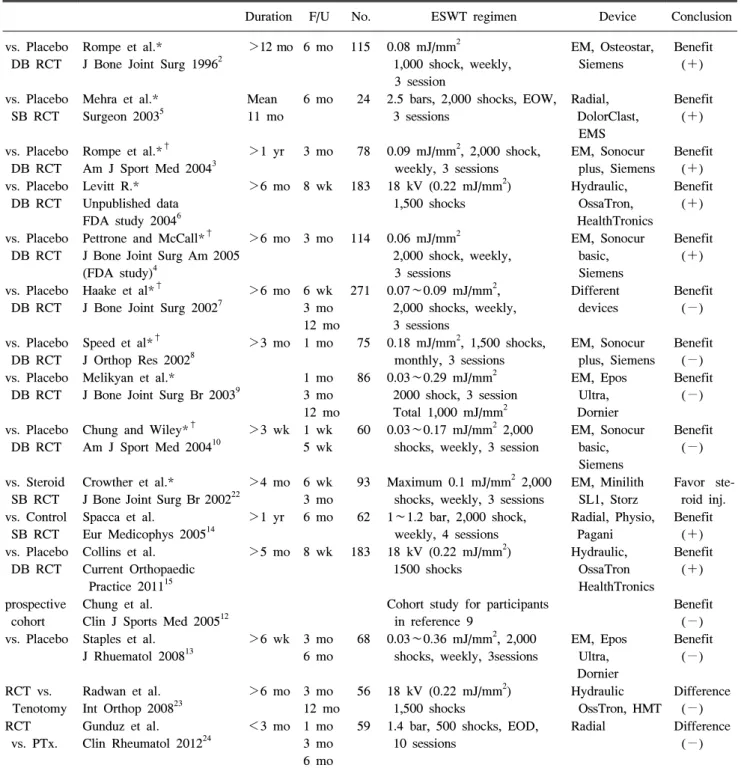
의 리뷰연구에 포함되었던 외측 상과염에 대한 체외충격파의 치료 효과에 대한 9편의 무작 위 위약 대조군 연구들(Table 1) 중 5편의 연구는 체외충격 파 치료의 효용성을 보고하였고,

2-6

다른 4편의 연구는 체외 충격파가 위약치료에 비해서 더 우월한 치료효과가 없음을 보고하였다.

7-10

그러나 Buchbinder 등

1

은 체외충격파 치료 의 효용성을 보고하였던 Mehra 등

5

과 Levitt 등

6

의 연구는 체외충격파의 치료 효용성을 보고하였으나, 저자들이 제시 한 데이터를 다시 분석하였을 때 체외충격파의 치료효과를 입증할 수 없었으며, 9개의 무작위 대조군 연구들에 포함된 1,006명의 대상자들의 데이터를 병합한 pooled analysis를 실시하였을 때 외측 상과염에서 체외충격파 치료효과를 인 정할 근거가 없었다고 보고하였다. 이후 지금까지 외측 상 과염에서 체외충격파의 사용에 대한 논란이 계속되어 왔다.

최근 Dingemanse 등

11

은 2005년 이후 발표된 5편의 무작위

대조군 연구들의(Table 1) 결과를 분석하였는데, Chung 등

12

,

Staples 등

13

의 2편의 연구에서는 4주, 6주, 12∼48주의 단

(2)

Table 1. Evidence of ESWT for the Management of Lateral Epicondylitis or Common Extensor Tendinopathy

Duration F/U No. ESWT regimen Device Conclusion

vs. Placebo DB RCT

Rompe et al.*

J Bone Joint Surg 1996

2

>12 mo 6 mo 115 0.08 mJ/mm

2

1,000 shock, weekly, 3 session

EM, Osteostar, Siemens

Benefit (+) vs. Placebo

SB RCT

Mehra et al.*

Surgeon 2003

5

Mean 11 mo

6 mo 24 2.5 bars, 2,000 shocks, EOW, 3 sessions

Radial, DolorClast,

EMS

Benefit (+) vs. Placebo

DB RCT

Rompe et al.*

Am J Sport Med 2004

3

>1 yr 3 mo 78 0.09 mJ/mm

2

, 2,000 shock, weekly, 3 sessions

EM, Sonocur plus, Siemens

Benefit (+) vs. Placebo

DB RCT

Levitt R.*

Unpublished data FDA study 2004

6

>6 mo 8 wk 183 18 kV (0.22 mJ/mm

2

) 1,500 shocks

Hydraulic, OssaTron, HealthTronics

Benefit (+) vs. Placebo

DB RCT

Pettrone and McCall*

J Bone Joint Surg Am 2005 (FDA study)

4

>6 mo 3 mo 114 0.06 mJ/mm

2

2,000 shock, weekly, 3 sessions

EM, Sonocur basic, Siemens

Benefit (+) vs. Placebo

DB RCT

Haake et al*

J Bone Joint Surg 2002

7

>6 mo 6 wk 3 mo 12 mo

271 0.07∼0.09 mJ/mm

2

, 2,000 shocks, weekly, 3 sessions

Different devices

Benefit (−) vs. Placebo

DB RCT

Speed et al*

J Orthop Res 2002

8

>3 mo 1 mo 75 0.18 mJ/mm

2

, 1,500 shocks, monthly, 3 sessions

EM, Sonocur plus, Siemens

Benefit (−) vs. Placebo

DB RCT

Melikyan et al.*

J Bone Joint Surg Br 2003

9

1 mo 3 mo 12 mo

86 0.03∼0.29 mJ/mm

2

2000 shock, 3 session Total 1,000 mJ/mm

2

EM, Epos Ultra, Dornier

Benefit (−) vs. Placebo

DB RCT

Chung and Wiley*

Am J Sport Med 2004

10

>3 wk 1 wk 5 wk

60 0.03∼0.17 mJ/mm

2

2,000 shocks, weekly, 3 session

EM, Sonocur basic, Siemens

Benefit (−) vs. Steroid

SB RCT

Crowther et al.*

J Bone Joint Surg Br 2002

22

>4 mo 6 wk 3 mo

93 Maximum 0.1 mJ/mm

2

2,000 shocks, weekly, 3 sessions

EM, Minilith SL1, Storz

Favor ste- roid inj.

vs. Control SB RCT

Spacca et al.

Eur Medicophys 2005

14

>1 yr 6 mo 62 1∼1.2 bar, 2,000 shock, weekly, 4 sessions

Radial, Physio, Pagani

Benefit (+) vs. Placebo

DB RCT

Collins et al.

Current Orthopaedic Practice 2011

15

>5 mo 8 wk 183 18 kV (0.22 mJ/mm

2

) 1500 shocks

Hydraulic, OssaTron HealthTronics

Benefit (+) prospective

cohort

Chung et al.

Clin J Sports Med 2005

12

Cohort study for participants in reference 9

Benefit (−) vs. Placebo Staples et al.

J Rhuematol 2008

13

>6 wk 3 mo 6 mo

68 0.03∼0.36 mJ/mm

2

, 2,000 shocks, weekly, 3sessions

EM, Epos Ultra, Dornier

Benefit (−) RCT vs.

Tenotomy

Radwan et al.

Int Orthop 2008

23

>6 mo 3 mo 12 mo

56 18 kV (0.22 mJ/mm

2

) 1,500 shocks

Hydraulic OssTron, HMT

Difference (−) RCT

vs. PTx.

Gunduz et al.

Clin Rheumatol 2012

24

<3 mo 1 mo 3 mo 6 mo

59 1.4 bar, 500 shocks, EOD, 10 sessions

Radial Difference

(−)

All articles above are included in the systemic review of Dingemanse et al.

11

*Articles included in the Cochrane review of Buchbinder et al.

1

Articles included in the systemic review of Speed C.

16

DB RCT: double blind randomized controlled trial, SB RCT: single blind randomized controlled trial, EM: electromagnetic, PTx.

Physiotherapy EOW: every other week, EOD: every other day.

(3)

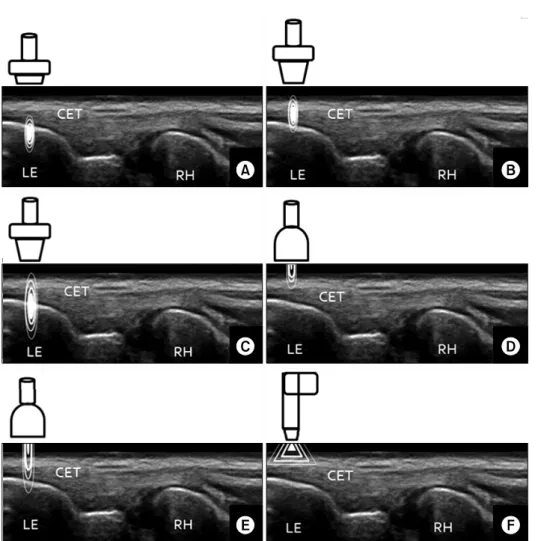
Fig. 1. Different focal geometry ac- cording to various devices. (A, C) Depth of focal area appears to be too much deep for the treatment of common extensor tendinopathy.

(B) Depth of focal area in A be- came proper by change of stand- off of applicator and depth of focal area in C became proper after low- ering energy level. (C, E) Focal area in B and D increased as energy level increased. (D, F) Focal areas seem to be too much shallow. CET:

이가 없었으며, Spacca 등

14

, Pettrone 등

4

, Collins 등

15

의 3편 의 연구에서는 8∼12주의 단기 추적관찰에서 위약치료에 비해서 의미 있는 치료효과를 보여 외측 상과염에서 체외충 격파의 중, 장기 치료효과에 대한 근거는 없지만 단기효과 에 대하여는 상반되는 근거가 인정된다고 보고하였다. 또한 2014년 Speed 등

16

은 대상자 수 40명 이상, 추적관찰 기간 12주 이상, 12주 이내 follow-up loss가 없는 high- quality의 무작위 대조군 연구 5편을(Table 1) 선정하여 focused type 의 저 에너지 체외충격파 치료 후 12주째의 치료효과를 분 석한 결과, 3편의 연구에서는 위약치료와의 차이가 없는 것 으로 나타났으나,

8,10

다른 2편의 연구에서는 의미 있는 통증 감소 또는 손목신전 시 통증호전이 관찰되어

3,4

상반되긴 하 지만 체외충격파 치료의 효용성에 대한 근거가 있다고 발표 하는 등 최근들어 외측 상과염에 대한 체외충격파 치료의 효용성에 대한 근거가 조금씩 증가되고 있는 추세이다.

외측 상과염의 치료에서 체외충격파의 임상적용

외측 상과염 환자의 체외충격파 치료를 효과적으로 시행 하기 위해서는 치료 대상 선정 시 증상의 이환 기간(dura- tion of symptom)에 대한 고려가 중요하다. 또한 해당 치료 부위의 고유한 해부학적 특성이 고려되어야 하며 이외에도 치료 강도(intensity), 초점 영역의 에너지(focal energy), 초 점의 모양과 크기(focal geometry) 등 사용 장비의 종류에 따른 특성 및 치료 프로토콜 등에 대한 고려도 중요하

다.

17,18

충격파 에너지는 bone-tendon interface와 같이 음파

저항이 차이가 나는 두 매질의 경계 지점에서 에너지를 발

산하여 해당 조직에 생물학적 효과를 미침으로써 치료효과

나 부작용을 가져오게 된다. 에너지 밀도(energy flux den-

sity)로 표시되는 초점 영역의 에너지 강도가 높아질수록,

초점의 넓이 또는 깊이가 커질수록, 또는 치료 시 사용된

shock의 횟수가 많아질수록 초점 영역부위에 더 많은 에너

지가 전달되어 치료효과가 더 높아질 수도 있지만 한편으

로는 출혈, 혈종 등의 직접적인 조직손상이나 골막(perio-

(4)

steum)의 과자극에 의한 통증 등이 부작용으로 나타나기

쉽다.

19-21

어깨의 석회성 건염의 치료는 연부조직이 외측 상

과에 비해 두꺼울 뿐 아니라 연부조직과 석회의 경계부위 에서 충격파 에너지가 흡수 또는 반사되어 약해지며, 족부 건막은 연부조직이 두껍고 체중부하에 의한 충격에 잘 견 딜 수 있는 compacted collagen fiber의 네트워크로 구성되 어 있다. 따라서 고 에너지 사용, 초점의 크기가 크고 깊은 장비사용, shock의 과다반복 등에 의한 부작용의 가능성이 상대적으로 적다. 하지만 외측상과와 같이 연부조직이 얇 고, 치료부위의 깊이가 얕아 체외충격파에 의한 부작용에 취약하면서도 치료부위의 면적이 좁고 뾰족하여 정확한 조 준이 어려운 부위는 의도하지 않은 반복자극이나 초점 크 기나 깊이의 조절실패로 치료부위의 연부조직이나 골막 등 에 과도한 충격파 에너지가 전달되어 통증증가로 인한 치 료실패의 가능성이 상대적으로 더 높다. 일반적으로 이러 한 부작용의 가능성은 에너지 밀도가 높은 고에너지를 사 용할수록 더 높아 진다. 또한 같은 에너지 밀도와 shock의 횟수로 치료를 한다고 가정하였을 때 초점영역의 크기가 크거나 깊은 장비일수록 치료효과가 더 좋을 수 있으나, 한 편으로는 과도한 에너지 전달에 의한 조직손상이나 골막 과자극 등의 가능성 또한 높아진다. 따라서 초점영역의 크 기와 깊이 등 사용하는 장비의 특성에 대해서 숙지하고 초 점영역이 치료하고자 하는 부위에 적절히 위치할 수 있도 록 고려하는 것이 좋다(Fig. 1). 실제로 체외충격파 치료의 효용성이 없었다고 보고하였던 이전 연구들을 분석해 보 면, Staples 등

13

(0.03∼0.36 mJ/mm

2

)과 Chung 등

12

(0.03

∼0.17 mJ/mm

2

), Speed 등

8

(0.18 mJ/mm

2

), Melikyan 등

9

(0.03∼0.29 mJ/mm

2

)은 3개월 이내의 너무 짧은 이환 기간 을 가진 환자를 대상으로 고에너지가 사용되었던 문제가 있다. Haake 등

7

(0.07∼0.09 mJ/mm

2

)은 이환 기간이 6개 월 이상인 환자를 대상으로 저에너지를 사용하였으나 치료 부위로 결정된 부위에 충격파 applicator를 arm으로 고정시 킨 상태에서 치료를 시행하여, 특정 부위가 과도하게 반복 자극 되었던 문제가 있었다. 이에 비해, 체외충격파의 효용 성을 보고하였던 Rompe 등

2

(0.08 mJ/mm

2

), Rompe 등

3

(0.09 mJ/mm

2

)과 Pettrone 등

4

(0.06 mJ/mm

2

)의 연구에서 는 이환 기간이 6개월 이상인 환자를 대상으로 저에너지를 사용하여 환자의 통증반응에 따라 치료부위의 위치를 조절 하면서 치료하여 성공적인 치료결과를 보고하였다. 이러한 점을 고려하여 본 저자는 외측 상과염의 체외충격파 치료 시 선행연구의 protocol (electromagnetic device, 2000 shocks, weekly, 3회)을 기준으로 할 때 1. 가급적 이환 기간 6개월 이상 환자 대상, 2. 가급적 저 에너지 사용, 3. 사용 장비의 초점부위의 크기와 깊이를 숙지하여 해당 치료부위 에 초점영역이 적절히 위치하도록 조절, 4. 환자의 통증반

응에 따라 치료위치를 적절히 미세이동 5. 초점영역의 크기 와 깊이를 감안하여 치료 시 사용하는 shock의 횟수를 줄여 서 1 session 치료 시 과도한 충격파 에너지가 전달되지 않 도록 유의하며 이때 부족해진 총 유효 치료에너지의 양을 보충하기 위해서 치료 세션의 횟수를 늘린 protocol을 권장 하고자 한다. 예를 들면 1. electromagnetic device, 1,000 shocks, weekly, 6회 또는 2. electrohydraulic device, 500 shocks, weekly, 6회. 만약 환자의 치료 후 통증이 과도하게 길게 나타나는 경우 통증을 유발하는 동작을 철저하게 제 한하며 냉찜질을 시행하고, 치료 session간의 interval을 늘 려 급성통증이 가라앉도록 기다려 원치 않는 조직손상에 의한 통증을 최대한 회피하고 조절하는 노력이 치료 성적 을 높이는 데 중요하게 작용할 것으로 생각된다.

REFERENCES

1. Buchbinder R, Green SE, Youd JM, Assendelft WJ, Barnsley L, Smidt N. Shock wave therapy for lateral elbow pain. The Cochrane database of systematic reviews 2005:

Cd003524

2. Rompe JD, Hope C, Kullmer K, Heine J, Burger R.

Analgesic effect of extracorporeal shock-wave therapy on chronic tennis elbow. The Journal of bone and joint surgery British volume 1996; 78: 233-237

3. Rompe JD, Decking J, Schoellner C, Theis C. Repetitive low-energy shock wave treatment for chronic lateral epi- condylitis in tennis players. The American journal of sports medicine 2004; 32: 734-743

4. Pettrone FA, McCall BR. Extracorporeal shock wave ther- apy without local anesthesia for chronic lateral epicondy- litis. The Journal of bone and joint surgery American vol- ume 2005; 87: 1297-1304

5. Mehra A, Zaman T, Jenkin AI. The use of a mobile litho- tripter in the treatment of tennis elbow and plantar fasciitis.

The surgeon : journal of the Royal Colleges of Surgeons of Edinburgh and Ireland 2003; 1: 290-292

6. Levitt R. Shockwave therapy for chronic lateral epi- condylitis—an FDA study. Paper Presented at AOSSM Specialty Day, AAOS Annual Meeting, San Francisco, CA, USA, 13 March 2004

7. Haake M, Konig IR, Decker T, Riedel C, Buch M, Muller HH. Extracorporeal shock wave therapy in the treatment of lateral epicondylitis : a randomized multicenter trial. The Journal of bone and joint surgery American volume 2002;

84-a: 1982-1991

8. Speed CA, Nichols D, Richards C, et al. Extracorporeal

shock wave therapy for lateral epicondylitis--a double blind

randomised controlled trial. Journal of orthopaedic re-

(5)

search: official publication of the Orthopaedic Research Society 2002; 20: 895-898

9. Melikyan EY, Shahin E, Miles J, Bainbridge LC. Extracor- poreal shock-wave treatment for tennis elbow: A RANDOMISED DOUBLE-BLIND STUDY. The Journal of bone and joint surgery British volume 2003; 85-B:

852-855

10. Chung B, Wiley JP. Effectiveness of Extracorporeal Shock Wave Therapy in the Treatment of Previously Untreated Lateral Epicondylitis: A Randomized Controlled Trial. The American journal of sports medicine 2004; 32: 1660-1667 11. Dingemanse R, Randsdorp M, Koes BW, Huisstede BM.

Evidence for the effectiveness of electrophysical modalities for treatment of medial and lateral epicondylitis: a system- atic review. British journal of sports medicine 2014; 48:

957-965

12. Chung B, Wiley JP, Rose MS. Long-term effectiveness of extracorporeal shockwave therapy in the treatment of pre- viously untreated lateral epicondylitis. Clinical journal of sport medicine : official journal of the Canadian Academy of Sport Medicine 2005; 15: 305-312

13. Staples MP, Forbes A, Ptasznik R, Gordon J, Buchbinder R. A randomized controlled trial of extracorporeal shock wave therapy for lateral epicondylitis (tennis elbow). The Journal of rheumatology 2008; 35: 2038-2046

14. Spacca G, Necozione S, Cacchio A. Radial shock wave therapy for lateral epicondylitis: a prospective randomised controlled single-blind study. Europa medicophysica 2005;

41: 17-25

15. Collins ED, Hildreth, David H., Jafarnla, Korsh K. A clin- ical study of extracorporeal shock waves (ESW) for treat- ment of chronic lateral epicondylitis. Current Orthopaedic Practice 2011; 22: 185-192

16. Speed C. A systematic review of shockwave therapies in

soft tissue conditions: focusing on the evidence. British journal of sports medicine 2014; 48: 1538-1542

17. Speed CA. Extracorporeal shock-wave therapy in the man- agement of chronic soft-tissue conditions. The Journal of bone and joint surgery British volume 2004; 86: 165-171 18. Wang CJ. Extracorporeal shockwave therapy in muscu- loskeletal disorders. Journal of orthopaedic surgery and re- search 2012; 7: 11

19. Haake M, Boddeker IR, Decker T, et al. Side-effects of ex- tracorporeal shock wave therapy (ESWT) in the treatment of tennis elbow. Archives of orthopaedic and trauma sur- gery 2002; 122: 222-228

20. Peters J, Luboldt W, Schwarz W, Jacobi V, Herzog C, Vogl TJ. Extracorporeal shock wave therapy in calcific tendinitis of the shoulder. Skeletal radiology 2004; 33: 712-718 21. Rompe JD, Kirkpatrick CJ, Kullmer K, Schwitalle M,

Krischek O. Dose-related effects of shock waves on rabbit tendo Achillis. A sonographic and histological study. The Journal of bone and joint surgery British volume 1998; 80:

546-552

22. Crowther MA, Bannister GC, Huma H, Rooker GD. A pro- spective, randomised study to compare extracorporeal shock-wave therapy and injection of steroid for the treat- ment of tennis elbow. The Journal of bone and joint surgery British volume 2002; 84: 678-679

23. Radwan YA, ElSobhi G, Badawy WS, Reda A, Khalid S.

Resistant tennis elbow: shock-wave therapy versus percuta- neous tenotomy. International orthopaedics 2008; 32:

671-677

24. Gunduz R, Malas FU, Borman P, Kocaoglu S, Ozcakar L.

Physical therapy, corticosteroid injection, and extracor- poreal shock wave treatment in lateral epicondylitis.

Clinical and ultrasonographical comparison. Clinical rheu-

matology 2012; 31: 807-812

수치

Table  1.  Evidence  of  ESWT  for  the  Management  of  Lateral  Epicondylitis  or  Common  Extensor  Tendinopathy
Fig.  1.  Different  focal  geometry  ac- ac-cording  to  various  devices.  (A,  C)  Depth  of  focal  area  appears  to  be  too  much  deep  for  the  treatment  of  common  extensor  tendinopathy

참조

관련 문서

Autho: Effectiveness of surgery for lumbar stenosis and degenerative spondylolisthesis in the octogenarian population: analysis of the Spine Patient Outcomes Research

The aim of this study was to provide a optimal drug therapy which secures effectiveness and safeness in elderly patients by analyzing polypharmacy and the

In order to investigate the effectiveness of the horticultural therapy program, the researcher carried out both the pre- and post-tests using the Korean Form

Bismuth-containing quadruple therapy as second-line treatment for Helico- bacter pylori infection: effect of treatment duration and antibiotic resistance on the eradication

Effects of fluid resuscitation with colloids vs crystalloids on mortality in critically ill patients presenting with hypovolemic shock: the CRISTAL randomized trial..

The effect of group exercise on physical functioning and falls in frail older people living in retirement villages: a randomized, controlled trial... Wyman JF, Croghan

1 John Owen, Justification by Faith Alone, in The Works of John Owen, ed. John Bolt, trans. Scott Clark, "Do This and Live: Christ's Active Obedience as the

(Background) The standard triple therapy used as the first-line treatment for Helicobacter pylori infection are a combination of proton pump inhibitor(PPI),