J Korean Surg Soc 2011;80:241-244 DOI: 10.4174/jkss.2011.80.4.241
ORIGINAL ARTICLE
Journal of the Korean Surgical Society
JKSS
pISSN 2233-7903ㆍeISSN 2093-0488
Copyright © 2011, the Korean Surgical Society Received July 20, 2010, Accepted January 13, 2011
Correspondence to: Soon-Tae Park
Department of Surgery, Gyeongsang National University Hospital, 90 Chilam-dong, Jinju 660-702, Korea Tel: +82-55-750-8090, Fax: +82-55-750-8732, E-mail: [email protected]
cc Journal of the Korean Surgical Society is an Open Access Journal. All articles are distributed under the terms of the Creative Commons Attribution Non-Commercial License (http://creativecommons.org/licenses/by-nc/3.0/) which permits unrestricted non-commercial use, distribution, and reproduction in any medium, provided the original work is properly cited.
The indices of body size and aggressiveness of papillary thyroid carcinoma
Ju-Yeon Kim, Eun-Jung Jung, Sang-Ho Jeong, Chi-Young Jeong, Young-Tae Ju, Young-Jun Lee, Soon-Chan Hong, Sang-Kyeong Choi, Woo-Song Ha, Soon-Tae Park
Department of Surgery, Gyeongsang National University School of Medicine, Jinju, Korea
Purpose: The incidence of papillary thyroid carcinoma (PTC) is increasing worldwide. Positive associations between indices of body size and thyroid cancer have been reported. However, the relationships to cancer severities and/or behaviors are uncertain. Methods: We performed a retrospective analysis of the data of patients who underwent total thyroidectomy due to PTC. The epidemiologic factor and pathologic report after operation were determined based on chart review. The relation- ships between indices of body size and these parameters were assessed. Results: Positive association between body mass in- dex and T stage was found, but it was not statically significant. In neck lymph node metastasis, the group with metastasis had a tendency for larger mean height and weight, but significant difference was found only in height. However, in the multi- variate analysis, the age and size of nodules were only identified as independent risk factors of neck lymph node metastasis (P = 0.000 and 0.019). Conclusion: There was no independent association between indices of body size and stages of PTC in patients who underwent total thyroidectomy.
Key Words: Body size, Height, Weight, Body mass index, Papillary thyroid carcinoma
INTRODUCTION
The incidence of papillary thyroid carcinoma (PTC), which is the most common histologic type of thyroid ma- lignancy, is increasing worldwide [1]. High cure rates are achieved after initial treatment of patients who develop PTC. However, some patients are at a high risk of re- currence and even of death. Many publications have been devoted to finding prognostic factors for PTC, focusing on epidemiological, biological, clinical and pathological data [2-5].
In recent years, positive associations between height,
weight and body mass index (BMI) and PTC have been re- ported [6-13]. The World Cancer Research Fund (WCRF) report concludes to a potential association between thy- roid cancer and body size, possibly through changes in io- dine requirement [14].
Most of these studies have looked into the etiology of thyroid cancer by comparing with healthy controls, how- ever, it is unclear whether prognostic role of the body size in the severity and recurrence of PTC. Recently, Paes et al.
[15] suggested that obesity may be correlated with a less aggressive tumor invasion, however it was not significant.
Thus, more studies on effects of obesity for the thyroid
Ju-Yeon Kim, et al.
242 thesurgery.or.kr
Table 1. The characteristics of the 315 patients
Characteristics Value
Sex (M:F) 47:268
Age (yr) 51.09 ± 13.7
<45 101 (32.06)
≥45 214 (67.94)
Body size
Height (cm) 159.17 ± 7.98
Weight (kg) 62.16 ± 9.91
BMI (kg/m2) 24.51 ± 3.20
Pathologic results
T1/T2/T3/T4 125/9/167/14
N0/N1 194/121
Values are presented as mean ± SD or number (%).
BMI, body mass index.
Table 2. Relationship between indices of body size and T stage
T1 T2 T3 T4 P-value
Height (cm) 159.89 ± 7.47 161.87 ± 6.29 158.28 ± 8.03 161.73 ± 11.44 0.069
Weight (kg) 62.26 ± 10.26 64.04 ± 9.26 61.55 ± 9.49 67.53 ± 11.22 0.812
BMI (kg/m2) 24.31 ± 3.27 24.37 ± 2.55 24.55 ± 3.19 25.87 ± 3.02 0.664
Values are presented as mean ± SD.
BMI, body mass index.
cancer are needed.
In this study, we aimed to examine the association of in- dices of body size with aggressiveness and recurrence of PTC. So, we performed a retrospective investigation of the body size and cancer characteristics of patients who un- derwent total thyroidectomy PTC in our hospital.
METHODS
We reviewed the charts of the persons who underwent a health examination from January 2007 to December 2009 in Health Examination Center of Gyeongsang National University. Among these, the patients who underwent to- tal thyroidectomy for PTC were selected for the study. In each operation, when lymph node metastasis was sus- pected from the preoperative or intraoperative findings, central neck and/or lateral neck lymph node dissection were performed.
The epidemiologic factor and pathologic report after operation were determined based on chart review. Tumor- node-metastasis stage was based on the American Joint Committee on Cancer cancer staging manual seventh edi- tion [16]. For each patients, the height and weight reported in the anesthesia summary was used to calculate the BMI according to its determined formula (i.e., BMI = weight [kg] / height [m2]).
All data are expressed as mean ( ± standard deviation).
The SPSS (SPSS Inc., Chicago, IL, USA) was used for stat- istical analysis, and the one way analysis of variance test and chi-square test were used to compare the indices of body size and other parameters between T and N stage sub-groups.
Multivariate analysis was performed with logic re- gression analysis to identify the independent predictors of
lymph node metastasis. P < 0.05 was considered statisti- cally significant.
RESULTS
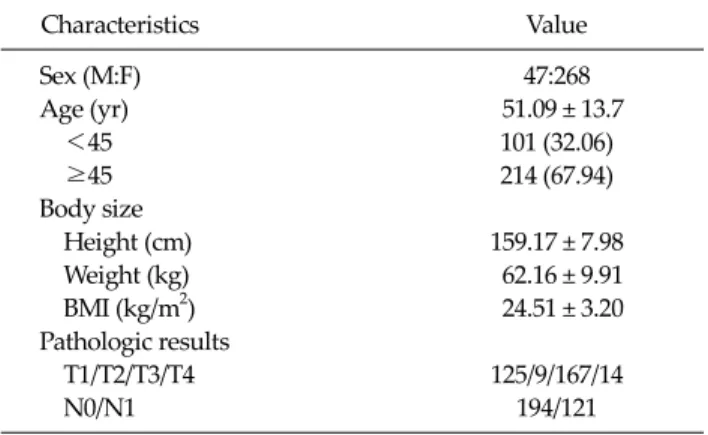
A total of 315 PTC patients (47 men and 268 women) were studied. The mean age was 51.09 years (range, 12 to 88 years). The mean BMI was 24.51 ± 3.20 kg/m2 and 133 patients (42.2%) had a BMI same or higher than 25 kg/m2. One hundred seventh-nine patients (56.8%) had nodules which were extrathyroidal extension, and 121 patients had regional lymph node metastasis (Table 1).
Body size and T stage
The correlation between the body size and T stage is shown in Table 2. Although positive association between BMI and T stage was found, it was not statically signi- ficant. The mean age of T1 and T2 (49.4 ± 12.37 years old) was significantly lower than that of T3 and T4 (52.34 ± 13.46 years old, P = 0.046).
Body size and papillary thyroid carcinoma
thesurgery.or.kr 243
Table 3. Relationship between indices of body size and N stage
N0 N1 P-value
Height (cm) 158.38 ± 6.88 160.44 ± 9.37 0.026 Weight (kg) 61.58 ± 8.95 63.09 ± 11.24 0.189 BMI (kg/m2) 24.56 ± 3.23 24.44 ± 3.14 0.741 Values are presented as mean ± SD.
BMI, body mass index.
Body size and lymph node metastasis
A total of 124 patients had neck lymph node metastasis:
87 patients had only central neck lymph node metastasis, 7 patients had only lateral neck lymph node metastasis and 26 patients had both central and lateral neck lymph node metastasis. The higher rates of lymph node meta- stasis were seen in men when compared to women (55.3%
vs. 35.4%, P = 0.014). And, the patients with lymph node metastasis were younger than patients of non-metastasis (48.93 years old vs. 52.44 years old, P = 0.020).
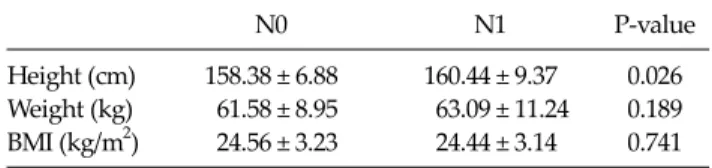
In the patients who were founded to have neck lymph node metastasis, the mean height and weight were larger than the others, but significant difference were founded only on height (Table 3). A multivariate analysis was con- ducted to find factors affecting the metastasis of neck lymph nodes, and age and size of nodules were only iden- tified as independent risk factors (P = 0.000 and 0.019).
Body size and recurrence
After a median follow-up of 23.6 months (range, 9 to 44 months), 7 patients showed tumor recurrence in neck lymph nodes. There were no statistically significant corre- lations between the body size and the existence of recur- rence.
DISCUSSION
Recently many studies on the correlations between thy- roid cancer and height, weight, and BMI have been pub- lished [6,11,17,18]. However, great heterogeneity exists among studies as to the actual association between body size and thyroid malignancy. The WCRF report concludes to a potential association between thyroid cancer and body size, possibly through changes in iodine require-
ment [14]. Renehan et al. [8] conducted a meta-analysis of five prospective studies on thyroid cancer and BMI, and reported that the risk of thyroid cancer for each increase of 5 in BMI among men and women were 1.52 and 1.14, respectively. According to a study by Sung et al. [18] on the development of various cancers by height, the greater the height, the higher the frequency of thyroid cancer became for both men and women.
Studies have been carried out on BMI and cancer risk, but the relationship between obesity and thyroid cancer stage or behavior remains unclear. Recently, Paes et al. [15]
reported that a higher BMI was found not be associated with more aggressive tumor features or a greater like- lihood of recurrence or persistence. Rather, they suggested that obesity may be correlated with a less aggressive tu- mor invasion, though it was not significant.
This study also found no statically significant difference between indices of body size and T and N stage. In neck lymph node metastasis, the group of positive metastasis had taller mean height, but there was no significant differ- ence in multivariate analysis. Because the younger pa- tients had an increased tendency to be taller than older pa- tients, and the patients of positive lymph node metastasis were younger than the others.
Since this study was a retrospective study, it was limited in that various biases could not be excluded. This study was also limited in that it could not represent the patients who underwent lobectomy of the thyroid (small size and solitary cancer) since the subjects were only selected from patients who underwent total thyroidectomy among the PTC patients. Moreover, because this study had short peri- od of follow-up and was carried out with a relatively small group of patients, the prognosis was not directly com- pared.
In this study, our findings suggest that PTC severity and recurrence are not associated with indices of body size. A further confirmatory study should be conducted.
CONFLICTS OF INTEREST
No potential conflict of interest relevant to this article was reported.
Ju-Yeon Kim, et al.
244 thesurgery.or.kr
REFERENCES
1. Davies L, Welch HG. Increasing incidence of thyroid can- cer in the United States, 1973-2002. JAMA 2006;295:2164-7.
2. Mazzaferri EL. Management of a solitary thyroid nodule.
N Engl J Med 1993;328:553-9.
3. Hay ID, Bergstralh EJ, Goellner JR, Ebersold JR, Grant CS.
Predicting outcome in papillary thyroid carcinoma: devel- opment of a reliable prognostic scoring system in a cohort of 1779 patients surgically treated at one institution during 1940 through 1989. Surgery 1993;114:1050-7.
4. Cady B. Papillary carcinoma of the thyroid gland: treat- ment based on risk group definition. Surg Oncol Clin N Am 1998;7:633-44.
5. Loh KC, Greenspan FS, Gee L, Miller TR, Yeo PP. Patholo- gical tumor-node-metastasis (pTNM) staging for papillary and follicular thyroid carcinomas: a retrospective analysis of 700 patients. J Clin Endocrinol Metab 1997;82:3553-62.
6. Engeland A, Tretli S, Akslen LA, Bjørge T. Body size and thyroid cancer in two million Norwegian men and women.
Br J Cancer 2006;95:366-70.
7. Goodman MT, Kolonel LN, Wilkens LR. The association of body size, reproductive factors and thyroid cancer. Br J Cancer 1992;66:1180-4.
8. Renehan AG, Tyson M, Egger M, Heller RF, Zwahlen M.
Body-mass index and incidence of cancer: a systematic re- view and meta-analysis of prospective observational studies. Lancet 2008;371:569-78.
9. Iribarren C, Haselkorn T, Tekawa IS, Friedman GD. Cohort study of thyroid cancer in a San Francisco Bay area popula- tion. Int J Cancer 2001;93:745-50.
10. Mack WJ, Preston-Martin S, Bernstein L, Qian D. Lifestyle and other risk factors for thyroid cancer in Los Angeles County females. Ann Epidemiol 2002;12:395-401.
11. Dal Maso L, La Vecchia C, Franceschi S, Preston-Martin S, Ron E, Levi F, et al. A pooled analysis of thyroid cancer studies. V. Anthropometric factors. Cancer Causes Control 2000;11:137-44.
12. Ron E, Kleinerman RA, Boice JD Jr, LiVolsi VA, Flannery JT, Fraumeni JF Jr. A population-based case-control study of thyroid cancer. J Natl Cancer Inst 1987;79:1-12.
13. Flegal KM, Carroll MD, Ogden CL, Curtin LR. Prevalence and trends in obesity among US adults, 1999-2008. JAMA 2010;303:235-41.
14. World Cancer Research Fund/American Institute for Can- cer Research. Food, nutrition, physical activity, and the prevention of cancer: a global perspective. Washigton, DC:
Americal Institute for Cancer Research; 2007.
15. Paes JE, Hua K, Nagy R, Kloos RT, Jarjoura D, Ringel MD.
The relationship between body mass index and thyroid cancer pathology features and outcomes: a clinicopatho- logical cohort study. J Clin Endocrinol Metab 2010;95:4244- 50.
16. Edge SB, Byrd DR, Compton CC, Frits AG, Greene FL, Trotti A. AJCC cancer staging manual. 7th ed. New York:
Springer; 2010.
17. Leitzmann MF, Brenner A, Moore SC, Koebnick C, Park Y, Hollenbeck A, et al. Prospective study of body mass index, physical activity and thyroid cancer. Int J Cancer 2010;126:
2947-56.
18. Sung J, Song YM, Lawlor DA, Smith GD, Ebrahim S.
Height and site-specific cancer risk: a cohort study of a Korean adult population. Am J Epidemiol 2009;170:53-64.