KEY WORDS:
Headache; Hand acupuncture; Tension- type headache; Probable Migraine
Received : Aug 11, 2011 Revised : Sep 1, 2011 Accepted : Sep 2, 2011
I . Introduction
Headache is a unspecific and subjective symptom and one of most common symptom being able to experience. Many reports at home and abroad said the prevalence rate was 47% to 92.6%
1-3).
Headache has been classified by many causes, such as migraine, tension-type headache, cluster headache, other primary headache, headache attrib- uted to head and/or neck trauma, headache attribut
ed to psychiatric disorder and others
4-5). Western medicine treatment of headache also was various depending on the cause
5).
Headache was one of the important disease in oriental traditional medicine and has been catego- rized into external contraction such as wind-cold, wind-heat, and wind-dampness and internal damage such as hyperactivity of liver yang, phlegm turbidi-
ABSTRACT
Objectives : The purpose of 29 case series is to report the possibility that a hand acupuncture is effec- tive in relieving headache.
Methods : After approval from the Institutional Review Board (IRB), I analyzed 29 cases medical records of outpatients with headache, who visited OO oriental medical hospital from December 2008 to December 2010, who have taken a hand acupuncture's treatment without other intervention, and who were diagnosed with one disease of international classification of headache disease second ver- sion (ICHD-2).
The data was analyzed with Wilcoxon signed rank test to determine whether a hand acupuncture's treatment differed between before and after treatment's Visual Analogue Scale(VAS) according to types of headache and syndrome differentiation. Statistics program was used SPSS 18.0. Differences were considered significant at P<0.05.
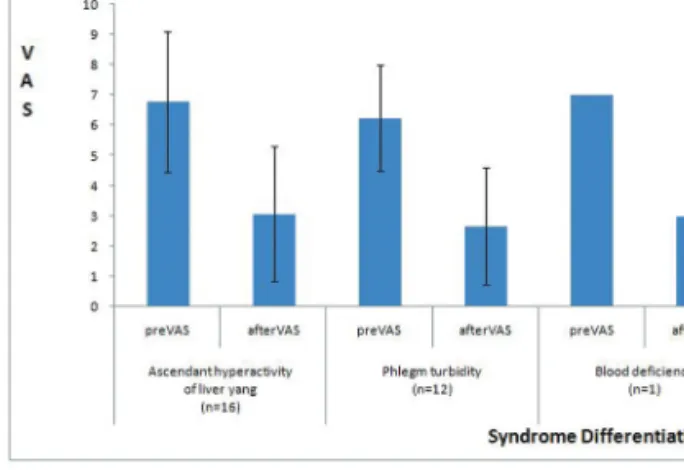
Results :The VAS of patients with headache was reduced after treatment of hand acupuncture from 6.57 2.04 to 2.90 2.04 for overall headache, from 6.32 2.05 to 2.47 2.03 for tension-type headache(P<0.001), from 7.10 2.18 to 3.70 1.77 for migraine(P<0.001), and from 6.00 1.41 to 2.50 3.54 for headache unspecified. A hand acupuncture produced a decrease in VAS of both ascen- dant hyperactivity of liver yang(P<0.001) and phlegm turbidity according to syndrome differentia- tion(P=0.002). No adverse event were encountered in any of the patients.
Conclusions : It is suggested that a hand acupuncture may be effective in relieving headache, and could be applicable to first choice of acupuncture treatment for headache.
Seung-Ho Sun*
Department of Oriental Internal Medicine, Oriental Medicine Hospital of Sangji University, Wonju, Korea Case Report
Case Series Report on the Effect of Hand Acupuncture - Focusing on 29 Patients with Headache -
2011 Korean Pharmacopuncture Instltute http://pharmacopuncture.co.kr
This is an Open-Access article distributed under the terms of the Creative Commons Attribution Non-Commercial License (http://cre- ativecommons.org/licenses/by-nc/3.0/) which permits unrestricted non- commercial use, distribution, and reproduction in any medium, provid- ed the original work is properly cited.
Corresponding Author
Seung-Ho Sun. Department of Oriental Internal Medicine, Oriental Medicine Hospital of Sangji University, 283 Woosan-dong, Wonju 220-955, Korea
Tel : +82-33-741-9209 Fax : +82-33-732-2124 E-mail : [email protected]
cc
ty, qi deficiency, blood deficiency, blood stasis, yin deficiency, and so on according to cause of oriental traditional medicine, which have diverse methods of treating that based on this cause and symptom differentiation
6-7).
Acupuncture is representative treatment of orien- tal traditional medicine. Acupuncture treatment on headache has been reported not only nationwide, but also worldwide
8-19).
Acupuncture treatment on headache has been studied about migraine
8), tension-type headache
9), and chronic headache
10)mainly at overseas, but the effect of that has been a controversial issue because both positive
9-10)and negative
8)effect of that has be- en reported. Besides, various acupuncture treatme- nts, such as auricular acupuncture
11-12), electroacup- uncture
13), and laser acupuncture
14-15), have been studied and the effect of them was good.
In addition to traditional acupuncture
11-12), the do- mestic studies of new acupuncture treatment such as pharmacoacupuncture
13)and aromatic acupunc-
ture
14-15)have been carried out and the effect of them
was positive.
Hand acupuncture has been more widely used to treat acute and chronic pain and functional disorde- rs, but it don't have now not only systemic research- es but also case report and series and pilot studies based on them.
I request systemic clinical trial to evaluate the effect of headache and need case series that can offer a preliminary data and clue of them.
The purpose of 29 case series is to report the pos- sibility that a hand acupuncture is effective in relieving headache.
II. Subjects & Methods
1. Subjects
Target subjects were outpatients with headache who visited OO oriental medical hospital from
December 2008 to December 2010 and who have taken a hand acupuncture treatment without other intervention. These medical records were reviewed by inclusion and exclusion criteria, so twenty-nine cases were selected finally.
2. Inclusion criteria
2.1 Patients were diagnosed with one disease of international classification of headache disease sec- ond version (ICHD-2)
4), such as tension-type heada- che, migraine, cluster headache, headache attribut- ed to head and/or neck trauma, headache attributed to psychiatric disorder and others.
2.2 Patients have only to take a hand acupunc- ture without other intervention.
2.3 The evaluation records of before and after treatment, for example visual analog scale (VAS) or questionnaire, must be included in medical records.
2.4 Medical records must have western diagno- sis, chief complain, symptom differentiation, past history, family history, onset, pain region, pain duration, pain frequency, drinking, and smoking.
3. Exclusion criteria
The cases were dropped out if medical records meet at least one of the following conditions.
3.1 If herbal medication or moxibustions, or oth- er physical treatment were recorded in medical records with hand acupuncutre.
3.2 If medical records of hand acupuncture and
all western treatment except hypertension, Diabetes
Mellitus, and hyperlipidemia have been document-
ed.
4. Outcome variable
1) Visual Analog Scale (VAS)
Visual Analog Scale was used to evaluate the subjective intensity of headache. Severest intensity of headache was consider 10 points of VAS and no pain was consider 0 point of that. The subjective intensity of headache was measured before and after treatment whenever outpatients visited a hos- pital to treat headache.
5. The methods of treatment
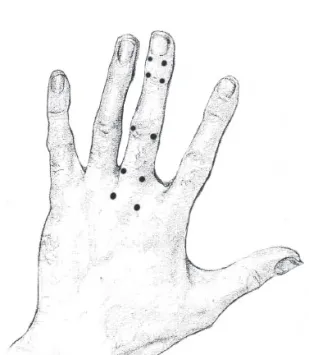
After a finger skin was disinfected with alcohol, sterile needles (gauge 0.20mm, length 15mm, stain- less steel and manufactured by Hanglimseowon, Seoul) were inserted perpendicularly at ten acu- points (Fig. 1) on left middle finger of right-hander or on right middle finger of left-hander by practi- tioner of ten-years experience. Depth of insertion was 2 to 3mm and needle retention time was 20 minutes without finger's stimulation and obtaining qi. No intervention was used except acupuncture.
6. The methods of study
With approval from the Institutional Review Board of the Oriental medical hospital of Sangji University, data on patients with headache from December 2008 through December 2010 was col- lected retrospectively and was selected according to inclusion and exclusion criteria.
Data including VAS of before and after treat- ment, western diagnosis, chief complain, symptom differenciation, past history, family history, onset, pain region, duration, frequency, drinking, and smoking were retrieved from those of cases select- ed finally.
7. Statistics analysis
Data are reported as frequency(n) and percent(%) for ordinary variable and as mean SD for continu- ous variable. The data was analyzed with Wilcoxon signed rank test to determine whether a hand acupuncture's treatment differed between before and after treatment's VAS according to types of headache and syndrome differentiation. Statistics program was used SPSS 18.0. Differences were considered significant at P<0.05.
III. Results
The number of women was 2.2 times more than that of men, and mean age was 47.79 13.66 years.
The types of headache were 17(58.6%), 10(34.5%), and 2(6.9%) persons for tension-type headache, probable migraine, and headache unspecified, respectively.
Ascendant hyperactivity of liver yang(n=16) and phlegm turbidity(n=12) occupied most of types of syndrome differentiation(Table 1).
Fig 1. Acupoints of Hand Acupuncture
The duration of onset was 16.50 11.79 days.
Non-smoking and non-drinking was more than smoking and drinking. The patients with past histo- ry associated with headache were four people. The
patients with past history such as stroke, hyperten- sion, and Diabetes Mellitus were less than those without past history.
The patients with headache related to stress were
Category n %
Sex Female 20 69.0
Male 9 31.0
Age (mean SD) 47.79 13.66
Diagnosis Tension type headache 17 58.6
Probable migraine 10 34.5
Headache unspecified 2 6.9
Syndrome differentiation Ascendant hyperactivity of liver yang 16 55.2
Phlegm turbidity 12 41.4
Blood deficiency 1 3.4
Duration (day, mean SD) 16.50 11.79
Smoking Yes 5 17.2
No 24 82.8
Drinking Yes 7 24.1
No 21 72.4
Past History of headache Yes 4 13.8
No 25 86.2
CVA(P/H) Yes 3 10.3
No 26 89.7
Hypertension(P/H) Yes 10 34.5
No 19 65.5
DM(P/H) Yes 3 10.3
No 26 89.7
Stress Yes 18 62.1
No 11 37.9
Headache region Frontal 7 24.1
(Duplication was included) Occipital 8 27.6
Left 12 41.4
Right 7 24.1
Top 5 17.2
All region 6 20.7
Headache symptom Stabbing pain 13 44.8
Heavy pain 10 34.5
Tightening pain 4 13.8
Blank pain 3 10.3
Bugs-crawling sensation 2 6.9
Bursting pain 3 10.3
Throbbing pain 2 6.9
Other pain 11 37.9
Table 1. Demographic Characteristics of Outpatients(n=29)
SD : Standard Deviation, P/H : Past History
18(62.1%) and were more than those without stress.
Left-side region placed first in headache region, occipital region came second, followed by frontal, right-side, all region and top region. Stabbing pain came first in headache symptoms, followed by heavy pain and tightening pain.
Twenty-nine cases, selected finally, had the results to evaluate VAS before and after single treatment without repeated treatments.
The VAS of 29 patients with Overall headache decreased significantly from 6.57 2.04 before treatment to 2.90 2.04 after treatment. (P<0.001)
The VAS of 3 types of headache was reduced after treatment of hand acupuncture from 6.32 2.05 to 2.47 2.03 for tension-type headache(P<
0.001), from 7.10 2.18 to 3.70 1.77 for migraine (P<0.001), and from 6.00 1.41 to 2.50 3.54 for headache unspecified (Fig. 2).
A hand acupuncture produced a decrease in VAS of both ascendant hyperactivity of liver yang(P<
0.001) and phlegm turbidity according to syndrome differentiation(P=0.002).
No adverse event were encountered in any of the patients.
IV. Discussion
A hand acupuncture used at 29 cases is different from that of textbook and is depending on the prin- ciple of Park's human body matched structure's the- ory and Koryo hand treatment
20).
This hand acupuncture's principle is that the region of distal phalax at middle finger is commen- surate with headache of human body and that of middle and proximal phalanx is equal to neck of that. Based on this principle, the acupuncture points of middle finger is stimulated to relieve headache.
The acupuncture points of these cases was select- ed for myself to reduce headache because stimula- tion of the acupoints at middle finger, which are corresponded to head and neck region, accelerate the circulation of qi and blood between head and truck. It is presumed that it is more convenient to use intradermal needle instead of 20 mm 0.15 mm needle used at these cases.
Most of patients were non-smokers, non-drinkers, and middle-age and stressful women without past history such as hypertension, stroke and Diabetes Mellitus and so on. The region of headache was all alike except left region.
The international classification of headache dis- orders 2nd edition (ICHD-2)
4)used at these cases,
Fig 2. The Visual Analogue Scale of Before and After treat- ment by Headache Type
preVAS : Visual Analogue Scale of before treatment After VAS : Visual Analogue Scale of after-treatment
* P 0.05
Fig 3. The Visual Analogue Scale of before and after Treatment by Syndrome Differentiation
preVAS : Visual Analogue Scale of before-treatment After VAS : Visual Analogue Scale of after-treatment
* P 0.05