https://doi.org/10.4174/astr.2019.97.3.119 Annals of Surgical Treatment and Research
Postthyroidectomy obesity in a Korean population:
does the extent of surgery matter?
Min-Young Park1, Sang Eun Nam1, Kyoung Sik Park1,2, Madhuri Saindane1, Young-Bum Yoo1, Jung-Hyun Yang1, Ah-Leum Ahn3, Jae-Kyung Choi3, Won Seo Park4
1Department of Surgery, Konkuk University School of Medicine, Seoul, Korea
2Research Institute of Medical Science, Konkuk University School of Medicine, Seoul, Korea
3Department of Family Medicine, Konkuk University School of Medicine, Seoul, Korea
4Department of Surgery, Kyung Hee University School of Medicine, Seoul, Korea
INTRODUCTION
The incidence rate of thyroid cancer has been growing rapidly in Korea since the 1980s, with the highest incidence in 2010 according to the National Cancer Registration and Statistics
[1,2]. The 5year survival rate of thyroid cancer patients after thyroidectomy is 99.9%, which has led to increased interest in the quality of life of thyroid cancer survivors [2,3]. Patients diagnosed with thyroid cancer who undergo thyroidectomy often experience fatigue and persistent weight gain despite
Received July 1, 2019, Revised July 15, 2019, Accepted July 19, 2019
Corresponding Author: Kyoung Sik Park
Department of Surgery, Konkuk University School of Medicine, 120-1 Neungdong-ro, Gwangjin-gu, Seoul 05030, Korea
Tel: +82-2-2030-7697, Fax: +82-2-2030-8270 E-mail: [email protected]
ORCID: https://orcid.org/0000-0001-9806-9839
Copyright ⓒ 2019, the Korean Surgical Society
cc Annals of Surgical Treatment and Research is an Open Access Journal. All articles are distributed under the terms of the Creative Commons Attribution Non- Commercial License (http://creativecommons.org/licenses/by-nc/4.0/) which permits unrestricted non-commercial use, distribution, and reproduction in any medium, provided the original work is properly cited.
Purpose: The purpose of this study was to investigate the prevalence of postthyroidectomy obesity, and the relationship between the extent of thyroidectomy and obesity.
Methods: A survey conducted at an outpatient clinic from June to October 2014 and retrospective charts for patients undergoing thyroidectomy at Konkuk University Medical Centers from June 2009 to December 2013 were reviewed. We compared clinical characteristics and pre- and postoperative obesity-related factors in 227 patients who underwent total thyroidectomy or lobectomy.
Results: Patients included 39 males and 188 females with a mean age of 46.0 ± 11.0 years; the mean follow-up period was 23.9 ± 16.7 months, and 90 of the 227 patients showed postthyroidectomy obesity. In effect of operative extent on postoperative obesity, patients who underwent TT (48.2 years) than those who underwent lobectomy (43.4 years). TT group had longer follow-up and the frequency of menopause was higher than in the lobectomy group. No differences in postthyroidectomy obesity, body weight change, or body mass index (BMI), change among 2 groups. The predictors of postthyroidectomy obesity were older age, female, heavy alcohol consumption (P = 0.029), higher preoperative BMI (P <
0.001), larger postoperative weight gain (P = 0.024), and larger BMI change. However, the extent of thyroidectomy did not affect postthyroidectomy obesity. Preoperative BMI (P < 0.001) and heavy alcohol consumption (P = 0.03) were independent factors of postthyroidectomy obesity.
Conclusion: The extent of thyroidectomy does not affect postthyroidectomy obesity. Preoperative BMI and heavy alcohol consumption are risk factors for postthyroidectomy obesity. Studies are needed to suggest preoperative life style modification to prevent postthyroidectomy obesity.
[Ann Surg Treat Res 2019;97(3):119-123]
Key Words: Lobectomy, Obesity, Thyroid neoplasms, Thyroidectomy
efforts to lose weight [4]. Although most evidence supports weight gain after thyroidectomy, weight loss has also been reported [5,6].
Obesity is considered by many surgeons as a challenge asso
ciated with perioperative complications that may worsen the outcome [7]. Overweight and obesity, indicated by high body mass index (BMI), are possible risk factors for thyroid cancer [7].
As per the National Health and Nutrition Examination Survey of the United States aggregated in 2009–2010, the predominance of heftiness was 35.5% and 35.8% among grownup people individually, a noteworthy increment contrasted and 12%
among men and 17% among ladies in 1976–1980. [68]. Whether or not the degree of obesity increases after thyroidectomy is unclear [7]. Given the controversy in the literature surrounding the impact of obesity on surgical outcomes, we aimed to investigate the relationship between thyroidectomy and obesity, and between the extent of thyroidectomy and obesity in thyroid cancer patients.
METHODS
The present study was approved by the Institutional
Review Board (approval number: KUH1020065) of the Konkuk University Medical Center. Written informed consent was obtained from all participants. In June 2014, a total of 234 patients who had been diagnosed with thyroid cancer and had undergone surgery at the university medical center between June 2009 and December 2013 were surveyed for their postoperative obesity, fatigue, and physical activity. Their height, body weight, BMI), blood pressure, and basic blood test including thyroidstimulating hormone (TSH) level before and after surgery were compared and analyzed. Four patients who had also been diagnosed with other cancers, such as colon cancer, breast cancer, or prostate cancer; 2 patients who had undergone total thyroidectomy (TT) after initial thyroid lobectomy due to relapse; and 1 subject who was lost during followup were excluded. A total of 227 patients were included in the analysis, of which 103 patients had undergone subtotal thyroidectomy and 124 had undergone TT.
We defined patients as obese (BMI ≥ 25.0 kg/m2), as proposed by the World Health Organization Western Pacific Region, the International Association for the Study of Obesity, and the International Obesity Task Force. Metabolic Equivalent of Task values (METs) were used to classify physical inactivity. METs
Table 1. Lobectomy vs. total thyroidectomy
Variable Total
(n = 227) Lobectomy
(n = 103) Total thyroidectomy
(n = 124) P-value
Age (yr) 46.0 ± 11.0 43.4 ± 9.7 48.2 ± 11.5 0.001*
Female sex 188 (82.8) 81 (78.6) 107 (86.3) 0.128
Duration (mo) 23.9 ± 16.7 18.4 ± 14.6 28.3 ± 17.0 <0.001*
Menopause (n/female) 63/188 19 44 0.004*
IPAQ 2,566.6 ± 2,734.5 2,562.5 ± 2,780.2 2,570.1 ± 2,707.2 0.983
Inactivity, <600 IPAQ 50 (22.0) 22 (21.4) 28 (22.6) 0.825
Smoking 11 (4.8) 8 (7.8) 3 (2.4) 0.071
Heavy alcohol consumption 19 (8.4) 12 (11.7) 7 (5.6) 0.104
At surgery
Weight (kg) 62.3 ± 11.9 62.1 ± 12.3 62.4 ± 11.6 0.839
Height (cm) 160.9 ± 7.7 162.4 ± 8.6 159.7 ± 6.8 0.010*
BMI (kg/m2) 24.0 ± 3.6 23.5 ± 3.7 24.4 ± 3.5 0.074
Obesitya) 88 (38.8) 55 (32.0) 55 (44.4) 0.058
TSH (μIU/mL) 1.92 ± 1.20 1.77 ± 0.97 2.04 ± 1.35 0.090
At follow-up
Weight (kg) 62.6 ± 12.1 62.7 ± 12.7 62.5 ± 11.7 0.908
BMI (kg/m2) 24.1 ± 3.6 23.7 ± 3.7 24.4 ± 3.5 0.149
Obesitya) 90 (39.6) 34 (33.0) 56 (45.2) 0.062
TSH (μIU/mL) 1.02 ± 1.76 1.82 ± 1.86 0.35 ± 1.34 <0.001*
Weight change (kg) 0.36 ± 3.57 0.64 ± 3.56 0.13 ± 3.58 0.284
BMI change (g/m2) 0.10 ± 1.42 0.18 ± 1.44 0.03 ± 1.41 0.417
Values are mean ± standard deviation or number of individuals (percentage).
IPAQ, International Physical Activity Questionnaire; BMI, body mass index; Weight change = (weight at follow-up) - (weight at surgery); BMI change = (BMI at follow-up) - (BMI at surgery); TSH, thyroid-stimulating hormone.
P-values are based on a comparison of lobectomy versus total thyroidectomy by Mann-Whitney U-test (quantitative variables), or chi- square or Fisher exact test (categorical variables).
*P < 0.05, significant differences. a)Obesity is defined as BMI ≥ 25 kg/m2.
are multiples of the resting metabolic rates and were calculated using the Korean version of the International Physical Activity Questionnaire, short form (version 1.0, Seoul, Korea). Physical inactivity was defined as less than 600 METmin/wk. The data were analyzed using Student ttest, chisquare test, analysis of covariance, and logistic regression. Data are presented as means
± standard deviations.
RESULTS
Patients’ characteristics
The mean age of all patients was 46.0 ± 11.0 years (range, 18–77 years). There were 188 women (82.8%) and 39 men (17.2%).
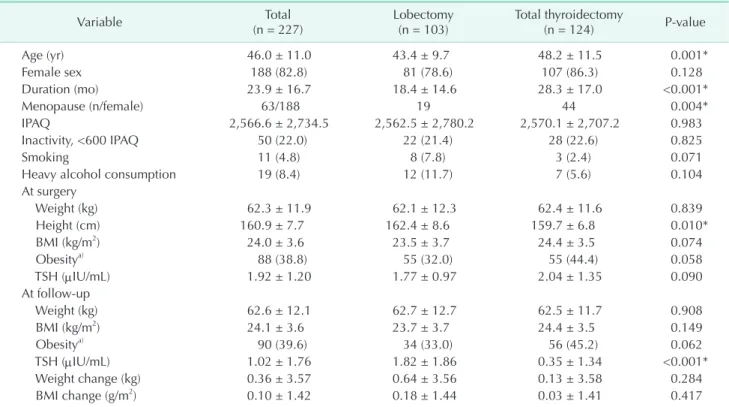
The mean followup duration was 23.9 ± 16.7 months (range, 3.0–69.0 months). At the time of surgery, 38.8% of the patients were obese. Postthyroidectomy obesity was observed in 90 of the 227 patients (39.6%; Table 1).
Comparison between lobectomy and TT
The TT group was older than the lobectomy group and had no difference between men and women. Menopause in women was more frequent in the TT group than in lobectomy group (P < 0.05). The prevalence of postthyroidectomy tended to be higher tendency in the TT group than in the lobectomy group (P = 0.062). The followup period of the TT group (28.3 ± 17.0 months) was longer than that of the lobectomy group (18.4 ± 14.6 months). The postoperative TSH level was 1.82 ± 1.86 μIU/
mL in the lobectomy group and 0.35 ± 1.34 μIU/mL in the TT group, and the weight increase after surgery was 0.45 ± 0.38 kg and 0.17 ± 0.36 kg, respectively, with no significant difference between the 2 groups (P = 0.608). The BMI increased by 0.09 ± 0.41 kg/m2 in the lobectomy group and by 0.04 ± 0.14 kg/m2 in the TT group, with no significant difference between the groups (P = 0.417) (Table 1).
Predictors of postthyroidectomy obesity
In the univariate analysis, the predictors of postthyroidectomy obesity were older age (P = 0.001), female sex (P = 0.001), alcohol drinking (P = 0.029), and higher preoperative BMI (P <
0.001) (Table 2).
In the multivariate analysis, preoperative BMI (P < 0.001), heavy alcohol consumption (P = 0.026), and followup duration (P < 0.035) were independent predictors of postthyroidectomy obesity (Table 2).
DISCUSSION
The increasing rate of obesity in Korea, as well as in Western countries, is a growing public health problem [8]. According to the data from the 2015 Korea National Health and Nutrition Examination Survey for Korean adults aged 19 years or older,
the prevalence of obesity (BMI ≥ 25 kg/m2) is about 40% for men and 26% for women, i.e., onethird of Korean adults are obese [8,9]. In this retrospective cohort study, we evaluated the relationship between thyroidectomy and obesity. Patients who undergo thyroidectomy are frequently concerned about weight gain after the initial treatment, but there are few data about weight changes in thyroid cancer patients undergoing thyroidectomy and the results are controversial [9]. In our present study, 38.8% (88 of 227) patients were obese at the time of surgery and 39.6% (90 of 227) showed postthyroidectomy obesity during followup.
Previous research reported inconsistent associations between different degrees of obesity as a postoperative outcome [9]. Our study focused on the relationship between thyroidectomy in thyroid cancer patients and obesity, and considered the extent of thyroid resection as a contributing factor to postoperative obesity. Several studies have investigated whether or not thyroid cancer patients gain weight after thyroidectomy.
Kitahara et al. [1] compared 120 thyroid cancer patients who showed normal thyroid functions after TT with 120 patients who showed normal thyroid functions after treatment for hypothyroidism. Jonklaas and NsouliMaktabi [5] found that the TT group showed a much higher weight gain for a year. Thyroid cancer survivors who had developed iatrogenic hyperthyroidism after TT did not lose weight because of hyperthyroidism and had agingrelated increases in body mass [10]. However, another study that compared 102 thyroid cancer patients who had normal thyroid function after TT with 92 Table 2. Univariate and multivariate analysis of predictors asso ciated with postthyroidectomy obesity (BMI ≥ 25 kg/m2)
Variable Univariate analysis P-value
Multivariate analysis OR (95% CI) P-value
Age (yr) 0.626
Female sex 0.658
Duration (mo) 0.039 1.032 (1.002–1.063) 0.035 Menopause state 0.615
IPAQ 0.782
Smoking 0.369
Alcohol
consumption 0.059 6.492 (1.250–33.712) 0.026 Preopeative BMI
(kg/m2) <0.001 3.945 (2.646–5.883) <0.001 Total thyroidectomy 0.920
Preoperative TSH
(μIU/mL) 0.697
Postoperative TSH
(μIU/mL) 0.346
Variables with P < 0.10 in the univariate analysis were included in the multivariate analysis.
BMI, body mass index; OR, odds ratio; CI, confidence interval;
IPAQ, International Physical Activity Questionnaire.
thyroid nodule patients who had normal thyroid function reported no significant difference in the weight change and BMI between the 2 groups [4,6].
Obesity is generally believed to be a risk factor for the development of postoperative complications [6]. Although being obese is believed to be associated with medical hazards, recent literature shows no convincing data to support this assumption [11]. In our study, patients who were already overweight or had high BMI at the time of surgery had a higher risk of obesity after thyroidectomy. The preoperative BMI was significantly associated with postoperative BMI (Pearson correlation, r = 0.923, P < 0.001), and 39.6% of the participants showed postoperative obesity (odds ratio, 3.945; P < 0.001)
Previous exposures of the neck area to radiation, excessive iodine intake, chronic autoimmune thyroiditis, and obesity are some of the known risk factors of the increased incidence of thyroid cancer [1,7,12]. It is wellknown that higher BMI leads to higher the risks for various cancers, such as colon cancer, pancreatic cancer, and breast cancer, or endometrial cancer in menopausal women [13,14]. There are reports that adipocyte proliferation and the action of adipocytokines in obese people cause insulin resistance and inflammation, which interacts with thyroid with and affects the occurrence of thyroid cancer [15,16].
Patients with differentiated thyroid epithelial cancer ex
perienced significant weight gain compared to their baseline weight after TT with ongoing TSH suppression [17]. Obesity is not only related to thyroid cancers, but is also closely related to the actual function of the thyroid. It is widely known that hyperthyroidism may cause weight loss and that hypothyroidism may cause weight gain; accordingly, hyperthyroidism treatment may lead to weight gain and hypothyroidism treatment to weight loss [18]. Many population studies have reported a positive correlation between blood TSH levels and the BMI of obese people [17,18]. In our study, the mean TSH level was 1.92 ± 1.20 μIU/mL (range, 0.01–10.48 μIU/
mL). At the time of the survey, the mean weight was 62.6 ± 12.1 kg (range, 41.9–115.1 kg); the mean BMI was 24.1 ± 3.6 kg/m2 (range, 16.0–37.4 kg/m2); the mean TSH level was 1.02 ± 1.76 μIU/
mL (range, 0.01–10.48 μIU/mL). We provided thyroid hormone replacement therapy with levothyroxine after thyroidectomy and suppressed the TSH level according to the American Thyroid Association Guideline Taskforce on Thyroid Nodules and Differentiated Thyroid Cancer 2009, which explains why the TSH level was higher in the thyroid lobectomy group than in the TT group. Although the weight gain was higher in the thyroid lobectomy group than in the TT group, the differences in weight change and BMI change between the 2 groups were not statistically significant (P = 0.284 and P = 0.417, respectively) even when iatrogenic hyperthyroidism with thyroid hormone replacement therapy after TT was compared
with thyroid lobectomy.
A few studies on the impact of thyroid function on lipid metabolism are available. Bel Lassen et al. [19] proposed that endogenous subclinical hyperthyroidism after thyroidectomy may directly affect lipid profiles after thyroidectomy. Jung et al. [20] suggested that changes in thyroid function after thyroidectomy can be associated with changes in the concentration and functions of lipid profiles.
Recreational alcohol intake is common across the globe and health and social problems resulting from alcohol consumption are becoming a concern [21,22]. The relationship between alcohol intake and body weight has been extensively studied over the past years [21,22]. Our results show the risk of obesity after surgery in the alcohol consumption group was 6.492 times that of the group that did not consume alcohol.
Patients who underwent TT surgery tended to be older and had a longer followup period than patients who underwent lobectomy (P < 0.001). We perform thyroid lobectomy when patients have a low risk of papillary thyroid cancer according to the American Thyroid Association guidelines. Recently, thyroid lobectomy has been performed more frequently than in the past because surgeons and patients tend to prefer it to TT if there are no oncological problems [23]. This resulted in a difference of about 1 year in the followup duration between 2 groups. Although we adjusted for the time factor, it could be a limitation of our study. The small sample size was another limiting factor in this study, and largerscale studies and randomized prospective studies would be needed in the future.
Limitations of the study also include the retrospective nature of the data, so our study should be viewed as descriptive and hypothesis generating and not establishing causality. Another limitation was our inability to ascertain the difference in weight measurement error between various scales, because weights were measured during routine clinical care by multiple providers.
In conclusion, the extent of thyroidectomy does not signi
ficantly affect postthyroidectomy obesity. Preoperative obesity and heavy alcohol consumption are risk factors for postthyroidectomy obesity. Future welldesigned larger studies and life style management for obesity control are needed.
CONFLICTS OF INTEREST
No potential conflict of interest relevant to this article was reported.
ACKNOWLEDGEMENTS
This paper was written as part of Konkuk University's research support program for its faculty on sabbatical leave in 2016.
REFERENCES
1. Kitahara CM, Platz EA, Freeman LE, Hsing AW, Linet MS, Park Y, et al. Obesity and thyroid cancer risk among U.S. men and women: a pooled analysis of five prospective studies. Cancer Epidemiol Biomarkers Prev 2011;20:46472.
2. Jung KW, Won YJ, Kong HJ, Oh CM, Seo HG, Lee JS. Cancer statistics in Korea: inci
dence, mortality, survival and prevalence in 2010. Cancer Res Treat 2013;45:114.
3. Chen AY, Jemal A, Ward EM. Increasing incidence of differentiated thyroid cancer in the United States, 19882005. Cancer 2009;115:38017.
4. Sohn SY, Joung JY, Cho YY, Park SM, Jin SM, Chung JH, et al. Weight changes in patients with differentiated thyroid car
ci noma during postoperative longterm fol lowup under thyroid stimulating hor mone suppression. Endocrinol Metab (Seoul) 2015;30:34351.
5. Jonklaas J, NsouliMaktabi H. Weight changes in euthyroid patients undergoing thyroidectomy. Thyroid 2011;21:134351.
6. Weinreb JT, Yang Y, Braunstein GD. Do patients gain weight after thyroidectomy for thyroid cancer? Thyroid 2011;21:1339
42.
7. Han JM, Kim TY, Jeon MJ, Yim JH, Kim WG, Song DE, et al. Obesity is a risk fac tor for thyroid cancer in a large, ultra sono gra
phi cally screened population. Eur J Endo
crinol 2013;168:87986.
8. Baik I. Forecasting obesity prevalence in Korean adults for the years 2020 and 2030 by the analysis of contributing factors.
Nutr Res Pract 2018;12:2517.
9. Milone M, Musella M, Conzo G, Cam
pana G, De Filippo D, Coretti G, et al.
Thy roi dectomy in high body mass index pa tients: a single center experience. Int J Surg 2016;28 Suppl 1:S3841.
10. Polotsky HN, Brokhin M, Omry G, Polotsky AJ, Tuttle RM. Iatrogenic hyper
thyroidism does not promote weight loss or prevent ageingrelated increases in body mass in thyroid cancer survivors.
Clin Endocrinol (Oxf) 2012;76:5825.
11. Tjeertes EK, Hoeks SE, Beks SB, Valentijn TM, Hoofwijk AG, Stolker RJ. Obesitya risk factor for postoperative complications in general surgery? BMC Anesthesiol 2015;
15:112.
12. Pellegriti G, Frasca F, Regalbuto C, Squa
trito S, Vigneri R. Worldwide increasing incidence of thyroid cancer: update on epidemiology and risk factors. J Cancer Epidemiol 2013;2013:965212.
13. Renehan AG, Tyson M, Egger M, Heller RF, Zwahlen M. Bodymass index and incidence of cancer: a syste matic review and metaanalysis of pro spec tive observational studies. Lancet 2008;371:
56978.
14. Calle EE, Kaaks R. Overweight, obesity and cancer: epidemiological evidence and proposed mechanisms. Nat Rev Cancer 2004;4:57991.
15. PazaitouPanayiotou K, Polyzos SA, Mantzoros CS. Obesity and thyroid can
cer: epidemiologic associations and under
lying mechanisms. Obes Rev 2013;14:
100622.
16. Santini F, Marzullo P, Rotondi M, Cecca
rini G, Pagano L, Ippolito S, et al. Mecha
nisms in endocrinology: the cross talk bet
ween thyroid gland and adipose tissue:
signal integration in health and disease.
Eur J Endocrinol 2014;171:R13752.
17. Díez JJ, Iglesias P. Relationship between thyro tropin and body mass index in euthy roid subjects. Exp Clin Endocrinol Dia betes 2011;119:14450.
18. Pearce EN. Thyroid hormone and obesity.
Curr Opin Endocrinol Diabetes Obes 2012;
19:40813.
19. Bel Lassen P, Kyrilli A, Lytrivi M, Ruiz Patino M, Corvilain B. Total thyroidec
tomy: a clue to understanding the meta
bolic changes induced by subclinical hyper thyroidism? Clin Endocrinol (Oxf) 2017;86:2707.
20. Jung KY, Ahn HY, Han SK, Park YJ, Cho BY, Moon MK. Association between thy
roid function and lipid profiles, apolipo
proteins, and highdensity lipopro tein fun ction. J Clin Lipidol 2017;11:134753.
21. Traversy G, Chaput JP. Alcohol consum
ption and obesity: an update. Curr Obes Rep 2015;4:12230.
22. MaldonadoMolina MM, Reingle JM, Tobler AL, Komro KA. Effects of beverage
specific alcohol consumption on drinking be haviors among urban youth. J Drug Educ 2010;40:26580.
23. Sarkar S, Banerjee S, Sarkar R, Sikder B. A review on the history of 'thyroid surgery'.
Indian J Surg 2016;78:326.