한국환경보건학회지, 제47권 제1호(2021) J Environ Health Sci. 2021; 47(1): 1-19
1
pISSN: 1738-4087 eISSN: 2233-8616 https://doi.org/10.5668/JEHS.2021.47.1.1
어린이제품 내 프탈레이트류 및 대체제의 규제와 독성자료에 대한 연구
이인혜* · 나진성** · 지경희***†
*용인대학교 자연과학연구소, **한국생산기술연구원, ***용인대학교 산업환경보건학과
Regulation of Phthalates and Their Alternatives in Children’s Products and Their Toxicity Data
Inhyae Lee*, Jinsung Ra**, and Kyunghee Ji***†
*Institute of Natural Science, Yongin University
**Regulatory Chemical Analysis & Risk Assessment Center, Korea Institute of Industrial Technology
***Department of Occupational and Environmental Health, Yongin University
ABSTRACT
Objectives: Phthalates, which are widely used as plasticizers, have been recognized as endocrine disruptors. In the present study, we provided information on the regulation of these chemicals and summarized the information available on their detection and toxicity in children’s products and those of their alternatives.
Methods: The regulatory frameworks related to phthalates in children’s products in Korea, the United States (US), and the European Union (EU) were compared. Data on the detection concentration of 16 phthalates and seven phthalate alternatives that could be used in polyvinyl chloride (PVC) plastic products for children as well as on their toxicity classification and endocrine disruption toxicity were collected from the literature.
Results: Korea adopted US and EU chemical standards for six phthalates (DEHP, BBP, DBP, DINP, DIDP, and DNOP), but not others (e.g., DIBP, DPP, DHP, and DCHP). Among the ten phthalates and seven substitutes for which regulatory standards were not determined, DIBP, DHP, DEHA, DIBA, DINA, and DEHT were detected in children’s products made from PVC plastic. DIBP and DHP, which have a reproductive toxicity classification of 1B, were frequently detected in PVC toys. The reproductive toxicity, estrogenicity, and anti-androgenic activity of the unregulated phthalates and their alternatives have been reported in diverse in vitro and in vivo assays.
Conclusion: The use of unregulated phthalates and their substitutes in children’s products is increasing. Further monitoring and toxicological information on phthalate alternatives is required to develop proper management plans.
Key words: Adipates, children’s products, endocrine disruption, phthalates, terephthalates
I. 서 론
일반적으로 영·유아와 어린이는 성인에 비해 소비 자 제품 내 유해화학물질 노출에 더 취약하다. 영·유
아는 손이나 물체를 입으로 가져가는 독특한 행동 특성이 있으며,1) 어린이는 성인에 비해 단위 체중 당 섭취량과 호흡량이 많기 때문에 환경유해인자에 더 많이 노출될 수 있다.2) 또한 영아는 젖병, 카시
†Corresponding author: Department of Occupational and Environmental Health, Yongin University, Yongin, 17092, Republic of Korea, Tel: +82-31-8020-2747, Fax: +82-31-8020-2886, E-mail: [email protected]
Received: 1 December 2020, Revised: 13 January 2021, Accepted: 15 January 2021 종 설 Review
2 이인혜 · 나진성 · 지경희
J Environ Health Sci 2021; 47(1): 1-19 http://www.kseh.org/
트, 유모차 등에 자주 접촉하여 이러한 제품에 포함 된 화학물질에 다빈도로 노출될 수 있다.3)이 기간 동안 신경계, 내분비계, 생식 등에 손상을 입으면 그 영향이 평생동안 지속될 수 있으며,4) 유아는 뇌혈관 장벽이 완전히 발달하지 않아 해로운 화학물질이 중 추 신경계에 쉽게 유입될 수 있다.5) 따라서 영·유아 와 어린이는 성인과 차별화된 환경보건 관리가 필요 하다.
어린이는 자주 놀거나 만지는 제품을 통해 프탈레 이트류, 비스페놀 A, 브롬화난연제, 중금속 등 다양 한 유해화학물질에 노출될 수 있다. 예를 들어, 폴 리염화비닐(polyvinyl chloride, PVC) 플라스틱 제품 에서 가소제로 사용되고 있는 프탈레이트류는 완구, 문구용품, 어린이가 사용하는 생활용품, 화장품, 개 인 위생용품에서 검출되었다.6~8)한 연구에서는 3~12 세 미만 어린이들의 이용빈도가 높은 제품을 분석하 였을 때 가방, 신발, 지우개 순으로 프탈레이트 함 량이 높게 나타났으며, di-(2-ethylhexyl) phthalate (DEHP)는 최고 627,836 mg/kg, diisononyl phthalate (DINP)는 최고 473,202 mg/kg으로 검출되었다.9)세 안제에서는 dimethyl phthalate (DMP)가 4.0~7.9 mg/
kg 범위로 검출되었다.10) 경구, 경피 노출을 통한 전 이량 시험에서는 악세서리, 놀이용 바닥매트, 물놀이 용품 등을 통해 DEHP, dibutyl phthalate (DBP), DINP의 인체 전이가 일어날 수 있음이 확인되었다.11) 프탈레이트는 플라스틱에 유연성을 더해주는 가소 제, 안정제, 점성 조절제, 유화제, 고화제의 특성이 있어 전자제품, 바닥재, 식품용기, 화장품, 혈액백, 어린이용 완구/문구용품 등 다양한 제품에 사용되어 왔다.12) 영·유아는 체내기관이나 면역 및 대사체계가 완전히 발달하지 않아 제품을 사용하는 과정에서의 프탈레이트 노출에 취약하며, 어린이들의 1일 프탈 레이트 섭취량이 어른들보다 높은 것으로 보고되었 다.13)체내에 침투한 프탈레이트는 비정상적인 호르 몬 작용을 유도하거나 정상적인 호르몬 작용을 방해 함으로써 내분비계 교란물질로 작용할 수 있으며, 정 자 수 감소,14) 성조숙증 유발,15) 불임16) 등이 야기될 수 있다. 이러한 프탈레이트의 잠재적 유해성을 피 하기 위해 가소제로서의 특성을 유지할 수 있는 다 양한 대체물질이 개발되었으며, adipate류, terephthalate 류 등이 대표적이다.
화학물질이 함유된 어린이제품의 사용이 늘어나면
서, 영·유아 및 어린이의 건강을 보호하기 위해 여 러 국가들이 어린이제품에 들어간 화학물질의 함유 량과 용출량을 규제하고 있다. 우리나라에서도 어린 이에게 미치는 노출과 건강 악영향을 최소화하기 위 해 산업통상자원부의 「어린이제품안전특별법」, 환 경부의 「환경보건법」, 「화학물질의 등록 및 평가 등에 관한 법률」등 다양한 환경보건 정책들이 적 용되고 있으며, 6종 프탈레이트(DEHP, benzyl butyl phthalate (BBP), DBP, DINP, diisodecyl phthalate (DIDP), di-n-octyl phthalate (DNOP))에 대한 기준 이 마련되어 있다. 그러나 관리부처 및 관련 법률에 따라 다르게 규제되고 있어 신규 어린이제품에 대한 관리 사각지대가 발생하고 있으며, 대체물질의 안전 성에 대한 검토가 필요한 상황이다.
본 연구에서는 어린이제품 내 프탈레이트류에 대 해 한국, 미국, 유럽이 규제하는 방법을 비교하고, PVC 플라스틱 어린이제품에 함유가 가능한 프탈레 이트류 및 대체물질의 검출현황과 독성자료를 수 집·분석하였다.
II. 연구 방법
1. 어린이제품 내 화학물질의 규제현황 조사 PVC 플라스틱 어린이제품을 관리하는 한국, 미국, 유럽의 주요 법률을 확인하여 규제대상과 해당 어린 이제품을 조사·정리하였다. 즉, 우리나라 산업통상자 원부의 「어린이제품안전특별법」, 환경부의 「환경 보건법」, 식품의약품안전처의 영·유아용 식품 용기 기준, 미국의 「소비자제품안전개선법(Consumer Product Safety Improvement Act, CPSIA)」, 유럽연 합의「신화학물질관리제도(Registration, Evaluation, Authorization, and Restriction of Chemicals, REACH)」의 규제대상 어린이제품과 프탈레이트류 물질의 규제기준을 조사하였다.
산업통상자원부의「어린이제품안전특별법」에서는 제17조, 제22조, 제25조에 근거하여 안전인증, 안전 확인, 공급자적합성확인 어린이제품을 “안전관리대 상 어린이제품”으로 명칭하고 있으며, 환경부의「환 경보건법」에서는 제24조에 근거하여 어린이용품 내 환경유해인자를 관리하고 있다. 본 연구에서는 산업 통상자원부고시 제2019-0201호 ‘어린이제품 공통안 전기준’17)에 제시된 프탈레이트계 가소제의 허용치
어린이제품 내 프탈레이트류 및 대체제의 규제와 독성자료에 대한 연구 3
http://www.kseh.org/ J Environ Health Sci 2021; 47(1): 1-19
와 ‘어린이용품 환경유해인자 사용제한 등에 관한 규정’18)에 제시된 어린이용 플라스틱 제품 내 프탈 레이트류 물질의 제한내용을 조사하였다. 또한 식품 의약품안전처에서 관리하고 있는 ‘영·유아용 식품 용 기·포장 제조에 관한 프탈레이트 기준’에 대해서도 조사하였다.19)
미국에서는 「독성물질규제법(Toxic Substances Control Act, TSCA)」, 「소비자제품안전개선법 (CPSIA)」등 국가 전체에 공통적으로 적용되는 연 방법(federal law)과 각 주가 독자적으로 기업에 적 용하는 주법(state law)에 따라 화학물질 규제가 이 루어지고 있다. 어린이제품에서의 프탈레이트류 규 제는 「소비자제품안전개선법(CPSIA)」이 적용되고 있으며, 이 법은 어린이용 제품의 안전요구사항을 강 화하기 위한 목적으로「소비자제품안전법(Consumer Product Safety Act, CPSA)」에 완구 및 육아용품에 대한 납과 프탈레이트 규제조항을 추가한 것이다. 적 용대상 품목은 만12세 이하 어린이의 완구(toy), 만 3세 이하 영·유아의 수면과 수유를 촉진하거나 빨기, 씹는 일을 돕기 위해 고안된 육아용품(child care article), 어린이의 입에 넣을 수 있는 완구(toy that can be placed in a child’s mouth)이다. 본 연구에서 는 소비자제품안전위원회(US Consumer Product Safety Commission, CPSC)가 2014년 12월 30일에 공표한 CPSIA의 개정안(2018년 4월 25일 이후에 제조·수입된 제품에 적용)20~21)을 토대로 완구 및 육 아용품에 대한 프탈레이트 기준을 조사하였다.
유럽연합에서는 「장난감 안전법(Toy Safety Directive 88/368/EEC)22)」에 따라 0~14세까지 어린 이들이 가지고 놀 수 있는 모든 제품에 대한 안전 사항을 규정하고 있으며, 완구류(toy) 및 육아용품 (childcare articles) 내 프탈레이트 가소제에 대한 지 침은 별도로 제정하여 어린이용품을 관리하고 있다 (Directive 2005/84/EC).23)이를 발전시켜 유럽위원회 (European Commission; EC)에서는 2018년 12월 18 일「신화학물질관리제도(REACH)」부속서 XVII내 Entry51 개정안24~25)을 채택하였으며, 이 개정안에는 EU 시장에 출시되는 소비자 제품에 프탈레이트 4종 의 사용을 제한하는 내용이 담겨 있다. 또한 부속서 XVII내 Entry52에 따라 어린이의 입에 닿을 수 있 는 플라스틱 육아용품과 완구류에 대해 프탈레이트 3종의 함유량을 제한하고 있다. 본 연구에서는 이 내
용을 토대로 완구와 아동보호 제품에 적용되는 프탈 레이트 기준을 조사하였다.
2. 플라스틱 어린이제품 내 프탈레이트류 및 대 체제의 검출현황과 유해성 자료 조사
미국 환경보호청(US EPA)에서 구축한 Database of Chemicals associated with Plastic Packaging (CPPdb; https://actor.epa.gov/cpcat/faces/home.xhtml) 의 CPPdb_List A (chemicals LIKELY associated with plastic packaging, 902종), CPPdb_List B (chemicals POSSIBLY associated with plastic packaging, 3,353종)를 토대로 폴리염화비닐(PVC) 플 라스틱 제품에 함유될 수 있는 173종 물질을 확인 하였다.26) 그 중 프탈레이트류 16종(DEHP, BBP, DBP, DINP, DIDP, DNOP, dicyclohexyl phthalate (DCHP), diisobutyl phthalate (DIBP), dihexyl phthalate (DHP), butoxycarbonylmethyl butyl phthalate (BCMBP), dimethoxyethyl phthalate (DMEP), decyl octyl phthalate (DOP), diallyl phthalate (DAP), diundecyl phthalate (DUDP), dibasic lead phthalate (DLP), diisoheptyl phthalate (DIHP)) 및 adipate류 대체제 6종(di-(2-ethylhexyl) adipate (DEHA), dibutyl adipate (DBA), dioctyl adipate (DOA), diisobutyl adipate (DIBA), diisodecyl adipate (DIDA), diisononyl adipate (DINA)), terephthalate류 대체제 1종(di-(2-ethylhexyl) terephthalate (DEHT))을 대상으로 유럽화학물질청(European Chemical Agency, ECHA)에 제시된 harmonized classification을 조사하였다.27) 우리나라에서 관리기 준이 설정되지 않은 프탈레이트 10종(DCHP, DIBP, DHP, BCMBP, DMEP, DOP, DAP, DUDP, DLP, DIHP)과 대체제 7종(DEHA, DBA, DOA, DIBA, DIDA, DINA, DEHT)에 대해서는 문헌에 보고된 어 린이제품 내 검출현황을 조사하였다. 프탈레이트 16 종, adipate류 대체제 6종, terephthalate류 대체제 1 종의 유해성에 관한 자료는 2020년 10월까지 게재 된 문헌 중 Pubmed, Web of Science에 ‘대상물질명 또는 CAS 번호’, ‘영향(estrogenicity/anti-estrogenicity, androgenicity/anti-androgenicity)’의 키워드를 입력해 검색하였다. 정리한 in vivo, in vitro assay는 아래와 같으며, Klimisch score 1, 2등급에 해당하는 자료로 정리하였다.28)
4 이인혜 · 나진성 · 지경희
J Environ Health Sci 2021; 47(1): 1-19 http://www.kseh.org/
• In vitro estrogen receptor (ER) binding assay, ER transactivation assay, ER reporter gene assay, E-screen assay
• In vitro androgen receptor (AR) binding assay, AR transactivation assay, AR reporter gene assay
• In vivo estrogenic/anti-estrogenic assay (Uterotrophic assay and pubertal assay)
• In vivo androgenic/anti-androgenic assay (Hershberger assay and pubertal assay)
III. 연구결과 및 고찰
1. 어린이제품 내 화학물질의 규제현황 조사
「어린이제품안전특별법」의 ‘어린이제품 공통안전 기준’에는 합성수지제 어린이제품(만 13세 이하)에 대한 6종 프탈레이트(DEHP, DBP, BBP, DINP, DIDP, DNOP)의 총 함유량 허용기준(0.1% 이하)이 제시되 어 있다(Table 1).17) ‘어린이용품 환경유해인자 사용 제한 등에 관한 규정’에는 어린이용 플라스틱 제품 (만 13세 미만)에의 DNOP(경구노출에 따른 전이량 9.9×10⁻¹ µg/cm2/min 미만, 경피노출에 따른 전이량 5.5×10⁻² µg/cm2/min 미만) 및 DINP (경구노출에 따 른 전이량 4.0×10⁻¹ µg/cm2/min 미만, 경피노출에 따 른 전이량 2.2×10⁻² µg/cm2/min 미만)의 경구노출, 경피노출 전이량 기준이 설정되어 있다(Table 1).18) 또한 ‘영·유아용, 식품 용기 제조 시 DBP, BBP를 사용해서는 안된다’는 식품용기 규정이 있다.19)
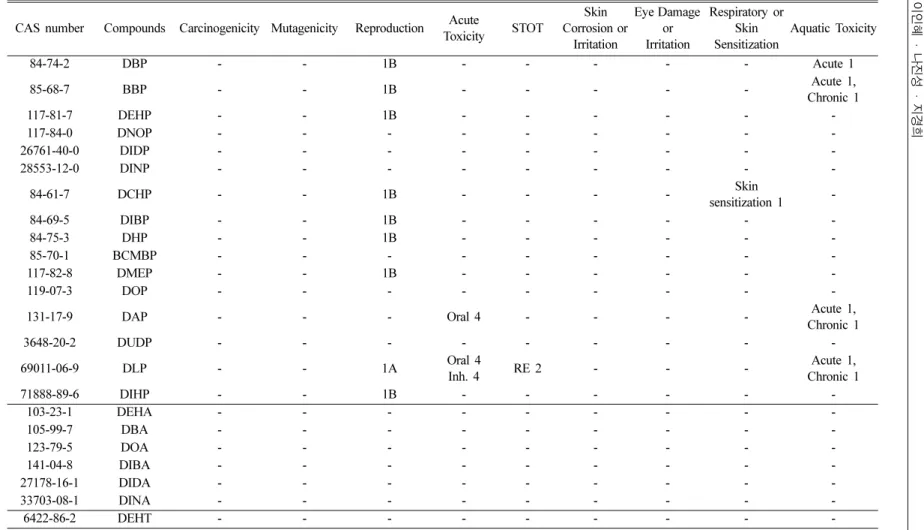
미국에서는「소비자제품안전개선법(CPSIA)」에 따 라 만3세 이하 영·유아의 육아용품과 완구 내 9종 프탈레이트류(DEHP, BBP, DBP, DINP, DIDP, DIBP, DPP, DHP, DCHP)의 함유량을 0.1% 이하로 제한하 고 있으며, 입에 닿을 수 있는 완구에 DINP의 함유 량을 0.1% 이하로 규제하고 있다(Table 1).20~21) 9종 프탈레이트 관리물질 중 6종(DEHP, DBP, BBP, DIBP, DHP, DCHP)은 세계조화시스템(GHS)에 따라 생식 독성을 유발하는 물질(group 1B)로 분류된다(Table 2).
유럽연합에서는 「신화학물질관리제도(REACH)」
부속서 XVII 내 Entry 51개정안에 따라 2020년 7 월 7일 이후 플라스틱 육아용품과 완구류에 4종 프 탈레이트류(DEHP, DBP, BBP, DIBP)가 개별 또는 혼합하여 총 함유량 허용기준(0.1%) 이상의 농도로
포함될 경우 시장 출시가 제한된다(Table 1).25)부속 서 XVII내 Entry 52에 따라 3종 프탈레이트류(DINP, DIDP, DNOP)는 어린이의 입에 닿을 수 있는 플라 스틱 육아용품과 완구류에 개별 또는 혼합하여 총 함유량 허용기준(0.1%) 이상의 농도로 포함될 경우 시장 출시가 제한된다(Table 1).24) 7종 프탈레이트 관리물질 중 4종(DEHP, DBP, BBP, DIBP)은 세계 조화시스템(GHS)에 따라 생식독성을 유발하는 물질 (group 1B)로 분류된다(Table 2).
우리나라에서는 「어린이제품안전특별법」,「환경 보건법」, 식품의약품안전처의 ‘영·유아용 식품 용기
·포장 제조에 관한 프탈레이트 기준’을 토대로 6종 프탈레이트(DEHP, DBP, BBP, DINP, DIDP, DNOP) 를 관리하고 있으나, PVC 플라스틱 어린이제품 내 포함될 수 있는 10종의 프탈레이트(DCHP, DIBP, DHP, BCMBP, DMEP, DOP, DAP, DUDP, DLP, DIHP)와 7종의 대체제(DEHA, DBA, DOA, DIBA, DIDA, DINA, DEHT)에 대해서는 구체적인 관리기 준이 설정되어 있지 않다. 미국에서는 만3세 이하 영·유아의 육아용품과 완구 내 DIBP, DHP, DCHP 함유량을 0.1% 이하로 제한하고 있으며, 유럽연합에 서도 DIBP는 플라스틱 어린이제품과 완구에 함유량 허용기준(0.1%) 이상의 농도로 포함될 경우 시장 출 시가 제한되고 있다. 제품 내 검출빈도 및 검출농도, 세계조화시스템(GHS)의 생식독성 등을 고려하여 PVC 플라스틱 어린이제품 내 프탈레이트 규제항목 과 그 기준을 업데이트할 필요가 있다.
2. 플라스틱 어린이제품 내 프탈레이트류 및 대 체제의 검출현황
PVC 플라스틱 어린이제품에서 관리기준이 설정되 지 않은 프탈레이트류 10종, adipate류 대체제 6종, terephthalate류 대체제 1종 중 검출된 자료를 Table 3에 정리하였다. 생식독성 1B 등급으로 분류된 DIBP 는 완구에서 평균 0.45~27%,29~32) 점핑볼에서 31.9%,33) 캐릭터 파우치에서 0.04%33) 검출되었으며, DHP는 완구에서 최대 0.19%34)로 검출되었다. 최근 프탈레 이트 규제가 강화되면서 adipate류(DEHA, DIBA, DINA)나 terephthalate류(DEHT)의 검출 보고가 높 아지고 있다. 만3세 이하 영·유아의 육아용품과 완 구에서 DEHA는 2~4%, DIBA는 0.6%, DINA는 4~6%, DEHT는 7~10% 검출되었으며,29) 유아용품,
어린이제품 내 프탈레이트류 및 대체제의 규제와 독성자료에 대한 연구5
http://www.kseh.org/JEnvironHealthSci2021;47(1):1-19
Table 1. Regulation of phthalates in children’s products in Korea, the United States, and the European Union
Korea The Unites States European Union
Special Act on the Safety of Children’s Products
• DEHP+BBP+DBP+DIDP+DINP+DNOP ≤0.1%
(children’s products, age ≤13)
The Consumer Product Safety Improvement Act of 2008
• DEHP ≤0.1% (child care articles and toys)
• BBP ≤0.1% (child care articles and toys)
• DBP ≤0.1% (child care articles and toys)
• DIBP ≤0.1% (child care articles and toys)
• DPP ≤0.1% (child care articles and toys)
• DHP ≤0.1% (child care articles and toys)
• DCHP ≤0.1% (child care articles and toys)
• DINP ≤0.1% (child care articles and toys which can be placed in the mouth)
Commission Regulation (EU) 2018/2005
• DEHP ≤0.1% (toys or childcare articles)
• BBP ≤0.1% (toys or childcare articles)
• DBP ≤0.1% (toys or childcare articles)
• DIBP ≤0.1% (toys or childcare articles)
• DEHP+BBP+DBP+DIBP ≤0.1% (toys or childcare articles)
Ministry of Food and Drug Safety Notice
• DBP and BBP should not be used in food containers and packaging for infants and toddlers
Environmental Health Law
• DINP oral migration limit <4.01×10⁻¹μg/cm2/min, dermal migration limit <2.20×10⁻² μg/cm2/min (children’s plastic products, age <13)
• DNOP oral migration limits <9.90×10⁻¹μg/cm2/min, dermal migration limits <5.50×10⁻² μg/cm2/min (children’s plastic products, age <13)
Commission Regulation (EU) 552/2009
• DIDP ≤0.1% (children’s products which can be placed in the mouth)
• DINP ≤0.1% (children’s products which can be placed in the mouth)
• DNOP ≤0.1% (children’s products which can be placed in the mouth)
• DIDP+DINP+DNOP ≤0.1% (children’s products which can be placed in the mouth)
Abbreviation: DEHP: di-(2-ethylhexyl) phthalate, BBP: benzyl butyl phthalate, DBP: dibutyl phthalate, DIBP: diisobutyl phthalate, DINP: diisononyl phthalate, DIDP: diisodecyl phthalate, DNOP: di-n-octyl phthalate, DPP: di-n-pentyl phthalate, DHP: di-n-hexyl phthalate, DCHP: dicyclohexyl phthalate.
6이인혜 · 나진성 · 지경희
JEnvironHealthSci2021;47(1):1-19http://www.kseh.org/
Table 2. GHS classification of 16 phthalates and 6 alternatives that can be included in PVC plastic children’s products
CAS number Compounds Carcinogenicity Mutagenicity Reproduction Acute
Toxicity STOT
Skin Corrosion or
Irritation
Eye Damage or Irritation
Respiratory or Skin Sensitization
Aquatic Toxicity
84-74-2 DBP - - 1B - - - Acute 1
85-68-7 BBP - - 1B - - - Acute 1,
Chronic 1
117-81-7 DEHP - - 1B - - - -
117-84-0 DNOP - - - -
26761-40-0 DIDP - - - -
28553-12-0 DINP - - - -
84-61-7 DCHP - - 1B - - - - Skin
sensitization 1 -
84-69-5 DIBP - - 1B - - - -
84-75-3 DHP - - 1B - - - -
85-70-1 BCMBP - - - -
117-82-8 DMEP - - 1B - - - -
119-07-3 DOP - - - -
131-17-9 DAP - - - Oral 4 - - - - Acute 1,
Chronic 1
3648-20-2 DUDP - - - -
69011-06-9 DLP - - 1A Oral 4
Inh. 4 RE 2 - - - Acute 1,
Chronic 1
71888-89-6 DIHP - - 1B - - - -
103-23-1 DEHA - - - -
105-99-7 DBA - - - -
123-79-5 DOA - - - -
141-04-8 DIBA - - - -
27178-16-1 DIDA - - - -
33703-08-1 DINA - - - -
6422-86-2 DEHT - - - -
Abbreviation: DBP: dibutyl phthalate, BBP: benzyl butyl phthalate, DEHP: di-(2-ethylhexyl) phthalate, DNOP: di-n-octyl phthalate, DIDP: diisodecyl phthalate, DINP: diisononyl phthalate, DCHP: dicyclohexyl phthalate, DIBP: Diisobutyl phthalate, DHP: dihexyl phthalate, BCMBP: butoxycarbonylmethyl butyl phthalate, DMEP: dimethoxyethyl phthalate, DOP: decyl octyl phthalate, DAP: diallyl phthalate, DUDP: diundecyl phthalate, DLP: dibasic lead phthalate, DIHP: diisoheptyl phthalate, DEHA: di-(2-ethylhexyl) adipate, DBA:
dibutyl adipate, DOA: dioctyl adipate, DIBA: diisobutyl adipate, DIDA: diisodecyl adipate, DINA: diisononyl adipate, DEHT: di-(2-ethylhexyl) terephthalate, STOT: specific target organ toxicity.
어린이제품 내 프탈레이트류 및 대체제의 규제와 독성자료에 대한 연구7
http://www.kseh.org/JEnvironHealthSci2021;47(1):1-19
Table 3. Concentrations of 10 phthalates (except 6 regulated phthalates) and 6 alternatives that can be included in PVC plastic children’s products
CAS No. Compounds Sample Location Year N Median Mean Minimum Maximum Ref.
84-69-5 DIBP
Cored blocks USA - 1 - 0.90% - - 31
Toys and childcare articles Netherlands 2007 - - 2% - - 29
Toys and childcare articles Germany, Austria, Switzerland 2007 - - 2% - - 29
Pinafores, shoes Germany, Austria, Switzerland 2007 17 - 24% - - 30
Water toys Germany, Austria, Switzerland 2007 56 - 5% - - 30
Various toys Germany, Austria, Switzerland 2007 25 - 27% - - 30
Jumping ball Korea 2020 1 - 31.9% - - 33
Character pouch Korea 2020 1 - 0.04% - - 33
Dolls India - 1 - 0.45% - - 32
84-75-3 DHP Toys Turkey - 30 - - - 0.185% 34
103-23-1 DEHA Toys and childcare articles Netherlands 2007 - - 4% - - 29
Toys and childcare articles Germany, Austria, Switzerland 2007 - - 2% - - 29
141-04-8 DIBA Toys and childcare articles Netherlands 2007 - - 0.6% - - 29
33703-08-1 DINA
Toys and childcare articles Netherlands 2007 - - 6% - - 29
Toys and childcare articles Germany, Austria, Switzerland 2007 - - 4% - - 29
Baby articles Germany, Austria, Switzerland 2007 49 - 21% - - 30
Dolls Germany, Austria, Switzerland 2007 105 - 18% - - 30
Water toys Germany, Austria, Switzerland 2007 56 - 25% - - 30
6422-86-2 DEHT
Children’s products USA 2008 14 - 21.90% 2.5% 57.9% 7
Plastic toy USA 2014 4 - 14.52% 8.37% 21.20% 35
Children’s backpack USA 2014 5 - 10.76% 5.38% 25.50% 35
Toys and childcare articles Netherlands 2007 - - 7% - - 29
Toys and childcare articles Germany, Austria, Switzerland 2007 - - 10% - - 29
Dolls Germany, Austria, Switzerland 2007 105 - 20% - - 30
Water toys Germany, Austria, Switzerland 2007 56 - 37% - - 30
Zippered spoon-chopstick storage case Korea 2020 1 - 20.63% - - 33
Character pouch Korea 2020 1 - 17.28% - - 33
Jump rope Korea 2020 1 - 19.02% - - 33
Pencil case Korea 2020 2 - 15.90% 11.49% 20.30% 33
Bathroom shoes Korea 2020 1 - 32.19% - - 33
Abbreviation: DIBP: diisobutyl phthalate, DHP: dihexyl phthalate, DEHA: di-(2-ethylhexyl) adipate, DIBA: diisobutyl adipate, DINA: diisononyl adipate, DEHT: di-(2-ethylhexyl) terephthalate.
8 이인혜 · 나진성 · 지경희
J Environ Health Sci 2021; 47(1): 1-19 http://www.kseh.org/
인형, 물놀이 장난감에서 DINA는 18~25%, DEHT 는 20~37% 검출되었다.30) DEHT는 어린이용품에서 2.5~57.9%,7) 플라스틱 완구에서 8.37~21.20%,35)어 린이용 백팩에서 5.38~25.5%35) 검출되었다. 국내에 서 유통되는 PVC 수저집, 캐릭터 파우치, 줄넘기 줄, 필통, 욕실화에서도 DEHT가 11.49~32.19%로 검출 되었다.33) PVC 플라스틱 완구에서 DEHA, DIBA, DEHT의 검출 보고가 높아지고 있고 프탈레이트 함 유량 허용기준(0.1%)에 비해 6~579배 높은 농도로 검출되고 있으므로, 이에 대한 주기적인 모니터링이 필요하다.
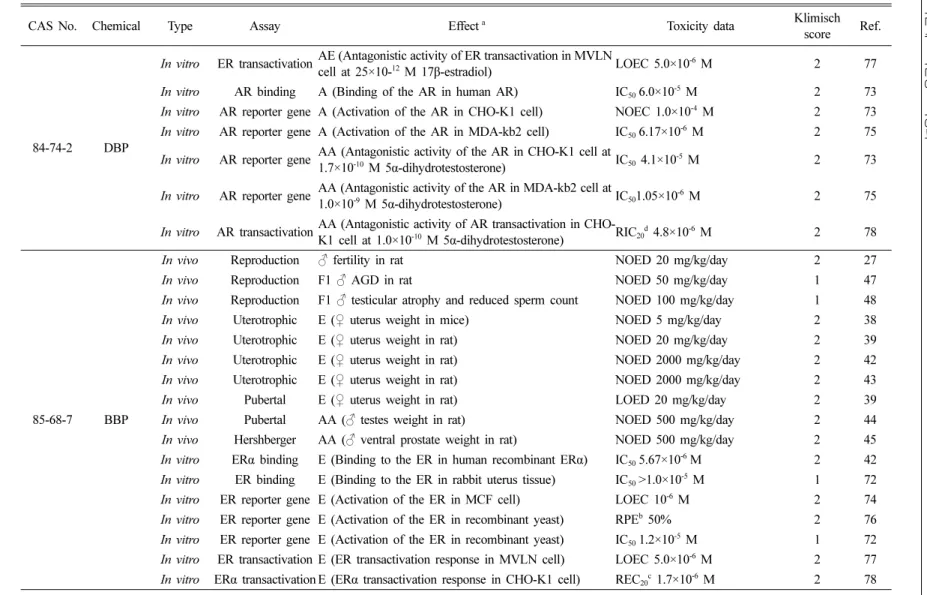
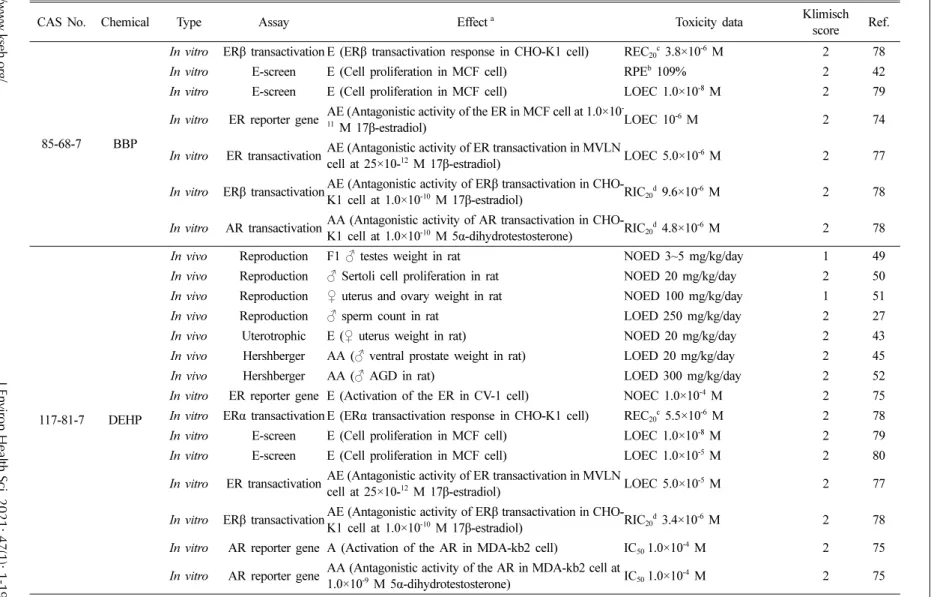
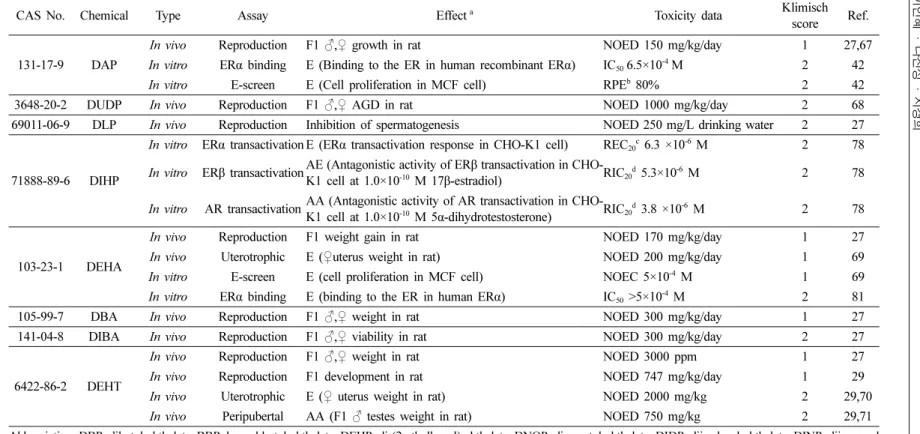
3. 프탈레이트류 및 대체제의 유해성 자료 조사 22종의 물질 중에서 17종의 프탈레이트류 및 대체 물질에 대한 생식/후세대 발달독성, 에스트로겐성, 항안드로겐성의 내분비계 교란독성 연구가 확인되었 으며, 5종의 물질(BCMBP, DMEP, DOP, DIHP, DOA)에 대해서는 이러한 유해성 연구가 필요함을 확인하였다(Table 4). In vitro 세포 실험, in vivo 동 물 실험 뿐만 아니라 역학조사에서도 임신기간 중 또는 영·유아기 동안에 프탈레이트류 물질에 노출되 면 정상적인 호르몬 조절 방해, 생식기의 정상적인 발달 및 기능 저해, 정자 수 감소,14) 성조숙증 유발,15) 자궁내막증,36)유방암 발병37) 등 다양한 건강영향이 초래될 수 있음이 확인되었다. 어린이가 제품을 통 해 프탈레이트류에 노출될 경우 서서히 그 영향이 나타나 평생 지속될 수 있으므로,4) 어린이제품 내 내분비계 교란독성의 잠재력이 큰 프탈레이트류 물 질 또는 그 대체제에 대한 지속적인 모니터링과 관 리방안 마련이 필요하다.
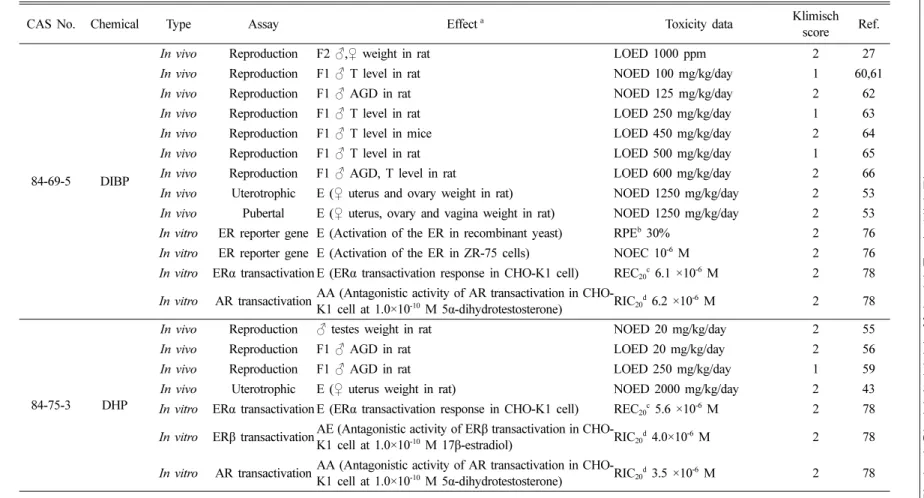
OECD 시험지침 416, 421, 422 등에 따른 설치류 의 생식/후세대 발달독성 또는 내분비계 교란독성을 연구한 문헌 중에서 프탈레이트류 12종(DBP,27,38~46) BBP,27,38~39,42~45,47~48) DEHP,27,43,45,49~52) DNOP,43,45) DIDP,43,45) DINP,27,43,45,53) DCHP,27,40,54~59) DIBP,27,53,60~66)
DHP,43,55~56,59) DAP,27,67) DUDP,68) DLP27)), adipate류 대체제 5종(DEHA,27,69) DBA,27) DIBA,27) DIDA,27) DINA27)), terephthalate류 대체제 1종(DEHT27,29,70~71)) 에 대한 결과가 보고되었다. 프탈레이트를 랫드에 노 출시켜 살펴본 Uterotrophic assay에서는 DBP, BBP, DNOP, DHP<DIDP, DINP<DEHP 순으로 estro- genicity가 높게 나타났으며,43) DIBP의 estrogenicity
가 DINP보다 높게 나타났다.53) Hershberger assay에 서 살펴본 anti-androgenicity는 BBP, DNOP, DINP
<DIDP<DBP, DEHP 순으로 높게 나타났다.45) 프탈 레이트의 생식/후세대 발달 독성 시험에서는 어미 세대에 노출된 수컷 태자의 독성이 암컷보다 민감하 게 나타났으며, DIBP의 경우 수컷 랫드의 생식독성 (NOED 125 mg/kg/day)이 암컷(NOED 625 mg/kg/
day)보다 5배 높게 나타났다.62)국내 프탈레이트 규 제는 DEHP, DBP, BBP에 중점을 두고 있는데, PVC 플라스틱 완구에서 다빈도로 보고되고 있는 DIBP 역시 DBP, BBP와 유사하거나 보다 큰 유해 영향을 유발할 수 있는 가능성이 있으므로 안전성에 대한 지속적인 검증과 관리기준 마련이 필요하다.
ER/AR binding assay, ER/AR reporter gene assay, ER/AR transactivation assay, E-Screen assay 등의 in vitro 내분비계 교란독성 시험을 통한 DBP, BBP, DEHP, DNOP, DIDP, DINP, DCHP, DIBP, DHP, DIHP, DEHT의 연구결과가 보고되었으며(Table 4), DBP, BBP, DEHP, DNOP, DIDP, DINP, DCHP, DIBP, DHP, DIHP의 에스트로겐성 및 항안드로겐성 이 확인되었다.29,42,72~81) 탄소 사슬의 길이(4~6개)가 짧은 프탈레이트류인 DCHP, DIBP, DHP는 human ERα를 활성화하거나 AR 활성을 저해함이 관찰되었 다.78) MDA-kb2 세포를 이용한 androgenicity, anti- androgenicity 시험에서는 DEHP에 비해 DBP의 독 성이 컸다.76) DEHP, DBP, BBP의 estrogenicity는 비 슷하게 나타났으나,77,79) anti-estrogenicity는 DEHP에 비해 DBP, BBP가 높게 나타났다.77) MCF 세포를 이용한 E-screen assay에서는 estrogenicity가 DBP, DHP<DEHP, BBP<DCHP82) 또는 DIDP<DNOP<
DAP<DBP<BBP 순으로 나타났다.42) 현재 규제되고 있지 않은 DHP, DAP의 내분비계 교란독성이 규제 대상 프탈레이트류보다 작지 않으므로, 이에 대한 안 전성 검증과 관리기준 마련이 필요하다. 프탈레이트 류 물질의 paired ester 그룹 및 탄화수소의 구조와 위치에 따라 내분비계 교란독성의 크기가 달라질 수 있으나, 이 물질들이 공통적으로 발현하는 독성 자 체를 줄일 수 있는 대체물질 개발이 필요하다.
Adipate류 및 terephthalate류 대체제는 프탈레이트 류 물질에 비해 가소성이 낮으며 제조비용이 비싼 편이지만, 독성이 낮다고 예측되어 대체물질로 많이 활용되고 있다.83) DBA, DIBA의 생식독성 NOED는
어린이제품 내 프탈레이트류 및 대체제의 규제와 독성자료에 대한 연구9
http://www.kseh.org/JEnvironHealthSci2021;47(1):1-19
Table 4. Toxicity data for reproduction and endocrine disruption of 16 phthalates and 7 alternatives
CAS No. Chemical Type Assay Effect a Toxicity data Klimisch
score Ref.
84-74-2 DBP
In vivo Reproduction F1 ♂ embryotoxicity in rat LOED 52 mg/kg/day 2 27
In vivo Reproduction Maternal toxicity in rat NOED 385 mg/kg/day 2 27
In vivo Uterotrophic E (♀ uterus weight in mice) NOED 5 mg/kg/day 2 38
In vivo Uterotrophic E (♀ uterus weight in rat) NOED 10 mg/kg/day 2 39
In vivo Uterotrophic E (♀ uterus weight in rat) NOED 200 mg/kg/day 2 40
In vivo Uterotrophic E (♀ uterus weight in rat) NOED 500 mg/kg/day 2 41
In vivo Uterotrophic E (♀ uterus weight in rat) NOED 2000 mg/kg/day 2 42
In vivo Uterotrophic E (♀ uterus weight in rat) NOED 2000 mg/kg/day 2 43
In vivo Pubertal E (♀ uterus weight in rat) LOED 10 mg/kg/day 2 39
In vivo Pubertal AA (♂ testes weight in rat) LOED 500 mg/kg/day 2 44
In vivo Hershberger AA (♂ ventral prostate weight in rat) LOED 20 mg/kg/day 2 45
In vivo Hershberger AA (♂ testes weight in rat) LOED 500 mg/kg/day 1 46
In vitro ER binding E (Binding to the ER in rabbit uterus tissue) IC50 >1.0×10⁻⁵M 1 72 In vitro ERα binding E (Binding to the ER in human recombinant ERα) IC50 2.75×10⁻⁵ M 2 42
In vitro ERα binding E (Binding to the ER in human ERα) IC50 2.7×10⁻⁴ M 2 73
In vitro ER reporter gene E (Activation of the ER in MCF cell) LOEC 10-5M 2 74
In vitro ER reporter gene E (Activation of the ER in MVLN cell) NOEC 1.0×10⁻⁴ M 2 73
In vitro ER reporter gene E (Activation of the ER in CV-1 cell) LOEC 1.0×10⁻⁵M 2 75
In vitro ER reporter gene E (Activation of the ER in recombinant yeast) IC50 >2.0×10⁻⁴M 1 72 In vitro ER reporter gene E (Activation of the ER in recombinant yeast) RPEb 35% 2 76 In vitro ER transactivation E (ER transactivation response in MVLN cell) LOEC 5.0×10⁻⁶M 2 77 In vitro ERα transactivation E (ERα transactivation response in CHO-K1 cell) REC20c 6.0×10⁻⁶ M 2 78
In vitro E-screen E (Cell proliferation in MCF cell) LOEC 1.0×10⁻⁸M 2 79
In vitro E-screen E (Cell proliferation in MCF cell) RPEb 106% 2 42
In vitro ER reporter gene AE (Antagonistic activity of the ER in MCF cell at 1.0×10-
11 M 17β-estradiol) LOEC 10-5M 2 74
In vitro ER reporter gene AE (Antagonistic activity of the ER in MVLN cell at
1.0×10⁻¹⁰ M 17β-estradiol) NOEC 1.0×10⁻⁴ M 2 73
10이인혜 · 나진성 · 지경희
JEnvironHealthSci2021;47(1):1-19http://www.kseh.org/
Table 4. Continued
CAS No. Chemical Type Assay Effect a Toxicity data Klimisch
score Ref.
84-74-2 DBP
In vitro ER transactivationAE (Antagonistic activity of ER transactivation in MVLN
cell at 25×10-12 M 17β-estradiol) LOEC 5.0×10⁻⁶M 2 77
In vitro AR binding A (Binding of the AR in human AR) IC50 6.0×10⁻⁵M 2 73
In vitro AR reporter gene A (Activation of the AR in CHO-K1 cell) NOEC 1.0×10⁻⁴ M 2 73 In vitro AR reporter gene A (Activation of the AR in MDA-kb2 cell) IC50 6.17×10⁻⁶ M 2 75 In vitro AR reporter gene AA (Antagonistic activity of the AR in CHO-K1 cell at
1.7×10⁻¹⁰ M 5α-dihydrotestosterone) IC50 4.1×10⁻⁵M 2 73
In vitro AR reporter gene AA (Antagonistic activity of the AR in MDA-kb2 cell at
1.0×10⁻⁹ M 5α-dihydrotestosterone) IC501.05×10-6M 2 75
In vitro AR transactivationAA (Antagonistic activity of AR transactivation in CHO-
K1 cell at 1.0×10⁻¹⁰ M 5α-dihydrotestosterone) RIC20d 4.8×10⁻⁶ M 2 78
85-68-7 BBP
In vivo Reproduction ♂ fertility in rat NOED 20 mg/kg/day 2 27
In vivo Reproduction F1 ♂ AGD in rat NOED 50 mg/kg/day 1 47
In vivo Reproduction F1 ♂ testicular atrophy and reduced sperm count NOED 100 mg/kg/day 1 48
In vivo Uterotrophic E (♀ uterus weight in mice) NOED 5 mg/kg/day 2 38
In vivo Uterotrophic E (♀ uterus weight in rat) NOED 20 mg/kg/day 2 39
In vivo Uterotrophic E (♀ uterus weight in rat) NOED 2000 mg/kg/day 2 42
In vivo Uterotrophic E (♀ uterus weight in rat) NOED 2000 mg/kg/day 2 43
In vivo Pubertal E (♀ uterus weight in rat) LOED 20 mg/kg/day 2 39
In vivo Pubertal AA (♂ testes weight in rat) NOED 500 mg/kg/day 2 44
In vivo Hershberger AA (♂ ventral prostate weight in rat) NOED 500 mg/kg/day 2 45
In vitro ERα binding E (Binding to the ER in human recombinant ERα) IC50 5.67×10⁻⁶ M 2 42 In vitro ER binding E (Binding to the ER in rabbit uterus tissue) IC50 >1.0×10⁻⁵M 1 72
In vitro ER reporter gene E (Activation of the ER in MCF cell) LOEC 10-6M 2 74
In vitro ER reporter gene E (Activation of the ER in recombinant yeast) RPEb 50% 2 76 In vitro ER reporter gene E (Activation of the ER in recombinant yeast) IC50 1.2×10⁻⁵M 1 72 In vitro ER transactivation E (ER transactivation response in MVLN cell) LOEC 5.0×10⁻⁶M 2 77 In vitro ERα transactivation E (ERα transactivation response in CHO-K1 cell) REC20c 1.7×10⁻⁶ M 2 78
어린이제품 내 프탈레이트류 및 대체제의 규제와 독성자료에 대한 연구11
http://www.kseh.org/JEnvironHealthSci2021;47(1):1-19
Table 4. Continued
CAS No. Chemical Type Assay Effect a Toxicity data Klimisch
score Ref.
85-68-7 BBP
In vitro ERβ transactivation E (ERβ transactivation response in CHO-K1 cell) REC20c 3.8×10⁻⁶ M 2 78
In vitro E-screen E (Cell proliferation in MCF cell) RPEb 109% 2 42
In vitro E-screen E (Cell proliferation in MCF cell) LOEC 1.0×10⁻⁸M 2 79
In vitro ER reporter gene AE (Antagonistic activity of the ER in MCF cell at 1.0×10-
11 M 17β-estradiol) LOEC 10-6M 2 74
In vitro ER transactivationAE (Antagonistic activity of ER transactivation in MVLN
cell at 25×10-12 M 17β-estradiol) LOEC 5.0×10⁻⁶M 2 77
In vitro ERβ transactivationAE (Antagonistic activity of ERβ transactivation in CHO-
K1 cell at 1.0×10⁻¹⁰ M 17β-estradiol) RIC20d 9.6×10⁻⁶ M 2 78
In vitro AR transactivationAA (Antagonistic activity of AR transactivation in CHO-
K1 cell at 1.0×10⁻¹⁰ M 5α-dihydrotestosterone) RIC20d 4.8×10⁻⁶ M 2 78
117-81-7 DEHP
In vivo Reproduction F1 ♂ testes weight in rat NOED 3~5 mg/kg/day 1 49
In vivo Reproduction ♂ Sertoli cell proliferation in rat NOED 20 mg/kg/day 2 50
In vivo Reproduction ♀ uterus and ovary weight in rat NOED 100 mg/kg/day 1 51
In vivo Reproduction ♂ sperm count in rat LOED 250 mg/kg/day 2 27
In vivo Uterotrophic E (♀ uterus weight in rat) NOED 20 mg/kg/day 2 43
In vivo Hershberger AA (♂ ventral prostate weight in rat) LOED 20 mg/kg/day 2 45
In vivo Hershberger AA (♂ AGD in rat) LOED 300 mg/kg/day 2 52
In vitro ER reporter gene E (Activation of the ER in CV-1 cell) NOEC 1.0×10⁻⁴ M 2 75
In vitro ERα transactivation E (ERα transactivation response in CHO-K1 cell) REC20c 5.5×10⁻⁶ M 2 78
In vitro E-screen E (Cell proliferation in MCF cell) LOEC 1.0×10⁻⁸M 2 79
In vitro E-screen E (Cell proliferation in MCF cell) LOEC 1.0×10⁻⁵M 2 80
In vitro ER transactivationAE (Antagonistic activity of ER transactivation in MVLN
cell at 25×10-12 M 17β-estradiol) LOEC 5.0×10⁻⁵M 2 77
In vitro ERβ transactivationAE (Antagonistic activity of ERβ transactivation in CHO-
K1 cell at 1.0×10⁻¹⁰ M 17β-estradiol) RIC20d 3.4×10⁻⁶ M 2 78
In vitro AR reporter gene A (Activation of the AR in MDA-kb2 cell) IC50 1.0×10⁻⁴M 2 75 In vitro AR reporter gene AA (Antagonistic activity of the AR in MDA-kb2 cell at
1.0×10⁻⁹ M 5α-dihydrotestosterone) IC50 1.0×10⁻⁴M 2 75
12이인혜 · 나진성 · 지경희
JEnvironHealthSci2021;47(1):1-19http://www.kseh.org/
Table 4. Continued
CAS No. Chemical Type Assay Effect a Toxicity data Klimisch
score Ref.
117-84-0 DNOP
In vivo Uterotrophic E (♀ uterus weight in rat) NOED 2000 mg/kg/day 2 43
In vivo Hershberger AA (♂ ventral prostate weight in rat) NOED 500 mg/kg/day 2 45
In vitro ERα binding E (Binding to the ER in human recombinant ERα) IC50 6.60×10⁻⁶ M 2 42
In vitro E-screen E (Cell proliferation in MCF cell) RPEb 35% 2 42
26761-40-0 DIDP
In vivo Uterotrophic E (♀ uterus weight in rat) NOED 200 mg/kg/day 2 43
In vivo Hershberger AA (♂ ventral prostate weight in rat) NOED 100 mg/kg/day 2 45
In vitro ERα binding E (Binding to the ER in human recombinant ERα) IC50 1.29×10⁻⁵ M 2 42
In vitro E-screen E (Cell proliferation in MCF cell) RPEb 19% 2 42
28553-12-0 DINP
In vivo Reproduction Fertility in rat NOED 500 mg/kg/day 1 27
In vivo Uterotrophic E (♀ uterus weight in rat) NOED 200 mg/kg/day 2 43
In vivo Uterotrophic E (♀ uterus and ovary weight in rat) NOED 1380 mg/kg/day 2 53
In vivo Pubertal E (♀ ovary weight in rat) LOED 276 mg/kg/day 2 53
In vivo Hershberger AA (♂ ventral prostate weight in rat) NOED 500 mg/kg/day 2 45
In vitro ER reporter gene E (Activation of the ER in recombinant yeast) RPEb 15% 2 76
84-61-7 DCHP
In vivo Reproduction Fertility in rat NOED 16~21 mg/kg/day 2 27
In vivo Reproduction F1 ♂ weight in rat LOED 10 mg/kg/day 2 54
In vivo Reproduction ♂ testes weight in rat NOED 20 mg/kg/day 2 55
In vivo Reproduction F1 ♂ AGD in rat LOED 20 mg/kg/day 2 56
In vivo Reproduction F1 ♀ AGD in rat LOED 20 mg/kg/day 2 57
In vivo Reproduction F1 ♂,♀ weight in rat NOED 500 mg/kg/day 2 58
In vivo Reproduction F1 ♂,♀ weight in rat NOED 500 mg/kg/day 1 59
In vivo Uterotrophic E (♀ uterus weight in rat) NOED 200 mg/kg/day 2 40
In vitro ERα transactivation E (ERα transactivation response in CHO-K1 cell) REC20 2.8 ×10⁻⁶ M 2 78 In vitro ERβ transactivationAE (Antagonistic activity of ERβ transactivation in CHO-
K1 cell at 1.0×10⁻¹⁰ M 17β-estradiol) REC20c 2.5 ×10⁻⁶M 2 78 In vitro AR transactivationAA (Antagonistic activity of AR transactivation in CHO-
K1 cell at 1.0×10⁻¹⁰ M 5α-dihydrotestosterone) RIC20d 3.8 ×10⁻⁶ M 2 78
어린이제품 내 프탈레이트류 및 대체제의 규제와 독성자료에 대한 연구13
http://www.kseh.org/JEnvironHealthSci2021;47(1):1-19
Table 4. Continued
CAS No. Chemical Type Assay Effect a Toxicity data Klimisch
score Ref.
84-69-5 DIBP
In vivo Reproduction F2 ♂,♀ weight in rat LOED 1000 ppm 2 27
In vivo Reproduction F1 ♂ T level in rat NOED 100 mg/kg/day 1 60,61
In vivo Reproduction F1 ♂ AGD in rat NOED 125 mg/kg/day 2 62
In vivo Reproduction F1 ♂ T level in rat LOED 250 mg/kg/day 1 63
In vivo Reproduction F1 ♂ T level in mice LOED 450 mg/kg/day 2 64
In vivo Reproduction F1 ♂ T level in rat LOED 500 mg/kg/day 1 65
In vivo Reproduction F1 ♂ AGD, T level in rat LOED 600 mg/kg/day 2 66
In vivo Uterotrophic E (♀ uterus and ovary weight in rat) NOED 1250 mg/kg/day 2 53
In vivo Pubertal E (♀ uterus, ovary and vagina weight in rat) NOED 1250 mg/kg/day 2 53 In vitro ER reporter gene E (Activation of the ER in recombinant yeast) RPEb 30% 2 76
In vitro ER reporter gene E (Activation of the ER in ZR-75 cells) NOEC 10-6 M 2 76
In vitro ERα transactivation E (ERα transactivation response in CHO-K1 cell) REC20c 6.1 ×10⁻⁶M 2 78 In vitro AR transactivationAA (Antagonistic activity of AR transactivation in CHO-
K1 cell at 1.0×10⁻¹⁰ M 5α-dihydrotestosterone) RIC20d 6.2 ×10⁻⁶ M 2 78
84-75-3 DHP
In vivo Reproduction ♂ testes weight in rat NOED 20 mg/kg/day 2 55
In vivo Reproduction F1 ♂ AGD in rat LOED 20 mg/kg/day 2 56
In vivo Reproduction F1 ♂ AGD in rat LOED 250 mg/kg/day 1 59
In vivo Uterotrophic E (♀ uterus weight in rat) NOED 2000 mg/kg/day 2 43
In vitro ERα transactivation E (ERα transactivation response in CHO-K1 cell) REC20c 5.6 ×10⁻⁶M 2 78 In vitro ERβ transactivationAE (Antagonistic activity of ERβ transactivation in CHO-
K1 cell at 1.0×10⁻¹⁰ M 17β-estradiol) RIC20d 4.0×10⁻⁶ M 2 78
In vitro AR transactivationAA (Antagonistic activity of AR transactivation in CHO-
K1 cell at 1.0×10⁻¹⁰ M 5α-dihydrotestosterone) RIC20d 3.5 ×10⁻⁶ M 2 78
14이인혜 · 나진성 · 지경희
JEnvironHealthSci2021;47(1):1-19http://www.kseh.org/
Table 4. Continued
CAS No. Chemical Type Assay Effect a Toxicity data Klimisch
score Ref.
131-17-9 DAP
In vivo Reproduction F1 ♂,♀ growth in rat NOED 150 mg/kg/day 1 27,67
In vitro ERα binding E (Binding to the ER in human recombinant ERα) IC50 6.5×10⁻⁴ M 2 42
In vitro E-screen E (Cell proliferation in MCF cell) RPEb 80% 2 42
3648-20-2 DUDP In vivo Reproduction F1 ♂,♀ AGD in rat NOED 1000 mg/kg/day 2 68
69011-06-9 DLP In vivo Reproduction Inhibition of spermatogenesis NOED 250 mg/L drinking water 2 27
71888-89-6 DIHP
In vitro ERα transactivation E (ERα transactivation response in CHO-K1 cell) REC20c 6.3 ×10⁻⁶M 2 78 In vitro ERβ transactivationAE (Antagonistic activity of ERβ transactivation in CHO-
K1 cell at 1.0×10⁻¹⁰ M 17β-estradiol) RIC20d 5.3×10⁻⁶ M 2 78
In vitro AR transactivationAA (Antagonistic activity of AR transactivation in CHO-
K1 cell at 1.0×10⁻¹⁰ M 5α-dihydrotestosterone) RIC20d 3.8 ×10⁻⁶ M 2 78
103-23-1 DEHA
In vivo Reproduction F1 weight gain in rat NOED 170 mg/kg/day 1 27
In vivo Uterotrophic E (♀uterus weight in rat) NOED 200 mg/kg/day 1 69
In vitro E-screen E (cell proliferation in MCF cell) NOEC 5×10⁻⁴ M 1 69
In vitro ERα binding E (binding to the ER in human ERα) IC50 >5×10⁻⁴M 2 81
105-99-7 DBA In vivo Reproduction F1 ♂,♀ weight in rat NOED 300 mg/kg/day 1 27
141-04-8 DIBA In vivo Reproduction F1 ♂,♀ viability in rat NOED 300 mg/kg/day 2 27
6422-86-2 DEHT
In vivo Reproduction F1 ♂,♀ weight in rat NOED 3000 ppm 1 27
In vivo Reproduction F1 development in rat NOED 747 mg/kg/day 1 29
In vivo Uterotrophic E (♀ uterus weight in rat) NOED 2000 mg/kg 2 29,70
In vivo Peripubertal AA (F1 ♂ testes weight in rat) NOED 750 mg/kg 2 29,71
Abbreviation: DBP: dibutyl phthalate, BBP: benzyl butyl phthalate, DEHP: di-(2-ethylhexyl) phthalate, DNOP: di-n-octyl phthalate, DIDP: diisodecyl phthalate, DINP: diisononyl phthalate, DCHP: dicyclohexyl phthalate, DIBP: diisobutyl phthalate, DHP: dihexyl phthalate, DAP: diallyl phthalate, DUDP: diundecyl phthalate, DLP: dibasic lead phthalate, DIHP: diisoheptyl phthalate, DEHA: di-(2-ethylhexyl) adipate, DBA: dibutyl adipate, DIBA: diisobutyl adipate, DEHT: di-(2-ethylhexyl) terephthalate, AGD: anogenital distance, ER: estrogen receptor, IC50: median inhibitory concentration, LOEC: lowest observed effective concentration, LOED: lowest observed effective dose, NOEC: no observed effective concentration, NOED: no observed effective dose, T: testosterone.
aAssay type is expressed as A (androgenicity), AA (anti-androgenicty), AE (anti-estrogenicity), and E (estrogenicity).
bThe relative proliferative effect (RPE) is expressed as a percentage of the response induced by 17β-estradiol (E2).
cThe 20% relative effective concentration (REC20) is the concentration of the test compound showing 20% of the agonistic activity of 10-9 M 17β-estradiol (E2).
dThe 20% relative inhibitory concentration (RIC20) is the concentration of the test compound showing 20% of the antagonistic activity of 10-10 M 17β-estradiol via ERβ or 10-10 M 5α-dihydrotestosterone (DHT) via AR, respectively.
어린이제품 내 프탈레이트류 및 대체제의 규제와 독성자료에 대한 연구 15
http://www.kseh.org/ J Environ Health Sci 2021; 47(1): 1-19
300 mg/kg/day로27) DBP의 생식독성 NOED 385 mg/
kg/day,27) DIBP의 생식독성 NOED 100 mg/kg/
day60~61)보다 독성이 작거나 유사하게 나타났으나
DINP의 생식독성 NOED 500 mg/kg/day27)보다는 크 게 나타났다. DEHA의 생식독성 NOED 170 mg/kg/
day27) 역시 DEHP의 생식독성 NOED 3~100 mg/kg/
day49~51)보다는 독성이 작게 나타났으나, Uterotrophic
assay를 통한 estrogenicity는 다른 규제대상 프탈레 이트류(예: DNOP)43)보다 독성이 높게 나타났다.
DEHT의 생식독성 NOED는 747 mg/kg/day로29) DEHP의 생식독성 NOED 3~250 mg/kg/day27,49~51)에 비해 독성이 작게 나타났으나, 만성적으로 노출되면 눈과 코에 이상을 초래할 수 있음이 보고되었다.83) 프탈레이트의 규제가 강해짐에 따라 대체물질들의 사용이 증가하고 있지만, 이러한 대체물질들(예:
DINA)의 안전성 검증을 위한 독성자료의 확보는 매 우 부족한 편이다. PVC 플라스틱 완구에서 보고가 증가되고 있는 DEHA, DIBA, DEHT의 내분비계 교 란독성이 기존 규제대상 프탈레이트류에 비해 현저 히 작지 않으므로, 추후 충분한 독성 자료의 확보로 안전성 검증과 모니터링이 필요하다.
IV. 결 론
본 연구에서는 어린이제품에 함유된 프탈레이트류 및 그 대체물질에 대해 한국, 미국, 유럽이 규제하 는 방법을 비교하였고, PVC 플라스틱 어린이제품에 함유가 가능한 프탈레이트류 및 대체제의 검출현황 과 독성자료를 조사하였다. 우리나라의 어린이제품 내 프탈레이트류 규제는 6종 프탈레이트(DEHP, DBP, BBP, DINP, DIDP, DNOP)에 대해 미국, 유럽연합 과 같은 기준(0.1% 이하)으로 이루어지고 있으나, 10종 프탈레이트류 및 7종 대체제는 구체적인 관리 기준이 미설정되어 있다. DIBP, DHP는 생식독성 1B 등급으로 분류되고 폴리염화비닐(PVC) 플라스틱 완 구에서도 다빈도로 보고되고 있으므로, 추후 관리기 준 마련이 필요하다. 프탈레이트 대체제가 내분비계 교란을 포함한 유해성을 잠재적으로 내포할 가능성 이 있으며, 이러한 대체물질에 대한 안전성 검증이 지속적으로 이루어질 필요가 있다.
감사의 글
본 연구는 한국산업기술평가관리원 소비자제품안 전기술기반조성사업(과제번호 20007183)의 지원을 받아 수행되었습니다.
References
1. Landrigan P, Goldman L. Children’s vulnerability to toxic chemicals: a challenge and opportunity to strengthen health and environmental policy. Health Aff. 2011; 30: 5842-5850.
2. United States Environmental Protection Agency.
Child-Specific Exposure Factors Handbook. EPA/
600/R-06/096F. 2008.
3. Stapleton HM, Klosterhaus S, Keller A, Ferguson PL, van Bergen S, Cooper E, et al. Identification of flame retardants in polyurethane foam collected from baby products. Environ Sci Technol. 2011; 45:
5323-5331.
4. Negev M, Berman T, Reicher S, Balan S, Soehl A, Goulden S, et al. Regulation of chemicals in chil- dren’s products: How U.S. and EU regulation impacts small markets. Sci Total Environ. 2018;
616-617: 462-471.
5. Landrigan PJ, Kimmel CA, Correa A, Eskenazi B.
Children’s health and the environment: public health issues and challenges for risk assessment.
Environ Health Perspect. 2004; 112(2): 257-265.
6. Akkbik M, Turksoy VA, Koçoğlu S. Simultaneous quantitative detection of 10 phthalates in PVC chil- dren’s toys by HPLC-PDA. Toxicol Mech Methods.
2020; 30(1): 33-38.
7. Babich MA, Bevington C, Dreyfus MA. Plasticizer migration from children’s toys, child care articles, art materials, and school supplies. Reg Toxicol Pharmacol. 2020; 111: 104574.
8. Koniecki D, Wang R, Moody RP, Zhu J. Phthalates in cosmetic and personal care products: concentra- tions and possible dermal exposure. Environ Res.
2011; 111: 329-335.
9. Lee JH. Study on Analytical Migration and Risk Assessment of Phthalates for Children’s Product.
Konkuk University; 2017. Doctoral Dissertation.
10. Sardar SW, Choi Y, Park N, Jeon J. Occurrence and concentration of chemical additives in consumer products in Korea. Int J Environ Res Public Health.
2019; 16: 5075.
16 이인혜 · 나진성 · 지경희
J Environ Health Sci 2021; 47(1): 1-19 http://www.kseh.org/
11. Choi IS, Choi SC. Contents and migration of heavy metals and phthalates in children’s products and phthalates in children’s products. J Kor Soc Envi- ron Eng. 2014; 36(2): 127-138.
12. Lioy PJ, Hauser R, Gennings C, Koch HM, Mirkes PE, Schwetz BA, et al. Assessment of phthalates/
phthalate alternatives in children’s toys and child- care articles: review of the report including conclu- sions and recommendation of the chronic hazard advisory panel of the consumer product safety com- mission. J. Expo. Sci. Environ. Epidemiol. 2015;
25(4): 343-353.
13. Kho YL, Jeong JY, Choi KH, Kim PG. Determina- tion of phthalate metabolites in Korean children’s urine by high performance liquid chromatography with triple quadrupole tandem mass spectrometry. J Environ Health Sci. 2008; 34(4): 271-278.
14. Kwon B, Ji K. Estrogenic and androgenic potential of phthalates and their alternatives. J Environ Health Sci. 2016; 42(3): 169-188.
15. Yum T, Lee S, Kim Y. Association between preco- cious puberty and some endocrine disruptors in human plasma. J. Environ. Sci. Health A. 2013; 48:
912-917.
16. Tranfo G, Caporossi L, Paci E, Aragona C, Romanzi D, Carolis CD, et al. Urinary phthalate monoesters concentration in couples with infertility problems. Toxicol. Lett. 2012; 213: 15-20.
17. Ministry of Trade, Industry and Energy. Ministry of Trade, Industry and Energy Notice No. 2019-201.
Notification of Revision of Common Safety Stan- dards for Children’s Products. Available: https://
www.motie.go.kr/motie/in/ay/policynotify/notify/
bbs/bbsView.do?bbs_seq_n=63555&bbs_cd_n=5.
[accessed 17 September 2020].
18. Ministry of Environment. Regulations on restric- tions on the use of environmentally harmful factors for children’s products. Available: http://www.law.
go.kr/admRulInfoP.do?admRulSeq=2100000061809
#J1835732. [accessed 17 September 2020].
19. Ministry of Food and Drug Safety. Ministry of Food and Drug Safety Notice No. 2020-43. Food Utensils, Containers, and Packaging Regulations.
Available: https://www.mfds.go.kr/brd/m_207/view.
do?seq=14529 [accessed 21 December 2020].
20. The Consumer Product Safety Improvement Act of 2008. Available: https://www.cpsc.gov/Business-- Manufacturing/Business-Education/Business-Guid- ance/Phthalates-Information. [accessed 17 Septem- ber 2020].
21. US Consumer Product Safety Commission. Toy
Safety Standard ASTM F963-17. Available: https://
www.cpsc.gov/Business--Manufacturing/Business- Education/Toy-Safety/ASTM-F-963-Chart. [accessed 17 September 2020].
22. European Commission. Directive 2005/84/EC.
Available: http://eur-lex.europa.eu/LexUriServ/Lex- UriServ.do?uri=OJ:L:2005:344:0040:0043:en:PDF [accessed 18 December 2020].
23. European Union. Toys Safety Directive 88/368/
EEC. Available: http://www.loc.gov/law/foreign- news/article/european-union-new-toy-safety-rules- enter-into-force/ [accessed 18 December 2020].
24. European Union. Commission Regulation (EU) No 552/2009 of 22 June 2009 amending Regulation (EC) No 1907/2006 of the European Parliament and of the Council on the Registration, Evaluation, Authorisation and Restriction of Chemicals (REACH) as regards Annex XVII. 2009.
25. European Union. Commission Regulation (EU) 2018/2005 of 17 December 2018 amending Annex XVII to Regulation (EC) No 1907/2006 of the European Parliament and of the Council concern- ing the Registration, Evaluation, Authorisation and Restriction of Chemicals (REACH) as regards bis(2-ethylhexyl) phthalate (DEHP), dibutyl phthal- ate (DBP), benzyl butyl phthalate (BBP) and diisobutyl phthalate (DIBP). 2018.
26. Ksenia G, Ema S. S48, CCPDBLISTA, Database of Chemicals Likely (List A) associated with Plastic Packaging (CPPdb). Available: https://zenodo.org/
record/265814#.X8C-uKZ7ky8. [accessed 27 November 2020].
27. European Chemicals Agency (ECHA). Information on Chemicals. Available: https://echa.europa.eu/
[accessed 17 September 2020].
28. Klimisch HJ, Andreae M, Tillmann U. A system- atic approach for evaluating the quality of experi- mental toxicological and ecotoxicological data.
Regul Toxicol Pharmacol. 1997; 25(1), 1-5.
29. Maag J, Lassen C, Brandt UK, Kjøholt J, Molander L, Mikelsen SH. Identification and Assessment of Alternatives to Selected Phthalates. Danish Minis- try of the Environment. Environmental Project No.
1341 2010; 2010.
30. Biedermann-Brem S, Biedermann M, Pfenninger S, Bauer M, Altkofer W, Rieger K, et al. Plasticizers in PVC toys and childcare products: what succeeds the phthalates? market survey 2007. Chromato- graphia. 2008; 68: 227-234.
31. Korfali SI, Sabra R, Jurdi M, Taleb RI. Assessment of toxic metals and phthalates in children’s toys and
어린이제품 내 프탈레이트류 및 대체제의 규제와 독성자료에 대한 연구 17
http://www.kseh.org/ J Environ Health Sci 2021; 47(1): 1-19
clays. Arch. Environ Contam Toxicol. 2013; 65:
368-381.
32. Stringer R, Labunska I, Santillo D, Johnston P, Sid- dorn J, Stephenson A. Concentrations of phthalate esters and identification of other additives in PVC children’s toys. Environ Sci Pollut Res. 2000; 7: 1- 7.
33. Ministry of Trade, Industry and Energy. Monitoring of Chemical Substances in Consumer Products and Establishment of Computerized Risk Information.
2020.
34. Akkbik M, Turksoy VA, Koçoğlu S. Simultaneous quantitative detection of 10 phthalates in PVC chil- dren’s toys by HPLC-PDA. Toxicol Mech Methods.
2019; 30(1): 33-38.
35. Xie M, Wu Y, Little JC, Marr LC. Phthalates and alternative plasticizers and potential for contact exposure from children’s backpacks and toys. J Expo Sci Environ Epidemiol. 2016; 26(1): 119-124.
36. Kim SH, Cho SH, Ihm HJ, Oh YS, Heo SH, Chun S, et al. Possible role of phthalate in the pathogen- esis of endometriosis: in vitro, animal, and human data. J Clin Endocrinol Metab. 2015; 100: E1502- E1511.
37. López-Carrillo L, Hernández-Ramírez RU, Calafat AM, Torres-Sánchez L, Galván-Portillo M, Need- ham LL, et al. Exposure to phthalates and breast cancer risk in northern Mexico. Environ Health Perspect. 2010; 118: 539-544.
38. Coldham NG, Dave M, Sivapathasundaram S, McDonnell DP, Connor C, Sauer MJ. Evaluation of a recombinant yeast cell estrogen screening assay.
Environ Health Perspect. 1997; 105: 734-742.
39. Ahmad R, Verma Y, Gautam AK, Kumar S. Assess- ment of estrogenic potential of di-n-butyl phthalate and butyl benzyl phthalate in vivo. Toxicol Ind Health. 2015; 31: 1296-1303.
40. Yamasaki K, Takeyoshi M, Yakabe Y, Sawaki M, Imatanaka N, Takatsuki M. Comparison of reporter gene assay and immature rat uterotrophic assay of twenty-three chemicals. Toxicology. 2002; 170: 21- 30.
41. Kim HS, Kang TS, Kang IH, Kim TS, Moon HJ, Kim IY, et al. Validation study of OECD rodent Uterotrophic assay for the assessment of estrogenic activity in Sprague-Dawley immature female rats. J Toxicol Environ Health Part A. 2005; 68: 2249- 2262.
42. Kim YJ, Ryu JC. Evaluation of estrogenic effects of phthalate analogues using in vitro and in vivo screening assays. Mol Cell Toxicol. 2006; 2: 106-
113.
43. Zacharewski TR, Meek Md, Clemons JH, Wu ZF, Fielden MR, Matthews JB. Examination of the in vitro and in vivo estrogenic activities of eight com- mercial phthalate esters. Toxicol Sci. 1998; 46: 282- 293.
44. Ashby J, Lefevre PA. The peripubertal male rat assay as an alternative to the Hershberger castrated male rat assay for the detection of anti-androgens, oestrogens and metabolic modulators. J Appl Toxi- col. 2000; 20: 35-47.
45. Lee BM, Koo HJ. Hershberger assay for antiandro- genic effects of phthalates. J Toxicol Environ Health A. 2007; 70: 1365-1370.
46. Barlow NJ, Mcintyre BS, Foster PMD. Male repro- ductive tract lesions at 6, 12, and 18 months of age following in utero exposure to di(n-butyl) phthal- ate. Toxicol Pathol. 2004; 32: 79-90.
47. Tyl RW, Myers CB, Marr MC, Fail PA, Seely JC, Brine DR, et al. Reproductive toxicity evaluation of dietary butyl benzyl phthalate (BBP) in rats. Reprod Toxicol. 2004; 18: 241-264.
48. Nagao T, Ohta R, Marumo H, Shindo T, Yoshimura S, Ono H. Effect of butyl benzyl phthalate in Sprague-Dawley rats after gavage administration: a two-generation reproductive study. Reprod Toxicol.
2000; 14: 513-532.
49. Blystone CR, Kissling GE, Bishop JB, Chapin RE, Wolfe GW, Foster PMD. Determination of the di- (2-ethylhexyl) phthalate NOAEL for reproductive development in the rat: importance of the retention of extra animals to adulthood. Toxicol Sci. 2010;
116(2): 640-646.
50. Li LH, Jester Jr WF, Laslett AL, Orth JM. A single dose of di-(2-ethylhexyl) phthalate in neonatal rats alters gonocytes, reduces sertoli cell proliferation, and decreases cyclin D2 expression. Toxicol Appl Pharmacol. 2000; 166(3): 222-229.
51. Tomonari Y, Kurata Y, David RM, Gans G, Kawasuso T, Katoh M. Effect of di(2-ethylhexyl) phthalate (DEHP) on genital organs from juvenile common marmosets: I. morphological and biochem- ical investigation in 65-week toxicity study. J Tox- icol Environ Health. 2006; 69: 1651-1672.
52. Jarfelt K, Dalgaard M, Hass U, Borch J, Jacobsen H, Ladefoged O. Antiandrogenic effects in male rats perinatally exposed to a mixture of di(2-ethyl- hexyl) phthalate and di(2-ethylhexyl) adipate.
Reprod Toxicol. 2005; 19: 505-515.
53. Sedha S, Gautam AK, Verma Y, Ahmad R, Kumar S. Determination of in vivo estrogenic potential of
18 이인혜 · 나진성 · 지경희
J Environ Health Sci 2021; 47(1): 1-19 http://www.kseh.org/
di-isobutyl phthalate (DIBP) and di-isononyl phthal- ate (DINP) in rats. Environ Sci Pollut Res. 2015;
22: 18197-18202.
54. Li X, Chen X, Hu G, Li L, Su H, Wang Y, et al., Effects of in utero exposure to dicyclohexyl phthal- ate on rat fetal Leydig cells. Int J Environ Res Pub- lic Health. 2016; 13: 246.
55. Ahbab MA, Barlas, N. Developmental effects of prenatal di-n-hexyl phthalate and dicyclohexyl phthalate exposure on reproductive tract of male rats: postnatal outcomes. Food Chem Toxicol. 2013;
51: 123-136.
56. Ahbab MA, Barlas N. Influence of in utero di-n- hexyl phthalate and dicyclohexyl phthalate on fetal testicular development in rats. Toxicol Lett. 2015;
233(2): 125-137.
57. Ahbab MA, Güven C, Koçkaya EA, Barlas N.
Comparative developmental toxicity evaluation of di-n-hexyl phthalate and dicyclohexyl phthalate in rats. Toxicol Ind Health. 2017; 33(9): 696-716.
58. Yamasaki K, Okuda H, Takeuchi T, Minobe Y.
Effects of in utero through lactational exposure to dicyclohexyl phthalate and p,p’-DDE in Sprague- Dawley rats. Toxicol Lett. 2009; 189: 14-20.
59. Saillenfait AM, Gallissot F, Sabaté JP. Differential developmental toxicities of di-n-hexyl phthalate and dicyclohexyl phthalate administered orally to rats. J Appl Toxicol. 2009; 29: 510-521.
60. Howdeshell KL, Wilson VS, Furr J, Lambright CR, Rider CV, Blystone CR. A mixture of five phthal- ate esters inhibits fetal testicular testosterone pro- duction in the Sprague-Dawley rat in a cumulative, dose-additive manner. Toxicol Sci. 2008; 105(1):
153-165.
61. Hannas BR, Lambright CS, Furr J, Howdeshell KL, Wilson VS, Gray Jr. LE. Dose-response assessment of fetal testosterone production and gene expres- sion levels in rat testis following in utero exposure to diethylhexyl phthalate, diisobutyl phthalate, diiso- heptyl phthalate, and diisononyl phthalate. Toxicol Sci. 2011; 123(1): 206-216.
62. Saillenfait AM, Sabaté JP, Gallissot F. Diisobutyl phthalate impairs the androgen-dependent reproduc- tive development of the male rat. Reprod Toxicol.
2008; 26: 107-115.
63. Saillenfait AM, Sabaté JP, Denis F, Antoine G, Rob- ert A, Roudot AC, et al. Evaluation of the effects of α-cypermethrin on fetal rat testicular steroidogene- sis. Reprod Toxicol. 2017; 72: 106-114.
64. Han SY, Kim HS, Han SK, Lee RD, Park KL, Yang KW. Study on the estrogenic activity of di-(2-ethyl-
hexyl) adipate in E-screen assay and uterotrophic assay. Korean J Food Sci Technol. 2000; 32(4):
964-969.
65. Wang X, Sheng N, Cui R, Zhang H, Wang J, Dai J.
Gestational and lactational exposure to di-isobutyl phthalate via diet in maternal mice decreases testos- terone levels in male offspring. Chemosphere. 2017;
172: 260-267.
66. Hannas BR, Lambright CS, Furr J, Evans N, Foster PMD, Gray EL, et al. Genomic biomarkers of phthalate-induced male reproductive developmental toxicity: a targeted RT-PCR array approach for defining relative potency. Toxicol Sci. 2012; 125(2):
544-557.
67. Borch J, Axelstad M, Vinggaard AM, Dalgaard M.
Diisobutyl phthalate has comparable anti-andro- genic effects to di-n-butyl phthalate in fetal rat tes- tis. Toxicol Lett. 2006; 163: 183-190.
68. Saillenfait AM, Gallissot F, Sabaté JP. Evaluation of the developmental toxicity of diallyl phthalate administered orally to rats. Food Chem Toxicol.
2008; 46: 2150-2156.
69. Saillenfait AM, Gallissot F, Sabaté JP, Remy A.
Prenatal developmental toxicity studies on diunde- cyl and ditridecyl phthalates in Sprague-Dawley rats. Reprod Toxicol. 2013; 37: 49-55.
70. Faber WD, Deyo JA, Stump DG, Navarro L, Ruble K, Knapp J. Developmental toxicity and uterotro- phic studies with di-2-ethylhexyl terephthalate.
Birth Defects Res B Dev Reprod Toxicol. 2007; 80:
396-405.
71. Gray LE Jr, Ostby J, Furr J, Price M, Veeramach- aneni DNR, Parks L. Perinatal exposure to the phthalates DEHP, BBP, and DINP, but not DEP, DMP, or DOTP, alters sexual differentiation of the male rat. Toxicol Sci. 2000; 58: 350-365.
72. Andersen HR, Andersson AM, Arnold SF, Autrup H, Barfoed M, Beresford NA, et al. Comparison of short-term estrogenicity tests for identification of hormone-disrupting chemicals. Environ Health Per- spect. 1999; 107: 89-108.
73. Satoh K, Nonaka R, Ohyama K, Nagai F, Ogata A, Iida M. Endocrine disruptive effects of chemicals eluted from nitrile-butadiene rubber gloves using reporter gene assay systems. Biol Pharm Bull. 2008;
31: 375-379.
74. Jobling S, Reynolds T, White R, Parker MG, Sumpter JP. A variety of environmentally persistent chemicals, including some phthalate plasticizers, are weakly estrogenic. Environ Health Perspect. 1995;
103: 582-587.
어린이제품 내 프탈레이트류 및 대체제의 규제와 독성자료에 대한 연구 19
http://www.kseh.org/ J Environ Health Sci 2021; 47(1): 1-19
75. Shen O, Du G, Sun H, Wu W, Jiang Y, Song L, et al. Comparison of in vitro hormone activities of selected phthalates using reporter gene assays. Tox- icol Lett. 2009; 191: 9-14.
76. Harris CA, Henttu P, Parker MG, Sumpter JP. The estrogenic activity of phthalate esters in vitro. Envi- ron Health Perspect. 1997; 105: 802-811.
77. Ghisari M, Bonefeld-Jorgensen EC. Effects of plas- ticizers and their mixtures on estrogen receptor and thyroid hormone functions. Toxicol Lett. 2009; 189:
67-77.
78. Takeuchi S, Iida M, Kobayashi S, Jin K, Matsuda T, Kojima H. Differential effects of phthalate esters on transcriptional activities via human estrogen receptors α and β, and androgen receptor. Toxicol- ogy. 2005; 210: 223-233.
79. Chen FP, Chein MH. Lower concentrations of phthalates induce proliferation in human breast can- cer cells. Climacteric. 2014; 17: 377-384.
80. Blom A, Ekman E, Johannisson A, Norrgren L,
Pesonen M. Effects of xenoestrogenic environmen- tal pollutants on the proliferation of a human breast cancer cell line (MCF-7). Arch Environ Contam Toxicol. 1998; 34: 306-310.
81. Kirchnawy C, Hager F, Piniella VO, Jeschko M, Washüttl M, Merti J, et al. Potential endocrine dis- rupting properties of toys for babies and infants.
PLoS One. 2020; 15(4): e0231171.
82. Okubo T, Suzuki T, Yokoyama Y, Kano K, Kano I.
Estimation of estrogenic and anti-estrogenic activi- ties of some phthalate diesters and monoesters by MCF-7 cell proliferation assay in vitro. Biol Pharm Bull. 2003; 26: 1219-1224.
83. Kim W, Gye MC. Maleficent effects of phthalates and current states of their alternatives: a review.
Korean J Environ Biol. 2017; 35(1): 21-36.
<저자정보>
이인혜(연구원), 나진성(수석연구원), 지경희(교수)