Characteristics of Inpatient Care and Rehabilitation for Acute First-Ever Stroke Patients
Won Hyuk Chang,1 Yong-Il Shin,2 Sam-Gyu Lee,3 Gyung-Jae Oh,4 Young Shil Lim,5 and Yun-Hee Kim1
1Department of Physical and Rehabilitation Medicine, Center for Prevention and Rehabilitation, Heart Vascular and Stroke Institute, Samsung Medical Center, Sungkyunkwan University School of Medicine, Seoul;
2Department of Rehabilitation Medicine, Pusan National University School of Medicine, Busan;
3Department of Physical and Rehabilitation Medicine, Chonnam National University Medical School, Gwangju;
4Department of Preventive Medicine, Wonkwang University School of Medicine, Iksan;
5Ministry of Health and Welfare, Sejong, Korea.
Received: September 24, 2013 Revised: April 11, 2014 Accepted: April 16, 2014
Corresponding author: Dr. Yun-Hee Kim, Department of Physical and Rehabilitation Medicine, Center for Prevention and Rehabilitation, Heart Vascular and Stroke Institute, Samsung Medical Center, Sungkyunkwan University School of Medicine, 81 Irwon-ro, Gangnam-gu,
Seoul 135-710, Korea.
Tel: 82-2-3410-2824, Fax: 82-2-3410-0052 E-mail: [email protected]
∙ The authors have no financial conflicts of interest.
© Copyright:
Yonsei University College of Medicine 2015 This is an Open Access article distributed under the terms of the Creative Commons Attribution Non- Commercial License (http://creativecommons.org/
licenses/by-nc/3.0) which permits unrestricted non- commercial use, distribution, and reproduction in any medium, provided the original work is properly cited.
Purpose: The purpose of this study was to analyze the status of inpatient care for acute first-ever stroke at three general hospitals in Korea to provide basic data and useful information on the development of comprehensive and systematic rehabili- tation care for stroke patients. Materials and Methods: This study conducted a retrospective complete enumeration survey of all acute first-ever stroke patients admitted to three distinct general hospitals for 2 years by reviewing medical re- cords. Both ischemic and hemorrhagic strokes were included. Survey items in- cluded demographic data, risk factors, stroke type, state of rehabilitation treatment, discharge destination, and functional status at discharge. Results: A total of 2159 patients were reviewed. The mean age was 61.5±14.4 years and the ratio of males to females was 1.23:1. Proportion of ischemic stroke comprised 54.9% and hem- orrhagic stroke 45.1%. Early hospital mortality rate was 8.1%. Among these pa- tients, 27.9% received rehabilitation consultation and 22.9% underwent inpatient rehabilitation treatment. The mean period from admission to rehabilitation consul- tation was 14.5 days. Only 12.9% of patients were transferred to a rehabilitation department and the mean period from onset to transfer was 23.4 days. Improve- ments in functional status were observed in the patients who had received inpatient rehabilitation treatment after acute stroke management. Conclusion: Our analysis revealed that a relatively small portion of patients who suffered from an acute first- ever stroke received rehabilitation consultation and inpatient rehabilitation treat- ment. Thus, applying standardized clinical practice guidelines for post-acute reha- bilitation care is needed to provide more effective and efficient rehabilitation services to patients with stroke.
Key Words: Stroke, inpatients, acute management, rehabilitation, Korea
INTRODUCTION
Stroke is a major cause of serious, long-term disability in Korea.1 In Korea, the an-
stroke symptoms. Primary diagnostic codes of I60‒68 (In- ternational Classification of Disease-10 code) were used.
Finally, only patients with confirmed diagnosis by neurolo- gists or neurosurgeons via radiologic examination, such as brain MRI or CT scan, were included. Patients with tran- sient ischemic attack (TIA) or admission after 7 days of symptom onset were excluded from this study. TIA was de- fined as symptoms resolving within 24 hours of onset and no CT or MRI evidence of acute infarction. Survey of med- ical records was performed by rehabilitation specialists for all patients. The study protocol was approved by the Institu- tional Review Boards in our institutes.
Study variables
Demographic data, a detailed history of premorbid risk fac- tors, and clinical variables were collected from medical re- cords. Demographic data of stroke patients included age, gender, years of education, and marital status. Premorbid stroke risk factors comprised TIA, hypertension, diabetes, hyperlipidemia, and cardiac disease. Based on clinical, neu- roradiological, cardiac, and hematological profiles, the sub- type of ischemic stroke was classified according to the Trail of Org 10172 in Acute Stroke Treatment (TOAST) catego- ries. The subtypes of hemorrhagic stroke were classified as intracerebral hemorrhage, subarachnoid hemorrhage, intra- ventricular hemorrhage, subdural hematoma, and epidural hematoma. Duplicate classification of the subtype of hem- orrhagic stroke was permitted.
Initial treatments of stroke other than antiplatelet therapy were identified: for example, intravenous tissue plasmino- gen activator (tPA) or intra-arterial thrombolysis in ischemic stroke and surgical treatment in hemorrhagic stroke. Dis- charge status including morality and discharge destination were assessed in all patients. We also examined clinical vari- ables included as parameters for stroke rehabilitation. Items for rehabilitation status included interval between stroke on- set to rehabilitation consultation and transfer to the rehabili- tation department.
Stroke severity and functional status of patients were col- lected at admission and discharge, respectively. Also, we ob- tained the functional status of patients transferred to the reha- bilitation department at the time of transfer. Stroke severity was assessed by the Korean version of the National Institute of Health Stroke Scale (K-NIHSS).14 Functional status was obtained by common, well-validated tests as follows: cogni- tive function as the Korean Mini-Mental Status Examination (K-MMSE),15 language function as the Aphasia Quotients nual incidence of stroke has increased gradually, while the
stroke mortality rate has decreased gradually.2 Since many stroke survivors are left with stroke sequelae to some de- gree, disability after stroke is an important burden to pa- tients, caregivers, and society.3 Therefore, considering the increase in stroke prevalence, the burden of post-stroke dis- ability has garnered greater importance to public health.4
Rehabilitation from stroke comprises multidisciplinary supportive services, from intervention during acute stages to the management of chronic complications.4 It is well known that stroke rehabilitation should begin as soon as di- agnosis has been established and is medically feasible. Pre- vious studies have identified that functional outcomes are better when patients are mobilized and start rehabilitation in the acute phase of their disease.5-7 Furthermore, intensive rehabilitation therapy improves functional outcomes and quality of life and lessens the burden of caregivers of stroke patients.8-10 However, several reports have explained that failure to undergo rehabilitation treatment is associated with several factors, such as ignorance of rehabilitation treat- ment or insufficient communication between doctors and patients.11-13 Although a few reports have assessed the status of stroke rehabilitation in Korea, no complete enumeration survey of multiple centers have been conducted.11,13
The aim of this study was to analyze the status of inpa- tient care for acute first-ever stroke patients at three general hospitals in Korea to provide basic data and useful informa- tion for developing comprehensive and systematic rehabili- tation care for stroke patients in Korea. To our knowledge, this is the first multi-centered enumeration survey in Korea to investigate the characteristics of inpatient rehabilitation care for all first-ever stroke patients.
MATERIALS AND METHODS
Patient population
We identified all patients aged 18 years or older who were admitted to the three representative hospitals in three dis- tinct areas of Korea under a diagnosis of acute first-ever stroke during the two-year period between January 2008 and December 2009. Hospitals were selected from a metro- politan district (Samsung Medical Center), a midsized city (Pusan National University Hospital), and a rural county (Chonnam National University Hospital). Acute stroke pa- tients were defined as patients with ischemic or hemorrhag- ic stroke who were admitted within 7 days from the onset of
Demographic characteristics
The demographic characteristics of the patients are shown in Fig. 2. Overall, the proportion of males (55.1%) was greater than females (44.9%), which was consistent for all three hospitals. Mean age was 61.5±14.4 years. Age distribution of the stroke patients showed the highest proportion for pa- tients in their 8th decade (23.4%), followed by those in their 7th (22.9%) and 6th (20.8%) decades of life. Overall, 70%
of the subjects were married and only 5% were single. Edu- cation level under elementary school was most common in the overall population. However, education level over uni- versity was most common in Samsung Medical Center.
Premorbid risk factors
Among the patients with stroke, the prevalence of premor- bid risk factors was as follows: hypertension (50.2%), diabe- tes (18.3%), cardiac disease (7.1%), hyperlipidemia (6.1%), and TIA (2.3%). The prevalence of premorbid stroke risk factors was similar in both genders and higher in older pa- tients (Table 1).
Initial treatment of first-ever stroke patients
Intravenous tPA was used as an initial treatment in 14.4%
of acute ischemic stroke patients. Intravenous heparin treat- ment was administered in 8.7%, intra-arterial urokinase in 4.5%, stent insertion in 3.9%, intra-arterial tPA in 1.6%, and intravenous urokinase in 0.5% of ischemic stroke patients.
Antiplatelet therapy was performed in most of the ischemic stroke patients. In hemorrhagic stroke, the most frequent surgical treatment was hematoma aspiration (27.6%), fol- lowed by aneurysm coiling (19.5%) (Fig. 3).
Status of stroke rehabilitation during first admission Among the 2159 first-ever stroke patients, rehabilitation using the standardized aphasia diagnostic test,16 and mobility
as the Functional Ambulatory Category (FAC).17 Activity re- strictions were assessed via a modified Rankin Scale (mRS)18 and Glasgow Outcome Scale (GOS).19 Independence in ac- tivity of daily living was obtained by the Korean Modified Barthel Index (K-MBI).20
Statistical analyses
Statistical analyses were conducted using SPSS ver. 20.0 for Windows (SPSS Inc., Chicago, IL, USA). For descrip- tive purposes, means were calculated for continuous vari- ables and proportions for categorical variables.
RESULTS
Subjects
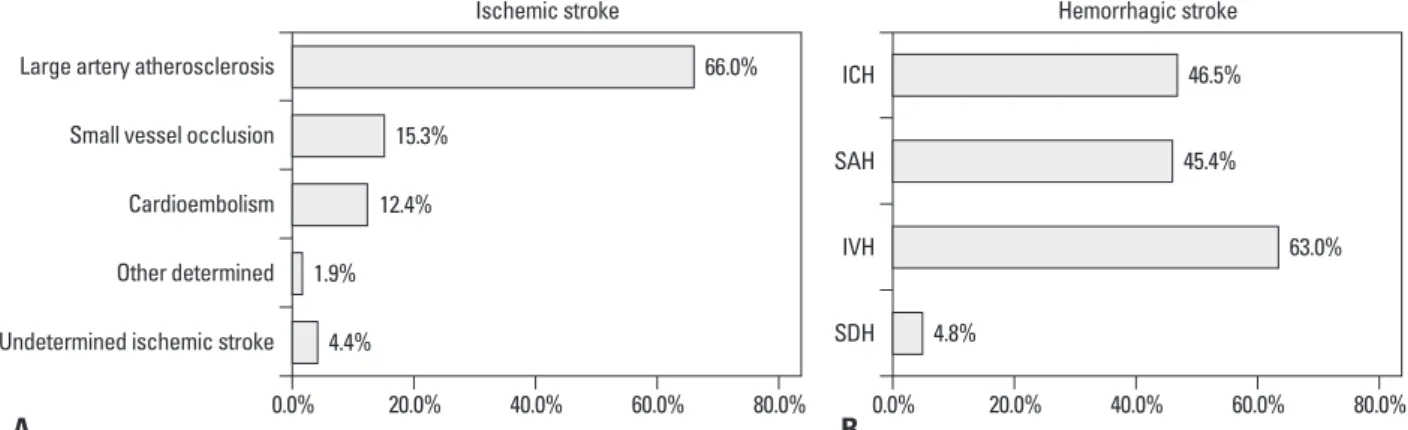
The data of 2159 patients were included in the analysis. In total, 549 patients from Samsung Medical Center, 622 from Pusan National University Hospital, and 988 from Chonnam National University Hospital were included. During the hos- pital admission period, 174 patients died, resulting in an early mortality rate of 8.1%. The early mortality rates for the three hospitals were 10.2%, 11.4%, and 4.8%, respectively. The proportion of patients with ischemic stroke comprised 54.9%
and hemorrhagic stroke 45.1%. The proportions of ischemic stroke for the three hospitals were 38.7%, 51.7%, and 66.1%, respectively. Subtypes of stroke are shown in Fig. 1. The sub- types of ischemic stroke by the TOAST classification and their proportions comprised large artery atherosclerosis (66.0%), small vessel occlusion (15.3%), and cardioembo- lism (12.4%). Hemorrhagic strokes were classified as intra- cerebral hemorrhage (46.5%), subarachnoid hemorrhage (45.4%), and intraventricular hemorrhage (63.0%).
Fig. 1. Subtypes of acute first-ever stroke. (A) Ischemic stroke. (B) Hemorrhagic stroke. ICH, intracerebral hemorrhage; SAH, subarachnoid hemorrhage;
IVH, intraventricular hemorrhage; SDH, subdural hematoma.
Undetermined ischemic stroke SDH
IVH SAH ICH
Other determined Cardioembolism Small vessel occlusion Large artery atherosclerosis
0.0% 20.0% 40.0% 60.0% 80.0% 0.0% 20.0% 40.0% 60.0% 80.0%
A B
4.4% 4.8%
63.0%
45.4%
46.5%
1.9%
12.4%
15.3%
66.0%
Ischemic stroke Hemorrhagic stroke
versity Hospital, only 19 patients (2.0%) were transferred to the rehabilitation department. The mean interval from stroke onset to rehabilitation consultation was 14.5 days, and the mean interval from stroke onset to transfer to the rehabilitation department was 23.4 days. Mean hospital stay in the rehabilitation department was 24.8 days.
According to stroke type, the rates of rehabilitation con- sultation, receiving rehabilitation therapy, and transfer to the rehabilitation department were 32.1%, 25.5%, and 10.9%
for ischemic stroke and 24.5%, 21.1%, and 15.4% for hem- orrhagic stroke, respectively. While the rates of rehabilita- tion consultation and receiving rehabilitation therapy were consultation was undertaken in 603 patients (27.9%) and
495 patients (22.9%) received rehabilitation therapy. The rates of rehabilitation consultation were 45.7%, 22.8%, and 21.3% at Samsung Medical Center, Pusan National Univer- sity Hospital, and Chonnam National University Hospital, respectively. The rates of receiving rehabilitation therapy were 42.1%, 15.6%, and 19.5% at Samsung Medical Cen- ter, Pusan National University Hospital, and Chonnam Na- tional University Hospital, respectively. However, only 279 patients (12.9%) were transferred to the rehabilitation de- partment after acute stroke management for comprehensive stroke rehabilitation (Table 2). In Chonnam National Uni-
Fig. 2. Demographic characteristics of acute first-ever stroke patients. (A) Age. (B) Sex. (C) Marital status. (D) Years of education.
Table 1. Premorbid Risk Factors in Acute First-Ever Stroke Patients
Total (%) Age group (%) Sex (%)
≤49 50‒59 60‒69 70‒79 ≥80 Male Female
Hypertension 1083 (50.2) 127 (31.3) 200 (44.5) 267 (54.0) 300 (59.4) 189 (62.0) 585 (49.2) 498 (51.3) Diabetes mellitus 396 (18.3) 41 (10.1) 61 (13.6) 106 (21.5) 119 (23.6) 69 (22.6) 229 (19.3) 167 (17.2) Cardiac disease 153 (7.1) 10 (2.5) 16 (3.6) 34 (6.9) 51 (10.1) 42 (13.8) 85 (7.1) 68 (7.0) Hyperlipidemia 131 (6.1) 14 (3.4) 22 (4.9) 32 (6.5) 41 (8.1) 22 (7.2) 75 (6.3) 56 (5.8)
TIA 50 (2.3) 6 (1.5) 11 (2.4) 9 (1.8) 15 (3.0) 9 (3.0) 34 (2.6) 16 (1.6)
Others 30 (1.4) 11 (2.8) 7 (1.6) 5 (1.0) 5 (1.0) 2 (0.7) 10 (0.8) 20 (2.1)
TIA, transient ischemic attack.
Yrs 0.0
5.0 10.0 15.0 20.0 25.0
(%)
≤49 50–59 60–69 70–79 ≥80
A B
18.8 20.8 22.9 23.4
14.1
Age Sex
Male Female 44.9%
55.1%
Yrs 0.0
10.0 20.0 30.0 40.0
(%)
0–6 7–9 10–12 ≥13 Unknown
D
36.7
14.6
26.9
19.3
2.5 Years of education
C
Marital status
Married Separated/bereavement Single Not described
5.3%
10.4%
14.3%
70.0%
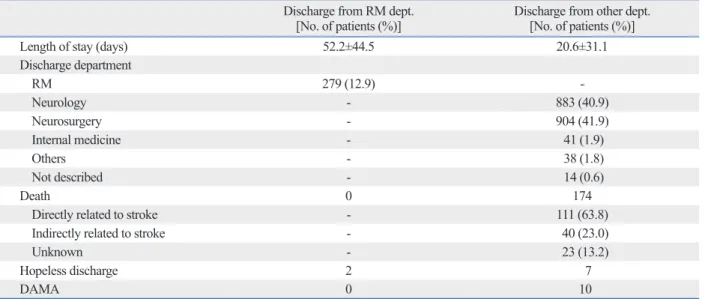
was directly related to stroke.
Stroke severity and functional status at discharge Stroke severity and functional status at the time of discharge are shown in Table 4. K-NIHSS and mRS were higher in the patients discharged from the rehabilitation department.
K-MMSE, K-MBI, and GOS scores were higher in the pa- tients discharged from other departments than those dis- charged from the rehabilitation department.
For the patients who received inpatient rehabilitation treat- ment, functional status at the time of rehabilitation transfer and discharge were analyzed. Improvement of functional status was noticed in most measurements after inpatient re- habilitation treatment: NIHSS decreased from 10.2 to 5.3;
K-MMSE was initially 17.7 and increased to 22.0 at the time of discharge; the average FAC score increased from 1.4 to 2.7; and K-MBI score increased from 35.3 to 64.3.
Global functional impairment, as measured by mRS, also improved, decreasing from 4.8 to 2.8. GOS increased from 4.2 to 4.8.
Discharge destination
Among patients discharged from the rehabilitation depart- ment, 31.9% of patients were discharged to their home and 47.7% were discharged to another hospital to continue in- patient rehabilitation treatment. Meanwhile, among patients discharged from other departments, 41.4% were discharged to their home and 41.2% were discharged to another hospi- tal for further medical or rehabilitation treatment (Table 5).
Patients who were discharged to their home had relative- ly mild strokes, as their stroke severity scale at discharge was 5.6 in K-NIHSS. Meanwhile, patients discharged to a rehabilitation hospital showed greater stroke severity of 13.1 in K-NIHSS at the time of discharge.
higher for ischemic stroke than hemorrhagic stroke, the rate of transfer to the rehabilitation department was higher for hemorrhagic stroke than ischemic stroke.
Discharge status
Among all first-ever stroke patients, 12.9% were discharged from the rehabilitation department, while 87.1% of patients were discharged from other department, such as the neurol- ogy department (40.9%), neurosurgery department (41.9%), and internal medicine department (1.9%). The mean length of total hospital stay was 52.2 days in patients who were discharged from the rehabilitation department and 20.6 days in patients who were discharged from other depart- ments. One hundred and seventy-four patients died during the admission period, which resulted in a hospital death rate of 8.1%; meanwhile, no cases of death were reported dur- ing rehabilitation. As shown in Table 3, 63.8% of mortality
Fig. 3. Initial treatment other than antiplatelet therapy for acute first-ever stroke patients. (A) Ischemic stroke. (B) Hemorrhagic stroke. IV, intravenous; tPA, tissue plasminogen activator; IA, intraarterial; UK, urokinase.
Table 2. Rehabilitation Therapy for Acute First-Ever Stroke Patients
No. of patients (%) Number of patients with RM consultation 603 (27.9) Mean interval between onset and RM
consultation (days) 14.5±46.9
Within 1 wk 149 (24.7)
1 to 2 wks 102 (16.9)
2 to 4 wks 150 (24.9)
4 to 12 wks 174 (28.9)
More than 12 wks 28 (4.6)
Number of patients received rehabilitation
therapy 495 (22.9)
Number of patients transferred to RM 279 (12.9) Mean interval between onset and RM
transfer (days) 23.4±36.8
Mean hospital days in RM (days) 24.8±20.3 RM, rehabilitation medicine.
IV UK Burr hole surgery
Crainectomy Aneurysm coiling Hematoma aspiration
IA tPA Stent insertion IA UK IV heaprin IV tPA
0.0% 5.0% 10.0% 15.0% 20.0% 0.0% 10.0% 20.0% 30.0%
A B
0.5% 4.7%
10.3%
19.5%
27.6%
1.6%
3.9%
4.5%
8.7%
14.4%
Ischemic stroke Hemorrhagic stroke
stroke patients admitted to three general hospitals in Korea.
According to the 2006 report on the Construction of a Na- tional Surveillance System for Cardiovascular and Cerebro- vascular Diseases,1 overall stroke incidence was greater in women (220/100000 person-years) than in men (213/100000 person-years) in Korea. The gender proportion in this study
DISCUSSION
This study reported details on demographic characteristics, stroke risk factors, stroke subtypes, and characteristics of initial treatment and post-acute rehabilitation for first-ever Table 3. Discharge Status of Acute First-Ever Stroke Patients
Discharge from RM dept.
[No. of patients (%)] Discharge from other dept.
[No. of patients (%)]
Length of stay (days) 52.2±44.5 20.6±31.1
Discharge department
RM 279 (12.9) -
Neurology - 883 (40.9)
Neurosurgery - 904 (41.9)
Internal medicine - 41 (1.9)
Others - 38 (1.8)
Not described - 14 (0.6)
Death 0 174
Directly related to stroke - 111 (63.8)
Indirectly related to stroke - 40 (23.0)
Unknown - 23 (13.2)
Hopeless discharge 2 7
DAMA 0 10
RM, rehabilitation medicine; dept., department; DAMA, discharged against medical advice.
Table 4. Stroke Severity and Functional Status of Stroke Patient at Transfer and Discharge
Functional status Discharge from RM dept.
[No. of patients (%)] Discharge from other dept.
[No. of patients (%)]
At transfer At discharge
K-NIHSS 10.2±7.7 (63.0) 5.3±7.7 (61.6) 4.8±7.9 (43.5)
K-MMSE 17.7±10.1 (85.1) 22.0±11.9 (79.9) 25.5±15.3 (4.7)
FAC 1.4±1.6 (78.6) 2.7±2.1 (79.8) 2.8±2.1 (36.6)
AQ 51.8±40.4 (33.1) 55.8±39.3 (35.5) 32.4±36.8 (1.2)
K-MBI 35.3±28.6 (85.5) 64.3±37.9 (82.2) 74.3±39.4 (15.7)
mRS 4.8±8.0 (48.9) 2.8±6.5 (51.4) 2.6±0.8 (31.0)
GOS 4.2±2.7 (46.4) 4.8±3.1 (52.2) 5.0±3.4 (28.9)
RM, rehabilitation medicine; dept., department; K-NIHSS, Korean version of the National Institute of Health Stroke Scale; K-MMSE, Korean Mini-Mental Status Examination; FAC, Functional Ambulatory Category; AQ, Aphasia Quotients; K-MBI, Korean Modified Barthel Index; mRS, modified Rankin Scale;
GOS, Glasgow Outcome Scale.
Values are mean±standard deviation.
Table 5. Discharge Destination
Discharge destination No. of patients (%)
Discharge from RM dept. Discharge from other dept.
Home 89 (31.9) 779 (41.4)
RM of general hospital 49 (17.6) 76 (4.0)
Other dept. of general hospital 4 (1.4) 281 (15.0)
Rehabilitation hospital 84 (30.1) 91 (4.8)
Local hospital/clinic 10 (3.6) 187 (10.0)
Others 11 (3.9) 139 (7.4)
Not described 32 (11.5) 327 (17.4)
RM, rehabilitation medicine; dept., department.
base on stroke patients in Korea.
Although early rehabilitation after stroke is an important factor in long-term functional recovery, the proportion of patients who received consultation services and who were transferred to rehabilitation departments was considerably low. Among 2159 acute first-ever stroke patients, 603 pa- tients (27.9%) received rehabilitation consultation service;
moreover, only 279 patients (12.9%) were transferred to a rehabilitation department. As well, the mean period from stroke onset to transfer was very late (23.4 days). Accord- ing to recent multi-centered prospective studies, early reha- bilitation after stroke has proven safe, efficient, and effec- tive in improving functional recovery.27,28 Importantly, the number of days from stroke onset to rehabilitation admis- sion showed a negative correlation with functional recov- ery.29 Moreover, clinical practice guidelines for stroke reha- bilitation in Korea recommend that rehabilitation treatment after stroke should be started immediately as the patient’s medical condition permits (Recommendation A, evidence level Ia), desirably within 72 hours (Recommendation B, evidence level III).30 Therefore, the importance of rehabili- tation treatment after acute stroke should be acknowledged by not only patients and their caregivers, but also medical staff, including neurologists and neurosurgeons, who are in charge of acute stroke management.
A previous report demonstrated that patients who receive rehabilitation treatment show superior gains in functional independence and fewer complications, compared to pa- tients who do not.31 In our study, the patients who had been transferred to the rehabilitation department showed obvious improvements in all functional measures for motor, cogni- tion, and language functions; a comparison with patients who did not receive inpatient rehabilitation service was not performed in this study. Meanwhile, stroke severity and functional deficits among patients who received inpatient re- habilitation treatment were greater than among patients who did not receive inpatient rehabilitation care upon first being admitted to the hospital. This implies that intensive rehabili- tation treatment was provided mostly to severe patients rath- er than patient with relatively mild stroke, whom might have needed rehabilitation services as well. This may also be the reason why the proportion of patients discharged to their home from the rehabilitation department was lower than those discharged from other departments.
There are several limitations in our study. First, this study is a retrospective study of past medical records, and some data were either missing or unavailable for analysis. De- was different with this previous report. According to age
stratification, the highest number of patients comprised those in their 8th decade (23.4%), followed by those in their 7th and 6th decades. This result was congruent with the lat- est report from the Korean Center for Disease Control, in which the age group with the highest number of patients was the 65- to 74-year-old group, followed by the 75- to 84- and the 55- to 64-year-old age groups.21 While the inci- dence and prevalence of stroke increased with age in this study, the population of patients over the age of 80 years was relatively low, much lower than the other age groups.
Among the risk factors of stroke, hypertension (50.2%) was the most frequent, followed by diabetes (18.3%), cardiac disease (7.1%), and hyperlipidemia (6.1%). These findings corresponded with prior studies from Korea and other west- ern countries, and support guideline recommendations that these factors should be strictly controlled in order to pre- vent stroke.22,23
In our study population, the proportions of ischemic and hemorrhagic strokes were different from those of Cauca- sians. The proportion of ischemic stroke was 54.9% in our study, while western countries have reported proportions of ischemic stroke from 81% to 89.1%.24-26 According to esti- mation from the database of Korean Health Insurance Re- view Agency, the incidence of ischemic stroke increased annually by 7.2% during period from 1995 to 2003. The proportion of ischemic stroke in 2003 increased to 65.2%
as a result. However, the proportion of ischemic stroke in 2003 was relatively lower than that in Caucasians.21 The rea- son for the lower incidence of ischemic stroke in our study is not clear; it may reflect bias among the institutions in- cluded in this study. Among ischemic strokes, large artery atherosclerosis (66%) was the most common type, fol- lowed by small vessel occlusion (15.3%) and cardioembo- lism (12.4%). These results are somewhat incongruent with the report of the Korean Stroke Registry study group that showed large artery atherosclerosis in 37.1%, small vessel occlusion in 23.3%, and cardioembolism in 20.5%. These inconsistencies may be related to differences between these two studies in the number of years of patient recruitment and participating institutions. Also, patients with recurrent stroke were not included in our study population, as the population in our study comprised only patients diagnosed with acute first-ever stroke. This could be another reason for discrepancy between our results and those from previ- ous studies. Nevertheless, a nationwide, long-term prospec- tive study is certainly needed to obtain a more reliable data-
land Stroke Outcomes Study. Part 2: Cognition and functional outcomes 5 years poststroke. Neurology 2010;75:1608-16.
4. Langhorne P, Bernhardt J, Kwakkel G. Stroke rehabilitation. Lan- cet 2011;377:1693-702.
5. Hayes SH, Carroll SR. Early intervention care in the acute stroke patient. Arch Phys Med Rehabil 1986;67:319-21.
6. Musicco M, Emberti L, Nappi G, Caltagirone C; Italian Multi- center Study on Outcomes of Rehabilitation of Neurological Pa- tients. Early and long-term outcome of rehabilitation in stroke pa- tients: the role of patient characteristics, time of initiation, and duration of interventions. Arch Phys Med Rehabil 2003;84:551-8.
7. Paolucci S, Antonucci G, Grasso MG, Morelli D, Troisi E, Coiro P, et al. Early versus delayed inpatient stroke rehabilitation: a matched comparison conducted in Italy. Arch Phys Med Rehabil 2000;81:695-700.
8. Bernhardt J, Dewey H, Thrift A, Collier J, Donnan G. A very early rehabilitation trial for stroke (AVERT): phase II safety and feasi- bility. Stroke 2008;39:390-6.
9. Slot KB, Berge E, Dorman P, Lewis S, Dennis M, Sandercock P, et al. Impact of functional status at six months on long term sur- vival in patients with ischaemic stroke: prospective cohort studies.
BMJ 2008;336:376-9.
10. Toschke AM, Tilling K, Cox AM, Rudd AG, Heuschmann PU, Wolfe CD. Patient-specific recovery patterns over time measured by dependence in activities of daily living after stroke and post- stroke care: the South London Stroke Register (SLSR). Eur J Neurol 2010;17:219-25.
11. Cho SC, Choi KH, Lee DJ, Ha SB. Interval between initial hospital arrival and start of rehabilitation therapy in sroke patients of tertiary medical center. J Korean Acad Rehabil Med 1998;22:9-14.
12. Kim HG, Jung SH, Lee KM, Park SW, Chun MH, Jung HY, et al.
Utilization and satisfaction of rehabilitation service in patients with brain disorders in Korea. J Korean Acad Rehabil Med 2010;
34:297-303.
13. Kim WH, Lee KB, Kim SK, Jang SN, Kim BS, Lim HJ, et al.
Utilization status of rehabilitation hospital or clinic in patients with stroke. Korean J Stroke 2005;7:144-50.
14. Oh MS, Yu KH, Lee JH, Jung S, Ko IS, Shin JH, et al. Validity and reliability of a korean version of the national institutes of health stroke scale. J Clin Neurol 2012;8:177-83.
15. Kang Y, Na DL, Hahn S. A validity study on the Korean Mini- Mental State Examination (K-MMSE) in dementia patients. J Ko- rean Neurol Assoc 1997;15:300-8.
16. Kim H, Na DL. Paradise. Korean version of Western Aphasia Bat- tery (K-WAB). 1st ed. Seoul: Paradise Welfare Foundation; 2001.
17. Holden MK, Gill KM, Magliozzi MR, Nathan J, Piehl-Baker L.
Clinical gait assessment in the neurologically impaired. Reliability and meaningfulness. Phys Ther 1984;64:35-40.
18. Burn JP. Reliability of the modified Rankin Scale. Stroke 1992;23:
438.
19. Rappaport M, Hall KM, Hopkins K, Belleza T, Cope DN. Disabil- ity rating scale for severe head trauma: coma to community. Arch Phys Med Rehabil 1982;63:118-23.
20. Jung HY, Park BK, Shin HS, Kang YK, Pyun SB, Paik NJ, et al.
Development of the Korean Version of Modified Barthel Index (K-MBI): Multi-center Study for Subjects with Stroke. J Korean Acad Rehabil Med 2007;31:283-97.
21. Hong KS, Bang OY, Kim JS, Heo JH, Yu KH, Bae HJ, et al.
Stroke Statistics in Korea: Part II Stroke Awareness and Acute Stroke Care, A Report from the Korean Stroke Society and Clini-
scriptions for functional assessments were not completed in large number of patients, especially among patients who had not been transferred to the rehabilitation department.
Second, we collected data from the three tertiary hospitals in three distinct areas of Korea, which might not fully re- flect the general characteristics of Korean stroke patients.
Despite the above mentioned limitations, this large-scale retrospective complete enumeration study provides valu- able information on the current status of medical and reha- bilitation therapy offered to patients with first-ever stroke.
Further study with multi-center prospective cohort design is needed to investigate the effects of rehabilitation on long- term functional status and quality of life of stroke patients in Korea.
In conclusion, this study described the status of medical and rehabilitation treatment offered to acute first-ever stroke patients in Korea. Although patients receiving inpatient reha- bilitation treatment after acute stroke management showed significant improvements in functional status, relatively few patients received rehabilitation consultation and inpa- tient rehabilitation treatment. Thus, applying standardized clinical practice guidelines for post-acute rehabilitation care of stroke patients is needed to provide more effective and efficient rehabilitation services for improving functional ability and quality of life therein.
ACKNOWLEDGEMENTS
We would like to thank Dr. Myung Jun Shin, Dr. Jae-Young Han, and Dr. Seung Yeol Lee for their help with this re- search. This study was supported by a grant of Research of Korea Centers for Disease Control and Prevention (2011E3 301300).
REFERENCES
1. Hong KS, Bang OY, Kang DW, Yu KH, Bae HJ, Lee JS, et al.
Stroke statistics in Korea: part I. Epidemiology and risk factors: a report from the korean stroke society and clinical research center for stroke. J Stroke 2013;15:2-20.
2. Park S, Hong SB, Kim JW, Yang YH, Park MH, Kim BN, et al.
White-matter connectivity and methylphenidate-induced changes in attentional performance according to α2A-adrenergic receptor gene polymorphisms in Korean children with attention-deficit hy- peractivity disorder. J Neuropsychiatry Clin Neurosci 2013;25:
222-8.
3. Barker-Collo S, Feigin VL, Parag V, Lawes CM, Senior H. Auck-
Stroke 1988;19:1083-92.
26. Mohr JP, Caplan LR, Melski JW, Goldstein RJ, Duncan GW, Kis- tler JP, et al. The Harvard Cooperative Stroke Registry: a prospec- tive registry. Neurology 1978;28:754-62.
27. Langhorne P, Stott D, Knight A, Bernhardt J, Barer D, Watkins C.
Very early rehabilitation or intensive telemetry after stroke: a pilot randomised trial. Cerebrovasc Dis 2010;29:352-60.
28. Tay-Teo K, Moodie M, Bernhardt J, Thrift AG, Collier J, Donnan G, et al. Economic evaluation alongside a phase II, multi-centre, randomised controlled trial of very early rehabilitation after stroke (AVERT). Cerebrovasc Dis 2008;26:475-81.
29. Inouye M, Kishi K, Ikeda Y, Takada M, Katoh J, Iwahashi M, et al. Prediction of functional outcome after stroke rehabilitation. Am J Phys Med Rehabil 2000;79:513-8.
30. Kim YH, Han TR, Jung HY, Chun MH, Lee J, Kim DY, et al.
Clinical practice guideline for stroke rehabilitation in Korea. Brain Neurorehabil 2009;2:1-38.
31. Sorbello D, Dewey HM, Churilov L, Thrift AG, Collier JM, Don- nan G, et al. Very early mobilisation and complications in the first 3 months after stroke: further results from phase II of A Very Early Rehabilitation Trial (AVERT). Cerebrovasc Dis 2009;28:378-83.
cal Research Center For Stroke. J Stroke 2013;15:67-77.
22. Jung KH, Lee SH, Kim BJ, Yu KH, Hong KS, Lee BC, et al. Sec- ular trends in ischemic stroke characteristics in a rapidly devel- oped country: results from the Korean Stroke Registry Study (sec- ular trends in Korean stroke). Circ Cardiovasc Qual Outcomes 2012;5:327-34.
23. Sacco RL, Adams R, Albers G, Alberts MJ, Benavente O, Furie K, et al. Guidelines for prevention of stroke in patients with ischemic stroke or transient ischemic attack: a statement for healthcare pro- fessionals from the American Heart Association/American Stroke Association Council on Stroke: co-sponsored by the Council on Cardiovascular Radiology and Intervention: the American Acade- my of Neurology affirms the value of this guideline. Stroke 2006;
37:577-617.
24. Bamford J, Sandercock P, Dennis M, Burn J, Warlow C. A pro- spective study of acute cerebrovascular disease in the community:
the Oxfordshire Community Stroke Project--1981-86. 2. Inci- dence, case fatality rates and overall outcome at one year of cere- bral infarction, primary intracerebral and subarachnoid haemor- rhage. J Neurol Neurosurg Psychiatry 1990;53:16-22.
25. Bogousslavsky J, Van Melle G, Regli F. The Lausanne Stroke Registry: analysis of 1,000 consecutive patients with first stroke.