ON THE DISCRETE GALERKIN METHODS FOR NONLINEAR INTEGRAL EQUATIONS
YOUNG CROON SONG
1. Introduction
We consider the discrete Galerkin and iterated discrete Galerkin method for the numerical solutionofnonlinear operator equation
(1) x = Kx,
whereK is a completely continuous operator defined on a Bana.ch space X and x is the solution to be determined. Ourmain applicationis to let X = 0[0,1], the spaceof continuous functions equipped with the norm
11 x 11
=
sup Ix(t) I, x E 0[0,1],tE[O,I]
and (1) is the nonlinear integral equation (2) x(t) - (Kx)(t)
-1
1 k(t,s,x(s» ds, t E [0,1] , x E0[0,1],withk(t,s,u) sufficiently smooth onG == [0, 1] x [0, 1] xR so that Kx E
0[0,1]. Further, it is assumed that the solution x* to be determined is geometrically isolated ( see [13] ) - that is to say, there is some ball
no
== {x EX:IIx - x*1I
$ a}, witha >0, that contains no solutions of (1) other than x*.Let 8n be a finite n - dimensional approximating subspace ofX and Kn be a completely continuous operator mapping on X. Then a solution of equation,
(3)
Received September 16, 1991. RevisedDecember 31,1991.
This work was partially supportedbyKOSEF. Project number 91-08-00-01.
may be considered an approximate equation of (1). WhenK n= PnK, where Pn is the unique orthogonal projection from.a Hilbert space containingX intoSn, the equation(3)is called the Galerkin equation.
An analysis of this method is given in Krasnoselskii et al. (1972).
Assuming Xn exists, the iterated Galerkin approximation
x
n is given by(4)
Applying the Galerkin method to the equation (2), discrete Galerkin and iterated discrete Galerkin method arises when numerical integra- tion is used to calculate the required integrals. To see the form of integrals that arises, we consider integral form of the Galerkin method applied to the equation (2). To this end, let {unoUn2 ' ... , unn } be a basis ofSn' Assume
n
xn(t) - LanjUnj(t),
;=1
t E [0,1].
Then equation (3) is equivalent to solving for {an) in the nonlinear system
(5)
n
Lan; <un"unj >
i=1
_ < [1 k(t,s,tan;un;(s))ds,unj >,
10
i=1j = 1, ... ,n,
where < .,. > denotes the usual £2[0,1] innerproduct, that is
<U,v > =
1
1u(s)v(s)ds,Assumig X n exists, iterated Galerkin approximation
x
n is given by (6) Xn(t) - (Kxn)(t)-1
1 k(t,s,xn(s)) ds, t E [0,1].To solve (5) and (6), we need the numerical integration scheme. Let In be a sequence of quadrature formulae;
(7)
m n
Inx = L Wi,mnX(ti,mJ, i=1
x E C[O,1],
with all ti,mn E [a, b] and all Wi,m n > O. Here mn is the number of abscissas. We assume that the numerical integration scheme Inx converges to Ix as n -+ 00for allx E
era,
b]. HereIx denote the usual integration,Ix =
1
1 x(t) dt.With the assumptions on the quadrature formulae, we may suppose that there exists a constant W >0 such that , for details see [6] ,
(8)
m n
LWi,mn ~ W, i=1
Vn > 1.
Ordinarily, the weights and the abscissas will be written simply as Wk and tk. Applying (7) to (5) and (6), we obtain the discrete Galerkin scheme for the integral equation (2);
n
zn(t) = Lbn,un,(t), i=1
(9)
(10)
n
Lbn, < un"u ni >n i=1
m n n
= <
L
k(t,sk, L bn,Un,(Sk»Wk,Uni >n,k=1 i=1
m n
zn(t) - L k(t, Si, Zn(Si»Wi, i=1
where < .,. >n is the discrete inner product ( see [2] ) defined by f,9 E C[O,1].
(11)
mn
< f,9 >n
= L
wld(tk)9(tk), k=lThe principal task in this paper is to show that the approximation zn converges, under suitable conditions, to an exact solution x* of (1), and to analysis the rate of this convergence. Infact we will show that , under mild conditions , zn has a higer order of convergence than the discrete Galerkin approximation Zn converging to x*. This phenomenion is known as super-convergence , and has been studied in K. E. Atkinson and A. Bogomolny (1987), K. E. Atkinson and F.
A. Potra (1989), Chatelin and Lebber (1984) and S. Joe (1987) for the linear integral equations. A more recent contribution to nonlinear integral equation is K. E. Atkinson and F. A. Potra (1987) and S.
Kumar and I. H. Sloan (1987).
Insection 2, we give some necessary background material including estimates of the order of convergence for the Galerkin scheme, and the analysis of discrete Galerkin scheme is given in Section 3. Section 4 contains some numerical examples.
2. Background material
Inthis section, we reformulate the theory [11],[12],[13] of the approx- imate solutions. And then, we apply the results to the Galerkin and iterated Galerkin equations. Also, in section 3 , we apply this results to the discrete Galerkin scheme.
The fundamental theorem about approximate equation (3) was given by Krasnoselskii et al. (see [12J, lemma19.1 ). The following version of this theorem is sufficient for our purposes.
LEMMA 1. Let x* be a solution of (1). Suppose that the operator K and Kn , n 2 1, are completely continuous on X and Frecnet dif- ferentiable on some neighborhood V ofx*. Further, we assume that Knx* -+ Kx* andKn'(x*) -+ K'(x*) on B(X), the spaceofbounded linear operators on X, as n -+ 00. Suppose that {Kn'(x*) : n 2 I}
is a family of collectively compact operators on X, and 1 is not an eigenvalue ofK'(x*). Ifa familyofmappings
K n' : x EX ----t Kn'(x) E B(X) , n 21,
is equicontinuous on some neigbborbood US; V ofx* ;i.e., given€ > 0 tbere ish>0such that IIx -
yll
<himpliesIIKn'(x) - Kn'(y) 11 < €, x, y E U.
Tben for sufficiently large n, equation Knx = x bas a uniquesolution
Xn in some neighborbood
n
S; U ofx* and tbe solution satisfies tbe estimate(12) c> O.
Proof. Since K is completely continuous, K'(x*) is compact in X (see Krasnoselkii and Zabreiko, 1984, p.77). Then a direct application oftheorem 1.6 in [1] shows that for sufficiently large n, (1-Kn'(x*))-1 exists and uniformly bounded, say1I(1-Kn'(x*))-11l ;5 M. To simplify the notation, we will suppose that the above argument holds for all n ~ 1. Now fix some q (0 < q < 1). From the equicontinuity of the mapping x --+ Kn'(x), we can take 00 > 0 so small that the ball
n
={x : IIx - x*1I <ho} is contained inUandwhenever x E Q. So the condition (19.3) in [11] is satisfied. Now Knx* --+ x* implies that for sufficiently large n,
So the condition (19.4) in [12] is satisfied. Estimate (12) is that of (19.5) in [12].
To use lemma 1, we need to write the Galerkin and iterated Galerkin equations (3),(4) in the operator form. To this end, we firstly define Pn,the (unique) L2[a,b] orthogonal projection onto the spaceSn. For all tPE Sn, the operator Pnsatisfies
< Png,tP> = <g,tP >,
v
9E L<X>[a, b].As mentioned in the introduction, the Galerkin approximation Zn
will belong to a finite dimensional space8n ~ C(a, b],which is of finite element character. For our analysis, a detailed description of8n is not required. However, we shall assume that the subspaces 8n and the node points {tk } are such that
AI. n ...oolim 11 x - Pnx 11
= °
for all x E C[a, b].Usually some form of quasi-uniformity on the partition is required.
For more general conditions, see Gusmann (1980). Using the orthog- onal projection Pn ,equation (3) may be written as
(13)
and iterated Galerkin approximation
x
n = KXn satisfies the equation(14) x E C[0,1].
We remark that ifK is Frechet differentiable onX thenK Pn ,n~ 1 is Frechet differentiable on X and the Frechet derivative of KPn at x EX is given by:
x EX, n ~ 1.
Frechet differentiability of the integral operatorK usually depends on the differentiability of the kernelk(t,s,u). We now state the fol- lowing results concerning the properties ofk(t,s, u ).
PROPOSITION 1. Suppose tnat tbe kernel k(t,s, u)iscontinuous and bas a continuous partial derivative ak(:~,u) for all (t,s,u) E (0,1] x [0,1] x R. Tben
(i) K is a completely continuous operator from C[O,1] intoitself.
(ii) K is Frecnet differentiable on C[O, 1]; its Frecbet derivative at x E C[O, 1] istbe linear integral operator given by
(K'x)(y)(t)
= 11 fJk(t':Jux(s))y(s)ds, yEC[O,1].
(iii) mapping x -+ K'(x) is continuous from C[O,1] intoB(C[O,l]).
Proof. Part (i),(ii) are well-known ( see [13], p. 83 ). To prove (ill), note that 8k~~,u) is uniformly continuous on any compact subset of [0,1] x [0,1] x R. So givenf >
°
there exists 6>°
such thatok ok
I
&(t,s,a) - au(t,s,b)I
< fwhenever
la - bl
< 6. Now let x,y,uE C[O,1] and /Ix - Y/I < 6 ,lIull
~ 1. Then for any t E [0,1]I
(K'x)(u)(t) (K'y)(u)(t)I
~ fThis proves our theorem.
From AI, Pn is uniformly bounded on C[O,1]. Hence from the ar- gument in [13] ( p.74 ), PnK and KPnare completely continuous.
PROPOSITION 2. Let x* be a solution of (1). Suppose Al holds.
Also suppose that the kernel k(t, s, u) is continuous and has a con- tinuous partial derivative 8k~~,u) for all (t, s, u) E [0,1] x [0,1] x R.
Then
(i) x -+ K'(Pnx)Pn , n ~ 1,is a family ofequicontinuous map- pings from C[O,1] intoB(C[O,1».
(ii) {K'(Pnx*)Pn :n ~ 1} form a pointwise convergent and col- lectively compactfamilyof operators onC[O, 1].
Proof. Part (i) follows from proposition 1 and the uniform bound- edness ofPn' To prove (ii), we note that
11 K'(Pnx*) - K'(x*) 11 - +
°
as n-+ 00.So, we may assume that there is a constant et>
°
such that11 K'(Pnx*) 11 ~ et < 00.
Now for u E C[O,1],
Proving that K'(Pnx*)Pnu - t K'(x*)u as n - t 00, for all u EC[O,l].
Now for u E 0b the closed unit ballin C[O,lJ,
Now let p - sUPn>ll/Pnll. Then given € >
°
there exists 6 >°
suchthat -
I
:(t,s,pnx*(s» -:~(t"S,PnX*(S» I
<~,
ift, t' E [O,lJ , It - t'l <6. Hence for uEfh,
when
It - t'l
<6. This complete the proof, by Arzela-Ascoli theorem.Now we will establish the order of convergence of Galerkin and it- erated Galerkin method for solving(1).
THEOREM 1. Suppose that the hypothesis of proposition 2 holds.
H 1 is not an eigenvalue of K'(x*) . Then
(i) Equation (13) hasa uniquesolutionXn in someneighborhood ofx* and the solution satisfies the estimate
(15) a > 0.
(ii) Equation (14) has a uniquesolution
x
n in someneighborhood ofx* . Further, if ~:~(t,s, u) exists and continuous on [0, 1Jx [O,lJ x R thenx
n satisfies the estimate(16)
IIXn -
x*1I ::;
supI
< (1 - Pn)kt , (1 - Pn)x* >I
tE[O,I]
+
f3 11 x* - PnX* 112 ,where f3 >
°
and kt(s) = ::(t,s,x*(s».Proof. Part (i) is well known ( see [13] ,p. 326 ). Existence and uniqueness of the approximation
x
n follows from lemma 1. So we prove (16). By Taylor's formula we havek(t,S,(Pnx*)(s» = k(t,5,x*(s» +
;~
(t,s, x*(s»(x*(s) - Pnx*(s»+
~ ~:
(t,s, x*(s)+8Pnx*(s »(x*(s) - Pnx*(s»2, (0 < 8< 1).From the uniform continuity of ~ on any compact subset of [0,1] X [0,1] x R, we have
III
k(t,s,(Pnx*)(s»-k(t,s,x*(s»dsl :5III
kt(s)(I-Pn)x*(s)dsl+
p 11 x* - Pnx* 112•Combine this with (12), we get the estimate (16).
3. Discrete Galerkin Scheme
In this section, we prove the existence of discrete Galerkin and it- erated discrete Galerkin approximations Zn ,
zn
and give the order of convergence of the the approximations.For the analysis of discrete Galerkin method we firstly discuss the discrete orthogonal projection Qn introduced by Atkinson, K.E. and Bogomolny,A. [1987]. Using this discrete projection, we will give an error analysis for the discrete Galerkin method. Here we summarize the results in [2]. Let ~ be the martix of order n x mn with
~i'k
=
Un,(tk), i=
1, ...,n,
k=
1, ...,m
n,where { Un, } is a basis of Sn and { tk } node points. Hereafter we assume that n :5mn and Rank(~)= n . 'With these assumptions, we can define the discrete orthogonal projection Qn. For Z E
cra,
b], the discrete orthogonal projection Qn: C[a, b] --+ Sn is defined by< Qnz, x >n = < z, x >n, x E Sn
where < .,. >n is the discrete inner product (11). We state a relation between orthogonal projection Pn and discrete orthogonal projection Qn.
LEMMA 2 (ATKINSON, K.E.,AND BOGOMOLNY, A. 1987).
(i) Ifthe family {Qn : n ~ 1} is uniformly bounded on C[a,b}.
Then
(17) 11 1 - Qnl 11 :5 c 11 1 - Pnl 11, with c >
°
independent of n andI.(ii) Qn is selfadjoint onC[O,1],relative to the discrete innerprod- uct (11);
(18) <Qnl,9 >n = < I,Qn9 >n,
1,9
E C[0,1}In fact, the uniform boundednessof{Qn : n ~ 1} depends on the approximating space Bn and the partition of node points. (Atkinson, K.E.,and Bogomolny, A. 1987). Hereafter, for our analysis, we assume that Qn is uniformly bounded.
Recall the numerical integral operatorKn based on the integration rule (7),
mn
(Knx)(t) =
L
Wj k(t,Si,X(Sj»,;=1
x E C[D,1].
Using the orthogonal projection Qn and the numerical integral op- eratorKn , equation (9) may be written in the operator form
(19)
and iterated discrete Galerkin approximation zn - Knzn satisfies the equation
(20) Z E C[0,1}.
PROPOSITION 3. Suppose that the kernelk(t,s, u)iscontinuous and has continuous partial derivative :~(t,s, u) for all (t, s, u) E [0, 1] X
[0,1] X R. Then
(i) Kn is a completely continuous operator from CID,1] into itself.
(ii) Kn is Frechet differentiable on [0,1] x [0,1] x R andits deriv- ativeat x EC[O,1] is given by
(21) , m
n 8k
(Kn x)y(t) =
?=
8u(t'Si,X(Si»y(Si)'1=1
yE C[O,1].
(iii) Mapping x -+ Kn'(x) , n ~ 1 ,is continuous from C[O,1] into B(C[O,1]).
Proof. Part (ii) is well known ( see [1] , p. 97 ). To prove (i) , note that the function k(t,s, u) is uniformly continuous on [0, 1] x [0, 1] x [-r, r], 0:$ r < 00. Thus for any f >
°
there is as>°
such thatI
k(t,s,u) - k(t+~t,s,u)1<
fwhen (t,s,u),(t+~t,s,u)E [0,1] x [0,1] x [-r,r] and I~tl <S. Now let t E [0,1] and x E C[O,1]. We suppose that
IIxll
:$ r. Then givenf>O
(22)
mn
:$
L
Wi (Ik(t+
~t,si,X(Si» - k(t,si,X(Si»1i=1 mn
:$ f
L
Wi :$ f Wi=1
ifI~tl < S. Final inequality is due to (8). This shows that {Knx : x E Ur, n ~ I} is a family of equicontinuous functions. Now the following implication
x E Ur => IIKnXIl :$ sup Ik(t, s,u)1 W
(t,8,u)E[O,I] X[O,I]x[-r,r]
shows that {Kn(Ur ) : n ~ I} is precompact by the Arzela-Ascoli theo- rem. Now we show that Kn is continuous from C[O,1] into C[O,1]. Let x,y EC[O,1] and f >
°
be given. Then from the uniform continuity of k(t,s, u) there exists S >°
such thatI
k(t,s,a) - k(t,s,b)I
< f ,W
when
la - bl
<b. HenceifIIx -
yI/ <b thenI
(Knx)(t) - (Kny)(t)I
< w ~ = E.W
This proves part (i). From the uniform continuity of ~:(t,s, u)on any compact subset of [0,1]x [0,1] xR ,part (iii) can be proved in similar manner to the above argument.
From Al and (17), discrete orthogonal projection Qn is uniformly bounded on C[O, 1]. Hence from the arguments in [ 12 , p74 ], QnKn and KnQn are completely continuous.
PROPOSITION4. Suppose that the hypothesis ofproposition2holds.
Then
(i) x -+QnKn'(x),n ?: 1, is a family of equicontinuous mappings on C[O,1]. Moreover, {QnKn'(x*) : n ?: I} form a point- wise convergent and collectively compact family of operators on C[O,1].
(ii) {x -+ Kn'(Qnx)Qn : n ?: 1} is a family of equicontinuous mappings. Moreover {Kn'(Qnx*)Qn : n ?: 1} form a point- wise convergent and collectively compact family of operators on C[O,1].
Proof. We prove part (ii). Part (i) can be dealt with in similar manner. Letx,yE C[O, 1] ,t E [0,1] andSUPnI/Qnl/ Sq. GivenE>
°
there is b>
°
suct thatok ok f
I~(t,s,x(s)) - ~(t,s,y(s)) I < - ,
vU vU qw
when Ix(s) - y(s)1
s
b. So ifu Efh andIIx - yll
< b thenI
Kn'(Qnx)Qnu(t) - Kn'(Qny)Qnu(t)I
mn ok ok
<
L
I ou(t,s;,(QnX)(S;)) ou(t,s;,(QnY)(S;)) II(Qnu)(s;)1;=1
< E.
(23)
(24) (25)
This proves equicontinuity. Now we prove
IIK
n '(Qnx*) - K'(x*)1I --t 0 as n --t 00. Given € >0 we can take 6 >0 such that, ifIUl -
u21 < 6 thenok ok
€I
ou(t,s,ud - 8u(t,s,u2 )I
< 2w·Since IIQnx* -
x*1I
--t 0 and IIKn'(x*) - K'(x*)1I --t 0 as n --t 00, we can take no such that n ~ no implies11 Qn x* - x* 11 < 6,
11 Kn'(x*) - K'(x*) 11 <
i·
So, from (23) , (24) and (25) , we get
(26) 11 Kn'(Qn x*) - K'(x*) 11 - + 0, as n --t 00.
Pointwise convergent directly follows from (26). Also from (26), we may suppose that
(27) a > O.
Now if x E 01 then
and given € > 0 there is 6> 0 such that
Hence if
It - t'l
~ 6 and y E01 thenSo {Kn'(Qnx*)Qn : n ~ I} form a collectively compact family of operators on C[O,1] by the Arzela-Ascoli theorem.
THEOREM 2. Suppose that the hypothesis of proposition 2 holds.
If1 is not an eigenvalue of K'(x*). Then
(i) Equation (19) has a unique solution Zn in some neighborhood of x* and Zn satisfies the estimate
(28) 11 Zn - x* 11 ::; 0:1 11 x* - Pnx* 11
+
0:2 11 Knx* - Kx* 11 0:1,0:2>O.(ii) Equation (20) has a unique solution in insome neighborhood of x*. Furthermore, if
S(
t,s, u) exists and continuous on [0,1] x [0,1] x R, then in satisfies the estimate(29) 11 in - x* 11
::; {31 11 Kx* - Knx* 11
+
{32 11 x* - Pnx* 112+
{33 SUpI
< x* - Qn x* , kt - Qnkt >ntE[O,I]
{31 , {32 , {33 >
o.
Proof. Existence and uniqueness of the approximations Zn , in fol- lows from lemma 1. So we prove (28) , (29). From (12), we get
11 x* - Zn 11 ::; 0: 11 Kx* - QnKnx* 11
::; 0:1 11 x* - Qn x*11 + 0:2 IIQnll1l Knx* - Kx* 11 This is the result (28). We now prove (29). From (12), we have (30) 11 X* - in 11 ::; {3 11 X* - KnQn x* 11
::; {3 11 Kx* - Knx* 11
+
(3 11 KnQn x * - Knx* 11By Taylor's formula, we have k(t, s, (Qnx*)(s»
=
k(t,s,x*(s»+
8kau
(t,s,x*(s»(x*(s) - Qnx*(s»182k
+ - 2 -2(t,s,x*(s)+8Qnx*(s»(x*(s) - Qnx*(s)?, 8u
(0< 8 < 1).
From the uniform continuity of ~ on any compact subset of [0,1] X
[0,1] X R, we have
m n m n
- I
I:k(t,si,X*(Si» Wi - I:k(t,Si,(QnX*)(sd) WiI
~l ~l
< (32 I < kt, (1 - Qn)x* >n I + (33 11 x* - QnX* 112 Combine this with (18) and (30), we obtain (29).
4. Numerical examples
We illustrate the convergence results that were given in Theorem 1, 2for the Galerkin and discrete Galerkin method.
Now let X ={xo,Xl, ... ,xn-l,Xn} ,where 0= Xo < Xl < ... <
Xn-l < Xn = 1,be a partition of [0,1] with h = max (Xi - Xi-I ).
1:$ i:$n
We shall assume that the mesh is quasi-uniform, that is, there is a constant c such that h / minl<i<n(Xi - Xi-I) ::::; c. We take Bn to be the set of piecewise linear fun~ti~nsand we take the solution x* from (1) is of class Ca[O,1]. Then it is well-known that, ( see [5], corollary 7 )
(31) 11 Pnx* - x* 11 = O(hmin(a,2»).
Further, we suppose that g(t,s) = k(t,s,x*(s» and k(t,s) -
~~(t,s,x*(s)) are the Chatelin and Lebbar class ofE(a, I) :
AfunctionW : [0,1]X[0, 1] - t R is of classE(a'/) (witha ~ I' a ~
0'1 ~ -1 ) if and only if
( ) {
WI(t,S), W t,s =
W2(t, s),
0::::; s <t ::::; 1, O::::;t::::;s::::; 1
with WI E
ca(
{O ::::; s ::::; t ::::; I}), W2 Eca(
{O ::::; t ::::; S ::::; I})and W E C')'([O,I] X [0,1]) for 1 ~ 0. In cases1 = -1, W may have a discontinuity of the first kind on {s =t}.
Ifwe take the m -points Gauss-Legendre quadrature formula for the numerical integration (6). Then from the arguments in [ 7 ] ( p. 50 ), we get
Also, using Atkinson and Potra ( 1987 , Lemma 1 ) and Chatelin and Lebbar ( 1984 , Lemma 9 ), we can show that
where, (11
=
minea,2) and,82=
min({1l"+
2).So, from (15),(16),(28),(29) and (31), we expect that (34)
(35) (36) (37)
11 Xn - x* 11
=
O(hIlI )11 Xn - x* 11 = O(hPt+P2 )
11 Zn - x* 11 = O(hmin(Pt,Pa»)
11 Zn - x* 11 = O(hmin (Pt+P2,Pa»
where, ,81 = min(a,2) , f32 = min(a"
+
2,2) , (13 = min(a"+
2,2m).
With these facts, we give results for two integral equations. Our first equation is
x(t) = J(t)
+ 11 t+s+x1 2(s) ds,
where f is so chosen that
x*(t)
=
e-t, t E [0,1]is a solution of the equation. The functionK is given by K(t,s,u) = J(t)
+
1.
2·t+s+u
In this case, the constants a andI can be chosen as large as desired.
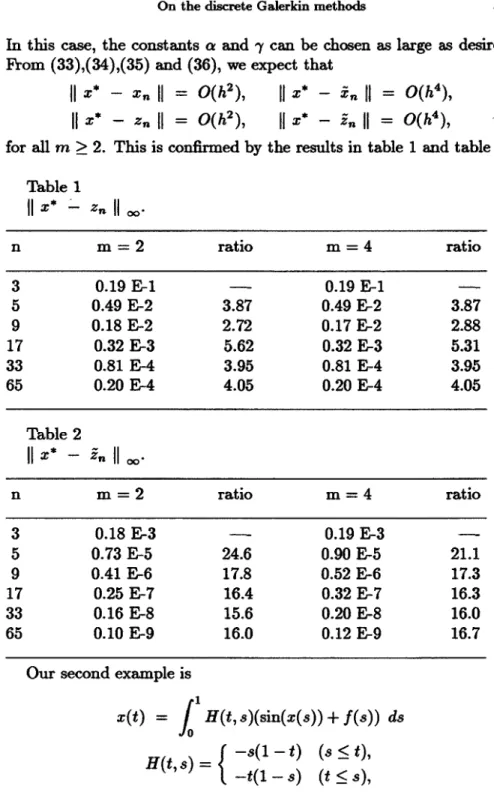
From (33),(34),(35) and (36), weexpect that
11 x· - xn 11
=
O(h2), 11 x· -x
n 11=
O(h4),11 x· - zn 11 = O(h2), 11 x· - zn 11 = O(h4),
for all m 2::2. This is confirmed by the results in table 1 and table 2.
Table 1
11 x· Zn 11 00·
n m=2 ratio m=4
3 0.19 E-1 0.19 E-1
5 0.49 E-2 3.87 0.49 E-2
9 0.18 E-2 2.72 0.17 E-2
17 0.32 E-3 5.62 0.32 E-3
33 0.81 E-4 3.95 0.81 E-4
65 0.20 E-4 4.05 0.20 E-4
Table 2
11 x· - zn 11 00·
n m=2 ratio m=4
3 0.18 E-3 0.19 E-3
5 0.73 E-5 24.6 0.90 E-5
9 0.41 E-6 17.8 0.52 E-6
17 0.25 E-7 16.4 0.32 E-7
33 0.16 E-8 15.6 0.20 E-8
65 0.10 E-9 16.0 0.12 E-9
Our second example is
x(t) =
1
1H(t,s)(sin(x(s))+
/(s)) ds { -s(l-t) (s ~t),H(t,s) = ( )
(t ~s), -t l-s
ratio
3.87 2.88 5.31 3.95 4.05
ratio
21.1 17.3 16.3 16.0 16.7
with f(s) so chosen that
*( ) t(l - t) x t = (t+2)"
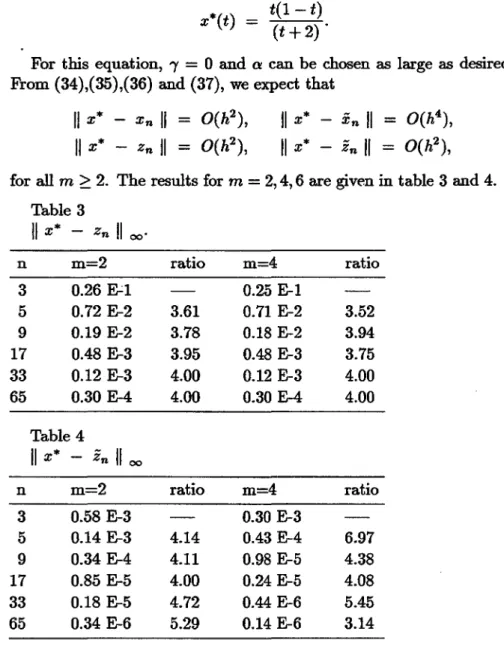
For this equation, 'Y = 0 anda can be chosen as large as desired.
From (34),(35),(36) and (37), we expect that
"x* - Xn 11 - O(h2), "x* -
x
n " = O(h4),"x* - zn"
=
O(h2), 11 x* - zn" = O(h2), for allm ;::: 2. The results for m = 2, 4, 6 are given in table 3 and 4.Table 3
"x* - Zn " 00.
n m=2 ratio m=4 ratio
3 0.26 ~1 0.25 E-1
5 0.72 E-2 3.61 0.71 E-2 3.52
9 0.19 E-2 3.78 0.18 E-2 3.94
17 0.48 E-3 3.95 0.48 E-3 3.75
33 0.12 E-3 4.00 0.12 E-3 4.00
65 0.30 E-4 4.00 0.30 E-4 4.00
Table 4
" x* - zn " 00
n m=2 ratio m=4 ratio
3 0.58 E-3 0.30 E-3
5 0.14 E-3 4.14 0.43 E-4 6.97
9 0.34 E-4 4.11 0.98 E-5 4.38
17 0.85 E-5 4.00 0.24 E-5 4.08
33 0.18 E-5 4.72 0.44 E-6 5.45
65 0.34 E-6 5.29 0.14 E-6 3.14
Ineach cases, the partition X is given by
{* :
0 ~ i ~ n}. Themaximum errors listed in Table 1,2,3 and 4 were estimated by taking the largest of the computed errors att = 1~8'i = 0, ..., 128. All compu-
tations were carried out in double precision on a Sun 4/20 computer.
References
1. P. M. Anselone, Collectively Compact Operator Approzimation Theory, Pren- tice-Hall, Inc., Englewood Cliffs, N. J., 1971.
2. K. E. Atkinson and A. Bogomolny, The Discrete Galerkin Method for Integral Equations, Math. Comp., 48, 1987,595-616.
3. K. E. Atkinson and F. A. Potra, On the Discrete Galerkin Method for Fred- holm Integral Equations of the second kind, I.M. A. J. Numer. Anal., 9, 1989, 385-403.
4. , Projection and Iterated Projection Methods for Nonlinear Integral Equations, SIAM. J. Numer. Anal., 24, 1987.
5. F. Chatelin and Lebbar, Superconvergence results for the iterated projection method applied to a fredholm integral equation of the second kind and the cor- responding eigenvalue problem, J. Integral Equation, 6, 1984,71-91.
6. Colin W Cryer, Numerical Functional Analysis, Oxford University Press, 1982.
7. L. M. Delves and J. L. Mohamed, Computational methods for integral equa- tions, Cambridge University Press, 1985.
8. B. Gusmann, Loo bounds of L2 projections on splines, in Quantitative Ap- proximation, R. A. de Yore and K. Scherer, eds., Academic press, New York, 1980.
9. V. Huston and J. S. Pym, Applications of Functional Analysis and Operator Theory, Academic Press, 1980.
10. S. Joe, Discrete Galerkin Methods for Fredholm Integral Equations of the sec- ond kind, I. M. A. J. Numer. Anal. 7, 1987,149-164.
11. M. A. Krasnoselskii, Topological Method in the Theory Of Nonlinear Integral Equations, Oxford, Pergamon Press,1964.
12. M. A. Krasnoselskii, G. M. Vainikko, P. P. Zabreiko, Ja. B. Rutickii, V. Ja.
Stecenko, Approzimate Solution of Operator Equations, Groningen, Wolters- Noodhoff Publ., 1972.
13. M. A. Krasnoselkii, P. P. Zabreiko, Geometrical Methods of Nonlinear Analysis, Springer-Verlag, 1984.
14. S. Kumar and I. H. Sloan, A New Collocation Type Method for Hammerstein Integral Equations, Math. Comp. 48, 1987,585-593.
Department of Computer Science Kwangju University
Kwangju 502-703, Korea