J. Korean Math. Soc. 32 (1995), No.3, pp. 541-551
NUMERICAL SOLUTION FOR NONLINEAR KLEIN-GORDON EQUATION BY COLLOCATION METHOD WITH RESPECT TO SPECTRAL METHOD
IN JUNG LEE
1. Introd uction
The nonlinear Klein Gordon equation
(1)
where L1 is the Laplacian operator in Rd (d = 1,2,3), Vu (u) is the derivative of the "potential function" V, and f is a source term inde- pendent of the solution u, in various areas of mathematical physics.
Among the particular cases which are the practical relevance, we take V1I.(u) = lulQu with et > 0 (quantum mechanics), refer to [5].
The convergence of the Galerkin finite element method for second or- der hyperbolic equations has been studied by many authors: cf. among others Dupont[3], who obtained error estimates for time-discrete and time continuous approximations of linear problems, and Dendy [2], who examined nonlinear problems as well as various modified Galerkin methods. To compute the nonlinear term Vu (u), the product approxi- mation is used by Yves Tourigny [6J. This approximation is a technique which consists of replacing the nonlinear term by its interpolant in the finite-dimensional subspaces. This provides an interesting alternative to numerical quadrature and greatly eases the implementation of the Galerkin method.
In this paper, by the collocation method, when n =2, we get the numerical solutions of (1). We shall show the stability and convergence for using spectral method technic.
Received June 21, 1994. Revised November 18, 1994.
1991 AMS Subject Classification: 65M70.
Key words: collocation method, spectral method.
To define a collocation method with spectral method techics, we give as many distinct points
XI: kE J (a set of indices)
in the domain 0 or in its boundary ao as the dimension of the space PolN(O) in which the spectral solution is sought. At the number of these points, located onaothe boundary conditions are imposed. The remaining points are used to enforce the differential equation.
We assume that for any k E J, there exists a polynomial 4>1: E PolN(O), nessarily unique, such that
if k =m, if k #m.
The 4>1:'S form a basis for the polynomials of degree N, since vex) = LI:EJv(xl:)4>I:(x) for all v E PolN(O). Let J be divided into two disjoint subsets Je and Jb, such that ifkE Jb, theXI:'s are on the part
ao of the boundary. Moreover, let LN be an approximation to the operatorL in which derivatives are taken via collocation at the points XI:'so The collocation soluton is a polynomial uN E PolN(O) which satisfies the equations
{
LNUN(Xk)= I(xk) BuN(Xk) = 0
for all k E Je , for allk E Jb.
The unknowns in a collocation method are the values of uN at the points XI:, i.e., the coefficients of uN with respect to the Lagrange basis. We introduce a bilinear form (U,V)N on the space Z = CO(O) of the functions continuous up to the boundaryof0 by fixing a family of weightsWk > 0 and setting .
(u, v) = L U(Xk)V(Xk)Wk
kEJ
The existence of the Lagrange basis ensures that (u, v)N is an inner product on PolN(O). Consequently, we define a discrete norm on POIN(O) as
for u EPOIN(O)
Numerical solution for nonlinear Klein-Gordon equation 543
The basis of the tPk'S is orthogonal under the discrete inner product.
We make the assumption that the nodes {xd and the weights {wd are such that
(U,V)N = (u,v) for all u,V such that uv EP012N-I(n).
In all the applicatios, this assumption is fulfilled since the Xk'S are the knots of quadrature formulas of Gaussian type.
Let XN be the space of the polynomials of degree less than or equal to N which satisfy the boundry conditions, i.e.,
Then the collocation method is equivalently written as
IfYN is the space spanned by the tPk'S with k E le, i.e.,
then can be wri tten as
2. Stability
Let n be an interval [-1,1J. We would like to approximate the solution of the following problem
82u 82u
&2 - 8x2 +lulQu =f m Q=n x [0,TJ (2) u(.,O) =Uo and ( ; ) (.,0) =UI in n
u(-1,t) = u(1,t) = ° for t E [O,TJ
where Uo E Ho(n), Ul E L(Q) and f E L(Q) are given functions, T>O.
The solution uN (x,t) of the Legendre Tau approximation of this problem is for all t >0 a polynomial of degreeN inx, which is zero at x = ±l and satisfies the equations,
[ : [uft"(x,t) - u~(x,t)+luN(x,tW~uN(x,t)] v(x)dx
=
[11
f(x,t)v(x)dx t >0, for all t EPN-2 (3)[11
[uN (x, 0) - uo(x)] v(x)dx = 0[11 [uf (x, 0) - Ul(X)} v(x)dx= 0
Let we set XN = {u E PNlu(-l) = u(l) = 0, YN = PN-2 and
(u,v) =J~lu(x)v(x)dx. For all uE XN we have
-1
-11UxxPN-2Udx =-1
- 1 - 11 u~udx =1
1(u x)2dxBut, we know that the degree of luNlou N is greater than 2N - 1.
Here, we shall use the approximation of luNlou N in (3). We subsi- tute INluNlou N intead of luNlou N where IN : C(n) -+ XN is the interpolation operator.
We shall find the approximate solutionuN EXN such that
[11[uft"(x, t) - u~(x,t)+INlu N(x, t)lou N(x,t)]v(x)dx
=
[11
f(x,t)v(x)dx t > 0, for all v E PN-2 (4)[11
[uN(x,O) -uo(x)] v(x)dx= 0[11 [uf(x,O) - Ul(X)] v(x)dx = O.
Numerical solution for nonlinear Klein-Gordon equation 545 ,
THEOREM 1. For someT > 0,
IIPN-2uf(t)1I1..,(-1,1) +lIu~(t)1I2+(2/P,8)lIuN(t)II~'(_l,l) :::;{IIPN-2uf(0)1I1..,(-l,l)+lIu~(0)1I2 +(2/P,8l1uN(O)II~'(_1,l)
+
l
TIIf(s)1I1..,(_l,l)dsleTProof. Take v= PN-2Uf, from the left hand side first term in (4)
[11 uu(x, t)PN-2Uf (x, t)dx
=
1
1 PN-2UU(X, t)PN-2Uf (x, t)(l - x2)dx-1
=(1/2)~IIPN-2uf(t)1I1..,(-1,1)' and the second term,
-1
1U~2:(X't)PN-2Uf(x, t)dx-1
1
1 N d N= un(x, t)PN-2-
d u (x, t)dx
-1 t
1
1 N d N= U2: (x, t)-dU2: (x, t)dx
-1 t
=(1/2)~lIu~(t)1I2.
Now, forp = et+2, refer to [4],
(l/p)~lIuN(x,t)II~"(_l,l)
= [11 luN(x, tWl'u N(x,t)u;V(x, t)dx
= [11 lu N(x,t)IQuN(x,t)(1- X2)PN_2Uf(x,t)dx
We can choose thef3 which satisfies lIu N-INuNII;, = lIu N -PNuNII;, + IIRNuNII;,
..'(l/pldtJhtJ~.~DJlt~~~l,l~,._,."d .."-._..,,,,.~,,,,,--,~~.__.
~f3
[11
IN {luN(x,tW~uN(x,t)} PN-2Uf(x,t)dx Therefore, from the equation[11 [uft(x, t) - u~z(x,t)+INlu N(x, t)IQu N(x, t)] PN-2uf' (x, t)dx
= [ :f(~,t)PN-2uf'(X,t)dx
weobtain
( / ) d 11 N 2 d N 2
1 2 dt PN-2Ut (t)IILw(-l,l) +(1/2) dtlIuz (t)1I
+(l/Pf3)~lIuN(t)lItp(-I,l)
~
[11
[uft(x,t)-u~(X,t)+INluN(x,t)IQuN(x,t)] Pn -2uf'(x,t)dx1 12 1 . N 2
~'2l1f(t)1L",(-l,l) +'2"PN-2ut (X)IIL",(-I,I)
IIPN-2uf(t)lIi",(-I,l)+lIu~(t)1I2+(2/P(3)lIuN
(t)1I1p(-1,1)
~IIPN-2uf(O)lIi",(-l,l) +lIu:(0)112+(2/P(3)lIuN
(O)1I1p(-1,1)
+
Lt
Ilf(s)lIi",(_l,l)ds +Lt
IIPN-2uf'(s)1I2ds Applying Gronwall's inequality we complete the proof.This theorem shows the stability of the approximate solution ofuN for
0=
1
1(uN(x,O) -: uo(x» u:"",dx=-1
1(u~(x,O)- uo",(x» u:"dX-1 -1
Numerical solution for non linear Klein-Goroon equation 547
1
1 u~(x,O)u~dx =1
1 uo:c(x)u&:,dx-1 -1
:::;c[11uo:c(x)uo",(x)dx <clluoll~Wl)
3. Convergence
Let RN be a projection operator from a dense subspace W of DB upon XN, where DB is a set which satisfies the boundary condition of (2). For each u E W, we further require RNu to satisfy the exact boundry conditions, i.e.,
We define the norm IIgIIE. = sUPueE.#O ~!',i2 for all 9 E E* that is dual ofE.
Let e(x, t) = uN (x, t) - RNu. We obtain the following theorem.
THEOREM 2. Assume that lulQ'u E H1(-1,1) IIPN-2et(t)IIL<-1,1) +lIex(t)112
:::; {IIPN-2et(O)IIL(-1,1) + Ilex(O)1I2+M2T} eT
:::; {IIPN-2et(O)IIL(-1,1) +clleoll~A<'l) +M2T} eT
Proof. From (3), we have
[11[uft - u~x +INlu N(x,t)lQ'uN(x,t) - I(x,t)] v(x)dx = 0
t > 0, for all v EPN-2
We get (5)
~~IIPN-2et(t)1I1w(-I,I) +~~Ilex(t)112
= J:l(utt - RNuft)et+(.1!-Nuft.-:- uxx)et +(lulQu - INluNIQuN)etdx
=IIPN-2(Utt - RNuft)III1 PN-2 et!lLw(-I,I)
. N
+IIPN-2(RNu x·x - uxx)IIIIPN-2 etIlLw(-I,I)
+IIlulQu- INluN IQ
uN
IIIIPN-2 et!lLw(_I,I) We refer to [I}: For each v EHJ(-1,1)
(PN-2(Utt - RNUtt),V)
=(Utt - RNUtt, v) - (Utt - RNUtt, v - PN-2V)
=«Utt-RNUit)x, (0-.RN0)x).-(utt-RNUtt, V-PN-2V) where 0is the only function in HJ(-1,1) satisfying -0xx = vthen we
*. . .
For eachv E HJ(-1,1)
(PN-2(U - Rnu)xx,v)
= - «u - Rnu)x,vx) - «u - Rnu)xx,v - PN-2V)
=«u - Rnu)x,vx) - (u xx - Pn- 2uxx ,v - P,i-2V)
Numerical solution for nonlinear Klein-Gordon equation 549
here we have used the fact that bothPN-2Uxz and(R,.u)xzare orthog- onal to v - PN-2V. Using the same approximation results as before, wededuce
In Legendre approximations, for all u EHm(-1,1) lIu - 1NUIlHt(-l,l)
~CN2l+!-mlluIlHm(_l,l) for 0~ I$ m with m > ~.
Asswne that lulQu EH1(-1,1) let1=0. We get
IIlulou - 1NluNlouNIIL2(_l,l)
=lIlulou - 1nluIQIIL2(_I,I) $ CN!-mllluIO'uIlHm(_I,I)'
We may asswne that m 2:: 2.
LetM = CN1-mlluttIlHm-2(_I,I)+CN1-mlluIlHm(_1,1)+CN-! IlIul1 UIlHm-2(_1,1) clearly M -+ 0 as N -+ 00. From (5)
IIPN-2et(t)1I1",(_1,1) +lIez(t)1I2
~IIPN-2et(O)IIL(-l,l) + lIez(O)1I2
+Lt M2
ds+
J
II PN-2 et(x,s)IIL.(_l,l)dsWe know that lIez(O)1I2 $ clleoll~~«(}) and applying Gronwall's inequal- ity we conclude the proof.
4. Numerical results
Set uN(x, t) = L:~o ai(t)li(x) is aN-degree Lagrange polynomial with N +1nodes as -1 = Xo < Xl < X2··· < Xn= 1. We substitute
uN(x,t) into (2), we get
Jla-(t) .
d;2 -l~(xi)al(t)+ ...+liV(xi)an(t) +la~(tWl!ai(t) = f(Xi' t) i = 0, 1,2, ... ,N
Applying the boundry condition and the difference equation with
Jlai(tj) _ alt;+!) - 2ai(tj)+ai(tj-1)
dt2 - h2
ai(tO) =0
ai(tI) =hUI(Xi)
where h is a mesh size and tj =jh, we obtain a system of N - 1 equations. For one example, let
f(x, t) = - 2sin(1rx)+I(t - t 2)sin(1rX)IQ(t - t2)sin(1rx) + 1r2(t - t2)sin(1rx)
'::: (x,O) = sin(1rx),
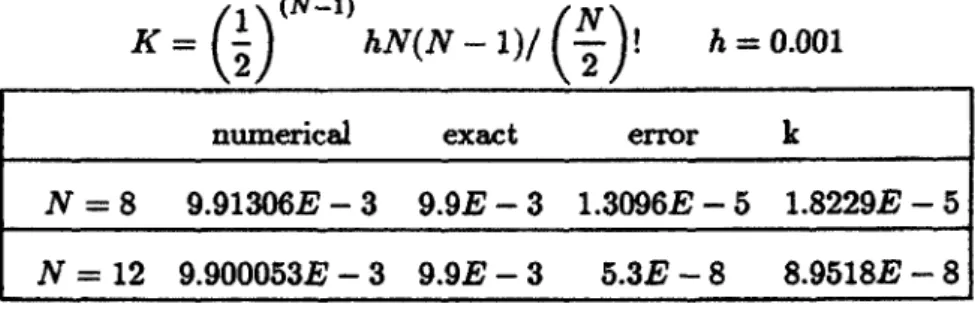
then we obtain the numerical solution as table 1.
Practically, this example has exact solution such that(t-t2)sin(1rx).
We can calculate errors. These errors are approximately less than C(k)(N-1) hN(N - 1)(~)(N-1)/ (~)! in that C (k)(N-1) is esti- mated from M which is in theorem 2., and N(N...:1)(~)(N-1)/ (~)!
is calculated by a second order defferentiation of N-degree Laglange polynomial. Briefly, the errors are less than (i)(N-1)hN(N-1)/ (~)!
and are independent ofQ.
Numerical solution for nonlinear Klein-Gordon equation 551
(
1)(N-l) (N)
K="2 hN{N -1)/ "2 ! h =0.001
numerical exact error k
N=8 9.91306E - 3 9.9E-3 1.3096E - 5 1.8229E - 5 N= 12 9.900053E - 3 9.9E-3 5.3E -8 8.9518E -8
table 1. The numericaJ. estimation of u{1/2, 0.01), error and error bound. For time valuet
we get results by 10th iteration.
References
1.Claudio Canuto M., Yousuff Hussaini Alfio quarteroni thomas A. Zang, Spec- tral Methods in Fluid Dynamics, Springer-Verlag, 1988.
2. Dendy, J. E.,An analysis of some Galerbn schemes for the solution of ninlin- ear time-dependent problems,SIAMJ. Numer. Anal..
3. Dupont, T., L estimates for Galerbn methods for second-order hyperbolic equa- tions,SIAM J.Numer. Anal..
4. Masanori Hosoya and Yoshio Yamada, On some nonlinear wave eguations I:
local e:tistence and regularity of solutions, J. Fac. Sci. univ. Tokyo Sect. lA, Math. 38 (1991), 225-238.
5. Perring,J. K.and Skyrme, T.R.H, A model unified field equation,Nud. Phys 31 (1962), 225-238.
6. Yves Truginy, Product a1'1'rozimation for nonlinear Klein-Gordon equations, IMA jourmal of Numerical Analysis 9 (1990), 449-462.
Department of Mathematics Hoseo University
ASM 337-850, Korea