J. Comput. Fluids Eng. Vol.21, No.2, pp.1-11, 2016. 6 / 1
1. Introduction
As solving real fluid dynamic problems introduce new challenges like modeling very large scale complex systems, there is increasing demand for advanced(more accurate and powerful) computational algorithms. Discontinuous Galerkin (DG) method has recently found its way into the mainstream of CFD as an alternative to finite volume and finite element methods. DG method is not only very compact, but also conservative, stable, and robust with strong mathematical supports. In particular, it is suitable for unstructured grids, parallelization, and hp-adaptivity[1-6].
DG method requires very simple treatment at the boundaries to achieve the uniform high-order of accuracy throughout the domain, at least for smooth problems;
therefore, it can be easily appled to solving complex flows and geometries. DG method is basically built upon two advantageous features commonly associated with finite element(FEM) and finite volume methods(FVM). Similar to continuous FEM method, it obtains the solution in an element by expanding a high-order polynomial. It also considers the physics of the wave propagation to estimate a unique solution at the interface of the elements, similar to the finite volume and finite difference methods[7].
These features make DG very powerful for solving hyperbolic systems; however, there are certain challenging issues in the development of the DG methods that require further investigation.
DG method, similar to other high-order methods, suffers from the existence of the spurious oscillations near the
P ERFORMANCE OF L IMITERS IN M ODAL D ISCONTINUOUS G ALERKIN M ETHODS FOR 1-D E ULER E QUATIONS
A. Karchani1 and R.S. Myong*1,2
1Graduate School of Mechanical and Aerospace Engineering, Gyeongsang Nat'l Univ.
2Dept. of Aerospace and Software Engineering & Research Center for Aircraft Parts Technology, Gyeongsang Nat'l Univ.
1-D 오일러 방정식에 관한 Modal 불연속 갤러킨 기법에서의 Limiter 성능 비교
아볼파즐 카르차니,1 명 노 신*1,2
1경상대학교 대학원 기계항공공학부
2경상대학교 항공우주및SW공학전공 및 항공기부품기술연구소
Considerable efforts are required to develop a monotone, robust and stable high-order numerical scheme for solving the hyperbolic system. The discontinuous Galerkin(DG) method is a natural choice, but elimination of the spurious oscillations from the high-order solutions demands a new development of proper limiters for the DG method. There are several available limiters for controlling or removing unphysical oscillations from the high-order approximate solution; however, very few studies were directed to analyze the exact role of the limiters in the hyperbolic systems. In this study, the performance of the several well-known limiters is examined by comparing the high-order(p1, p2, and p3) approximate solutions with the exact solutions. It is shown that the accuracy of the limiter is in general problem-dependent, although the Hermite WENO limiter and maximum principle limiter perform better than the TVD and generalized moment limiters for most of the test cases. It is also shown that application of the troubled cell indicators may improve the accuracy of the limiters under some specific conditions.
Key Words : Discontinuous Galerkin(DG) method, hyperbolic system, 1-D Euler equations, limiters
Received: March 3, 2016, Revised: June 1, 2016, Accepted: June 1, 2016.
* Corresponding author, E-mail: [email protected] DOI http://dx.doi.org/10.6112/kscfe.2016.21.2.001
Ⓒ KSCFE 2016
2 / J. Comput. Fluids Eng. A. Karchani ․ R.S. Myong
discontinuities. In general, there are three approaches to eliminate spurious oscillations from a numerical solution:
artificial viscosity, digital filter, and limiter. Among these, the approach based on limiters may be preferable, since they can be used not only to control wiggles but also to enforce the nonlinear stability to the numerical scheme[8].
The choice of limiter functions can be categorized into three different types: 1) slope limiter, 2) spectral limiter, and 3) non-oscillatory limiter.
Slope limiters were initially developed for finite volume method. They can be categorized into several branches according to the limiting stencil, limiting process, and the shape of the limiting function. Among available slope limiters, total variation diminishing(TVD), total variation bounded(TVB), local extremum diminishing(LED), essentially local extremum diminishing(ELED), monotonicity preserving(MP), and multi-dimensional limiters[9,10] are often employed in the high-order numerical methods.
The spectral limiters have originally been developed for high-order spectral methods. In fact, there are few spectral limiters for DG methods such as high-order sub-cell limiter, moment limiter, and modified moment limiter. In these limiters, the moments of the solution are limited in a hierarchical manner. The highest-order moment of the solution is first corrected. The lower-order moments are then considered for further correction, if the highest-order moment has been changed in previous step. These limiters are usually used with a trouble cell indicator to minimize the numerical diffusion enforced to the solution due to mean of the limiters in smooth regions.
Non-oscillatory reconstruction schemes were introduced first by Harten[11] and had been developed further by several researchers[7,12]. Although the monotonicity of the solution is not guaranteed, non-oscillatory schemes can be used as the high-order schemes. It is also possible to use them as a high-order limiter in DG framework owing to their capability in preservation of the high-order solution in stiff regions. In general, non-oscillatory limiters consider an/several oscillatory high-order solution(s) to reconstruct a non-oscillatory high-order solution in the trouble element.
However, the use of traditional non-oscillatory limiters are restricted to pure scientific researches due to their disadvantages such as cumbersome implementation in unstructured grids and use of very large stencils during reconstruction. Recently, a new compact and simple Hermite WENO limiter[13] has been proposed that can overcome the shortcomings of the traditional WENO limiters for structured and unstructured meshes.
In this study, we aim to examine the level of accuracy
of various limiters for the one-dimensional hyperbolic systems, in particular, gas dynamic Euler equations. A high-order explicit DG method is first developed with special attention to the application of the limiters for solving the linear and nonlinear advection equation and Euler equations. Modal DG method is employed, since it has been widely used in DG community due to its advantages[14,15] over nodal DG method. Several benchmark problems with available exact analytical solutions were then considered for verification. Finally, the accuracy of the limiters in capturing discontinuities was examined in detail by comparing the profile of the numerical solutions with the exact solutions.
2. Governing equations
Euler equations describe the pure convection of the flow quantities in an inviscid fluid. In many applications, for instance, high Reynolds number flows, where a boundary layer is very thin compared to the dimension of the body, it is a valid assumption to neglect the viscous effects and employ the Euler model. Application of Euler equations enables to observe important phenomena such as compressive shock waves, expansive waves, contact discontinuity, and vortices around sharp edges. Moreover, Euler equations can serve as the basis for the development of numerical discretization methods and boundary conditions. Nonetheless, numerical solutions of Euler equations may be considered acceptable only if the equations are solved in a conservative way. The dimensionless form of the one-dimensional hyperbolic Euler system can be expressed in conservative form as follows,
Ω
Ω (1)where conservative variables and inviscid flux
vector are defined as
(2)
where and are a composite number[16] and the Reynolds number, respectively; is the mass density; u is
PERFORMANCE OF LIMITERS IN MODAL DISCONTINUOUS GALERKIN… Vol.21, No.2, 2016. 6 / 3
the velocity in the x-direction; p is the scalar pressure, and E is the total energy density. The system (1), after applying the method of line(MOL) to decouple the time and spatial coordinates, can be transformed into a decoupled system in time and space. In the present work, a modal DG method is used for discretizing the spatial coordinate and a 3rd-order strong stability preserving(SSP) method is used for time-marching.
3. Numerical method: discontinuous Galerkin
A class of numerical schemes, particularly efficient for the high-order approximation of the CFD applications, are the spectral hp methods[17]. According to the terminology defined in [17], spectral methods are those in which the numerical solution is fitted by series of modal functions and the accuracy of the approximate solution improves with increasing the number of modal functions. Based on the definition of the polynomial space (ansatz) function, spectral hp methods can be classified into several categories. The most popular high-order spectral methods are discontinuous Galerkin(DG), spectral difference(SD), spectral volume(SV), and correction procedure via reconstruction(CPR) methods.
The choice of the polynomial space function and test function are the main features that distinguish high-order methods from finite difference and finite volume methods.
In classical finite element methods(i.e., continuous finite element method), the global solution is discretized using the finite dimensional functions which are locally continuous in character with finite regularities that attempt to represent the shape of the true solution. Therefore, they may not always produce the true solution at some flow conditions like high-speed conditions[18]. In contrast, high-order spectral methods consider globally smooth functions as the test functions and allow more freedom to define polynomial space function which provides enough capability to study the high-speed problems.
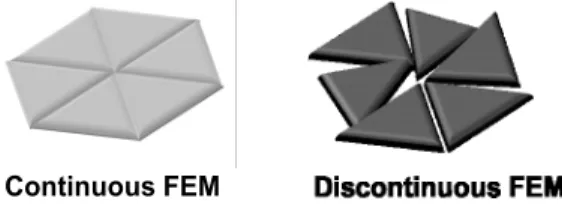
In continuous Galerkin(CG) method, a Hilbert space HΩ is used to approximate the finite polynomial space function. It means that, if function belongs to Hilbert space HΩ, it has to be continuous across the elements and satisfy
Ω ∇∇Ω ≤ ∞On the other hand, discontinuous Galerkin(DG) method uses a least-square space function LΩ for approximating the polynomial space function, therefore, the space function needs to be continuous inside the element
Continuous FEM
Fig. 1 Discontinuous Galerkin solution versus continuous Galerkin solution
space but not over the elemental interfaces, as shown in fig. 1. In DG method, degree of freedoms(DOFs) are overlapped on the elemental edges and vertices. Therefore, the computational cost of DG method for inverting the mass matrix is higher than that of CG method.
Nonetheless, DG may not always be more expensive than CG method, since the application of additional DOFs in DG method yields more accurate solutions than CG method on the same mesh. In addition, owing to the discontinuous polynomial space function and usage of an upwind monotone numerical flux function at the interface of the elements[3], DG method is often considered the best choice for numerically solving convective-dominated problems.
DG methods are categorized into three types depending on the type of basis function used in the polynomial expansion series: 1) modal, 2) nodal, and 3) hybrid DG methods. Modal method may be preferred as the base of the next generation of the numerical models in the computational fluid dynamics. Modal DG method combines high-order time integration scheme, for example, the Runge-Kutta method, with the traditional DG method for solving hyperbolic systems. This method was initially developed by incorporating the numerical flux function with TVB slope limiters into the original DG framework[3]. In this study a modal Runge-Kutta DG (RKDG) method is developed to study the performance of various limiters in the DG method for hyperbolic systems, in particular, gas dynamic Euler equations.
In order to discretize Eq. (1), the exact solution of is approximated by series of Legendre polynomials of degree of p, and the computational domain is tessellated by the bounded non-overlapping control volumes
Ω,
(3)
where is the ith local degree of the freedoms of
4 / J. Comput. Fluids Eng. A. Karchani ․ R.S. Myong
the conservative variable approximated solution. is the ith modal Legendre basis function. Considering the method of weighted residual and Galerkin method, the governing Eq. (1) are multiplied with the test function which is taken to be equal to the basis function and then integrated by parts over an element. It results in the formulation of the system for as follows
Ω
Ω∇
Ω (4)where n is the outward unit normal vector. V and S represent the volume and boundary of the element Ω, respectively.
The weak formulation of the modal DG method can be obtained by considering the sequence of mathematical manipulations and replacing the physical flux functions with numerical functions at interfaces as
∈
Ω
∈
Ω
∈
Ω
(5)
where
is the ith-component of the conservative variable vector , is the outward unit normal vector component in x-direction, and
denotes the ith test function which is set to be similar to the Legendre basis function for modal Galerkin method.
In order to solve the system (5) numerically, a series of the numerical tasks, such as determination of the volume and surface integrals in the standard element, evaluation of the numerical flux functions, calculation of the solution projection in every local element, and estimation of the local degree of freedoms for each of the independent variables, are needed.
In the present work, linear mapping is considered for transforming real element to standard element.
Gauss-Legendre quadrature rule has been implemented for both the volume and the boundary integrations. The Rusanov(called as local Lax-Friedrichs) flux is applied for discretization of the inviscid flux functions at interfaces.
4. Limiters
DG method, similar to other high-order methods
affected by an inherent conflict between monotonicity -preserving and high-order accuracy, suffers from the existence of the spurious oscillations near the discontinuities like shock front in gas dynamics. To control these oscillations in acceptable level in DG framework, a limiter was first implemented by Chavent and Cockburn in 1989[19]. They developed Van Leer’s TVD-type limiter for improving the stability of the DG method. They showed that the slope limiter must be applied not only in the stiff regions but also in some part of the smooth regions that are affected by wiggles.
Goodman and LeVeque[20] also proved that any multi-dimensional TVD scheme is at most first order of accuracy in stiff flow regions. As it is not possible to develope high-order schemes with the TVD property in which high-order solutions are maintained uniformly throughout of the domain, developing more accurate new limiters was considered an important issue in the DG community.
Cockburn et al.[3] developed a TVB slope limiter to improve the performance of TVD limiters by relaxing the monotonicity constraints. The TVB slope limiter employs the modified Minmod function instead of the TVD-Minmod function in order to maintain the formal accuracy of the scheme at the extremum. Although it yields moderately improved results in various applications, the definition of the adjusting user input parameter is still questionable. Moreover, it is not possible to extend this limiter to multi-dimensional applications[5]. For this reason, several alternative limiters including generalized moment(GM) limiter[21] and maximum principle(MP) limiter[22] were proposed to preserve monotonicity near the discontinuous regions. Among these limiters, some are well-received in the DG community.
In this study, TVD[3,19,20] limiter, GM limiter[21], MP limiter[22], and Hermite WENO(HWENO) limiter[7]
in conjunction with KXRCF(Krivodonova-Xin-Remacle -Chevaugeon-Flaherty)[23] trouble cell indicator and positivity-preserving feature[22] are considered. Their performance in capturing discontinuities is analyzed by comparing limited and unlimited approximate DG solutions with the exact solutions.
5. Results and discussion
We consider exact solutions of the scalar hyperbolic equation, inviscid Burger equation, and inviscid Euler equations, which are the well-known benchmark problems to examine the level of accuracy of the limiters. The
10 / J. Comput. Fluids Eng. A. Karchani ․ R.S. Myong
and its adjacent neighbors. Also, in case of the maximum principle limiter, degradation of the accuracy of the solution is minimized through relaxation of the monotonicity condition and activation of limiter only when the high-order solution in the trouble element exceeds the maximum and minimum value of the initial condition. It was also shown that application of characteristics field variables in the limiting process yields better solution, owing to the feature that the propagation characteristics of the flow are better taken into consideration.
The present study also showed that the maximum principle limiter may be considered reliable if the global maximum and minimum variables are defined precisely.
Furthermore, it was shown that the limiters with troubled cell indicators in general provide better solutions. On the other hand, the TVD, generalized moment limiters without employing a trouble cell indicator led to significant degradation of the solution accuracy.
The present study has been limited to the linear and non-linear hyperbolic systems without the diffusive viscous terms. The extension of the present line of investigation on limiters to the case of convection-diffusion problem like the Navier-Stokes- Fourier equations will require additional efforts.
Further, only one-dimensional problems have been analyzed for their simplicity, although most of the practical applications are multi-dimensional and thus accurate multi-dimensional limiters remain critical.
Nevertheless, we expect that the results obtained from the present work will remain important in analyzing and designing high performance limiters, since the essential theoretical and numerical properties of shock discontinuities are well-defined in one-dimensional situation.
Acknowledgments
This work was supported by the National Research Foundation of Korea(NRF 2015-M1A3A3A02-010621), South Korea.
References
[1] 1991, Cockburn, B. and Shu, C.W., "The Runge-Kutta local projection p1 discontinuous Galerkin finite element method for scalar conservation laws,"
RAIRO-Modélisation Mathématique et Analyse Numérique, Vol.25, pp.337-361.
[2] 1989, Cockburn, B. and Shu, C.W., "TVB
Runge-Kutta local projection discontinuous Galerkin finite element method for conservation laws. II.
General framework," Mathematics of Computation, Vol.52, pp.411-435.
[3] 1989, Cockburn, B., Lin, S.Y. and Shu, C.W., "TVB Runge-Kutta local projection discontinuous Galerkin finite element method for conservation laws III:
one-dimensional systems," Journal of Computational Physics, Vol.84, pp.90-113.
[4] 1989, Shu, C.W. and Osher, S., "Efficient implementation of essentially non-oscillatory shock capturing schemes II," Journal of Computational Physics, Vol.83, pp.32-78.
[5] 1990, Cockburn, B., Hou, S. and Shu, C.W., "The Runge-Kutta local projection discontinuous Galerkin finite element method for conservation laws IV: The multidimensional case," Mathematics of Computation, Vol.54, pp.545-581.
[6] 2014, Chang, T.K., Park, J.S. and Kim, C., "Efficient computation of compressible flow by higher-order method accelerated using GPU," Journal of Computational Fluids Engineering, Vol.19, No.3, pp.52-61.
[7] 2012, Jiang, Z.H., Yan, C., Yu, J. and Yuan, W.,
"Hermite WENO based limiters for high-order discontinuous Galerkin method on unstructured grids,"
Acta Mechanica Sinica, Vol.28, pp.241-252.
[8] 2001, Gottlieb, S., Shu, C.W. and Tadmor, E.,
"Strong stability preserving high-order time discretization methods," SIAM Review, Vol.43, pp.89-112.
[9] 2014, Park, J.S. and Kim, C., "Higher-order multi- dimensional limiting strategy for discontinuous Galerkin methods in compressible inviscid and viscous flows," Computers & Fluids, Vol.96, pp.377-396.
[10] 2016, Park, J.S. and Kim, C., "Hierarchical multi- dimensional limiting strategy for correction procedure via reconstruction," Journal of Computational Physics, Vol. 308, pp.57-80.
[11] 1997, Harten, A., "ENO schemes with subcell resolution," Upwind and High-Resolution Schemes (edited by M.Y. Hussaini et al.), Springer.
[12] 2010, Zhang, X. and Shu, C.W., "On maximum principle satisfying high-order schemes for scalar conservation laws," Journal of Computational Physics, Vol.229, pp.3091-3120.
[13] 2012, Jiang, Z.H., Yan, C., Yu, J., Yuan, W.,
"Hermite WENO based limiters for high order discontinuous Galerkin method on unstructured grids,"
PERFORMANCE OF LIMITERS IN MODAL DISCONTINUOUS GALERKIN… Vol.21, No.2, 2016. 6 / 11
Acta Mechanica Sinica, Vol.28, pp.241-252.
[14] 2014, Le, N.T.P., Xiao, H. and Myong, R.S., "A triangular discontinuous Galerkin method for non-Newtonian implicit constitutive models of rarefied and microscale gasses," Journal of Computational Physics, Vol.273, pp.160-184.
[15] 2014, Xiao, H. and Myong, R.S., "Computational simulations of microscale shock-vortex interaction using a mixed discontinuous Galerkin method,"
Computers & Fluids, Vol.105, pp.179-193.
[16] 2004, Myong, R.S., "A generalized hydrodynamic computational model for rarefied and microscale diatomic gas flows," Journal of Computational Physics, Vol.195 pp.655-676.
[17] 2013, Karniadakis, G. and Sherwin, S., Spectral/hp Element Methods for Computational Fluid Dynamics, Oxford University Press.
[18] 2009, Ueckermann, M.P., Towards Next Generation Ocean Models: Novel Discontinuous Galerkin Schemes for 2D Unsteady Biogeochemical Models, M.S. Thesis, Massachusetts Institute of Technology.
[19] 1989, Chavent, G. and Cockburn, B., "The local projection P0 P1 discontinuous Galerkin finite element method for scalar conservation laws," RAIRO-
Modélisation Mathématique et Analyse Numérique, Vol.23, No.4, pp.565-592.
[20] 1985, Goodman, J.B. and LeVeque, R.J., "On the accuracy of stable schemes for 2D scalar conservation laws," Mathematics of Computation, Vol.45, No.171, pp.15-21.
[21] 1994, Biswas, R., Devine, K.D. and Flaherty, J.E.,
"Parallel, adaptive finite element methods for conservation laws," Applied Numerical Mathematics, Vol.14, pp.255-283.
[22] 2012, Zhang, X., Xia, Y. and Shu, C.W., "Maximum principle satisfying and positivity preserving high-order discontinuous Galerkin schemes for conservation laws on triangular meshes," Journal of Scientific Computing, Vol.50, pp.29-62.
[23] 2004, Krivodonova, L., Xin, J., Remacle, J.F., Chevaugeon, N. and Flaherty, J.E., "Shock detection and limiting with discontinuous Galerkin methods for hyperbolic conservation laws," Applied Numerical Mathematics, Vol.48, pp.323-338.
[24] 1991, Einfeldt, B., Roe, P. L., Munz, C. D. and Sjogreen, B., "On Godunov type methods near low densities," Journal of Computational Physics, Vol.92, pp.273-295.