• 검색 결과가 없습니다.

Ameliorative Effects of Ombuoside on Dopamine Biosynthesis in PC12 CellsUchralsaikhan Davaasambuu

N/A
N/A
Protected

Academic year: 2022

Share "Ameliorative Effects of Ombuoside on Dopamine Biosynthesis in PC12 CellsUchralsaikhan Davaasambuu"

Copied!
4
0
0

로드 중.... (전체 텍스트 보기)

전체 글

(1)

Natural Product Sciences 24(2) : 99-102 (2018)

https://doi.org/10.20307/nps.2018.24.2.99

99

Ameliorative Effects of Ombuoside on Dopamine Biosynthesis in PC12 Cells

Uchralsaikhan Davaasambuu

1

, Keun Hong Park

1

, Hyun Jin Park

1,2

, Hyun Sook Choi

3

, Chong Kil Lee

1,2

, Bang Yeon Hwang

1

, and Myung Koo Lee

1,2,

*

1

College of Pharmacy and

2

Research Center for Bioresource and Health, Chungbuk National University, Cheongju 28160, Korea

3

Department of Food and Nutrition, Chungcheong University, Cheongju 28171, Republic of Korea

Abstract − This study investigated the effects of ombuoside, a flavonol glycoside, on dopamine biosynthesis in PC12 cells. Ombuoside at concentrations of 1, 5, and 10 µM increased intracellular dopamine levels at 1 - 24 h.

Ombuoside (1, 5, and 10 µM) also significantly increased the phosphorylation of tyrosine hydroxylase (TH) (Ser40) and cyclic AMP-response element binding protein (CREB) (Ser133) at 0.5 - 6 h. In addition, ombuoside (1, 5, and 10 µM) combined with L-DOPA (20, 100, and 200 µM) further increased intracellular dopamine levels for 24 h compared to L-DOPA alone. These results suggest that ombuoside regulates dopamine biosynthesis by modulating TH and CREB activation in PC12 cells.

Keywords − Ombuoside, Dopamine biosynthesis, TH, CREB, PC12 cells

Introduction

Dopamine levels in the brain are associated with several devastating diseases such as Parkinson’s disease (PD), Alzheimer’s disease, schizophrenia, and affective disorders.

1

In dopamine biosynthetic pathways, tyrosine hydroxylase (EC 1.14.16.2; TH), the rate-limiting enzyme, catalyzes the conversion of L-tyrosine to L-3,4- dihydroxyphenylalanine (L-DOPA).

2

TH activity is mainly regulated via the cyclic AMP (cAMP)-cAMP-dependent protein kinase A (PKA)-cAMP-response element binding protein (CREB) pathway.

3,4

The long-term regulation of TH is also involved in TH gene transcription and induction of TH mRNA, which is regulated by the cAMP-PKA- CREB system.

4-6

TH at Ser40 is a major phosphorylation residue.

5,6

In addition, L-DOPA is the most effective and frequently prescribed therapy for controlling symptoms of PD.

1,8

L-DOPA also increases intracellular levels of dopamine in PC12 cells,

9,10

which may be applied in the in vitro model of PD.

Gynostemma pentaphyllum (Cucurbitaceae) has been used as a herbal tea and contains many types of gynosaponins (GPS), flavonoids, polysaccharides, vitamins, and amino acids.

11

The ethanol extract (80%) from G.

pentaphyllum (GP-EX) exerts ameliorating effects on chronic stress-induced anxiety in mice.

12

GP-EX and GPS have shown protective effects against neurotoxicity by reducing TH neuronal cell death and L-DOPA-induced dyskinesia in rat models of PD.

13,14

GP-EX and GPS also show anxiolytic effects on affective disorders in an MPTP-lesioned mouse model of PD.

15

In addition, ombuoside (7,4'-di-O-methylquercetin-3- O-beta-rutinoside) is one of the flavonol glycoside components of GP-EX.

11

Flavonoids exhibit a variety of biological activities, such as antioxidant, antimicrobial, anti-inflammation, cytotoxic, and anti-allergy effects by scavenging free radicals and reactive oxygen species.

16-19

PC12, rat adrenal pheochromocytoma, cells have been widely used to investigate dopamine biosynthesis and L- DOPA-induced oxidative cytotoxicity.

9,10,20

In this study, the effects of ombuoside on dopamine biosynthesis in PC12 cells were investigated to examine whether ombuo- side is a beneficial bioactive component of GP-EX, similar to GPS.

Experimental

Materials – Ombuoside (purity > 97.0%) was obtained from BioBioPhar Co. Ltd. (Kunming, Yunnan). L-DOPA, isoproterenol, and 3-(4,5-dimethyl-2-thiazolyl)-2,5-diphenyl- 2H-tetrazolium bromide (MTT) were purchased from Sigma-Aldrich (St. Louis, MO). RPMI1640 medium, donor-horse serum, fetal bovine serum, and antibiotics

*Author for correspondence

Myung Koo Lee, College of Pharmacy and Research Center for Bioresource and Health, Chungbuk National University, Cheongju 28160, Korea.

Tel: +82-43-261-2822; E-mail: [email protected]

(2)

100 Natural Product Sciences

were purchased from Gibco BRL (Grand Island, NY).

Primary antibodies against TH, phospho-TH (Ser40), CREB, phospho-CREB (Ser133), and β-actin were also purchased from Cell Signaling Technology (Danvers, MA). All other chemicals were of reagent grade.

Cell culture – PC12 cells were grown in an RPMI 1640 medium supplemented with 10% heat-inactivated horse serum, 5% heat-inactivated fetal bovine serum, penicillin (100 units/ml), and streptomycin (100 μg/ml).

The cells were placed in a humidified atmosphere with 5% CO

2

and 95% air at 37

o

C, as previously described.

20

Determination of dopamine levels and cell viability – PC12 cells were treated with ombuoside for the designated time and the cells were harvested with phosphate buffered saline. Trichloroacetic acid (1 M, 100 µ l) and isoproterenol (200 pmol, internal standard) were added to pellet extract and dopamine levels were measured by an HPLC system (Toso, Tokyo, Japan) with a fluorescence detector (F1000, Hitachi, Tokyo) (Ex/Em, 350/460 nm).

10

The dopamine levels were expressed as nmol/mg protein and percentage of the control group.

In addition, cell viability was evaluated using a con- ventional MTT assay,

21

with a Bauty Diagnostic Microplate Reader (Molecular Devices, Sunnyvale, CA).

10

Western blot analysis – Analysis of the phosphorylation of TH at Ser40 [phospho-TH (Ser40)], CREB at Ser133 [phospho-CREB (Ser133)], and β-actin were determined by western blot analysis.

4,10

Protein samples (20 μg in each lane, 50 μg for caspase-3) were electrophoresed and the blot analysis was conducted using primary antibodies (1:1,000 in TBS-T with 5% bovine serum albumin [BSA]) at 4

o

C and secondary antibodies (1:5,000 in TBS- T with 5% BSA) according to standard procedures (Amersham Pharmacia Biotech, Inc., Piscataway, NJ) as previously described.

4,10

Statistical analysis – Protein amounts were determined using BSA as a standard.

22

All data are expressed as the means ± S.E.M. of at least four independent experiments.

Statistical analyses were performed using analysis of variance (ANOVA) followed by Dunnett’s test for multiple comparisons, and a P-value < 0.05 was considered to be statistically significant.

Result

Intracellular dopamine levels and cell viability – Ombuoside (1, 5, and 10 μM) slightly increased intracellular dopamine levels for 1 h, and then intracellular dopamine levels were significantly increased for 3 – 24 h (increase of 122 – 136%, P < 0.05). The increase in dopamine levels

by ombuoside was treatment-, time-, and dose-dependent (Fig. 1). Ombuoside at concentrations up to 50 μM did not alter cell viability for 24 h. However, ombuoside at 100 μM reduced cell viability to 80.4% (P < 0.05) at 24 h compared to the control group (data not shown).

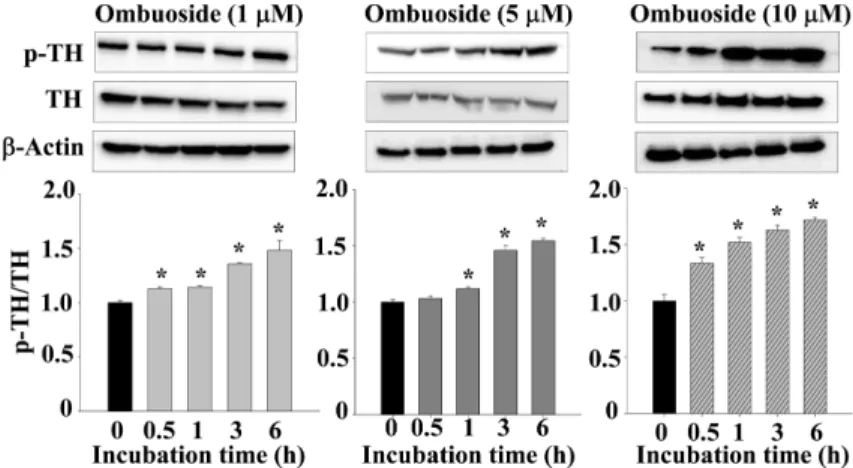
TH and CREB phosphorylation – Ombuoside (1, 5, and 10 μM) showed significant increase in TH pho- sphorylation at Ser40 in a time-dependent manner (Fig.

2). TH phosphorylation started to rise at 30 min and the increase in phosphorylated TH was further enhanced by ombuoside (1, 5, and 10 μM) for 6 h by 1.48-, 1.54-, and 1.71-fold (P < 0.05) (Fig. 2).

In addition, phosphorylation of CREB at Ser133 was induced after treatment with ombuoside (1, 5, and 10 μM) for 0.5 – 6 h (increase by 1.44-, 1.61-, and 1.68-fold at 6 h, P < 0.05) (Fig. 3).

L-DOPA-induced dopamine levels – Intracellular levels of dopamine in PC12 cells were increased by treatment with L-DOPA at 25 − 200 μM for 24 h (Fig. 4).

10

Co- treatment with ombuoside (1, 5, and 10 μM) and L- DOPA (20, 100, and 200 μM) increased intracellular levels of dopamine to 148 − 176% (20 μM, P < 0.05), 197 − 228% (100 μM, P < 0.05), and 197 − 228% (200 μM, P < 0.05) compared to the L-DOPA-treated group after 24 h (Fig. 4).

Discussion

GP-EX has shown protective effects on dopaminergic neurons by mediating anti-oxidative functions in animal Fig. 1. Effects of ombuoside on dopamine content in PC12 cells.

PC12 cells were treated with ombuoside (1, 5, and 10 µM) and

then incubated for 1 − 24 h. PC12 cells were harvested and then

dopamine levels were determined by an HPLC method. The

mean control levels of intracellular dopamine (0 h) were 3.78 ±

0.31 nmol/mg protein. The results are expressed as the means ±

S.E.M. (n = 6 − 8).

*

P < 0.05 compared to the control levels

(ANOVA followed by Dunnett’s test).

(3)

Vol. 24, No. 2, 2018 101

models of PD.

13-15

Ombuoside is a flavonol glycoside of GP-EX.

11

In this study, we investigated the effects of ombuoside on dopamine biosynthesis in PC12 cells.

Ombuoside at concentrations up to 50 μM did not reduce cell viability for 24 h (data not shown). Ombuoside (1, 5, and 10 μM) significantly enhanced intracellular dopamine levels in a dose-dependent manner at 6 – 24 h (Fig. 1). TH phosphorylation (Ser40) was also signifi- cantly increased after treatment with ombuoside (1, 5, and 10 μM) in a time-dependent manner (Fig. 2). TH pho- sphorylation (Ser40) was enhanced by ombuoside at 30 min and this increase in phosphorylated TH was maintained for 6 h. In addition, ombuoside (1, 5, and 10 μM) significantly increased the phosphorylated levels of CREB at Ser133 for 0.5 – 6 h (Fig. 3).

Dopamine biosynthesis is mainly regulated by TH

activation. Short-term activation of TH occurs through phosphorylation of TH at Ser40 by the cAMP-CREB system in dopaminergic neurons and PC12 cells

4,7

and long-term regulation is achieved through TH gene expression by activating the PKA-CREB system.

4-6

In addition, CREB is activated by phosphorylation at Ser133 through the cAMP-PKA system

3,4,7

and then binds to the CRE region, a TH promoter, which is essential for the regulation of TH gene expression.

4,7,24

These results suggest that ombuoside enhances dopamine biosynthesis through CREB and TH phosphorylation in PC12 cells.

L-DOPA at 20 – 200 μM significantly elevates the intracellular levels of dopamine by activation of the cAMP-PKA-CREB system in PC12 cells.

9,10

However, L- DOPA at high concentration (200 μM) reduces the phosphorylation of TH, PKA, and CREB at 24 – 48 h, Fig. 2. Effects of ombuoside on the phosphorylation of TH (Ser40) in PC12 cells. PC12 cells were treated with ombuoside (1, 5, and 10 µM) for 0.5 − 6 h. Immunoblots of lysates of cell pellets were probed with phospho-TH and then the phosphorylation of TH (Ser40) (p-TH) and total TH were analyzed by western blotting. The values of the relative density ratios of p-TH/TH are expressed in arbitrary units. The results are expressed as the means ± S.E.M. (n = 4).

*

P < 0.05 compared to the control levels (ANOVA followed by Dunnett’s test).

Fig. 3. Effects of ombuoside on the phosphorylation of CREB (Ser133) in PC12 cells. PC12 cells were treated with ombuoside (1, 5, and

10 µM) for 0.5 − 6 h. Immunoblots of lysates of cell pellets were probed with phospho-CREB and then the phosphorylation of CREB

(Ser133) (p-CREB) and total CREB were analyzed by western blotting. The values of the relative density ratios of p-CREB/CREB are

expressed in arbitrary units. The results are expressed as the means ± S.E.M. (n = 4).

*

P < 0.05 compared to the control levels (ANOVA

followed by Dunnett’s test).

(4)

102 Natural Product Sciences

which leads to decrease in dopamine levels because of L- DOPA-induced oxidative cytotoxicity.

10,24

Treatment with L-DOPA alone (20, 100, and 200 μM) increased intra- cellular dopamine levels (Fig. 4).

10

Ombuoside (1, 5, and 10 μM) co-administered with L-DOPA (20, 100, and 200 μM) for 24 h further increased the intracellular levels of dopamine in PC12 cells compared to L-DOPA alone (Fig.

4.), indicating that ombuoside enhanced L-DOPA-induced dopamine biosynthesis in PC12 cells.

In general, flavonoids exhibit anti-oxidative functions.

16

The anti-oxidative functions of ombuoside may serve as the mechanism of dopamine biosynthesis in PC12 cells.

GP-EX and GPS have been shown to exhibit protective effects against neurotoxicity by reducing TH neuronal cell death and L-DOPA-induced cytotoxicity in rat models of PD.

13,14

The functional relationships between GP-EX, GPS, and ombuoside need to be further elucidated for pharmaceutical application.

In conclusion, ombuoside enhanced dopamine biosy- nthesis by regulating the CREB-TH system in PC12 cells.

Further in vivo work should be conducted to elucidate its efficacy using animal models.

Acknowledgements

This research was financially supported by the National

Research Foundation of Korea (grant no. 2013R1A1A 2058230, 2015-2016), Republic of Korea.

References

(1) Fahn, S. Ann. NY Acad. Sci. 2003, 991, 1-14.

(2) Nagatsu, T.; Levitt, M.; Udenfriend, S. J. Biol. Chem. 1964, 239, 2910-2917.

(3) Kilbourne, E. J.; Nankova, B. B.; Lewis, E. J.; McMahon, A.;

Osaka, H.; Sabban, D. B.; Sabban, E. L. J. Biol. Chem. 1992, 267, 7563- 7569.

(4) Kim, K. S.; Lee, M. K.; Carroll, J.; Joh, T. H. J. Biol. Chem. 1993, 268, 15689-15695.

(5) Campbell, D. G.; Hardie, D. G.; Vulliet, P. R. J. Biol. Chem. 1986, 261, 10489-10492.

(6) Haycock, J. W. Neurochem. Res. 1993, 18, 15-26.

(7) Kim, K. S.; Park, D. H.; Wessel, T. C.; Song, B.; Wagner, J. A.; Joh, T. H. Proc. Natl. Acad. Sci. USA. 1993, 90, 3471-3475.

(8) Marsden, C. D.; Parkes, J. D. Lancet 1977, 1, 345-349.

(9) Migheli, R.; Godani, C.; Sciola, L.; Delogu, M. R.; Serra, P. A.;

Zangani, D.; De Natale, G.; Miele, E.; Desole, M. S. J. Neurochem. 1999, 73, 1155-1163.

(10) Jin, C. M.; Yang, Y. J.; Huang, H. S.; Lim, S. C.; Kai, M.; Lee, M.

K. Eur. J. Pharmacol. 2008, 591, 88-95.

(11) Razmovski-Naumovski, V.; Huang, T. H. W.; Tran, V. H.; Li, G. Q.;

Duke, C. C.; Roufogalis, B. D. Phytochem. Rev. 2005, 14, 197-219.

(12) Choi, H. S.; Zhao, T. T.; Shin, K. S.; Kim, S. H.; Hwang, B. Y.;

Lee, C. K.; Lee, M. K. Molecules 2013, 18, 4342-4356.

(13) Choi, H. S.; Park, M. S.; Kim, S. H.; Hwang, B. Y.; Lee, C. K.;

Lee, M. K. Molecules 2010, 15, 2814-2824.

(14) Shin, K. S.; Zhao, T. T.; Park, K. H.; Park, H. J.; Hwang, B. Y.;

Lee, C. K.; Lee, M. K. BMC Neurosci. 2015, 16, 23.

(15) Shin, K. S.; Zhao, T. T.; Choi, H. S.; Hwang, B. Y.; Lee, C. K.;

Lee, M. K. Brain Res. 2014, 1567, 57-65.

(16) Rice-Evans, C. A.; Miller, N. J.; Paganga, G. Free Radic. Biol.

Med. 1996, 20, 933-956.

(17) Amaro-Luis, J. M.; Adrián, M.; Díaz, C. Ann. Pharm. Fr. 1997, 55, 262-268.

(18) Pollard, S. E.; Kuhnle, G. G.; Vauzour, D.; Vafeiadou, K.; Tzounis, X.; Whiteman, M.; Rice-Evans, C.; Spencer, J. P. Biochem. Biophys. Res.

Commun. 2006, 350, 960-968.

(19) Kumar, S.; Pandey, A. K. Scientific World Journal 2013, 2013, 162750.

(20) Tischler, A. S.; Perlman, R. L.; Morse, G. M.; Sheard, B. E. J.

Neurochem. 1983, 40, 364-370.

(21) Mosmann, T. J. Immunol. Methods. 1983, 65, 55-63.

(22) Lowry, O. H.; Rosebrough, N. J.; Farr, A. L.; Randall, R. L. J. Biol.

Chem. 1951, 193, 265-275.

(23) Gonzalez, G. A.; Montminy, M. R. Cell 1989, 59, 675-680.

(24) Basma, A. N.; Morris, E. J.; Nicklas, W. J.; Geller, H. M. J.

Neurochem. 1995, 64, 825-832.

Received September 1, 2017 Revised February 8, 2018 Accepted February 11, 2018 Fig. 4. Effects of ombuoside on L-DOPA-induced dopamine

levels in PC12 cells. PC12 cells were exposed to L-DOPA (20, 100, and 200 µM) in the absence or presence of ombuoside (1, 5 and 10 µM) for 24 h. PC12 cells were harvested and then dopamine levels were determined by an HPLC method. The mean control levels of intracellular dopamine were 3.56 ± 0.24 nmol/mg protein. The results are expressed as the means ± S.E.M.

( n = 6 − 8).

*

P < 0.05 compared to the control levels (untreated

cells),

#

P < 0.05 compared to corresponding L-DOPA treatment

(20, 100, and 200 µM) (ANOVA followed by Dunnett’s test).

수치

Fig. 3. Effects of ombuoside on the phosphorylation of CREB (Ser133) in PC12 cells. PC12 cells were treated with ombuoside (1, 5, and 10 µM) for 0.5 − 6 h

참조

관련 문서

The expression levels of apoptotic related proteins and caspase dependent proteins by the ostreolysin purified from P.ostreatus on cell viability in FaDu human

The proliferations of MC3T3-E1 cell seeded on pristine PCL scaffold and surface modified scaffolds for 1, 3, and 5 days... ALP activity of the MC3T3-E1 cell seeded

Concentration-Dependent inhibition of cell viability by adenosine in human oral fibroblast and FaDu human head and neck squamous cell carcinoma · · ·

Effects of phase I periodontal treatment on gingival crevicular fluid levels of matrix metalloproteinase-3 and tissue inhibitor of metalloproteinase-1.

The present study was designed to investigate the role in intracellular calcium mobilization of two representative endoplasmic reticulum (ER) proteins, STIM1

protein levels in control or PIG3 depleted HCT116 and HeLa cells were tested. by

Then statistical mechanics asks this: (1) in how many ways can the n particles be distributed over the available energy levels such that the total energy of the crystal is U,

Glutamate excitotoxicity induced by excessive activation of NMDA receptor causes various damage to cells, which leads to cell death.. In previous studies, increased ROS