• 검색 결과가 없습니다.

Phellodendron amurense and Its Major Alkaloid Compound, Berberine Ameliorates Scopolamine-Induced Neuronal Impairment and Memory Dysfunction in Rats

N/A
N/A
Protected

Academic year: 2022

Share "Phellodendron amurense and Its Major Alkaloid Compound, Berberine Ameliorates Scopolamine-Induced Neuronal Impairment and Memory Dysfunction in Rats"

Copied!
11
0
0

로드 중.... (전체 텍스트 보기)

전체 글

(1)

79

ABBREVIATIONS: PA, Phellodendron amurense; BER, berberine;

AD, Alzheimer’s disease; ACh, acetylcholine; SCO, scopolamine;

CNS, central nervous system; IL-1β, interleukin-1β; TNF-α, tumor necrosis factor-α; PAT, passive avoidance test; MWM, Morris water maze; TA, tacrine; ChAT, Cholineacetyltransferase; AchE, Acethyl- cholinesterase; PBS, phosphate-buffered saline; ABC, avidin–biotin–

peroxidase complex; DAB, 3,3’-diaminobenzidine; ELISA, Enzyme- Linked Immunosorbent Assay; BDNF, Brain-derived neurotrophic factor; CREB, cAMP-response element-binding protein; COX-2, cyclooxygenase-2; RT-PCR, reverse transcription-polymerase chain reaction; GAPDH, glyceraldehyde-3-phosphate dehydrogenase;

ANOVA, analysis of variance; NF-κB, nuclear factor-kappaB; PGE2, prostaglandins E2.

Received December 8, 2011, Revised February 17, 2012, Accepted March 3, 2012

Corresponding to: Bombi Lee and Dae-Hyun Hahm, Acupuncture and Meridian Science Research Center, College of Oriental Medicine, Kyung Hee University, 1, Hoegi-dong, Dongdaemun-gu, Seoul 130-701, Korea. (Tel) 82-2-961-0943, (Fax) 82-2-963-2175, (E-mail) bombi@

khu.ac.kr and [email protected]

*These authors are equally contributed to this study.

This is an Open Access article distributed under the terms of the Creative Commons Attribution Non-Commercial License (http://

creativecommons.org/licenses/by-nc/3.0) which permits unrestricted non-commercial use, distribution, and reproduction in any medium, provided the original work is properly cited.

Phellodendron amurense and Its Major Alkaloid Compound, Berberine Ameliorates Scopolamine-Induced Neuronal Impairment and Memory Dysfunction in Rats

Bombi Lee

1,

*, Bongjun Sur

2

, Insop Shim

1,2

, Hyejung Lee

1,2

, and Dae-Hyun Hahm

1,2,

*

1

Acupuncture and Meridian Science Research Center,

2

The Graduate School of Basic Science of Oriental Medicine, College of Oriental Medicine, Kyung Hee University, Seoul 130-701, Korea

W e examine whether Phellodendron amurense (PA) and its major alkaloid compound, berberine (BER), improved memory defects caused by administering scopolamine in rats. Effects of PA and BER on the acetylcholinergic system and pro-inflammatory cytokines in the hippocampus were also investi- gated. Male rats were administered daily doses for 14 days of PA (100 and 200 mg/kg, i.p.) and BER (20 mg/kg, i.p.) 30 min before scopolamine injection (2 mg/kg, i.p.). Daily administration of PA and BER improved memory impairment as measured by the passive avoidance test and reduced the escape latency for finding the platform in the Morris water maze test. Administration of PA and BER significantly alleviated memory-associated decreases in cholinergic immunoreactivity and restored brain-derived neurotrophic factor and cAMP-response element-binding protein mRNA expression in the hippocampus. PA and BER also decreased significantly the expression of proinflammatory cytokines such as interleukin-1β, tumor necrosis factor-α and cyclooxygenase-2 mRNA in the hippocampus. These results demonstrated that PA and BER had significant neuroprotective effects against neuronal impairment and memory dysfunction caused by scopolamine in rats. These results suggest that PA and BER may be useful as therapeutic agents for improving cognitive functioning by stimulating cholinergic enzyme activity and alleviating inflammatory responses.

Key Words: Scopolamine, Memory, Cholinergic neurons, Brain-derived neurotrophic factor, Proinflam- matory cytokines

INTRODUCTION

Alzheimer’s disease (AD), which is characterized by a pro- gressive decline in cognitive functioning due to degeneration of the cholinergic nervous system and neuronal dysfunction, is one of the most common forms of dementia in the aging population [1]. In discussions of the neuropathological fea- tures of memory loss and cognitive dysfunction, as observed primarily, in patients with AD, cholinergic deficits and neu- ronal dysfunction have been considered a primary causes [2]. Accordingly, various cholinergic drugs have been appro- ved to treat AD, and they exert their therapeutic effects

by counteracting acetylcholine (ACh) deficits and consequen- tly enhancing the ACh levels in the brain [3].

In the present study, intraperitoneal (i.p.) administration

of the muscarinic antagonist scopolamine (SCO), a blocker

of muscarinic ACh receptors, was exploited as a pharmaco-

logical model for AD in rats. SCO induces dysregulation

of the cholinergic neuronal pathway and memory circuits

in the central nervous system (CNS), resulting in serious

impairments in learning, acquisition, and short-term reten-

tion of spatial memory tasks [4]. Because such lesions in

cholinergic neuronal circuits result in decreased ACh release

and subsequent dysfunction in learning and memory, the

SCO-induced amnesic model has been widely used to provide

(2)

a model system of memory dysfunction to screen for phar- macological agents with memory-enhancing activities [5].

Inflammation, as well as cholinergic neuronal degener- ation, may play an important role in the pathogenesis of the degenerative changes and cognitive impairment asso- ciated with AD. Proinflammatory cytokines, such as inter- leukin-1β (IL-1β) and tumor necrosis factor-α (TNF-α) are upregulated in the AD brain [6]. These inflammatory cyto- kines may play a role as neurotoxic agents in the patho- logical cascade of AD [7].

Many studies have reported that the use of herbal medi- cine or natural products in treating Alzheimer type-de- mentia patients improved their memory related symptoms [8,9]. However, there has been little scientific evidence re- ported regarding their effectiveness or mechanisms of their action.

Phellodendron amurense (PA) has been widely used in Korean traditional medicine to treat bacterial infection of the respiratory system and chronic inflammatory diseases [10]. PA and its major alkaloid compound, berberine (BER), have multiple pharmacological actions and produce a varie- ty of biological effects in the CNS [11]. In particular, BER has been reported to improve diabetes-induced memory im- pairment and to reduce oxidative stress [12]. Several stud- ies have shown that BER was effective in ameliorating spa- tial memory impairment and decreasing the expression of IL-1β in a rat model of AD [13], suggesting that the anti-in- flammatory effects of PA and BER may result from their ability to inhibit the degeneration of cholinergic neurons, thereby alleviating deficits in spatial learning ability in the memory-impairment animal model [14].

The aim of the present study was to evaluate the ability of PA and BER to improve learning and memory in rats exposed to repeated SCO-induced memory deficits as meas- ured by performance on the passive avoidance test (PAT) and the Morris water maze (MWM) test. Moreover, we ex- amined how these effects were related to the cholinergic system and to anti-inflammatory effects to determine the neural mechanisms underlying the memory-enhancing acti- vity of PA and its main alkaloid compound, BER.

METHODS Animals

Adult male Sprague-Dawley (SD) rats weighing 260∼280 g were obtained from Samtako Animal Co. (Seoul, Korea).

The rats were housed in a limited-access rodent facility with up to five rats per polycarbonate cage. The room con- trols were set to maintain the temperature at 22±2

o

C and the relative humidity at 55±15%. Cages were lit by artificial light for 12 h each day. Sterilized drinking water and stand- ard chow diet were supplied ad libitum to each cage during the experiments. The animal experiments were conducted in accordance with the Guide for the Care and Use of Labo- ratory Animals (NIH Publications No. 80-23), revised in 1996, and were approved by the Kyung Hee University Ins- titutional Animal Care and Use Committee. All animal ex- periments began at least 7 days after the animals arrived.

Main reagent

Scopolamine hydrobromide, tacrine (TA) and BER were obtained from standard commercial suppliers (Sigma-Aldrich

Chemical Co., St Louis, MO, USA). PA, used in this study, was purchase from an oriental drug store (Health maxi- mum Co., Jecheon, Korea). A voucher specimen of PA has been deposited at the herbarium located at the College of Oriental Medicine, Kyung Hee University (Code number KH-PA01 for PA), according to described previous study [15].

One hundred grams of PA were cut into small pieces and extracted three times with 4 l of 85% methanol by soni- cation in a reflux condenser for 24 h at room temperature (25±2

o

C). The extracted solutions were combined, filtered through Whatman No. 1 filter paper, concentrated using a rotary vacuum evaporator (EYELA CCA-1110, Tokyo Rikakikai Co., Tokyo, Japan) to obtain concentrated extracts, and then lyophilized (EYELA FD-800). The final yield of PA in a powder form was 13.7% (w/w).

Experimental groups

To develop learning and memory deficits, male rats were intraperitoneally injected at 2 mg/kg body weight with SCO, dissolved in physiological saline solution, once a day for 14 days. Normal animals received saline instead of SCO as a vehicle. Different rats in an experimental group were sub- jected to either behavioral testing or immunohistochemistry.

The rats were randomly divided into seven groups of seven individuals as follows: normal group (SAL group, n=7), the saline-induced plus 200 mg/kg PA-treated group (PA group, n=7), the SCO-induced and saline-treated group (SCO group as a control, n=7), the SCO-induced plus 20 mg/kg BER- treated group (SCO+BER20 group, n=7), the SCO-induced plus 100 mg/kg PA-treated group (SCO+PA100 group, n=7), the SCO-induced plus 200 mg/kg PA-treated group (SCO+

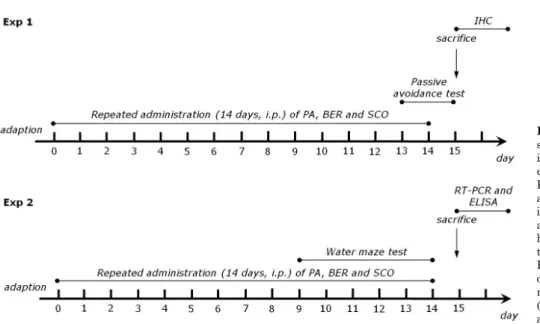
PA200 group, n=7), and the SCO-induced plus 0.2 mg/kg TA-treated group (SCO+TA group, n=7). TA, a centrally acting cholinesterase inhibitor, was used as a positive control. The rats were intraperitoneally administrated with PA and BER once a day for 14 days, and PA and BER were dissolved in 0.9% physiological saline. Thirty minutes after PA and BER administration, all rats except SAL group were received the SCO injection. When starting 9th day af- ter SCO injection, rats performed to take the MWM task.

The experimental schedule of all drug administration and behavioral tests are shown in Fig. 1.

Passive avoidance test

All animals were subjected to a passive avoidance test.

The test was basically performed according to the step-

through method described previously [16]. The Gemini

Avoidance System (SD Instruments., San Diego, CA, USA)

was used for this experiment. Basically, the step-through

passive avoidance apparatus consists of a two-compartment

acrylic box with a lightened compartment connected to a

darkened one by an automatic guillotine door. Electric shock

was delivered to the grid floor of both compartment, made

of stainless steel rods (3 mm diameter) spaced 1 cm apart,

by an isolated shock generator (Behbood Pardaz Co., Ghaem,

Iran). First, rats were taken trials to acquisition test in the

apparatus. In this trial, rats were placed in a lightened

compartment for 300 s, and then the guillotine door was

opened. Rats have native preference to the dark environ-

ment. Immediately upon entering the dark compartment,

the door was closed. Acquisition test was recorded the la-

tencies times for entering the dark compartment. After 30

min, rats were again placed in the lightened compartment.

(3)

Fig. 1. Experimental schedules of scopolamine-induced spatial memory impairments in the rats. Exp 1 was designed to explore the efficacy of PA and BER administration for amelioration of memory impairment in an animal model using a passive avoidance test (PAT) and immuno- histochemistry. Exp 2 was designed to explore the efficacy of PA and BER administration for amelioration of memory impairment in an animal model using the Morris water maze (MWM) test, ELISA and RT-RCT analyses.

Rats had spontaneously entered the dark compartment, the guillotine door was closed and a mild electrical shock (0.5 mA) was applied for 3 s. Exactly 24 h after the acquisition trial for training, the retention test was performed. The rat was again placed in the lightened compartment and the guillotine door was opened. The retention test was meas- ured the latencies times for entering the dark compartment in a same method with acquisition test. The maximum en- try latency allowed in the retention test was 180 s [17].

Morris water maze test 1. Morris water maze apparatus

The MWM test was performed using a polypropylene cir- cular pool (painted white internally, 2.0 m in diameter and 0.35 m high). The pool contained water maintained at a temperature of 22±2

o

C. The water was made opaque by adding 1 kg of skim milk powder. During the MWM test, a platform 15 cm in diameter was located 1.5 cm below the water in one of four sections of the pool, approximately 50 cm from the sidewalls. The pool was surrounded by many cues external to the maze. The pool was divided into four quadrants of equal area. A digital camera was mounted to the ceiling above the pool and was connected to a compu- terized recording system equipped with a tracking program (S-MART: PanLab Co., Barcelona, Spain), which permitted on- and off-line automated tracking of the paths taken by the rats.

2. Hidden platform trial for acquisition test

The MWM test was initiated on the 9

th

day after the PA, BER and SCO administration commenced. The animals re- ceived three trials per day. The rats were trained to find the hidden platform, which remained in a fixed location throughout the test. The trials lasted for a maximum of 180 s, and the time it took to find the submerged platform was recorded each time. The animals were tested three tri- als per day for 5 days, and they received a 60-s probe trial on the sixth day. Finding the platform was defined as stay- ing on it for at least 4 s before the acquisition time of 180 s ended. If the rat failed to find the platform in the allotted

time in first trial of hidden platform test, those rats should placed onto the platform for 20 s and assigned a latency of 180 s. Between one trail and the next, water was stirred to erase olfactory traces of previous swim patterns. The en- tire procedure took sixth consecutive days, and each animal had three training trials per day, with a 30- to 40-min inter- trial interval.

3. Probe trial for retention test

For the probe trial, each rat was placed into the water diagonally from the target quadrant, and for 60 s, was al- lowed to search the water from which the platform had been removed. The probe trial was expressed by the ratio of the time spent for searching the platform in the target quadrant to total duration spent for swimming in the pool.

Cholineacetyltransferase (ChAT) and Acethylcholine- sterase (AchE) immunohistochemistry

For immunohistochemical studies, the animals were deeply anesthetized with sodium pentobarbital (80 mg/kg, by in- traperitoneal injection) and perfused through the ascending aorta with normal saline (0.9%) followed by 300 ml (per rat) of 4% paraformaldehyde in 0.1 M phosphate-buffered saline (PBS). The brains were removed, post-fixed over-night, and cryoprotected with 20% sucrose in 0.1 M PBS at 4

o

C.

Coronal sections 30 μm thick were cut through the septal region and hippocampus using a cryostat (Leica CM1850;

Leica Microsystems Ltd., Nussloch, Germany). The sections were immunostained for ChAT expression using the avi- din-biotin-peroxidase complex (ABC) method. Briefly, the sections were rinsed three times for 5 min each in PBS and then incubated with primary rabbit anti-ChAT antibody (1:2,000 dilution; Cambridge Research Biochemicals Co., Bellingham, UK), or goat anti-AchE antibody (1:2,000 di- lution; Santa Cruz Biotechnology Inc., CA, USA) in PBST (PBS plus 0.3% Triton X-100) for 72 h at 4

o

C. Both secon- dary antibodies were obtained from Vector Laboratories Co.

(Burlingame, CA, USA) and diluted 1:200 in PBST contain-

ing 2% normal serum. To visualize immunoreactivity, the

sections were incubated for 90 min in ABC reagent (Vecta-

(4)

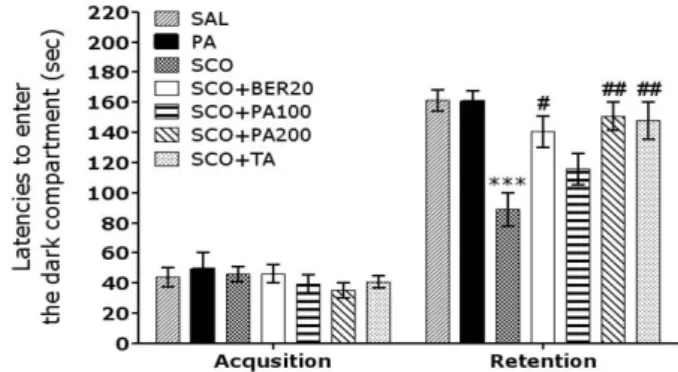
Fig. 2. Effect of PA and BER on the latencies to enter the dark compartment in the acquisition trial and in the retention test during the PAT test. ***p<0.001 vs. the SAL group;

#

p<0.05 and

##

p<0.01 vs. the SCO group.

stain Elite ABC kit; Vector Labs. Co., Burlingame, CA, USA), and incubated in a solution containing 3,3'-diaminobenzi- dine (DAB; Sigma) and 0.01% H

2

O

2

for 1 min. Images were captured using the AxioVision 3.0 imaging system (Carl Zeiss, Inc., Oberkochen, Germany) and processed using Adobe Photoshop (Adobe Systems, Inc., San Jose, CA, USA). The sections were viewed at 200×magnification, and the num- bers of cells within 100×100-μm

2

grids were counted by ob- servers blinded to the experimental groups. Medial septum and hippocampal area cells were obtained according to the stereotactic atlas of Paxinos and Watson [18]. The cells were counted in three sections per rat within the hippo- campal area.

Enzyme-Linked Immunosorbent Assay (ELISA) in plasma After SCO injection for 14 days, IL-1β and IL-6 concen- tration in blood was determined. For this study, the un- anesthetized rats were rapidly decapitated, and the blood was quickly collected via the abdominal aorta. Homogeniza- tion was carried out on ice using a tissue homogenizer and incubated for 1 min at 4

o

C with shaking. Homogenates were centrifuged and supernatants were collected. Protein con- centrations were estimated by the procedure of Taylor et al. [19] with BSA as the standard. The IL-1β and IL-6 con- centration was measured by a competitive enzyme-linked immunoassay (ELISA) using a rabbit polyclonal IL-1β and IL-6 antibody (IL-1β and IL-6; R&D Systems, Minneapolis, MN, USA) according to the manufacturer’s protocol. Sam- ples (or standard) and conjugate were added to each well, and the plate was incubated for 1 h at room temperature without blocking. After wells were washed several times with buffers and proper color developed, the optical density was measured at 450 nm using an ELISA reader (MutiRead 400; Authos Co., Vienna, Austria).

Total RNA preparation and RT-PCR analysis The hippocampus from each of four rats in each group was isolated. After decapitation, the brain was quickly re- moved and stored at -80

o

C until use. The total RNA was isolated from the brain sample using a TRIzol

reagent (Invitrogen Co., Carlsbad, CA, USA) and RNA was extrac- ted according to the supplier’s instruction. Complementary DNA was synthesized from total RNA with a reverse tran- scriptase (Takara Co., Shiga, Japan). Brain-derived neuro- trophic factor (BDNF), cAMP-response element-binding protein (CREB), IL-1β, TNF-α, and cyclooxygenase-2 (COX-2) mRNA expression levels were determined by the reverse transcription-polymerase chain reaction (RT-PCR).

RT-PCR was performed using a PTC-100 programmable thermal controller (MJ Research, Inc., Watertown, MA, USA). All primers were designed using published mRNA sequences and primer design software (Primer 3; The Whitehead Institute for Biomedical Research, Cambridge, MA, USA; www.genome.wi.mit.edu) offered through their website. The PCR products were separated on 1.2% agarose gels and stained with ethidium bromide after which the den- sity of each band was evaluated using an image- analyzing system (i-Max

TM

, CoreBio System Co., Seoul, Korea). Com- plementary DNA expression levels were determined by cal- culating the relative density of each BDNF, CREB, IL-1β, TNF-α, and COX-2 band to glyceraldehyde-3-phosphate de- hydrogenase (GAPDH).

Statistical analysis

All measurements were performed by an independent in- vestigator blinded to the experimental conditions. Results in figures are expressed as mean±standard error of means (SE). Differences within or between normally distributed data were analyzed by analysis of variance (ANOVA) using SPSS (Version 13.0; SPSS, Inc., Chicago, IL, USA) followed by Tukey’s post hoc test. Statistical significance was set at p<0.05.

RESULTS

Effect of PA and its main alkaloid compound, BER on the passive avoidance test

To determine whether PA or BER promotes recovery of memory dysfunction, PA or BER was administered to rats with SCO-induced impairment of memory, and their memory and cognitive functions were examined by the PAT (Fig.

2). The rats in all groups were confirmed to have no physio-

logical defect (i.e., motor function defect) or intrinsic cogni-

tive impairment prior to SCO-induced impairments estab-

lished through acquisition trials without electric challenge

in the PAT. No significant difference was found between

the groups in the time required for acquisition trials, as

indicated by the latencies for entering the dark compart-

ment. After acquisition, the effect of PA or BER on reten-

tion latency, indicated by the latency times for entering the

dark compartment, was measured 24 hours after applying

electric shock in the dark room in the PAT. Regarding re-

tention, rats in the SCO+BER20 group (p<0.05) and the

SCO+PA200 group (p<0.01) were shown to have signifi-

cantly increased latencies for entering the dark compart-

ment compared with the SCO group. This study indicates

that SCO injection severely impaired long-term memory,

while the PA and BER treatment significantly attenuated

the SCO-induced memory deficit in the PAT test. It also

indicated that the recovery of memory impairment of rats

in the 200 mg/kg PA-treated group was better than those

rats in the 20 mg/kg BER-treated group, and almost com-

patible with the rats in the 0.2 mg/kg TA-treated group.

(5)

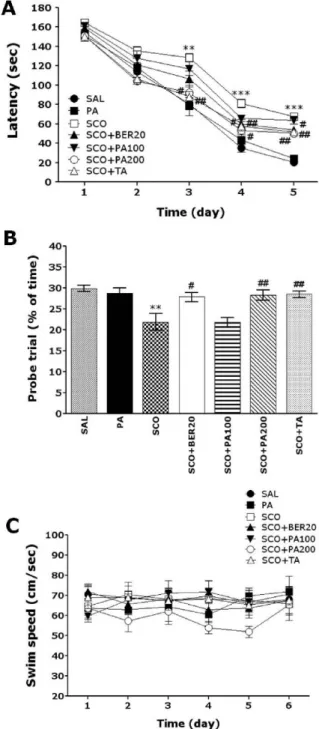
Fig. 3. Time to escape (latency) during acquisition trials of hidden platform (A), probe trial (B), and swim speed (C) during the Morris water maze test. **p<0.01 and ***p<0.001 vs. the SAL group;

#

p

<0.05 and

##

p<0.01 vs. the SCO group.

Effect of PA and its main alkaloid compound, BER on the water maze test

The effect of PA or BER treatment on the swimming time to reach the submerged platform is illustrated in Fig. 3.

The SAL group rapidly learned the location of the sub- merged hidden platform and reached it within 20 s on day 5 of the trials. The SCO group showed a marked retardation

in escape latency, probably due to memory deficits resulting from SCO-induced impairment of learning and memory.

Analysis of escape latency revealed that rats in both the SCO+BER20 group and the SCO+PA200 group had sig- nificantly reduced swimming latency as compared with those in the SCO group (SCO+BER20 group: p<0.05 on day 4 and 5, and SCO+PA200 group: p<0.05 on day 3, p<0.01 on day 4 and 5; Fig. 3A). To examine the spatial memory of rats, the performance in the probe trial on day 6 was analyzed by comparing the percentage of time spent swimming to the expected position of platform (Fig. 3B).

The times spent swimming around was significantly re- duced in the rats that swam to the target area where the platform had been located. The repeated administration of SCO severely impaired spatial performance in the MWM test (p<0.01). Rats in the 20 mg/kg BER-treated (p<0.05) group and the 200 mg/kg PA-treated (p<0.01) group spent more time around the platform area than did those in the SCO group. The SCO group was not significantly different from other groups in terms of mean swimming speed, as calculated by dividing the total swim distance by the la- tency (Fig. 3C). Total distance traveled in each group was closely associated with escape latency in this task (data not shown). Based on these results, the 20 mg/kg of BER-treat- ed and 200 mg/kg of PA-treated rats showed greater im- provements in acquisition during the hidden platform trial and reached the platform quicker than the SCO-treated rats. PA and BER treatment significantly attenuated the SCO-induced deficit of learning and memory demonstrated in the water maze. Thus, PA-treated rats and BER-treated rats showed a significant amelioration in the memory re- tention test because they spent more time in the quadrant where the platform was formerly located and swam over the former location of the platform more frequently. It also indicated that the swimming latency of spatial memory im- pairment in rats receiving 200 mg/kg PA administration was better than those rats receiving 20 mg/kg BER admin- istration, and almost compatible with the rats receiving 0.2 mg/kg TA administration.

Effect of PA and its main alkaloid compound, BER on septo-hippocampal choline acetyltransferase Following the behavioral tasks, brain tissue samples from the subjects were analyzed using immunohistochemi- stry to investigate the effect of PA or BER administration on neurons loss due to SCO-induced memory impairment.

ChAT immunoreactivity analysis in the septo-hippocampal cholinergic neurons areas are shown in Fig. 4. The brains of the SCO group showed significant neurons loss in the medical septum and hippocampal regions of septo-hippo- campal cholinergic neurons, as compared to the SAL group (p<0.001; Fig. 5A). The number of ChAT-immunoreactive neurons significantly increased in the medical septum re- gion in the SCO+BER20 group (p<0.01) and the SCO+

PA200 group (p<0.01), as compared to the SCO group. Also,

the number of ChAT-immunoreactive neurons significantly

increased in hippocampal region in the SCO+BER20 group

(p<0.05) and the SCO+PA200 group (p<0.05), as compared

to the SCO group. Losses of ChAT-immunoreactivity in

SCO-induced memory impairment rats were significantly

restored by the PA and BER administration, and the num-

ber of ChAT-immunopositive neurons was closely similar

to that of the control group. It also indicated that the ChAT

activity in the septo-hippocampal cholinergic neurons in

(6)

Fig. 4. Representative photographs showing the distribution of choline acetyltransferase- and acetylcholine- sterase-reactive cells in the hippo- campus of the SAL-ChAT-MS (A), SCO-ChAT-MS (B), SCO+PA200- ChAT-MS (C), SAL-ChAT-hippocam- pus (D) SCO-ChAT-hippocampus (E), SCO+PA200-ChAT-hippocampus (F), SAL-AchE-CA1 (G), SCO-AchE- CA1 (H), SCO+PA200-AchE-CA1 (I), SAL-AchE-CA1 (J), SCO-AchE-CA1 (K), and SCO+PA200-AchE-CA1 (L) groups. Sections were cut coronally at 30 μm. Scale bar indicates 50 μm.

Fig. 5. Percentage (±SE) values of the mean number of choline acetyltransferase (ChAT)-stained neurons (A) and the density of acetylcholinesterase-stained neuron (B) in different hippocampal areas after the Morris water maze task. **p<0.01 and ***p<0.001 vs.

the SAL group;

#

p<0.05 and

##

p<0.01 vs. the SCO group.

rats receiving 200 mg/kg PA administration was better than those rats receiving 20 mg/kg BER administration, and almost compatible with the rats receiving 0.2 mg/kg TA administration.

Effect of PA and its main alkaloid compound, BER on hippocampal acetylcholinesterase

The density of AchE-immunopositive fibers in the CA1 and CA3 area of the rat hippocampus was significantly de- creased in the SCO group as compared to the SAL group (p<0.01; Fig. 5B). The AchE-reactive neuronal activity in

the CA1 and CA3 area of hippocampus due to SCO-induced memory impairment was significantly restored in the SCO+

BER20 group (p<0.05) and the SCO+PA200 group (p<

0.05), as compared to the SCO group. The effect of PA and BER on the density of AchE reactive neurons in hippo- campus CA3 region was similar to that in the CA1 region.

It also indicated that the density of AchE-reactive neurons

in the hippocampus in rats receiving 200 mg/kg PA admin-

istration was better than those rats receiving 20 mg/kg

BER administration, and almost compatible with the rats

receiving 0.2 mg/kg TA administration.

(7)

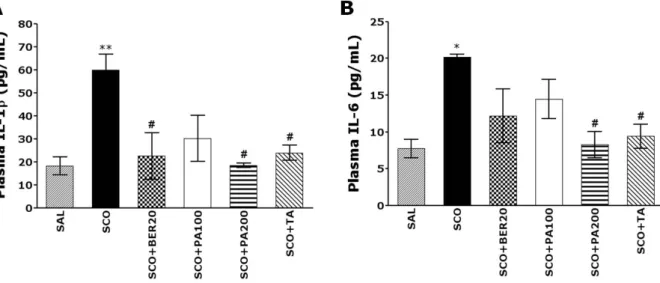
Fig. 6. Interleukin-1 beta (IL-1β) (A) and Interleukin-6 (IL-6) (B) protein expression in rat plasma after scopolamine injection for 14 days.

*p<0.05 and **p<0.01 vs. the SAL group;

#

p<0.05 vs. the SCO group.

Fig. 7. PCR bands and their relative intensities of brain-derived neurotrophic factor (BDNF) and cAMP-response element-binding protein (CREB) mRNA (A), and PCR bands and their relative intensities of interleukin-1 beta (IL-1β), tumour necrosis factor (TNF)-α, and cyclooxygenase-2 (COX-2) mRNA (B) in the hippocampus of scopolamine-induced cognitive impairment rats. *p<0.05 and **p<0.01 vs.

the SAL group;

#

p<0.05 and

##

p<0.01 vs. the SCO group.

Effect of PA and its main alkaloid compound, BER on the IL-1β and IL-6 protein expression in the plasma

The ELISA analysis demonstrated that SCO administra- tion for 14 days significantly increased the plasma IL-1β and IL-6 proteins expression in the rats by 229.07% and 161.39%, respectively. The expression of IL-1β protein in the plasma was markedly increased in the SCO group, as

compared to the SAL group (p<0.01; Fig. 6A). The expres- sion of IL-1β protein in the plasma due to SCO-induced memory impairment was significantly restored in the SCO

+BER20 group (p<0.05) and the SCO+PA200 group (p<

0.05), as compared to SCO group. The expression of IL-6 protein in the plasma was also markedly increased in the SCO group, as compared to the SAL group (p<0.05; Fig.

6B). The expression of IL-6 protein in the plasma due to

SCO-induced memory impairment was significantly re-

stored in the SCO+PA200 group (p<0.05), as compared

(8)

to SCO group. It also indicated that the expression of IL-1β and IL-6 proteins in the plasma in rats receiving 200 mg/kg PA administration was better than those rats receiving 20 mg/kg BER administration, and almost compatible with the rats receiving 0.2 mg/kg TA administration.

Effect of PA and its main alkaloid compound, BER on BDNF, CREB, IL-1β, TNF-α and COX-2 mRNA expression levels in the hippocampus

The effect of PA or BER administration on BDNF, CREB, IL-1β, TNF-α and COX-2 mRNA expression levels in the rats with SCO-induced hippocampus lesions was investi- gated using RT-PCR analysis (Fig. 7). Hippocampal BDNF and CREB mRNA expression in the SCO group were sig- nificantly decreased as compared to that of the SAL group (p<0.01). The decreased expression of BDNF and CREB mRNA in the SCO group was significantly restored in the SCO+BER20 group (p<0.05) and the SCO+PA200 group (p<0.01). It also indicated that the expression of BDNF and CREB mRNA in the hippocampus in rats receiving 200 mg/kg PA administration was better than those rats receiv- ing 20 mg/kg BER administration, and almost compatible with the rats receiving 0.2 mg/kg TA administration. Hippo- campal IL-1β and TNF-α mRNA expression in the SCO group was significantly increased as compared to that of the SAL group (p<0.05 and p<0.01, respectively). The in- creased expression of IL-1β mRNA in the SCO group was significantly restored in the SCO+PA200 group (p<0.05).

The increased expression of TNF-α mRNA in the SCO group was also significantly restored in the SCO+PA200 group (p<0.01). It also indicated that the expression of IL-1 β and TNF-α mRNA in the hippocampus in rats receiving 200 mg/kg PA administration was better than those rats receiving 20 mg/kg BER administration, and almost com- patible with the rats receiving 0.2 mg/kg TA admini- stration. Hippocampal COX-2 mRNA expression in the SCO group were also significantly increased as compared to that of the SAL group (p<0.01). The increased expression of COX-2 mRNA in the SCO group was significantly restored in the SCO+PA100 group (p<0.05) and the SCO+PA200 group (p<0.05). It also indicated that the expression of COX-2 mRNA in the hippocampus in rats receiving 200 mg/kg PA administration was almost compatible with the rats receiving 0.2 mg/kg TA administration.

DISCUSSION

PA is well known to have multiple pharmacological activ- ities and has been used for treating various cognitive dis- orders and psychosomatic diseases such as stress [20].

Although typical prescriptions including PA are known to be clinically effective in alleviating memory-related symp- toms, the underlying mechanisms of PA in those effects have not been investigated. A major component of PA is BER, which could potentially possess anti-AD effects [21].

Recently, some studies demonstrated that BER could inhi- bit the expression of some inflammatory factors through the nuclear factor-κB (NF-κB) signaling pathway [22]. Also, BER can penetrate the blood-brain barrier to reach the striatum, cortex, and hippocampus, and thus, BER might act directly in brain nuclei to produce neuroprotective ef- fects [11]. However, our results are not consistent with the previous studies showing that BER could inhibit memory

impairment and expression of the inflammatory factor in- terleukin-1β by increasing microglial activation [13]. The difference between our results and those of previous studies may result from differing effects of BER on immune and inflammatory factor expression in different animal modes of Alzheimer’s disease.

The present results demonstrated that repeated SCO-in- duced dementia produced severe deficits in performance on tests of cognitive functioning as well as corresponding signs of neurodegeneration in the brain, including decreased ChAT and AchE activities in the hippocampus. Our results showed that administration of PA and BER significantly improved learning and memory on the PAT and it decrea- sed the escape latency and increased the number of plat- form crossings in the MWM test in a rat model of AD. It also produced increased ChAT and AchE immunoreactivity in septo-hippocampal cholinergic neurons areas and increa- sed BDNF and CREB mRNA expression in the hippocam- pus associated with the SCO-induced memory impairment in male rats. PA and BER also inhibited the increase in proinflammatory cytokines in the plasma and hippocampus of rats with SCO-induced deficits.

Our results suggest that administration of 200 mg/kg PA produced a significantly higher inhibitory effect on activity than did 20 mg/kg BER. It is known that PA contains pal- matine and coptisine as well as BER, and previous reports have shown that palmatine and coptisine regulated behav- ioral activity and had CNS effects. Thus, other alkaloids may also affect SCO-induced memory deficits and the chol- inergic system.

Chronic administration of SCO in animals transiently produces several deficits in learning acquisition and short- term memory that are considered to be similar to the chol- inergic deficits in AD or senile CNS dysfunction [3]. The well-replicated amnesic effect of SCO has been interpreted as a principal consequence of the blockade of post-synaptic muscarinic M1 transmission, leading to disruption in the functioning of the hippocampus in working memory. Thus, the SCO-induced amnesic model has been widely used as a pharmacological model of memory dysfunction in screening for agents with potential cognition-enhancing effects [4].

This study showed that SCO significantly shortened the step-through latency of the retention trial in the PAT, dem- onstrating that the central cholinergic neuronal system plays an important role in learning acquisition and synaptic plasticity. PA and BER prolonged the step-through latency of the passive avoidance response that had been shortened by SCO. These results suggest that the anti-amnesic effect of PA and BER in SCO-induced memory impairment may be mediated by the cholinergic nervous system.

To confirm the effects of PA and BER on other types of

memory, we performed the MWM test to evaluate spatial

learning. The MWM test is a hippocampus-dependent mem-

ory task that is frequently used for examining cognitive def-

icits and demonstrating permanent spatial learning ability

and reference memory in rodents [23]. Animals encode spa-

tial working information during the learning step, which

then serves to guide future memory retrieval. The current

finding that the memory deficits demonstrated by the SCO-

impaired rats in the MWM task were more pronounced

than were those in the SAL group were consistent with a

previous study [24]. During the trial sessions, the PA and

BER groups showed significantly reduced escape latency,

enhanced cognitive performance, and amelioration of the

memory deficits associated with SCO. In terms of average

(9)

swim speeds and rest times, both indices of motor function- ing, the SCO group did not differ significantly from the PA-treated and BER-treated groups, suggesting that motor impairment was not the primary cause of the poor perform- ance of the SCO group in the MWM test. Thus, it is evident that PA and BER administration improved MWM perform- ance by directly enhancing spatial working memory. Scores on the escape and the spatial probe tests of the MWM test are considered to primarily reflect long-term spatial memo- ry ability. In this study, PA and BER treatment shortened the escape latency without affecting swimming velocity and extended the time spent swimming in the place where the platform was previously located. In the probe test, admini- stration of PA and BER lowered the escape latency to levels comparable to those demonstrated by the control group and significantly increased the number of times that the rats crossed the platform location [25].

Our results showed that chronic administration of SCO also produced severe deficits in cholinergic neuron dysfunc- tion as well as decreased ChAT and AchE activities in the hippocampus, indicating neurodegeneration in the brain.

Impairment in the hippocampus generally results in dimin- ished spatial learning ability [23,26]. It seems likely that the central cholinergic neuronal system plays an important role in learning acquisition and synaptic plasticity [27]. The expression and activation of AchE and ChAT regulate the dynamic concentration of ACh in the cholinergic synapses in the brain [28]. PA and BER improved cholinergic neu- rons in the hippocampus and continuously induced in- creases in ChAT and AchE activities, which eventually re- sulted in recovery of the entire cholinergic circulation path- way [29]. According to the cholinergic hypothesis, memory impairment in patients with senile dementia is due to selec- tive and irreversible deficits in cholinergic function or alter- nation in hippocampal functioning in the brain [29]. Thus, cholinesterase inhibitors and ChAT activators may compen- sate for reduced the ACh levels in brains with AD disease.

Previous biochemical and behavioral evidence indicated that central cholinergic transmission declines as a result of SCO administration [30] and the type of dementia asso- ciated with AD [31]. This type of decline has been closely associated with cognitive disturbances. It seems likely that the observed amelioration in the deficits in spatial learning capability demonstrated in the PA-treated and BER-treated rats were associated with the increased release of ACh.

Thus, we propose that the beneficial effects of PA and its major alkaloid compound, BER, to ameliorate memory im- pairments could be related to increase central cholinergic functioning.

On the other hand, new findings concerning the activa- tion of BDNF and CREB as novel therapeutics have been reported through several basic and clinical studies [32]. The intentional expression of BDNF and CREB proteins in the brain provides a novel treatment strategy for healing mem- ory deficits [33]. Recent experimental evidence strongly supports the role of BDNF in the modulation of synaptic function and plasticity in CNS for learning and memory processes, besides its actions on neuronal cell survival and prevention of neurodegeneration [33]. Also, there is suffi- cient evidence that the CREB regulates the expression of genes involved in neuroplasticity, cell survival, and cogni- tion [34]. The phosphorylated CREBs are able to bind to cAMP response elements of the target genes considered to be involved in long-term memory formation [35]. Thus, BDNF transcription, regulated by CREB, may also be a

critical player in the adaptive neuronal responses under- lying learning and memory function [36]. Thus, a previous study suggested a close correlation between reduced ex- pression of BDNF and CREB in the hippocampus and cog- nitive impairment [37]. SCO-induced memory deficits in- duced significant reductions of the BDNF and CREB mRNA expression in the hippocampus and poor performance in the hippocampus-dependent tasks [38,39]. We thus proposed that administration of PA and BER significantly prevented the reduction of the BDNF and CREB mRNA expression induced by SCO. These findings suggested that the benefi- cial effects of PA and BER reduces SCO-induced memory and learning deficits by the increase in BDNF expression via the CREB signaling pathway and could be related to increase in neuronal functioning.

At the same time, many studies have suggested that amyloid β-peptide (25-35)-induced or SCO-induced IL-1β and TNF-α expression is upregulated in AD [40] and that these cytokines may play a role in several events in the pathological cascade of AD [41]. These results suggest that inflammatory reactions may be related to the pathogenesis of degenerative changes and cognitive impairment [42]. In the present study, SCO administration caused an increase in the proinflammatory cytokines IL-1β and TNF-α as well as learning and memory deficits. PA and BER inhibited the increased activation of proinflammatory cytokines such as IL-1β and TNF-α in SCO-treated rats.

Many studies have suggested that the inducible gene en- coding COX-2 is a key element that modulates the gen- eration of proinflammatory mediators including various prostagladins [43]. It is known that the expression of COX-2 and the synthesis of prostaglandin E2 (PGE2), one of its products, are increased in the hippocampus of AD patients, which may be related to the pathogenesis of the degener- ative changes and cognitive impairments [44]. These results suggest that inflammatory responses to SCO injection sig- nificantly stimulated the expression of COX-2 mRNA in the hippocampus through modulating the NF-κB pathway [45].

The increase in COX-2 expression by NF-κB activation can accelerate inflammatory responses and subsequently con- tribute to learning and memory deficits. Thus, treatment with long-lasting COX-2 inhibitors during the initial stages of AD, before clinical symptoms of dementia appear, may suppress inflammatory responses and the synthesis of pro-inflammatory mediators in the brain [46]. In the pres- ent study, PA significantly decreased SCO-stimulated beha- vioral changes and memory disturbances through inhibition of COX-2 mRNA expression. Thus, we proposed that the anti-inflammatory effects of PA and BER significantly re- versed impairment in spatial working memory.

The present study showed that repeated SCO-induced de-

mentia produced learning and memory deficits as well as

associated degeneration of cholinergic neurons, impairment

of neuronal function and inflammatory reactions in rats,

as evidenced by their performances on the PAT and MWM

tests and gene expression analysis in a rat model of AD

disease. However, administration of PA and BER attenu-

ated these SCO-induced dementia effects, as indicated by

improved cognitive functioning during behavioral tests and

increases in the density of cholinergic neurons. Thus, PA

and its major alkaloid compound, BER may be useful

agents in preventing cholinergic dysfunction, neuronal im-

pairment, and anti-inflammatory effects such as those ob-

served in AD.

(10)

ACKNOWLEDGEMENTS

This work was supported by a grant from the Kyung Hee University in 2011 (KHU-20110087).

REFERENCES

1. Blennow K, de Leon MJ, Zetterberg H. Alzheimer's disease.

Lancet. 2006;368:387-403.

2. Hasselmo ME. The role of acetylcholine in learning and memory. Curr Opin Neurobiol. 2006;16:710-715.

3. Drever BD, Anderson WG, Johnson H, O'Callaghan M, Seo S, Choi DY, Riedel G, Platt B. Memantine acts as a cholinergic stimulant in the mouse hippocampus. J Alzheimers Dis. 2007;

12:319-333.

4. Klinkenberg I, Blokland A. The validity of scopolamine as a pharmacological model for cognitive impairment: a review of animal behavioral studies. Neurosci Biobehav Rev. 2010;34:1307- 1350.

5. Mohapel P, Leanza G, Kokaia M, Lindvall O. Forebrain acetylcholine regulates adult hippocampal neurogenesis and learning. Neurobiol Aging. 2005;26:939-946.

6. Solfrizzi V, D'Introno A, Colacicco AM, Capurso C, Todarello O, Pellicani V, Capurso SA, Pietrarossa G, Santamato V, Capurso A, Panza F. Circulating biomarkers of cognitive decline and dementia. Clin Chim Acta. 2006;364:91-112.

7. Viau S, Maire MA, Pasquis B, Grégoire S, Fourgeux C, Acar N, Bretillon L, Creuzot-Garcher CP, Joffre C. Time course of ocular surface and lacrimal gland changes in a new scopola- mine-induced dry eye model. Graefes Arch Clin Exp Ophthal- mol. 2008;246:857-867.

8. Wang JF, Wei DQ, Chou KC. Drug candidates from traditional chinese medicines. Curr Top Med Chem. 2008;8:1656-1665.

9. Hara H, Kataoka S, Anan M, Ueda A, Mutoh T, Tabira T. The therapeutic effects of the herbal medicine, Juzen-taiho-to, on amyloid-beta burden in a mouse model of Alzheimer's disease.

J Alzheimers Dis. 2010;20:427-439.

10. Park EK, Rhee HI, Jung HS, Ju SM, Lee YA, Lee SH, Hong SJ, Yang HI, Yoo MC, Kim KS. Antiinflammatory effects of a combined herbal preparation (RAH13) of Phellodendron amu- rense and Coptis chinensis in animal models of inflammation.

Phytother Res. 2007;21:746-750.

11. Zhang J, Yang JQ, He BC, Zhou QX, Yu HR, Tang Y, Liu BZ.

Berberine and total base from rhizoma coptis chinensis attenuate brain injury in an aluminum-induced rat model of neurodegenerative disease. Saudi Med J. 2009;30:760-766.

12. Bhutada P, Mundhada Y, Bansod K, Tawari S, Patil S, Dixit P, Umathe S, Mundhada D. Protection of cholinergic and antioxidant system contributes to the effect of berberine ame- liorating memory dysfunction in rat model of streptozotocin- induced diabetes. Behav Brain Res. 2011;220:30-41.

13. Zhu F, Qian C. Berberine chloride can ameliorate the spatial memory impairment and increase the expression of interleukin- 1beta and inducible nitric oxide synthase in the rat model of Alzheimer's disease. BMC Neurosci. 2006;7:78.

14. Hung TM, Dang NH, Kim JC, Jang HS, Ryoo SW, Lee JH, Choi JS, Bae K, Min BS. Alkaloids from roots of Stephania rotunda and their cholinesterase inhibitory activity. Planta Med. 2010;76:1762-1764.

15. Lee BB, Chae YB, Kwon YK, Yang CH, Kim MR, Kim KJ, Hahm DH, Lee HJ, Shim IS. Inhibitory action of cortex phel- lodendris on nicotine-induced behavioral sensitization. Korean J Oriental Physiology & Pathology. 2004;18:767-773.

16. Shahidi S, Komaki A, Mahmoodi M, Atrvash N, Ghodrati M.

Ascorbic acid supplementation could affect passive avoidance learning and memory in rat. Brain Res Bull. 2008;76:109-113.

17. Mohamed AF, Matsumoto K, Tabata K, Takayama H, Kitajima M, Watanabe H. Effects of Uncaria tomentosa total alkaloid and its components on experimental amnesia in mice: eluci- dation using the passive avoidance test. J Pharm Pharmacol.

2000;52:1553-1561.

18. Paxinos G, Watson C. The rat brain in stereotaxic coordinates.

New York: Academic Press; 1986.

19. Taylor BM, Kolbasa KP, Chin JE, Richards IM, Fleming WE, Griffin RL, Fidler SF, Sun FF. Roles of adhesion molecules ICAM-1 and alpha4 integrin in antigen-induced changes in microvascular permeability associated with lung inflammation in sensitized brown Norway rats. Am J Respir Cell Mol Biol.

1997;17:757-766.

20. Zhou HY, Wang D, Cui Z. Ferulates, amurenlactone A and amurenamide A from traditional Chinese medicine cortex Phellodendri Amurensis. J Asian Nat Prod Res. 2008;10:409-413.

21. Kulkarni SK, Dhir A. Berberine: a plant alkaloid with therapeutic potential for central nervous system disorders.

Phytother Res. 2010;24:317-324.

22. Gu L, Li N, Gong J, Li Q, Zhu W, Li J. Berberine ameliorates intestinal epithelial tight-junction damage and down-regulates myosin light chain kinase pathways in a mouse model of endotoxinemia. J Infect Dis. 2011;203:1602-1612.

23. Jonasson Z. Meta-analysis of sex differences in rodent models of learning and memory: a review of behavioral and biological data. Neurosci Biobehav Rev. 2005;28:811-825.

24. Lee B, Park J, Kwon S, Park MW, Oh SM, Yeom MJ, Shim I, Lee HJ, Hahm DH. Effect of wild ginseng on scopolamine- induced acetylcholine depletion in the rat hippocampus. J Pharm Pharmacol. 2010;62:263-271.

25. Blokland A, Geraerts E, Been M. A detailed analysis of rats' spatial memory in a probe trial of a Morris task. Behav Brain Res. 2004;154:71-75.

26. Sharma D, Puri M, Tiwary AK, Singh N, Jaggi AS. Antiamnesic effect of stevioside in scopolamine-treated rats. Indian J Pharmacol. 2010;42:164-167.

27. Kotani S, Yamauchi T, Teramoto T, Ogura H. Pharmacological evidence of cholinergic involvement in adult hippocampal neurogenesis in rats. Neuroscience. 2006;142:505-514.

28. Kumar R, Jaggi AS, Singh N. Effects of erythropoietin on memory deficits and brain oxidative stress in the mouse models of dementia. Korean J Physiol Pharmacol. 2010;14:345-352.

29. Giacobini E. Long-term stabilizing effect of cholinesterase inhibitors in the therapy of Alzheimer' disease. J Neural Transm Suppl. 2002;62:181-187.

30. Wei J, Lu DX, Qi RB, Wang HD, Jiang XH. Effect of Kangshuai Yizhi Formula I on learning and memory dysfunction induced by scopolamine in mice. Chin J Integr Med. 2010;16:252-257.

31. Counts SE, He B, Che S, Ginsberg SD, Mufson EJ. Galanin hyperinnervation upregulates choline acetyltransferase expres- sion in cholinergic basal forebrain neurons in Alzheimer's disease. Neurodegener Dis. 2008;5:228-231.

32. Williams CM, El Mohsen MA, Vauzour D, Rendeiro C, Butler LT, Ellis JA, Whiteman M, Spencer JP. Blueberry-induced changes in spatial working memory correlate with changes in hippocampal CREB phosphorylation and brain-derived neuro- trophic factor (BDNF) levels. Free Radic Biol Med. 2008;45:

295-305.

33. Vaynman S, Ying Z, Gomez-Pinilla F. Interplay between brain-derived neurotrophic factor and signal transduction modulators in the regulation of the effects of exercise on synaptic-plasticity. Neuroscience. 2003;122:647-657.

34. Kida S, Josselyn SA, Peña de Ortiz S, Kogan JH, Chevere I, Masushige S, Silva AJ. CREB required for the stability of new and reactivated fear memories. Nat Neurosci. 2002;5:348-355.

35. Guzowski JF, McGaugh JL. Antisense oligodeoxynucleotide- mediated disruption of hippocampal cAMP response element binding protein levels impairs consolidation of memory for water maze training. Proc Natl Acad Sci USA. 1997;94:2693- 2698.

36. Tyler WJ, Alonso M, Bramham CR, Pozzo-Miller LD. From acquisition to consolidation: on the role of brain-derived neurotrophic factor signaling in hippocampal-dependent lear- ning. Learn Mem. 2002;9:224-237.

37. Xu J, Rong S, Xie B, Sun Z, Deng Q, Wu H, Bao W, Wang

D, Yao P, Huang F, Liu L. Memory impairment in cognitively

(11)

impaired aged rats associated with decreased hippocampal CREB phosphorylation: reversal by procyanidins extracted from the lotus seedpod. J Gerontol A Biol Sci Med Sci.

2010;65:933-940.

38. Hong SW, Yang JH, Joh EH, Kim HJ, Kim DH. Gypenoside TN-2 ameliorates scopolamine-induced learning deficit in mice.

J Ethnopharmacol. 2011;134:1010-1013.

39. Xue W, Hu JF, Yuan YH, Sun JD, Li BY, Zhang DM, Li CJ, Chen NH. Polygalasaponin XXXII from Polygala tenuifolia root improves hippocampal-dependent learning and memory. Acta Pharmacol Sin. 2009;30:1211-1219.

40. Dickson DW, Lee SC, Mattiace LA, Yen SH, Brosnan C.

Microglia and cytokines in neurological disease, with special reference to AIDS and Alzheimer's disease. Glia. 1993;7:75-83.

41. Eikelenboom P, Zhan SS, van Gool WA, Allsop D. Inflammatory mechanisms in Alzheimer's disease. Trends Pharmacol Sci.

1994;15:447-450.

42. Rothwell N, Allan S, Toulmond S. The role of interleukin 1 in

acute neurodegeneration and stroke: pathophysiological and therapeutic implications. J Clin Invest. 1997;100:2648-2652.

43. Fehér A, Juhász A, Rimanóczy A, Kálmán J, Janka Z.

Association study of interferon-γ, cytosolic phospholipase A2, and cyclooxygenase-2 gene polymorphisms in Alzheimer disease. Am J Geriatr Psychiatry. 2010;18:983-987.

44. Fujimi K, Noda K, Sasaki K, Wakisaka Y, Tanizaki Y, Iida M, Kiyohara Y, Kanba S, Iwaki T. Altered expression of COX-2 in subdivisions of the hippocampus during aging and in Alzheimer's disease: the Hisayama Study. Dement Geriatr Cogn Disord. 2007;23:423-431.

45. Jung K, Lee B, Han SJ, Ryu JH, Kim DH. Mangiferin ameliorates scopolamine-induced learning deficits in mice. Biol Pharm Bull. 2009;32:242-246.

46. Kumar A, Seghal N, Padi SV, Naidu PS. Differential effects

of cyclooxygenase inhibitors on intracerebroventricular colchi-

cine-induced dysfunction and oxidative stress in rats. Eur J

Pharmacol. 2006;551:58-66.

수치

Fig. 1. Experimental schedules of  scopolamine-induced spatial memory impairments in the rats
Fig. 2. Effect of PA and BER on the latencies to enter the dark  compartment in the acquisition trial and in the retention test  during the PAT test
Fig. 3. Time to escape (latency)  during acquisition  trials of hidden  platform (A), probe trial (B), and swim speed (C) during the Morris  water maze test
Fig. 4. Representative photographs  showing the distribution of choline  acetyltransferase- and  acetylcholine-sterase-reactive cells in the  hippo-campus of the SAL-ChAT-MS (A),  SCO-ChAT-MS (B), SCO+PA200-  ChAT-MS (C),  SAL-ChAT-hippocam-pus (D) SCO-ChA
+2

참조

관련 문서

As a result, the number of vasopressin and oxytocin-containing neurons was decreased in the paraventricular and supraoptic nucleus in chronic alcohol group..

In this study, we found that Pin1 plays a pivotal role in insulin- induced AP-1 activation through its interaction with p70S6K and prolongs activity of

This study aims to analyze the process and the features of corporate e-Learning as a form of informal learning. For this purpose, the concept of

Taking account of these results, in this work, it looks that chlorogenic acid depresses the CA secretory effect revealed by cholinergic secretagogues as well as Ang II

The purpose of the present study was to evaluate the effect of Tisseel™, used as an adjunct to tooth ash and plaster of Paris mixture, on the early healing of surgically

Of average biomass of zooplankton, Southern East-Sea having the highest water temperature and salinity, showed the highest biomass, as well as relatively high

Introduction to shape memory effect and shape memory alloy Introduction to electro-active polymer4. Application examples of smart

 Application of nano : single electron memory combination of Single Electron Box.