Treatment Outcome of Patients with Anaplastic Thyroid Cancer:
A Single Center Experience
Sun Min Lim,
1Sang-Joon Shin,
1,2Woong Youn Chung,
3Cheong Soo Park,
3Kee-Hyun Nam,
3Sang-Wook Kang,
3Ki Chang Keum,
4Joo Hang Kim,
1,2Jae Yong Cho,
1,5Yun Kyoung Hong,
6and Byoung Chul Cho
1,21Department of Internal Medicine, Yonsei University College of Medicine, Seoul;
2Division of Medical Oncology, Yonsei Cancer Center, Yonsei University College of Medicine, Seoul;
Departments of 3General Surgery and 4Radiation Oncology, Yonsei University College of Medicine, Seoul;
5Department of Medical Oncology, Gangnam Severance Cancer Center, Yonsei University College of Medicine, Seoul;
6JE UK Institute for Cancer Research, Gumi, Korea.
Received: January 31, 2011 Revised: May 13, 2011 Accepted: May 26, 2011
Corresponding author: Dr. Byoung Chul Cho, Division of Medical Oncology, Yonsei Cancer Center, Yonsei University College
of Medicine, 50 Yonsei-ro, Seodaemun-gu, Seoul 120-752, Korea.
Tel: 82-2-2228-8100, Fax: 82-2-393-3652 E-mail: [email protected]
∙ The authors have no financial conflicts of interest.
© Copyright:
Yonsei University College of Medicine 2012 This is an Open Access article distributed under the terms of the Creative Commons Attribution Non- Commercial License (http://creativecommons.org/
licenses/by-nc/3.0) which permits unrestricted non- commercial use, distribution, and reproduction in any medium, provided the original work is properly cited.
Purpose: Anaplastic thyroid cancer is known to have a poor prognosis due to its aggressive and rapid metastasis with median survival of less than 6 months. Multi- modal treatment involving surgery and chemoradiotherapy has been used to im- prove the survival of patients. Here, we retrospectively review of treatment out- come of 13 consecutive patients who were treated at a single center. Materials and Methods: We retrospectively reviewed medical records of 13 anaplastic thy- roid cancer patients who received multidisciplinary treatment between 2006 and 2010. Kaplan-Meier survival curve was used to analyze progression-free survival and overall survival of patients. Results: The median patient age at diagnosis was 69 years, and six patients had stage IVc diseases. Eight patients received primary surgery followed by radiotherapy or concurrent chemoradiotherapy (CCRT). Five patients received weekly doxorubicin-based definitive CCRT, but only one pa- tient’s condition remained stable, while the rest experienced rapid disease progres- sion. The median progression-free survival was 2.8 months (95% CI, 1.2-4.4 months), and the median overall survival was 3.8 months (95% CI, 3.0-4.6 months). Conclusion: Patients with anaplastic thyroid cancer showed poor prog- nosis despite multimodality treatment. Therefore, identification of novel therapeu- tic targets is warranted to take an effective mode of treatment.
Key Words: Anaplastic thyroid cancer, treatment outcome, prognosis, survival, chemoradiotherapy
INTRODUCTION
Anaplastic thyroid cancer (ATC) is a rare disease, accounting for 1.6% of all thy- roid cancers. It is known to be the most lethal among all thyroid cancers, and the median life expectancy is about 4 months.1,2 Due to its dismal prognosis, there have been different kinds of treatment modalities to improve patient survival. The
resonance imaging (MRI). The staging of the tumors was done according to the 2002 (sixth edition) Union Internatio- nale Contre le Cancer/American Joint Committee on Can- cer TNM system.11 This study was approved by the Institu- tional Review Board of Severance Hospital.
Chemoradiotherapy
Patients were administered with 10 mg/m2 doxorubicin week- ly, concurrently with radiotherapy. Patients were required to have an absolute neutrophil count ≥1500/μL without evi- dence of active infection and platelet count ≥100000/μL. A dose reduction of doxorubicin to 10% was prescribed in cases of febrile neutropenia and grade 3 or more chemo- therapy-related non-hematologic toxicity. Antiemetic thera- py was routinely given before chemotherapy. Granulocyte- colony stimulating factor was not provided for prophylactic purposes.
For 3-dimensional conformal radiotherapy, the definitive curative radiation dose to the primary tumor was 70 Gy, de- livered in single daily fractions of 2.0 Gy for 5 days a week.
Involved lymph nodes were to receive 63 to 70 Gy, and the dose administered to uninvolved lymph nodes were 45-54 Gy. All patients underwent dental evaluation and treatment as soon as possible before the initiation of radiotherapy.
Surgery
Surgical therapy for ATC included radical resection for pa- tients with resectable tumors, palliative resection for tumor debulking purposes, and excisional biopsy only for unre- sectable cases. R0 resection indicated complete resection with no microscopic residual tumor. Residual disease at the resection margin was divided into microscopic (R1) resec- tion and macroscopic (R2) resection.12
Evaluation of response and toxicity
Each patient underwent baseline evaluations, including a complete physical examination, CT and/or MRI of the target lesion. Tumor response was evaluated by clinical examina- tion, neck CT scan or MRI 4 to 6 weeks after chemoradio- therapy, and at follow-up visits until disease progression. Pa- tients were followed by imaging study with CT scan or MRI every three months. Based on the Response Evaluation Cri- teria in Solid Tumor criteria, responses were assessed and categorized as complete response, partial response, stable disease, and progressive disease. Complete response was defined as complete disappearance of all measurable disease for a duration of at least 4 weeks, and partial response (PR) first treatment option is to perform palliative surgeries of
thyroid cancer to reduce the tumor burden. However, many patients present with an inoperable disease, and complete resection is possible for only up to one-third of patients at presentation.3 After the surgery, either radiotherapy or che- motherapy or both could be provided to prevent tumor pro- gression and further distant metastasis.4
Weekly administration of low-dose doxorubicin concur- rently with radiation therapy showed an acceptable toxicity and may be a therapeutic option for patients with ATC.5,6 The 2-year local control rate is 68%, and the median sur- vival time is 1 year.6 Combination chemotherapy with bleo- mycin, doxorubicin, and cisplatin resulted in response rate of 40% in advanced thyroid cancer, producing considerable palliative effects.7 It is noteworthy that best responses to this regimen were observed often in patients with ATC. There are increasing interests in the use of taxanes for ATC, with an overall response rate of 53% in advanced ATC patients who were treated with a 96-hour infusion of paclitaxel.8
In addition to chemotherapy, radiotherapy may help im- prove survival depending on the extent of disease. Postop- erative radiotherapy improved survival of patients with dis- ease extending to adjacent tissue, but it does not provide much benefit for patients with further extended disease or distant metastasis.9 Compared with once-daily regimen, a twice-daily fractionation regimen was well tolerated and showed a trend toward improved survival (13.6 months vs.
10.3 months in patients treated with once-daily fraction- ation). Moreover, the 6-month local progression-free rate in patients who underwent radical radiotherapy was 94.1%, which was significantly higher compared with palliative ra- diotherapy (64.6%). The median overall survival was lon- ger with radical radiotherapy (11.1 months) compared with palliative radiotherapy (3.2 months).10
In this study, we retrospectively reviewed 13 ATC pa- tients who received multidisciplinary treatment at the Yon- sei Cancer Center between 2006 and 2010.
MATERIALS AND METHODS
We identified ATC patients who received multimodality treatment, based on the cancer registry data of the Yonsei Cancer Center from 2006 to 2010. Medical records of all patients were retrospectively reviewed. Initially, patients were examined by laboratory tests and imaging studies, in- cluding neck computed tomography (CT) or neck magnetic
as 30% decrease at least in the sum of diameters of target lesions. Progressive disease (PD) is 20% increase at least in the sum of diameters of target lesions and an absolute in- crease by at least 5 mm. Stable disease was defined as nei- ther sufficient shrinkage to qualify for PR nor sufficient in- crease to qualify for PD.13 Toxicity was recorded according to the National Cancer Institute Common Toxicity Criteria (version 2.0).
Statistical analysis
The SPSS statistical package was used for statistical analy- sis. Local recurrence was defined as tumor recurrence in the neck. Recurrences at other sites were scored as distant me- tastases. Progression-free survival was defined as the time from the first day of therapy until first disease progression, death, or death from any cause. Overall survival was de- fined as the time from the first day to the date of death from any cause. Survival curves were estimated using the Ka- plan-Meier method.
RESULTS
Table 1 summarizes patient characteristics. The median pa- tient’s age at diagnosis was 69 years, and there were 4 men and 9 women. The majority of patients had Eastern Coop- erative Oncology Group (ECOG) PS 1. Most patients (54%) presented with unresectable primary tumors (T4b) with the median size of 9 cm (range, 3-12 cm) and regional nodal involvement (N1). The size of the primary tumor av- eraged 9 cm (range, 3-12 cm). Six patients (46%) had dis- tant metastasis (IVc) at diagnosis. The most common site of distant metastasis was the mediastinum followed by the lung. Five patients received doxorubicin-based definitive concurrent chemoradiotherapy (CCRT), and eight received surgery followed by postoperative RT or CCRT. Palliative surgery was performed in four patients with unresectable primary tumors in order to relieve local symptoms from a large neck mass or impending tracheal obstruction.
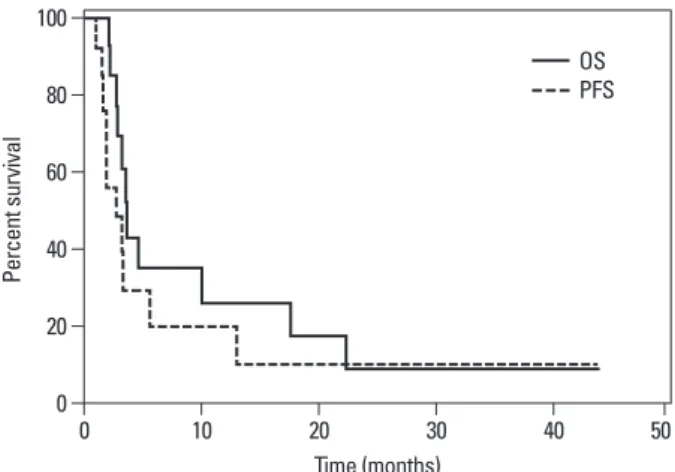
Fig. 1 shows the Kaplan-Meier curve of progression-free survival (dotted line) and overall survival (black line) of all patients. The median progression-free survival and overall survival were 2.8 months (95% CI, 1.2-4.4 months) and 3.8 months (95% CI, 3.0-4.6 months), respectively.
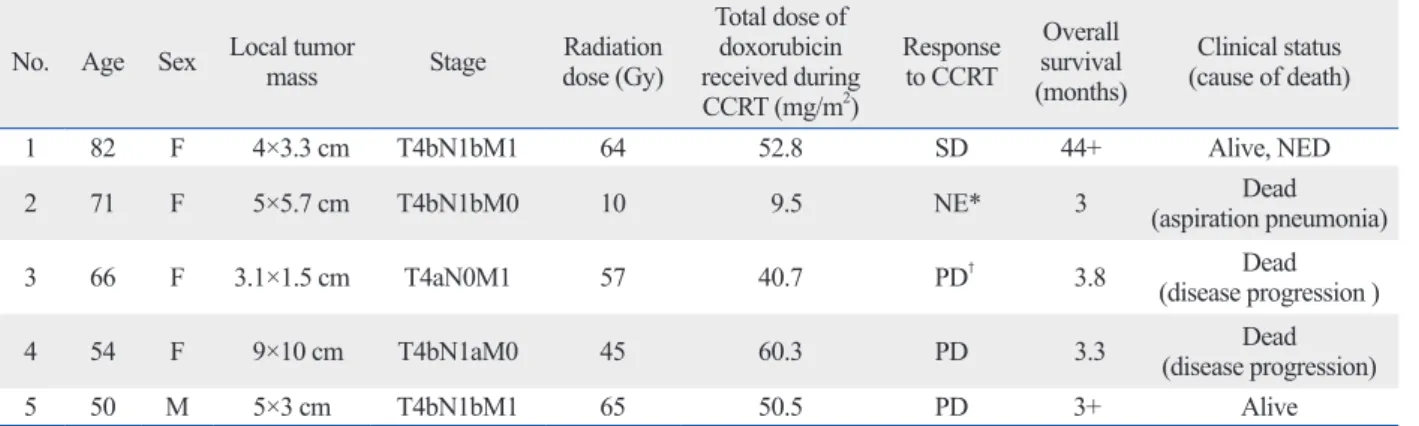
Table 2 shows the treatment outcomes of five patients who were treated with definitive doxorubicin-based CCRT as an initial therapy for primary tumor. One patient re- Table 1. Baseline Characteristics of Patients
Patient characteristics n=13
Age (yr)
Median (range) 69 (50-84)
Sex, no (%)
Male 4 (31)
Female 9 (69)
ECOG performance status, no (%)
0 1 (7)
1 11 (86)
2 1 (7)
Stage of primary tumor*, no (%)
T4a 6 (46)
T4b 7 (54)
Nodal stage*, no (%)
N0 0 (0)
N1a 2 (15)
N1b 11 (85)
Overall stage of disease*, no (%)
IVa 5 (39)
IVb 2 (15)
IVc 6 (46)
Size of tumor 9 cm (3 -12 cm)
Distant metastasis, no (%)
Mediastinum 6 (85)
Lung 3 (23)
Bone 2 (28)
Brain 1 (14)
Treatment modality
Doxorubicin-based definitive CCRT 5 Surgery†
R0 resection 2
R1 resection 2
R2 resection 4
ECOG, Eastern Cooperative Oncology Group; CCRT, concurrent chemora- diotherapy.
*Tumor and nodal disease extent based on the 6th edition of the Ameri- can Joint Committee Cancer Staging Manual.
†Surgery was followed by postoperative RT or CCRT.
Fig. 1. Overall survival (black line) and progression-free survival (dotted line) in patients with anaplastic thyroid carcinoma. OS, overall surrival;
PFS, progression-free survival.
0 20 40 60 80 100
Percent survival
0 10 20 30 40 50
Time (months)
OSPFS
secutive patients with ATC treated with surgery, hyperfrac- tionated radiotherapy, and chemotherapy. The overall sur- vival was poor with only 9% of patients surviving 2 years after treatment. De Crevoisier, et al.16 treated 30 patients with combined modality therapy, resulting in 1-year surviv- al of 46% and a 3-year survival of 27%, which was slightly better outcome than most other studies. Thus, a new combi- nation therapy is needed to improve patient survival. Che- motherapy has changed from monotherapy with doxorubi- cin to polychemotherapy based on newer agents such as paclitaxel. Radiotherapy has evolved from postoperative treatment to preoperative treatment, administering higher doses, using hyperfractionating, and accelerating dose schedules. There is not yet universal protocol for the treat- ment of ATC.
CCRT was used for most of our patients in a definitive or postoperative setting. This regimen is known to be effective for relief of symptoms arising from a large tumor mass.
This is certainly important in a disease that often causes death by suffocation. ATC is highly aggressive, and resec- tion of all macroscopic disease is usually not feasible at the time of diagnosis. However, if tumors can be managed by aggressive surgery with preservation of organ function, sur- gery plus adjuvant chemotherapy and radiotherapy may be the best option for now.
It is imperative to develop innovative strategies beyond the conventional methods to tackle this lethal disease. A re- cent study by Troch, et al.17 showed high efficacy of con- comitant treatment with docetaxel and radiation. To exam- ine a high rate of p53 mutation in ATC, they performed a retrospective analysis of six patients with ATC using docetax- el and external beam radiation. The results were remarkable with four patients achieving complete remission, and two ceived gamma knife radio surgery due to brain metastasis
before CCRT. One patient discontinued treatment due to early disease progression, and another patient died of aspi- ration pneumonia during CCRT. After CCRT, only one pa- tient’s condition remained stable, and rapid disease progres- sion was observed in the other four patients. Side effects occurred in all patients during definitive doxorubicin-based CCRT. Two patients experienced grade 3 and 4 hematolog- ic toxicity, respectively. Most nonhematologic toxicities were easily manageable, with mucositis and esophagitis being the two most common adverse events: grade 1 mucositis in two patients and grade 1 esophagitis in 4 patients. One pa- tient developed grade 3 mucositis accompanied by grade 2 neutropenia. These events required hospitalization for par- enteral nutrition and fluid replacement. Two patients devel- oped aspiration pneumonia during CCRT, requiring paren- teral antibiotics, and one eventually died from respiratory distress. The main side effect of radiotherapy was radiation dermatitis, and acute reactions were mainly confined to the irradiated fields. The irradiated skin showed various de- grees of erythema with hyperpigmentation, and a few pa- tients developed moist skin desquamation toward the end of the treatment. All acute reactions had completely subsid- ed 3 to 4 weeks after the completion of the treatment.
DISCUSSION
ATC typically concerns elderly patients, and many patients have distant metastases at the time of diagnosis.14 Due to its rarity and heterogeneity, it is difficult to draw conclusion for definitive treatment strategies.
Tennvall, et al.15 reported treatment outcome of 55 con-
Table 2. Treatment Outcome of 5 Patients Treated with Definitive Doxorubicin-Based CCRT No. Age Sex Local tumor mass Stage Radiation
dose (Gy)
Total dose of doxorubicin received during CCRT (mg/m2)
Response to CCRT
Overall survival (months)
Clinical status (cause of death)
1 82 F 4×3.3 cm T4bN1bM1 64 52.8 SD 44+ Alive, NED
2 71 F 5×5.7 cm T4bN1bM0 10 9.5 NE* 3 Dead
(aspiration pneumonia)
3 66 F 3.1×1.5 cm T4aN0M1 57 40.7 PD† 3.8 Dead
(disease progression )
4 54 F 9×10 cm T4bN1aM0 45 60.3 PD 3.3 Dead
(disease progression)
5 50 M 5×3 cm T4bN1bM1 65 50.5 PD 3+ Alive
SD, stable disease; PD, progressive; NED, no evidence of disease; NE, non-evaluable; CCRT, concurrent chemoradiotherapy.
*Non-evaluable due to death before follow up imaging study.
†This patient experienced rapid disease progression before completion of CCRT.
factors. Cancer 2005;103:1330-5.
2. Gilliland FD, Hunt WC, Morris DM, Key CR. Prognostic factors for thyroid carcinoma. A population-based study of 15,698 cases from the Surveillance, Epidemiology and End Results (SEER) program 1973-1991. Cancer 1997;79:564-73.
3. McIver B, Hay ID, Giuffrida DF, Dvorak CE, Grant CS, Thomp- son GB, et al. Anaplastic thyroid carcinoma: a 50-year experience at a single institution. Surgery 2001;130:1028-34.
4. Pierie JP, Muzikansky A, Gaz RD, Faquin WC, Ott MJ. The effect of surgery and radiotherapy on outcome of anaplastic thyroid car- cinoma. Ann Surg Oncol 2002;9:57-64.
5. Kim JH, Leeper RD. Treatment of anaplastic giant and spindle cell carcinoma of the thyroid gland with combination Adriamycin and radiation therapy. A new approach. Cancer 1983;52:954-7.
6. Kim JH, Leeper RD. Treatment of locally advanced thyroid carci- noma with combination doxorubicin and radiation therapy. Cancer 1987;60:2372-5.
7. De Besi P, Busnardo B, Toso S, Girelli ME, Nacamulli D, Simioni N, et al. Combined chemotherapy with bleomycin, adriamycin, and platinum in advanced thyroid cancer. J Endocrinol Invest 1991;14:475-80.
8. Ain KB. Management of undifferentiated thyroid cancer. Bail- lieres Best Pract Res Clin Endocrinol Metab 2000;14:615-29.
9. Chen J, Tward JD, Shrieve DC, Hitchcock YJ. Surgery and radio- therapy improves survival in patients with anaplastic thyroid car- cinoma: analysis of the surveillance, epidemiology, and end results 1983-2002. Am J Clin Oncol 2008;31:460-4.
10. Wang Y, Tsang R, Asa S, Dickson B, Arenovich T, Brierley J.
Clinical outcome of anaplastic thyroid carcinoma treated with ra- diotherapy of once- and twice-daily fractionation regimens. Can- cer 2006;107:1786-92.
11. Union Internationale Contre le Cancer. TNM classification of ma- lignant tumors. 6th ed. New York: Wiley-Liss; 2002.
12. Chang HS, Nam KH, Chung WY, Park CS. Anaplastic thyroid carcinoma: a therapeutic dilemma. Yonsei Med J 2005;46:759-64.
13. Eisenhauer EA, Therasse P, Bogaerts J, Schwartz LH, Sargent D, Ford R, et al. New response evaluation criteria in solid tumours:
revised RECIST guideline (version 1.1). Eur J Cancer 2009;45:
228-47.
14. Swaak-Kragten AT, de Wilt JH, Schmitz PI, Bontenbal M, Lev- endag PC. Multimodality treatment for anaplastic thyroid carcino- ma--treatment outcome in 75 patients. Radiother Oncol 2009;92:
100-4.
15. Tennvall J, Lundell G, Wahlberg P, Bergenfelz A, Grimelius L, Akerman M, et al. Anaplastic thyroid carcinoma: three protocols combining doxorubicin, hyperfractionated radiotherapy and sur- gery. Br J Cancer 2002;86:1848-53.
16. De Crevoisier R, Baudin E, Bachelot A, Leboulleux S, Travagli JP, Caillou B, et al. Combined treatment of anaplastic thyroid car- cinoma with surgery, chemotherapy, and hyperfractionated accel- erated external radiotherapy. Int J Radiat Oncol Biol Phys 2004;
60:1137-43.
17. Troch M, Koperek O, Scheuba C, Dieckmann K, Hoffmann M, Niederle B, et al. High efficacy of concomitant treatment of undif- ferentiated (anaplastic) thyroid cancer with radiation and docetax- el. J Clin Endocrinol Metab 2010;95:E54-7.
18. Wiseman SM, Masoudi H, Niblock P, Turbin D, Rajput A, Hay J, et al. Anaplastic thyroid carcinoma: expression profile of targets for therapy offers new insights for disease treatment. Ann Surg Oncol 2007;14:719-29.
patients partial response. This suggests that a novel thera- peutic approach is strongly warranted.
Molecular targets for ATC treatment are under develop- ment,18 and Epidermal growth factor receptor (EGFR) has been extensively studied as a possible target. Abnormal EGFR activation leads to EGFR mRNA and/or protein over- expression, which leads to cancer development and pro- gression. Aberrant EGFR signaling leads to cellular prolif- eration, angiogenesis, and cancer invasion and metastasis.19 Kim, et al.20 recently reported the antiproliferative effects of cetuximab and irinotecan in an orthotopic anaplastic thy- roid cancer mouse xenograft model. They demonstrated that cetuximab and irinotecan synergistically interact to in- hibit the growth of orthotic anaplastic thyroid carcinoma xe- nografts and result in 93% tumor growth inhibition. BRAF mutation was found to be associated with proliferation of thyroid carcinoma cells. Thus, suppression of BRAF might have a therapeutic potential, and BRAF mutation can be used as a prognostic factor.21 Antonelli, et al.22 recently at- tempted to test in vitro sensitivity of thyroid cancer cells obtaining by fine needle aspiration (FNA) to chemothera- peutic agents. FNA is relatively simple and easy, and testing the chemosensitivity of cells obtained by FNA minimizes unnecessary surgical procedures and administration of inef- fective chemotherapeutic agents.
In summary, ATC is known to have a poor prognosis due to its aggressive and rapid metastasis. The treatment of ATC with targeted therapeutics requires further clinical studies.
Developing combinations of targeted therapies involving multicenter clinical trial will be helpful to optimize treat- ment plan in the future. Moreover, prospective investiga- tions in a multicenter clinical trial setting are needed to elu- cidate an effective mode of treatment.
ACKNOWLEDGEMENTS
This research was supported by Basic Science Research Pro- gram through the National Research Foundation of Korea (NRF) funded by the Ministry of Education, Science and Technology (2010-0011577).
REFERENCES
1. Kebebew E, Greenspan FS, Clark OH, Woeber KA, McMillan A.
Anaplastic thyroid carcinoma. Treatment outcome and prognostic
21. Antonelli A, Fallahi P, Ferrari SM, Carpi A, Berti P, Materazzi G, et al. Dedifferentiated thyroid cancer: a therapeutic challenge.
Biomed Pharmacother 2008;62:559-63.
22. Antonelli A, Ferrari SM, Fallahi P, Berti P, Materazzi G, Barani L, et al. Primary cell cultures from anaplastic thyroid cancer obtained by fine-needle aspiration used for chemosensitivity tests. Clin En- docrinol (Oxf) 2008;69:148-52.
19. Baselga J, Arteaga CL. Critical update and emerging trends in epi- dermal growth factor receptor targeting in cancer. J Clin Oncol 2005;23:2445-59.
20. Kim S, Prichard CN, Younes MN, Yazici YD, Jasser SA, Bekele BN, et al. Cetuximab and irinotecan interact synergistically to in- hibit the growth of orthotopic anaplastic thyroid carcinoma xeno- grafts in nude mice. Clin Cancer Res 2006;12:600-7.