R eceived R e v i s e d A ccepted
: October 17, 2017 : March 19, 2018 : March 27, 2018
+Corresponding author: Hang-Seok Chang, MD, PhD Department of Surgery, Yonsei University College of Medicine 211 Eonjuro, Gangnam-gu, Seoul 06273, Korea.
Tel: +82-2-2019-3370 Fax: +82-2-3462-5994 E-mail: [email protected]
대한두경부종양학회지, 제34권 제1호, 2018. pp.9-13 Korean Journal of Head & Neck Oncology, Vol.34, No.1
http://doi.org/10.21593/kjhno/2018.34.1.9 ISSN 1229-5183(Print) / ISSN 2586-2553(Online)
갑상선 유두암 뇌전이의 치료 효과
배현우⋅김석모⋅김수영⋅장호진⋅김법우⋅이용상⋅장항석+⋅박정수
연세대학교 강남세브란스병원 갑상선암센터
Treatment Outcomes of Brain metastasis from Papillary Thyroid Cancer
Hyeonwoo Bae, MD, Seok-Mo Kim, MD, Soo Young Kim, MD, PhD, Ho Jin Chang, MD, Bup-Woo Kim, MD, Yong Sang Lee, MD, Hang-Seok Chang, MD, PhD+, Cheong Soo Park, MD, PhD
Thyroid Cancer Center, Gangnam Severance Hospital, Yonsei University College of Medicine, Seoul, Korea
= Abstract =
Background/Objectives: Brain metastasis (BM) is a rare form of distant metastasis with papillary thyroid cancer (PTC). Patients with BM of PTC carry a poor prognosis. The aim of this study was to contribute to the under- standing of this disease by analyzing patients with BM of PTC.
Materials & Methods: Between March 2003 and December 2013, the patient database was conducted to identify thyroid cancer patients treated. Among the 22,758 thyroid cancer patients, 14 (0.06 %) were identified to have metastasis to the brain during follow-up. The medical records of 14 patients with BM were retrospectively reviewed, focusing on the following: patient characteristics, synchronous or previous distant metastasis, treatments including whole brain radiotherapy (WBRT), stereotactic radiosurgery (SRS) and surgery, and characteristics on radiologic findings, time interval between first diagnosis of primary thyroid cancer and BM and survival after BM.
Results: The mean age at initial diagnosis and BM were 50.9 ± 15.8 years and 61.3 ± 12.7 years. The mean duration between initial diagnosis and BM was 10.4 ± 7.9 years. Patients were treated with varied combinations of surgery, SRS and WBRT except 4 patients who had refused treatment. The median overall survival (OS) time after BM diagnosis was 10 months (range 1 -19). Patients receiving treatment (WBRT and/or surgery, SRS) had a significant longer median OS of 16.5 months in comparison to 3.5 months for those treated without treatment.
(p = 0.005)
Conclusion: Patients who received aggressive treatment had a longer OS than those with only supportive care.
Treatment such as surgery, SRS and WBRT should be considered in patients with BM.
Key W ords : Brain metastasis, Thyroid cancer, Surgery, Radiotherapy, Survival
Introduction
Distant metastasis (DM) of papillary thyroid cancer (PTC) may occur at the time of initial thyroidectomy or during follow-up, and the lungs and bone are the most common
sites for DM from PTC.1-3) Although PTC generally carries an excellent prognosis, the presence of DM may affect ther- apeutic outcomes. Brain metastasis (BM) is a rare form of DM that occurs less frequently than metastases to lung and bone.4,5) The prognosis of patients with BM from PTC is dismal, and they have a lower survival rate than those with- out brain involvement.1,5,6) BM is typically a late event in PTC progression and systemic I131 is rarely used. Typically, the same armamentarium of whole-brain radiotherapy (WBRT), stereotactic radiosurgery (SRS) and surgery used in other solid tumors is applied to PTC.7,8) Based on the
Demographic characteristics of patients (N = 14)
Male : Female 6 : 8 (42.9% : 57.1%)
Age at ID (years), mean ± SD 50.9 ± 15.8
Age at BM (years), mean ± SD 61.3 ± 12.7
Duration between ID and BM (months), mean ± SD 124.7 ± 95.5
Combined DM 13(92.9%)
ECOG
0 3 (21.4%)
1 10 (71.4%)
3 1 (7.2%)
Mean number of BM, mean ± SD, (range) 3.1 ± 1.8
Mean maximal BM size (mm), mean ± SD 28 ± 14
Treatment modalities
None 4 (28.6%)
WBRT only 3 (21.4%)
Surgery + WBRT 6 (42.9%)
SRS + WBRT 1 (7.1%)
Median overall survival (months), (range) 10 (1 - 19)
ID: Initial diagnosis BM: Brain metastasis SD: standard deviation
DM: Diabete mellitus WBRT: whole brain radiotherapy SRS: stereotactic radiosurgery
Table 1. Demographic characteristics of patients with brain metastasis of papillary thyroid carcinoma (n = 14)
limited number of cases reported the optimal treatment is unclear although there may be a benefit to treatments in- cluding WBRT, SRS and surgery. The aim of this study was to review our experience in a large tertiary referral center related to the contemporary patterns of care and out- come of patients treated for BM from PTC.
Materials and Methods
A search of the patient database at the Thyroid Cancer Center, Gangnam Severance Hospital of Korea was con- ducted to identify thyroid cancer patients treated from March 2003 through December 2013. All PTC patients were retrospectively found by searching for the codes of diag- nosis which were registered in the database of our institute according to the international classification of diseases (ICD). All diagnoses of thyroid cancer were histologically confirmed by either fine needle aspiration biopsy or surgical excision. A total of 22,758 patients included were histologi- cally confirmed to have PTC between March 2003 and December 2013. Among the 22,758 thyroid cancer patients, 14 (0.06 %) were identified to have metastasis to the brain during follow-up. All BMs were diagnosed by computerized tomography (CT) or magnetic resonance imaging (MRI).
The medical records of 14 patients with BM were retro-
spectively reviewed, focusing on the following: patient characteristics, synchronous or previous distant metastasis, treatments including WBRT, SRS and surgery, and charac- teristics on radiologic findings, time interval between first diagnosis of primary thyroid cancer and BM and survival after BM. The performance status of each patient was rated according to the Eastern Cooperative Oncology Group (ECOG) score classification. Statistical Packages for Social Sciences (SPSS) version 20.0 (IBM SPSS, Armonk, NY, USA) was used for statistical analysis. Survival after intra- cranial metastasis was calculated using the Kaplan-Meier method, and survival time was measured from the date of initial diagnosis of BM to death or the last follow-up. The Institutional Review Board approved this study. Owing to the nature of the study, neither patient approval nor in- formed consent was required.
Results
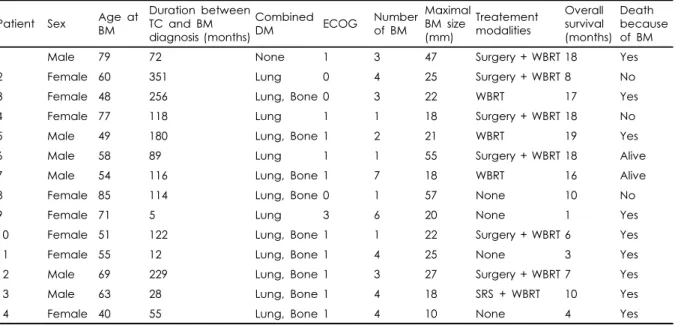
Demographic characteristics of the 14 patients with BM of PTC were studied (Table 1). The mean duration between ID and BM was 124.7 ± 95.5 months. Thirteen patients presented other previous and/or synchronous DM. Ten pa- tients presented with only headaches or nauseas as their initial symptom, one had right side weakness and the other
Fig. 1. Overall survival rate. The continuous line represents da- ta for patients who underwent whole brain radiotherapy (WBRT) with or without surgery, stereotactic radiosurgery (n
= 10), while the dotted line represents data for the patient without treatment. The median survival time with or without treatment was 16.5 and 3.5 months, respectively (p = 0.005)
Patient Sex Age at BM
Duration between TC and BM diagnosis (months)
Combined
DM ECOG Number
of BM
Maximal BM size (mm)
Treatement modalities
Overall survival (months)
Death because of BM
1 Male 79 72 None 1 3 47 Surgery + WBRT 18 Yes
2 Female 60 351 Lung 0 4 25 Surgery + WBRT 8 No
3 Female 48 256 Lung, Bone 0 3 22 WBRT 17 Yes
4 Female 77 118 Lung 1 1 18 Surgery + WBRT 18 No
5 Male 49 180 Lung, Bone 1 2 21 WBRT 19 Yes
6 Male 58 89 Lung 1 1 55 Surgery + WBRT 18 Alive
7 Male 54 116 Lung, Bone 1 7 18 WBRT 16 Alive
8 Female 85 114 Lung, Bone 0 1 57 None 10 No
9 Female 71 5 Lung 3 6 20 None 1 Yes
10 Female 51 122 Lung, Bone 1 1 22 Surgery + WBRT 6 Yes
11 Female 55 12 Lung, Bone 1 4 25 None 3 Yes
12 Male 69 229 Lung, Bone 1 3 27 Surgery + WBRT 7 Yes
13 Male 63 28 Lung, Bone 1 4 18 SRS + WBRT 10 Yes
14 Female 40 55 Lung, Bone 1 4 10 None 4 Yes
TC: Thyroid cancer BM: Brain metastasis DM: diabete mellitus
Table 2. Individual clinical findings of patients with brain metastases of papillary thyroid carcinoma
three patients were incidentally found to have brain meta- stasis during systemic evaluation. The mean number of BM was 3.1 ± 1.8 with a mean maximal size of 28 ± 14 mm (range 10 – 57 mm). Patients were treated with varied com- binations of surgery, SRS and WBRT except 4 patients who had refused treatment. In total, 3 patients (21.4%) received WBRT, 6 patients (42.9%) underwent resection of tumor and WBRT and only one patient underwent SRS and WBRT. The median overall survival (OS) time after BM diagnosis was 10.0 months. (Table 1)
At the time of the last follow-up, two patients were still
alive, with follow-up ranging from 16 to 18 months. (Fig.
1) Among the 12 patients who died, death was due to pro- gression of the brain lesions in 9 patients and to progression of lung metastases in three (all patients with a pulmonary evolution). Survival comparisons were performed between subgroups of patients according to treatment received. OS is not statistically different according to the presence or ab- sence of neurologic symptoms at the moment of BM diag- nosis, the number of BM lesions, the maximal size of BM and kind of treatment modalities. Patients receiving treatment (WBRT and/or surgery, SRS) had a significant longer median OS of 16.5 months in comparison to 3.5 months for those received only supportive care. (p = 0.005) (Fig. 1)
Discussion
Brain metastasis from PTC is very rare, with the frequency in the largest reported case series of around 1.2 % and is associated with high mortality rate.4,6) In our study, the prev- alence of PTC with BM was 0.06%, which is not consistent with previous reports. The reason is that among the 22,758 PTC patients, 12,269 PTC patients underwent operation within recent 5 years. Another reason is that among 22,758 PTC patients, only 2,803 patients who was diagnosed ten ago. In previously published cases of PTC brain metastasis, the male to female ratio was 1.2:1, and the mean age at the time of diagnosis was 58.5 years.9) In these series, the
ratio and mean age is consistent with other studies.
Although patients with papillary thyroid cancer can ex- pect 10-year survival rate of more than 90%, the rate drops to 30% to 50% in patients with lung metastasis. For those with brain metastasis, median survival is reported to be only 12.4 months.10,11) In our series, with a median OS after BM of 10.0 months, outcomes of BM patients from DTC appear poor. However, outcomes of patients treated with WBRT or surgery or SRS were better with a median OS of 16.5 months. In comparison, OS was only 3.5 months without WBRT or surgery or SRS. Few data are available in the literature and most of the publications are case reports.9,12-14) Since brain metastasis of PTC is a very rare event, specific risk factors for brain metastasis have not been reported.
Controversy also exists regarding the best therapeutic ap- proach in these patients. Due to its rare incidence and the lack of data from prospective studies, the standard treatment for intracranial metastasis from thyroid cancer has not been established, and the selection of a treatment relies largely on data reported by retrospective studies and case reports.
A universal standard treatment protocol for these patients has not been developed, and gross total resection followed by radiation iodine is the treatment of choice.4)
The question of how to select patients for aggressive treatments is essential. In our series, all patients except one had other distant metastases. In addition, other distant meta- stasis was not an argument against invasive management.
The most discriminating prognostic factor seems simple to be the presence of brain-directed treatment for the lesions of BM at diagnosis. In our series, OS is not statistically different according to the presence or absence of neurologic symptoms at the moment of BM diagnosis, the number of BM lesions, the maximal size of BM and kind of treatment modalities. Even though one patient had seven lesions of BM, he was alive after WBRT of 16 months. Common neu- rological symptom for BM with PTC is non-localizing head- ache or consciousness disturbance caused by increased in- tracranial pressure. Probably reflecting the notorious ten- dency of thyroid cancer for bleeding, intratumoral hemor- rhage can be the onset of the symptoms. In this study, an ECOG performance status of 0 was observed in 3 patients.
Their BM lesions were incidentally found through PET-CT of routine follow-up. Among them, there was a patient who had a 5.7cm sized mass. The reason of that is the character-
istic of PTC which is slow growing carcinoma. For above mentioned reason, the mean duration between initial diag- nosis and BM was 124 months. Furthermore the longest duration among them was 351 months. To our knowledge, it was the longest duration which has ever reported.
Recent advances with targeted agents such as tyrosine kinase inhibitor (TKI) offer hope for the management of metastatic refractory thyroid cancer.15) TKI has been suc- cessfully used in the treatment of advanced or metastatic refractory PTC.16) However, these novel drugs are asso- ciated with an increased risk of hemorrhage and their use for BM is not recommended, and the role of chemotherapy remains very limited and no recommendation for its use can be made at this time.4) TKI was not approved for these patients by national health insurance yet.
Our results must be interpreted with caution because this was a retrospective study evaluating only a small number of patients with intracranial metastasis. However, our study is of interest because improved long-term survival was ach- ieved among the treated patients by various treatment modalities. In conclusion, patients who received aggressive treatment had a longer OS than those with only supportive care. Brain-directed treatment such as surgery, SRS and WBRT should be considered in patients with BM.
References
1) Dinneen SF, Valimaki MJ, Bergstralh EJ, Goellner JR, Gorman CA, Hay ID. Distant metastases in papillary thyroid carcinoma:
100 cases observed at one institution during 5 decades. J Clin Endocrinol Metab. 1995;80:2041-2045.
2) Lin JD, Huang MJ, Juang JH, Chao TC, Huang BY, Chen KW, et al. Factors related to the survival of papillary and follicular thy- roid carcinoma patients with distant metastases. Thyroid.
1999;9:1227-1235.
3) Durante C, Haddy N, Baudin E, Leboulleux S, Hartl D, Travagli JP, et al. Long-term outcome of 444 patients with distant meta- stases from papillary and follicular thyroid carcinoma: benefits and limits of radioiodine therapy. J Clin Endocrinol Metab.
2006;91:2892-2899.
4) Henriques de Figueiredo B, Godbert Y, Soubeyran I, Carrat X, Lagarde P, Cazeau AL, et al. Brain metastases from thyroid car- cinoma: a retrospective study of 21 patients. Thyroid. 2014;24:
270-276.
5) Chiu AC, Delpassand ES, Sherman SI. Prognosis and treatment of brain metastases in thyroid carcinoma. J Clin Endocrinol Metab. 1997;82:3637-3642.
6) Hoie J, Stenwig AE, Kullmann G, Lindegaard M. Distant meta-
stases in papillary thyroid cancer. A review of 91 patients. Cancer.
1988;61:1-6.
7) Choong NW, Gore E. Stereotactic radiosurgery for the manage- ment of brain metastases. N Engl J Med. 2010;363:592; author reply 592-593.
8) Bernad DM, Sperduto PW, Souhami L, Jensen AW, Roberge D.
Stereotactic radiosurgery in the management of brain metastases from primary thyroid cancers. J Neurooncol. 2010;98:249-252.
9) Tahmasebi FC, Farmer P, Powell SZ, Aldape KD, Fuller GN, Patel S, et al. Brain metastases from papillary thyroid carcinomas. Virchows Arch. 2013;462:473-480.
10) McWilliams RR, Giannini C, Hay ID, Atkinson JL, Stafford SL, Buckner JC. Management of brain metastases from thyroid car- cinoma: a study of 16 pathologically confirmed cases over 25 years. Cancer. 2003;98:356-362.
11) Sherman SI. Thyroid carcinoma. Lancet. 2003;361:501-511.
12) Biswal BM, Bal CS, Sandhu MS, Padhy AK, Rath GK.
Management of intracranial metastases of differentiated carci- noma of thyroid. J Neurooncol. 1994;22:77-81.
13) Miranda ER, Padrao EL, Silva BC, De Marco L, Sarquis MS.
Papillary thyroid carcinoma with brain metastases: an unusual 10-year-survival case. Thyroid. 2010;20:657-661.
14) Aguiar PH, Agner C, Tavares FR, Yamaguchi N. Unusual brain metastases from papillary thyroid carcinoma: case report.
Neurosurgery. 2001;49:1008-1013.
15) Ye X, Zhu Y, Cai J. Relationship between toxicities and clinical benefits of newly approved tyrosine kinase inhibitors in thyroid cancer: A meta-analysis of literature. J Cancer Res Ther.
2015;11 Suppl 2:C185-190.
16) Boudou-Rouquette P, Thomas-Schoemann A, Bellesoeur A, Goldwasser F. Sorafenib for patients with differentiated thyroid cancer. Lancet. 2015;385:227-228.