Predictive Factors for Switched EGFR-TKI Retreatment in Patients with EGFR-Mutant Non-Small Cell Lung Cancer
Byoung Soo Kwon, M.D.
1, Ji Hyun Park, M.D., Ph.D.
2, Woo Sung Kim, M.D., Ph.D.
1, Joon Seon Song, M.D., Ph.D.
3, Chang-Min Choi, M.D., Ph.D.
1,2, Jin Kyung Rho, Ph.D.
4,5and Jae Cheol Lee, M.D., Ph.D.
2Departments of
1Pulmonary and Critical Care Medicine,
2Oncology, and
3Pathology,
4Asan Institute for Life Sciences,
5
Department of Convergence Medicine, Asan Medical Center, University of Ulsan College of Medicine, Seoul, Korea
Background: Third-generation tyrosine kinase inhibitors of the epidermal growth factor receptor (EGFR-TKIs) have proved efficacious in treating non-small cell lung cancer (NSCLC) patients with acquired resistance resulting from the T790M mutation. However, since almost 50% patients with the acquired resistance do not harbor the T790M mutation, retreatment with first- or second-generation EGFR-TKIs may be a more viable therapeutic option. Here, we identified positive response predictors to retreatment, in patients who switched to a different EGFR-TKI, following initial treatment failure.
Methods: This study retrospectively reviewed the medical records of 42 NSCLC patients with EGFR mutations, whose cancers had progressed following initial treatment with gefitinib or erlotinib, and who had switched to a different first- generation EGFR-TKI during subsequent retreatment. To identify high response rate predictors in the changed EGFR-TKI retreatment, we analyzed the relationship between clinical and demographic parameters, and positive clinical outcomes, following retreatment with EGFR-TKI.
Results: Overall, 30 (71.4%) patients received gefitinib and 12 (28.6%) patients received erlotinib as their first EGFR-TKI treatment. Following retreatment with a different EGFR-TKI, the overall response and disease control rates were 21.4%
and 64.3%, respectively. There was no significant association between their overall responses. The median progression- free survival (PFS) after retreatment was 2.0 months. However, PFS was significantly longer in patients whose time to progression was ≥10 months following initial EGFR-TKI treatment, who had a mutation of exon 19, or whose treatment interval was <90 days.
Conclusion: In patients with acquired resistance to initial EGFR-TKI therapy, switched EGFR-TKI retreatment may be a salvage therapy for individuals possessing positive retreatment response predictors.
Keywords: Carcinoma, Non-Small-Cell Lung; Epidermal Growth Factor Receptor Tyrosine Kinase Inhibitor;
Retreatment; Predictive
Address for correspondence: Jae Cheol Lee, M.D., Ph.D.
Department of Oncology, Asan Medical Center, University of Ulsan College of Medicine, 88 Olympic-ro 43-gil, Songpa-gu, Seoul 05505, Korea Phone: 82-2-3010-3208, Fax: 82-2-3010-6961, E-mail: [email protected]
Received: Sep. 13, 2016, Revised: Dec. 12, 2016, Accepted: Feb. 9, 2017
cc It is identical to the Creative Commons Attribution Non-Commercial License (http://creativecommons.org/licenses/by-nc/4.0/).
Copyright © 2017
The Korean Academy of Tuberculosis and Respiratory Diseases.
All rights reserved.
Introduction
Lung cancer is the most common form of cancer and the leading cause of cancer-related mortality worldwide
1. Because of changing in smoking habits such as cessation of smoking, increase in the number of female smokers, and use of filtered tobacco, the incidence of non-small cell cancer (NSCLC) con- tinues to increase
2,3. In the early 2000s, platinum-based dou- blet chemotherapy was the treatment of choice for NSCLC, with the median survival time being less than 8 months
4.
The discovery that mutations in the tyrosine-kinase epider- mal growth factor receptor (EGFR) gene were responsible for cell proliferation, cellular escape from apoptosis, and cell migration in NSCLC led to the development of a new class of therapeutic agents, the tyrosine kinase inhibitors (TKIs).
Treatment with EGFR-TKI results in significantly prolonged progression-free survival (PFS) than platinum-based doublet therapy, particularly in Asian, female, non-smoking patients
5.
In previous studies, the median PFS following EGFR-TKI treatment ranged from 10 to 14 months
6,7. However, acquired resistance to EGFR-TKI is unavoidable because of several mechanisms and results in reduced treatment response.
In 50%–60% of patients who acquire resistance to first- generation EGFR-TKIs, the mutation T790M is responsible
8. Resistance can also develop via other mechanisms, such as c- MET amplification, transformation to small cell carcinoma, and AXL activation
8-13. Although third-generation EGFR-TKIs have proven efficacy in T790M-positive NSCLC patients, there are no effective therapeutic options for patients who acquire resistance by other mechanisms
14,15.
Several clinical trials have been conducted to investigate the efficacy of EGFR-TKI retreatment after first-line EGFR- TKI treatment failure
16-21. In most of these previous studies, a favorable outcome was achieved in patients who showed a good response to prior EGFR-TKI therapy. However, there are as yet no consistent data on whether factors such as age, sex, smoking history, and subtype of EGFR mutation can affect the outcomes of EGFR-TKI retreatment. In 2013, switched EGFR- TKI retreatment was approved in Korea for use in patients who develop acquired resistance to first-line EGFR-TKI. With this as a momentum, we conducted the present study to iden- tify the predictors of improved outcomes following EGFR-TKI retreatment.
Materials and Methods
1. Study design
The inclusion criteria for this study were patients aged 18 years or older with NSCLC with activating EGFR mutations who underwent EGFR-TKI retreatment therapy at the Asan Medical Center between 2005 and 2016. Patients eligible for inclusion in the study were those who received once-daily doses of 250 mg gefitinib or 150 mg erlotinib for at least 1 month prior to disease progression and were then re-treated with a different first-generation EGFR-TKI after stopping the initial therapy. We included patients regardless of whether they were administered conventional chemotherapy between the two EGFR-TKI treatments. Patients must have had at least one measurable lesion and an Eastern Cooperative Oncol- ogy Group (ECOG) performance status (PS) of 0–3. Excluded from the study were patients who switched EGFR-TKI owing to drug toxicity or intolerability, who were treated with sec- ond- or third-generation EGFR-TKIs as part of a clinical trial, or whose EGFR mutation status was unknown.
2. Treatment response evaluation
Demographic information and clinical data such as vital signs, results of physical examination, and blood test results were extracted from each patient’s medical record. Disease progression was assessed by the examination of radiographic data available for each patient, such as chest X-rays and com- puted tomography scans, which were administered every 1–2 months during treatment. Drug response was assessed via Response Evaluation Criteria In Solid Tumors (RECIST).
Efficacy outcomes including overall response and survival following the second EGFR-TKI treatment were calculated.
PFS was defined as the length of time from the start of treat- ment to the date of disease progression or death. Time to progression (TTP) was defined as the length of time from the start of treatment to the date of disease progression. Overall survival (OS) was defined as the length of time from the start of treatment to the date of all-cause death. Disease control rate (DCR) was defined as the percentage of patients who have achieved complete response (CR), partial response (PR), or stable disease. Response rate (RR) was defined as the percent- age of patients who achieved either a CR or PR.
3. EGFR mutation analysis
The activating EGFR mutation in each enrolled patient was confirmed by nested polymerase chain reaction (PCR).
4. Statistical analysis
DCR and RR were compared using Fisher exact test. TTP,
Table 1. Baseline characteristics
Variable Initial EGFR-TKI
Total p-value
Gefitinib (n=30) Erlotinib (n=12)
Age, yr 0.315
<60 14 (46.7) 8 (66.7) 22
>60 16 (53.3) 4 (33.3) 20
Sex 0.040
Male 10 (33.3) 0 10
Female 20 (66.7) 12 (100) 32
Smoking 0.222
Current* 1 (3.3) 1 (8.3) 2
Ex-smoker
†6 (20.0) 0 6
Never smoker
‡23 (76.7) 11 (91.7) 34
Stage 0.545
IB 3 (10) 0 3
IIA 2 (6.7) 0 2
IIIA 1 (3.3) 1 (3.3) 2
IV 24 (80) 11 (91.7) 35
EGFR mutation 0.178
Exon 18 1 (3.3) 1 (8.3) 2
Exon 19 15 (50) 9 (75) 24
Exon 21 14 (46.7) 2 (16.7) 16
ECOG PS 0.651
0-1 24 (80) 11 (91.7) 35
>2 6 (20) 1 (8.3) 7
Values are presented as number (%).
*Someone who was currently smoking or had stopped smoking less than 1 year ago.
†Someone who had stopped smoking 1 year or more ago.
‡Someone who had never smoked cigarettes.
EGFR-TKI: epidermal growth factor receptor tyrosine kinase inhibitor; ECOG: Eastern Cooperative Oncology Group; PS: performance status.
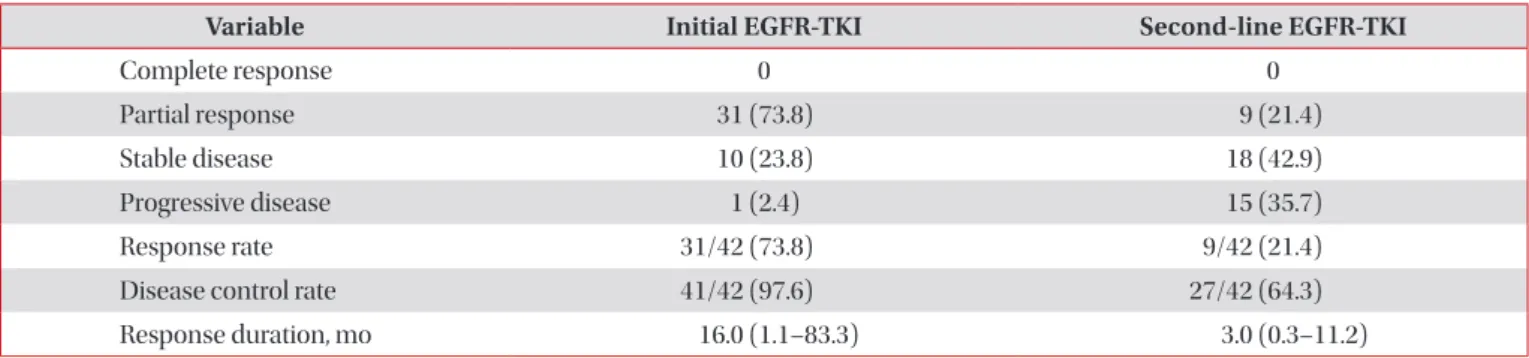
Table 2. Response to EGFR-TKI
Variable Initial EGFR-TKI Second-line EGFR-TKI
Complete response 0 0
Partial response 31 (73.8) 9 (21.4)
Stable disease 10 (23.8) 18 (42.9)
Progressive disease 1 (2.4) 15 (35.7)
Response rate 31/42 (73.8) 9/42 (21.4)
Disease control rate 41/42 (97.6) 27/42 (64.3)
Response duration, mo 16.0 (1.1–83.3) 3.0 (0.3–11.2)
Values are presented as number (% or range).
Response rate=Complete response+Partial response, Disease control rate=Complete response+Partial response+Stable disease.
EGFR-TKI: epidermal growth factor receptor tyrosine kinase inhibitor.
PFS, and OS were estimated by the Kaplan-Meier method. All analyses were performed using SPSS version 20 (IBM Corp., Armonk, NY, USA).
Results
1. Patient characteristics
A total of 42 patients who received switched EGFR-TKI retreatment between January 2005 and March 2016 were in- cluded in the study. Patient baseline characteristics are shown in Table 1. The median age of patients was 64 years (range, 48–86 years), 76.2% of the patients were women, and 95.2%
were ex-smokers or had never smoked. The quality of life measured as ECOG PS was 0 or 1 for 35 patients (83.3%).
All patients had histologically-confirmed adenocarcinoma and possessed activating EGFR mutations as determined by nested PCR. With regard to EGFR genotypes, 24 patients (57.1%) had an exon 19 deletion mutation, 16 (38.1%) had an exon 21 point mutation, and two (4.8%) had an exon 18 point mutation. Stage at initial diagnosis was less than IIIA in seven patients, but their disease advanced to stage IV in 16 months (range, 6.5–37.3 months). Initial EGFR-TKI treatment was gefitinib for 30 patients (71.4%) and erlotinib for 12 patients (28.6%).
2. Efficacy of EGFR treatment and retreatment
RR was 73.8% (31/42) for the first EGFR-TKI treatment and 21.4% (9/42) for retreatment following treatment failure with the first EGFR-TKI. DCR for the first EGFR-TKI treatment was 97.6% (41/42) and 64.3% (27/42) for the second EGFR- TKI (Table 2). There was no significant association between overall RR and DCR of the first and second EGFR-TKI (p=0.676 and p=0.357, respectively).
The time interval between treatment and retreatment ranged from 0 to 34.5 months (median, 7.1 months; 95% con- fidence interval [CI], 4.6–9.3 months), with 32 of 42 patients receiving systemic chemotherapy prior to the second EGFR- TKI treatment. There was no association between PFS and the number of chemotherapy cycles (p=0.412).
For the first EGFR-TKI treatment, the median PFS was 10.4 months (95% CI, 6.4–13.9) and the median PFS was 2.0 months for the second EGFR-TKI (95% CI, 1.2–2.9). After the second EGFR-TKI, 38/42 patients (90.5%) had experienced a PFS event (disease progression or death).
Results of univariate and multivariate analysis of poten- tial predictors of treatment response are shown in Table 3.
The analysis showed that longer PFS following switching was significantly associated with EGFR mutation subtype (p<0.001) and with a TTP longer than 10 months (p=0.037).
No significant association was found between PFS and the in- Table 3. Univariate and multivariate analysis
Variable Univariate analysis Multivariate analysis
HR (95% CI) p-value HR (95% CI) p-value
Sex
Male 1 0.889 1 0.867
Female 0.95 (0.4–2.1) 1.1 (0.5–2.4)
ECOG PS
0-1 1 0.300 1 0.477
2-4 2.2 (1.0–4.8) 1.4 (0.6–3.3)
Initial TKI TTP, mo
≥10 1 0.037 1 0.030
<10 2.0 (1.0–3.9) 2.3 (1.1–4.9)
Subtype of EGFR mutation
Exon 19 1 <0.001 1 0.008
Exon 21 2.4 (1.1–4.9) 1.8 (0.8–3.8)
Exon 18 3.5 (3.5–143.2) 18.3 (2.7–123.7)
Interval duration*, day
<90 1 0.056 1 0.019
≥90 2.14 (1.0–4.8) 2.8 (1.2–6.6)
*Time interval between first epidermal growth factor receptor tyrosine kinase inhibitor (EGFR-TKI) and second EGFR-TKI.
HR: hazard ratio; CI: confidence interval; ECOG: Eastern Cooperative Oncology Group; PS: performance status; TTP: time to progression.
terval of time elapsed between the two EGFR-TKI treatments (p=0.056). There was no association between PFS and ECOG score (p=0.300), smoking history (p=0.089), or site of metas- tasis (p=0.594). In particular, no significant differences were noted in the PFS of patients having bone or brain metastases.
Thirty-six patients had experienced an OS event, and me- dian OS for EGFR-TKIs was 26.6 months (95% CI, 21.5–31.8 months).
After adjusting for sex, age, ECOG, PS, and response to EGFR-TKI, multivariate analysis showed that PFS was sig- nificantly longer in patients who had a TTP greater than 10 months following the first EGFR-TKI treatment (p=0.030) and for patients with an exon 19 mutation (p=0.008). Additionally, having a time interval between treatments of less than 90 days showed significantly longer PFS (p=0.019) (Figure 1).
The order of administration of gefitinib and erlotinib had no effect on the outcome. The median PFS was 2.3 months for patients treated with erlotinib after gefitinib failure, whereas the median PFS was 1.2 months for patients treated with ge- fitinib after erlotinib failure. The difference in median PFS did not achieve statistical significance (p=0.851).
Discussion
A number of mechanisms leading to EGFR-TKI resistance have been identified
12,14,15,22-24, and treatment options for pa- tients with EGFR-TKI resistance are still being investigated.
The T790M mutation, c-MET amplification, AXL activation, transformation to mesenchymal cells, and tumor heterogene- ity are all possible mechanisms leading to resistance to first- generation EGFR-TKI
12-14. At present, there are no proven treatment options for patients with acquired resistance except
for those with the T790M mutation.
Although no prospective, randomized controlled trials have been conducted examining retreatment efficacy, there is some evidence that retreatment is effective in some patients. While the median PFS of first-line EGFR-TKI treatment was 10–14 months
6,7, PFS following EGFR-TKI re-administration was 2–13.8 months
18,25-28. The greater variability in PFS following EGFR-TKI retreatment compared to that of first-line therapy might be attributable to differences in the study populations and small sample sizes. However, it suggests that we should search for factors predicting favorable outcome and narrow down the indication of EGFR-TKI retreatment according to those factors.
In our study, RR for EGFR-TKI retreatment was 21.4% and DCR was 64.3%. Previous studies have reported RR percent- ages ranging from 9.5% to 27.3% and DCR percentages rang- ing from 28.6% to 77.3%
17,18,21,25. Our results showed that the RR for EGFR-TKI retreatment was not correlated with the RR for first-line EGFR-TKI, while longer PFS for second-line EGFR-TKI was related to longer TTP for first-line EGFR-TKI.
These data suggest that a favorable outcome from first-line EGFR-TKI should be considered when selecting patients as candidates for retreatment.
The type of retreatment protocol to use is another consider- ation. Retreating with the same EGFR-TKI
20,21,25,29,30, switching to another EGFR-TKI
17,18,26-28, and using EGFR-TKI therapy in combination with standard chemotherapy
31have all been at- tempted. Tang et al.
32conducted a prospective study in which patients who showed a response to gefitinib therapy were enrolled and divided into two categories based on whether the retreatment was with gefitinib or erlotinib. There was no significant difference in the outcome between the two groups.
In general, efficacy does not seem to be associated with the Figure 1. (A) Progression-free survival of second epidermal growth factor receptor tyrosine kinase inhibitor (EGFR-TKI) by time to progres- sion (TTP). (B) Progression-free survival of second EGFR-TKI by interval duration. (C) Progression-free survival of second EGFR-TKI by EGFR mutation subtype.
100
80
60
40
20
0
0 5
Progression-freesurvival(%)
A
Time (mo)
10 15
100
80
60
40
20
0
0 5
Progression-freesurvival(%)
B
10 15
100
80
60
40
20
0
0 5
Progression-freesurvival(%)
C
10 15
TTP <10 TTP >10
p=0.037
Time interval <90
>90 Time interval
p=0.056
Exon 18 Exon 19 Exon 21
p<0.001
Time (mo) Time (mo)