Clinical Features of Re-Emerging Hepatitis A: An Analysis of Patients Hospitalized during an Urban Epidemic in Korea
Hee Kyoung Choi,
1,2Young Goo Song,
1,2Chang Oh Kim,
1,2So Youn Shin,
1,2Bum Sik Chin,
1,2Sang Hoon Han,
1,2Sung Joon Jin,
1,2Yun Tae Chae,
1,2Ji-Hyeon Baek,
1,2Sun Bean Kim,
1Do Young Kim,
1Jun Yong Park,
1June Myung Kim,
1,2and Jun Yong Choi
1,21Department of Internal Medicine, 2AIDS Research Institute, Yonsei University College of Medicine, Seoul, Korea.
Received: November 30, 2009 Revised: March 17, 2010 Accepted: April 6, 2010
Corresponding author: Dr. Jun Yong Choi, Department of Internal Medicine, Yonsei University College of Medicine, 250 Seongsan-ro, Seodaemun-gu, Seoul 120-752, Korea.
Tel: 82-2-2228-1975, Fax: 82-2-392-5548 E-mail: [email protected]
∙ The authors have no financial conflicts of interest.
© Copyright:
Yonsei University College of Medicine 2011 This is an Open Access article distributed under the terms of the Creative Commons Attribution Non- Commercial License (http://creativecommons.org/
licenses/by-nc/3.0) which permits unrestricted non- commercial use, distribution, and reproduction in any medium, provided the original work is properly cited.
From April 2008 to November 2008, many cases of hepatitis A were reported in Seoul and Gyeonggi Province in Korea. Furthermore, the rate of severe or fulmi- nant hepatitis have significantly increased during the latest epidemic (13.4% vs.
5.2%, p=0.044). Therefore, widespread use of vaccine is warranted to reduce the burden of hepatitis A in Korea.
Key Words: Hepatitis A, disease outbreaks
In Korea, hepatitis A is a disease that must be reported to the district public health authority. Since April 2008, the incidence of hepatitis A has increased, particularly in Seoul and the adjacent areas in Gyeonggi Province (Fig. 1).1 Therefore, we con- sidered this as an epidemic of hepatitis A. At that time, more patients with hepatitis A have been admitted to Severance Hospital, a tertiary teaching hospital in Seoul, Korea (Fig. 2). During this period, many physicians felt that severity, mortality and complications of hepatitis A increased compared with previous period. In the pres- ent study, we analyzed clinical features of acute hepatitis A patients who were hos- pitalized during the latest epidemic. The aim of the present study was to verify an increment of severe cases in recent hepatitis A epidemic and to discuss strategies to prevent hepatitis A in Korea.
We retrospectively reviewed medical records of 245 acute hepatitis A patients who were admitted to Severance Hospital between January 2006 and November 2008, and compared clinical manifestations of hepatitis A observed during the lat- est epidemic (from April 2008 to November 2008, period 1) with previous one (from January 2006 to March 2008, period 2). Patients who were transferred from other provinces or were suspected to have acquired hepatitis A virus (HAV) in for- eign countries were excluded. The diagnosis of acute hepatitis A was made by the detection of serum IgM antibody against HAV along with clinical manifestations.
Commercially available enzyme immunoassays (Abbott Laboratories, North Chica- go, IL, USA) were used to detect IgM anti-HAV, anti-HCV, HBsAg and antibody to HBsAg. Patients with prothrombin time less than 40% compared to the control
were considered significant. Statistical analysis was per- formed using SPSS for Windows, version 12.0 (SPSS Inc., Chicago, IL, USA). This study was approved by the institu- tional review board of the hospital.
Among our patients, 132 cases of hepatitis A were detect- ed during period 1 (111 cases per 10,000 hospital admis- sions), and 113 cases during period 2 (30 cases per 10,000 hospital admissions). A total of 224 patients were finally in- cluded in this analysis after excluding 21 patients who were referred from other provinces or suspected to have acquired HAV in foreign countries.
The demographic characteristics of patients with hepatitis A are listed in Table 1. The majority of patients were in their thirties (31-40 years, 46.5%) during period 1, whereas the majority of patients were in their twenties (21-30 years, 41.2%) during period 2. Moreover, the rate of patients in teens (11-20 years, 3.9%) during period 1 was greatly re- duced compared with period 2 (13.4%). It seems that re- duced proportions of age group moved to thirties or forties, suggesting that the pattern of acute hepatitis A is changing from small outbreaks in crowding areas such as school or military, to large-scale outbreaks in community. The major- and without hepatic encephalopathy were defined as having
severe acute hepatitis (AHs).2 Fulminant hepatitis (FH) was defined as less than 40% prothrombin time compared to the control and also presentation of hepatic encephalopathy.3 Limited acute hepatitis (AH) were those with prothrombin time more than 40% compared to the control, and without hepatic encephalopathy. Complications included acute re- nal failure (ARF), prolonged cholestatic hepatitis, hemolyt- ic anemia, gastrointestinal bleeding, acalculous cholecystitis, pancreatitis and autoimmune hepatitis (antinuclear antibody titer >1:160 or positive smooth-muscle antibody titer >1:80 and compatible liver biopsy findings). ARF was defined as an increase in serum creatinine concentration to ≥0.5 mg/dL or by 50% compared with the baseline value.4 Prolonged cholestatic hepatitis was defined as having clinical jaundice lasting for at least 12 weeks, with a peak of bilirubin >10 mg/dL.5 Continuous data were reported as mean±SD, and the Student’s t-test was employed to compare parametric data. Nonparametric data were analyzed with Mann-Whit- ney U-test. Categorical variables were reported as frequen- cy distributions, and Chi-square or Fisher’s exact tests were performed. All p values were two-tailed, and p values <0.05
Fig. 1. Reported annual number of hepatitis A patients in Seoul and Gyeonggi Province.
Fig. 2. Monthly incidence of hospitalization for hepatitis A in Severance Hospital.
Case/10,000 admission 0
50 100 150 200 250
Jan-06 Mar-06 May-06 Jul-06 Sep-06 Nov-06 Jan-07 Mar-07 May-07 Jul-07 Sep-07 Nov-07 Jan-08 Mar-08 May-08 Jul-08 Sep-08 Nov-08 0
200 400 600 800 1,000 1,200
Jan Feb Mar Apr May Jun Jul Aug Sep Oct Nov Dec
20022003 20042005 20062007 2008
developed 18 complications associated with hepatitis A.
One patient in period 1 had ARF with hemolytic anemia, and one patient in period 2 experienced ARF and gastroin- testinal bleeding simultaneously. No patient died during both periods. The proportion of severe cases (severe or ful- minant hepatitis A) was significantly higher in period 1 ity of patients were males in both period 1 (63.8%) and pe-
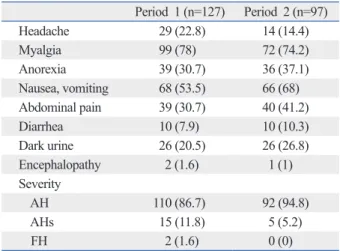
riod 2 (61.9%). Hepatitis A incidence of males was approx- imately twice higher than that of females. However, there is no evidence to indicate that males are more susceptible to HAV than females.6 The differences between males and fe- males may be related to risk activities such as hand wash- ing and contaminated food ingestion. The underlying dis- ease including hypertension, diabetes and chronic liver diseases were less prevalent in period 1, although it was sta- tistically insignificant. The path of infection was obscure for most patients. The most frequently reported symptoms included myalgia, nausea, vomiting and abdominal pain, and there were no significant differences between the two groups (Table 2). The laboratory tests (leukocyte and plate- let counts, hemoglobin, serum aspartate transaminase, ala- nine tranasaminase, bilirubin and albumin) on admission day or at its worst values did not show significant differenc- es between the two groups (Table 3). However, C-reactive protein at the time of admission was slightly higher in peri- od 1 (2.73±3.26 vs. 1.56±1.86, p=0.012. The clinical com- plications and outcomes are shown in Table 4. Sixteen pa- tients (11 patients in period 1 and 5 patients in period 2)
Table 1. Demographic Characteristics and Presumed Etiology of Hepatitis A Patients
Total (n=224) Period 1 (n=127) Period 2 (n=97)
Mean age (yrs) 31±8 31±7 30±9
Age distributions (yrs)
-10 2 (0.9) 1 (0.8) 1 (1.0)
11-20 18 (8) 5 (3.9) 13 (13.4)
21-30 92 (41.1) 52 (40.9) 40 (41.2)
31-40 97 (43.3) 59 (46.5) 38 (39.2)
41- 15 (6.7) 10 (7.9) 5 (5.2)
Gender (male) 141 (62.9) 81 (63.8) 60 (61.9)
Underlying disease
No underlying disease 206 (92) 120 (94.5) 86 (88.7)
Hypertension 6 (2.7) 2 (1.6) 4 (4.1)
Diabetes 5 (2.2) 1 (0.8) 4 (4.1)
Non-hepatobiliary malignancy 2 (0.9) 1 (0.8) 1 (1)
Others 7 (3.1) 3 (2.4) 4 (4.1)
Liver disease 18 (8) 7 (5.5) 11 (11.3)
B-viral carrier 15 (6.7) 6 (4.7) 9 (9.3)
C-viral carrier 1 (0.4) 1 (0.8) 0 (0)
Liver cirrhosis, B-viral 1 (0.4) 0 (0) 1 (1)
Liver cirrhosis, C-viral 1 (0.4) 0 (0) 1 (1)
Hepatocellular carcinoma 0 (0) 0 (0) 0 (0)
Presumed etiology
Raw fish or shellfish ingestion 44 (19.6) 23 (18.1) 21 (21.6)
Close contact with patients 11 (4.9) 8 (6.3) 3 (3.1)
Unknown 169 (75.4) 96 (75.6) 73 (75.3)
Values are presented as mean±standard deviation or as number (%).
Table 2. Symptoms and Severity of Hepatitis A Patients Period 1 (n=127) Period 2 (n=97)
Headache 29 (22.8) 14 (14.4)
Myalgia 99 (78) 72 (74.2)
Anorexia 39 (30.7) 36 (37.1)
Nausea, vomiting 68 (53.5) 66 (68)
Abdominal pain 39 (30.7) 40 (41.2)
Diarrhea 10 (7.9) 10 (10.3)
Dark urine 26 (20.5) 26 (26.8)
Encephalopathy 2 (1.6) 1 (1)
Severity
AH 110 (86.7) 92 (94.8)
AHs 15 (11.8) 5 (5.2)
FH 2 (1.6) 0 (0)
AH, limited acute hepatitis; Ahs, severe acute hepatitis; FH, fulminant hepatitis.
Values are presented as number (%).
compatible with cholestatic hepatitis.
During the recent decades, the incidence of hepatitis A in Korea has decreased along with rapidly improved sanita- tion and living standards, thanks to the nation’s economic growth.7 In Korea, the immunity to HAV in adults over the age of 30 years was 100% in the 1980s and more than 97%
in 1999.8 Therefore, acute hepatitis A in adults was consid- ered uncommon, and testing for anti-HAV antibody in adults (13.4 vs. 5.2%, p=0.044). However, the duration of admis-
sion, the rate of complications and mortality did not in- crease. Looking at the age distribution of severe cases, se- vere cases are limited to patients in their twenties or thirties.
Particularly, during period 1, more than 10% of patients in these age groups experienced severe forms of hepatitis.
Liver biopsy was performed in two patients, and both of them showed portal inflammation and bridging necrosis,
Table 3. Biochemical Characteristics of Hepatitis A Patients
Period 1 (n=127) Period 2 (n=97) p value*
WBC, /mm3 6,004±3,699 5488±2216 0.196
Hemoglobin, mg/dL 15±2 15±2 0.247
Platelet (admission), ×103/mm3 180±70 197±84 0.099
Platelet (lowest), ×103/mm3 176±72 191±87 0.072
AST (admission), IU/L 2,823±3,110 2,182±2,648 0.105
AST (peak), IU/L 3,352±3,406 2,733±3,188 0.170
ALT (admission), IU/L 3,097±2,415 2,675±2,055 0.16
ALT (peak), IU/L 3,472±2,460 3,151±2,191 0.313
Total bilirubin (admission), mg/dL 4.7±4.5 4.3±2.6 0.424
Total bilirubin (peak), mg/dL 6.8±5.1 6.2±3.1 0.251
Albumin, mg/dL 4.0±0.5 4.1±0.4 0.220
ALP, IU/L 185±85 211±110 0.051
INR (admission) 1.3±0.4 1.2±0.5 0.025
INR (peak) 1.4±0.4 1.3±1.2 0.008
CRP, mg/dL 2.73±3.26 1.56±1.86 0.012
WBC, white blood cell; AST, aspartate transaminase; ALT, alanine transaminase; ALP, alkaline phosphatase; CRP, C-reactive protein; AH, limited acute hepatitis; AHs, severe acute hepatitis; FH, fulminant hepatitis.
Values are presented as mean±standard deviation.
*Values by Student’s t-test or Mann-Whitney U-test.
Table 4. Outcomes of Hepatitis A
Period 1 (n=127) Period 2 (n=97) p value
Duration of admission (days) 8±5 9±5 0.112*
Severe cases (AHs or FH) 17 (13.4%) 5 (5.2%) 0.044
Age distributions (yr)
-10 0/1 (0%) 0/1 (0%)
11-20 0/5 (0%) 0/13 (0%)
21-30 9/52 (17.3%) 2/40 (5.0%)
31-40 8/59 (13.6%) 3/38 (7.9%)
41- 0/10 (0%) 0/5 (0%)
Complications 11 (8.7%) 5 (5.2%) 0.434
Acute renal failure 9 (7.1 %) 5 (5.2 %) 0.592
Prolonged cholestatic hepatitis 1 (0.8%) 0 (0%) 1.0
Hemolytic anemia 1 (0.8%) 0 (0%) 1.0
Gastrointestinal bleeding 1 (0.8 %) 1 (1.0%) 1.0
Acalculous cholecystitis 0 (0%) 0 (0%) -
Pancreatitis 0 (0%) 0 (0%) -
Autoimmune hepatitis 0 (0%) 0 (0%) -
Mortality 0 (0%) 0 (0%) -
AH, limited acute hepatitis; AHs, severe acute hepatitis; FH, fulminant hepatitis.
Values are presented as mean±standard deviation or as number (%).
*Value by Student’s t-test.
plications occurred in 10 patients during the recent epidemic.
The hepatitis A virus may serve as a trigger for autoimmune hepatitis in genetically susceptible people. However, there was no case of autoimmune hepatitis associated with hepa- titis A in this study. Fulminant hepatitis, which occurs in less than 1% of the cases, appears to be more frequent in adults than in children.22,23 Previously, disease severity was considered to be linked to individual host factors such as age and underlying liver disease. Older age is classically re- lated to greater morbidity and mortality of hepatitis A. How- ever, it is not clear whether this is due directly to liver failure or to decompensation caused by underlying diseases.24 In the case of the Shanghai epidemic, factors that contributed to mortality in patients with severe diseases included age of
>40 years and other comorbid conditions (e.g., chronic hep- atitis C).25 In this study, however, patients with underlying liver disease or age of >40 years did not show differences in clinical outcomes. Although more patients were in severe conditions during the latest epidemic, we did not observe any change in mortality. It is quite likely due to the fact that some mortality cases transferred from other district were excluded from this analysis. Although mortality was not significantly different between the two periods, more pa- tients in period 1 experienced severe hepatitis and more pa- tients were hospitalized. Therefore, the morbidity of hepati- tis A in the period 1 is not negligible.
Hepatitis A vaccine has not been routinely recommended as part of the childhood immunization scheme in Korea.
Vaccination has been recommended for people in high risk groups, including travelers to areas where hepatitis A is en- demic, people with occupational exposure to the virus, in- jection drug users, patients with chronic liver disease, ho- mosexual individuals, and people who live in communities with cyclic epidemics. A need for more widespread use of hepatitis A vaccine is growing in countries with transitional epidemiology such as Korea. In Korea, vaccination of peo- ple with high risks is recommended, but not refunded by the public health system. Immunoglobulin such as post-ex- posure prophylaxis has not been widely used in this coun- try. However, many people who were hospitalized for severe hepatitis A were young and did not have related risk factors.
Implementing the current recommendations for vaccination would not have prevented most of complications and deaths occurred during period 1. Without measures that increases immunity to hepatitis A in young adults, future epidemics with severe consequences such as the one described herein, should be expected.
was not recommended, even in high risk patients. As hy- giene conditions improved, transmission factors have been under control, keeping children from being exposed to the virus. Such children became a large adult population with no immunity to HAV. The seroprevalence of anti-HAV has been steadily declined among children. Low rates of IgG anti-HAV have been observed, particularly in the age group of 10-24 years, which matches with the age group of acute hepatitis A patients who were identified through the recent- ly increased incidence in Korea.9 Since the seroprevalence of anti-HAV has been decreasing among adults in Korea,10,11 there is a substantial potential for severe morbidity and mortality during sporadic outbreaks. In this study, the high- est incidence was observed in patients in their twenties or thirties, and this was concordant with previous reports pub- lished in Korea.10-12 Once they are infected, they develop se- vere hepatitis.7,13-15 In this study, patients in these age groups are likely to experience severe symptoms. These changes have an impact on morbidity because the severity of symp- toms increases with the age of the infected individual. Thus, as natural immunity in the population decreases, particular- ly in children and young adults, the number of susceptible individuals increases, enhancing the likelihood of hepatitis A outbreaks. A large and increasing number of hepatitis A patients in Korea can be attributable to the increased sus- ceptibility of the population, especially in young people.
Another possible reason is the increased virus circulation in the community, leading to community-wide spread of in- fection and outbreaks in different groups through various transmission routes. Transportation of goods and people from highly endemic areas has introduced a spread of HAV virus. Genotyping of the virus has not yet been performed during period 1, but is planned. Until the late 1990s, a single HAV genotype IA strain has been detected in Korea. Recent- ly, a new genotype IIIA was found to co-circulate with geno- type IA strains in Korea. Moreover, it has been suggested that more various types of strains might have been import- ed from highly endemic countries.16 Similar epidemiologi- cal changes have been seen in many countries worldwide.17 Recent hepatitis A epidemics in urban areas of industrial- ized countries have not been traced to a common source.18-20 Thus, effective prevention of HAV infection has become in- creasingly important. Similarly, we were unable to identify risk factors for transmission in more than 75% of patients.
Although the majority of hepatitis A cases are self-limit- ed acute hepatitis, some develop into severe forms of hepa- titis or cause unexpected complications.21 Extrahepatic com-
changing epidemiology of hepatitis A in children and the consider- ation of active immunization in Korea. Yonsei Med J 2000;41:34-9.
8. Choi W, Eom HS, Kim IH, Lee DH, Kim PS, Kim HG, et al. Pat- terns of acute hepatitis A and anti-HAV seroprevalence of kyungin province. Korean J Gastroenterol 1999;34:69-75.
9. Kim TY, Sohn JH, Ahn SB, Son BK, Lee HL, Eun CS, et al.
[Comparison of recent IgG anti-HAV prevalence between two hospitals in Seoul and Gyeonggi area]. Korean J Hepatol 2007;
13:363-9.
10. Song HJ, Kim TH, Song JH, Oh HJ, Ryu KH, Yeom HJ, et al.
Emerging need for vaccination against hepatitis A virus in patients with chronic liver disease in Korea. J Korean Med Sci 2007;22:
218-22.
11. Lee D, Cho YA, Park Y, Hwang JH, Kim JW, Kim NY, et al. Hep- atitis a in Korea: epidemiological shift and call for vaccine strate- gy. Intervirology 2008;51:70-4.
12. Lee EJ, Kwon SY, Seo TH, Yun HS, Cho HS, Kim BK, et al.
[Clinical features of acute hepatitis A in recent two years]. Korean J Gastroenterol 2008;52:298-303.
13. Rakela J, Redeker AG, Edwards VM, Decker R, Overby LR, Mosley JW. Hepatits A virus infection in fulminant hepatitis and chronic active hepatitis. Gastroenterology 1978;74:879-82.
14. Poovorawan Y, Theamboonlers A, Sinlaparatsamee S, Chaiear K, Siraprapasiri T, Khwanjaipanich S, et al. Increasing susceptibility to HAV among members of the young generation in Thailand.
Asian Pac J Allergy Immunol 2000;18:249-53.
15. Byun KS, Kim JH, Song KJ, Baek LJ, Song JW, Park SH, et al.
Molecular epidemiology of hepatitis A virus in Korea. J Gastroen- terol Hepatol 2001;16:519-24.
16. Yun H, Kim S, Lee H, Byun KS, Kwon SY, Yim HJ, et al. Genetic analysis of HAV strains isolated from patients with acute hepatitis in Korea, 2005-2006. J Med Virol 2008;80:777-84.
17. Jenson HB. The changing picture of hepatitis A in the United States. Curr Opin Pediatr 2004;16:89-93.
18. Shaw FE Jr, Sudman JH, Smith SM, Williams DL, Kapell LA, Hadler SC, et al. A Community-wide epidemic of hepatitis A in Ohio. Am J Epidemiol 1986;123:1057-65.
19. Skinner JT. Community-wide epidemic of hepatitis A--Shelby County, Tennessee. J Tenn Med Assoc 1995;88:468-9.
20. Tong MJ, el-Farra NS, Grew MI. Clinical manifestations of hepa- titis A: recent experience in a community teaching hospital. J In- fect Dis 1995;171 Suppl 1:S15-8.
21. Cuthbert JA. Hepatitis A: old and new. Clin Microbiol Rev 2001;14:38-58.
22. Lemon SM, Shapiro CN. The value of immunization against hep- atitis A. Infect Agents Dis 1994;3:38-49.
23. Brown GR, Persley K. Hepatitis A epidemic in the elderly. South Med J 2002;95:826-33.
24. Lednar WM, Lemon SM, Kirkpatrick JW, Redfield RR, Fields ML, Kelley PW. Frequency of illness associated with epidemic hepatitis A virus infections in adults. Am J Epidemiol 1985;122:226-33.
25. Halliday ML, Kang LY, Zhou TK, Hu MD, Pan QC, Fu TY, et al.
An epidemic of hepatitis A attributable to the ingestion of raw clams in Shanghai, China. J Infect Dis 1991;164:852-9.
The limitation of the study is relatively small population.
Therefore, further research needs to be conducted with a large cohort of patients, in order to properly document com- plications and management of the disease. Our findings may not be generalized, considering biases related to which patients sought medical care and which physicians chose to hospitalize them. We were unable to assess patients who were not hospitalized. We could not apply a molecular epi- demiologic approach due to limitation of samples. Most pa- tients were reported with obscure etiology, and we could not identify transmission route in this study. It could be ex- plained as one of the characteristics of recent urban epi- demic, however, it could also be one of limitations of our study related to retrospective nature.
In conclusion, although the majority of hepatitis A patients completely recovered during period 1, many patients had to be hospitalized or developed associated complications. Hep- atitis A may become a major public health issue in years to come. Changes in epidemiological pattern would increase the disease burden, may cause large-scale community-wide outbreaks and result in higher healthcare costs. Therefore, prevention of the disease requires not only strengthening young adult’s immunity to hepatitis A through vaccination, but also conducting intensive public awareness campaigns and detailed interventions in the course of transmission.
REFERENCES
1. http://stat.cdc.go.kr.
2. Takahashi Y, Shimizu M. Aetiology and prognosis of fulminant viral hepatitis in Japan: a multicentre study. The Study Group of Fulminant Hepatitis. J Gastroenterol Hepatol 1991;6:159-64.
3. Fujiwara K, Yokosuka O, Ehata T, Saisho H, Saotome N, Suzuki K, et al. Association between severity of type A hepatitis and nu- cleotide variations in the 5’ non-translated region of hepatitis A vi- rus RNA: strains from fulminant hepatitis have fewer nucleotide substitutions. Gut 2002;51:82-8.
4. Thadhani R, Pascual M, Bonventre JV. Acute renal failure. N Engl J Med 1996;334:1448-60.
5. Gordon SC, Reddy KR, Schiff L, Schiff ER. Prolonged intrahe- patic cholestasis secondary to acute hepatitis A. Ann Intern Med 1984;101:635-7.
6. Barros H, Oliveira F, Miranda H. A survey on hepatitis A in Portu- guese children and adolescents. J Viral Hepat 1999;6:249-53.
7. Sohn YM, Rho HO, Park MS, Park JH, Choi BY, Ki M, et al. The