32 J Radiopharm Mol Probes Vol. 4, No. 1, 2018 https://doi.org/10.22643/JRMP.2018.4.1.32
Journal of Radiopharmaceuticals and Molecular Probes Vol. 4, No. 1, 2018 J Radiopharm Mol Probes 2018;4(1):32-35
ISSN 2384-1583(Print) / ISSN 2508-3848(Online)
Novel zirconium-89-based radiopharmaceuticals for medical application
Hee-Kwon Kim*
Department of Nuclear Medicine, Molecular Imaging & Therapeutic Medicine Research Center, Cyclotron Research Center, Biomedical Research Institute, Chonbuk National University Medical School and Hospital, Jeonju, Jeonbuk 54907, Republic of Korea
Since utilization of metal is attractive research area applicable to medical applications, several metals have been studied by many scientists. Zr-89 is known as one of important radioisotopes nowadays. Novel ligands for Zr-89 have been developed, and Zr-89-based radiopharmaceuticals have been employed for positron emission tomography (PET) study. In this highlight review, recent advances on Zr-89 utilization for radiophramaceuticals are illustrated.
ABSTRACT
Received: June 21, 2018 / Revised: June 26, 2018 / Accepted: June 28, 2018
Correspnding Author : Hee-Kwon Kim, Department of Nuclear Medicine, Chonbuk National University Medical School and Hospital, Jeonju, Jeonbuk 561-712, Republic of Korea. Tel: +82 63 250 2768, Fax: +82 63 255 1172, E-Mail address: [email protected] Copyright©2018 The Korean Society of Radiopharmaceuticals and Molecular Probes
Key Word: Zr-89, Positron emission tomography (PET), Ligand
지르코늄(Zirconium)은 원자번호가 40번인 원소로 원소 기호는 Zr이다. Zr-89는 반감기가 78.41 시간으로 알려져 있으며, 주로 Y-89을 타깃으로 하는 핵반응을 진행하는 방 법으로 제조하고 이후 여러 정제방법에 생산되어 사용되고 있다 (1). 특히 Zr-89은 양전자방출핵종(positron-emitting radionuclide)이기에 양전자 방출 단층촬영술(positron emission tomography, PET)을 이용한 질병의 진단에 유용 하게 사용되고 있다. 본 하이라이트 미니리뷰논문에서는 최 근 Zr-89을 이용하여 정밀의료에 대한 적용하기 위한 관련 된 연구 결과들을 소개하고자 한다.
먼저 Zr-89을 효과적으로 이용하기 위해 배위화학 (coordination chemistry)이 유용하게 사용되고 있으며, 이 와 연관된 여러 가지 킬레이트를 이용한 연구가 진행되었다.
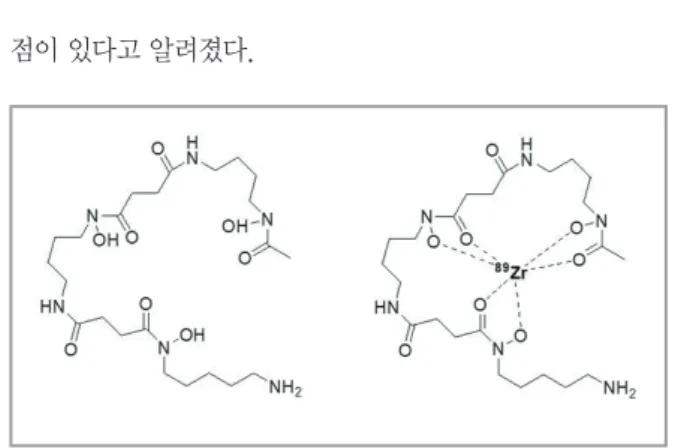
가장 먼저 사용된 킬레이트는 desferrioxamine (DFO)로 현 재 널리 이용되고 있다. 이것은 Zr-89과 함께
89
Zr-DFO 형 태의 complex를 만들어89
Zr-immuno-PET 연구에 사용되 고 있다 (2-3). 그러나89
Zr-DFO 의 경우 stability등의 단점이 있다고 알려졌다.
그리고 EDTA와 DTPA 등의 다른 킬레이트들도 Zr-89 와 complex를 이루어 사용되는 것이 보고 되었다 (1). 최 근에는 Wadas 그룹에서 여러 종류의 리간드인 DOTA, DOTP DOTAM 을
89
ZrCl과 반응하여 Zr-complex를 만들 기도 하였다 (4). 이 후 만들어진89
Zr-complex (Zr-DOTA, ZrDOTP, Zr-DOTAM)를 과량의 EDTA, 고농도의 금속이 온 (Fe3+
, Zn2+
, Co2+
, Cu2+
, Mg2+
, Gd3+
, Ga3+
) 및 serumREVIEW
Figure 1. Structure of DFO and its
89Zr-complex
33
www.ksramp.or.kr Journal of Radiopharmaceuticals and Molecular Probes
protein 등을 이용하여 in vitro stability를 측정하였고
89
Zr–DOTA >>89
Zr–DOTP >89
Zr–DOTAM >89
Zr–DFO 순으로 Zr-complex 안정성이 높은 것으로 밝혀졌다. 특히89
Zr–DOTA은 7일 정도의 기간에도 변화가 생기지 않고 안 정한 것을 발견했다또한 in vivo biodistribution 실험을 진행하여,
89
Zr–DOTAM의 경우에는 간과 지라에서 방사성량이 많이 측정 되는 것을 보였고,
89
Zr–DOTA는 상대적으로 적은 양의 방 사성이 간이나 콩팥과 뼈에서 보이는 것을 확인하였다. 그 러나89
Zr–DOTP 의 경우 일반적으로89
Zr–DOTA 와 비 슷한 양상을 보였으나 뼈에서 높은 양의 방사성 물질이 보 이는 것을 발견되었다. 이런 결과를 바탕으로89
Zr–DOTA 와89
Zr–DFO를 이용하여 dynamic PET 영상연구를 진행하 였다. PET 영상을 비교하면89
Zr–DFO의 경우 4시간과 24 시간 후에도 콩팥에 많이 축적되어 있는 것을 확인하였으나,89
Zr–DOTA인 경우 1시간 이내에서는89
Zr–DFO 와 비교 해서 콩팥과 뼈에서 적은 양이 축적되는 것을 확인할 수 있 었고, 4시간에는 방광에 적은 양의89
Zr–DOTA가 보였고, 24시간 후에는 거의 보이는 않은 것으로 확인 하여 생체에 서 오래 머물지 않고 쉽게 제거되는 성질을 갖고 있는 것을 발견하였다. 따라서89
Zr–DOTA를 이용하면 현재 사용되고 있는89
Zr–DFO의 단점을 보완하여 효과적으로 정밀 의료 (precision medicine)에 적용할 수 있는 것을 확인 하였다.또한 Zr-89을 precision medicine에 적용하기 위해, Zr-89을 도입한 단클론 항체(monoclonal antibodies, mAbs)를 이용한 immune-PET 연구가 여러 연구자들에 의 해 진행이 되어 현재 다양한 분야에서 비임상 및 임상실험을 진행하고 있다. 그 중에 한 예가
89
Zr-huJ591을 이용하여 전 이성 전립선암(Metastatic Prostate Cancer)을 가진 환자에 게서89
Zr-huJ591 immuno-PET 영상 연구를 하는 것이었 다 (5). 이 경우 10명의 환자에서 5 mCi의89
Zr-huJ591을 주 입하고 생분포, 제거 및 병변 (lesion) 축적 등을 조사하였다.PET 영상에서
89
Zr-huJ591은 뼈나 연부조직에 lesion에 표 적 하여 축적되는 것을 확인하였으며, 이는99m
Tc-MDP을 이용한 bone scan 이나 FDG scan을 이용한 영상 연구보다 도 좋은 결과를 보였다. 특히89
Zr-huJ591를 이용한 영상을 분석해 보면 12 lesion 중에 11개가 positive한 결과를 보였 는 데, 이것은 9개의 positive한 결과를 보인 FDG를 이용한 PET scan 보다 우수한 결과를 나타냈다는 것을 증명하였다.또한 유방암을 가진 사람에게서 암전이를 측정하는 것도 진행되었다 (6). trastuzumab는 human epidermal growth factor receptor 2 (HER2)에 표적작용을 하는 데, 이것을 이 용하여 HER2-positive 유방암을 진단하는 데 유용하게 사 용되었다. 한가지 예로 HER2-negative 초기 유방암 환자 를
89
Zr-trastuzumab 을 이용한 PET/CT scan을 한 경우 HER2-positive 한 암전이가 발견되는 것을 확인할 수 있 었다.이 외에도 vascular endothelial growth factor A (VEGF-A)를 표적으로 하는 연구가 진행되었다 (7-12).
VEGF-A는 악성유방암 (malignant breast tumors) 및 유 관상피내암 (ductal carcinoma in situ)등에 과발현 되고
Figure 2. Structure of tetraazamacrocylic ligands and their
89Zr-complex
34 J Radiopharm Mol Probes Vol. 4, No. 1, 2018 Hee-Kwon Kim
있으며, 여러 가지 질병에 연관되어 있다고도 알려져 있다.
Bevacizumab은 이런 VEGF-A에 표적 작용하는 단클론 항 체로 보고 되었으며 이것을 이용한 여러 연구 들이 진행되었 다. 특히
89
Zr-bevacizumab-PET은 유방암, 페암, 신장암 (Renal Cell Carcinoma), 신경내분비종양(Neuroendocrine Tumors) 등 여러 분야에 사용되어 효과적으로 종양의 생물 학적 성질을 규명하고 치료의 정도를 확인할 수 있었다.이러한 결과들을 종합해 보았을 때, Zr-89를 이용한 연구 는 현재의 단점들을 해결하고, 멀지 않은 시기에 F-18이나 C-11 과 같이 PET 를 이용한 영상연구에 크게 이바지 될 것 이며, 정밀의학을 통한 환자의 진단과 치료에 성공적으로 적 용 될 수 있으리라 기대된다.
References
1. Wadas TJ, Wong EH, Weisman GR, Anderson CJ.
Coordinating radiometals of copper, gallium, indium, yttrium, and zirconium for PET and SPECT imaging of disease. Chem Rev 2010;110:2858–2902.
2. Holland JP, Divilov V, Bander NH, Smith-Jones PM, Larson SM, Lewis JS.
89
Zr-DFO-J591 for immunoPET of prostate-specific membrane antigen expression in vivo. J Nucl Med 2010;51:1293–1300.3. Holland JP, Sheh Y, Lewis JS. Standardized methods for the production of high specific-activity zirconium-89.
Nucl Med Biol 2009;36:729–739.
4. Pandya DN, Bhatt N, Yuan H, Day CS, Ehrmann BM, Wright M, Bierbach U, Wadas TJ. Zirconium tetraazamacrocycle complexes display extraordinary stability and provide a new strategy for zirconium- 89-based radiopharmaceutical development. Chem Sci 2017;8:2309–2314.
5. Pandit-Taskar N, O'Donoghue JA, Beylergil V, Lyashchenko S, Ruan S, Solomon SB, Durack JC, Carrasquillo JA, Lefkowitz RA, Gonen M, Lewis JS,
Holland JP, Cheal SM, Reuter VE, Osborne JR, Loda MF, Smith-Jones PM, Weber WA, Bander NH, Scher HI, Morris MJ, Larson SM.
89
Zr-huJ591 immuno-PET imaging in patients with advanced metastatic prostate cancer. Eur J Nucl Med Mol Imaging 2014;41:2093–2105.
6. Ulaner GA, Hyman DM, Ross DS, Corben A, Chandarlapaty S, Goldfarb S, McArthur H, Erinjeri JP, Solomon SB, Kolb H, Lyashchenko SK, Lewis JS, Carrasquillo JA. Detection of HER2-Positive Metastases in Patients with HER2-Negative Primary Breast Cancer Using 89Zr-Trastuzumab PET/CT. J Nucl Med 2016;57:1523–1528.
7. Gaykema SB, Brouwers AH, Lub-de Hooge MN, Pleijhuis RG, Timmer-Bosscha H, Pot L, van Dam GM, van der Meulen SB, de Jong JR, Bart J, de Vries J, Jansen L, de Vries EG, Schröder CP.
89
Zr-bevacizumab PET imaging in primary breast cancer. J Nucl Med 2013;54:1014–1018.8. Gaykema SB, Schröder CP, Vitfell-Rasmussen J, Chua S, Oude Munnink TH, Brouwers AH, Bongaerts AH, Akimov M, Fernandez-Ibarra C, Lub-de Hooge MN, de Vries EG, Swanton C, Banerji U.
89
Zr-trastuzumab and89
Zr-bevacizumab PET to evaluate the effect of the HSP90 inhibitor NVP-AUY922 in metastatic breast cancer patients. Clin Cancer Res 2014;20:3945–3954.9. Bahce I, Huisman MC, Verwer EE, Ooijevaar R, Boutkourt F, Vugts DJ, van Dongen GA, Boellaard R, Smit EF. Pilot study of
89
Zr-bevacizumab positron emission tomography in patients with advanced non- small cell lung cancer. EJNMMI Res 2014;4:35.10. Oosting SF, Brouwers AH, van Es SC, Nagengast WB, Oude Munnink TH, Lub-de Hooge MN, Hollema H, de Jong JR, de Jong IJ, de Haas S, Scherer SJ, Sluiter WJ, Dierckx RA, Bongaerts AH, Gietema JA, de Vries EG.
89
Zr-bevacizumab PET visualizes35
www.ksramp.or.kr Journal of Radiopharmaceuticals and Molecular Probes
heterogeneous tracer accumulation in tumor lesions of renal cell carcinoma patients and differential effects of antiangiogenic treatment. J Nucl Med 2015;56:63–69.
11. van Asselt SJ, Oosting SF, Brouwers AH, Bongaerts AH, de Jong JR, Lub-de Hooge MN, Oude Munnink TH, Fiebrich HB, Sluiter WJ, Links TP, Walenkamp AM, de Vries EG. Everolimus reduces