ISSN 2234-3806 • eISSN 2234-3814
https://doi.org/10.3343/alm.2017.37.6.559 www.annlabmed.org 559
Ann Lab Med 2017;37:559-562
https://doi.org/10.3343/alm.2017.37.6.559
Letter to the Editor
Diagnostic Genetics
A Case of Antley-Bixler Syndrome With a Novel Likely Pathogenic Variant (c.529G>C) in the POR Gene
Jongwon Oh, M.D.1, Ju-Sun Song, M.D.1, Jong Eun Park, M.D.1, Shin Yi Jang, Ph.D.2, Chang-Seok Ki, M.D.1, and Duk-Kyung Kim, M.D.2
Department of Laboratory Medicine and Genetics1, Samsung Medical Center, Sungkyunkwan University School of Medicine, Seoul; Division of Cardiology2, Department of Medicine, Heart Vascular Stroke Institute, Samsung Medical Center, Sungkyunkwan University School of Medicine, Seoul, Korea
Dear Editor,
Antley-Bixler syndrome (ABS) is a rare congenital multiple mal- formation syndrome caused by mutations in fibroblast growth factor receptor 2 (FGFR2) and cytochrome p450 oxidoreduc- tase (POR) genes [1-3]. FGFR2-related ABS is autosomal domi- nant, while POR-related ABS is autosomal recessive. In addition to skeletal malformations, POR mutation also causes glucocorti- coid deficiency and congenital adrenal hyperplasia with ambig- uous genitalia in both sexes [4, 5].
FGFR2 encodes a transmembrane receptor tyrosine kinase, and POR encodes cytochrome p450 oxidoreductase, which transfers electrons to microsomal enzymes, including three ste- roidogenic enzymes: P450c17 (17α-hydroxylase/17,20 lyase), P450c21 (21-hydroxylase), and P450aro (aromatase) [6].
In Korea, one case of FGFR2-related ABS and two cases of POR-related ABS have been reported thus far [7, 8]. Here we present a patient with ABS carrying a novel likely pathogenic vari- ant in the POR gene.
A 21-yr-old woman with delayed puberty, loss of pubic hair, and skeletal anomalies presented to the Department of Medi- cine, Heart Vascular Stroke Institute of Samsung Medical Cen- ter, Seoul, Korea. She was of normal stature and development, compared with general Korean standards. Her prenatal history was unremarkable. Mild facial dysmorphism was noted: micro- gnathia, high arched palate, and low-set deformed ears. Multi- ple skeletal abnormalities, including shortening of the fourth metatarsal bones, delayed closure of the hand and foot growth plates, and bilateral elbow dysplasia, were observed (Fig. 1). Ul- trasonography revealed an underdeveloped uterus. Although baseline 17-α-OH-progesterone level was elevated to 531 ng/dL, adrenocorticotropic hormone (ACTH) was within the normal range (27.1 pg/mL). In the rapid ACTH test, cortisol level de- creased from 14.6 μg/dL to 13.1 μg/dL, and aldosterone level increased from 71.0 ng/dL to 102.7 ng/dL. On the basis of the clinical signs of skeletal anomaly and secondary amenorrhea, the patient was suspected of having ABS. However, compared
Received: March 5, 2017 Revision received: March 29, 2017 Accepted: July 10, 2017
Corresponding author: Chang-Seok Ki
Department of Laboratory Medicine and Genetics, Samsung Medical Center, Sungkyunkwan University School of Medicine, 81 Irwon-ro, Gangnam-gu, Seoul 06351, Korea
Tel: +82-2-3410-2709, Fax: +82-2-3410-2719, E-mail: [email protected] Co-corresponding author: Duk-Kyung Kim
Division of Cardiology, Department of Medicine, Samsung Medical Center, Sungkyunkwan University School of Medicine, Heart Vascular and Stroke Institute Imaging Center, Samsung Medical Center, Sungkyunkwan University School of Medicine, 81 Irwon-ro, Gangnam-gu, Seoul 06351, Korea Tel: +82-2-3410-3419, Fax: +82-2-3410-3849,
E-mail: [email protected]
© Korean Society for Laboratory Medicine.
This is an Open Access article distributed under the terms of the Creative Commons Attribution Non-Commercial License (http://creativecommons.org/licenses/by-nc/4.0) which permits unrestricted non-commercial use, distribution, and reproduction in any medium, provided the original work is properly cited.
1 / 1 CROSSMARK_logo_3_Test
2017-03-16 https://crossmark-cdn.crossref.org/widget/v2.0/logos/CROSSMARK_Color_square.svg
Oh J, et al.
Novel likely pathogenic variant in the POR gene
560 www.annlabmed.org https://doi.org/10.3343/alm.2017.37.6.559 with previous reports, this patient had a relatively weak pheno-
type with respect to impaired sexual development and steroido- genesis. We performed exome sequencing instead of targeted Sanger sequencing for the following reasons: (1) the patient had a mild phenotype; (2) the FGFR2 and POR genes contain a large number of exons, and conventional gene-by-gene sequencing would be more expensive and time-consuming than exome se- quencing, and (3) exome sequencing would allow for the analy- sis of new ABS candidate genes.
After obtaining informed consent, genomic DNA was extracted and purified by using the Agilent SureSelect Human All Exon v5 Kit (Agilent Technologies, Santa Clara, CA, USA) and sequenced on a HiSeq 2000 platform (Illumina, Inc., San Diego, CA, USA).
By exome sequencing, a known POR pathogenic variant, NM_
000941.2: c.1370G >A (p.Arg457His) and a novel POR mis- sense variant, c.529G>C expected to cause an amino acid sub- stitution (p.Gly177Arg), were identified in the proband. There were no suspected pathogenic variants in the FGFR2 gene. Sanger se- quencing validated the c.529G>C (p.Gly177Arg) and c.1370G>A (p.Arg457His) variants in the POR gene. Analysis of her parents confirmed that the c.529G>C (p.Gly177Arg) variant was inher- ited from the father, and c.1370G >A (p.Arg457His) from the mother (Fig. 2).
The c.1370G>A (p.Arg457His) variant has been reported in Korean patients with ABS, and is a known global founder muta- tion causing ABS [7-9]. The p.Gly177Arg variant was absent from the single nucleotide polymorphism database (dbSNP) (build 149), the Exome Aggregation Consortium (http://exac.
broadinstitute.org/), and the Korean reference genome data- bases. In silico analysis, with both SIFT (http://sift.bii.a-star.edu.
sg/index.html) and PolyPhen-2 (http://genetics.bwh.harvard.
edu/pph2/), predicted p.Gly177Arg to be deleterious. Thus, we conclude that this variant is likely pathogenic [10].
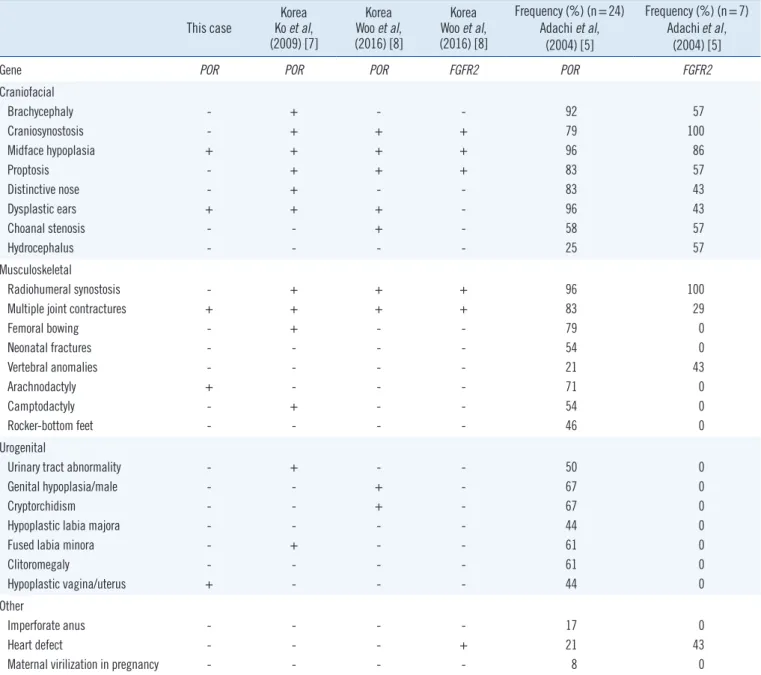
POR-related ABS is usually diagnosed at a younger age relative to FGFR2-related ABS, because it causes congenital adrenal hy- perplasia. However, the present case had a relatively weak phe- notype and was diagnosed over the age of 20 years. Neverthe- less, the clinical features of this patient were similar to those re- ported for POR mutations relative to FGFR2 mutations (Table 1).
In conclusion, we have identified a novel, likely pathogenic variant (c.529G>C; p.Gly177Arg) in the POR gene and this is Fig. 2. Partial genomic DNA sequences from the POR genes of the patient and her parents. The patient has compound heterozygous mutations, c.529G>C and c.1370G>A, which are carried by her father and mother, respectively. Symbol [=] means wild type.
Fig. 1. Radiographs of the patient’s hands, elbows, and feet. X-rays showing arachnodactyly of the hands (A), bilateral elbow dysplasia and subluxation of the proximal radioulnar joint (B), and bilateral shortening and clinodactyly of the fourth metatarsal bones (C).
A
B
C
Oh J, et al.
Novel likely pathogenic variant in the POR gene
https://doi.org/10.3343/alm.2017.37.6.559 www.annlabmed.org 561
the third reported case of ABS in Korea. This report will contrib- ute to a better understanding of the genetic background of Ko- rean patients with ABS.
Authors’ Disclosures of Potential Conflicts of Interest
No potential conflicts of interest relevant to this article were re- ported.
Table 1. Clinical presentation of patients with Antley-Bixler syndrome
This case Korea
Ko et al, (2009) [7]
Korea Woo et al, (2016) [8]
Korea Woo et al, (2016) [8]
Frequency (%) (n=24) Adachi et al,
(2004) [5]
Frequency (%) (n=7) Adachi et al,
(2004) [5]
Gene POR POR POR FGFR2 POR FGFR2
Craniofacial Brachycephaly Craniosynostosis Midface hypoplasia Proptosis Distinctive nose Dysplastic ears Choanal stenosis Hydrocephalus
- - + - - + - -
+ + + + + + - -
- + + + - + + -
- + + + - - - -
92 79 96 83 83 96 58 25
57 100 86 57 43 43 57 57 Musculoskeletal
Radiohumeral synostosis Multiple joint contractures Femoral bowing Neonatal fractures Vertebral anomalies Arachnodactyly Camptodactyly Rocker-bottom feet
- + - - - + - -
+ + + - - - + -
+ + - - - - - -
+ + - - - - - -
96 83 79 54 21 71 54 46
100
29 0 0 43 0 0 0 Urogenital
Urinary tract abnormality Genital hypoplasia/male Cryptorchidism Hypoplastic labia majora Fused labia minora Clitoromegaly
Hypoplastic vagina/uterus
- - - - - - +
+
- - - + - -
- + + - - - -
- - - - - - -
50 67 67 44 61 61 44
0 0 0 0 0 0 0 Other
Imperforate anus Heart defect
Maternal virilization in pregnancy
- - -
- - -
- - -
- + -
17 21 8
0 43 0 +, finding present; -, finding absent.
REFERENCES
1. Chun K, Siegel-Bartelt J, Chitayat D, Phillips J, Ray PN. FGFR2 muta- tion associated with clinical manifestations consistent with Antley-Bixler syndrome. Am J Med Genet 1998;77:219-24.
2. Miller WL. P450 oxidoreductase deficiency: a new disorder of steroido- genesis with multiple clinical manifestations. Trends Endocrinol Metab 2004;15:311-5.
3. Flück CE, Tajima T, Pandey AV, Arlt W, Okuhara K, Verge CF, et al. Mu- tant P450 oxidoreductase causes disordered steroidogenesis with and without Antley-Bixler syndrome. Nat Genet 2004;36:228-30.
4. Reardon W, Smith A, Honour JW, Hindmarsh P, Das D, Rumsby G, et
Oh J, et al.
Novel likely pathogenic variant in the POR gene
562 www.annlabmed.org https://doi.org/10.3343/alm.2017.37.6.559 al. Evidence for digenic inheritance in some cases of Antley-Bixler syn-
drome? J Med Genet 2000;37:26-32.
5. Adachi M, Tachibana K, Asakura Y, Yamamoto T, Hanaki K, Oka A.
Compound heterozygous mutations of cytochrome P450 oxidoreduc- tase gene (POR) in two patients with Antley–Bixler syndrome. Am J Med Genet A 2004;128A:333-9.
6. Sahakitrungruang T, Huang N, Tee MK, Agrawal V, Russell WE, Crock P, et al. Clinical, genetic, and enzymatic characterization of P450 oxidore- ductase deficiency in four patients. J Clin Endocrinol Metab 2009;94:
4992-5000.
7. Ko JM, Cheon CK, Kim GH, Yoo HW. A case of Antley-Bixler syndrome caused by compound heterozygous mutations of the cytochrome P450
oxidoreductase gene. Eur J Pediatr 2009;168:877-80.
8. Woo H, Ko JM, Shin CH, Yang SW. Two cases of Antley-Bixler syndrome caused by mutations in different genes, FGFR2 and POR. J Genet Med 2016;13:31-5.
9. Adachi M, Asakura Y, Matsuo M, Yamamoto T, Hanaki K, Arlt W. POR R457H is a global founder mutation causing Antley–Bixler syndrome with autosomal recessive trait. Am J Med Genet A 2006;140:633-5.
10. Richards S, Aziz N, Bale S, Bick D, Das S, Gastier-Foster J, et al. Stan- dards and guidelines for the interpretation of sequence variants: a joint consensus recommendation of the American College of Medical Genet- ics and Genomics and the Association for Molecular Pathology. Genet Med 2015;17:405-24.