Journal of Educational Evaluation for Health Professions
2019, Korea Health Personnel Licensing Examination Institute
This is an open-access article distributed under the terms of the Creative Commons Attribution License, which permits unrestricted use, distribution, and reproduction in any medium, provided the original work is properly cited.
J Educ Eval Health Prof 2019;16:18 • https://doi.org/10.3352/jeehp.2019.16.18
Review
Artificial intelligence (AI) is expected to affect various fields of medicine substantially and has the potential to improve many aspects of healthcare. However, AI has been creating much hype, too. In applying AI technology to patients, medical professionals should be able to resolve any anxiety, confusion, and questions that patients and the public may have. Also, they are responsible for ensuring that AI be-comes a technology beneficial for patient care. These make the acquisition of sound knowledge and experience about AI a task of high importance for medical students. Preparing for AI does not merely mean learning information technology such as computer program-ming. One should acquire sufficient knowledge of basic and clinical medicines, data science, biostatistics, and evidence-based medicine. As a medical student, one should not passively accept stories related to AI in medicine in the media and on the Internet. Medical stu-dents should try to develop abilities to distinguish correct information from hype and spin and even capabilities to create thoroughly validated, trustworthy information for patients and the public.
Keywords: Artificial intelligence; Machine learning; Deep learning; Medical students
What should medical students know about artificial
intelligence in medicine?
Seong Ho Park
1*, Kyung-Hyun Do
1, Sungwon Kim
2, Joo Hyun Park
3, Young-Suk Lim
41Department of Radiology and Research Institute of Radiology, Asan Medical Center, University of Ulsan College of Medicine, Seoul, Korea 2Department of Radiology, Research Institute of Radiological Science and Center for Clinical Image Data Science, Severance Hospital, Yonsei
University College of Medicine, Seoul, Korea
3Department of Medical Education, University of Ulsan College of Medicine, Seoul, Korea
4Department of Gastroenterology, Asan Medical Center, University of Ulsan College of Medicine, Seoul, Korea
Introduction
The use of artificial intelligence (AI) for medicine has recently drawn much attention due to the advances in machine learning techniques involving multiple layers of artificial neural networks trained on big data, i.e., deep learning [1,2]. AI is expected to af-fect various fields of medicine substantially and has the potential to improve many aspects of healthcare [1]. On the downside, AI has been creating much hype, too. It is not difficult to find on the Internet stories about how fast and accurately modern AI software
programs can analyze the patient’s medical information and auto-matically present diagnoses, even more precisely than human ex-perts, with a nuance that AI will soon dominate the medical prac-tice. However, these stories are mostly quite exaggerated or, at best, explain the matter only superficially. In reality, few AI tech-niques are currently used in medical practice.
Nevertheless, at the time when the current medical students will commence their career as medical professionals after comple-tion of studies and training, various AI software tools will likely be used in clinical practice. In applying AI technology to patients, medical professionals are not ones who are in the backseat but should be in the driver’s seat. They should be able to resolve any anxiety, confusion, and questions that patients and the public may have about applying AI to medicine. Medical professionals are also responsible for ensuring that AI becomes a technology
bene-*Corresponding email: [email protected]
Editor: A Ra Cho, The Catholic University of Korea, Korea
Received: June 15, 2019; Accepted:July 3, 2019
Published: July 3, 2019
ficial for patient care. These make the acquisition of sound knowl-edge and experience about AI a task of high importance for medi-cal students. The purpose of this article is to provide a succinct summary of the current state of AI from a medical viewpoint and suggest what medical students should do to prepare for the era of AI in medicine.
Artificial intelligence-related terms
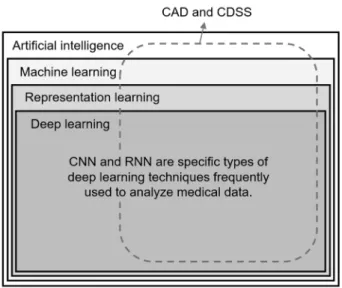
AI is a broad term that refers to algorithms that allow comput-ers to perform tasks requiring human cognitive abilities. With the recent development of deep learning technology, the terms ‘deep learning’ and ‘AI’ are increasingly often used as synonyms. The hierarchy of common AI-related terms are visually summarized in Fig. 1 [3].
Hype versus reality
Since the Go champion Sedol Lee was defeated in early 2016 by Google’s AlphaGo developed using deep learning technolo-gies, AI has often been referred to by lay media and some people as a technology that would replace many physicians in the foresee-able future. However, 3 years later, now ironically, worries exist that many companies developing AI software tools for medical use are facing the risk of shutting down. In other words, AI soft-ware tools for medical applications that have been developed so
far are not being consumed in real-world clinical practice. Why? The most important criterion for adopting AI technology in medical practice is that the technology should help provide better quality care for patients and improve healthcare outcomes of the patients, that is, create quality and value for patients. One notable example of failure by not fulfilling this requirement is IBM’s Wat-son for Oncology. This AI software designed to provide informa-tion to assist cancer diagnosis was released in 2013 by IBM and was introduced by 8 hospitals in Korea (Republic of) in 2016 and 2017 (none since 2018) [4]. However, unlike what has been ex-posed to the public, diagnostic suggestions provided by Watson for Oncology were not as accurate as expected. As a result, the ini-tial atmosphere of triumph was soon superseded by a sober evalu-ation of advantages and drawbacks [5,6]. In fact, the MD Ander-son Cancer Center, one of the best cancer hospitals in the United States, attempted to introduce Watson for Oncology early in 2017, but found problems and stopped the project after having spent $62 million [7]. Also, IBM laid off approximately up to 70% of staff in the corresponding business division in the first half of 2018 [8]. Just as drugs and any other medical devices are required to pass a strict validation of safety and efficacy before they can be used for patients, thorough clinical validation before clinical adop-tion is critical for AI technology, too, regarding how accurate it is and how large of a benefit with patient care it can provide without creating any inadvertent harms [9-13].
One of the key points to consider when evaluating the accuracy of an AI algorithm is external validation, i.e., testing the algorithm accuracy using datasets collected independently from the training dataset [11,14-17]. This is due to strong data dependency of AI algorithms. The process of training AI algorithms is different from that of human learning, as the latter is based on understanding concepts and principles, while the former is based on the search for patterns in given data without an understanding of concepts and principles [18]. When a large amount of data is input to a computer, it creates mathematical formulae (i.e., a mathematical representation of the patterns) that associate the data to answers to afford AI. Modern AI technologies such as deep learning are known to have high accuracy compared to past technologies in finding the patterns. However, they have a strong dependency on training data. While high accuracy is generally guaranteed within the data used for training, the accuracy for data that were not used for training can be low. The accuracy of AI algorithms cannot go beyond the information inherent to the datasets on which they are trained and cannot avoid the biases and errors in the training data. This strong data dependency of AI poses a particular con-cern in the medical field [19]. The datasets used to train AI algo-rithms for medical applications are prone to various selection
bi-Fig. 1. Hierarchy of artificial intelligence-related terms. CAD and CDSS are the most common types of software tools in the appli-cation of AI in medicine. CAD, computer-aided detection/diagno-sis; CDSS, clinical decision support system; CNN, convolutional neural network; RNN, recurrent neural network.
ases and may not adequately represent target populations in re-al-world clinical practice for many reasons [19]. Also, unexpected situations can occur in real-world clinical practice at any time, not infrequently [19]. As a result, there is a genuine risk that the accu-racy of an AI algorithm may drop if the AI software is applied to the data and patients of another hospital or data acquired from other imaging systems or methods [13,20-23]. Likewise, it is un-certain how accurately an AI algorithm would perform in various real-world practice settings until it is validated directly in such clinical environments.
For proper validation of the clinical accuracy of AI algorithms, the test data should have the following features [11,16,17]: (1) data collected avoiding biases from specific indications (i.e., target patient groups in well-defined clinical scenarios) to which the AI software will be applied; (2) data from hospitals other than the institution in which the data for AI training were collected, and (3) data collected from multiple institutions. Also, whenever pos-sible, prospectively collected data should be used [11,14,16,17]. However, most AI software applications for medical use devel-oped until now have not been validated in this way [24], and the lack of appropriate clinical validation for AI algorithms, a phe-nomenon referred to as ‘digital exceptionalism,’ raises a significant concern [25,26].
The second criterion for adopting AI technology in medicine is that it should support healthcare providers or hospital administra-tion if not directly helps patients. One successful example well ad-dressing this point is an AI software developed and introduced by the University of Pittsburgh Medical Center (UPMC) [27]. This software analyzes data of hospitalized patients and estimates the probability of re-hospitalization within seven and 30 days after discharge. In the United States, the hospital may not receive reim-bursement from insurers if a patient is re-hospitalized within a short period after discharge, and the early re-hospitalizations may ultimately work as a disadvantage to the hospital when it makes a contract with insurers. Therefore, it is crucial for hospitals to re-duce the rate of early re-hospitalizations. UPMC is now reported to be reaping the benefits of its investment of $100 million in the enterprise analytics [27].
What can artificial intelligence do for medicine?
If properly designed and used, AI technology could reinforce many weaknesses in current medical practice [1]. If time-consum-ing processes that require simple repetitive work are taken care of by AI, it would substantially reduce the fatigue of healthcare pro-viders, and physicians could spend more time in facing with pa-tients and concentrating on more complicated medical tasks [1].
AI technology may also reduce the number of inadvertent errors in clinical practice and may decrease differences in judgments among medical professionals. If patient conditions can be monitored 24 hours a day by AI systems, which would practically be impossible for humans to do, the patients may be managed more safely. Fur-thermore, new patterns discovered by AI through the analysis of big data from clinical practice may lead to the development of new biomarkers for diagnosis and treatment. Inputs by medical profes-sionals who understand medicine, specific details of clinical prac-tice, as well as patients, are critical for realizing these expectations. Many medical AI software applications developed to date were created mainly to make use of large data that happen to have al-ready been available rather than addressing the actual needs identi-fied by practitioners in real clinical world (i.e., definition of prob-lems or pertinent use cases in real-world practice first, followed by data collection to address the needs). It is another reason why AI software applications developed so far are rarely used in clinical practice and highlights the importance of input by medical profes-sionals who actually take care of patients on the spot.
Which medical sector will be most affected by
artificial intelligence?
It was spoken merely a few years ago that AI might soon replace specialists in radiology or pathology departments. However, with increasing understanding of AI, we now know that these prema-ture “predictions” are only revealing a very shallow understanding of the technology and its application in medicine at the time. Do we not have to worry about AI replacing physicians then? In many cases, AI tools for medicine mostly play the role of a virtual assis-tant for physicians and healthcare systems, helping them to pro-vide more accurate and efficient patient care, of which typical ex-amples are many AI tools that have been being developed in the fields of radiology and pathology. On the other hand, in the set-ting of managing common chronic illnesses or primary healthcare, AI could be designed and used as a virtual assistant for patients and the public [1]. For example, patients pondering about wheth-er or not to visit physicians for counseling or examination related to their minor health issues or patients wanting their prescription for chronic medication reissued might want to have AI do some of these functions so that they could save hospital visits. A similar scenario may also apply to emergency room visits. For example, if an AI system can make a suggestion using skin photographs taken with a smartphone in a child who has skin rash and fever at night regarding whether the child should visit the emergency room im-mediately or visit a pediatrician’s office the following day, the number of children visiting the emergency room during the night
might decrease. In these scenarios, AI algorithms provide infor-mation directly to the patients and enable them to take their healthcare into their own hands. The work for developing AI al-gorithms of this kind has lagged behind AI for clinicians and healthcare systems [1]. However, AI tools for directly coaching patients and the public about common chronic conditions and mild health issues will likely soon become a major topic for dis-cussion regarding AI in medicine given the large volume that these take in healthcare. Medical professionals in the AI era have an important responsibility in clinically validating the tools, pro-viding trustworthy information about them, and making the right decisions about their adoption in the best interest of the patients.
What should medical students do to prepare
themselves for artificial intelligence?
Medical students should acquire the appropriate knowledge and experience required for them to act as ones who take the ulti-mate responsibility for their patients when applying the AI tech-nology to them. Preparing for AI does not merely mean learning information technology such as computer programming. One should acquire sufficient knowledge of basic and clinical medi-cines (which constitute the fundamentals of medical practice and are keys to understanding how to use AI for medicine), data sci-ence, biostatistics, and evidence-based medicine. Even as a medi-cal student, one should not passively accept stories related to AI in medicine in the media and on the Internet. Medical students should try to develop abilities to distinguish correct information from hype and spin [28] and even capabilities to create thorough-ly validated, trustworthy information for patients and the public. While the curricula at medical schools would have yet to evolve to accommodate the educational needs sufficiently, some medical colleges in Korea (Republic of) such as University of Ulsan and Yonsei University have recently started providing AI-dedicated elective courses to the students.
Conclusion
AI is expected to affect various fields of medicine substantially and, if properly designed and used, has the potential to reinforce many weaknesses in current medical practice and improve many aspects of healthcare. Healthcare professionals are responsible for ensuring that AI becomes a technology beneficial for patient care. Medical students should develop abilities to distinguish correct information about AI from hype and spin and even capabilities to create thoroughly validated, trustworthy information for patients and the public to prepare for the era of AI in medicine.
ORCID
Seong Ho Park: https://orcid.org/0000-0002-1257-8315; Kyung-Hyun Do: https://orcid.org/0000-0003-1922-4680; Sungwon Kim: https://orcid.org/0000-0001-5455-6926; Joo Hyun Park: https://orcid.org/0000-0001-8029-0316; Young-Suk Lim: https://orcid.org/0000-0002-1544-577X
Authors’ contributions
Conceptualization: SHP, KHD. Writing–original draft: SHP. Writing–review & editing: KHD, SK, JHP, YSL.
Conflict of interest
No potential conflict of interest relevant to this article was re-ported.
Funding
None.Acknowledgments
None.Supplementary materials
Supplement 1. Audio recording of the abstract.
References
1. Topol EJ. High-performance medicine: the convergence of hu-man and artificial intelligence. Nat Med 2019;25:44-56. https:// doi.org/10.1038/s41591-018-0300-7
2. Lee JG, Jun S, Cho YW, Lee H, Kim GB, Seo JB, Kim N. Deep learning in medical imaging: general overview. Korean J Radiol 2017;18:570-584. https://doi.org/10.3348/kjr.2017.18.4.570
3. Chartrand G, Cheng PM, Vorontsov E, Drozdzal M, Turcotte S, Pal CJ, Kadoury S, Tang A. Deep learning: a primer for radiolo-gists. Radiographics 2017;37:2113-2131. https://doi.org/ 10.1148/rg.2017170077
4. Kim CJ. Two years since the introduction of Watson for On-cology to Korea: diminishing hype and a growing list of dilem-ma. Hankook Ilbo [Internet]. 2018 Dec 12 [cited 2019 Jun 14]. Available from: http://www.hankookilbo.com/News/ Read/201812101071352371.
5. Ross C, Swetlitz I. IBM’s Watson supercomputer recommended ‘unsafe and incorrect’ cancer treatments, internal documents show. Stat News [Internet]. 2018 Jul 25 [cited 2019 Jun 14]. Available from: https://www.statnews.com/2018/07/25/ ibm-watson-recommended-unsafe-incorrect-treatments/. 6. Kim EY. Is the boiling hype about Watson for Oncology just
cooling off? Cheongnyeon Uisa [Internet]. 2019 May 17 [cited 2019 Jun 14]. Available from: http://www.docdocdoc.co.kr/ news/articleView.html?idxno= 1068354.
7. Mulcahy N. Big data bust: MD Anderson-Watson Project dies. Medscape [Internet]. 2017 Feb 22 [cited 2019 Jun 14]. Avail-able from: https://www.medscape.com/viewarticle/876070. 8. Thomson I. IBM’s Watson Health wing left looking poorly after
‘massive’ layoffs. The Register [Internet]. 2018 May 25 [cited 2019 Jun 14]. Available from: https://www.theregister.co. uk/2018/05/25/ibms_watson_layoffs/.
9. Greaves F, Joshi I, Campbell M, Roberts S, Patel N, Powell J. What is an appropriate level of evidence for a digital health in-tervention? Lancet 2019;392:2665-2667. https://doi. org/10.1016/S0140-6736(18)33129-5
10. Maddox TM, Rumsfeld JS, Payne PRO. Questions for artificial intelligence in health care. JAMA 2019;321:31-32. https://doi. org/10.1001/jama.2018.18932
11. Park SH, Do KH, Choi JI, Sim JS, Yang DM, Eo H, Woo H, Lee JM, Jung SE, Oh JH. Principles for evaluating the clinical imple-mentation of novel digital healthcare devices. J Korean Med As-soc 2018;61:765-775. https://doi.org/10.5124/jkma.2018. 61.12.765
12. SFR-IA Group; CERF; French Radiology Community. Artifi-cial intelligence and medical imaging 2018: French Radiology Community white paper. Diagn Interv Imaging 2018;99:727-742. https://doi.org/10.1016/j.diii.2018.10.003
13. Tang A, Tam R, Cadrin-Chênevert A, Guest W, Chong J, Barfett J, Chepelev L, Cairns R, Mitchell JR, Cicero MD, Poudrette MG, Jaremko JL, Reinhold C, Gallix B, Gray B, Geis R; Canadi-an Association of Radiologists (CAR) Artificial Intelligence Working Group. Canadian Association of Radiologists white paper on artificial intelligence in radiology. Can Assoc Radiol J 2018;69:120-135. https://doi.org/10.1016/j.carj.2018.02.002
14. Parikh RB, Obermeyer Z, Navathe AS. Regulation of predictive analytics in medicine. Science 2019;363:810-812. https://doi. org/10.1126/science.aaw0029
15. Yu KH, Kohane IS. Framing the challenges of artificial intelli-gence in medicine. BMJ Qual Saf 2019;28:238-241. https://doi. org/10.1136/bmjqs-2018-008551
16. Park SH, Han K. Methodologic guide for evaluating clinical per-formance and effect of artificial intelligence technology for
medical diagnosis and prediction. Radiology 2018;286:800-809. https://doi.org/10.1148/radiol.2017171920
17. England JR, Cheng PM. Artificial intelligence for medical image analysis: a guide for authors and reviewers. AJR Am J Roentge-nol 2019;212:513-519. https://doi.org/10.2214/AJR.18.20490
18. Park SH. Artificial intelligence in medicine: beginner’s guide. J Korean Soc Radiol 2018;78:301-308. https://doi.org/10.3348/ jksr.2018.78.5.301
19. Park SH, Kim YH, Lee JY, Yoo S, Kim CJ. Ethical challenges re-garding artificial intelligence in medicine from the perspective of scientific editing and peer review. Sci Ed 2019 Jun 13 [Epub]. https://doi.org/10.6087/kcse.164
20. Zech JR, Badgeley MA, Liu M, Costa AB, Titano JJ, Oermann EK. Variable generalization performance of a deep learning model to detect pneumonia in chest radiographs: a cross-sec-tional study. PLoS Med 2018;15:e1002683. https://doi.org/ 10.1371/journal.pmed.1002683
21. Nsoesie EO. Evaluating artificial intelligence applications in clin-ical settings. JAMA Netw Open 2018;1:e182658. https://doi. org/10.1001/jamanetworkopen.2018.2658
22. Li X, Zhang S, Zhang Q, Wei X, Pan Y, Zhao J, Xin X, Qin C, Wang X, Li J, Yang F, Zhao Y, Yang M, Wang Q, Zheng Z, Zheng X, Yang X, Whitlow CT, Gurcan MN, Zhang L, Wang X, Pasche BC, Gao M, Zhang W, Chen K. Diagnosis of thyroid cancer us-ing deep convolutional neural network models applied to sono-graphic images: a retrospective, multicohort, diagnostic study. Lancet Oncol 2019;20:193-201. https://doi.org/10.1016/ S1470-2045(18)30762-9
23. Ting DS, Cheung CY, Lim G, Tan GS, Quang ND, Gan A, Hamzah H, Garcia-Franco R, San Yeo IY, Lee SY, Wong EY, Sa-banayagam C, Baskaran M, Ibrahim F, Tan NC, Finkelstein EA, Lamoureux EL, Wong IY, Bressler NM, Sivaprasad S, Varma R, Jonas JB, He MG, Cheng CY, Cheung GC, Aung T, Hsu W, Lee ML, Wong TY. Development and validation of a deep learning system for diabetic retinopathy and related eye diseases using retinal images from multiethnic populations with diabetes. JAMA 2017;318:2211-2223. https://doi.org/10.1001/jama. 2017.18152
24. Kim DW, Jang HY, Kim KW, Shin Y, Park SH. Design character-istics of studies reporting the performance of artificial intelli-gence algorithms for diagnostic analysis of medical images: re-sults from recently published papers. Korean J Radiol 2019;20:405-410. https://doi.org/10.3348/kjr.2019.0025
25. AI diagnostics need attention. Nature 2018;555:285. https:// doi.org/10.1038/d41586-018-03067-x
26. The Lancet. Is digital medicine different? Lancet 2018;392:95. https://doi.org/10.1016/S0140-6736(18)31562-9
27. Slabodkin G. UPMC cuts hospital readmission rates with ML algorithm. Health Data Management [Internet]. 2019 Mar 4 [cited 2019 Jun 14]. Available from: https://www.healthdata- management.com/news/upmc-cuts-hospital-readmis-sion-rates-with-ml-algorithm.
28. Ochodo EA, de Haan MC, Reitsma JB, Hooft L, Bossuyt PM, Leeflang MM. Overinterpretation and misreporting of diagnos-tic accuracy studies: evidence of “spin”. Radiology 2013;267:581-588. https://doi.org/10.1148/radiol.12120527