논문 2011-48CI-6-3
ERPM: 모바일 Ad-hoc 무선 네트워크에서 이동성을 이용한 엔트로피 기반 라우팅 프로토콜
*( ERPM: An Entropy-based Routing Protocol using Mobility in Mobile Ad-hoc Wireless Networks )
안 병 구*, 이 주 상**
( Beongku An and JooSang Lee )
요 약
본 논문에서는 모바일 Ad-hoc 무선 네트워크에서 유비쿼터스 융합 서비스를 효과적으로 지원하기 위한 이동성을 이용한 엔트로피 기반 라우팅 프로토콜(ERPM)을 제안한다. 제안된 ERPM의 주요한 특징은 다음과 같다. 첫째, ERPM은 노드들의 이 동성을 이용한 엔트로피 개념을 기반으로 하여 안정된 라우팅 경로들을 설정할 수 있다. 둘째, ERPM은 노드들의 이동성을 이 용한 엔트로피 개념에 의해서 경로들의 안정성을 평가 할 수 있다. 셋째, ERPM은 소스노드와 목적지 노드 사이에 다중 경로 가 존재할 때 경로들의 이동성 측면에서 가장 안정된 경로를 선택할 수 있다. 제안된 ERPM의 성능평가는 OPNET을 사용한 시뮬레이션과 이론적 분석을 통하여 이루어진다. 성능평가를 통하여 제안된 ERPM은 안정된 경로 설정 및 데이터 전송효율 을 효과적으로 증가 시킬 수 있음을 알 수 있다.
Abstract
In this paper, we propose an Entropy-based Routing Protocol using Mobility (ERPM) for supporting ubiquitous convergence services efficiently in mobile ad-hoc wireless networks. The main features that the ERPM introduces to obtain the goals can be summarized as follows. First, ERPM can construct stable routing routes based on the entropy concepts using mobility of nodes. Second, ERPM can quantitatively evaluate the stability of route by entropy concepts using mobility of nodes. Third, ERPM can select the most stable route in the view points of mobility of routes between a source node and a destination node, where multiple paths are available. The performance evaluation of the proposed ERPM performed via simulation using OPNET and analysis shows that the ERPM can support the construction of stable routing routes and increase the transmission ratio of data efficiently.
Keywords : Routing, Route Stability, Mobility, Entropy, Mobile Ad-hoc Wireless Networks
* 평생회원, 홍익대학교 컴퓨터정보통신공학
(Dept. of Computer & Infor. Comm, Eng., Hongik University)
** 학생회원, 홍익대학교 대학원 전자전산공학과 (Dept. of Electronics & Computer Eng., Graduate School, Hongik University)
※ 이 논문은 2011학년도 홍익대학교 학술연구진흥비 에 의하여 지원되었음.
접수일자: 2011년9월28일, 수정완료일: 2011년11월2일
Ⅰ. Introduction
Due to the random movement of nodes, the bandwidth and power limitations, and the lack of fixed infrastructure, the development of efficient routing protocols to support the various networking operations in mobile ad-hoc wireless networks present many issues and challenges[1~2]. How to apply the technologies of ad-hoc networks for
supporting ubiquitous convergence services efficiently
? This is one of the most interesting issues and challenge in mobile ad-hoc wireless networks. Thus, in this work we just focus on the development of ad-hoc routing protocol which can be applied for ubiquitous convergence services efficiently. The basic motivations of the proposed ERPM stem from the conditions of best route that should satisfy at least route stability[3~4] in self-organizing mobile ad-hoc wireless networks. The proposed ERPM can select the most stable routing route in the view points of mobility of nodes between a source node and a destination node, in an environment where multiple paths are available in a mobile ad-hoc wireless networks[1~2, 5]. This paper consists of as follows.
The proposed routing protocol, ERPM, is explained in Section II, and Section III presents the theoretical analysis of the ERPM. The performance of the ERPM is presented in Section IV and Section V concludes this paper.
Ⅱ. The Proposed Routing Protocol: ERPM
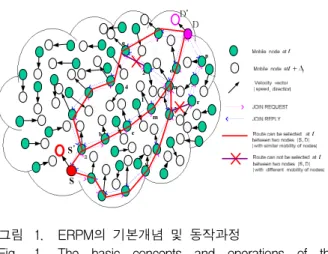
In this section, we describe the proposed routing protocol, called Entropy-based Routing Protocol using Mobility (ERPM), which is the extended works of our previous paper[4]. Fig. 1 shows the basic concepts and presents the operations of the ERPM.
The basic motivations of the proposed ERPM stem
그림 1. ERPM의 기본개념 및 동작과정
Fig. 1. The basic concepts and operations of the ERPM.
from the commonality observed in the location uncertainty in mobile ad-hoc wireless networks and the concept of entropy. These common characteristics have motivated our work in developing the ERPM using entropy concepts and utilizing mobility information as the corresponding variable features, in order to select stable routing routes and quantitatively evaluate (measure and calculate) route stability in self-organizing mobile ad-hoc wireless networks.
Even if we can find a good routing routes between a source node and a destination node at time , the routing route scan be broken during some time interval ∆ due to the location uncertainity of mobile nodes in mobile ad-hoc wireless networks. Thus, our goals are to construct very stable routing routes that can be still alive at least during some time interval
∆ to increase packet delivery ratio with long route lifetime as well as to quantitatively evaluate (measure and calculate) the stability of the routes to select the most stable route between a source node and a destination node, in an environment where multiple paths are available in a mobile ad-hoc wireless networks.
In this paper, we assume all nodes have sufficient power. Thus, we don’t consider the node power problems in this works. Also, each node in the given networks is assumed to be aware its position with the aid of reliable position system (i.e., GPS). The operations of the ERPM are as follows.
Step 1: The source node (node S) generates and advertises a JOIN REQUEST to its neighbor nodes using the broadcast. The JOIN REQUEST consists of the source node ID, mobility information of the node which sends the JOIN REQUEST, sequence number from the source node.
Step 2: When a node which is (sequence number) node from the source node receives a JOIN REQUEST from the neighbor node, the node accepts the message except the one that received the request from and the node store node ID, sequence number,
the mobility information of the upstream node(to source node) and itself node in REQUEST TABLE (REQT).
Step 3: When a destination node (node D)receives a JOIN REQUEST, the node accepts the message except the one that arrives at via the same routes comparing with previous arrival JOIN REQUESTs.
The destination node generates and forwards a JOIN REPLY to the upstream node (to source node). The JOIN REPLY consists of the destination node ID and mobility information of the node which sends the JOIN REPLY, sequence number from the destination node.
Step 4: When a node receives a JOIN REPLY from the downstream node (to destination node), the node executes the operation as follows:
Ÿ Store node ID, sequence number, the mobility information of the downstream node ID(to destination node) in REPLY TABLE (REPT).
Ÿ If the sequence number of the current node () is greater than two(i.e., No. of downstream nodes≥2), the route stability (RS) (i.e., ) is calculated by using the proposed entropy-based route stability(RS)[6]
method presented in section III. See equations (4). (example of this operation in Fig. 2: node o, node p, node n, node m, node c, node b, node a).
Ÿ If the RS is greater than some threshold (i.e.,
≥), the node stores the route stability information up to previous node in the REPT for all candidate routes. The priority number based on the route stability information is assigned in the REPT if there are multiple routes for the node. The node advertises the JOIN REPLY to its upstream nodes (to source node). (example of this operation in Fig. 2: node a)
Ÿ If the RS is less than some threshold (i.e.,
≤RS), the node doesn't advertise the JOIN REPLY any more. (example of this operation: node r)
Ÿ These operations are executed until the JOIN REPLY arrives at the source node.
Step 5: When the source node receives the JOIN REPLY messages via each routes, the source node forwards the data messages to the destination node
via the most stable route depending on the priority number in REPT.
Step 6: When a node over the stable routing routes receives the data messages which are sent by previous node (to source node) from the source node, the node forwards the data messages over a route depending on the priority number in REPT to next node (to destination). This operation is executed until the destination node receives the data message.
Ⅲ. The theoretical analysis of the ERPM
Our previous works[6] in detail describes how to use entropy concepts for selecting and evaluating routes in mobile ad-hoc networks. In this section, we present just the basic concepts of the theoretical analysis of the proposed ERPM by using the Fig.1.
The relative velocity between nodes m and n at time t is defined as
(1) As mentioned earlier, the variable features considered here is the relative mobility between two nodes. Therefore, we have as
(2)
where is the number of discrete times that velocity information can be calculated and disseminated to other neighboring nodes within time interval ∆.
In general, the entropy ∆ at mobile m is calculated as follows:
∆ log
∈
∆log∆
(3)
where ∆
∈
.
In this relation, by we denote the set (or any subset) of the neighboring nodes of node m, and by
the cardinality (degree) of set .
As can be observed from the previous relation, the entropy ∆ is normalized so that
≤∆ ≤ . It should be noted that the entropy, as defined here, is small when the change of the variable values in the given region is severe and large when the change of the values is small [7]. In general in mobile ad-hoc wireless networks the route between a source node and a destination node may traverse multiple intermediate nodes (hops). We define the entropy-based Route Stability (RS) between two nodes S and D during some interval
∆ as ∆ to evaluate, estimate and quantify end to end route stability as equation (4):
∆
∆ (4)
where denotes the number of intermediate mobile nodes over a route between the two end nodes(S, D).
Ⅳ. Performance Evaluation
In this section, we evaluate the performance of the ERPM.
1. Simulation Scenario and Framework
The performance evaluation of our protocol is accomplished via both simulation using the Optimized Network Engineering Tool (OPNET) and the theoretical analysis. A mobile ad-hoc wireless networks consisting of 50 nodes that are placed randomly within a rectangular region of 1 km x 1 km is modeled in the simulation. Each node is modeled as an infinite-buffer, store-and-forward queuing station, and is assumed to be aware of its position with the aid of a reliable position location system(i.e., GPS). The mobile nodes are assumed to have constant radio range of Z= 250m.
In this simulation, two different mobility models are used. In the first mobility scenario, random mobility pattern is model. A mobile node picks a
position within the simulation area randomly in each movement epoch, then move towards it with a speed in the range [0, m axkm/h] direction range [0, 2]
respectively. The speed and direction are updated independently for each node every ∆ seconds(in our simulation ∆= 5 second). The pause time at the end of each epoch is zero second.
In the second mobility scenario, a group-based mobility pattern[8] is modeled . Specifically, nodes are grouped into several groups, where we assume that nodes in the same group have similar mobility characteristics (speed and direction). The speed and direction of each group are selected randomly at the start point of the simulation within the speed range [0, m axkm/h] and the direction range [0, 2] and is assumed that the group holds these speed and direction for the duration of the simulation. Regarding the moving direction of the mobiles, at the beginning of the simulation a starting moving direction is selected randomly for each group (different groups have different initial directions). Initially, each group consists of 5 nodes.
If a mobile arrives at the boundary of the given network coverage area, the node reenters into network.
2. Performance Metrics
The performance metrics that we use in this paper for the evaluation purposes are the following:
Ÿ Packet delivery ratio (PDR): It is defined as the number of data packets delivered to a destination node over the number of data packets supposed to be delivered to a destination node. This ratio represents the routing effectiveness of our strategy.
Ÿ Control overhead: It is defined as the average number of control signal packets related to the route creation process that are received by a node per one route creation process.
Ÿ Delay: It is defined as the average latency time for route creation between a source node and a destination node.
Ÿ Route lifetime: It is defined as the survival time (connected time) of the routing route
constructed between a source node and a destination node.
3. Numerical Results and Discussion
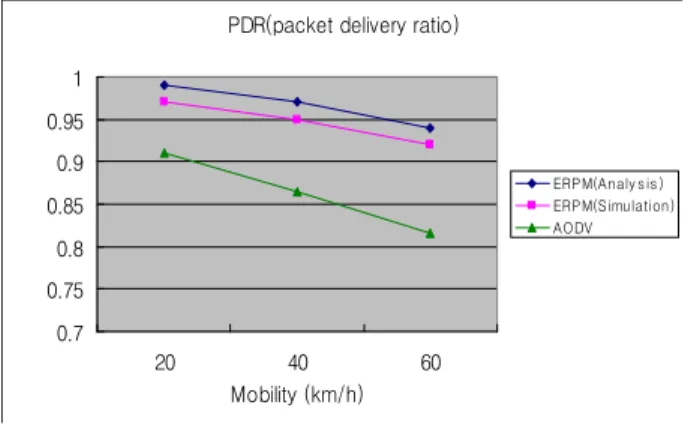
Fig. 2 and Fig.6 illustrate the PDR (packet delivery ratio) of the routing protocols with the results of both simulation and analysis as a function of mobility. Since in mobile ad-hoc wireless networks one of the most distinct characteristics is mobility, we initially evaluate the system’s performance as a function of mobility speed, in order to study and determine its applicability in different networking environments. In the theoretical analysis of ERPM (Section III), we already defined and evaluated one measure, equation(4), to estimate and quantify end to end route stability. We should verify whether both the PDR and the route stability are closing as a
PDR(packet delivery ratio)
0.7 0.75 0.8 0.85 0.9 0.95 1
20 40 60
Mobility (km/h)
PDR ERPM(Analy s is )
ERPM(Simulation) AODV
그림 2. 이동성 함수로서의 페킷전달효율 (랜덤 이동성) Fig. 2. Packet delivery ratio (PDR) as a function of
mobility (random mobility)
Route Lifetime
0 1 2 3 4 5 6
20 40 60
Mobility [km/h]
Lifetime [sec] |
ERPM AODV
그림 3. 이동성 함수로서의 경로 라이프타임 (랜덤 이동성)
Fig. 3. Route lifetime as a function of mobility.
(random mobility)
function of mobility. The reason is that the PDR must be increased if the route stability () is increased. As we can see in these figures, ERPM shows very good performance in highly dynamic situations in which both mobility patterns are supported. Specifically, these figures show that the numerical results of both simulation and analysis for ERPM are very closing in both mobility patterns.
Especially, in the mobility 2 scenario the PDR of the ERPM (Fig.6) presents more good result than the corresponding PDR of AODV[9]. The reason is that in our protocol the routing routes are created and selected on the basis of the entropy-based concepts using mobility. Therefore, the impact of a link break is minimal (especially in group mobility) on our routing protocol (ERPM) capability of delivering the data to the destination node.
Control Overhead
0 1 2 3 4 5
20 40 60
Mobility (km/h)
Control Overhead
ERPM AODV
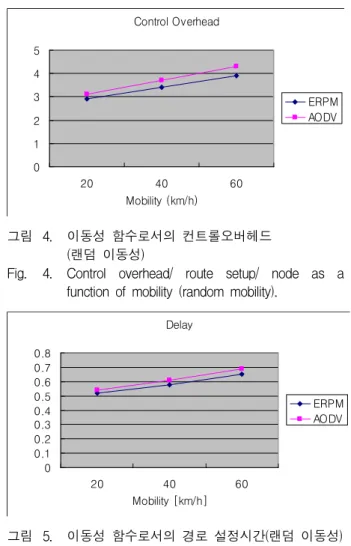
그림 4. 이동성 함수로서의 컨트롤오버헤드 (랜덤 이동성)
Fig. 4. Control overhead/ route setup/ node as a function of mobility (random mobility).
Delay
0 0.1 0.2 0.3 0.4 0.5 0.6 0.7 0.8
20 40 60
Mobility [km/h]
Delay [sec]
ERPM AODV
그림 5. 이동성 함수로서의 경로 설정시간(랜덤 이동성) Fig. 5. Delay for route setup as a function of mobility.
(random mobility)
Fig. 3 and Fig.7 present the route lifetime between a source node and a destination node as a function of mobility speed for two mobility scenarios. As we can see in Fig.3 and Fig.7, the route lifetime of the ERPM is longer than the corresponding lifetime of AODV(especially in group mobility scenario). The main reason is that ERPM uses the entropy-based concepts using mobility for route creation. Therefore, since the impact of a link break is minimal (especially in mobility 2) on our routing protocol (ERPM) capability of delivering the data to the destination node, the created routes can be alive during much more times. Then, the route lifetime between a source node and a destination node is increased.
Fig. 4 and Fig.8 demonstrate the control overhead associated with the route creation and maintenance as
PDR(packet delivery ratio)
0.7 0.75 0.8 0.85 0.9 0.95 1
20 40 60
Mobility (km/h)
PDR ERPM(Analy s is )
ERPM(Simulation) AODV
그림 6. 이동성 함수로서의 페킷전달효율 (그룹 이동성) Fig. 6. Packet delivery ratio as a function of mobility.
(group mobility)
Route Lifetime
0 1 2 3 4 5 6
20 40 60
Mobility [km/h]
Lifetime [sec] |
ERPM AODV
그림 7. 이동성 함수로서의 경로 라이프타임 (그룹 이동성)
Fig. 7. Route lifetime as a function of mobility.
(group mobility)
a function of mobility speed for two mobility scenarios. The control overhead includes all the control signals (packets) that need to be exchanged among the various nodes in order to create and maintain the routing routes. As we can see in Fig.4 and Fig.8, the control overhead remains relatively constant as the speed increases. The reason is that the updates for route creation are operated periodically. However, the number of control signals for route creation and maintenance may slightly increase as the mobility speed increase because more control signals for route creation and maintenance may need to be exchanged according to the increasing of the mobility speed.
Fig. 5 and Fig.9 describe the average delay (latency time) for route creation as a function of
Control Overhead
0 1 2 3 4 5
20 40 60
Mobility [km/h]
Control Overhead
ERPM AODV
그림 8. 이동성 함수로서의 컨트롤오버헤드 (그룹 이동성)
Fig. 8. Control overhead/ route setup/ node.
(group mobility) Delay
0 0.1 0.2 0.3 0.4 0.5 0.6 0.7 0.8
20 40 60
Mobility [km/h]
Delay [sec]
ERPM AODV
그림 9. 이동성 함수로서의 경로 설정시간(그룹 이동성) Fig. 9. Delay for route setup as a function of mobility.
(group mobility)
mobility speed for two mobility scenarios. The delay includes all the latency times that need to be spent between a source node to a destination node for route creation. As we can see in Fig.5 and Fig.9, the delay for route creation remains relatively constant and low because both ERPM and AODV[9] use reactive concepts for route creation. However, the delay of ERPM is slightly less than the corresponding delay of AODV[9]. The reason is that ERPM can create very stable routing routes by entropy-based concepts using node mobility. Therefore, the average delay (latency time) for route creation may be reduced according to the decreased number of update control signals for route creation and maintenance. However, the average delay for route creation may slightly be increased as the mobility speed increase because more control signals for route creation may need to be exchanged according to the increasing of the mobility speed. The more control signals spend much more times.
Ⅵ. Concluding Remarks
In this paper, we propose an Entropy-based Routing Protocol using Mobility (ERPM) suitable for Mobile Ad-hoc Wireless Networks. The main goals of this paper are in showing and proposing how the routing routes are decided on route stability based on entropy concepts using mobility of mobile nodes to increase the operational lifetime of routes as well as how the stability of routing routes can be measured quantitatively in mobile ad-hoc wireless networks.
The performance evaluation of ERPM demonstrates the proposed routing protocol’s efficiency in terms of packet delivery ratio, control overhead, end-to-end delay, and route lifetime, as a function of mobility and indicates that ERPM can provide a very efficient routing strategy that is suitable for application in mobile ad-hoc wireless networks. Especially, we can see the numerical results of both simulation and the theoretical analysis are very similar and closing. The numerical results demonstrated, as expected, that our
protocol’s improved performance is even more significant in the case of group-oriented movements.
참 고 문 헌
[1] R. Ramanathan and M. Steenstrup,
“Hierarchically -Organized, Multihop Mobile Wireless Networks for Quality-of Services Support,” ACM/Baltzer Mobile Networks and Applications, vol.3, no.1, pp.101-119, 1998.
[2] Beongku An, Symeon Papavassiliou, “Supporting Multicasting in Mobile Ad-hoc Wireless Networks: Issues, Challenges and Current Protocols,” Wireless Communications and Mobile Computing (WCMC), vol. 2, issue 2, pp.115-130, March 2002.
[3] Sachin Abhyankar and Dharma P. Agrawal,
“Distributed Mobility-Aware Route Selection for Wireless Ad-hoc Networks,” Proc. of Performance, Computing and Communications Conferecne, pp.241-247, April 2002.
[4] Beongku An, Joo Sang Lee, Nam-Soo Kim, “An Entropy-based Routing Protocol using Mobility in Mobile Ad-hoc Wireless Sensor Networks,”
Proc. of IEEE ICACT 2009, vol. 2, pp. 949-952, February 2009.
[5] Elizabeth M. Royer, Chai-Keong Toh, “A Review of Current Routing Protocols for Ad-hoc Mobile Wireless Networks,” IEEE Personal Communications, pp. 46- 55, August 1999.
[6] Beongku An, Symeon Pappavassiliou, “An Entropy-Based Model for Supporting and Evaluating Stability in Mobile Ad-hoc Wireless Networks,” IEEE Communications Letters, vol. 6, issue 8, pp.328-330, August 2002.
[7] Akira Shiozaki, “Edge Extraction Using Entropy Operator,” Computer Vision, Graphics, and Image Processing 36, 1-9, 1986.
[8] Xiaoyan Hong, Mario Gerla, Guangyu Pei and Ching-Chuan Chiang, “A Group Mobility Model for Ad-Hoc Wireless networks,” Proc. of ACM/IEEE MSWiM'99, August 1999.
[9] C.E Perkins and E.M. Royer, “Ad-Hoc ondemand distance Vector Routing,” Proc. of WMCSA ’99, pp 90-100, February 1999.
저 자 소 개 안 병 구(평생회원)
1988년 경북대학교전자공학 (학사)
1996년 (미) olytechnic Univ.
Dept. of Electrical &
Computer Eng.(석사).
2002년 (미)New Jersey Institute of Technology (NJIT), Dept. of Electrical & Computer Eng.(박사)
1989년~1993년 포항산업과학기술연구(RIST), 선임연구원.
2003년~현재 홍익대학교 컴퓨터정보통신공학과 교수
2008년~현재 한국인터넷방송통신학회(IWIT) 부회장
2010년~현재 대한전자공학회 컴퓨터소사이티 부회장
2005년~2010년 Marquis Who's Who in Science and Engineering
(세계과학기술인명사전) 등재,
2006년~2010년 Marquis Who's Who in the World(세계인명사전) 등재
<주관심분야: Wireless Networks, Ad-hoc &
Sensor Networks, QoS Routing & Multicast Routing, Cooperative Communication, VLC, Bioinformatics, Cross-Layer Technology, Mobility Management, Location-Based Technology>
이 주 상(학생회원)
2006년 홍익대학교 컴퓨터정보 통신공학과(학사) 2008년 홍익대학교 대학원 전자
전산공학과(석사) 2008년 3월∼현재 홍익대학교
대학원 전자전산공학과 재학(박사과정)
<주관심분야:Ad-hoc & Sensor Networks, Mobile Wireless Networks, Routing, Cooperative Communications, Multicast Routing Protocols, Cross-Layer>