MP-AODV : A New Multipath Routing Protocol Based on AODV in Mobile Ad Hoc Networks
Yun-Sung Lee*, Sang-Hwa Chung**
1)
MP-AODV : AODV 기반 모바일 Ad-Hoc 네트워크에서의 다중경로 라우팅 프로토콜
이 윤 성*, 정 상 화**
요 약
본 논문에서는 모바일 노드들의 움직임이 심한 MANET 환경에서 데이터의 전송을 보다 안정적이고 신뢰성 있 게 하기 위해 소스 목적지 간의 다중 경로를 찾는 새로운 방법을 제시하고자 한다. 새로운 다중경로 라우팅은 먼저 AODV에 기반을 두어 주경로를 설정하고 주경로로 설정된 노드는 보조경로 탐색에 참여하지 못하도록 하여 주경로 와 보조경로를 노드 비 겹침(disjoint)하게 형성한다. 또한 주경로가 설정된 후 바로 데이터 전송을 시작하고 데이 터 전송이 되고 있는 중에 백그라운드로 보조경로 탐색을 실행하여 경로 탐색 시에 발생하는 데이터 전송의 지연을 주경로 탐색 시에만 발생하도록 한다. 주경로와 보조경로 중 하나의 경로가 단절되면 즉시 다른 경로로 데이터 전송 을 하게 되고 단절된 경로는 경로유지를 통해 다시 노드 비 겹침 경로를 찾는다. 또한 노드 비 겹침, 링크 비 겹침 방식을 혼합한 하이브리드 방식을 제안하여 네트워크의 상황에 따라 적합한 방식으로 경로를 탐색하도록 한다.
Qualnet 기반 시뮬레이션을 수행한 결과, 제안한 라우팅 프로토콜을 사용한 경우 AODV, AOMDV에 비해 높은 패킷 전송률을 보이고 종단간 지연시간도 줄어든다.
▸Keyword : AODV 라우팅, 다중경로 AODV 라우팅, 모바일 애드혹 네트워크, 다중경로 선택 기법, 하 이브리드 모드
Abstract
In this paper, we propose a new multipath routing protocol and compare it with other multipath routing protocols in mobile ad hoc network (MANET) environments. The new multipath routing establishes the main route using a mechanism based on Ad Hoc On-demand Distance Vector(AODV), after which data transmission starts immediately. The backup route search process
∙제1저자 : 이윤성 교신저자 : 정상화
∙투고일 : 2011. 01. 14, 심사일 : 2011. 02. 10, 게재확정일 : 2011. 03. 07
*, ** 부산대학교 컴퓨터공학과(Dept. of Computer Science Engineering,0 Pusan National University)
※ “This work was supported by the Grant of the Korean Ministry of Education, Science and Technology"(The Regional Core Research Program/Institute of Logistics Information Technology)
takes place while data are transmitted, to reduce the transmission delay. The protocol can also operate in a hybrid node-disjoint/link-disjoint mode, where the protocol finds the node-disjoint backup route first; if the node-disjoint does not exist, the protocol discovers the link-disjoint backup route from the main route. When either of the main route or the backup route is broken, data are transmitted continuously through the other route and the broken route is recovered by the route maintenance process. The results of simulations, based on the Qualnet simulator, show that the proposed multipath routing protocol increases the packet transmission success rate and reduces end-to-end delays, when compared with AODV and AOMDV protocols.
▸Keyword : AODV, AOMDV, MANET, Multipath Routing, Hybrid mode
I. Introduction
A mobile ad hoc network (MANET) is a type of wireless network that is composed of wireless mobile nodes. Each mobile node dynamically changes the network topology without relying on a wired backbone network or a fixed base station. Mobile nodes in MANETs are constrained by their limited power, processing, memory resources and by a high degree of mobility.
In a network composed of mobile nodes, changes in the network topology require the frequent rebuilding of routes, so maintaining stable routes may be infeasible. Therefore, routing protocols for MANETs consider node mobility, stability and the reliability of data transmission. Based on these criteria, various multipath routing protocols have been suggested as extensions to conventional single-path routing protocols such as the AODV approach [1]. For example, the Ad Hoc On-demand Multiple Distance Vector (AOMDV [2]) protocol discovers multiple routes by recording the path over which RREQ packets have been sent, and the Ad Hoc On-demand Distance Vector Backup Route (AODV-BR [3]) and AODV-Multipath (AODVM [4]) protocols use overhearing to send RREP packets for discovering multiple routes.
In this paper, we propose a new multipath routing protocol that is based on the AODV protocol for MANETs. The new multipath routing protocol
establishes the main route using a mechanism based on AODVs, and then the data transmission starts immediately. The backup route search process takes place while data are transmitting, to reduce the transmission delay. The protocol can also operate in a hybrid mode, combining node-disjoint and link-disjoint modes. This means that the protocol looks for the node-disjoint backup route first, but if the node-disjoint route does not exist, the protocol discovers the link-disjoint backup route from the main route. When either of the main route or the backup route is broken, data are transmitted continuously through the other route and the broken route is recovered by the route maintenance process.
This protocol improves the packet transmission rate and reduces the end-to-end delay by establishing multiple routes in the hybrid mode between the node-disjoint route and the link-disjoint route. It also reduces the packet transmission delay by discovering the backup route while data are transmitted.
The remainder of the paper is organized as follows. In Section 2, we present related work.
Section 3 illustrates the proposed multipath routing protocol (MP-AODV). In Section 4, we evaluate the performance of MP-AODV using the Qualnet simulator [10], and we conclude the paper in Section 5.
II. Related Work
Multipath routing establishes multiple routes between source and destination nodes. For fault tolerance, even if one route failure occurs, source nodes can maintain connections by using other routes. Thus, multipath routing protocols can reduce data transmission failures and minimize delays that are caused by route disconnections.
Multipath routing protocols search node-disjoint, link-disjoint or nondisjoint routes during the route discovery process [7][8]. Node-disjoint routes have completely disjoint routes where there are no nodes or links in common. Link-disjoint routes have no links in common but may have nodes in common.
Nondisjoint routes may contain nodes or links in common. If a node or link fails in nondisjoint and link-disjoint routes, and it is used by both the main and backup routes, then the main and backup routes will be disconnected at the same time. However, in node-disjoint routes, the main and backup routes use completely different nodes or links. Therefore, even though the main route will be disconnected, data transmission may be available through the backup routes[6].
a) Node-disjoint b) Link-disjoint Fig. 1. Difference between node-disjoint and
link-disjoint
In single-path routing protocols, route maintenance may be performed after the routes fail.
Therefore, data transmission will be stopped while the new route is established, causing data transmission delays. Alternatively, multipath routing protocols generally perform the route maintenance process after all routes fail. To perform the route maintenance process before all routes fail, the network must always maintain multiple routes.
This can reduce data transmission delays caused by link failure, but it cause the routing overhead of
control packets such as RREQ or RREP packet[6].
Several implementations of multipath routing are based on AODVs; typical examples are AOMDV, AODVM, AODV-BR protocols. The AOMDV [4]
protocol establishes loop-free link-disjoint paths in the network. When intermediate nodes receive the RREQ packet from the source node, the AOMDV protocol stores all RREQ packets, unlike in the conventional AODV protocol where duplicates are discarded. So each node maintains a ‘firsthop_list’, where information from an additional field called
‘firsthop’ in RREQ packets indicates the neighbor node of the source nodes. If the firsthop of a received RREQ packet is duplicated from its own firsthop_list, the RREQ packet is discarded.
However, if the RREQ packet is not duplicated from previous RREQ packets, then the node updates the
‘nexthop’, ‘hopcount’ and ‘advertised_hopcount’ fields in the routing table. At the destination, RREP packets are sent from each received RREQ packet.
Multiple routes are constructed from RREP packets, which follow the reverse routes that have previously been set up over intermediate nodes. On the other hand, AOMDV protocol has the routing overhead for generating multi-paths. To solve this problem Sudipto Das et al, propose the optimization to reduce alternative route discovery time of AOMDV routing protocol. The intermediate node gathers its neighbor information and use to dynamically determine the node to which a particular data packet has to be forwarded. Using this approach a better load balancing can be obtained in addition to utilization of the additional routes, if feasible, and in the process maintaining these routes[12].
For the AODVM [4] protocol, intermediate nodes are not allowed to send an RREP packet directly to the source node, and intermediate nodes do not discard the duplicate RREQ packets. However, the intermediate nodes record all received RREQ packets in the routing table. The destination node sends an RREP packet for all of the received RREQ packets.
An intermediate node forwards a received RREP
packet to the neighbor in the routing table.
Whenever a node overhears one of its neighbors broadcasting an RREP packet, it removes that neighbor from its routing table because nodes cannot participate in more than one route.
For the AODV-BR [3] protocol, neighbor nodes overhear the RREP packets when establishing and maintaining the backup routes during the route initiation process. If part of the main route is broken then nodes broadcast error packets to neighbor nodes. When neighbor nodes receive the error packet, they establish an alternate route using information about the RREP packets overheard from previous RREP packets. Another research based on AODV-BR is NDAMR(Node-disjoint alternative multiple path) algorithm. NDAMR generates non-overlap multi-paths from source node to destination node. But unlike AODV-BR, NDAMR has only two shortest node-disjoint path because of reducing intermediate node’s overhearing overhead[11].
The AOMDV protocol has the overhead of storing multiple next hops, hopcounts and the firsthop list for each destination. By overhearing the neighbor’s packets, the AODVM protocol may not establish alternate routes depending on the path along which the RREP packets are sent. Strictly speaking, AODV-BR is not a multipath routing protocol, because it only maintains bypass routes when the main route is broken, by using the neighbor nodes around the main routes.
Finally, our previous research is Node-disjoint multipath routing protocol in Mobile Ad hoc network, but node-disjoint shows poor performance when the network topology is limited or small number of nodes.[13]
For this reason, this paper considered the advantages and disadvantages of existing algorithms and proposed the new multi-path routing protocol based on AODV.
III. Multipath AODV Protocol
In this paper, we propose the Multipath AODV (MP-AODV) protocol based on the AODV protocol.
The MP-AODV protocol is for MANETs that configure their network topology randomly because of freely moving mobile nodes. In these situations, nodes frequently fail.
In AOMDV and AODV-BR finds a new multipath after cut off all path. But MP-AODV performs secondary path discovery process in background mode after establishing primary path. Also while communication using primary path, if MP-AODV recognize the link failure of the secondary path, the protocol search the alternative path again in the background. MP-AODV maintains only one alternative path because of restricting flooding control packets in the background.
The MP-AODV protocol is composed of three suites in the routing module: the node-disjoint MP-AODV, the link-disjoint MP-AODV and hybrid MP-AODV. The MP-AODV protocol uses two node-disjoint or link-disjoint routes between a source node and a destination node to solve the transmission delay problem caused by node failures.
The MP-AODV protocol should reduce the transmission delay using backup routes that are not broken if the main route fails. In addition, if the MP-AODV protocol does not establish node-disjoint routes, depending on the number of nodes in the network topology, then it creates link-disjoint routes to improve the reliability of data transmission.
Figure 2 shows the pseudo algorithm of MP-AODV suites.
Main route discovery process
Backup route discovery process in background If the node-disjoint route exists
Find the node-disjoint backup route Else find the link-disjoint backup route If route failure
Route maintenance
Fig. 2. Pseudo algorithm of MP-AODV
In addition, the data transmission of AODV or AOMDV protocol is started after the multipath is found. This causes overhead at the first route
Type J R G D U S C N Reserved Hop Count RREQ ID
Destination IP Address Destination Sequence Number
Originator IP Address Originator Sequence Number
Type R A S Reserved Prefix Size Hop Count Destination IP Address
Destination Sequence Number Originator IP Address Originator Sequence Number
destination Next hop Hop count source route_flag …
D I n S 1 …
…
discovery and delays the first data transmission.The MP-AODV approach solves these problems by starting data transmission immediately after the main route discovery process, and the backup route discovery process then starts while data is transmitted. Separating the main route and backup route discovery process reduces the transmission delay.
1. Feature of MP-AODV
The MP-AODV protocol separates main route discovery and backup route discovery processes. So the MP-AODV have to distinguish control packets for main route from backup route. ‘Seen Table’ of MP-AODV is used to check the duplicate of received RREQ packet. When intermediate nodes receive the RREQ packet, they store the RREQ ID value and information about the source node to the routing table.
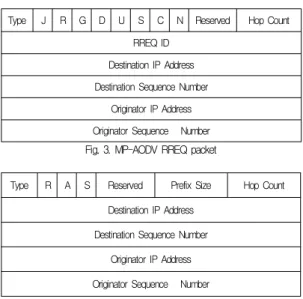
As shown in Figure 3 and Figure 4, we added an additional 1-bit flag ‘S’ to distinguish between packets in the main route (RREQ, RREP) and the backup route (RREQ_2, RREP_2). We also appended a flag ‘C’ to avoid overlapped link-disjoint routes, and a flag ‘N’ to identify a route as node-disjoint or link-disjoint.
Fig. 3. MP-AODV RREQ packet
Fig. 4. MP-AODV RREP packet
The MP-AODV protocol added 1-byte ‘route_flag’
and ‘source’ field to routing table for backup route discovery as shown in Figure 5. When the node receives the RREP packet, the source field in the routing table is used to store the address of the source node and route_flag field as the value ‘1’ to indicate the node to be used in the main route.
When the MP-AODV performs the backup route discovery process, if the route_flag is ‘1’ and the source field is same address as RREQ_2 packet, the protocol recognizes that the node is used in main route. So the MP-AODV generates the node-disjoint or link-disjoint route by using these routing table information.
Fig. 5. MP-AODV Routing Table
2. Route discovery
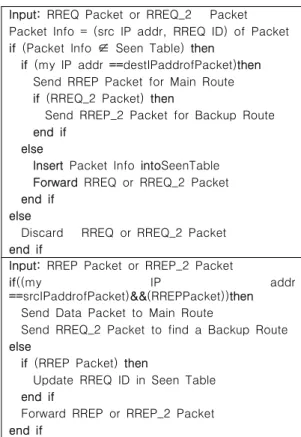
To establish a main route, a source node broadcasts an RREQ packet (with the RREQ ID value of one) to a destination node, similar to the conventional AODV protocol. The process is shown in Figure 6.
When intermediate nodes receive the RREQ packet, they store the RREQ ID value and information about the source node in the seen table.
A destination node transmits the RREP packet, which is sent back to the source node along the reverse path. Unlike a conventional AODV, intermediate nodes that receive the RREP packet increment the RREQ ID value in the Seen Table. By incrementing the RREQ ID value, the protocol ensures that a backup route will not use any nodes that belong to the main route.
When a source node receives the RREP packet, the main route is established, and the source node starts data transmission and broadcasts the RREQ_2 packet (a packet with a RREQ ID value of two) for simultaneously searching for a backup route.
Input: RREQ Packet or RREQ_2 Packet Packet Info = (src IP addr, RREQ ID) of Packet if (Packet Info ∉ Seen Table) then
if (my IP addr ==destIPaddrofPacket)then Send RREP Packet for Main Route if (RREQ_2 Packet) then
Send RREP_2 Packet for Backup Route end if
else
Insert Packet Info intoSeenTable Forward RREQ or RREQ_2 Packet end if
else
Discard RREQ or RREQ_2 Packet end if
Input: RREP Packet or RREP_2 Packet
if((my IP addr
==srcIPaddrofPacket)&&(RREPPacket))then Send Data Packet to Main Route
Send RREQ_2 Packet to find a Backup Route else
if (RREP Packet) then
Update RREQ ID in Seen Table end if
Forward RREP or RREP_2 Packet end if
RREQ_2 is a packet for establishing a backup route, and its flag bit F is set to one.
Fig. 6. Algorithm for node-disjoint route discovery
When the RREQ_2 packet is delivered to an intermediate node, the RREQ ID value in the Seen Table is compared with the RREQ ID value in the RREQ_2 packet. If it is identical, the node discards the RREQ_2 packet. If not, the node forwards the RREQ_2 packet continuously. When a node belonging to the main route receives the RREP packet, the RREQ ID value in the RREQ_2 packet and the RREQ ID value in the Seen Table are identical because the protocol has already increased the RREQ ID value in the Seen Table during the previous route discovery process. After this process, the intermediate nodes belonging to the main route do not join in the backup routes. Therefore, the network has node-disjoint routes between the source and destination. After the RREQ_2 packet reaches the destination node, the destination node sends the RREP_2 packet (with flag bit F set to one) back to
the source node. When the source node receives the RREP_2 packet, the backup route is established.
Unlike the main route discovery process, this protocol does not increase the RREQ ID value in the Seen Table of each node belonging to the backup route. Instead, the destination node retransmits the RREP packet to the source node to increment the RREQ ID value in the Seen Table of each node belonging to the main route. This means that nodes belonging to the main route always have a RREQ ID value one higher than nodes in the backup route.
If the node-disjoint route does not exist in the route discovery process, the MP-AODV approach finds the link-disjoint route. This is similar to the node-disjoint route. The difference is that the MP-AODV approach finds the backup route using flag ‘C’ of the RREQ packets. Then the protocol can discover the backup route that uses some nodes of the main route. Figure 7 shows the algorithm for the link-disjoint route discovery.
Input: RREQ_2 packet
Packet Info = (src IP addr, RREQ ID) of Packet if (Packet Info ∉ Seen Table) then
Insert Packet Info into Seen Table Set route_flag into Seen Table if (Route Entry == NULL) and
(my IP addr ≠ dest IP addr of Packet) then Set C_flag into Seen Table
else if (C flag == 1) then Unset C_flag into Seen Table end if
if(myIPaddr == dest IP addr of Packet) then Send RREP_2 Packet
else
Forward RREQ_2 Packet with C_flag end if
end if
Fig. 7. Algorithm for link-disjoint route discovery
For finding the secondary path, the MP-AODV sends more control packets such as RREQ, RREP than exist algorithm. But control packets are very small size packet compared to the data packets. So it does not degrade the network performance as shown in experimental results.
3. Route maintenance
When the main route or backup route fails, The MP-AODV protocol performs route maintenance process. RERR packet is used to notify the link failure to source node. As shown in Figure 4, we defined ‘route_flag’ field for the source node to distinguish between main and backup routes. A value of zero for ‘route_flag’ indicates the main route, and a value of one indicates the backup route.
When the source node receives the RERR packet it checks the ‘route_flag’ in the routing table and determines whether it belongs to the main or backup route.
When the RERR packet is sent back to the source node, if ‘route_flag’ is zero, the main route failure is detected. After receiving the RERR packet, the source node starts data transmission through the backup route and initiates the route discovery process. Unlike in the conventional AODV protocol, the RREQ ID value is increased by two when the source node sends the RREQ packet for initiating the route discovery process, because nodes of the broken main route always have RREQ ID values one higher than nodes of the backup route. On the other hand, if the backup route is disconnected, then the source node finds the backup route in background mode.
Unlike the original AODV, the multipath routing scheme has a problem. When the different source performs the route discovery for the same destination, the intermediate node overwrites the routing information with the information given by the new route request packet. At this point, the existing route may lose node-disjoint or link-disjoint characteristics of multipath.
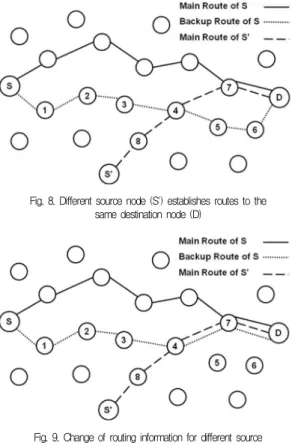
Figure 8 shows the manner in which the route is maintained when a new source node S’ performs the route discovery process to the same destination node D as the destination node of source node S (when a route has already been established between source node S and destination node D).
Fig. 8. Different source node (S') establishes routes to the same destination node (D)
Fig. 9. Change of routing information for different source node (S')
As shown in Figure 9, a conventional backup route (S→1→2→3→4→5→6→D) between S and D is disconnected by the recently established main route (S'→8→4→7→D) between S' and D.
The backup route (S→1→2→3→4→7→D) will be established between S and D. In this instance, node 7 will cause the node-disjoint property to be broken between the main and backup routes from S to D.
To solve this problem, the MP-AODV approach modifies the routing table of the conventional AODV protocol and uses a ‘source’ field as shown in Figure 5, which comprises the recorded information about the source node. Using this field, each pair has different routes even if the destination node for different source nodes is the same. Thus the MP-AODV maintains the node-disjoint or link-disjoint routes to destination node.
IV. Performance Evaluation
1. Experiment environment
In this paper, we developed the source code for the MP-AODV protocol based on the AODV protocol and evaluated the performance of the MP-AODV approach using the Qualnet simulator.
Our simulation modeled a network of 50 nodes placed randomly with a uniform distribution within a 1500 ´ 1500 meter area. The random waypoint mobility model was used. Each node randomly selects a new position and moves towards that location with a speed between 0 and 5 m/s, respectively. Once nodes reach the position, they become stationary for a pre-defined time then move another position. This pause time value varies from 100s to 500s. The whole process continues until the end of simulation. Simulations were performed over 500 seconds of data transmission. The source and destination node pairs were selected randomly over the network. Traffic was modeled using constant-bit-rate (CBR) sources with 512-byte data packets and a traffic rate of five packets per second.
We compared the simulation results of AODV and AOMDV protocols with three modes of the MP-AODV protocol (link-disjoint, node-disjoint and hybrid). Each simulation was performed 20 times, and averages were calculated.
2. Results and analysis
Measurements from the experiment comprise the successful data transmission rate from source to destination nodes, the data transmission delay times from source to destination nodes, and the control packet overhead for route discovery and route maintenance. Successful packet transmission rates indicate that the destination node received all packets sent from the source node, and can be computed using the following expression.
100 packet data ng transmitti of
numbers total
packet arrival of numbers
rate success on transmissi packet
´
=
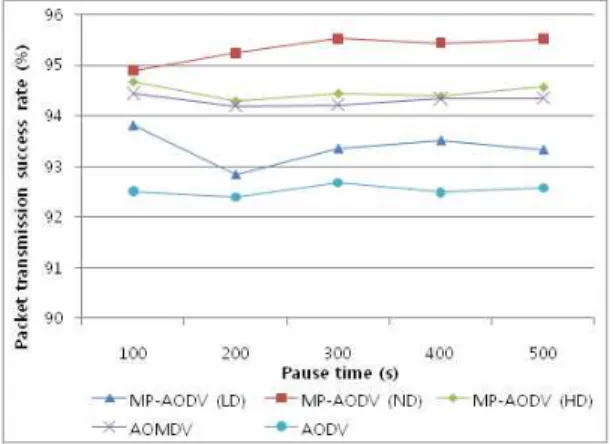
Figure 10 shows the packet transmission success rate from a variety of wireless ad hoc network protocols. Depending on the pause time of each node, the packet transmission success rate was measured. The longer pause time is proportional to network reliability So the node-disjoint MP-AODV protocol provides higher transmission success rate than the other protocols. In contrast, the link-disjoint MP-AODV protocol experiences more frequent route failures than the other protocols, and its performance is not good. But the hybrid mode and link-disjoint mode shows a low end-to-end delay to support user network service considering higher mobility of MANET.
Fig. 10. Comparison of success rate of packet transmission
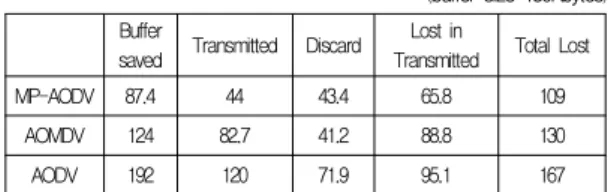
Table 1 shows the average number of data packet losses in wireless ad hoc networks. If the route does not exist when the source node wants to transmit data packets, packets are stored in a buffer while waiting for a route to be created to the destination node. Buffer saved packets transmitted after establishing backup route. But some packets are discarded in buffer because of buffer size or packet’s lifetime. In general, multipath routing has fewer packets that are stored in the buffer compared with single-path routing schemes such as AODV. This
Buffer
saved Transmitted Discard Lost in
Transmitted Total Lost
MP-AODV 87.4 44 43.4 65.8 109
AOMDV 124 82.7 41.2 88.8 130
AODV 192 120 71.9 95.1 167
means that multipath routing protocols have more available routes from source to destination than single-path routing schemes.
Table 1. Number of data packet losses
(buffer size=150Kbytes)
In addition, MP-AODV protocols have more efficient than AOMDV protocol. The AOMDV protocol has three routes at first, but the AOMDV performs route recovery after all that routes are broken. In MANET, the network topology continuously changed, AOMDV has more buffer saved packets because of frequent link failure. This means that buffer saved packets grows overall end-to-end delays and degrades network performance.
In contrast, when the backup route fails in MP-AODV protocols, MP-AODV performs the route discovery process in background mode and continues to maintain multiple routes. In addition, the node-disjoint MP-AODV protocol shows good path-retention rates compared with the link-disjoint and hybrid MP-AODV protocols. This means that network performance is affected depending on the number of the disjoint nodes in wireless ad hoc networks.
Fig. 11. Comparison of end-to-end delay time
When the route fails in the AODV protocol, the protocol performs the route discovery process again.
But multipath routing protocols generally have more than two routes; even if the main route is broken, the source node can transmit data packets through the backup route immediately. Therefore, multipath routing protocols have lower delay times because protocols do not need to wait for the route to be reinitiated.
As shown in Figure 11, the hybrid MP-AODV protocol is better than other protocols in end-to-end delay. When a node-disjoint route does not exist in the route discovery process, the hybrid MP-AODV protocol finds link-disjoint routes to maintain multiple routes. Therefore, the hybrid MP-AODV protocol provides lower end-to-end delay than AODV, AOMDV, link-disjoint MP-AODV, and the node-disjoint MP-AODV protocols.
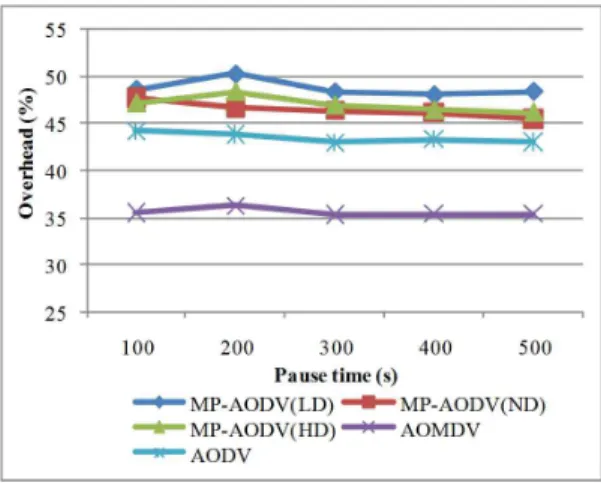
As shown in Figure 12, routing overheads can be computed using the following expression:
100 packets data packets control
packets control overhead
routing ´
+
=
Control packets such as RREQ and RREP packets are used for establishing routes. Data packets indicate the actual packets used for data transmission. Overall, the mobility of the network increases, the routing overhead increases. But routing overhead does not grow rapidly because MP-AODV does not find new route during the path discovery process.
The AOMDV protocol has the lowest routing overhead because it can find multiple routes in the route discovery process and does not find any route until all other routes fail. Our proposed MP-AODV protocol has higher routing overhead than AODV or AOMDV protocols because it floods RREQ packets within the network twice to establish two routes, and sends additional RREP packets for backup route. However, MP-AODV has more reliable alternative path than AOMDV or AODV. So MP-AODV can more reliable data communication than other protocols.
Fig. 12. Comparison of routing overhead in wireless ad-hoc network
Finally, we analyzed the routing overhead in various traffic types by measuring the number of transmitted packets and control packets. With 200s pause time, we increased data packet length gradually from 512byte to 16kbyte. In the experimental results AOMDV has lower routing overhead than other routing protocols in sending small data. But as the data size increases, the gap of overhead between our MP-AODV and AOMDV protocol decreases. It means that the routing overhead of MP-AODV becomes insignificant in sending larger data.
Fig. 13. Comparison of routing overhead in various traffics
IV. Conclusion
In this paper, we proposed a new multipath routing protocol based on the AODV protocol for
MANETs. We implemented the AODV and AOMDV protocols for comparison with our MP-AODV protocol, and evaluated these multipath routing protocols using the Qualnet simulator.
The MP-AODV protocol is composed of three suites in the routing module. The MP-AODV uses two node-disjoint or link-disjoint routes between a source node and a destination node to solve the transmission delay problem caused by node failures.
In addition, the MP-AODV protocol sends the data immediately after the main route has been found, by separating the main route and backup route discovery processes to reduce data transmission delays. Moreover, after discovering the multiple routes, the protocol always maintains two routes using the route maintenance process. Even if one route is broken, the MP-AODV can maintain a connection through the other route and perform the route discovery process in background mode.
Also MP-AODV can operate in a hybrid mode between node-disjoint and link-disjoint modes, where it finds the node-disjoint backup route first, and then finds again the link-disjoint backup route from the main route if the node-disjoint route does not exist. Therefore, the MP-AODV approach is more efficient than AODV or AOMDV approaches for MANETs with highly mobile nodes.
We compared the MP-AODV approach with conventional AODV and AOMDV protocols in various scenarios. The simulation results showed that the node-disjoint MP-AODV protocol has a higher packet transmission success rate than AODV and AOMDV approaches. The hybrid MP-AODV also reduces the end-to-end delays compared with the other approaches. On the other hand, compared to other protocols, the MP-AODV protocol has a slightly higher routing overhead. However in large data communication , such as video/audio streaming, the routing overhead of MP-AODV becomes insignificant.
Using the route discovery and maintenance processes of the MP-AODV protocol, networks can
Yun-Sung Lee
2006 : Pusan National University B.S. degree in Computer Science Engineering 2006 : Pusan National University
M.S. degree in Computer Science Engineering Current : Pusan National University
currently doctoral candidate in Computer Science Engineering
Email : [email protected] guarantee successful data transmission. In addition,
because two routes are always maintained, the MP-AODV protocol reduces the delay time between source node and destination node.
References
[1] C. Perkins, EM Royer, and S. Das, "Ad hoc On-Demand Distance Vector (AODV) Routing".
IETF RFC 3561, 2003.
[2] Mahesh K. Marina and Samir R. Das, "On-demand Multiple Distance Vector Routing in Ad Hoc Networks", In Proceedings of the International Conference for Network Protocol, 2001.
[3] Sung-Ju Lee and Mario Gerla, "AODV-BR: Backup Routing in Ad hoc Networks", In Wireless Communications and Networking Conference(IEEE WCNC), Volume 3, pp1311-1316, 2000.
[4] Zheniqiang Ye, Strikanth V. Krishnamurthy and Satish K. Tripathi, "A Framework for Reliable Routing in Mobile Ad Hoc Networks", IEEE INFOCOM 2003, 2003.
[5] Ian F. Akyildiza, Xudong Wangb, and Weilin Wangb,
"Wireless mesh networks: a survey. Computer Networks", Volume 47, Issue 4, pp445-487, March 2005.
[6] Jack Tsai and Tim Moors, "A review of multipath routing protocols: from wireless ad hoc to mesh networks", In Proceedings of ACoRN Early Career Researcher Workshop on Wireless Multihop Networking, July 2006.
[7] Stephen Mueller, Rose P. Tsang, and Dipak Ghosal, "Multipath routing in mobile ad hoc networks: issues and challenges", MCi Calzarossa, E. Gelenbe (Eds.), Lecture Notes in Computer Science, 2004.
[8] MTToussaint, "Multipath Routing in Mobile Ad Hoc Networks", TU-Delft/TNO Traineeship Report.
[9] Georgios Parissidis, Vincent Lenders, Martin May, and Bernhard Plattner, "Multi-path Routing Protocols in Wireless Mobile Ad Hoc Networks: A Quantitative Comparison.", LNCS 4003, pp313-326, NEW2AN 2006.
[10] SN Technologies – Available, Qualnet, HTTP:
http://www.scalable-networks.com .
[11] Chu-Hsing Lin, Fuu-Cheng Jiang, and Jen-Chieh Chang, "Node-disjoint Alternative Dual-path Routing for Data Salvation in Mobile Ad hoc Networks", In Proceedings of Ninth International Conference on Parallel and Distributed Computing, Applications and Technologies, 2008.
[12] Sudipto Das, Rajesh Roy, and Pradip K. Das,
"Optimizations To Multipath Routing Protocols In Mobile Ad hoc", In Proceedings of International Conference on Emerging Applications of IT, EAIT2006.
[13] Tae-hoon Kim, Sang-hwa Chung, Soo-young Kang, and Young-hwan Yoo, "AODV based Node-disjoint Multipath Routing Protocol in Mobile Ad hoc Network", KICS, Vol 34., No.
12., pp. 1371-1379, December 2009.
Authors
Sang-Hwa Chung
1985 : Seoul National University B.S. degree in Electrical Engineering
1988 : Iowa State University, US M.S. degree in Computer Engineering 1993 : University of Southern
Califonia Ph.D. degree in Computer Engineering Current : Pusan National University
Professor in the Computer Engineering Department Email : [email protected]