논문 2011-48TC-2-8
MANET환경에서 적용 가능한 복합적 다중 라우팅 기술
( Hybrid Multipath Routing in Mobile Ad Hoc Networks )
Ninh Khanhchi
*, 정 수 환
***( Khanhchi Ninh and Souhwan Jung )
요 약
VANET 응용 중 가장 중요한 한 가지는 긴급 메시지를 전송하여 적극적인 안전을 제공하는 것이다. 메시지를 받은 아무 노드나 재방송하게 되는 플러딩 기반 방송 방식의 브로드캐스트 스톰을 방지하기 위해, 기존의 프로토콜들은 중계노드의 수를 제한하기 위한 다른 방법을 사용한다. 하지만 기존의 프로토콜들은 높은 트래픽 밀도와 메시지 오버헤드를 발생시킴에도 볼구하고 낮은 전달 율을 가진다. 현재, 글로벌 위치확인 시스템(GPS)을 내장하고 레이더를 갖춘 차량 수의 극적인 증가는 이전에 볼수 없던 새로운 응용 시나리오를 만들었다. 따라서 우리는 GPS위치정보와 레이더를 사용한 인근 차량 감지를 기반으로 중계노드를 선택하는 브로 드캐스팅 프로토콜을 제안한다. 시뮬레이션 결과에서는 제안하는 프로토콜이 기존의 기법들보다 나은 성능을 가짐을 볼 수 있다.
Abstract
One of the most important VANET applications is providing active safety by broadcasting emergency messages. In order to prevent broadcast storm of flooding-based broadcasting scheme in which any node receiving message will rebroadcast, the existing protocols use the different methods to limit the number of relay nodes. Nevertheless, the existing protocols have low delivery ratio with high traffic density and cause message overhead. Currently, the dramatic increase in the number of vehicles equipped with Global Positioning System (GPS) and onboard radar created new application scenarios that were not feasible before. Consequently, we proposed a broadcasting protocol that selects relay node by using GPS-based position information and detecting neighboring vehicles with the help of onboard radar to. Simulation results show that our proposed protocol has better performance than the existing schemes.
Keywords : Vehicular Ad Hoc Networks; Broadcast; Global Positioning System; onboard radar.
Ⅰ. Introduction
A mobile ad hoc network (MANET) is an autonomous system of multi-hop, wireless mobile nodes that do not require base stations or any fixed
*
정회원,
**평생회원-교신저자, 숭실대학교 정보통신 전자공학부
(School of electronic Engineering, Soongsil University)
※ 이 논문은 2010년도 정부(교육과학기술부)의 재원으 로 한국연구재단의 지원을 받아 수행된 기초연구사 업임(No.2010-0000100)
접수일자: 2010년9월17일, 수정완료일: 2011년2월17일
infrastructure. It is characterized by dynamic topology, bandwidth-constraint, variable capacity link, energy constrained operation and limited physical security[1]. Hence, designing an efficient routing protocol for MANET is a crucial but challenging task.
There are a lot of unipath routing protocols have been proposed for MANET. The two most widely studied on-demand ad hoc routing protocols, Dynamic Source Routing (DSR)[2] and Ad hoc On-Demand Distance Vector (AODV)[3], discover routes via a flooding technique, where source (or any node
seeking the route) floods the entire network with a query packet in search of a route to the destination.
However, study in [4] shows that using a unipath may not be a good choice for MANET. When a unipath is used, the route may break due to the movement of node. Particularly, when multiple connections are set up in a network, the wireless links located at the center of the network carry more traffic and can, therefore, get congested. Moreover, the use of a unipath may cause latency because of the route re-discovery when a link is broken. Thus, multipath routing protocols have been suggested to overcome the drawbacks of unipath routing counterparts. The main purposes of multipath routing protocols are to improve delay, provide reliability, reduce overhead, and ensure load balancing as well as improve Quality of Service (QoS) of MANETs.
In this paper, we propose Hybrid Multipath Routing (HMR) scheme which establishes and utilizes multiple routes to improve the end-to-end delay and ensure the stability of routing performance. We apply the concept of source routing in DSR protocol to our scheme.
The remainder of the paper is organized as follows.
Section Ⅱ gives a brief review of disjoint and non-disjoint multipaht routing protocols.. Section Ⅲ presents the hybrid multipath model analysis and operation of the proposed scheme in detail. The simulation and results of performance analysis are described in Section Ⅳ. Finally, section V concludes the paper.
Ⅱ. Disjoint and Non-disjoint multipath routing protocols
Over the last few years, there have been a lot of works on multipath routing in MANET[10]. Finding multiple paths between a source and a destination in a single discovery may make the performance of the network more stable and more efficient. Recently, several different multipath routing protocols based on DSR and AODV have been proposed. Split Multipath
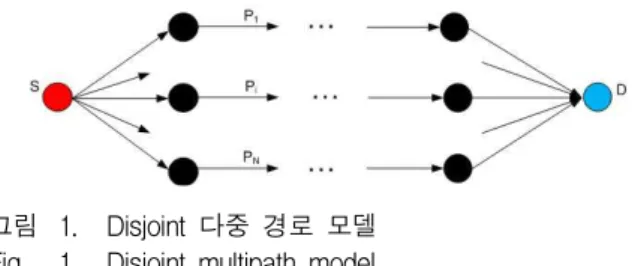
그림 1. Disjoint 다중 경로 모델 Fig. 1. Disjoint multipath model.
Routing (SMR)[5], Multipath Source Routing (MSR)[6], and Shortest Multipath Source Routing SMS[12] have been proposed by modifying DSR protocol, whereas Multipath AODV (AODVM)[7] and Node Disjoint- Multipath Routing (NDMR)[8] are AODV-based protocols. Besides, other schemes have also been introduced based on topology information such as Neighbor-Table-Based Multipath Routing NTBMR[9].
SMR is proposed by Lee and Gerla. Originated from DSR, SMR provides multiple routes which help minimize route recovery process and control message overhead by establishing and utilizing multiple routes of maximally disjoint paths. Meanwhile, modified and extended from AODV, Li and Cuthbert proposed NDMR.
NDMR uses a route discovery mechanism to find the shortest routing hops of loop-free paths with disjoint paths. These two routing protocols are based on the same disjoint multipath model as shown in Fig. 1.
However, recent studies in [9], [11] show that non-disjoint multipath model as indicated in Fig. 2 provides more substantial performance advantage and has higher route reliability when the wireless links are unrealizable. Besides, disjoint multipath equips only the source with alternate routes. This may cause the temporary loss of route for the data packets that are already in transit upstream from the failed link.
Distinguished from two disjoint multipath protocols mentioned above, SMS and NTBMR do not require the multiple routes to be disjoint. Extended from DSR,
그림 2. Non-disjoint 다중 경로 모델 Fig. 2. Non-disjoint multipath model.
SMS uses non-disjoint multipath model to build multiple paths that are shortest. The limitation of this approach is that the source node has to re-discover when the link breakage occurs at intermediate nodes.
This disadvantage may affect the performance of network in term of delay.
In NTBMR, every station maintains one neighbor table which stores its k-hop neighbor stations.
However, the disadvantage of NTBMR is that a special control message is used to create a neighbor table. The special messages used in a multipath routing can overwhelm the network, especially when the network is composed of a large number of nodes.
Therefore, the objective of this paper is to design a routing protocol which uses hybrid multipath model to overcome the drawbacks of existing multipath routing protocols.
Ⅲ. Hybrid multipath routing protocol
1. Hybrid multipath model
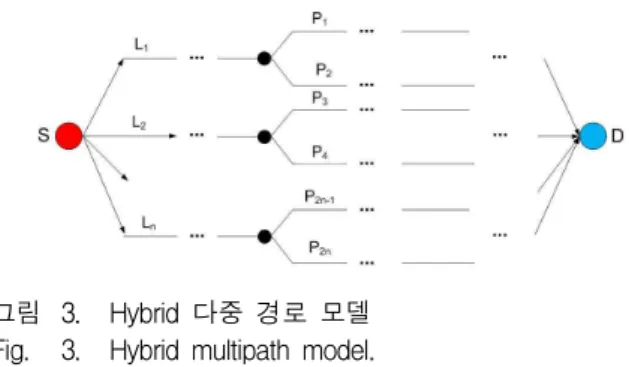
In this section, we propose a hybrid multipath model to multipath routing. In this model, we focus on reducing the frequency of query floods by exploring multiple routes from a single flooded query in order to avoid the overhead as well as reduce the end to end delay for re-discovery.
Combining disjoint and non-disjoint multipath models, the hybrid multipath model is depicted by a sequence of link groups
. In this model, there is neither common link nor common node among link groups. Each group
has a set of links
with the same hop-count and has a common node as an alternative node. In which, the links in group
have the same least hop-count m inand those in other groups
have the same hop-count
min
min
min
, respectively.Referring to Fig. 3, the source uses the first path
in group
as primary route for transmitting data packet to destination D until link breaks at
. When a link on
breaks, the common intermediate node그림 3. Hybrid 다중 경로 모델 Fig. 3. Hybrid multipath model.
will be played as an alternative node in order to switch to the alternative route
. In case the breakage occurs at
, the source node S has a responsibility for selecting the links on group
for transmitting continuously. This process continues until all links
and alternative paths
are broken.2. Analytic modeling
Let us consider the multiple routes from S to D where
denotes the event that the link
fails and
denotes the event that a link on path
fails. Let T represents the time between successive route discoveries. The new route discovery will be initiated only when all intermediate nodes lose their downstream links and alternative routes are broken from the source node. The time until the next route discovery T is the time until the event E is true, where E is described by the following logical expression
(1)
We represent the lifetime of a wireless link between a pair of nodes by an exponential random variable with mean l by taking the same assumptions as in [11]. Let
and
be exponential random variables representing the lifetime of routes
and
, respectively. Then T can be expressed as
maxmin max
min max
min max
(2)
Let us denote the random variable
max
by
. Following equation (3) in [11], the probability density function (pdf) of
is derived as
(3)
where,
in which is the length of both routes
and
.From equation (4) in [11], the cumulative distribution function (cdf) of
,
, is obtained as
·
(4)
The pdf and cdf of the exponential random variable
, representing the lifetime of route
consisting of wireless links, are respectively given by
(5)
(6)
where .
Let us denote the random variable
min
. Following equation (12) in [11], the pdf of
, , is expressed as
(7)
Substituting equations (3)-(6) into (7), the pdf of
is obtained as
(8)
where . m in
Derived similarly as equation (12) in [11], the pdf of
max
is obtained as
≠
(9)
where
is the cdf of
.3. Numerical results
In this section we evaluate the expected time interval between successive route discoveries of hybrid routing model by using the numerical technical. In this model the performance is dependent on three factors:
the number of group n, the length of primary route k and the position of common nodes. The mean life of a single link (
l
) is assumed to be 5. Also, we assume that the number of selected groups is assigned to n=2 and the position of common nodes is changed in each group
and
as followed:
(10)
where
The expected time interval between successive route discoveries is evaluated with different lengths of primary route (k=3,…,7) and with two different cases of the position of common nodes:
Case 1: The position of common node is closest to the source node.
(11)
Case 2: The position of common node is farthest to the source node.
(12)
Fig. 4. shows the performances of hybrid protocol in two cases with different lengths of primary route in comparison with those of single path protocol.Results indicate that our proposed protocol is superior to single path protocol. To compare the relative performances of disjoin, non-disjoint and our hybrid protocols, we take the results in the best case scenario for each of these protocols. The results of disjoin and non-disjoint protocols are taken from [11].
The performance of non-disjoint protocol only depends on the length of primary route.
As the results shown in Fig. 5, the routing using the hybrid multipath model always performs substantially
그림 4. 두 가지 경우의 Hybrid 프로토콜과 단일 경로 프로토콜 간의 성능 비교
Fig. 4. Performance of hybrid protocol in two cases is compared with the single path protocol.
그림 5. 세 종류의 다중 경로 프로토콜에서 예상되는 경로 탐색 시간 비교
Fig. 5. Comparison the expected time interval between route discoveries among the three variations of the multipath protocol.
better than that of the disjoint and non-disjoint multipath model. Therefore, we propose the hybrid multipath model for establishing the multipath routing of our scheme.
4. Hybrid Multipath Routing (HMR)
In this section, we present the operation of HMR routing protocol in detail. This proposed scheme is an on-demand routing protocol. When the source needs a route to the destination but no route information is available, it floods the RREQ messages over the entire network. HMR routing protocol constructs partial link-disjoint multiple routes to reduce end-to-end delay and packet loss. To gain this, the destination node has to know information of all available routes in order to select the desired ones.
Based on DSR, this scheme uses source routing
approach where the information of the nodes that constitute the route is included in the RREQ packet.
To archive the desired routes, the intermediate nodes are not allowed to send RREPs back to the source node even when they have route information to the destination. Instead, the destination node will send RREPs back to source node after choosing the best paths.
(1) Route discovery
A source initiates route discovery by flooding the network using query message for seeking a route to the destination. Each query message carries the sequence of hops it passed through in the message header. We assume that the first query reaching the destination is usually defined the shortest route between the source and the destination with the least hop-count. After the first query reaches the destination, the destination waits a certain duration of time to receive more RREQs and learn some possible routes for path selection process.
There are two phases in route discovery:
• Grouped-disjoint paths selection:
Due to using source routing approach, each node maintains a route cache, where complete routes to desired destination are stored. In route cache of destination, it stores all complete routes as possible in the certain duration of time. In the next step, the destination clusters the grouped-disjoint path base on the number of hop-count. The first group is chosen with the links has same the least hop-counts
min of the first path . Then the others group , ... with hop-count
min
,
min
... are clustered with same hop-count in each group.• The common node selection:
The second phase is the common node selection that only selects the routes which has the best common node in each group. As the results show in Fig. 4, the closer the position of common node to the source node, the better the routing performance performs. This common node plays an alternative
node to change the route to destination when occurring link broken. By this way, HMR can reduce not only the period of time for transmitting but also the packet loss. In our scheme, the destination is responsible for selecting and recording the desired routes as mentioned above. This can be archived because the destination knows the entire path information of routes. We limit the number of routes selected to two in each group and also two groups are chosen.
After finishing the path selection, the destination node sends RREPs to the source via the routes selected. As the source receives first RREP, it starts the data packet transmission. Also, the source records other routes to use when link breakage occurs. The first path is selected as a primary route and others are the alternative routes.
(2) Route maintenance
Due to the mobility, congestion or packet collision, a link of a route can be disconnected. In HMR, when the primary route breaks, the intermediate node detects the failure and sends a Route Error (RERR) packet back to the reverse direction of the route until it encounters the common node for switching the data to the destination.
In the worst case, all routes in the first group G1 break, the RERR packet is sent back to the source.
Then the source decides to selects one of paths in group G2 for re-transmission. However, when all routes of the session are broken, the source needs to initiate the route recovery process to update new route information.
Ⅳ. Performance evaluation
In this section, the performance of the proposed scheme is shown in the following simulation results.
We implemented the simulation using the simulator NS-2[13]. Our simulation modeled a network of 50 mobile nodes randomly placed within a 1000m x 1000m area for 500 seconds of simulation time. We
assume that every node has the capability to transmit and receive radio signal in a radius of 250 meters.
IEEE 802.11 MAC and physical protocols are adopted and the channel bit rate is 2 Mbps. The mobility model is the random waypoint model[14] which is used to simulate node movement. In our simulation, the minimum and the maximum speed were set constant to zero and 25 m/s, respectively. The packet size is set to 512 bytes and sending rate is set to 10 packets per second. We change the velocity of each node movement to investigate the performance influence of different mobility.
In performance evaluation, we choose the following metrics:
• Packet delivery ratio: the number of packets received by the destination divided by the number of packets originated by the source
• End-to-end delay: the time a source node attempts to send a packet to the time the packet arrives at the destination
We use DSR, NDMR and SMS as the reference routing protocols for comparing the performance results with proposed scheme. We collect the results at constant speeds of 5, 10, 15, 20 and 25 m/s.
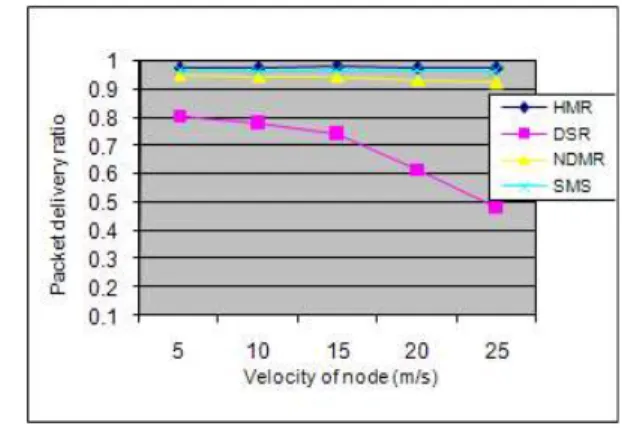
Fig. 6 shows the packet delivery ratio of proposed scheme, DSR, NDMR and SMS. It shows the packet delivery ratio of proposed scheme outperforms the others as the speed of node movement increases. It
그림 6. 패킷 전달 비율 Fig. 6. Packet delivery ratios.
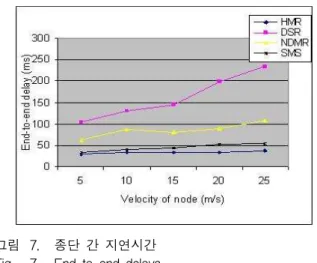
그림 7. 종단 간 지연시간 Fig. 7. End-to-end delays.
means that the number of packet received by destination of proposed scheme is highest. Obviously, the packet delivery ratio decreases dramatically in DSR at higher speeds. Fig. 6 shows DSR drops by 50% drop. The reason is that in DSR, only one route is used for each session and when that route is invalidated, the source uses the cached route that is learned from overhearing packets. If no such cached route is available, it sends a RREQ to discover a new route. Many data packets are dropped during this process and also more delay is needed to re-discover correct routes as showed in Fig. 7.
Also, Fig. 6 presents that the proposed scheme has packet delivery ratio higher than that of NDMR. In mobility scenario, the node movement is random; the proposed scheme uses multiple routes with the best common node as alternate route instead of using source node in NDMR when the link breakage is detected. Because NDMR use source node as alternative node, this can cause a temporary loss of route for the data packets that are already in transit upstream from the failed link. Thus, this makes the number of packet received by destination in proposed scheme is higher than one in NDMR. Also, it takes longer time for retransmitting in NDMR.
These figures also show that the performance of our proposed scheme outperforms SMS routing protocol when the velocity of node speeds up. In SMS the intermediate nodes are responsible for selecting the route for data transmission when the
link breakage occurs. However, it may not always be possible for all intermediate nodes get the desired alternative routes followed the SMS routing algorithm. Also, in worst case that the mobility happens in some intermediate nodes, the source node has to re-initiate the route discovery. While in HMR not only the common node in each link group but also the source node has responsibility for altering the alternative path when occurring of the failed link.
If the link fails at the common node, the source node will select another route in another group to transmit data continuously. Thus, the performance of our proposed scheme is more stable.
V. Conclusions
In this paper, we present an efficient on-demand routing protocol HMR which is the multipath routing algorithm using hybrid multipath model to improve the latency and packet loss as well as reduce the control overhead for re-discovery. In HMR, the multiple routes are established by selecting the routes that have a best common node with the same shortest path in each link group. The route is maintained by both the best common node and the source node, so it makes ensure the stability of routing performance.
Besides, our study indicates that HMR outperforms the DSR, NDMR and SMR because using the hybrid multiple model provides robustness to mobility. The simulation results show that HMR has a high packet delivery ratio and low end-to-end delay. Therefore, HMR is an efficient routing protocol and suitable for mobile ad hoc networks.
References
[1] M.S. Corson and J. Macker, “Mobile ad hoc networking (MANET): Routing protocol performance issues and evaluation consideration,
”IETF, RFC 2501 January 1999.
[2] J. Broch, D.B. Johnson, and D.A Maltz, “The Dynamic Source Routing for Mobile ad hoc
networks,” IETF Internet-draft, draft-ietf- manet-dsr-00.txt, 1998.
[3] C. Perkins, “Ad Hoc On-Demand Distance Vector routing,” IETF Internet-draft, draft-ietf- manet-aodv-00.txt, 1997.
[4] C. Chen, W. Wu and Z. Li, “Multipath Routing Modeling in Ad hoc networks,” in Proc. ICC 2005, Vol.5, May 2005.
[5] S.J. Lee and M. Gerla, “Split Multipath Routing with Maximally Disjoint Paths in Ad hoc networks,” in Proc. ICC 2001, pp. 3021-3205, June 2001.
[6] L. Wang, L. Zhang, Y. Shu and Dong
“Multipath source routing in wireless ad hoc networks,” in Proc. Canadian Conference on Electrical and Computer Engineering, Vol. 1, pp.
479-483, 2000.
[7] Z. Ye, S.V. Krishnamurthy and S.K. Tripathi, “A framework for reliable routing in mobile ad hoc networks,” in Proc. of the twenty-Second Annual Joint Conference of the IEEE Computer and Communications Societies (INFOCOM), Vol.
1, pp. 270-280, 2003.
[8] X. Li and L. Cuthbert, “Stable node-disjoin multipath routing with low overhead in mobile ad hoc networks,” in Proc. of the IEEE Computer Society’s 12th Annual International Symposium on Modeling, Analysis, and Simulation of Computer and Telecommunications Systems (MASCOTS2004), pp.184–191, October 2004.
[9] Z. Yao, J. Jiang, P. Fan, Z. Cao, and V.O.K Li,
“A Neighbor-Table-Based multipath routing in ad hoc networks,” in Proc. The 57th IEEE Semiannual Vehicular Technology Conference, Vol. 3, pp. 1739-1743, April 2003.
[10] T. Mohammed, E. Kemal, A. Sasan, and E.
Shervin., “Survey of multipath routing protocols for mobile ad hoc networks,” Jounal of Network and Computer Applications, Vol. 32, No. 6, pp.
1125-1143, November 2009.
[11] A. Nasipuri and S.R. Das, “On-Demand Multipath Routing for Mobile Ad hoc Networks,”
in Proc. of the 8th International Conference on Computer Communications and Networks (1999), Boston, pp. 64-70, October 1999.
[12] Z. Haseeb, H. David, A. Ivan, and A. Mahmood
“SMS: Shortest Multipath Source Routing for Mobile Ad hoc Networks,” in Proc. ICSPC 2007, November 2007.
[13] The VNIT Project, The Network Simulator –
NS-2, http://www.isi.edu/nsnam/ns/
[14] C. Bettstetter, G. Resta, P. Santi, “The Node Distribution of RWP Model for Wireless Ad Hoc Networks,” IEEE transactions on Mobile Computing, Vol. 2, No. 3, July-September 2003.
저 자 소 개
Ninh Khanhchi
(정회원) 2006년 Danang University ofTechnology Engineer of Information Engineering Technology
2008년∼현재 숭실대학교 정보 통신공학과 석사과정
<주관심분야 : 이동 네트워크 보안, 차량 네트워 크 보안>
정 수 환
(평생회원)-교신저자 1985년 서울대학교 전자공학과학사
1987년 서울대학교 전자공학과 석사
1996년 University of Washington 박사 1996년∼1997년 Stellar One SW Engineer 1997년∼현재 숭실대학교 정보통신전자공학부
정교수
2009년∼현재 지식경제부 지식정보보안 PD
<주관심분야 : 이동 네트워크 보안, 차량 네트워 크 보안, VoIP 보안, RFID/USN 보안>