INTRODUCTION
Measuring body morphometric of fishes is a basic pro- cedure in fishery sciences, because fishery species can identify and/or compare specific species, populations and stocks via morphometric relationships(King, 1995; Froese, 1998). In fisheries studies, the allometric growth parame- ter(b) and form factor(a) of weight-length relationships (WLRs) have been applied in assessing fish stocks and populations(Ricker, 1968; Hilborn and Walters, 2001). For example, WLRs are useful to predict the average weight at a given length or age group and then convert length data into weights to provide a measure of biomass(or vice ver- sa)(Froese, 2006; Froese et al., 2011), because stock as- sessment models and management for fisheries require in- formation about body weight for estimation and regulation of catches(Froese et al., 2014) and weight-at-age(Petrakis and Stergiou, 1995). Fulton’s condition factor is widely
used to measure the health of marine organisms(i.e. fish well-being) and seasonal body condition of individual fish (Le Cren, 1951; Froese, 2006). This factor is based on the hypothesis that for a given length, heavier fishes are in bet- ter condition than lighter fishes, and thus fatness is used as a measure of fish health(Bagenal and Tesch, 1978).
Walleye pollock(or Alaska pollock) Gadus chalcogram- mus(Pallas, 1814) is a member of the family Gadidae and widely distributed in North Pacific Ocean(Froese and Pauly, 2019). The species is demersal and lives between depths of 50~500m in eastern Korean waters(Kim et al., 2004), and mainly consumed various semi-benthic fishes and invertebrates(e.g. Dwyer et al., 1987; Yamamura et al., 2002; Adams et al., 2007). In the East Sea, G. chalco- grammus showed a spring and summer migration from spawning grounds to foraging area, and a winter migration returning to spawning grounds, with water temperature mainly affecting the distributions and movements of pol- lock(Kotwicki et al., 2005), but the evidence for this pat- tern of migration is sparse in the eastern sea of Korea. In addition, G. chalcogrammus constituted among the most
—141 — http://www.fishkorea.or.kr
* Corresponding author: Joo Myun Park Tel: 82-54-780-5344, Fax: 82-54-780-5319, E-mail: [email protected]
ISSN: 1225-8598(Print), 2288-3371(Online). DOI: https://doi.org/10.35399/ISK.31.3.3
Accepted: July 17, 2019
Spawning Season, and Factors Influencing Allometric Growth Pattern and Body Condition of Walleye Pollock
Gadus chalcogrammus in the Middle East Sea, Korea
By Chung Il Lee, Moon Hee Han, Hae Kun Jung, Hyun Je Park and Joo Myun Park
1,*
Department of Marine Bioscience, Gangneung-Wonju National University, Gangneung 25457, Republic of Korea
1Dokdo Research Center, East Sea Research Institute, Korean Institute of Ocean Science & Technology, Uljin 36315, Republic of Korea
ABSTRACT This study presents data on spawning season, weight-length relationships(WLRs) and condition factor of Gadus chalcogrammus inhabiting the middle East Sea, Korea. Monthly changes in the gonadosomatic index(GSI) revealed that the spawning period was from December to March. Over- all value of the exponent b, estimated by nonlinear least squares from weight and length data was 2.806, ranging from 2.778 for female fishes to 2.985 for immature group. The b values were similar between spawning and non-spawning, and between female and male fishes, but it was significantly higher for immature than mature fishes. The condition factors were significantly higher for immature than mature groups, and during non-spawning than spawning periods, but it was not significant between male and female fishes.
Key words: Gadus chalcogrammus, GSI, weight-length relationship, condition factor, East Sea
important fisheries species in Korean waters(Kim et al., 2004) as well as throughout North Pacific countries(Beam- ish and McFarlane, 1995). However, pollock fishery stock had dramatically decreased since 1980s due to overfishing and climate change induced oceanographic changes, or interplay of those influences. Studies on fisheries ecology including reproduction and growth are crucial in applica- tion to fisheries management and conservation(e.g. Brit- ton and Pegg, 2011; Park et al., 2018), but a few is known regarding fishery ecology and biology for G. chalcogram- mus inhabiting Korean waters. This paper provides data of fisheries characteristics including spawning season, WLR parameters and condition factors for G. chalcogrammus inhabiting East Sea, Korea.
MATERIALS AND METHODS
1. Field samplings
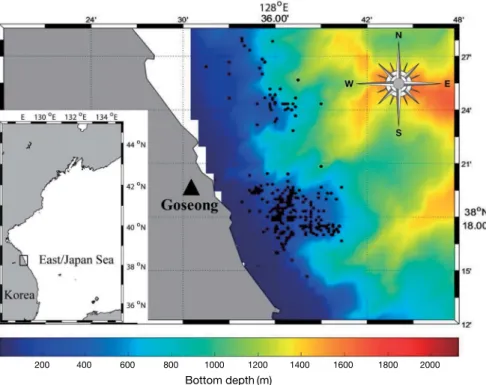
Fish specimens of 1,816 were collected in the middle East Sea, Korea at depths between 50~800m(Fig. 1).
Samplings were conducted monthly from August 2015 to January 2018, and fish samples were collected using pri- marily a bottom gillnet and occasionally demersal trawl (during summer season). Immediately after capture, indi- viduals were snap frozen, taken to the laboratory, and kept
frozen at -20°C until processing, which occurred imme- diately after thawing in the laboratory. Total length(TL) and whole-body weight(BW) were measured to the near- est millimeter and nearest gram, respectively using Verni- er calipers and electronic valance(Mettler Toledo ME204, USA). The peritoneum of each fish specimen was excised, and the gonads were removed and weighed to the nearest 0.001g(GW). Sex was determined macro- or microscop- ically by examining gonads via binocular microscope (Kern OZP-5, Germany). Fish maturity was estimated by plotting gonadosomatic index(GSI) values of male and female against their TL(Fig. 2). The TL with a dramatic increase in GSI was considered to be the minimum matu-
200 400 600 800 1000 1200 1400 1600 1800 2000 Bottom depth(m)
Fig. 1. Location of sampling area in the middle East Sea, Korea. Samples were collected along the shore lines within boxed area. The data of col- or depth contour were obtained from Korea Hydrographic and Oceanographic Agency(http://www.khoa.go.kr).
Fig. 2. The gonadosomatic index(GSI) and total length for male and female Gadus chalcogrammus inhabiting middle East Sea, Korea.
rity size(Tuuli et al., 2011), i.e. criteria to divide between juvenile(immature) and adult(mature). Immature groups had TL of 14.1~35.2cm for males and 13.0~38.9cm for females. Mature groups had TL of 35.3~83.0cm for males and 39.0~74.4cm for females. Such a sexual difference of maturity size was also reported in other walleye pollock population inhabiting northern Japan sea(Hamatsu and Yabuki, 2007).
2. Data analysis
The GSI was calculated as follows: GSI=(GW/BW)
×100, where GW is gonad weight(g) and BW is body weight(g). One-way analysis of variance(ANOVA) fol- lowed by Tukey’s post-hoc comparisons were used to assess whether there were significant differences of GSIs among months.
For each species, the weight-length function, BW =
aTLb, was fitted to the data using linear regressions of log10-transformed data, where BW represents body weight (g), TL is total length(cm), and a and b are the intercept and allometric coefficient, respectively. Extreme outliers were removed before fitting the regression because the data were increased measurement errors(Froese et al., 2011). The standard error(SE) of parameters a and b, and the statistical significance level of r2 were estimated. The b values were compared using a t-test at the 0.05 signifi- cance level to verify whether the linear regressions were significantly different from the isometric value of 3(Sokal and Rohlf, 1987). The comparison between obtained val- ues of t-test and the respective tabled critical values allow- ed for their inclusion in the isometric[I] range(b=3) or allometric ranges(negative allometry[A-]: b<3 or pos- itive allometry[A +]: b>3). In the present study, the WLR parameters were summarized in each sex(female and male), season(spawning and non-spawning), maturi-
Fig. 3. Monthly changes in GSIs of male and female Gadus chalcogrammus inhabiting middle East Sea, Korea. Vertical bars indicate standard deviation.
ty(immature and mature), and all specimens combined.
Analyses of covariance(ANCOVA) was used to test the effect of the categorical factors of sex, season and matu- rity in the relationships between body weight and total length. The relationships between BW and TL, and inter- actions between categorical factors and covariates on these relationships were investigated by ANCOVA.
The Fulton’s condition factor(K) was calculated for each specimen according to the equation K=100×BW/TL3 (Pauly, 1984; Froese, 2006). Differences in condition fac- tors were examined with respect to sex, season and matu- rity. The assumptions of normality and homoscedasticity were met for the species(P>0.05); three-way analysis of variances(ANOVAs) was used to assess whether there were significant influences on condition factor by season, maturity and sex as well as their two-way and three-way
interactions. All statistical analyses were performed using SYSTAT software(Systat version 18.0, SPSS Inc., Chica- go, IL, USA). An assumed significance level of 0.05 was used in all statistical analyses.
RESULTS
Monthly GSI values showed similar trends between male and female, with increasing from November, reach- ing the highest level between December and March, and decreasing thereafter(Fig. 3). ANOVA results showed that GSI values were significantly different among months, with the highest value in January and February, followed by December and March(ANOVA post-hoc test, P<0.05).
Condition factors(K) were shown collective trends with
Fig. 4. Monthly changes in condition factors of male and female Gadus chalcogrammus inhabiting middle East Sea, Korea. Vertical bars indicate standard deviation.
changing months between male and female(Fig. 4). The K values were increasing from late spring to summer, peak- ing during autumn and decreasing in winter. The GSI and condition factor showed opposite trends, with condition factor exhibiting higher values according to decrease GSIs during summer and autumn(Figs. 3 and 4).
Weight-length regressions(WLRs) were applied to 1,816 specimens of G. chalcogrammus. The estimated parame- ters of WLR, and descriptive statistics by sex, season, maturity and all fishes, are provided in Table 1. All WLRs were highly significant(P<0.05), with r2 values >0.888.
The r2 values ranged from 0.888 for mature group to 0.968 for individuals during the non-spawning period. ANCOVA
results revealed that the slope(b-value) of the WLR did not differ significantly between non-spawning and spawn- ing season, and between sexes, but it was significant be- tween immature and mature groups, with higher value for immature fishes than mature group(P<0.001).
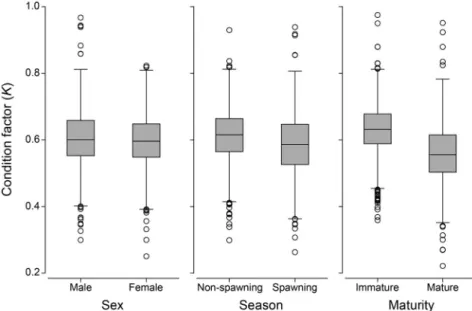
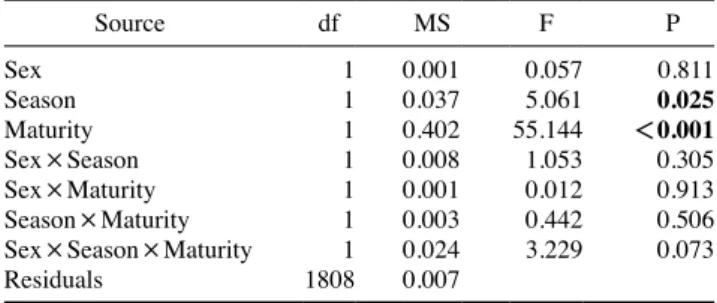
The mean values of condition factors were between 0.625 for immature G. chalcogrammus and 0.587 for ma- ture G. chalcogrammus, showing significantly higher value for immature fishes(P<0.05). The values were also sig- nificantly higher during non-spawning season than spawn- ing season(P<0.05). While there were no significant in- fluences of sex as well as their two- and three-way inter- actions among three categorical factors on condition fac-
Table 1. Weight-length relationship(WLR) parameters of Gadus chalcogrammus with respect to inhabiting middle East Sea, Korea. Bold letter indicates statistical significance at P≤0.05
Factors N TL(cm) BW(g) W=aLb
a SE b SE r2 ANCOVA G
SexMale 1,046 14.1~83.0 17.6~2,736.1 0.0111 0.025 2.818 0.016 0.968 0.061 A-
Female 770 13.0~74.4 12.9~2,620.1 0.0126 0.035 2.778 0.022 0.953 A-
Spawning season
Non-spawning 822 14.1~81.5 17.6~2,677.9 0.0095 0.027 2.871 0.018 0.968 0.272 A-
Spawning 994 13.0~83.0 12.9~2,736.1 0.0098 0.033 2.842 0.021 0.950 A-
Maturity
Immature(male) 875 14.1~35.2 17.6~329.5 0.0065 0.038 2.985 0.026 0.939 <0.001 I
(female) 13.0~38.9 12.9~392.3
Mature(male) 941 35.3~83.0 258.0~2,736.1 0.0114 0.078 2.806 0.047 0.888 A-
(female) 39.0~74.4 246.7~2,620.1
Total 1,816 13.0~83.0 12.9~2,736.1 0.0115 0.020 2.806 0.013 0.990
N=number of individuals, TL=total length, BW=wet body weight, a=intercept, b=slope, r2=coefficient of determination, SE=standard error, G=growth type, A- =negative allometry, I=isometry
Fig. 5. Box plots of condition factors for Gadus chalcogrammus in relation to sex, spawning season and maturity. Open cycles represent outliers.
tor(three-way ANOVAs; Table 2, Fig. 5).
DISCUSSION
Based on monthly GSI values, gonadal development begins from November, and the spawning period of G.
chalcogrammus is estimated from December to March (Fig. 3). The breeding season of G. chalcogrammus ap- peared to correspond to the decrease in water temperature.
This spawning season coincides with the results reported for other co-occurring fish species in middle East Sea, Korea, including Pacific cod Gadus macerocephalus and Gymnocanthus herzensteini(Lee et al., 2005; Park et al., 2007), as well as G. chalcogrammus inhabiting other re- gions of North Pacific(e.g. Smith, 1979; Maeda, 1986;
Hinckley, 1987).
The weight-length regressions for many fish species have been listed in FishBase which is a global biological database on fishes(Froese and Pauly, 2019). Our result provides the first quantitative WLR estimates for G. chal- cogrammus inhabiting the East Sea. The estimated b val- ues from this study fell within the standard range of 2.5~
3.5 which indicate for the majority of fish species(Froese, 2006). Overall b values were the lower end of the expect- ed range, indicating towards negative allometry, but that of immature group was shown isometry. Especially, G.
chalcogrammus showed ontogenetic changes in growth types allowing mature individuals to grow longer in size during a shorter period of time. While smaller specimens (immature group) have shown isometric growth pattern which occurs at the same rate for all parts of individuals so that its shape is consistent throughout development. Gen- erally, the allometric coefficient of the mass-length rela- tionship is mainly influenced by the quantity and quality of the ingested food(Fu et al., 2016; Phillips et al., 2018).
The digestive tracts of immature individuals may be well
adapted to efficiently exploit the food ingested(i.e. abun- dant semi-pelagic invertebrate; Park et al., 2018), while the negative allometry observed in mature individuals is implying allocation of more energy to axial growth rather than biomass(Wootton, 1990).
In this study, the condition factors were significantly dif- ferent between non-spawning and spawning, and between immature and mature fishes, but not between sexes. Be- cause there were no significant interactions among those factors, variations of condition factor of this species were attributed to seasonal or ontogenetic changes in body con- dition in relation to spawning behavior and/or food intakes.
Seasonal and ontogenetic changes in body condition were related with variations in energy reserves(protein, lipid, glycogen and total energy) which are usually driven by food availability, environmental conditions, and reproduc- tive status(Weatherley and Gill, 1987; Chellappa et al., 1995), consequently, changes in food reserves throughout the year(Hossain, 2010; Lavergne et al., 2013). Yamamu- ra et al.(2002) reported that G. chalcogrammus condition fell during winter and then recovered rapidly during spring and summer, due to the expenditure of energy reserves under reduced food availability, but the transformation of energy to gonad maturation during breeding season. Such a decrease of condition during winter also has been fre- quently reported in several high latitude fishes(e.g. Grif- fiths and Kirkwood, 1995; Paul and Paul 1998). While ontogenetic change in body condition may be related feed- ing behavior, because smaller fish need to ingest food more frequently than large fish, supporting their metabolic de- mand(Paul et al., 1998). Thus, such higher condition fac- tor and isometric growth pattern of smaller fishes are ad- vantageous for their development during younger period.
This study provides data on the spawning season, WLR parameters, and seasonal condition factors of G. chalco- grammus captured from the coastal waters of middle East Sea, Korea. These results contribute towards future con- servation studies of the species, and be useful for fishery biologists and managers in Korea.
ACKNOWLEDGMENTS
We would like to thank to members of Fisheries Ocean- ography Laboratory at Ganeneung-Wonju National Uni- versity for their assistances in the sample collections and measurements of the fishes. This research was parts of the project entitled “Walleye Pollock stock management based on Marine Information & Communication Technology”
funded by the Ministry of Oceans and Fisheries, Korea.
Table 2. Results of three-way ANOVAs testing the effects of sex, season, maturity and interactions of the three factors on condition fac- tor of Gadus chalcogrammus. Bold letters indicate statistical signifi- cance at P≤0.05
Source df MS F P
Sex 1 0.001 0.057 0.811
Season 1 0.037 5.061 0.025
Maturity 1 0.402 55.144 <0.001
Sex×Season 1 0.008 1.053 0.305
Sex×Maturity 1 0.001 0.012 0.913
Season×Maturity 1 0.003 0.442 0.506
Sex×Season×Maturity 1 0.024 3.229 0.073
Residuals 1808 0.007
This research was supported by the Korea Institute of Ocean Science & Technology project(PE99713).
REFERENCES
Adams, C.F., A.I. Pinchuk and K.O. Coyle. 2007. Seasonal changes in the diet composition and prey selection of walleye pollock (Theragra chalcogramma) in the northern Gulf of Alaska.
Fish. Res., 84: 378-389.
Bagenal, T.B. and A.T. Tesch. 1978. Conditions and growth patterns in freshwater habitats. Blackwell Scientific Publication, Ox- ford, pp. 75-89.
Beamish, R.J. and G.A. McFarlane. 1995. A discussion of the impor- tance of aging errors, and an application to walleye pollock:
the world’s largest fishery. Recent developments in fish oto- lith research. University of South Carolina Press, Columbia, pp. 545-565.
Britton, J.R. and J. Pegg. 2011. Ecology of European barbel Barbus barbus: implications for river, fishery, and conservation man- agement. Rev. Fish. Sci., 19: 321-330.
Chellappa, S., F.A. Huntingford, R.H.C. Strang and R.Y. Thomson.
1995. Condition factor and hepatosomatic index as estimates of energy status in male three-spined stickleback. J. Fish Biol., 47: 775-787.
Dwyer, D.A., K.M. Bailey and P.A. Livingston. 1987. Feeding habits and daily ration of walleye pollock(Theragra chalcogram- ma) in the eastern Bering Sea, with special reference to can- nibalism. Can. J. Fish. Aquat. Sci., 44: 1972-1984.
Froese, R. 1998. Length-weight relationships for 18 less-studied fish species. J. Appl. Ichthyol., 14: 117-118.
Froese, R. 2006. Cube law, condition factor and weight-length rela- tionships: history, meta-analysis and recommendations. J.
Appl. Ichthyol., 22: 241-253.
Froese, R. and D. Pauly(eds.). 2019. FishBase. World Wide Web electronic publication. version(02/2019). Available at:
http://www.fishbase.org.
Froese, R., A.C. Tsikliras and K.I. Stergiou. 2011. Editorial note on weight-length relations of fishes. Acta Ichthyol. Piscat., 41:
261-263.
Froese, R., J.T. Thorson and R.G. Reyes Jr. 2014. A Bayesian appro- ach for estimating length-weight relationships in fishes. J.
Appl. Ichthyol., 30: 78-85.
Fu, A.L., N. Hammerschlag, G.V. Lauder, C.D. Wilga, C.Y. Kuo and D.J. Irschick. 2016. Ontogeny of head and caudal fin shape of an apex marine predator: The tiger shark(Galeocerdo cuvier). J. Morphol., 277: 556-564.
Griffiths, D. and R.C. Kirkwood. 1995. Seasonal variation in growth, mortality and fat stores of roach and perch in Lough Neagh, Northern Ireland. J. Fish. Biol., 47: 537-554.
Hamatsu, T. and L. Yabuki. 2007. Density effects on length at matu- rity of walleye pollock Theragra chalcogramma off the Pa- cific coast of northern Japan in the 1990s. Fish. Sci., 73: 87-
97.
Hilborn, E. and C.J. Walters. 2001. Quantitative fisheries stock assess- ment: choice, dynamics and uncertainty. Chapman and Hall, New York, 570pp.
Hinckley, S. 1987. The reproductive biology of walleye pollock, Theragra chalcogramma, in the Bering Sea, with reference to spawning stock structure. Fish. Bull., 85: 481-498.
Hossain, M.Y. 2010. Length-weight, length-length relationships and condition factor of three Schibid catfishes from the Padma River, Northwestern Bangladesh. Asian Fish. Sci., 23: 329- Kim, Y.S., K.H. Han, C.B. Kang and J.B. Kim. 2004. Commercial 339.
fishes of the coastal and offshore waters in Korea. 2nd ed.
Hanguel, Busan, 333pp.(in Korean)
King, M. 1995. Fisheries biology, assessment and management. Fish- ing News Books. Blackwell Science, Oxford, UK, 341pp.
Kotwicki, S., T.W. Buckley, T. Honkalehto and G. Walters. 2005.
Variation in the distribution of walleye pollock(Theragra chalcogramma) with temperature and implications for sea- sonal migration. Fish. Bull., 103: 574-587.
Lavergne, E., U. Zajonz and L. Sellin. 2013. Length-weight relation- ship and seasonal effects of the Summer Monsoon on con- dition factor of Terapon jarbua(Forsskål, 1775) from the wider Gulf of Aden including Socotra Island. J. Appl. Ich- thyol., 29: 274-277.
Le Cren, E.D. 1951. The length-weight relationship and seasonal cycle in the gonad weight and condition in the perch(Perce fluviatilis). J. Anim. Ecol., 20: 201-219.
Lee, C.S., Y.H. Hur, J.Y. Lee, W.K. Kim, S.H. Hong, S.J. Hwang and S.H. Choi. 2005. Maturity and spawning of Pacific cod(Ga- dus macrocephalus) in the East Sea. Korean J. Fish. Aquat.
Sci., 38: 245-250.(in Korean)
Maeda, T. 1986. Life cycle and behavior of adult pollock(Theragra chalcogramma[Pallas]) in water adjacent to Funka Bay, Hokkaido Island. Bull. Int. North Pac. Fish. Commn., 45:
39-65.
Park, H.J., T.H. Park, C.I. Lee and C.K. Kang. 2018. Ontogenetic shifts in diet and trophic position of walleye pollock, Ther- agra chalcogramma, in the western East Sea(Japan Sea) revealed by stable isotope and stomach content analyses.
Fish. Res., 204: 297-304.
Park, J.M., T.F. Gaston, R. Riedel and J.E. Williamson. 2018. Bio- metric relationships between body and otolith measurements in nine demersal fishes from north-eastern Tasmanian waters, Australia. J. Appl. Ichthyol., 34: 801-805.
Park, K.Y., K.H. Park, S.I. Lee, H.W. Park, S.E. Hong, J.H. Yang and S.H. Choi. 2007. Maturity and spawning of black edged scul- pin Gymnocanthus herzensteini in the East Sea. Korean J.
Ichthyol., 19: 101-106.(in Korean)
Paul, A.J. and J.M. Paul. 1998. Comparisons of whole body energy content of captive fasting age zero Alaskan Pacific herring (Clupea pallasi Valenciennes) and cohorts over-wintering in nature. J. Exp. Mar. Biol. Ecol., 226: 75-86
Paul, A.J., J.M. Paul and R.L. Smith. 1998. Seasonal changes in whole-body energy content and estimated consumption rates of age 0 walleye pollock from Prince William Sound, Alaska.
Estuar. Coast. Shelf Sci., 47: 251-259
Pauly, D. 1984. Fish population dynamics in tropical waters: a man- ual for use with programmable calculators. ICLARM Stud- ies and Reviews 8. International Center for Living Aquatic Resources Management, Manila, Philippines, 325pp.
Petrakis, G. and K.I. Stergiou. 1995. Weight-length relationships for 33 fish species in Greek waters. Fish. Res., 21: 465-469.
Phillips, N.D., L. Kubicek, N.L. Payne, C. Harrod, L.E. Eagling, C.D.
Carson, V. Cappanera and J.D. Houghton. 2018. Isometric growth in the worldʼs largest bony fishes(genus Mola)?
Morphological insights from fisheries bycatch data. J. Mor- phol., 279: 1312-1320.
Ricker, W.E. 1968. Methods for assessment of fish production in freshwaters. Blackwell Scientific Publ., Oxford, 313pp.
Smith, G.B. 1979. The biology of walleye pollock. In: Favorite, F.,
W.J. Ingraham Jr., K.D. Waldron, E.A. Best, V.G. Wespestad, L.H. Barton, G.B. Smith, R.G. Bakkala, R.R. Straty and T.
Laevastu(eds.), Fisheries Oceanography-eastern Bering Sea Shelf. Northwest and Alaska Fisheries Center, Seattle, pp.
213-279.
Sokal, R.R. and F.J. Rohlf. 1987. Introduction to biostatistics. 2nd ed.
Freeman, New York, 363pp.
Tuuli, C.D., Y.S. De Mitcheson and M. Liu. 2011. Reproductive bi- ology of the greyfin croaker Pennahia anea in the northern South China Sea. Ichthyol. Res., 58: 302-309.
Weatherley, A.H. and H.S. Gill. 1987. The biology of fish growth.
Academic Press, London.
Wootton, R.J. 1990. Ecology of teleost fishes. Chapman & Hall, New Jersey.
Yamamura, O., S. Honda, O. Shida and T. Hamatsu. 2002. Diets of walleye pollock Theragra chalcogramma in the Doto area, northern Japan: ontogenetic and seasonal variations. Mar.
Ecol. Prog. Ser., 238: 187-198.
동해 중부 연안에 출현하는 명태 (Gadus chalcogrammus)의 산란기 및 성장패턴 (allometric growth pattern)과
비만도 (body condition) 변화에 영향을 미치는 요인
이충일
·
한문희·
정해근·
박현제·
박주면1강릉원주대학교 해양자원육성학과, 1한국해양과학기술원 독도전문연구센터
요 약 : 본 연구는 동해 중부 연안에 출현하는 명태(Gadus chalcogrammus)의 산란기, 체장-체중 관계(weight- length relationships, WLRs), 비만도(condition factor)를 조사하였다. 생식소숙도지수(gonadosomatic index, GSI))의
월변화를 통하여 추정한 명태의 산란기는 12월에서 3월이었다. 전반적인 체장-체중 관계식의 지수값 b는 2.806이
었고, 2.778(암컷)에서 2.980(미성숙 그룹)의 범위를 나타냈다. b값은 암수 사이에서 유사하였으나, 미성숙 그룹과
비산란기 동안 성숙 그룹 또는 산란기 보다 유의하게 높은 값을 나타냈다. 비만도는 미성숙 그룹에서 성숙 그룹보
다 유의하게 높았으나, 산란기와 비산란기, 암컷과 수컷 사이에서는 유의한 차이가 없었다.
찾아보기 낱말 : 명태, GSI, WLR, 비만도, 동해