Heavy Metal Resistant Phosphate Solubilizing Bacteria
June-Seob Song, Buddhi Charana Walpola, Doug-Young Chung, and Min-Ho Yoon*
Department of Bio-Environmental Chemistry, College of Agriculture and Life Sciences, Chungnam National University, Daejeon, 305-764, Korea.
Soil samples collected from abounded mines of Boryeong area in South Korea were used in isolating bacterial strains and their capacity to solubilize inorganic phosphates and heavy metal tolerance were assessed in vitro.
Three different inorganic phosphate sources (Ca phosphate, Fe phosphate, and Al phosphate) and four different heavy metals (Co, Cd, Pb and Zn) each with three concentrations (100 µg mL-1, 200 µg mL-1, and 400 µg mL-1) were used. The bacterial isolates PSB-1, PSB-2, PSB-3, and PSB-4 solubilized significantly higher amount of Ca phosphate during the first five days of incubation though subsequent drop in soluble phosphorus level in the medium was observed at the later stage (after 5 days) of the incubation. Solubilization of Ca phosphate and Fe phosphate was concomitant with the acidification of the culture medium compared to the control where it remained constant. Isolated strains could solubilize Fe phosphate to certain extent (25-45 µg mL-1) though solubilization of Al phosphate was found negligible. All the isolates were tolerant to heavy metals (Cd, Pb, and Zn) up to the concentration of 400 µg mL-1 except PSB-1 and PSB-8, which were shown to be vulnerable to Co even at 100 µg mL-1. Heavy metal tolerant strains should be further evaluated for plant growth promoting activities also under field conditions in order to assess their agricultural and environmental significance.
Key words: Heavy metals, Heavy metals tolerance, Phosphate solubilization
Received : 2012. 9. 7 Accepted : 2012. 9. 18
*Corresponding author : Phone: +82428216733 E-mail: [email protected]
Introduction
Soil phosphorous problem has become a matter of great concern and has attracted the attention of researchers, because, approximately 70-90% of phosphatic fertilizer applied to the soil is precipitated by Ca, Fe, and Al metal cations and these insoluble forms are not efficiently taken up by plants. Inoculation of phosphate-solubilizing micro- organism in soil has been shown to improve solubilization of insoluble phosphates, resulting in higher crop performances.
Mechanisms such as acidification by producing low molecular organic acids, chelation, and iron exchange reactions (Chaiharn and Lumyong, 2009) in growing environment attributed to the phosphate solubilization by these microorganisms. Apart from phosphorus solubilizing abilities, some of these microorganisms can benefit plant growth by several different mechanisms such as enhancing nitrogen fixation (Dobbelaere et al., 2003; Sahin et al., 2004), accelerating the accessibility of other trace elements (Mittal et al., 2008); synthesizing important growth promoting
substances such as siderophores (Wani et al., 2007) and antibiotics (Lipping et al., 2008), and providing protection to plants against soil borne pathogens (Hamdali et al., 2008). Plant growth promoting bacteria could improve plant competiveness and responses to external stress factors.
Soil pollution with heavy metals is caused severe environmental and human health hazard problems. The extensive and indiscriminate heavy metal accumulation in the soil adversely affects the beneficial microorganisms like phosphate solubilizing microorganisms and their physiological activities associated with soil fertility.
Isolation of heavy metal resistant microorganisms, which grow not only under contaminated environment but also possess plant growth promoting characteristics, is of particular importance for the degraded and polluted lands.
Therefore, the current study was undertaken to isolate phosphate solubilizing bacteria from heavy metal contaminated soils and to assess their heavy metal resistance with different heavy metals.
Material and Methods
Isolation of phosphate solubilizing bacterial strains Heavy metal contaminated soil collected from abounded mines of Boryeong area in South Korea was used in isolating phosphate solubilizing bacteria. Serially diluted soil sample aliquots were inoculated on NBRIP medium (National Botanical Research Institute Phosphate medium) containing 10 g glucose, 5 g Ca3(PO4)2, 5 g MgCl2.6H2O, 0.25 g MgSO4.7H2O, 0.2 g KCl, 0.1 g (NH4)2SO4 in 1 L distilled water (Nautiyal, 1999). The pH of the media was adjusted to 7. The petri plates were incubated for 7 days at 30℃.
Morphologically distinct colonies with clear halos were purified by repeated subculturing. Out of 20, a total of 8 isolates (PSB-1 to PSB-8) were selected considering greater halo size (>3 mm) and maintained on solid NBRIP agar medium until use.
Assay of Insoluble phosphate solubilization Phosphate solubilization assays were conducted with three different phosphate sources. The Ca phosphate solubilization assay performed using NBRIP medium and Al phosphate and Fe phosphate solubilization were assayed by adding 4 g L-1 AlPO4 or 6 g L-1 FePO4.2H2O separately instead of Ca3(PO4)2 in NBRIP medium. Three replicate flasks containing each medium (Ca phosphate, Fe phosphate, and Al phosphate) were inoculated with each isolate which were previously grown in sterilized liquid NBRIP medium (20 mL) at 30℃ for 2 days with continuous shaking at 150 rpm min-1. Three replicates of a control treatment each containing one insoluble phosphate source was also included in the experiment. The initial pH was adjusted to 7 in each medium. A sample (10 mL) of each cultured and control were taken 2, 5, and 7 days after inoculation and centrifuged at 8000 rpm for 15 min. The clear supernatant was used in determining the amount of phosphorous released into the medium using phospho- molybdate blue color method (Murphy and Riley, 1962).
The pH of the culture medium was also recorded with the pH meter equipped with glass electrode.
Assay of heavy metal resistance Isolated bacterial strains were assessed for their resistance to heavy metals by using agar dilution method (Cervantes et al., 1986).
Freshly prepared agar plates were amended with 5 different heavy metals (Cd, Co, Pb, Cu, and Zn) at various concentrations (100-400 µg mL-1). They were inoculated
with isolated strains and heavy metal tolerance was determined by the appearance of bacterial growth after 2 days of incubation at 30℃.
Values are given as means ± SD for triplicate samples.
All the data were analyzed by analysis of variance or by regression analysis. Differences were considered to be significant at the P ≤ 0.05 level.
Results and Discussion
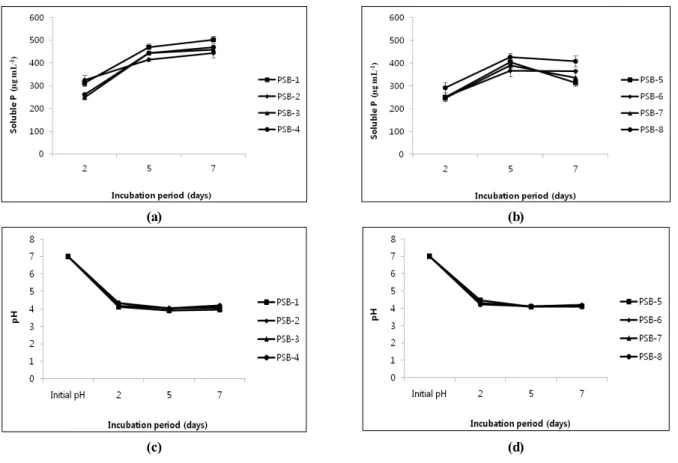
Periodic changes of the soluble phosphorus content and medium pH due to inoculation of isolated phosphate solubilizing microorganisms into NBRIP medium with Ca phosphate is presented in Fig. 1.
As incubation proceeds, available phosphorus contents in the medium were found to be increased by the phosphate solubilizing bacterial isolates. As can be seen in Fig. 1, the bulk of the solubilization occurred during the period of 2-5 days of the incubation. However, subsequent drop in soluble phosphorus level was observed on later days of the incubation. The amounts of inorganic phosphate solubilized by strains PSB-1, PSB-2, PSB-3, and PSB-4 were significantly higher than that of the other isolated strains.
The decrease could be due to the availability of soluble phosphorus in the culture medium, which has an inhibitory effect on further phosphate solubilization (Varsha-Narsian et al., 1994) or depletion of nutrients in the culture medium, in particular carbon source for the production of organic acids (Chaiharn and Lumyong, 2009; Kang et al., 2002; Kim et al., 2005). In the case of control, no significant change in the content of soluble phosphorus was observed throughout the incubation period.
As shown in the Fig. 1, the solubilization of ca phosphate was concomitant with the acidification of the culture medium compared to the control where it remained constant. The reduction of pH was rapid during the initial stages of incubation (first 2 days) followed by slower decrease. The inverse relationship between pH and soluble phosphorus concentration in the medium for all the bacterial strains implied that acidification of the medium could facilitate the inorganic phosphate solubilization.
Fig. 2 shows the changes of the soluble phosphorus content and medium pH due to inoculation of isolated phosphate solubilizing microorganisms into Fe phosphate containing NBRIP medium. Though all the strains were proved to be capable in solubilizing Fe phosphate, the rate of solubilization was remarkably lower (25-45 µg mL-1)
(a) (b)
(c) (d)
Fig. 1. Insoluble Ca Phosphate solubilization (µg mL-1 of filtrate) of isolated phosphate solubilizing bacterial strains (a) and (b), Changes of pH in Ca phosphate medium containing phosphate solubilizing bacterial strains (c) and (d).
(a) (b)
(c) (d)
Fig. 2. Insoluble Fe Phosphate solubilization (µg mL-1 of filtrate) of isolated phosphate solubilizing bacterial strains (a) and (b), Changes of pH in Fe phosphate medium containing phosphate solubilizing bacterial strains (c) and (d).
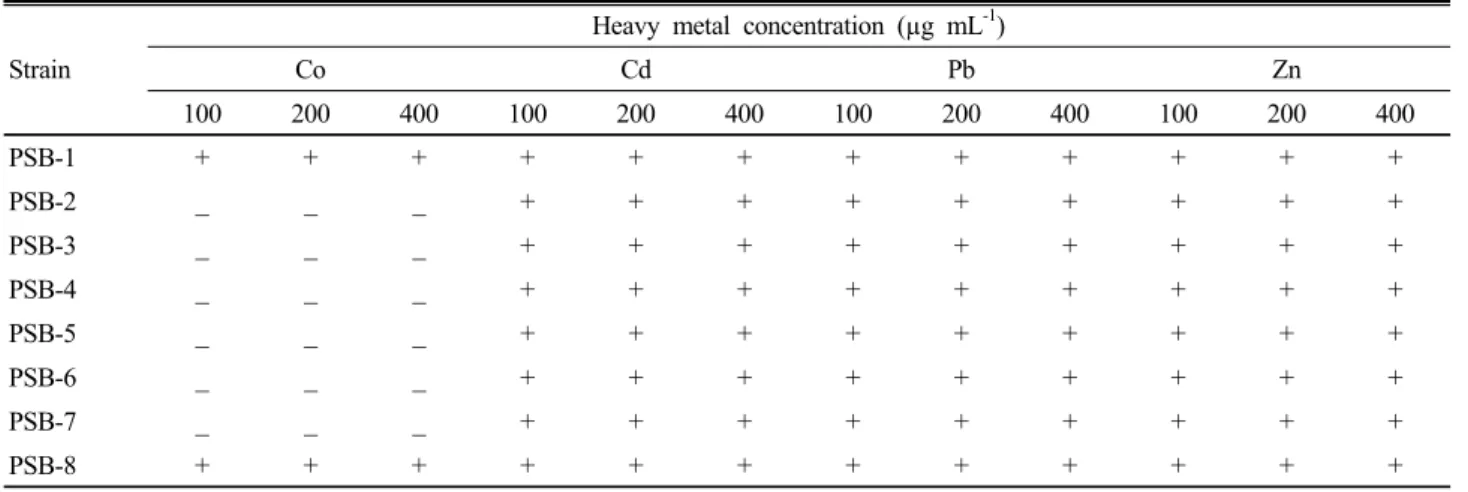
Table 1. Heavy metal tolerance among isolated phosphate solubilizing bacteria
Strain
Heavy metal concentration (µg mL-1)
Co Cd Pb Zn
100 200 400 100 200 400 100 200 400 100 200 400
PSB-1 + + + + + + + + + + + +
PSB-2 _ _ _ + + + + + + + + +
PSB-3 _ _ _ + + + + + + + + +
PSB-4 _ _ _ + + + + + + + + +
PSB-5 _ _ _ + + + + + + + + +
PSB-6 _ _ _ + + + + + + + + +
PSB-7 _ _ _ + + + + + + + + +
PSB-8 + + + + + + + + + + + +
(+): tolerance to the heavy metal.
(-): susceptible to the heavy metal.
than that of the Ca phosphate. Except PSB-7 and PSB-8 which showed delayed reach to the peak, all the other strains exhibited the maximum Fe phosphate solubilization during the first 2 days of incubation. More importantly, none of the isolates was capable of solubilizing Al phosphate, which is in agreement with Chung et al.
(2005); Barroso and Nahas (2005); Delvasto et al. (2006) and Son et al. (2006) who reported that though most of the phosphate solubilizing bacteria is very effective in mobilizing phosphorous from Ca phosphate, mobilization of phosphorous from Fe or Al phosphate occurs at a much lesser extent.
Nethertheless, the information available on this matter is scarce and even contradictory. Indeed, some studies show that phosphate solubilizing microorganisms, including fungi and bacteria, have only a limited capacity to solubilize Fe phosphate and Al phosphate (Banik and Dey, 1983;
Whitelaw et al., 1999). These studies suggest that where poorly soluble Fe phosphate and Al phosphate occur in high amounts, the microbial mediated mobilization of phosphorous may be less effective. However, Reyes et al.
(1999) reported that Penicillum rugulosum was more efficient in solubilizing Al phosphate and Fe phosphate than hydroxyapatite. Illmer et al. (1995) also reported a Pseudomonas strain capable of solubilizing Al phosphate successfully.
All the phosphate solubilizing bacterial strains were proved to be tolerant to the heavy metals except PSB-1 and PSB-8, which were vulnerable to Co (Table 1). The strains were isolated from an abounded mine thus adaptation of microorganisms to such a heavy metal containing environment may be the possible reason attributed to metal tolerance. In fact, microorganisms
grown on environment enriched with metals could develop mechanisms to cope with a variety of toxic metals (Joseph et al., 2007). There are number of studies demonstrating the importance of bacterial inoculation for plant growth and heavy metal accumulation in heavy metal polluted environments (Khan, 2005; Sheng and Xia, 2006). Halstead et al. (1969) suggested that the process of inorganic phosphate solubilization facilitates the uptake of the metals from the soil.
However, the isolation of microorganisms both metal tolerant and efficient in producing plant growth promoting properties such as phosphate solubilizing ability, siderophore producing ability etc. can be useful to speed up the recolonization of the plant rhizosphere in polluted soil (Carlot et al., 2002). Therefore, further studies are needed to assess the other plant growth promoting activities of isolated phosphate solubilizing bacterial strains under heavy metal stress.
Conclusion
Isolated phosphate solubilizing bacterial strains were proved to be highly effective in solubilizing Ca phosphate, while the strains were capable in solubilizing Fe phosphate also to a certain extent. In contrast, Al phosphate solubilizing ability was negligible. All the isolates were exhibited to be tolerant to heavy metals (Cd, Pb, and Zn) up to the concentration of 400 µg mL-1. However, except PSB-1 and PSB-8, other isolates were vulnerable to Co even at 100 µg mL-1. Heavy metal tolerant strains should be further evaluated for plant growth promoting activities also under field conditions in order to assess their
agricultural and environmental significance.
References
Banik, S. and B.K. Dey. 1983. Phosphate solubilizing potentiability of the microorganisms capable of utilizing aluminium phosphate as a sole phosphate source. Zentralbl Mikrbiol. 138:17-23.
Barroso, C.B. and E. Nahas. 2005. The status of soil phosphate fractions and the ability of fungi to dissolve hardly soluble phosphates. Appl. Soil Ecol. 29:73-83.
Carlot, M., A. Giacomini, and S. Casella. 2002. Aspects of plant-microbe interactions in heavy metal polluted soil. Acta Biotechnol. 22:13-20.
Cervantes, C., J. Chavez, N.A. Cardova, P. De Na Mora, and J.
A. Velasco. 1986. Resistance to metal by Pseudomonas aerugenosa clinical isolates. Microbiol. 48:159-163.
Chaiharn, M. and S. Lumyong. 2009. Phosphate solubilization potential and stress tolerance of rhizobacteria from rice soil in Nothern Thailand. World J. Microbiol. Biotechnol.
25:305-314.
Chung, H., M. Park, M. Madhaiyan, S. Seshadri, J. Song, H.
Cho, and T. Sa. 2005. Isolation and characterization of phosphate solubilizing bacteria from the rhizosphere of crop plants of Korea. Soil Biol. Biochem. 37:1970-1974.
Delvasto, P., A. Valverde, A. Ballester, J.M. Igual, J.A. Munoz, F. Gonzales, M. L. Blazquez, and C. Garcıa. 2006. Characterization of brushite as a re-crystallization product formed during bacterial solubilization of hydroxyapatite in batch cultures.
Soil Biol. Biochem. 38:2645-2654.
Dobbelaere, S., A. Croonenborghs, A. Thys, D. Ptacek, Y. Okon, and J. Vanderleyden. 2003. Effects of inoculation with wild type Azospirillum brasilense and A. irakense strains on development and nitrogen uptake of spring wheat and grain maize. Biol. Fertil. Soils. 36:284-297.
Halstead, R.L., B.J. Finn, and A.J. MacLean. 1969. Extract- ability of nickel added to soils and its concentration in plants.
Can. J. Soil Sci. 49:335-342.
Hamdali, H., M. Hafidi, M.J. Virolle, and Y. Ouhdouch.
2008. Rock phosphate solubilizing Actinimycetes: Screening for plant growth promoting activities. World J. Microbiol.
Biotechnol. 24:2565-2575.
Illmer, P., A. Barbato, and F. Schinner. 1995. Solubilization of hardly soluble AlPO4 with P-solubilizing microorganisms.
Soil Biol. Biochem. 27:265-270.
Joseph, B., R. Ranjan Patra, and R. Lawrence. 2007. Characteri- zation of plant growth promoting rhizobacteria associated with chickpea (Cicer arietinum L.). Int. J. Plant Product.
1:142-149.
Kang, S.C., C.G. Ha, T.G. Lee, and D.K. Maheswari. 2002.
Solubilization of insoluble inorganic phosphates by a soil- inhabiting fungus Fomitopsis sp. PS 102. Curr. Sci. 82:439-442.
Khan, A.G. 2005. Role of soil microbes in the rhizospheres of plants growing on trace metal contaminated soils in phytoremediation. J. Trace Elem. Med. Biol. 18:355-364.
Kim, Y.H., B. Bae, and Y.K. Choung. 2005. Optimization of biological phosphorus removal from contaminated sediments with phosphate solubilizing microorganisms. J. Biosci. Bioeng.
1:23-29.
Lipping, Y., X. Jiatao, J. Daohong, F. Yanping, L. Guoqing, and L. Fangcan. 2008. Antifungal substances produced by Penicillium oxalicum strain PY-1-potential antibiotics against plant pathogenic fungi. World J. Microbiol. Biotechnol.
24:909-915.
Mittal, V., O. Singh, H. Nayyar, J. Kaur, and R. Tewari. 2008.
Stimulatory effect of phosphate solubilizing fungal strains (Aspergillus awamori and Penicillium citrinum) on the yield of chickpea (Cicer arietinum L. cv. GPF2). Soil Biol. Biochem. 40:718-727.
Murphy, J. and J.P. Riley. 1962. A modified single solution method for the determination of phosphate in mineral waters.
Anal. Chim. Acta. 27:31-36.
Nautiyal, C.S. 1999. An efficient microbiological growth medium for screening of phosphate solubilizing microorganisms. FEMS Microbiol. Lett. 170:265-270.
Reyes, I., L. Bernier, R.R. Simard, P. Tanguay, and H. Antoun.
1999. Characteristics of phosphate solubilization by an isolate of a tropical penicillium rugulosum and two UV-induced mutants. FEMS Microbiol. Ecol. 28:291-295.
Sahin, F., R. Cakmakci, and F. Kantar. 2004. Sugar beet and barely yields in relation to inoculation with N2-fixing and phosphate solubilizing bacteria. Plant Soil. 265:123-129.
Sheng, X. F. and J. J. Xia. 2006. Improvement of rape (Brassica napus) plant growth and cadmium uptake by cadmium- resistant bacteria. Chemosphere 64: 1036-1042.
Son, H.J., G. T. Park, M.S. Cha, and M.S. Heo. 2006.
Solubilization of insoluble inorganic phosphates by a novel salt- and pH-tolerant Pantoea agglomerans R-42 isolated from soybean rhizosphere. Bioresour. Technol. 97:204-210.
Varsha-Narsian, J., J. Thakkar, and H.H. Patel. 1994. Inorganic phosphate solubilization by some yeast. Indian J. Microbiol., 35:113 - 118.
Wani, P.A., M.S. Khan, and A. Zaidi. 2007. Co-inoculation of nitrogen fixing and phosphate solubilizing bacteria to promote growth, yield and nutrient uptake in chickpea. Acta Agron. Hung. 55:315-323.
Whitelaw, M.A., T.J. Harden, and K.R. Helyar. 1999. Phosphate solubilization in solution culture by the soil fungus Penicillium radicum. Soil Biol. Biochem. 31:655-665.