중금속 오염 토양 정화를 위한 식물생장촉진세균: 특성, 활용 및 전망
조경숙*
이화여자대학교
환경공학과
Received: August 26, 2020 / Revised: October 8, 2020 / Accepted: October 15, 2020
서 론
지구환경을
구성하고
있는
대기권
,수권
및
지각권은
인간
을
비롯하여
지구상의
모든
생명체에
영향을
미치고
있다
.특히
,인간은
토양에서
재배한
농작물을
주요한
식품으로
이
용하기
있기
때문에
지각권을
구성하는
토양은
가장
중요한
자연
자원이다
[1].농작물의
수확량을
높이기
위해
오랜
기
간
동안
지속적으로
사용한
비료
,살충제
및
제초제
등에
함
유된
중금속은
생분해
되지
않기
때문에
토양에
잔류
되어
왔다
[2, 3].또한
,산업화
및
도시화로
인해
중금속이
함유된
폐수
및
폐기물로
인해
토양의
중금속
오염은
점점
심화되
고
있다
[4, 5].토양에
축적된
중금속은
식물에
의해
흡수되
고
,먹이사슬에
의해
동물
및
인간
체내로
유입되기
때문에
,지구생태계내에서
생산자
역할을
담당하는
식물과
소비자인
동물과
인간에게
악영향을
미친다
[6].또한
,중금속은
분해자
역할을
하는
토양
미생물
군집의
다양성과
기능
변화를
야
기할
수도
있다
[7].이와
같이
중금속에
의한
토양
오염은
해
당
서식지에
생존하고
있는
생명체
뿐
아니라
,거시적인
측
면에서
탄소
,질소
,인
등과
같은
주요
물질의
생지화학적
순환
및
지구
생태계
항상성
유지
기작에도
영향을
미칠
수
있다
.중금속
오염
토양을
정화하기
위하여
추출법
(extraction),열탈착법
(thermal desorption),토양세척법
(soil washing),경작법
(land-farming),생물복원법
(bioremediation)및
식물
상복원법
(phytoremediation)등
다양한
기술이
개발되고
있
다
[1].추출법과
열탈착법에
의한
토양
정화
비용은
각각
240−
813 $/m3및
81−
252 $/m3로
타
기술에
비해
처리
단가
가
많이
높다
[8, 9].토양경작법과
토양세척법의
처리
단가는
각각
<100 $/m3과
71.4 $/m3로
평가되고
있다
[9, 10].또한
이러한
물리화학적
방법은
토성
,토양
비옥도
및
생물다양성
Plant Growth-promoting Bacteria for Remediation of Heavy Metal Contaminated Soil: Characteristics, Application and Prospects
Kyung-Suk Cho*
Department of Environmental Science and Engineering, Ewha Womans University, Seoul 03760, Republic of Korea
Remediating soils contaminated with heavy metals due to urbanization and industrialization is very important not only for human health but also for ecosystem sustainability. Of the available remediation technologies for heavy metal-contaminated soils, phytoremediation is a relatively low-cost environment-friendly technology which preserves biodiversity and soil fertility. The application of plant growth-promot-ing bacteria (PGPB) durgrowth-promot-ing the phytoremediation of heavy metal-contaminated soils can enhance plant growth against heavy metal toxicity and increase heavy metal removal efficiency. In this study, the sources of heavy metals that have adverse effects on microorganisms, plants, and humans, and the plant growth-promoting traits of PGPB are addressed and the research trends of PGPB-assisted phytoremediation over the last 10 years are summarized. In addition, the effects of environmental factors and PGPB inoculation methods on the performance of PGPB-assisted phytoremediation are discussed. For the innovation of PGPB-assisted phytoremediation, it is necessary to understand the behavior of PGPB and the interactions among plant, PGPB, and indigenous microorganisms in the field.
Keywords: Plant growth-promoting bacteria, heavy metal, phytoremediation, contaminated soil, remediation efficiency
*Corresponding author
Tel: +82-2-3277-2393, Fax: +82-2-3277-3275 E-mail: [email protected]
© 2020, The Korean Society for Microbiology and Biotechnology
에
부정적인
영향을
미친다
[11, 12].이에
비해
생물학적
방
법인
생물복원법과
식물상복원법의
처리
단가는
각각
59.9 $/m3및
19−
78 $/m3로
,물리화학적
방법에
비해
저렴하
다
[8, 10, 13].특히
,식물상복원법은
환경친화적이고
지속
가
능한
방법으로
평가되고
있다
[1, 14].식물상복원법을
이용한
중금속
오염
토양을
정화하기
위
해
실험실
규모부터
현장
규모까지
많은
연구가
진행되었지
만
,이
기술의
상용화
확대를
위해서는
식물
생장
및
중금속
제거
효율의
향상을
위한
기술
혁신이
필요하다
[1, 12].최근
들어
중금속
독성으로
인한
식물
생장
저해
및
중금속
정화
효율을
향상시키기
위해
식물생장촉진세균
(plant growth promoting bacteria, PGPB)을
식물상복원법에
활용하는
연
구들이
활발하게
진행되고
있다
[15, 16].이
방법에
의한
중
금속
제거
효율성을
평가하여
식물상복원법의
개발방향을
제시하려는
목적으로
,본
논문에서는
주요
토양오염물인
중
금속의
발생원
,미생물
·식물
·인간에
미치는
중금속
영향
및
PGPB의
식물생장촉진
기작을
정리하였다
.또한
,중금속
오
염
토양
정화를
위해
식물상복원법에
PGPB의
활용에
관한
최신
연구
동향
및
관련
기술
혁신을
위한
향후
전망에
대해
고찰하였다
.중금속 오염 발생원 및 영향
중금속은
원자
밀도가
5 g/cm3보다
큰
금속으로
,낮은
농
도에서
사람을
비롯한
동물과
식물
모두에게
독성이
있는
환
경에서
가장
위협적인
오염물질이
되고
있다
[17, 18].토양
뿐
아니라
물과
대기
환경을
오염시키는
중금속의
주요
발
생원을
Fig. 1에
정리하였다
.중금속을
포함한
광석의
자연
적인
풍화
,채광
,제련
과정
,금속
가공산업
,각종
산업폐기
물
,제약
·살충제
생산산업
,농업용
살충제
및
비료
사용
등이
다
[19, 20].중금속은
그
자체가
생체물질과
세포내에서
일어나는
대
사과정에
악영향을
미치고
,또한
세포내에서
반응성
산소
화
학종
(reactive oxygen species, ROS)을
형성하여
산화적
독
성반응을
야기한다
[20−
22].전이
중금속
(transition metal)은
unpaired전자를
가지고
있고
,이로
인해
산소는
superoxide (O2−)로
된다
(식
(1)).Mn + O2
→
Mn+1 + O2− (1)중성
환경에서
superoxide는
과산화수소
(H2O2)를
생성하
고
Haber-Wiss reaction에
의해
hydroxyl radicals(OH−)을
형성한다
(식
(2), (3)). Mn+1 + O2−→
Mn + O2 (2) Mn + H2O2→
O2+ OH−+ OH (3)생명체에
대한
중금속과
이로
인해
생성된
ROS의
독성
기
작을
Fig. 2에
도시하였다
[22].이들은
유전물질인
DNA구
조
변형
등을
유발하고
세포내
DNA손상의
수리
(repair)기
작을
방해하여
돌연변이를
야기한다
.중금속과
ROS는
RNA를
가수분해
(hydrolysis)하여
단백질
합성을
방해하며
,단백
질과
이온
채널을
저해하여
효소
활성을
억제한다
.중금속에
의해
생성된
ROS는
지질을
산화하여
세포막의
기능을
교란
한다
[22].미생물
,식물
및
인간에
미치는
중금속의
독성
영
향을
Fig. 3에
정리하였다
[20, 23−
25].중금속은
미생물의
단
Fig. 2. Effects of heavy metals and reactive oxygen species on cells [22].
백질
변성
, DNA복제
(replication)·전사
(transcription)·번역
(translation)기작
저해
,세포막
기능
교란
,세포분열
저해
및
단백질
활성
저해
현상을
유발할
수
있다
[24].식물의
중금
속에
의해
필수
금속이온
부족
,세포막
교란
,전자전달계
저
Table 1. Speciation, chemistry, toxicity and sources of heavy metals [1, 15, 16, 26-28].
Heavy metal
Oxidation state
Dominant/ reactive forms in soil
Concentration in soil (mg/kg)
Toxicity to plants Toxicity to humans Major sources Detected range Toxic level Arsenic (As) -3, 0, +3, +5
- Aerobic condition: As(V) is dominant (e.g.) arsenate (AsO4) 3-- Reducing condition: As(III)
is dominant (e.g.) arsenite (AsO3)
3-0.1-102 20 Reduction of plant growth, Increase of lipid peroxidation, Decrease of amino acids and Fe concentrations, Inhibi-tion of seed germinaInhibi-tion
Skin manifestation, can-cers, vascular and dermal disease, gastrointestinal problem, respiratory dam-age
Timber treatment, paints, pesticides, geothermal/ geogenic/natural pro-cesses, smelting operations, thermal power plants, fuel burning Cadmium (Cd) 0, +2 - High pH: Hydroxide (Cd(OH)2), carbonate (CdCO3) - Low pH (<8): Cd2+, aqueous sulfate species
0.01-7 3-8 Leaf chlorosis, Reduction of plant growth, Mem-brane degradation due to the production of reactive oxygen species, Inhibition of photosyn-thetic pigments
Degenerative bone dis-ease, kidney damage, renal disorder, human car-cinogens
Electroplating, batteries, fertilizers, Zn smelting, waste batteries, e-waste, paint sludge, incinerations & fuel combustion
Chromium (Cr)
0, +3, +6
- Cr(VI): dominant and toxic form (e.g.) chromate (CrO42-), dichromate (Cr2O7-) at shallow aquifers
- Cr(III): dominant form at low pH (<4)
5-1000 75-1000 Inhibition of seed germi-nation, Reduction of plant growth, Deleterious effects on photosynthesis, water relations, and min-eral nutrition, Increase of transpiration rate
DNA damage, carcino-gens, allergy reaction, irritant dermatitis, gastro-intestinal hemorrhage
Electroplating, alloy prod-ucts, aircrafts, industrial coolants, electronics, leather tanning, dyes, pesticides
Copper (Cu)
0, +1, +2
- Cu(II): the most toxic species (e.g.), Cu(OH)+, Cu2(OH)22+
- Aerobic alkaline condi-tion: CuCO3 is dominant soluble species - Anaerobic condition:
CuS(s) will form with sulfur
2-100 60-125 Induction of Fe deficiency, Reduction of plant growth, Increase of elec-trolyte leakage and per-oxidase activity of shoot tissues, Decrease of chlo-rophyll content, Increase of lipid peroxidation
Liver damage, Wilson disease, insomnia
Fungicides, electrical, paints, pigments, timber treatment, fertilizers, mine tailings, elec-troplating, smelting opera-tions
Lead (Pb)
0, +2 - Pb(II): dominant and reactive form
- Complexation with inor-ganic (Cl-, CO
32-, SO42-, PO43-) and organic ligands (humic and fulvic acids, EDTA, amino acids)
2-200 100-400 Inhibition of seed germi-nation, Reduction of plant growth, Reduction in chlorophyll, carotenoid contents, photosynthetic rate and CO2 assimilation
Damage to fetal brain, Kidney problem, affects the nervous system
Batteries, metal products, preservatives, petrol addi-tives, paints, e-waste, Smelt-ing operations, coal-based thermal power plants, ceramics, bangle industry Mercury
(Hg)
0, +1, +2 - Alkylated form (methyl/ ethyl mercury) depend-ing on the pH
- Oxidizing condition: Hg2+ and Hg22+
0.02-0.2 0.3-5 Disturbance of cellular structure and metabo-lism, Reduction of plant growth and leaf pigment contents, Reduction in photosynthesis and chlo-rophyll synthesis
Blindness and deafness, brain damage, digestive problems, kidney dam-age, lack of coordination, mental retardation
Instruments, fumigants, geothermal, thermal power plants, fluorescent lamps, hospital waste, electrical appliances
Zinc (Zn) 0, +2 - High pH: Zn is bioavail-able
- pH 7.0–7.5: Zn(OH)2 - Reducing condition:
Co-precipitate with hydrous oxides of Fe and Mg
10-300 70-400 Reduction of photosyn-thetic rate, Stomatal con-ductance, Leaf bronzing, Plant mortality, Chlorosis, Necrosis of mature leaves, Induction of Fe deficiency
Depression, lethargy, increased thirst
Dyes, paints, timber treatment, fertilizers, mine tailings, smelting, electro-plating
해
및
생장이
저해되는
영향을
받는다
[20, 23].인간에
대한
중금속
중독
현상은
두뇌
,소화계
,순환계
,신경계
및
생식계
를
포함한
모든
신체
기능
저하
및
발암까지
매우
다양하게
나타난다
[25].토양의
주요
오염원인
중금속
종류별로
화학적
특성
,농
도
,식물과
인간에
미치는
영향
및
주요
배출원을
Table 1에
요약
정리하였다
[1, 15, 16, 20, 26−
28].비소는
지구
지각을
구성하는
물질
중
20번째로
많은
금속으로
[29],호기적인
환
경에서는
+5가
산화가
(AS(V))인
arsenate(AsO4)3−로
주로
존
재한다
[16, 28]. Arsenate는
산성조건에서
Fe oxyhydroxides와
착화합물을
형성하거나
침전물을
형성한다
.비소는
혐기적
환경에서는
주로
수용성인
+3가
(As(III))인
arsenite (AsO3)3−로
존재한다
.지각의
자연적인
풍화작용
등과
같은
자연적
배출
원
및
페인트
및
살충제
제조업과
발전소
등과
같은
인위적
배출원에
의한
식수원과
농경지의
비소
오염은
발암물질로
심각하게
인간의
건강을
위협하고
있다
[1]. 0가
혹은
+2가의
산화가를
가진
카드뮴은
pH 8이상의
환
경에서는
수산염
(Cd(OH)2)혹은
탄산염
(CdCO3)화합물로
, pH 8보다
낮은
환경에서는
수용성
황산염
화합물의
형태로
존재한다
.카드뮴은
광합성
작용
저해
등으로
식물
생장을
억제할
뿐
만
아니라
,신장
질환
및
뼈가
연화
되어
변형
및
골절
등의
문제를
야기할
수
있다
[1].크롬은
방부식
특성을
가지고
있는
전자부품
,항공기
등의
코팅제로
사용되거나
,가죽
,염료
,종이
,유리
등의
각종
제
조업에서
많이
활용되고
있다
[1, 30].크롬은
0가
, +3가
및
+6가의
산화가를
갖는데
,주로
환경
중에서
chromate(CrO42−)혹은
dichromate(Cr2O7−)로
독성이
높은
크롬
(VI)화합물의
형태로
존재한다
.크롬
(VI)은
식물의
증산작용
및
광합성을
저해하고
,위장
장애
, DNA손상
및
암을
유발할
수
있다
.구
리는
0가
, +1가
및
+2가로
존재할
수
있는데
, Cu(OH)+, Cu2(OH)22+과
같은
2가
구리화합물의
독성이
가장
크다
.구
리로
오염된
토양은
식물의
구리
결핍
등의
성장
저해를
야
기한다
.납은
0가
및
+2가
산화가를
가지는데
,특히
납
(II)은
염소
,탄산염
,황산염
,인산염
등과
같은
무기물과
쉽게
결합
할
수
있다
. Humic acid와
fulvic acid등의
토양
유기물과
결합한
형태로
토양에서
검출된다
.수은은
환경
중에서
methyl mercury혹은
ethyl mercury등의
알킬화된
유기
수은
화합물의
형태로
존재하며
,식물의
세포
구조와
대사과정을
저해한다
[1].유기
수은
화합물은
금
속
수은보다
독성이
강하고
두통
,시력
/언어
/지각
장애
등의
신경
장애를
야기할
수
있다
. 0가
혹은
+2가의
형태로
존재
하는
아연은
용접
,도금
및
전자제조업에서
작업자의
직업병
을
유발
할
수
있으며
,식물의
철
결핍
현상을
유발하고
광
합성을
저해한다
.PGPB
의 식물생장촉진 기작
토양에서
중금속은
일반적으로
bioavailability가
낮은
불
용성
화합물로
존재한다
[31].식물은
다양한
종류의
뿌리
삼
출물
(root exudate)을
체외에
생산하여
근권
토양의
pH를
변
화시켜
중금속의
용해도를
증가시킬
수
있다
[32].이렇게
bioavailability가
높아진
중금속은
식물
뿌리
표면에
흡착
되거나
뿌리세포의
세포막을
통해
식물
조직체
내부로
흡
수될
수
있다
[31].식물을
이용한
오염토양의
중금속
정화
기작은
phytostalilization, rhizofiltration, phytoextraction및
phytovolatilization으로
구분된다
(Fig. 4) [33, 34]. Phytostalization은
식물의
근권에서
중금속을
산화
·환원
혹
은
침전시켜
중금속의
bioavailability을
낮추거나
고정화시
키는
것이다
. Rhizofiltration은
토양수
혹은
지하수에
함유
된
중금속을
식물
뿌리조직
외피에
존재하는
음성
전하를
가
진
세포
외
잔재물에
흡착시키거나
,세포막에
존재하는
carrier단백질을
통해
중금속을
세포
내부에
흡수시키는
기작이다
[35]. Phytoextraction은
식물이
토양으로부터
중금속을
흡수하여
식물
조직에
축적시키는
것이고
, phytovolatilization은
식
물
조직에
축적된
중금속을
가스상
중금속
화합물의
형태
로
대기
중으로
휘발시켜
제거하는
기작
이다
.식물이
토양
으로부터
중금속을
흡수하여
뿌리
등의
식물조직체에
축적
할
수
있는
능력은
생물농축인자
(Bioconcentration factor, BF)로
비교
평가되는데
, BF값은
다음의
식
(4)에
의해
계
산한다
[36, 37]. BF = Cp/Cso (4)여기서
, Cp,식물조직내
중금속
농도
; Cso,토양
중
중금속
농도
.또한
,식물이
지하부
뿌리로
흡수한
중금속을
잎
등의
지
상부
식물조직으로
수송하여
저장할
수
있는데
,이러한
식물
조직내에서
중금속을
수송할
수
있는
능력은
수송인자
(translocation factor, TF)로
비교
평가된다
. TF값은
뿌리조
직내
중금속
농도
대비
지상부
식물조직내
중금속
농도
비
율로
계산한다
[36, 37]. TF = Cs/Cr (5)여기서
, Cp,뿌리내
중금속
농도
; Cso,지상부
식물조직내
중
금속
농도
.일반적으로
BF값과
TF값이
1보다
큰
식물종은
phytoextraction에
적합하고
, BF값은
1보다
크지만
TF값
이
1보다
작은
식물종은
phytostabilization에
적합하다
[34].그런데
,중금속에
의해
식물
생장과
활성이
저해를
받기
때문에
,식물상복원법의
중금속
제거
효율을
향상시키는
위
해서는
식물
생장을
촉진하는
PGPB의
활용은
매우
중요하
다
. PGPB에
의한
식물생장촉진
기작을
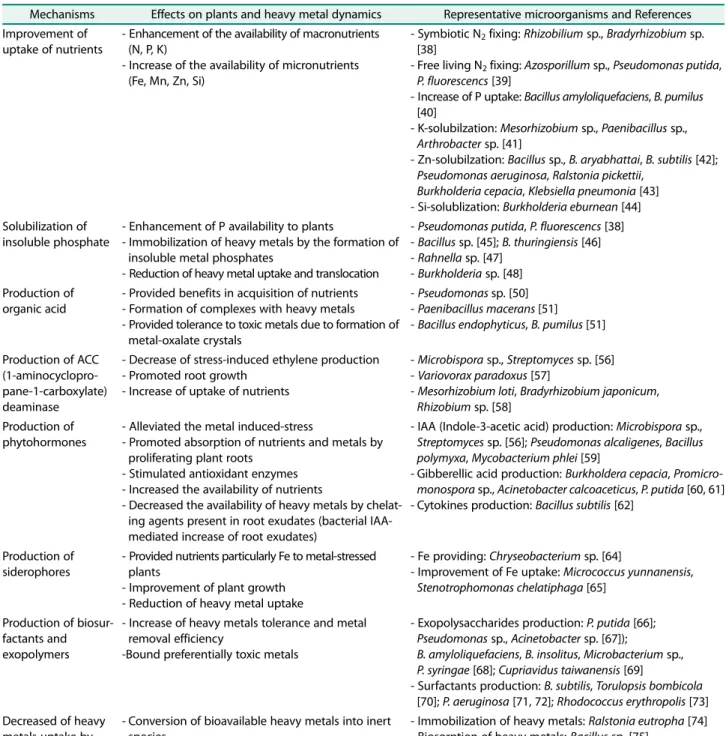
Table 2에
정리하
였다
.질소고정세균은
대기
중의
질소를
식물이
흡수
가능
한
질소화합물의
형태로
고정화하여
식물
생장에
필요한
macronutrient중
하나인
질소를
제공할
수
있다
.질소고
정세균은
식물과
공생관계를
형성하는
Rhizobilium sp.및
Bradyrhizobium sp.등과
같은
공생형
세균과
[38], Azosporillum sp.및
Pseudomonas sp.등과
같이
비공생형
세균으로
구분된다
[39]. Bacillus amyloliquefaciens및
B. pumilus등은
식물의
인의
흡수를
향상시키고
[40],Mesorhizobium, Paenibacillus
및
Arthrobacter등은
불용
성
칼륨을
용해하여
식물이
흡수
가능하도록
할
수
있다
[41].PGPR
은
식물
생장을
위해
미량으로
필요한
아연과
규소와
같은
micronutrient을
식물이
이용
가능하도록
availability를
증가시킬
수
있다
.아연을
가용화
할
수
있는
세균으로
Bacillus, Pseudomonas, Ralstonia, Burkholderia, Klebsiella
등이
있고
[42, 43],규소
가용화
세균으로
Burkholderia eburnean가
보고되고
있다
[44].불용성
인산염
화합물을
가용화
시킬
수
있는
Pseudomonas,Bacillus, Rahnella
및
Burkholderia등은
식물
생장에
필요
한
인산염을
공급하여
식물
생장을
촉진할
수
있다
[38, 45−
48].또한
,이들
세균에
의해
가용화된
인산염을
중금속과
결
합하여
불용성
화합물로
고정화되어
중금속의
이동성이
낮
게
된다
.이렇게
되면
식물에
의한
중금속
흡수량이
감소되
므로
,중금속
독성으로부터
식물을
보호하는
효과를
얻을
수
있다
[49]. PGPB에
의해
생산된
유기산은
식물의
생장을
촉진시키는
영양분으로
이용될
수
있다
[49].또한
,이러한
유기산은
중금
속과
복합
화합물을
형성할
수
있는데
,특히
metal-oxalate결정물로
되면
독성도가
낮아진다
[49].대표적인
유기산
생
성
세균으로
Pseudomonas, Paenibacillus및
Bacillus등이
보고되고
있다
[50, 51].1-aminocyclopropane-1-carboxylate (ACC)
는
식물
스트
레스
호르몬인
ethylene의
전구물질인데
[52, 53], PGPB중
에서
ACC를
암모니아와
2-oxobutanoate로
분해하는
ACC deaminase를
생산하는
세균이
있다
[54]. ACC deaminase를
생산하는
세균은
식물
뿌리
생장을
촉진하고
식물에
의한
영
양분
흡수를
증가시킬
수
있다
[49, 55].대표적인
ACCdeaminase
를
생산하는
세균으로
Microbispora, Streptomyces, Variovorax, Mesorhizobium, Bradyrhizobium및
Rhizobium등이
보고되고
있다
[56−
58]. PGPB중
일부는
식물
생장을
촉진하는
phytohormone을
생산할
수
있다
. Phytohormone을
생산하는
세균은
식물에
대한
중금속의
독성
영향을
감소시킬
수
있고
,뿌리
생장을
촉진하여
영양분과
중금속
흡수를
향상시키고
,식물의
항산
화
효소
활성을
촉진시킬
수
있다
[49, 55].대표적인
Table 2. Overall benefic mechanisms of plant-growing promoting bacteria on plants.
Mechanisms Effects on plants and heavy metal dynamics Representative microorganisms and References Improvement of
uptake of nutrients
- Enhancement of the availability of macronutrients (N, P, K)
- Increase of the availability of micronutrients (Fe, Mn, Zn, Si)
- Symbiotic N2 fixing: Rhizobilium sp., Bradyrhizobium sp. [38]
- Free living N2 fixing: Azosporillum sp., Pseudomonas putida, P. fluorescencs [39]
- Increase of P uptake: Bacillus amyloliquefaciens, B. pumilus [40]
- K-solubilzation: Mesorhizobium sp., Paenibacillus sp., Arthrobacter sp. [41]
- Zn-solubilzation: Bacillus sp., B. aryabhattai, B. subtilis [42]; Pseudomonas aeruginosa, Ralstonia pickettii,
Burkholderia cepacia, Klebsiella pneumonia [43] - Si-solublization: Burkholderia eburnean [44] Solubilization of
insoluble phosphate
- Enhancement of P availability to plants
- Immobilization of heavy metals by the formation of insoluble metal phosphates
- Reduction of heavy metal uptake and translocation
- Pseudomonas putida, P. fluorescencs [38] - Bacillus sp. [45]; B. thuringiensis [46] - Rahnella sp. [47]
- Burkholderia sp. [48] Production of
organic acid
- Provided benefits in acquisition of nutrients - Formation of complexes with heavy metals - Provided tolerance to toxic metals due to formation of
metal-oxalate crystals
- Pseudomonas sp. [50] - Paenibacillus macerans [51] - Bacillus endophyticus, B. pumilus [51] Production of ACC
(1-aminocyclopro-pane-1-carboxylate) deaminase
- Decrease of stress-induced ethylene production - Promoted root growth
- Increase of uptake of nutrients
- Microbispora sp., Streptomyces sp. [56] - Variovorax paradoxus [57]
- Mesorhizobium loti, Bradyrhizobium japonicum, Rhizobium sp. [58]
Production of phytohormones
- Alleviated the metal induced-stress
- Promoted absorption of nutrients and metals by proliferating plant roots
- Stimulated antioxidant enzymes - Increased the availability of nutrients
- Decreased the availability of heavy metals by chelat-ing agents present in root exudates (bacterial IAA-mediated increase of root exudates)
- IAA (Indole-3-acetic acid) production: Microbispora sp., Streptomyces sp. [56]; Pseudomonas alcaligenes, Bacillus polymyxa, Mycobacterium phlei [59]
- Gibberellic acid production: Burkholdera cepacia, Promicro-monospora sp., Acinetobacter calcoaceticus, P. putida [60, 61] - Cytokines production: Bacillus subtilis [62]
Production of siderophores
- Provided nutrients particularly Fe to metal-stressed plants
- Improvement of plant growth - Reduction of heavy metal uptake
- Fe providing: Chryseobacterium sp. [64]
- Improvement of Fe uptake: Micrococcus yunnanensis, Stenotrophomonas chelatiphaga [65]
Production of biosur-factants and exopolymers
- Increase of heavy metals tolerance and metal removal efficiency
-Bound preferentially toxic metals
- Exopolysaccharides production: P. putida [66]; Pseudomonas sp., Acinetobacter sp. [67]);
B. amyloliquefaciens, B. insolitus, Microbacterium sp., P. syringae [68]; Cupriavidus taiwanensis [69]
- Surfactants production: B. subtilis, Torulopsis bombicola [70]; P. aeruginosa [71, 72]; Rhodococcus erythropolis [73] Decreased of heavy
metals uptake by plants
- Conversion of bioavailable heavy metals into inert species
- Change of the speciation of heavy metals from bio-available forms to non-biobio-available ones
- Biosorption, bioaccumulation and sequestration of heavy metals
- Immobilization of heavy metals: Ralstonia eutropha [74] - Biosorption of heavy metals: Bacillus sp. [75]
- Sequestration of heavy metals: Bacillus cereus [76]
Change of heavy metals speciation
- Reduction of heavy metals toxicity - Reduction of Cr6+
to Cr3+: P. aeruginosa [77] Induced production
of antioxidant enzymes by plant
- Enhancement of tolerance to environmental stress - Enterobacter sp. [78] - Bacillus sp. [79] - B. thuringiensis [80] - P. aeruginosa [81]
균은
Microbispora, Streptomyces, Pseudomonas, Bacillus및
Mycobacterium등이
있다
[56, 59].또
다른
phytohormone인
gibberellic acid을
생산할
수
있는
세균으로
Burkholdera, Promicromonospora, Acinetobacter및
Pseudomonas등이
보고되었고
[60, 61], cytokine을
생산하는
세균으로
Bacillus subtilis가
있다
[62].철은
모든
생명체에
필수적으로
요구되는
미량영양분이나
,호기적인
토양
환경에서
철은
hydroxides혹은
oxyhydroxides와
같은
bioavailability가
매우
낮은
불용성
철화합물로
존
재한다
[63].미생물은
철과
매우
높은
친화력을
가진
저분자
킬레이터
(chelator)인
siderophores를
분비하여
환경으로부
터
철을
획득할
수
있다
[49, 55]. Siderophores을
분비하는
Chryseobacterium는
식물에
철을
제공하여
식물
생장을
촉
진할
수
있었다
[64].또한
, Micrococcus yunnanensis와
Stenotrophomonas chelatiphaga등의
siderophores생산균
의
공존에
의해
식물에
의한
철
흡수가
향상되는
효과가
있
었다
[65].세포
외부에
다당류와
계면활성제를
생산하는
세균의
공
존은
중금속에
대한
식물의
내성을
증가시키고
중금속
제거
효율을
향상시킬
수
있다
[49, 55].다당류를
생산하는
PGPB로
Pseudomonas, Acinetobacter, Bacillus, Microbacterium, P. syringae및
Cupriavidus등이
있다
[66−
69].또한
,계면활
성제를
생산하는
PGPB로는
B. subtilis, Torulopsis bombicola, P. aeruginosa및
Rhodococcus erythropolis등이
보고되고
있다
[70−
73]. PGPB중에서
생물학적으로
이용할
수
있는
중금속화합물
을
불활성
화합물
혹은
생물학적으로
이용
불가능한
중금속
으로
변환하거나
,세균의
세포
표면
혹은
내부로
중금속을
흡착
·흡수하여
식물에
의한
중금속
흡수량을
감소시킬
수
있
다
[49, 55].이러한
기능을
가진
PGPB로
Ralstonia eutropha, Bacillus sp.및
B. cereus등이
보고되고
있다
[74−
76].또한
, P. aeruginosa등의
세균은
독성이
강한
Cr6+을
Cr3+로
환원하
여
무독화
시킬
수
있다
[77].식물은
항산화
효소를
이용하
여
중금속에
대해
내성을
가지게
되거나
,중금속독성을
무독
화
시킬
수
있다
[49, 55]. Enterobacter sp., Bacillus sp., B. thuringiensis및
P. aeruginosa등은
중금속
오염
토양에서
식물에
의한
항산화
효소
생산을
유도하여
식물생장촉진
활
성을
가지고
있었다
[78−
81].단일 중금속 오염 토양의 phytoremediation에서
PGPB
활용 사례
중금속
오염
토양
정화를
위해
식물을
이용한
식물상복원
법에
PGPB를
활용한
사례
중
최근
10년간
진행된
연구동향
을
Table 3−
6에
정리하였다
.전세계적으로
수
백만명
이상
의
사람이
비소로
오염된
경작지와
식수
등으로
인해
비소
독성의
영향을
받고
있는
것으로
알려져
있다
[82].특히
,유
럽
,멕시코
,방글라데시
,파키스탄
,인도
,중국
등에서는
비
소
오염이
광범위하게
발견되고
있다
[82].국제암연구기구
(International Agency of Research on Cancer, IARC),
국
제보건기구
(World Health Organization, WHO)및
미국
환
경청
(Environmental Protection Agency, EPA)등은
비소를
발암물질로
분류하고
있다
[83].비소로
오염된
토양의
식물상정화법에
PGPB의
활용
효
과를
연구한
결과를
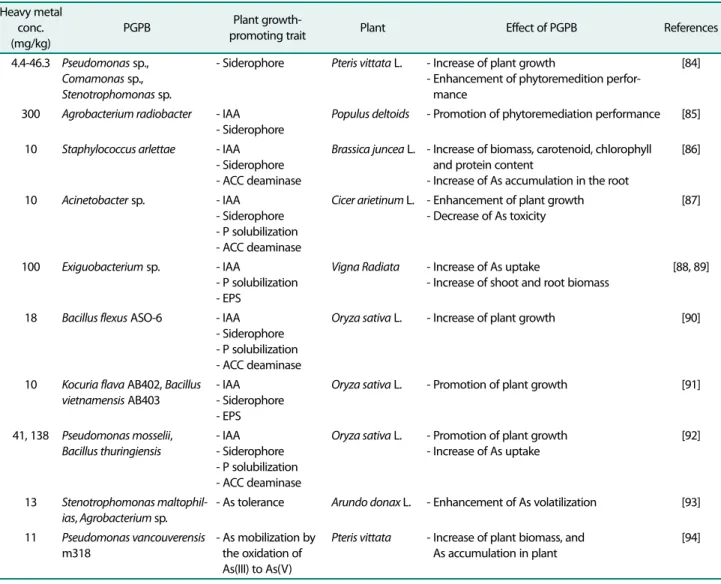
Table 3에
정리하였다
.고사리
(Pteris vittata L.)는
뿌리
삼출물로
불용성
비소화합물을
용해하여
비소를
식물조직내에
축적할
수
있는
대표적인
식물이다
[84].철과
착화합물을
형성할
수
있는
siderophore를
생산할
수
있는
PGPB (Pseudomonas sp., Comamonas sp.및
Stenotrophomonas sp.)을
고사리에
접종하면
고사리
생장이
증가되고
정화
효율도
향상되는
효과를
얻을
수
있었다
[84].미루나무
(Populus deltoids),갓
(Brassica juncea L.),병아리
콩
(Cicer arietinum L.)및
녹두
(Vigna Radiata)에
PGPR을
접종하여
식물
생장과
비소
정화
효율이
향상된
연구들도
보
고되고
있다
[85−
89].벼에
Bacillus flexus, Kocuria flava, Bacillus vietnamensis, Pseudomonas mosselii및
Bacillusthuringiensis
등과
같은
PGPB를
접종하면
벼
생장이
향상
되고
,토양으로부터
비소
흡수량도
증가하였다
[90−
92]. PGPB는
식물의
생장과
식물조직
체내로의
비소
축적을
향
상시킬
뿐
아니라
,식물에
의한
비소
휘발
제거능도
향상시
킬
수
있었다
[93]. Yang et al. (2020)은
비소
오염
토양
현장에서
비소
과축
적식물인
고사리
(Pteris vittata L.)의
비소
정화효율에
미치
는
근권세균인
Pseudomonas vancouverensis의
활용
효과를
조사하였다
[94].고사리는
As(III)보다는
As(V)를
효율적으
로
축적할
수
있는데
, P. vancouverensis는
As(III)을
As(V)로
산화함으로써
고사리에
의한
비소
흡수효율을
향상할
수
있었다
.즉
,이
균주를
접종한
조건에서
고사리의
조직에
축
적된
비소량은
이
균주를
접종하지
않은
조건에서
재배한
고
사리의
조직에
축적된
비소량보다
높았다
.또한
,이러한
비
소
정화
효율
증가에
미치는
P. vancouverensis의
접종
효과
는
3년동안
현장에서
안정적으로
관찰되었고
,고사리
근권
토양에서
비소
산화에
관여하는
효소인
arsenite oxidase (aioA-like)유전자도
검출되었다
.카드뮴은
농경지와
산업단지
토양의
주요
오염
중금속으
로
[95],특히
카드뮴으로
오염된
농경지에서
재배된
작물은
이를
소비하는
인간에까지
카드뮴
중독
문제를
야기할
수
있
다
[96]. Prapagdee et al. (2013)은
중금속
축적
식물로
알려
진
해바라기
(Helianthus annuus)의
생장과
카드뮴
흡수
효
BAM1
의
접종
효과를
평가하였다
[97]. MU1과
BAM1균주
는
IAA을
생산하고
카드뮴에
내성을
가진
PGPB이다
.이들
균주를
접종하지
않은
대조군에
비해
,이들
균주
접종에
의
해
카드뮴
오염
토양에서의
해바라기
뿌리
생장은
21−
68%향상되었고
,뿌리와
잎에서의
카드뮴
축적
농도가
1.3배
증
가하였다
[97].IAA
와
siderophore을
생산하고
ACC deaminase활성을
가진
Bradyrhizobium sp.을
벼과
식물인
쥐보리
(Loliummultiflorum L.)
에
접종한
결과
,카드뮴의
뿌리
축적량이
증
가하였다
[98].카드뮴을
과축적할
수
있는
2종류의
비름과
식물
(Amaranthus hypochondriacus, A. Mangostanus)에
,카드뮴에
내성이
있고
카드뮴을
유동화
할
수
있으며
식물
조직
내에서
서식하는
PGPB인
Rahnella sp. JN27을
접종
한
결과
,식물
생장과
카드뮴
흡수량이
증가하였다
[99].Rahnella sp. JN27
은
왕자의깃털
(A. hypochondriacus)근
권토양과
뿌리조직내에서
안정적으로
군락을
형성함이
확인
되어
,이들
사이에
symbiont관계
형성이
카드뮴
정화
효율
향상에
기여한
것으로
보인다
[99].벼과
식물인
큰개기장
(Panicum virgatum L.)에
PGPB (Pantoea vagans, Pseudomonas grimontii, P. veronii, P.fluorescens)
를
접종한
결과
,큰개기장의
생체량과
카드뮴
흡
수량이
증가하는
효과를
얻을
수
있었다
[100].우리나라와
중국에서
많이
자생하고
있는
소래풀
(Orychophragmus violaceus)을
대상으로
,카드뮴
오염
토양에서
소래풀의
생장
과
카드뮴
흡수량의
영향을
미치는
여러
종의
PGPB접종
효
과를
비교
분석하였다
[101].그
결과
, Bacillus megaterium을
접종한
경우
,무접종
대조군에
비해
소래풀
뿌리와
지상
부에
축적된
카드뮴
농도가
각각
2.29배와
2.86배
증가하여
,Table 3. Plant-growing promoting bacteria (PGPB)-assisted phytoremediation of As-contaminated soils.
Heavy metal conc. (mg/kg)
PGPB Plant
growth-promoting trait Plant Effect of PGPB References 4.4-46.3 Pseudomonas sp.,
Comamonas sp., Stenotrophomonas sp.
- Siderophore Pteris vittata L. - Increase of plant growth
- Enhancement of phytoremedition perfor-mance
[84]
300 Agrobacterium radiobacter - IAA - Siderophore
Populus deltoids - Promotion of phytoremediation performance [85] 10 Staphylococcus arlettae - IAA
- Siderophore - ACC deaminase
Brassica juncea L. - Increase of biomass, carotenoid, chlorophyll and protein content
- Increase of As accumulation in the root
[86]
10 Acinetobacter sp. - IAA - Siderophore - P solubilization - ACC deaminase
Cicer arietinum L. - Enhancement of plant growth - Decrease of As toxicity
[87]
100 Exiguobacterium sp. - IAA
- P solubilization - EPS
Vigna Radiata - Increase of As uptake
- Increase of shoot and root biomass
[88, 89]
18 Bacillus flexus ASO-6 - IAA - Siderophore - P solubilization - ACC deaminase
Oryza sativa L. - Increase of plant growth [90]
10 Kocuria flava AB402, Bacillus vietnamensis AB403
- IAA - Siderophore - EPS
Oryza sativa L. - Promotion of plant growth [91]
41, 138 Pseudomonas mosselii, Bacillus thuringiensis - IAA - Siderophore - P solubilization - ACC deaminase
Oryza sativa L. - Promotion of plant growth - Increase of As uptake
[92]
13 Stenotrophomonas maltophil-ias, Agrobacterium sp.
- As tolerance Arundo donax L. - Enhancement of As volatilization [93] 11 Pseudomonas vancouverensis
m318
- As mobilization by the oxidation of As(III) to As(V)
Pteris vittata - Increase of plant biomass, and As accumulation in plant
[94]
이
균주가
소래풀을
이용한
카드뮴
정화를
위한
최적의
PGPB임을
확인하였다
.옥수수
(Zea mays L.)는
중금속
정화를
위해
많이
활용되
고
있는
식물이다
.카드뮴
오염
토양
(30−
80 mg/kg)에
심은
옥수수에
PGPB (Ralstonia eutropha, Chryseobacterium humi, Klebsiella sp. CIK-518, Enterobacter sp. CIK-521R)를
접종하여
옥수수의
생장과
카드뮴
흡수량이
모두
향상되었
다
[74, 102, 103]. IAA및
siderophore생산능
, ACC deaminase활성
및
질소고정능을
지닌
Enterobacter aerogenes MCC 3092을
벼
(Oryza sativa L.)모종에
접종한
효과를
분석한
결
과
,에틸렌에
의한
식물의
스트레스가
감소하고
벼
모종에
카드뮴
흡수량이
감소하여
모종의
생장이
향상되었다
[104].IAA, siderophore
및
EPS생산능
,인산염
가용화
활성
및
ACC deaminase
활성
등
다양한
식물생장촉진
능력을
지닌
Paenibacillus sp. ISTP10
을
목화
(Gossypium hirsutum L.)에
접종하면
광합성
색소인
chrolophyll함량이
증가하여
식
물
생장이
향상되었다
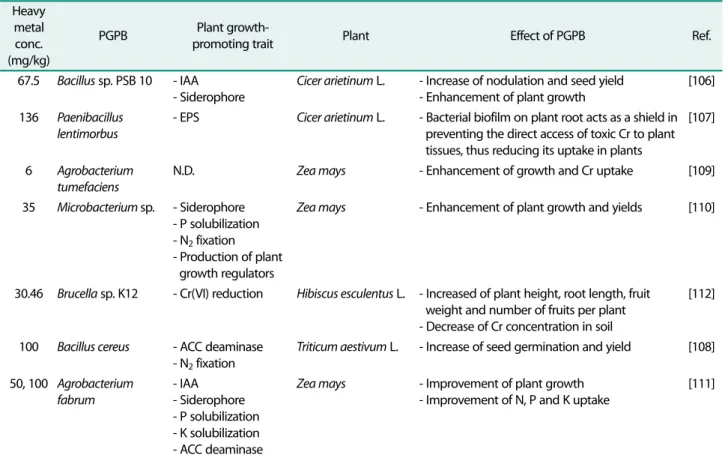
[105].크롬은
다양한
산업과
화학공정에서
사용되는
중금속으
로
,산화가가
6가인
Cr(VI)는
맹독
중금속이다
. IAA와
siderophore를
생산할
수
있는
Bacillus sp. PSB 10는
크롬
오염
토양에서
병아리콩
(Cicer arietinum L.)의
생장을
증가
시켜
콩
생산량을
향상시킬
수
있었다
[106].식물
생장을
촉
Table 4. Plant-growing promoting bacteria (PGPB)-assisted phytoremediation of Cd-contaminated soils.
Heavy metal conc. (mg/kg)
PGPB Plant growth-promoting
trait Plant Effect of PGPB Ref.
65.2 Micrococcus sp. MU01, Klebsiella sp. BAM1
- IAA
- ACC deaminase
Helianthus annus - Enhancement of root growth and Cd accumulation in root and leaf
[97] 20 Bradyrhizobium sp. - IAA
- Siderophore - ACC deaminase
Lolium multiflorum L. - Increase of Cd accumulation in root [98]
25 Rahnella sp. - IAA - Siderophore - P solubilization - ACC deaminase Amaranthus hypochondriacus, A. Mangostanus
- Enhancement of growth and Cd uptake
[99]
35 Pseudomonas grimontii, Pantoea vagans, Pseudomonas veronii, Pseudomonas fluorescens
- IAA - Siderophore - P solubilization
Panicum virgatum L. - Increase of biomass and Cd uptake
[100]
100 Bacillus megaterium - Cd tolerance - Root enlongation
Orychophragmus violaceus
- Enhancement of Cd accumulation in root and shoot
[101] 30 Ralstonia eutropha,
Chryseobacte-rium humi
- IAA - HCN - Siderophore - ACC deaminase
Zea mays L. - Enhancement of plant growth and Cd accumulation in root
[74]
80 Klebsiella sp. CIK-518, Enterobacter sp. CIK-521R
- P solubilization - EPS
-Auxin
Zea mays L. - Increase of Cd uptake [102]
500 Pseudomonas putida (ATCC 39213)
- IAA - Siderophore - ACC deaminase
Eruca sativa - Increase of root and shoot length, plant dry weight and chlorophyll contents
[103]
3 mg/l Enterobacter aerogenes MCC 3092 - IAA - Siderophore - ACC deaminase - N2 fixation
Oryza sativa L. - Reduction of oxidative stress, stress ethylene and Cd uptake in rice seedlings
- Increase of rice seedling growth
[104]
60 Paenibacillus sp. ISTP10 - IAA - Siderophore - P solubilization - ACC deaminase - EPS
- HCN
Gossypium hirsutum L. - Increase of chlorophyll contents, plant height and root length - Increase of plant fresh and dry
weight
[105]
진하는
phytohormone인
IAA생산능을
가진
Paenibacillus lentimorbus는
EPS를
생산하여
생물막
(biofilm)을
형성하여
200 mg-Cr/L
의
고농도
크롬에
대해
내성을
가지게
된다
[107].크롬으로
오염된
토양에서
병아리콩
(Cicer arietinum L.)에
이
세균을
접종하며
,이
세균의
바이오필름은
크롬
독
성으로부터
식물
조직을
보호하고
보호막으로
작용하여
궁
극적으로
크롬이
식물
조직
내부로
흡수되는
것을
감소시킬
수
있다
[107]. ACC deaminase활성
및
질소고정능이
있는
Bacillus cereus
을
밀
(Triticum aestivum L.)종자의
발아율
을
향상시킬
수
있었다
[108].크롬이
고농도로
함유된
가죽공장폐수로
인해
오염된
토
양에서
옥수수
(Zea mays)의
생장과
크롬
흡수량을
향상시킬
수
있는
균주를
분리하여
동정한
결과
, Agrobacterium tumefaciens로
동정되었다
[109].이들
균주의
접종에
의해
옥
수수
생장은
2.3−
4배
증가하였고
,크롬
흡수량은
7−
14배
증
가하였다
.또한
, Microbacterium sp.와
Agrobacterium fabrum도
크롬
오염
토양
조건에서
옥수수
생장을
향상시
킬
수
있었는데
,이들
균주는
siderophore생산능
,인산염
가
용화
활성
,질소고정능
, ACC deaminase활성
등의
식물생
장촉진
특성을
가지고
있음이
확인되었다
[110, 111].Maqbool et al. (2015)
는
독성이
강한
Cr(VI)를
독성이
낮
은
Cr(III)로
환원할
수
있는
Brucella sp. K12을
순수
분리
하여
,아욱과
다년생초인
오크라
(Hibiscus esculentus L.)에
접종한
효과를
조사하였다
[112]. K12균주를
미접종한
대조
군에
비해
, K12균주
접종한
조건에서
오크라의
지상부
높
이
,뿌리길이
,식물
한
개체당
열매
수확량이
각각
77.5%, 72.6%, 1.4배
그리고
2.9배
증가하였다
.또한
,토양
중
크롬
농도도
최대
69.6%감소하였다
.구리
,납
혹은
아연으로
오염된
토양의
식물상복원법에서
PGPB활용
사례를
Table 4에
정리하였다
.구리
오염
토양
에
식물생장촉진
특성을
가진
Microbacterium sp.를
옥수수
에
접종하여
식물
생장
향상
효과를
얻을
수
있었다
[110]. PGPB인
Paenibacillus mucilaginosus와
구리에
내성을
가
진
rhizobium인
Sinorhizobium meliloti을
접종하고
생분해
성
킬레이트
물질인
S,S-ethylenediaminedisuccinic acid (EDDS)를
첨가한
조건에서
알파파에
의한
구리
제거
효율
을
가장
높았다
[113]. EDDS만
첨가한
조건에서
알파파에
의
한
구리
제거
효율에
비해
, EDDS첨가와
동시에
이들
균주
를
접종했을
때
구리
제거효율이
1.2배
높았다
. EDDS만
첨
가하면
알파파
근권의
미생물군집
다양성이
낮아졌지만
,이
들
균주를
접종하면
근권
미생물
군집
다양성이
증가하는
효
과도
관찰되었다
.식물
생장
향상
능력이
있는
Azotobactor chroococum와
Rhizobium leguminosarum균주를
동시에
접종한
경우가
각각의
균주만을
접종한
결과에
비해
옥수수
(Zea mays L.)생장과
옥수수
조직내
납의
축적량이
크게
증가하였다
[114].또한
,납
오염
토양
(300−
900 mg/kg)에서
해바라기
(Helianthus annus var Hisun-33)에
3종의
PGPB (Pseudomonas gessardii BLP141, P. fluorescens A506, P. fluorescens LMG 2189)을
접종한
결과
,옥수수의
산화방지
(antioxidant)활성이
증
가하고
생장이
향상되었다
[115].아연으로
오염된
토양에서
돌나물과
다년생풀인
민밀똥비
름
(Sedum alfredii)의
생장과
아연
흡수율을
향상시키기
위
해
식물
조직
내부에
서식하는
PGPB인
Pseudomonas veronii을
접종하면
뿌리와
지상부
생체량이
각각
80−
525%및
11−
47%증가하였다
.또한
,뿌리와
지상부에
축적된
아연
농도도
각각
44%와
39%증가하였다
[116].아연
오염
토양
에서의
밀
(Triticum aestivum L.)의
생장은
IAA와
siderophore생산능과
ACC deaminase활성을
가진
Pseudomonasaeruginosa
접종에
의해
향상되었다
[81].겨자과
식물인
갓
(Brassica juncea)을
활용한
납
오염
토양
정화
과정에서
Rhizobium leguminozarum을
접종하면
식물
성장과
갓
조
직내
아연의
축적량은
증가하였다
[117].또
다른
PGPB인
Pseudomonas brassicacearum만을
접종하면
갓의
생장
촉
진
효과가
관찰되지
않았으나
, P. brassicacearum와
R. leguminozarum을
동시에
접종하면
식물생장촉진과
아연
정
화
효율
향상
효과가
관찰되었다
. PGPB공존
여부에
따라
식물체내
축적된
아연화합물의
형태도
차이가
있었다
. PGPB가
없는
조건에서는
갓
조직내
아연은
oxalate혹은
sulfate염
형태로
축적되었으나
, PGPB공존시
독성이
적은
아연
킬
레이트
형태로
갓
조직
내부에
축적되었다
.즉
, PGPB는
아
연
킬레이트
화합물
형성에
기여한
것으로
평가되었다
.혼합 중금속 오염 토양의 phytoremediation에서
PGPB
활용 사례
실제
중금속
오염
토양은
여러
종류의
중금속이
혼합된
상
태로
오염되어
있으므로
, 2종
이상의
혼합
중금속
오염
토양
을
대상으로
식물상복원법에
있어
PGPB활용에
대한
연구
사례를
Table 5에
정리하였다
.비소와
수은으로
오염된
토
양에서
갓
(Brassica juncea)과
화이트루핀
(Lupinus albus)의
생장은
Gordonia등을
비롯한
여러
종의
PGPB접종에
의
해
향상되었다
[118].풀완두
(Lathyrus sativus)를
이용하여
카드뮴과
납으로
오염된
토양을
정화함에
있어
Rhizobiumleguminosarum, Pseudomonas fluorescens, Luteibacter sp.
및
Variovorax sp.로
구성된
컨소시움의
접종
효과를
평
가하였다
[119].대조군
(컨소시움
무접종
)에
비해
, PGPB컨
소시움
접종에
의해
카드뮴과
납의
제거
효율은
각각
61%와
46%
증가하였다
.또한
,풀완두
뿌리
건조중량과
뿌리혹
개
돌나물과
식물인
세둠
(Sedum plumbizincicola)을
이용하
여
카드뮴과
아연으로
오염된
토양
정화
효율은
Bacilluspumilus E2S2, Bacillus sp. E1S2
의
접종으로
향상되었다
[75].특히
, Bacillus pumilus E2S2균주
접종에
의해
뿌리
와
총
건조중량은
각각
146%및
32%증가되었다
.또한
,카
드뮴과
아연
복합
오염
조건에서
뚱딴지
(Helianthustuberosus)
의
생장은
Pseudomonas sp. 228, Serratia sp. 246및
Pseudomonas sp. 262의
공존
조건에서
향상되었다
[120]. Siderophore,계면활성제
및
저분자의
유기산을
생산할
수
있는
Pseudomonas sp. LK9는
카드뮴
,구리
및
아연
복합
오
염
조건에서
까마중
(Solanum nigrum)에
의한
이들
중금속
의
흡수량이
증가되는
효과를
보였다
[50].또한
,카드뮴
,납
,아연
복합
오염
토양에서
호랑버들
(Salix Caprea),유채
(Brassica napus)
및
바보여뀌
(Polygonum pubescens)의
생
장과
중금속
정화
효율
향상에
PGPB접종
효과가
보고되었
다
[47, 121, 122].카드뮴
,구리
,니켈
및
아연
4종
복합
중금속
오염
토양에
서
서양겨자
(Sinapis alba L.)의
생장과
카드뮴
흡수량은
Brevibacterium casei MH8a
의
접종에
의해
향상되었다
[123]. IAA
와
EPS생산능이
있고
ACC deaminase활성이
가진
Bacillus gibsonii PM11및
Bacillus xiamenensisPM14
는
카드뮴
,구리
,크롬
및
아연
4종
복합
중금속
오염
토양에서
아마
(Linum usitatissimum L.)의
생장을
촉진시킬
수
있었다
[124]. Burkholderia sp. D54는
카드뮴
,구리
,납
및
아연
4종
복합
중금속
오염
토양에서
스피루리나
(Spirulina Platensis)및
민말똥비름
(Sedum alfredii Hance)의
생장을
촉진하여
중금속
흡수량을
증가시킬
수
있었다
[125, 126].Phytoremediation
에서 PGPB 활용 한계 및 과제
농업에서
식물의
생장을
촉진하기
위해
사용하고
있는
일
반적이면서
가장
검증된
방법이
화학비료의
사용이다
[15].따라서
,중금속
오염
토양의
식물상복원법에서
식물의
생장
을
촉진하기
위해서는
화학비료를
사용하는
것이
신뢰성
있
는
방법으로
생각할
수
있으나
,화학비료
사용으로
인한
2차
환경오염문제
뿐
아니라
식물
생장
촉진이
중금속
제거
효
율
향상으로
직접
연결되지
않는
경우도
종종
있기
때문에
,Table 5. Plant-growing promoting bacteria (PGPB)-assisted phytoremediation of Cr-contaminated soils.
Heavy metal conc. (mg/kg)
PGPB Plant
growth-promoting trait Plant Effect of PGPB Ref.
67.5 Bacillus sp. PSB 10 - IAA - Siderophore
Cicer arietinum L. - Increase of nodulation and seed yield - Enhancement of plant growth
[106] 136 Paenibacillus
lentimorbus
- EPS Cicer arietinum L. - Bacterial biofilm on plant root acts as a shield in preventing the direct access of toxic Cr to plant tissues, thus reducing its uptake in plants
[107]
6 Agrobacterium tumefaciens
N.D. Zea mays - Enhancement of growth and Cr uptake [109]
35 Microbacterium sp. - Siderophore - P solubilization - N2 fixation - Production of plant
growth regulators
Zea mays - Enhancement of plant growth and yields [110]
30.46 Brucella sp. K12 - Cr(VI) reduction Hibiscus esculentus L. - Increased of plant height, root length, fruit weight and number of fruits per plant - Decrease of Cr concentration in soil
[112]
100 Bacillus cereus - ACC deaminase - N2 fixation
Triticum aestivum L. - Increase of seed germination and yield [108] 50, 100 Agrobacterium fabrum - IAA - Siderophore - P solubilization - K solubilization - ACC deaminase
Zea mays - Improvement of plant growth - Improvement of N, P and K uptake
[111]
![Fig. 1. Major sources of heavy metals contamination [19].](https://thumb-ap.123doks.com/thumbv2/123dokinfo/4982897.55288/2.892.211.679.705.1088/fig-major-sources-heavy-metals-contamination.webp)
![Fig. 3. Effects of heavy metals and reactive oxygen species on microorganism, plant and human [23, 24]](https://thumb-ap.123doks.com/thumbv2/123dokinfo/4982897.55288/3.892.142.747.770.1098/effects-heavy-metals-reactive-oxygen-species-microorganism-plant.webp)
![Table 1. Speciation, chemistry, toxicity and sources of heavy metals [1, 15, 16, 26-28].](https://thumb-ap.123doks.com/thumbv2/123dokinfo/4982897.55288/4.892.86.806.280.1112/table-speciation-chemistry-toxicity-sources-heavy-metals.webp)
![Fig. 4. Phytoremediation technology of heavy metal-contaminated soil [34].](https://thumb-ap.123doks.com/thumbv2/123dokinfo/4982897.55288/5.892.226.657.661.1097/fig-phytoremediation-technology-heavy-metal-contaminated-soil.webp)