밭
밭과 과 시 시설 설재 재배 배지 지 토 토양 양의 의 인 인산 산가 가용 용화 화 미 미생 생물 물의 의 특 특성 성
Characterization of Phosphate-solubilizing Microorganisms in Upland and Plastic Film House Soils
서장선·권장식
Jang-Sun Suh,
*and Jang-Sik Kwon
농촌진흥청 국립농업과학원
National Academy of Agricultural Science, RDA Suwon 441-707, Korea
With the aim to explore the possible role of phosphate-solubilizing bacteria in soil, we conducted a survey of phosphate-solubilizing microorganisms colonizing in upland and plastic film house soils. Soil EC, pH, organic matter, available phosphate, exchangeable cation such as potassium, calcium and magnesium, and total P of plastic film house soils were higher than those of upland soils. Phosphate-solubilizing bacteria population was higher in plastic film house soils than upland soils, but species of phosphate-solubilizing bacteria was more diverse in the upland soils than the plastic film house soils. There was significant positive correlation between phosphate solubilization and phosphate-solubilizing bacteria in soils. Bacillus, Cedecea, Brevibacillus, Paenibacillus, Pseudomonas, Serratia spp. were isolated from upland soils and Bacillus and Cellulomonas spp. were from plastic film house soils.
Key words : Upland soil, Plastic film house soil, Phosphate-solubilizing bacteria
서 언
생물비료와 관련된 주요 미생물에는 무기태 질소를 고정하는 질소 고정균, 광합성작용을 하여 유기물을 형성하는 광합성균, 규산염 광물을 용해하여 칼리를 공급하는 칼리 용해균, 인산염을 가용하여 인산을 공 급하는 인산 가용화균 등이 있다(Wu et al., 2005).
인산 가용화균은 난용성 인산염을 미생물 스스로는 물론 작물이 이용할 수 있게 하는 기능을 가지고 있 는 미생물이다. 인산 가용화균의 가용화 기작은 착화 물 생성, sulphidric, nitric 및 carbonic acid 등에 의하 기도 하지만, gluconic acid, 2-ketogluconic acid, lactic, isovaleric, isobutyric, acetic, glycolic, oxalic, malonic 및 succinic acid와 같은 유기산에 의한 가용화도 주요 기 능이라고 보고되고 있다(Illmer and Schinner, 1992).
인산은 가용성 무기 인산염 형태로 토양에 시용되는 식물의 필수 양분이지만, 많은 부분이 불용화되어 식 물이 흡수할 수 없게 되는(Sing and Kapoor, 1994) 인 산의 특성은 화학비료 가격을 높일 뿐만 아니라 토양 비옥도면에서도 역효과를 나타낸다(Vassilev and Vassilev, 2003). 그러나 미생물을 이용한 인산 가용화
는 비료생산에 들어가는 고비용을 보상해줄 뿐 만 아 니라, 토양에 인산을 공급해주는 중요한 역할을 한다 (Rodriquez and Fraga, 1999). 본 연구는 생물비료로 서의 인산 가용화 균의 생태학적 특성을 알고자 시설 재배지 및 밭 토양을 대상으로 인산 가용화 균의 분 포 및 다양성을 조사하였다.
재료 및 방법
밭 토양은 사토, 사양토, 양토 및 식양토 등 토성별 로, 시설 재배지 토양은 토마토, 상추, 배추, 오이 등 재배 작물 종류별로 각각 두 지점에서 채취하였다. 토 양 화학성과 미생물상은 토양화학 및 토양미생물 분 석법을 이용하였다(농촌진흥청, 1988; 토양미생물연구 회, 1992). 인산가용화 세균 계수는 glucose, 10 g;
Ca3(PO4)2, 5 g; (NH4)2SO4, 0.5 g; NaCl, 0.2 g;
MgSO4ㆍ7H2O, 0.1 g; KCl, 0.2 g; yeast extract, 0.5 g; MnSO4ㆍH2O, 0.002 g; FeSO4ㆍ7H2O, 0.002 g의 조성을 가진 Pikovskaya (PVK) 배지를, 인산가용화 사상균은 Ca3(PO4)2 5 g을 첨가한 rose bengal 배지를 사용하였다. 세균의 속간 동정은 지방산 조성 및 함량 을 이용하는 MIDI 분석법을 사용하였다(Nautiyal, 1999; Suh et al., 2007).
접 수 : 2008. 9. 19 수 리 : 2008. 10. 11
*연락저자 : Phone: +82312900369, E-mail: [email protected]
결과 및 고찰
토양 화학성 토양 화학성은 Table 1과 같이 밭 토 양 pH는 4.88∼7.80, EC 0.20∼1.30 dSm-1, 유기물 4∼
44 g kg-1, 유효인산 55∼1,423 mg kg-1, 치환성 K, Ca, Mg는 각각 0.12∼1.63, 1.1∼15.8, 0.5∼13.8 cmol+ kg-1였다. 토양화학성 변화는 토성 간에 일정하지 않 았으나, 양토와 식양토의 유기물 및 유효인산 함량이 사토와 사양토에 비해 높은 경향이었다.
시설재배지 토양의 산도는 6.03∼7.62, EC는 3.80∼
7.90 dSm-1, 유기물은 26∼125 g kg-1, 유효인산은 1,047∼3,963 mg kg-1, 치환성 K, Ca, Mg 함량은 각각 0.67∼5.97, 6.9∼14.6, 1.6∼9.1 cmol+ kg-1이었다. 시설 재배지 토양은 밭 토양에 비해 EC, 유기물 및 유효인 산 함량이 높은 경향이었고, 재배 작물별 차이는 일정 하지 않았으나 상추와 오이 재배지에서 높았다. 토양 산도, EC, 유기물 함량, 유효인산 및 치환성 양이온 함량은 밭 토양에 비해 시설재배지 토양에서 높은 수 준이었다.
밭 토양의 토성별 총 인 및 분획별 인 함량은 Table 2와 같다. 총 인은 183∼2,929 mg kg-1, saloid-P는 0∼
19 mg kg-1, Ca-P는 5∼379 mg kg-1, Al-P는 10∼404 mg kg-1, Fe-P는 1∼187 mg kg-1이었다. 유효인산 함 량처럼 사토 및 사양토에 비해 양토 및 식양토에서
총 인 함량이 높은 경향이었다. 분획 인은 Saloid-P, Ca-P, Fe-P, Al-P의 순으로 인 함량이 많고 총 인과 같이 이들 분획 인도 양토 및 식양토에서 높은 경향 이었다.
시설재배지 토양의 총 인 함량은 2,386∼4,973 mg kg-1, Saloid-P 56∼379 mg kg-1, Ca-P 184∼513 mg kg-1, Al-P 294∼675 mg kg-1, Fe-P는 145∼310 mg kg-1이었다. 분획인별 함량은 Al-P와 Ca-P가 높은 경 향이었다. 시설 재배지의 인산 함량이 밭 토양보다 높 은 수준을 유지하였다.
토양 미생물상 토양에는 많은 종류의 미생물이 서식하고 있다. 이들 미생물중 대부분의 고유미생물 은 외부환경에 큰 영향을 받지 않지만 발효적 미생물 은 외부에서 투입되는 유기물 등의 물질에 의해 변동 되기 쉬운 특성을 가지고 있다. 따라서 외부 환경변화 에 대한 이들 미생물의 생태학적 특성을 평가하는 것 은 농경학상 중요한 의미를 가지게 된다. 투입되는 자 재는 유기물, 비료 등 다양한 특성을 지닌 물질이다.
특히 비료로 시용된 많은 양의 인산염은 시용 후 고 정되어 식물이 흡수할 수 없게 되는데(Omar, 1998), 비료시용이나 유기화합물의 효소적 분해 이외의 거의 유일한 인산 공급방법은 미생물에 의한 인산 가용화
Soil
Upland Sand
Sandy loam
Loam
Clay loam
Average Plastic film house
Tomato
Lettuce
Chinese cabbage
Cucumber
Average
6.16 7.80 4.93 6.49 5.70 5.91 6.65 4.88 6.07
6.66 7.26 7.31 7.62 6.03 6.77 6.87 6.79 6.91
0.25 0.35 0.65 0.20 1.30 0.75 0.25 0.40 0.52
7.40 4.50 4.10 5.50 3.80 5.75 7.90 4.55 5.44
12 4 18 11 24 23 32 44 21
47 64 80 84 34 34 125 26 62
62 60 234 55 1,203 1,074 1,423 1,243 669
1,261 1,408 2,309 2,474 1,414 1,047 3,963 1,683 1,945
0.52 0.12 1.26 0.33 1.63 1.00 0.94 0.82 0.83
2.74 0.85 2.02 2.48 1.57 0.67 5.97 2.34 2.33
15.8 3.4 1.1 6.3 7.0 2.7 1.6 15.0 6.6
13.2 14.6 14.2 12.8 11.0 6.9 11.4 9.1 11.7
13.8 0.7 0.5 1.7 2.8 1.5 0.7 7.7 3.7
5.9 5.0 6.3 6.0 4.9 1.6 9.1 2.5 5.2 Av.P2O5
OM EC
pH Mg
--- cmol+kg-1--- mg kg-1
g kg-1 dSm-1
1:5
Ca K
Ex. cation Table 1. Soil chemical properties of upland and plastic film house soils.
Soil
Upland Sand
Sandy loam
Loam
Clay loam
Average Plastic film house
Tomato
Lettuce
Chinese cabbage
Cucumber
Average
439 183 758 630 2,929 1,237 2,003 1,971 1,269
3,600 2,386 2,578 4,781 3,791 3,185 3,759 4,973 3,467
0 0 0 0 19 1 0 16 5
56 113 109 379 80 57 186 183 145
10 5 15 23 379 24 62 40 70
271 184 246 513 348 306 374 342 323
38 10 114 15 257 189 288 404 164
330 294 333 655 440 338 575 675 455
35 1 54 44 139 65 187 153 85
239 172 145 167 310 184 217 270 213 Fe-P Al-P
Ca-P Saloid-P
P fraction Total P
--- mg kg-1--- Table 2. Phosphate fraction of upland and plastic film house soils.
Soil
AB; Aerobic bacteria, Ac; actinomycetes, F; fungi, MB; mesophilic Bacillus, GN; Gram negative bacteria, FP; fluorescent Pseudomonas, PoB;
phosphobacteria, PoF; phosphofungi, ND; not detected on the dilution Upland
Sand
Sandy loam
Loam
Clay loam
Average Plastic film house
Tomato
Lettuce
Chinese cabbage
Cucumber
Average
105.3 120.0 80.9 166.9 124.4 72.3 676.6 73.7 177.5
229.3 269.6 302.3 418.0 77.0 132.2 388.9 285.6 262.9
1.4 3.3 4.5 42.5 3.4 1.4 20.7 15.6 11.6
64.3 27.3 88.9 61.4 14.0 11.2 17.2 70.2 44.3
223.9 93.0 527.0 165.9 161.0 169.4 194.5 393.6 241.0
264.6 265.4 337.8 228.6 75.4 109.1 146.0 173.5 200.1
14.1 36.0 13.2 135.7 97.6 3.9 102.5 4.6 51.0
166.3 518.3 529.6 199.7 116.8 76.9 224.4 1,343.1 396.9
40.5 31.0 9.2 43.2 27.8 25.5 313.5 26.2 64.6
58.0 34.0 198.1 224.0 86.9 31.7 61.2 136.7 103.8
30.0 45.8 226.6 125.0 151.2 25.0 114.6 33.6 94.0
282.2 382.0 310.0 171.6 370.8 396.8 137.2 205.8 282.1
17.7 5.6 12.5 11.8 12.9 9.1 0.7 16.8 10.9
16.9 11.7 17.0 6.9 0.8 0.7 3.4 8.0 8.2 PoF (×103) PoB
(×104) GN
(×104) MB
(×104) F
(×103) Ac
(×105) AB
(×105)
Microbial population (cfu g-1dry soil) Table 3. Microbial number of upland and plastic film house soils.
작용이라 할 수 있다. 이렇게 용해된 인산의 일부는 식물체로 전이 되는데, 인산 가용화 균은 식물 근권에 높은 비율로 군집을 형성하기 때문에 (Vesquez et al., 2000) 이러한 효과를 기대할 수 있다.
밭 토양의 토성별 주요 미생물상은 Table 3처럼 호 기성 세균은 72.3∼676.6×10⁵, 방선균 1.4∼42.5×10⁵, 사상균 93.0∼527.0×10³, 중온성 바실러스 3.9∼135.7×
104, 그람 음성균 9.2∼313.5×10⁴, 인산 가용화 세균 25.0∼226.6×10⁴, 인산 가용화 사상균 0.7∼17.7×10³ cfu g-1이지만, 토성별 뚜렷한 차이는 없었다. 한편 인 산 가용화 미생물은 사상균에 비해 세균이 높은 밀도 로 분포하고 있었다.
시설 재배지 토양의 호기성 세균 77.0∼418.0×10⁵, 방선균 11.2∼88.9×10⁵, 사상균 75.4∼337.8×10³, 중온 성 바실러스 76.9∼1,343.1×104, 그람 음성균 31.7∼
224.0×10⁴, 인산 가용화 세균 137.2∼396.8×10⁴, 인산 가용화 사상균 0.7∼17.0×10³, 그리고 B/F율은 87∼
266이었다.
인산가용화 사상균은 밭 토양에서 약간 높았지만, 세 균, 방선균, 사상균, 중온성 바실러스, 그람 음성균 및 인산가용화 세균수는 시설 재배지에서 높은 경향을 보 였다. 인산가용화미생물 밀도는 사상균에 비해 세균에 서 높으며, 인산가용화 세균은 밭 토양에 비해 시설재
배지 토양에서 비교적 높은 수준을 유지하였다.
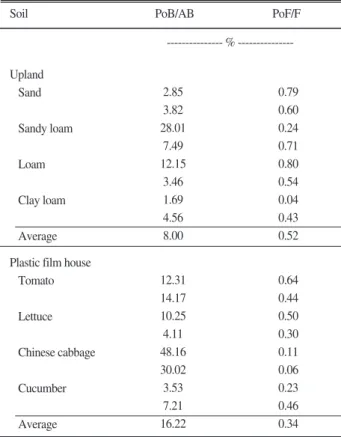
밭 토양의 호기성 세균에 대한 인산세균 비율 (PoB/AB)과 사상균에 대한 인산가용화 사상균 비율 (PoF/F)은 Table 4처럼 각각 1.69∼28.01%, 0.04∼
0.80%였다. 미생물에 대한 인산가용화균의 비율은 사 상균에 비해 세균이 높은 경향이었으나 토성별 유의 한 차이는 볼 수 없었다.
시설 재배지 토양의 PoB/AB와 PoF/F는 각각 3.53
∼48.16 및 0.06∼0.64였으며, 밭 토양에서와 같이 인 산가용화 사상균에 비해 인산가용화 세균의 비율이 높았다. 인산가용화 세균비율은 시설 재배지에서 사 상균은 밭 토양에서 높은 경향을 보였다.
인산 가용화 세균과 호기성 세균에 대한 비율은 유 의성은 없지만 유기물 함량이 높은 시설재배지 토양에 서 높은 수준이었다. 한편 토양 인산 가용화균 밀도와 인산 가용화량은 Fig. 1과 같이 LSD 5% 수준에서 유 의성이 있음이 관찰되었다. 콩 근권에서 분리된 Pantoea agglomerans의 인산 가용화능은 CaHPO4 1367 mg L-1, hydroxyapatite 1357 mg L-1 및 Ca3(PO4)2 1312 mg L-1이고(Son et al., 2006), 인산가용화사상균 에 의한 tricalcium phosphate의 가용화는 38-760 ug ml-1이라 (Mittal et al., 2008) 한 바와 같이, 인산 가용 화균의 밀도가 높아지면 토양의 유효 인산 함량이 증 가될 수 있기 때문에 토양의 난용성 인산염을 이용하 기 위해서는 토착 인산가용화 미생물의 활성을 높이는 방법도 적용할 필요가 있다고 생각된다.
인산가용화 세균의 종류 난용성인산염은 세균에 의해 유효인산으로 전환되는데, 이러한 작용에 관련 된 세 균 은 Pseudomonas, Mycobacterium, Micrococcus, Bacillus, Flavobacterium, Rhizobium, Mesorhizobium과 Sinorhizobium 등이 있다(Asea et al., 1988; Salih et al., 1989; Rodriguez and Fraga, 1999). 또한 Perez et al.(2007)은 갈철광 표면에서 Soil
PoB; phosphate-solubilizing bacteria, PoF; phosphate-solubilizing fungi, AB; Aerobic bacteria, F; fungi
Upland Sand
Sandy loam
Loam
Clay loam
Average Plastic film house
Tomato
Lettuce
Chinese cabbage
Cucumber
Average
2.85 3.82 28.01
7.49 12.15
3.46 1.69 4.56 8.00
12.31 14.17 10.25 4.11 48.16 30.02 3.53 7.21 16.22
0.79 0.60 0.24 0.71 0.80 0.54 0.04 0.43 0.52
0.64 0.44 0.50 0.30 0.11 0.06 0.23 0.46 0.34 PoF/F PoB/AB
--- % --- Table 4. Ratio of phosphate-solubilizing microorganisms to bacteria, and fungi in upland and plastic film house soils.
Fig. 1. Correlation between phosphate-solubilizing bacterial population and phosphate-solubilizing activity in upland and plastic film house soils.
Burkholderia, Serratia, Ralstonia 및 Pantoea 등의 인 산가용화 세균도 분리하였다고 한 바와 같이 배양이 가능한 다양한 종류의 인산가용화 세균이 토양에 서 식하고 있다.
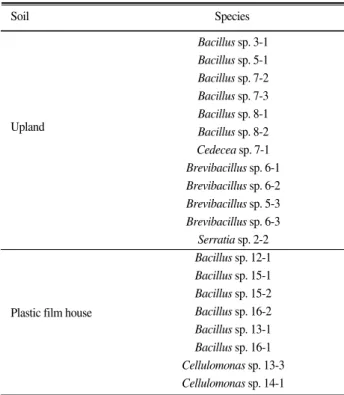
밭과 시설 재배지 토양에서 분리된 인산가용화 균 의 종류는 Table 5와 같다. 밭 토양에서는 Bacillus속, Cedecea속 , Brevibacillus속 , Paenibacillus속 , Pseudomonas속 및 Serratia속, 시설 재배지 토양에서 는 Bacillus속, Cellulomonas속이 분리되었다. 인산가용 화 세균의 수는 밭 토양 보다 시설 재배지 토양에서 높았으나, 세균의 종류는 밭 토양이 높아 인위적인 작 용이 많이 가해지는 시설재배지 토양의 다양성이 상 대적으로 낮음을 보여주는 것이라 생각된다.
적 요
토양에서 인산가용화 미생물의 역할을 탐색하기 위 해, 밭과 시설재배 토양에 서식하는 인산가용화 미생 물의 특성을 조사하였다. 노지 밭 토양에 비해 시설 재배지 토양에서 EC가 높았으며, 토양 pH, 유기물, 유효인산, 치환성 양이온 및 총 인도 시설재배지에서 비교적 높은 경향이었다. 인산가용화 세균의 수는 시 설재배지 토양이 밭 토양보다 높았으나, 인산가용화 세균의 종류는 밭 토양에 많았다. 인산가용화 세균의 밀도와 인산가용화능 간에 정의 상관이 있었다. 밭 토 양에서는 Bacillus, Cedecea, Brevibacillus, Paenibacillus Pseudomonas, Serratia속 등이 시설재배지 토양에서는
Bacillus, Cellulomonas 속 등의 인산가용화 세균이 분 리되었다.
인 용 문 헌
Asea, P.E.A., R.M.N. Kucey, J.W.B. Stewart, 1988. Inorganic phosphate solubilization by two Penicillium species in solution culture. Soil Biol. Biochem. 20: 459-464.
Illmer, P, and F. Schinner. 1992. Solubilization of inorganic phosphates by microorganisms isolated from forest soil. Soil Biol.
Biochem. 24: 389-395.
Mittala, V., O. Singha, H. Nayyarb, J. Kaura, and R. Tewaria. 2008.
Stimulatory effect of phosphate- solubilizing fungal strains (Aspergillus awamori and Penicillium citrinum) on the yield of chickpea (Cicer arietinum L. cv. GPF2). Soil Biol. Biochem. 40:
718-727
Nautiyal C.S. 1999. An efficient microbiological growth medium for screening phosphate-solubilizing microorganisms. FEMS Microbiology Letters. 170: 265-270.
Omar, S.A. 1998. The role of rock-phosphate-solubilizing fungi and vesicular-arbuscular-mycorrhiza(VAM) in growth of wheat plants fertilized with rock phosphate. World J. Microbiol. Biotechnol. 14:
211-218.
Perez, E., M. Sulbaran, M.M. Ball, and L.A. Yarzabal. 2007.
Isolation and characterization of mineral phosphate-solubilizing bacteria naturally colonizing a limonitic crust in the south-eastern Venezuelan region. Soil Biol. Biochem. 39: 2905-2914.
Rodriguez, H., and R. Fraga. 1999. Phosphate solubilizing bacteria and their role in plant growth promotion. Biotechnol. Adv. 17:319- 339.
Salih, H.M., A.I. Yonka, A.M. Abdul-Rahem, and B.H. Munam, 1989. Availability of phosphorous in calcareous soil treated with rock phosphate or superphosphate as affected by phosphate dissolving fungi. Plant and Soil 120, 181.185.
Sing, S., and K.K. Kapoor. 1994. Solubilization of insoluble phosphates by bacteria isolated from different sources. Environ.
Ecol. 12: 51-55.
Son, H.J., G.T. Park, M.S. Cha, and M.S. Heo. 2006. Solubilization of insoluble inorganic phosphates by a novel salt- and pH-tolerant Pantoea agglomerans R-42 isolated from soybean rhizosphere. 97:
204-210.
Suh, J. S., S. J. Kim, H. J. Noh, J. S. Kwon, and W. K. Jung, 2007, Long-term compositing and fertilization impact on dehydrogenase-producing bacteria and dehydrogenase activity in rice paddy soil. Korean J. Soil Sci. Fert. 40(4), 229-233.
Vassilev, N., Vassilev, M., 2003. Biotechnological solubilization of rock phosphate on media containing agro-industrial wastes. Appl.
Microbiol. Biotech. 61: 435-440.
Vesquez, P., G. Holguin, M.E. Puente, A. Lopez-Cortes, and Y.
Bashan, 2000. Phosphate-solubilizing microorganisms associated with the rhizosphere of mangroves in a semiarid coastal lagoon.
Biol. Fertil. Soils. 30: 460-468.
Wu, S.C., Z.H. Cao, Z.G. Li, K.C. Cheung, and M.H. Wong. 2005.
Soil
Upland
Plastic film house
Bacillus sp. 3-1 Bacillus sp. 5-1 Bacillus sp. 7-2 Bacillus sp. 7-3 Bacillus sp. 8-1 Bacillus sp. 8-2 Cedecea sp. 7-1 Brevibacillus sp. 6-1 Brevibacillus sp. 6-2 Brevibacillus sp. 5-3 Brevibacillus sp. 6-3
Serratia sp. 2-2 Bacillus sp. 12-1 Bacillus sp. 15-1 Bacillus sp. 15-2 Bacillus sp. 16-2 Bacillus sp. 13-1 Bacillus sp. 16-1 Cellulomonas sp. 13-3 Cellulomonas sp. 14-1
Species
Table 5. Phosphate-solubilizing bacteria isolated from upland and plastic film house soils.
Effects of biofertilizer containing N-fixer, P and K solubilizers and AM fungi on maize growth: a greenhouse trial. Geoderma. 125:
155-166
농촌진흥청. 1988. 토양화학분석법. 삼미인쇄사 토양미생물연구회. 1992. 토양미생물실험법. 양현당.