Korean J Environ Agric. 2014;33(3):220-230. English Online ISSN: 2233-4173 Published online 2014 June 27. http://dx.doi.org/10.5338/KJEA.2014.33.3.220 Print ISSN: 1225-3537
Phytoextraction of Heavy Metals Induced by
Bioaugmentation of a Phosphate Solubilizing Bacterium
KKIU Arunakumara,
1Buddhi Charana Walpola,
2Jun-Seob Song,
2Min-Jung Shin,
2Chan-Jung Lee
3and Min-Ho Yoon
2*1Department of Crop Science, Faculty of Agriculture, University of Ruhuna, Kamburupitiya, Sri Lanka
2Department of Bio-Environmental Chemistry, College of Agriculture and Life Sciences, Chungnam National University, Daejeon, 305-764, Korea
3Mushroom Research Division, National Institute of Horticultural & Herbal Science, RDA, Eumseong 369-873, Korea
Received: 21 March 2014 / Revised: 14 May 2014 / Accepted: 27 June 2014 Copyright ⓒ 2014 The Korean Society of Environmental Agriculture
This is an Open-Access article distributed under the terms of the Creative Commons Attribution Non-Commercial License (http://creativecommons.org/licenses/by-nc/3.0) which permits unrestricted non-commercial use, distribution, and reproduction in any medium, provided the original work is properly cited.
*교신저자(Corresponding author): Min-Ho Yoon Phone: +82-42-821-6733; Fax: +82-42-823-9241;
E-mail: [email protected]
220
Abstract
BACKGROUND: Excessive metals in the soil have become one of the most significant environmental problems. Phytoremediation has received considerable attention as a method for restoring the contaminated soils.
The microbes having remarkable metal tolerance and plant growth-promoting abilities could also play a significant role in remediation of metal-contaminated soils, because bioaugmentation with such microbes could promote phytoextraction of metals. Therefore, the present study was focused on evaluating the phytoextraction of heavy metals (Co, Pb and Zn) in Helianthus annuus (sunflower) induced by bioaugmentation of a phosphate solubilizing bacterium.
METHODS AND RESULTS: A phosphate solubilizing bacterium was isolated from metal-contaminated soils based on the greater halo size (>3 mm) with solid NBRIP agar medium containing 10 g glucose, 5 g Ca
3(PO
4)
2, 5 g MgCl
2⋅6H
2O, 0.25 g MgSO
4.7H
2O, 0.2 g KCl, 0.1 g (NH
4)
2SO
4in 1 L distilled water. Isolated bacterial strain
was assessed for their resistance to heavy metals;
CoCl
2.6H
2O, 2PbCO
3.Pb(OH)
2, and ZnCl
2at various concentrations ranging from 100-400 µg/mL (Co, Pb and Zn) using the agar dilution method. A pot experiment was conducted with aqueous solutions of different heavy metals (Co, Pb and Zn) to assess the effect of bacterial strain on growth and metal uptake by Helianthus annuus (sunflower).
The impact of bacterial inoculation on the mobility of metals in soil was investigated under laboratory conditions with 50 mL scaled polypropylene centrifuge tubes. The metal contents in the filtrate of plant extracts were determined using an atomic absorption spectrophotometer (Perkinelmer, Aanalyst 800, USA).
CONCLUSION: Inoculation with Enterobacter ludwigii PSB 28 resulted in increased shoot and root biomass and enhanced accumulation of Co, Pb and Zn in Helianthus annuus plants. The strain was found to be capable of promoting metal translocation from the roots to the shoots of H. annuus. Therefore, Enterobacter ludwigii PSB 28 could be identified as an effective promoter of phytoextraction of Co, Pb and Zn from metal-contaminated soils.
Key words: Enterobacter ludwigii PSB 28, Inoculation, Phytoextraction, Sunflower
Open Access
Research Article
Introduction
Metal contamination of soils has become one of the most significant environmental problems today. Metal uptake by crop plants from the contaminated agricultural lands can have strong adverse impacts on human health through the food chain (Karavoltsos et al ., 2002). Moreover, excessive metals in the soil can result in decreased crop yield due to the inhibition of plant metabolic processes (Singh and Aggarwal, 2006).
Apart from the metals with unknown biological functions (Cd, Cr, Pb, Co, Ag, Se, and Hg), essential elements (Fe, Mn, Zn, Cu, Mg, Mo, and Ni) also keep accumulating in agricultural soils by means of wastewater irrigation, animal manures and sewage sludge application, use of fertilizer and agrochemicals (Thomas et al ., 2012). In the toxicological point of view, the essential elements are also important, because, at higher concentrations they too can be toxic to plants as well as to dietary intake levels (Karavoltsos et al ., 2002).
With the continuous addition of undesirable metals into the environment, remediation of contaminated soils receives increasing attention (Cao et al., 2007).
However, due to the fact that metals are not easily degraded, remediation of the contaminated soils is always considered being a demanding exercise (Rajkumar et al ., 2008). Depending on the resource availability, severity of the problem, nature of the metals and contaminated soil, different methods have been employed in restoring the contaminated lands (Arunakumara et al , 2013). In this context, systematic technologies such as bioremediation, physical/chemical remediation and integrated remediation are among the widely used techniques (Luo, 2009). However, the physical and chemical methods such as physical separation, acid leaching or electrochemical processes, are considered to be ineffective because of high cost, low efficiency, and destruction of soil structure and fertility (Jing et al ., 2007). In contrast, phytoremediation, a method which uses plants to extract, sequester and detoxify pollutants has received considerable attention (Arunakumara, 2011). However, the wider application of the technology has been restricted due to the limitations such as low soil thickness that can be treated, low translocation rate of metals from roots to shoots, and the slowness of the treatment (Lebeau et al ., 2008).
The amount of heavy metals uptake in plants
varies with the mobility and the concentration of metals in soil (Chen et al ., 2010) and the interface between soil microbes and plant roots (rhizosphere) is displayed to have a great influence on the uptake of nutrients as well as on the decrease of metal toxicity (McNear, 2013). Since soil microbes could alter the metal status of the soil (Fazal and Bano, 2010), exploitation of such microbes to reduce the metal toxicity to plants is worth investigating (Rajkumar and Freitas, 2008). In this context, some metal resistant bacterial strains were proved exceptional at enhancing the growth of the host plant through different mechanisms such as the production of plant growth promoting substances, nitrogen fixation and phosphate solubilization (Hemambika et al ., 2013). As reported by Rajkumar et al. (2008), heavy metal tolerance of the microbes may be attributed to one or several mechanisms including exclusion, active removal, biosorption, and precipitation or bioaccumulation of metals both in external and intracellular spaces.
Therefore, microbes having remarkable metal tolerance and plant growth-promoting abilities could play a significant role in remediation of metal-contaminated soils, because bioaugmentation with such microbes could promote phytoextraction of metals (Prapagdee et al ., 2013). In the present study, we isolated phosphate solubilizing bacterial strains from metal-contaminated soils and the strain with the highest degree of metal resistance was employed in (i) assessing the potential of mobilization of Co, Pb and Zn, and (ii) evaluating the effects of inoculation with the selected strain on plant growth and uptake of Co, Pb and Zn by Helianthus annuus (sunflower).
Materials and Methods
Isolation of phosphate solubilizing bacterial strains Heavy metal contaminated soils collected from abandoned mines of Boryeong area in South Korea were used in isolating phosphate solubilizing bacteria.
Aliquots of serially diluted soil samples were
inoculated on NBRIP (National Botanical Research
Institute Phosphate) medium containing 10 g glucose,
5 g Ca
3(PO
4)
2, 5 g MgCl
2.6H
2O, 0.25 g MgSO
4.7H
2O, 0.2
g KCl, 0.1 g (NH
4)
2SO
4in 1 L distilled water
(Nautiyal, 1999). The pH of the media was adjusted
to 7 ± 0.1. The petri plates were incubated at 30
0C for
7 days. Morphologically distinct colonies with clear
halos were purified by repeated sub culturing. A total
of 20 isolates were selected based on the greater halo size (>3 mm) and maintained on solid NBRIP agar medium until use.
Assay of heavy metal resistance
Isolated bacterial strains were assessed for their resistance to heavy metals using the agar dilution method (Cervantes et al ., 1986). Freshly prepared agar plates were amended with 3 different heavy metals;
CoCl
2.6H
2O, 2PbCO
3.Pb(OH)
2, and ZnCl
2at various concentrations ranging from 100-400 μg/mL (Co, Pb and Zn). They were inoculated with isolated strains and heavy metal tolerance was determined by the appearance of the bacterial growth after 2 days of incubation at 30
0C. The bacterial strain showing the highest degree of metal resistance was selected for further studies.
Strain identification
The partial sequencing of 16S rRNA for the bacterial strain was done with the help of DNA sequencing service, SOLGENT, Daejeon, South Korea using universal primers, 27F (5’-AGAGTTTGATCCTGGCTCAG -3’) and 1492R (5’-GGTTACCTTGTTACGACTT -3’). The online program BLAST was used in identifying the related sequences with known taxonomic information available at the databank of NCBI (http://www.ncbi.
nlm.nih.gov/BLAST). A Phylogenetic tree was constructed using CLUSTAL X program (Thompson et al., 1997), which involved sequence alignment by neighbor joining method (Saitou and Nei, 1987) and maximum parsimony using the MEGA4 program (Kumar et al., 2001). Grouping of sequences was based on confidence values obtained by bootstrap analysis of 1,000 replicates. Gaps were edited in the BioEdit program and evolutionary distances were calculated using Kimura two parameter model. Reference sequences were retrieved from GenBank under the accession numbers indicated in the trees.
Effect of heavy metals on bacterial growth
NBRIP medium supplemented with heavy metals (Co, Pb and Zn) at the concentration of 200 mg/L was inoculated with bacterial suspension (10
6colony forming units/ml) and incubated with continuous shaking at 30
0C. Optical density of culture supernatant was measured at definite time intervals using UV spectrophotometer at 660 nm to estimate the cell growth.
Assay of inorganic phosphate solubilization
Bacterial culture having 10
6colony forming units/
mL (2 days old) was inoculated in sterilized liquid NBRIP medium (250 mL) supplemented with different heavy metals (Co, Pb and Zn) at the concentration of 200 mg/L and incubated with continuous shaking at 30
0C. Sterilized liquid NBRIP medium without supplemented with heavy metals was served as a control. A sample (10 ml) of each cultured and control were taken and centrifuged at 12000 ×g for 15 min.
The clear supernatant was used in determining the pH and amount of phosphorous released into the medium.
Effect of bacterial strain on growth and metal uptake by H. annuus
A pot experiment was conducted under green house conditions at the College of Agriculture, Chungnam National University in October 2012. The soils collected from several locations of a nearby forest and a waste button mushroom bed in Buyeo-gun area, Chungchungnam-do, South Korea, were mixed with the ratio of 1:1, air dried and sieved (2 mm). Sterilized soil (by steaming at 100°C for three consecutive days) was amended with aqueous solutions of different heavy metals (Co, Pb and Zn) to achieve the final concentrations of 200 mg/kg soil. They were then kept for 2 weeks in a greenhouse for metal stabilization and used in filling the plastic pots (25 cm diameter, 35 cm height). Seeds of H. annuus were surface sterilized by immersing in alcohol (70%) for 40 s, NaClO (1.0%) for 15 min followed by rinsing several times with sterile distilled water. Seeds sown in germination trays containing sterilized non-contaminated soil were provided with 14/10 light/ dark regime and kept at 25°C for germination. Bacterial cultures grown under standard conditions for 2 days were harvested by centrifugation at 12000 ×g at 15 min.
The cells were washed twice with sterile distilled water and resuspended in biological saline (0.85%
KCl) to be used in inoculation. Three weeks old seedlings were carefully uprooted from the germination bed and their roots were dipped in the bacterial culture (10
9colony forming units/mL) for 2 h.
They were transplanted into the plastic pots (five
plants/pot) containing 300 g of metal contaminated or
non- contaminated soil and allowed to grow at 25°C
and 14/10 light/dark regime. The average pH of soil
at the time of planting was recorded as 6.65. Three
weeks later, the plants were carefully uprooted and cleaned the root surface thoroughly with distilled water. As growth parameters, fresh and dry biomass was measured and accumulation of metals in plant biomass was quantified as described by Freitas et al . (2004). Each treatment had three replicates.
Mobility of the metals in soil
The impact of bacterial inoculation on the mobility of metals in soil was investigated under laboratory conditions with 50 mL scaled polypropylene centrifuge tubes. The bacterial strain transferred into 100 mL flasks containing LB broth was cultured aerobically on a rotating shaker (150 rpm) at 30
oC until reaching the final concentration of 10
6colony forming units/mL.
The bacterial cells were then harvested by centrifugation at 10000 × g for 15 min and washed in phosphate buffer (pH 7.0) twice. The bacterial pellet was washed in sterile water, re-centrifuged, and finally re-suspended in 5 mL sterile water. Artificially contaminated soil (1 g) in the centrifuge tubes was inoculated with small aliquots (up to 1 mL) of the final washed bacterial culture. After taking the weight the tubes, they were wrapped with brown paper and placed on an orbital shaker at 200 rpm at 25 °C. At the end of the period of 10 d, the weight of the tubes was recorded and 10 mL of sterile water were added to each tube to extract the soil water soluble heavy metals. The extracts were centrifuged at 10000 × g for 10 min and filtered and the metal contents in the filtrate were determined using an atomic absorption spectrophotometer (Perkinelmer, Aanalyst 800, USA). Artificially contaminated soil without inoculation with the strain served as the control after centrifugation.
Results
Isolation and identification of phosphate solubilizing bacterial strain
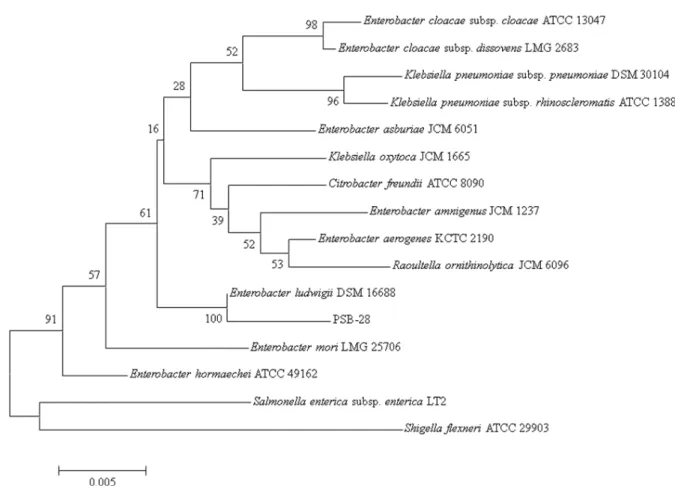
A total of 20 bacterial strains with the potential ability to solubilize inorganic phosphates were screened based on the greater halo size (>3 mm). They were then assessed for their resistance to heavy metals and the bacterial strain showing the highest degree of metal resistance was selected for the study. According to 16S rRNA sequence analysis, the selected strain showed close proximity with Enterobacter ludwigii DSM 16688. Phylogenetic tree (Fig. 1) shows the position of the isolated phosphate solubilizing bacterial strain
with respect to related species.
Effect of heavy metals on bacterial growth
The growth of the strain measured as the optical density of culture supernatant at definite time intervals is given in Fig. 2. During the incubation period of 36 h, none of the metal was found to be highly toxic to the strain. However, compared to the metal free culture medium, slight reductions in bacterial growth were observed in metal supplemented media.
Inorganic phosphate solubilization
Phosphate solubilization as measured by the amount of phosphorous released into the medium is depicted in Fig. 3. As indicated by the results, the strain was shown to be capable of utilizing tricalcium phosphate as the sole source of phosphate. However, the presence of metals in NBRIP medium (200 mg/L) caused reduction in phosphate solubilizations. Compared with the control, reductions were 26, 56, and 19%, respectively for Co, Pb and Zn.
Effect of bacterial strain on growth and metal uptake by H. annuus
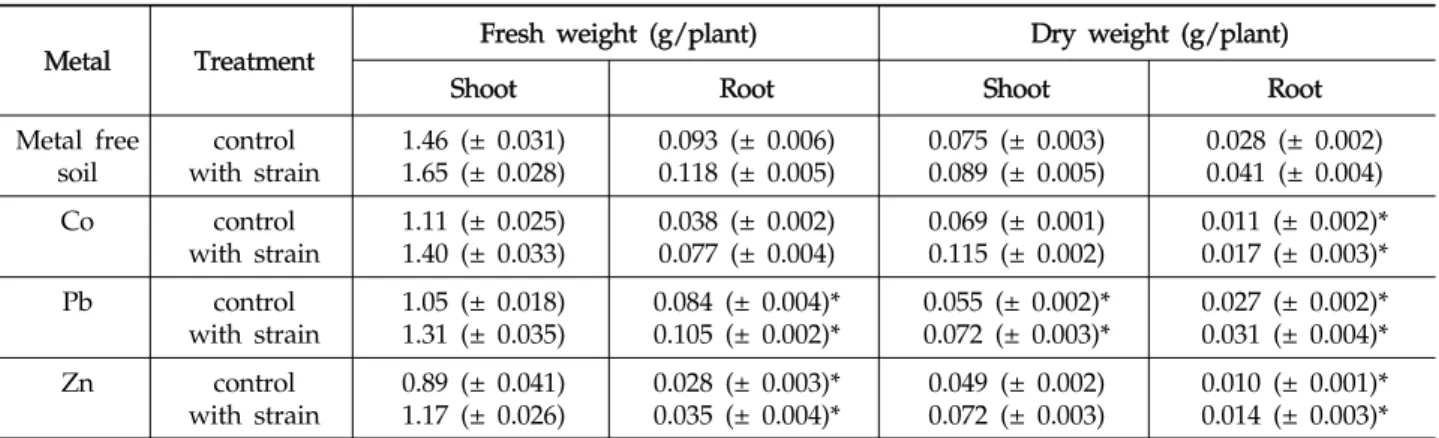
Inoculation with the strain resulted in increased fresh and dry biomass of H. annuus plants, compared to non-inoculated plants (Table 1). When non-inoculated plants were exposed to heavy metal stress, the growth was inhibited in a significant level with p <
0.05. For instance, Pb toxicity caused 23 and 20%
reductions in fresh and dry weight of the plant, respectively. Inoculation however led to increase in plant fresh and dry weight in the presence of heavy metals. The fresh and dry weight of the plants grown in Pb contaminated soils were respectively 25 and 26% higher than those of non-inoculated plants.
Similarly, in Zn contaminated soil, the percent increments were recorded as 31 and 46% respectively, and in Co contaminated soil, the corresponding figures were 33 and 49%.
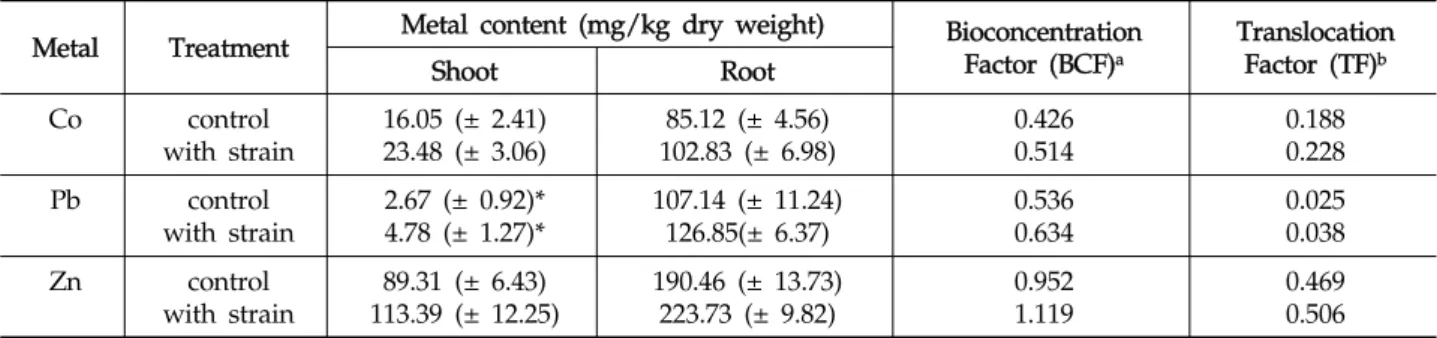
The amounts of Co, Pb and Zn accumulated in the
roots and shoots of H. annuus grown under
inoculated and non-inoculated conditions are given in
Table 2. Inoculation with Enterobacter ludwigii
PSB-28 resulted in increased accumulation of metals
both in the shoots and roots. The accumulations of
Co, Pb and Zn in shoots were respectively 45, 79 and
27% higher than those of non-inoculated plants. The
corresponding accumulations for Co, Pb and Zn in
Fig. 3. Phosphate solubilization by
Enterobacter ludwigii
PSB 28 on NBRIP medium supplemented with heavy metals (Co, Pb and Zn) at the concentration of 200 mg/L. Sterilized liquid NBRIP medium without supplemented with heavy metals was served as a control. Values are the means of three replicates. Error bars represent standard deviation.Fig. 2. Growth of
Enterobacter ludwigii
PSB 28 on sterilized liquid NBRIP medium supplemented with metals (Co, Pb and Zn) at the concentrations of 200 mg/L. Sterilized liquid NBRIP medium without supplemented with heavy metals was served as a control. Values are the means of three replicates. Error bars represent standard deviation.Fig. 1. Phylogenetic tree based on 16S rRNA gene sequences, showing the position of isolated phosphate solubilizing bacterial strain (PSB-28) with respect to related species. The scale bar indicates 0.002 substitutions per nucleotide position and accession numbers are given in parenthesis.
roots were 21, 18 and 17% higher than those of non-inoculated plants. Regardless of inoculation or non-inoculation, the accumulation of metals in root system was found to be considerably higher than that
of in shoots, which has been further confirmed by the low translocation factor (TF) for all the metals.
However, TF of Zn was significantly higher than that
of the other two metals. Similarly low bioconcentration
Metal Treatment Fresh weight (g/plant) Dry weight (g/plant)
Shoot Root Shoot Root
Metal free soil
control with strain
1.46 (± 0.031) 1.65 (± 0.028)
0.093 (± 0.006) 0.118 (± 0.005)
0.075 (± 0.003) 0.089 (± 0.005)
0.028 (± 0.002) 0.041 (± 0.004) Co control
with strain
1.11 (± 0.025) 1.40 (± 0.033)
0.038 (± 0.002) 0.077 (± 0.004)
0.069 (± 0.001) 0.115 (± 0.002)
0.011 (± 0.002)*
0.017 (± 0.003)*
Pb control
with strain
1.05 (± 0.018) 1.31 (± 0.035)
0.084 (± 0.004)*
0.105 (± 0.002)*
0.055 (± 0.002)*
0.072 (± 0.003)*
0.027 (± 0.002)*
0.031 (± 0.004)*
Zn control
with strain
0.89 (± 0.041) 1.17 (± 0.026)
0.028 (± 0.003)*
0.035 (± 0.004)*
0.049 (± 0.002) 0.072 (± 0.003)
0.010 (± 0.001)*
0.014 (± 0.003)*
Values are means (
n=3
) ± standard deviation. Within each column, means indexed by * are not significantly different atp > 0.05
between inoculated and non-inoculated plants according to Duncan’s multiple range test.Table 1. Effect of inoculation with
Enterobacter ludwigii
PSB 28 on shoot and root weight ofHelianthus annuus
factor (BCF) was also recorded from Co and Pb.
However, the results showed a good agreement and demonstrated that inoculation of the bacterial strain led to increase both TF and BCF of the three metals distinctly.
Mobility of the metals in soil
Metal mobilization potential of the strain was assessed in a batch experiment and the results showed that inoculation of the strain could increase the contents of water soluble metals in the soil. The mobilization of Co, Pb and Zn was respectively 41, 27 and 48% higher than those of the control soil (Fig. 4).
Fig. 4. Effect of inoculation with
Enterobacter ludwigii
PSB 28 on the mobilization of Co, Pb and Zn in soil. Soil without inoculation the strain served as the control.Values are the means of three replicates. Error bars represent standard deviation.
Discussion
Growth response of the present strain under metal contamination conditions is in line with Rajkumar et
al. (2008) and Prapagdee et al. (2013), who observed Zn, Cu and Ni resistance in Bacillus weihenstephanensis and Cd resistance in Klebsiella sp. BAM1. Generally microorganisms isolated from heavy metals contaminated soils possess the ability to withstand against multiple pollutants as they have adapted to such environments (Pal et al ., 2005;
Abou-Shanab et al ., 2007).
The effectiveness of the strain as a plant growth-promoter was assessed with Helianthus annuus , a species known to have an ability to accumulate biomass rapidly and take up substantial amounts of metals (Turgut et al ., 2004; Prapagdee et al ., 2013). As reported by Ouzounidou et al. (2005) and El-Tayeb et al . (2006), accumulation of plant biomass could be affected by excessive concentrations of heavy metals, which exert adverse impacts on growth and function of root system resulting in poor uptake of water and nutrients. As reported by Jiang et al . (2008), inoculation with Burkholderia sp. J62 led to increase shoot and root dry weights of corn and tomato plants. Inoculation with Pseudomonas fluorescens PsIA12 resulted in enhanced growth of Zea mays and its uptake of N, P and K (Egamberdiyeva et al., 2002). The content of P, K, S and Ca was reported to be increased by the inoculation of rhizobacteria in barley plant grown in metal contaminated soil (Belimov et al ., 2004).
According to them, inoculation with rhizobacteria
resulted in 42% increase in growth of the barley plant
compared to the control. Based on the results, they
further stated that nutrients play an important role in
the detoxification of heavy metals. Their findings
were in line with Lebeau et al . (2008), who reported
Metal Treatment Metal content (mg/kg dry weight) Bioconcentration Factor (BCF)a
Translocation Factor (TF)b
Shoot Root
Co control
with strain
16.05 (± 2.41) 23.48 (± 3.06)
85.12 (± 4.56) 102.83 (± 6.98)
0.426 0.514
0.188 0.228
Pb control
with strain
2.67 (± 0.92)*
4.78 (± 1.27)*
107.14 (± 11.24) 126.85(± 6.37)
0.536 0.634
0.025 0.038
Zn control
with strain
89.31 (± 6.43) 113.39 (± 12.25)
190.46 (± 13.73) 223.73 (± 9.82)
0.952 1.119
0.469 0.506
aBCF, metal concentration ratio of plant roots to soil; bTF, metal concentration ratio of plant shoots to roots.
Values are means (
n=3
) ± standard deviation. Within each column, means indexed by * are not significantly different atp > 0.05
between inoculated and non-inoculated plants according to Duncan’s multiple range test.Table 2. Effect of inoculation with