Introduction
Odontobutidae is a small family of fishes in the order Perciformes. They are native to fresh water rivers flowing into the South China Sea and the northwestern Pacific Ocean. There are twenty species in six genera. In Korea, 4 species in two genera of Odontobutidae are recognized (Kim, 1997; Choi, 1998). Molecular phylogenetic and morphological character analyses have been recently been studied using DNA sequencing in Odontobutidae (Thacker, 2003; Thacker and Hardman, 2005). In the Korean peninsula, the genus Odontobutis (Bleeker, 1874) has been re- ported by three species: Odontobutis platyceph- ala Iwata and Jeon, 1985, O. interrupta (Iwata and Jeon, 1985), and O. obscura (Temminck and Schlegel, 1845; Kim, 1997). O. platycephala and O. interrupta are known endemic species from
Korea. The genus Odontobutis has a wide geo- graphic distribution in Korean peninsula. The genus also reveals closely similar species from taxonomic point of view. Odontobutis interrupta has been previously known to serve as the sec- ond intermediate host of Echinostoma hortense (Ahn et al., 1985; Ahn and Ryang, 1986). The family Cottidae inhabits mostly marine habitats in the temperate and cold waters of the Northern Hemisphere. This group included with 70 genera and 300 species in the worldwide (Nelson, 1994).
Thirty six species belonging to 21 genera in the family Cottidae from Korea are reviewed (Kim and Youn, 1992). The genus Cottus belongs to the family Cottidae in Korea contains only three described species. Cottus czerskii is distributed in Duman River of Korea. C. koreanus and C.
hangiongensis are endangered species in Korea.
There have been a few previous studies of the parasites (Muzzall et al., 1997), genetic variation (Gyllenstewn and Ryman, 1988), and molecular evolution (Hunt et al., 1997; Yokoyama and Goto,
Karyotypes of Five Species in Odontobutidae and Cottidae of Korea
Gab Man Park and Ho Bok Song1,*
Department of Parasitology, Kwandong University College of Medicine, Gangneung 210-701, Korea
1Division of Life Sciences, College of Natural Sciences, Kangwon National University, Chuncheon 200-701, Korea
The chromosome numbers of five species in two families of Korea are investigated:
Odontobutis platycephala, O. interrupta, and O. obscura in Odontobutidae, and Cottus koreanus and C. hangiongensis in Cottidae. In Odontobutis species, the three species showed the diploid chromosome number, 2n==44 (NF==44) telocentric chromosomes. In Cottus species, the mitotic chromosomes from 24 groups with two chromosomes each indicated that it is a diploid. The karyotype of C. koreanus and C.
hangiongensis is 2n==48 and NF==52. These species is the first report on the chromosomes and the karyotype analysis except O. platycephala. Our findings provide cytotaxonomic evidence for the species distinctness of these five species whose descriptions were based primarily on external morphology.
Key words : karyotype, Cottidae, Odontobutidae, Cottus koreanus, C. hangiongensis, Odontobutis platycephala, O. interrupta, O. obscura, Korea
*Corresponding author: [email protected]
─
─ 155 ──
2005).
In recent years, through a considerable num- ber of works, a large amount of information has been accumulated on the chromosomes of the fishes. Cytogenetic studies of fishes have been important in aspects of phylogenetics and cytoge- netic relationships among the species (Collares- Pereira et al., 1998; Gozukara and Cavas, 2004).
Lee et al. (1983) and Lee (1986) reported the chromosome numbers and karyotypes of O. platy- cephala, genus Odontobutis. However, kary- ological studies of these two species of genus Odontobutis and two species of genus Cottus have not been examined. In this work, five spec- ies of two families of Korea were examined to de- termine and analyze the karyotypes for future comparative study of fish karyology.
Materials and Methods
The specimens used in this study were col- lected in Korea from July to October 2005, and examined shortly after collection. Six specimens of Odontobutis platycephala were collected in the Tonggok-ri, Namsan-myeon, Chuncheon-si, Gangwon-do, five specimens of O. interrupta in Wolmyeong-ri Yanggu-eup, Yanggu-gun, Gangwon-do, seven specimens of O. obscura in Gucheon-ri, Dongbu-myeon, Geoje-si, Gyeon- gsangnam-do, 3 specimens of Cottus koreanus in Jingdong-ri, Girin-myeon, Inje-gun, Gangwon-do, and five specimens of C. hangiongensis in Hosan- ri, Wondeok-eup, Samcheok-si, Gangwon-do. The chromosomes preparations were made on gills of the fish by the usual flame drying method (Ojima et al., 1972). The prepared slides were observed under an Olympus BX-51 microscope. Nomencla- ture of chromosome morphological types follows Levan et al. (1964). To estimate the NF value, the chromosomes of the group meta- and sub- metacentric were scored as bi-armed and the chromosomes of the group acrocentric as uni- armed. Voucher specimens of the five species used in this investigation have been placed in the Department of Parasitology, Kwandong University College of Medicine, Korea.
Results
1. Odontobutis platycephala
Diploid chromosome number of this species
was 44 (NF==44) and consisted of 22 pairs telo- centric chromosomes (Fig. 1). Table 1 shows the mean lengths and relative lengths of each chro- mosome as examined in three cells. Observed chromosomes ranged from 3.03 to 5.46µm. The mean total chromosome length based on the measurements of three cells was 99.84±2.97µm.
Fig. 1 B is the karyotype constructed from the chromosomes shown in Fig. 1 A, which was one of the most elongated complements. The chromo- somes were arranged by size. This species is the second report on the chromosomes. Lee et al.
(1983) and Lee (1986) reported the same chro- mosome numbers of 2n==44.
2. O. obscura
O. obscura had 44 diploid chromosomes con- sisting of 22 pairs of telocentric chromosomes (Fig. 2). Table 2 shows the mean lengths and relative lengths of each chromosome as exam- ined in three cells. Observed chromosomes ranged from 3.21 to 6.17µm. The mean total chromo- some length based on the measurements of three cells was 100.96±4.00µm. Fig. 2 B is the kary- otype constructed from the chromosomes shown in Fig. 2 A, which was one of the most elongated complements.
3. O. interrupta
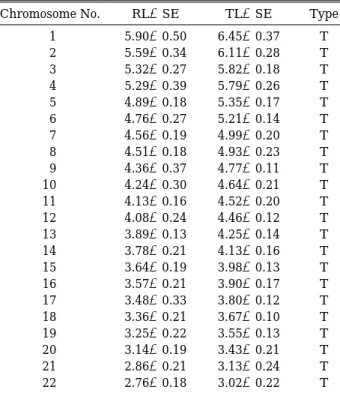
Chromosomes in six cells were observed and the chromosome number is 44 (NF==44). The karyotype of this species consists of 22 pairs of telocentric chromosomes (Fig. 3). Table 3 shows the mean lengths and relative lengths of each chromosome as examined in two cells. Observed chromosomes ranged from 3.02 to 6.45µm. Fig. 3 B is the karyotype constructed from the chromo- somes shown in Fig. 3 A, which was one of the most elongated complements. The karyotypes of this species arranged by size. There were no differences in diploid chromosome number or in chromosome morphology between males and females.
4. Cottus koreanus
Chromosomes in eight cells were observed and the chromosome number is 48 (NF==52). The karyotype of this species consists of two pairs of subtelocentric chromosomes and 22 pairs of telocentric chromosomes (Fig. 4). Table 4 shows the mean lengths and relative lengths of each
Table 1. Relative lengths and total lengths (µm) of chromo- somes of Odontobutis platycephala*
Chromosome No. RL±SE TL±SE Type
1 6.12±1.01 5.46±0.27 T
2 6.05±0.82 5.44±0.31 T
3 5.97±0.76 5.42±0.14 T
4 5.87±0.74 5.34±0.20 T
5 5.77±0.61 5.23±0.12 T
6 5.52±0.60 5.04±0.13 T
7 5.41±0.41 4.87±0.09 T
8 5.39±0.36 4.82±0.17 T
9 5.28±0.37 4.81±0.06 T
10 5.17±0.33 4.68±0.12 T
11 5.10±0.82 4.57±0.13 T
12 5.09±0.77 4.56±0.11 T
13 4.91±0.73 4.39±0.15 T
14 4.82±0.63 4.38±0.10 T
15 4.67±0.39 4.24±0.11 T
16 4.61±0.35 4.23±0.09 T
17 4.52±0.34 4.14±0.07 T
18 4.46±0.33 4.03±0.08 T
19 4.31±0.50 3.89±0.12 T
20 4.25±0.31 3.78±0.14 T
21 3.89±0.22 3.59±0.16 T
22 3.31±0.29 3.03±0.10 T
*Based on measurement of three karyotyped cells. RL±SE, relative length of the chromosome (percentage of the total length of the autosomes in diploid); TL, total length of the autosomes in diploid; SE, standard error; T, telocentric chromosomes.
Table 2. Relative lengths and total lengths (µm) of chromo- somes of Odontobutis obscura*
Chromosome No. RL±SE TL±SE Type
1 6.00±0.67 6.17±0.35 T
2 5.72±0.38 5.68±0.24 T
3 5.45±0.28 5.42±0.37 T
4 5.43±0.46 5.46±0.29 T
5 5.35±0.40 5.31±0.12 T
6 5.30±0.34 5.24±0.17 T
7 5.13±0.52 5.10±0.20 T
8 5.05±0.43 5.04±0.16 T
9 4.99±0.23 4.89±0.17 T
10 4.86±0.31 4.76±0.14 T
11 4.75±0.32 4.71±0.21 T
12 4.59±0.16 4.52±0.16 T
13 4.37±0.21 4.34±0.13 T
14 4.31±0.22 4.27±0.11 T
15 4.26±0.13 4.19±0.09 T
16 4.15±0.26 4.14±0.17 T
17 3.98±0.25 3.88±0.13 T
18 3.74±0.12 3.66±0.15 T
19 3.59±0.13 3.59±0.18 T
20 3.43±0.21 3.42±0.17 T
21 3.31±0.32 3.34±0.14 T
22 3.20±0.11 3.21±0.15 T
*Based on measurement of three karyotyped cells Fig. 1. A, Metaphase chromosome of Odontobutis platy-
cephala; B, Karyotype constructed from A. Scale bar indicates 10µm.
Fig. 2. A, Metaphase chromosome of Odontobutis obs- cura; B, Karyotype constructed from A. Scale bar indicates 10µm.
A
B
A
B
Table 4. Relative lengths and total lengths (µm) of chromo- somes of Cottus koreanus*
Chromosome No. RL±SE TL±SE Type
1 5.63±0.20 6.51±0.17 T
2 5.51±0.24 6.36±0.26 T
3 5.35±0.17 6.19±0.13 T
4 5.27±0.19 6.09±0.15 T
5 5.08±0.08 5.87±0.16 T
6 4.95±0.12 5.72±0.15 T
7 4.87±0.09 5.63±0.17 T
8 4.69±0.18 5.42±0.14 T
9 4.59±0.17 5.31±0.18 T
10 4.53±0.13 5.24±0.21 ST
11 4.25±0.06 4.92±0.24 T
12 4.12±0.14 4.76±0.18 T
13 4.06±0.08 4.70±0.12 T
14 3.93±0.11 4.55±0.21 T
15 3.79±0.12 4.38±0.17 T
16 3.71±0.23 4.29±0.23 T
17 3.61±0.13 4.18±0.17 T
18 3.48±0.11 4.02±0.18 T
19 3.33±0.12 3.85±0.24 T
20 3.23±0.10 3.74±0.17 T
21 3.10±0.17 3.59±0.15 ST
22 2.99±0.12 3.46±0.19 T
23 2.94±0.08 3.40±0.22 T
24 2.87±0.13 3.32±0.24 T
*Based on measurement of four karyotyped cells. ST, subtelo- centric chromosomes.
Table 3. Relative lengths and total lengths (µm) of chromo- somes of Odontobutis interrupta*
Chromosome No. RL±SE TL±SE Type
1 5.90±0.50 6.45±0.37 T
2 5.59±0.34 6.11±0.28 T
3 5.32±0.27 5.82±0.18 T
4 5.29±0.39 5.79±0.26 T
5 4.89±0.18 5.35±0.17 T
6 4.76±0.27 5.21±0.14 T
7 4.56±0.19 4.99±0.20 T
8 4.51±0.18 4.93±0.23 T
9 4.36±0.37 4.77±0.11 T
10 4.24±0.30 4.64±0.21 T
11 4.13±0.16 4.52±0.20 T
12 4.08±0.24 4.46±0.12 T
13 3.89±0.13 4.25±0.14 T
14 3.78±0.21 4.13±0.16 T
15 3.64±0.19 3.98±0.13 T
16 3.57±0.21 3.90±0.17 T
17 3.48±0.33 3.80±0.12 T
18 3.36±0.21 3.67±0.10 T
19 3.25±0.22 3.55±0.13 T
20 3.14±0.19 3.43±0.21 T
21 2.86±0.21 3.13±0.24 T
22 2.76±0.18 3.02±0.22 T
*Based on measurement of two karyotyped cells.
Fig. 4. A, Metaphase chromosome of Cottus koreanus; B, Karyotype constructed from A. Scale bar indicates 10µm.
Fig. 3. A, Metaphase chromosome of Odontobutis inter- rupta; B, Karyotype constructed from A. Scale bar indicates 10µm.
A
B
A
B
chromosome as examined in four cells. Observed chromosomes ranged from 3.32 to 6.51µm. The mean total chromosome length based on the measurements of three cells was 115.50±4.43 µm. Fig. 4 B is the karyotype constructed from the chromosomes shown in Fig. 4 A, which was one of the most elongated complements. The karyotypes of this species arranged by size. The mitotic metaphase chromosomes were observed in both sexes but sex chromosomes were not observed.
5. C. hangiongensis
This species showed 48 chromosomes (NF==52) in both sexes, consisting of two pairs of subte- locentric chromosomes and 22 pairs of telocentric chromosomes (Fig. 5). Table 5 shows the mean lengths and relative lengths of each chromosome as examined in three cells. Observed chromo- somes ranged from 3.27 to 6.32 µm. Fig. 5 B is the karyotype constructed from the chromosomes shown in Fig. 5 A, which was one of the most elongated complements. The karyotypes of this species arranged by size.
Discussion
Considering the potential application of the cytological approach to cyprinid systematic (Buth et al., 1991), erithrinid fish (Bertollo et al., 2004), Curimatidae (Brassesco et al., 2004), and Lori- cariidae (Alves et al., 2005; Kavalco et al., 2005), this study provides also data for a correct specific definition, due to the relatively high conservative character of karyotypes in the family (Rab and Collares-Pereira, 1995). The chromosome num- bers of about 13 species belonging to the Korean Perciformes have been reported previously (Table 6). Cytogenetic studies in three species of genus Odonobutis have shown constant diploid number 2n==44 chromosomes. Although having the same diploid number and types, the karyotype formu- lae a little differ in their size. In two species of genus Cottus, the diploid number, fundamental number and karyotype is almost identical. How- ever, when the chromosome of these species arranged by size, the subtelocentric chromosome was difference in a location. Cottus koreanus is located in the pair 11 and 18 and C. hangion-
Table 5. Relative lengths and total lengths (µm) of chromo- somes of Cottus hangiongensis*
Chromosome No. RL±SE TL±SE Type
1 5.62±0.25 6.32±0.35 T
2 5.48±0.24 6.16±0.26 T
3 5.32±0.21 5.98±0.16 T
4 5.24±0.19 5.89±0.23 T
5 5.04±0.23 5.67±0.12 T
6 4.91±0.17 5.52±0.12 T
7 4.80±0.09 5.39±0.12 T
8 4.65±0.14 5.23±0.20 T
9 4.55±0.17 5.11±0.13 T
10 4.48±0.10 5.04±0.11 T
11 4.29±0.12 4.82±0.14 ST
12 4.15±0.04 4.66±0.12 T
13 4.09±0.06 4.60±0.16 T
14 3.96±0.11 4.45±0.11 T
15 3.81±0.13 4.28±0.12 T
16 3.73±0.04 4.19±0.13 T
17 3.63±0.13 4.08±0.17 T
18 3.49±0.11 3.92±0.14 ST
19 3.33±0.12 3.75±0.11 T
20 3.24±0.14 3.64±0.16 T
21 3.14±0.11 3.53±0.11 T
22 3.04±0.12 3.42±0.18 T
23 2.99±0.13 3.36±0.12 T
24 2.91±0.10 3.27±0.11 T
*Based on measurement of three karyotyped cells.
Fig. 5. A, Metaphase chromosome of Cottus hangiongen- sis; B, Karyotype constructed from A. Scale bar indicates 10µm.
A
B
gensis is placed in the pair 10 and 21. The re- sults obtained showed a marked chromosomal conservation with the presence of 2n==44 chro- mosomes in genus Odontobutis and 2n==48 chro- mosomes in genus Cottus. The chromosome num- bers of O. platycephala have been reported by Lee et al. (1983) and Lee (1986). In comparison with this report, the chromosome numbers and karyotype had coincided. The karyotype of three species of genus Odontobutis was closely similar and differs only in chromosome size.
Detailed studies of chromosome morphology and population cytology of the present fishes are very little can be said on systematics based on the karyotypes other than chromosome numbers.
In fact modern cytogenetic techniques have only recently been adopted for studies of fishes. In the Korean Order Perciformes, nine species have
been karyologically investigated (Table 6). The diploid chromosome numbers of Korean Perci- formes were found to be 2n==44 and 2n==48. Kar- yotypes of these nine species were found to be different.
L. japonicus of Moronidae had 24 acrocentric chromosomes, S. scherzeri of Centropomidae had 2 submetacentric and 22 acrocentric chromosom- es, T. abscurus and T. trigonocephalus of Gobii- dae had 2 metacentric, 4 submetacentricand 16 acrocentric chromosomes, and R. brunneus had 22 subtelocentric chromosomes, O. obscura, O.
platycephala and O. interrupta of Odontobutidae had all 22 telocentric chromosomes. Thus, the species of Perciformes had high number telocen- tric chromosomes or acrocentric chromosomes.
However, to the best of our knowledge, no other species of Korean Scorpaeniformes has yet been
Table 6. Chromosome numbers of Korean Scorpaeniformes and Perciformes fishes by references and present study
Classification Chromosome No. (FN) Karyotype References
Order Scorpaeniformes Family Cottidae
Cottus koreanus 2n==48 (52) 2ST++22T Present study
C. hangiongensis 2n==48 (52) 2ST++22T Present study
Order Perciformes
Family Moronidae (Serranidae)
Lateolabrax japonicus 2n==48 (48) 24A Lee et al., 1984
Family Centropomidae
Park, 1981,
Siniperca scherzeri 2n==48 (52) 2SM++22A Lee et al., 1984,
Lee et al., 1997, Bang et al., 2001
Coreoperca kawamebari 2n==48 (54) 3SM++21T Bang et al., 2001
Coreoperca herzi 2n==48 2SM++22T Lee et al., 1983,
Bang et al., 2001 Family Gobiidae
Tridentiger abscurus 2n==44 (56) 2M++4SM++16A Lee et al., 1984
T. trigonocephalus 2n==44 (56) 2M++4SM++16A Lee et al., 1984 2n==44 (64) 10M (SM)++12T Lee, 1986
Synechogobius hasta 2n==44 (46) 1M (SM)++21T Lee, 1986
Gymnogobius heptacanthus 44 (44) 22T Lee, 1986
Chaenogobius annularis 44 (44) 22T Lee, 1986
Rhinogobius brunneus 2n==44 (44) 22ST Lee et al., 1983
Chaenogobius urotaenia 2n==44 - Lee et al., 1983
Periophthalmus modestus 2n==46 (62) 16M (SM)++30T Lee, 1986
Family Odontobutidae
O. platycephala 2n==44 (44) 22T Lee et al., 1983,
Lee, 1986, Present study
O. obscura 2n==44 (44) 22T Present study
O. interrupta 2n==44 (44) 22T Present study
Family Belontidae
Macropodus ocellatus 2n==48 (54) 6~7M++6~7S++1ST Lee et al., 1983
karyotyped except for a present study. In the present study, C. koreanus and C. hangiongensis of Cottidae had 2 subtelocentric and 22 telocen- tric chromosomes. The karyotypes of Korean cyprinid fishes are generally constructed by more bi-armed chromosomes than mono-armed ones (Lee et al., 1983, 1984; Song and Park, 2005), while in almost species of Scorpaeniformes and Perciformes fish the chromosome complement consists of mono-armed chromosomes than bi- armed one.
Also, we did not found sexual dimorphism of the chromosomes in this study. Further study will be need C- and Ag-banding analyses for the investigation of the karyosystematically evolu- tion in Korean Scorpaeniformes and Perciformes.
Acknowledgments
This work was supported by Kwandong Uni- versity Research Fund of 2006.
References
Ahn, Y.K. and Y.S. Ryang. 1986. Experimental and epide- miological studies on the life cycle of Echinostoma hor- tense Asada, 1926 (Trematoda: Echinostomatidae).
Korean J. Parasitol., 24 : 121~136.
Ahn, Y.K, Y.S. Ryang, P.R. Chung and K.T. Lee. 1985.
Echinostoma hortense metacercariae naturally encyst- ed in Odontobutis obscura interrupta (a freshwater fish) and experimental infection to rats. Korean J Parasitol., 23 : 230~235.
Alves, A.L., C. Oliveira and F. Foresti. 2005. Comparative cytogenetic analysis of eleven species of subfamilies Neoplecostominae and Hypostominae (Siluriformes:
Loricariidae). Genetica., 124 : 127~136.
Bang, I.C., Y.K. Nam, C.H. Noh, J.T. Park and K.H. Han.
2001. Cytogenetic analysis of three Centropomid spec- ies in Korea. J. Kor. Fish. Soc., 34 : 17~20.
Bertollo, L.A.C., C. Oliveria, W.F. Molina, V.P. Margarido, M.S. Fontes, M.C. Pastori, J das N. Falca~o and A.S.
Fenocchio. 2004. Chromosome evolution in the ery- thrinid fish, Erythrinus erythrinus (Teleostei: Char- aciformes). Heredity, 93 : 228~233.
Brassesco, M.S., M.C. Pastori, H.A. Roncati and A.S.
Fenocchio. 2004. Comparative cytogenetic studies of Curimatidae (Pisces, Characiformes) from the middle Parana River (Argentina). Gen. Mol. Res., 3 : 293~301.
Buth, D.G., T.E. Dowling and J.R. Gold. 1991. Molecular and cytological investigations. In Cyprinid Fishes- Systematics, Biology and Exploitation (Winfield, I.J. &
Nelson, J.E., eds.). Chapman & Hall, Fish and Fisher- ies Series, 3, London, pp. 83~126.
Chae, B.S. 1998. A new record of Odontobutis obscura
(Odontobutidae, Pisces). Kor. J. Ichthyol., 10 : 280~
281.
Collares-Pereira, M.J., M.I. Prospero, R.I. Bileu and E.M.
Rodrigues. 1998. Leuciscus (Pisces, Cyprinidae) karyotypes: Transect of Portuguese populations. Genet.
Mol. Biol., 21 : 63~69.
Gozukara, S.E. and T.Cavas. 2004. A karyological analysis of Garra rufa (Heckel, 1843) (Pisces, Cyprinidae) from the Eastern Mediterranean River basin in Turkey.
Turk. J. Vet. Anim. Sci., 28 : 497~500.
Gyllensten, U. and N. Ryman. 1988. Biochemical genetic variation and population structure of fourhorn sculpin (Myoxocephalus quadricornis; Cottidae) in Scandinavia.
Hereditas, 108 : 179~185.
Hunt, D.M., J. Fitzgibbon, S.J. Slobodyanyuk, J.K.
Bowmaker and K.S. Dulai. 1997. Molecular evolution of the cottoid fish endemic to Lake Baikal deduced from nuclear DNA evidence. Mol Phylogenet Evol., 8 : 415~
422.
Kavalco, K.F., R. Pazza, L.A.C. Bertollo and O. Moreira- Filho. 2005. Karyotypic diversity and evolution of Loricariidae (Pisces, Siluriformes). Heredity, 94 : 180~
186.
Kim, I.S. and C.H. Youn. 1992. Synopsis of the family Cottidae (Pisces: Scorpaeniformes) from Korea. Kor. J.
Ichthyol., 4 : 54~79.
Kim I.S. 1997. Illustrated encyclopedia of fauna & flora of Korea vol. 37 (Freshwater fishes). Ministry of Educa- tion, pp. 1~629.
Lee, G.Y. 1986. Karyotypes of the family Gobiidae fishes in Korea ( I ). Korea J. Limnol., 19 : 49~58.
Lee, H.Y., H.Y. Chai, S.K. Jeon and H.S. Lee. 1983. The karyotype analysis on 29 species of fresh water fish in Korea. Bull. Inst. Basic., Inha Univ., Vol. 4 : 79~93.
Lee, H.Y., H.S. Lee, J.W. Cho and Y.O. Lee. 1984. The karyotype ananysis on 21 species of fresh-water fish in Korea (II). Bull. Inst. Basic., Inha Univ., Vol. 5 : 125~
140.
Lee, W.O., S.I. Jang, J.Y. Lee and S.J. Son. 1997. Com- parison of morphological and chromosomal characteri- stics and cross breeding of the two types Korea Man- drin fish, Siniperca scherzeri. Korean J. Ichthyol., 9 : 228~234.
Levan, A., K. Fredga and A.A. Sandberg. 1964. Nomen- clature for centromeric position on chromosomes. Her- editas, 52 : 201~220.
Muzzall, P.M., C.R. Peebles, R.J. DeJong and A.D.
Hernandez. 1997. Parasites of the deepwater sculpin, Myoxocephalus thompsoni (Cottidae), from Lake Mi- chigan and Lake Huron. J. Parasitol., 83 : 160~162.
Nelson, J.S. 1994. Fishes of the world. Third edition. John Wiley & Sons, Inc., New York, 600 p.
Ojima, Y., M. Hayashi and K. Ueno. 1972. Cytogenetics studies in low vertebrates. Karyotype and DNA stud- iesin 15 species of Japanese Cyprinidae. Japan J. Genet., 47 : 431~440.
Park, E.H. 1981. Karyptype and genome size of two vari- ants of Mandarine fish, Siniperca scherzeri (Teleostei;
Serranidae). Korean J. Genetics, 3 : 63~68.
Rab, P. and M.J. Collares-Pereira. 1995. Chromosomes of
European cyprinid fishes (Cyprinidae, Cypriniformes):
a review, Folia Zool., 44 : 193~214.
Thacker, C.E. 2003. Molecular phylogeny of the gobioid fishes (Teleostei: Perciformes: Gobioidei). Mol. Phy- logenet. Evol., 26 : 354~368.
Thacker, C.E. and M.A. Hardman. 2005. Molecular phy- logeny of basal gobioid fishes: Rhyacichthyidae, Odon-
tobutidae, Xenisthmidae, Eleotridae (Teleostei: Perci- formes: Gobioidei). Mol. Phylogenet. Evol., 37 : 858~
871.
Yokoyama, R. and A. Goto. 2005. Evolutionary history of freshwater sculpins, genus Cottus (Teleostei; Cottidae) and related taxa, as inferred from mitochondrial DNA phylogeny. Mol. Phylogenet. Evol., 36 : 654~668.
한국산 동사리과(Odontobutidae)와 둑중개과(Cottidae) 5종의 핵형 박 갑 만∙송 호 복1,*
(관동대학교 의과대학 기생충학교실, 1강원대학교 자연과학대학 생명과학부)
한국산 동사리과(Odontobutidae)의 동사리(Odontobutis platycephala), 얼록동사리(O.
interrupta), 남방동사리(O. obscura) 그리고 둑중개과(Cottidae)의 둑중개(Cottus koreanus), 한둑 중개(C. hangiongensis) 등 5종의 핵형 분석을 실시하였다. 동사리, 얼록동사리, 남방동사리의 염 색체 수 및 핵형은2n==44 (22T), NF==44였으며, 둑중개와 한둑중개의 염색체 수와 핵형은2n==48 (2ST++22T), NF==52로 밝혀졌다.
Received : July 11, 2006 Accepted : August 31, 2006